
BrightEdge Review (2026): An Honest Assessment of Pricing, Strengths, and Real Limitations

TL;DR
- Best for True Enterprise: BrightEdge delivers its highest ROI for organizations managing 2,000+ pages across multiple domains and markets, with dedicated SEO teams of 3+ people.
- Key Strengths: Its most defensible features are Data Cube for large-scale competitive intelligence and StoryBuilder for connecting SEO performance to revenue in executive-ready reports.
- Major Drawbacks: Pricing is opaque and annual contracts create lock-in. Mid-market companies often find themselves in an "ROI trap," paying for enterprise features they can't fully leverage.
- The Core Limitation: Like all SEO platforms, BrightEdge diagnoses problems but doesn't execute the fixes. Its value is capped by your team's bandwidth to ship the changes it recommends.
- The Verdict: If you meet the enterprise criteria, it's a defensible investment. If not, you're likely paying a premium for underutilized capabilities, and the real constraint on your growth isn't the tool—it's the ability to implement its insights.
Searching for honest BrightEdge reviews online is a predictable exercise in frustration. You'll find the company's own site, featuring curated testimonials from Fortune 100 clients. You'll find Glassdoor pages about working at the company, not with the product. And you'll find a dozen competitor-authored "reviews" designed to expose a few flaws before funneling you toward their own demo.
None of this helps you answer the only question that matters: will BrightEdge deliver a positive return for your specific team, budget, and SEO maturity?
This is a different kind of review. Drawing on an analysis of over 760 user reviews from G2, Capterra, and TrustRadius, combined with practitioner-level operational analysis, we'll provide a balanced assessment. We'll cover where BrightEdge genuinely excels, where it consistently disappoints, and a clear decision framework for determining if it's worth the $40K–$100K+ annual investment. This is the analysis you need before you sign the contract.
What BrightEdge Actually Is (and Isn't)
BrightEdge is an enterprise SEO platform built for organizations managing thousands of pages across multiple domains, markets, and languages—it is not a tool for small teams or individual practitioners. This is the first point of confusion for many buyers. The platform competes with Conductor and seoClarity at the enterprise tier, not with Semrush or Ahrefs at the practitioner tier. They are fundamentally different product categories solving different problems.
The platform's architecture is built around several core workflow components:
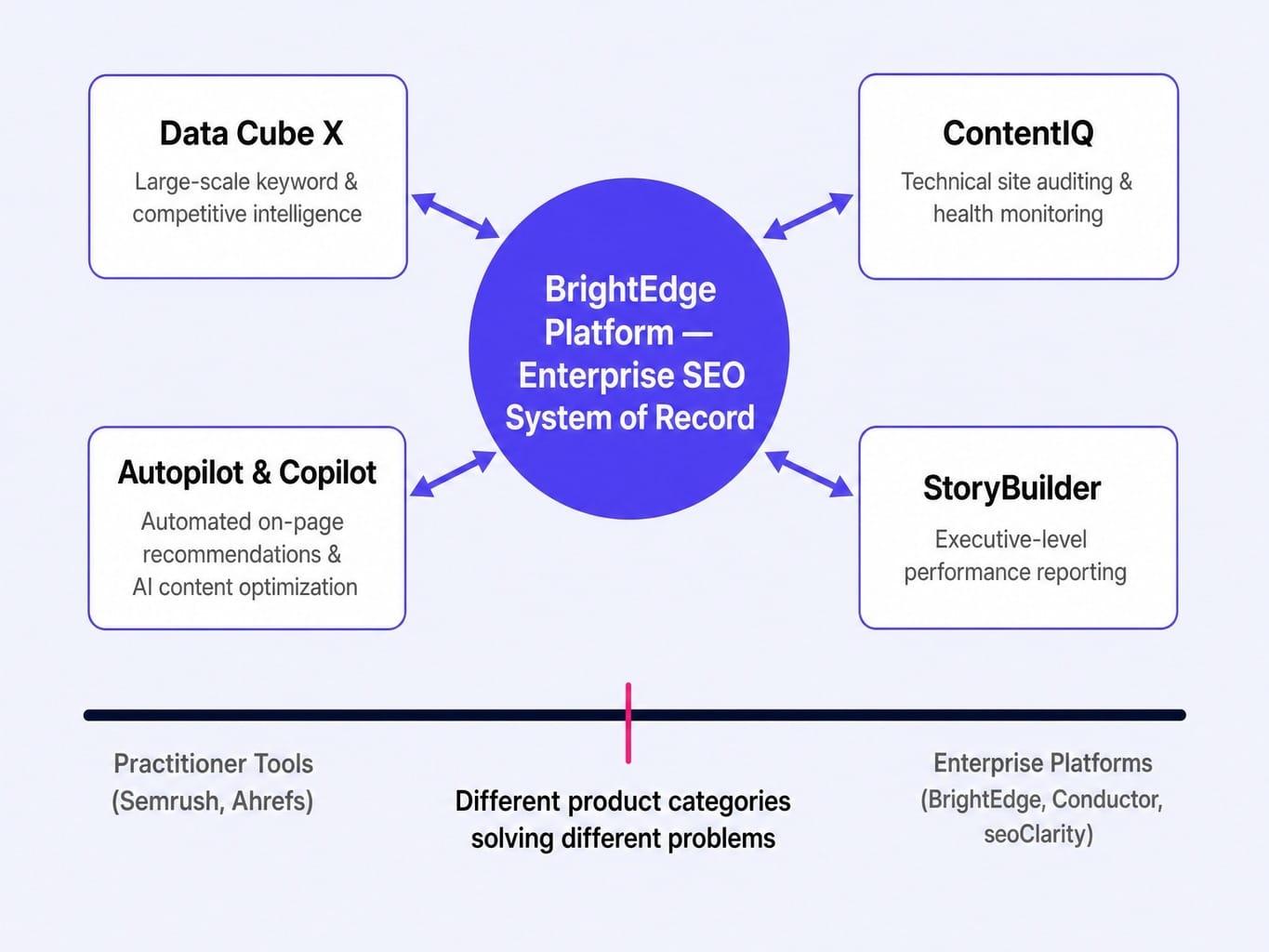
- Data Cube X: For large-scale keyword and competitive intelligence.
- ContentIQ: For technical site auditing and health monitoring.
- Autopilot & Copilot: For automated on-page recommendations and AI-assisted content optimization.
- StoryBuilder: For creating executive-level performance reports.
A practitioner using Semrush might spend their day doing keyword research, building a content brief, and then manually optimizing a page. An enterprise team using BrightEdge is more likely running a Data Cube pull to analyze share of voice shifts, reviewing Autopilot recommendations for a thousand pages at once, and using StoryBuilder to generate a report for the CMO.
With a client base that includes 57% of the Fortune 100 and over 2,000 enterprise customers, BrightEdge's core value proposition is unification: replacing 4-5 point solutions with a single system of record that connects keyword intelligence to content performance to business outcomes. Whether that unification justifies the steep price is the real question.
Where BrightEdge Genuinely Excels
Across 763+ G2 reviews, where BrightEdge holds a strong 4.4/5 rating, two capabilities consistently surface as genuine differentiators. These aren't just 'nice-to-have' features; they are the core reasons large, complex organizations renew their contracts despite the high cost.
Competitive Intelligence at Scale via Data Cube
Data Cube X is arguably BrightEdge's most defensible feature. It's the one capability that is consistently difficult to replicate with a stack of practitioner-level tools. In practice, a Data Cube pull allows a team to query vast competitive keyword landscapes across 24 countries and 28 SERP feature types, identifying share of voice shifts before they become visible in GA4. It's designed to surface high-value keyword opportunities that would require multiple, painstaking manual exports from a tool like Semrush or Ahrefs to even approximate.
Consider the workflow of an enterprise SEO director preparing for a quarterly business review. With Data Cube, they can generate a report showing the CMO exactly where the brand gained or lost visibility against named competitors, segmented by product line and market—in minutes, not days. The value here is directly proportional to the complexity of your competitive landscape. If you're a single-product company tracking 500 keywords, it's expensive overkill. If you're a multi-brand CPG company tracking 50,000 keywords across eight international markets, it can feel irreplaceable.
Executive Reporting That Connects SEO to Revenue
The second genuine differentiator is StoryBuilder. Its power isn't in being a more flexible dashboard—in fact, its customization options are often cited as a limitation. Its power is in solving a political problem that plagues in-house SEO teams: proving value to leadership that doesn't understand SEO.
StoryBuilder allows an SEO manager to pull organic performance data, overlay it with revenue attribution from an integrated analytics platform, and generate a board-ready report without ever opening Looker Studio or Google Sheets. This stands in stark contrast to the typical enterprise workflow: exporting data from Semrush, joining it with GA4 data in a spreadsheet, manually building slides, and spending two days on a report that gets five minutes of executive attention. StoryBuilder's value is in reducing the time-to-insight for non-technical stakeholders.
The caveat, frequently mentioned in user reviews, is that the custom report builder can have dashboard latency issues and lacks the flexibility for highly bespoke reporting needs. It excels at standardized workflows but may frustrate teams with complex, non-standard attribution models.
The Real Problems With BrightEdge (From Actual Users)
While the aggregate G2 rating of 4.4/5 is strong, it masks the varied experiences of different user segments. Digging into reviews on Capterra (4.1/5) and TrustRadius (7.3/10), and across forums like Reddit, reveals that complaints consistently cluster around three operational pain points. Understanding these is far more useful than looking at a star rating.
Pricing Opacity and Contract Lock-In
BrightEdge's biggest trust problem isn't the price itself, but the opacity surrounding it. The company does not publish pricing tiers, offers no self-serve trials, and structures deals around rigid annual contracts. A common scenario described by users involves a mid-market company receiving a quote for $40K–$80K per year for the base platform, only to discover later that essential add-on modules—like deep crawls with ContentIQ, additional market data in Data Cube, or API access beyond the standard rate limits—can push the total cost of ownership significantly higher.
This theme of "surprise charges" is a recurring complaint. The contract lock-in becomes a serious issue because once a year's worth of historical data, reports, and workflows are built inside the platform, your renewal leverage diminishes significantly. The sticker price is rarely the final price, and that disconnect is a primary source of buyer's remorse.
The Mid-Market ROI Trap
Perhaps the most underserved segment for BrightEdge is the mid-market company—organizations with 200 to 2,000 pages and lean 1-3 person SEO teams. These teams often pay a price approaching the enterprise tier but lack the organizational scale and complexity to make BrightEdge's core features valuable.
Imagine a Series B SaaS company with 800 pages and 15,000 monthly organic visitors. They sign a BrightEdge contract expecting a transformation. Instead, they find that Data Cube's competitive intelligence is overkill for their focused keyword universe, ContentIQ surfaces the same technical issues a free Screaming Frog crawl would find, and the Autopilot recommendations are too generic to implement without significant manual refinement by their already-stretched team.
BrightEdge's ROI is directly proportional to organizational complexity. Multi-domain, multi-market, multi-team environments can extract immense value. Single-product companies with lean teams often can't, and they end up in an ROI trap.
The Gap Between Insight and Action
The most fundamental limitation of BrightEdge—a limitation it shares with every enterprise SEO platform—is that it diagnoses but does not execute.
Consider this all-too-common scenario: BrightEdge's Autopilot surfaces 200 high-impact recommendations across your site. Your two-person SEO team reviews them and agrees with 40. But implementing those 40 changes requires engineering tickets, content rewrites, CMS updates, and stakeholder approvals. Three months later, only eight of them have been shipped. The platform correctly identified the problems, but the organization couldn't act on the insights fast enough.
The recommendation adoption rate is low for many teams not because the recommendations are bad, but because the workflow between "the platform says do X" and "X is live on the site" remains entirely manual and bottlenecked by human bandwidth. The value of any intelligence platform is ultimately capped by the team's ability to ship. This is the constraint most buyers fatally underestimate.
Is BrightEdge Worth the Money? A Decision Framework
The question "is BrightEdge worth it?" is framed incorrectly. The answer depends entirely on your organization's profile. Most brightedge reviews fail their readers by not specifying the conditions under which the platform becomes a defensible investment.
BrightEdge is likely worth the $40K–$100K+ annual cost if your organization meets all three of these conditions:
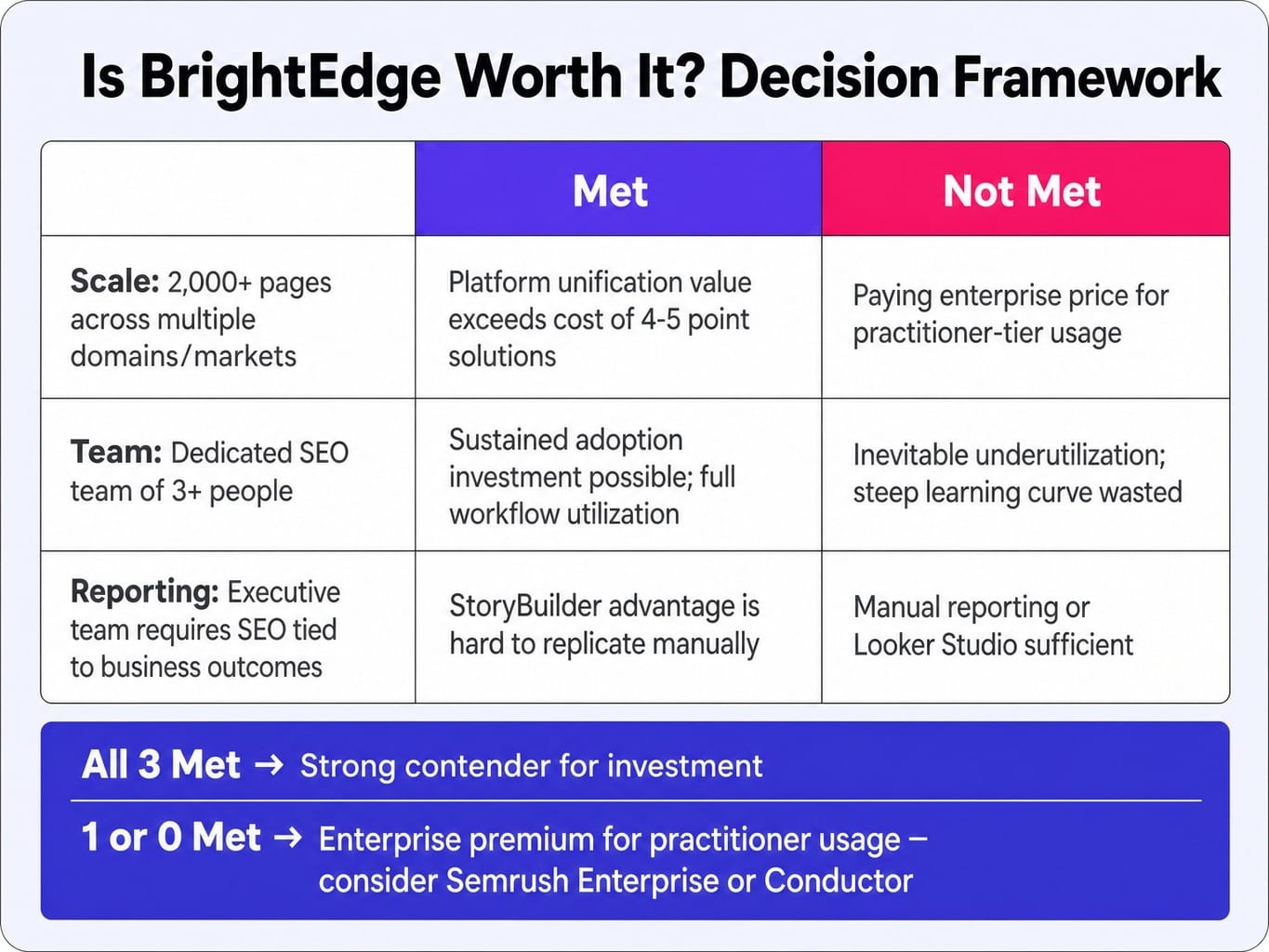
- You manage 2,000+ pages across multiple domains or markets. At this scale, the platform's unification value starts to exceed the cost and complexity of managing 4-5 separate point solutions.
- You have a dedicated SEO team of 3+ people. The learning curve and workflow complexity require a sustained investment in adoption. A solo marketer responsible for four other channels will inevitably underutilize it.
- Your executive team requires SEO reporting tied to business outcomes. StoryBuilder's ability to connect SEO activity to revenue is a genuine, hard-to-replicate advantage over building reports manually.
If you meet all three conditions, BrightEdge is a strong contender. If you meet one or none, you are almost certainly paying an enterprise premium for practitioner-tier usage.
For companies in the middle—the B2B SaaS business with 800 pages, a solo SEO manager, and $20M in revenue—the honest answer is that a platform like Semrush Enterprise or Conductor can often deliver 80% of the value at 40% of the cost. The key ROI metrics to track to justify the spend are share of voice change by product line, time-to-insight reduction for quarterly reporting, and the number of recommendations implemented per month, not just surfaced.
How BrightEdge Compares to the Alternatives
The right comparison set for BrightEdge depends on whether you're evaluating it against its enterprise peers or questioning if you need an enterprise platform at all.
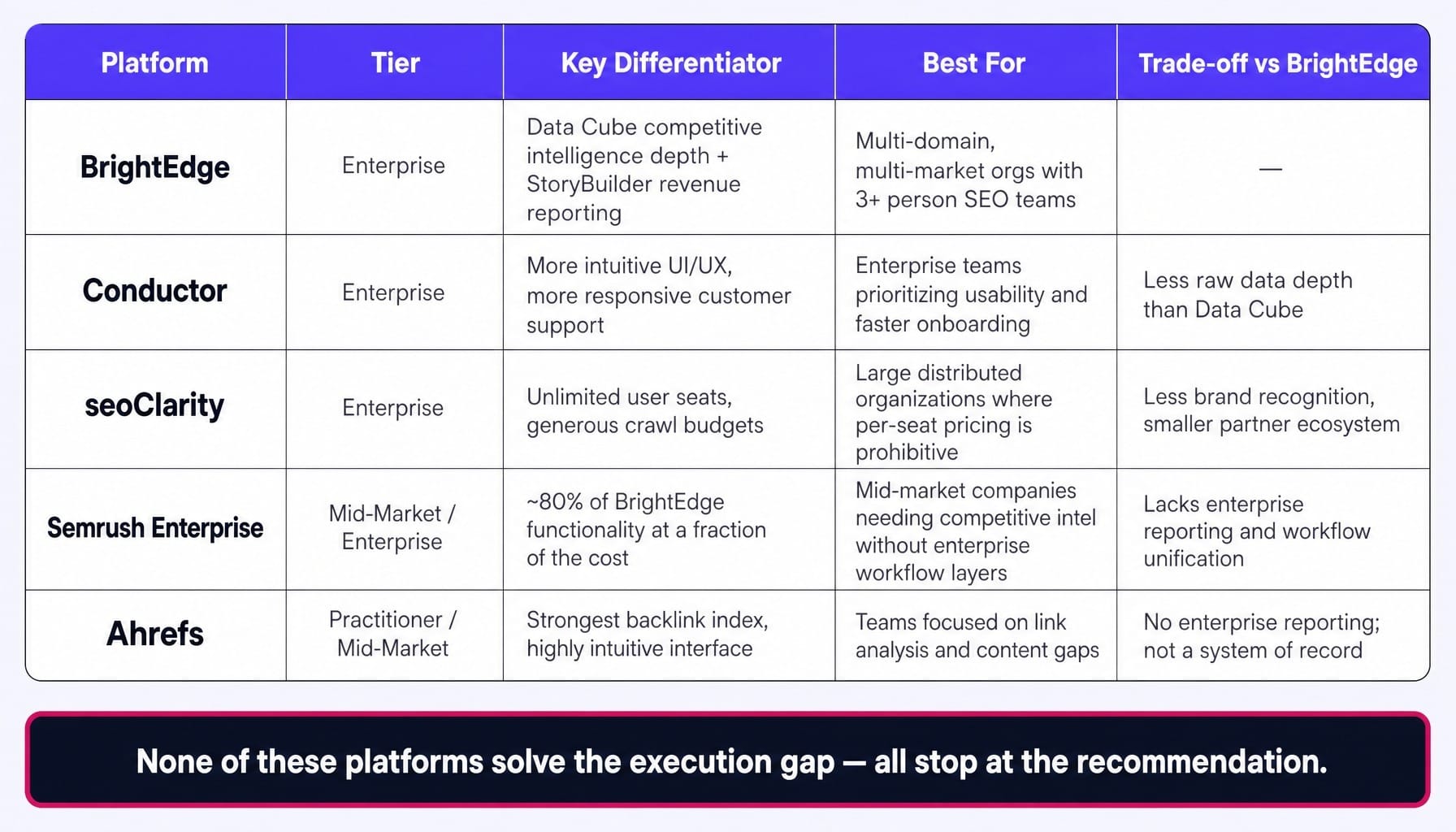
- Conductor: This is BrightEdge's closest enterprise competitor. It offers similar feature depth but is generally perceived by users as having a more intuitive UI/UX and more responsive customer support. It's best for enterprise teams that prioritize usability and a faster onboarding experience over the raw data depth of BrightEdge's Data Cube.
- seoClarity: Another enterprise player, seoClarity's key differentiator is its pricing model, which often includes unlimited user seats and more generous crawl budgets. This makes it a strong choice for large, distributed organizations where the per-seat pricing from BrightEdge or Conductor would become prohibitive.
- Semrush (Enterprise Tier): While not a direct 1:1 competitor, Semrush's enterprise offering covers about 80% of BrightEdge's core functionality for a fraction of the cost. It's the logical choice for mid-market companies that need robust competitive intelligence and rank tracking but don't need the enterprise-specific workflow and reporting layers.
Read more: Semrush vs Moz (2026): Which SEO Tool Fits Your Team's Actual Workflow | Spike
- Ahrefs: Known for having the strongest backlink index and a highly intuitive interface, Ahrefs excels at link analysis and content gap identification. It's best for teams where those are the primary use cases and enterprise-level reporting is either not required or handled through a separate BI tool.
But here's the uncomfortable truth: none of these platforms, including BrightEdge, solve the execution problem. They all stop at the recommendation, leaving the most difficult part—implementation—entirely on your team.
When the Real Problem Isn't Which Platform — It's the Shipping Gap
This entire analysis highlights a structural problem in the marketing tool landscape. Platforms like BrightEdge excel at identifying what needs to change but stop at the recommendation. The mid-market ROI trap exists because lean teams can't act on insights fast enough. The gap between 200 Autopilot recommendations and only 8 shipped changes in a quarter isn't a platform failure—it's a shipping failure.
This is the exact execution gap Spike AI is built to close.
Where BrightEdge tells you what to fix, Spike AI prioritizes the single highest-impact move across your website, SEO, and content—and then helps you ship it. Weekly. Without you needing to write engineering tickets or agency briefs. For lean B2B teams considering a $60K platform that surfaces recommendations they can't implement, the question isn't which platform to choose. It's whether to add an execution engine that turns those recommendations into revenue-generating changes. The constraint isn't intelligence; it's the capacity to act.
See how Spike AI turns your SEO backlog into weekly shipped improvements
The Verdict
BrightEdge is a genuinely powerful enterprise SEO platform, but only for organizations with the scale, team size, and budget to extract its full value. For that specific segment, it can be a defensible and strategic investment.
For everyone else, the honest answer is that the platform's intelligence often exceeds a team's ability to act on it. The real constraint on growth isn't a lack of recommendations, but a lack of bandwidth to implement them. The next generation of marketing systems won't just tell you what's wrong—they'll close the loop by getting the work done. And that shifts the entire definition of what makes a platform "worth it."
Frequently Asked Questions
What happens to your data if you cancel your BrightEdge contract?
You lose access to it. BrightEdge does not offer a bulk data export feature for historical Data Cube pulls, StoryBuilder reports, or ContentIQ crawl archives. When your contract ends, access to the platform and the data within it is terminated. It is critical to manually export key reports and keyword data before your contract expires, as this data lock-in is a significant factor in renewal negotiations.
How long does BrightEdge onboarding and implementation typically take?
Full onboarding, from contract signing to team proficiency, typically takes 8–12 weeks for a standard enterprise deployment. This timeline includes technical setup with GA4 or Adobe Analytics, configuring Data Cube for your competitive set, scheduling ContentIQ crawls, and completing team training sessions. The responsiveness of your assigned Customer Success Manager during this period can vary significantly based on your contract size.
Does BrightEdge integrate well with GA4 and Looker Studio?
BrightEdge offers a native integration with GA4 and can push data to Looker Studio through its Connect REST API. However, users report that API call rate limits can be a constraint for large-scale, real-time dashboards. Furthermore, the GA4 integration can sometimes lag behind Google's own API updates. Teams using Adobe Analytics generally report a smoother and more stable integration experience compared to GA4 users.
How does BrightEdge handle international and multi-language SEO?
This is a core strength. Data Cube X supports multi-market and multi-language tracking across 24 countries and 46 languages, a true enterprise-grade capability. However, be aware that each additional market typically increases the annual contract cost. Data freshness for non-English markets can also sometimes lag behind US/UK data by several days. It's a powerful feature for global brands, but may be overkill for companies with only one or two international markets.
What leverage do current customers have when negotiating BrightEdge contract renewals?
BrightEdge contracts are structured to auto-renew, so proactive management is key. The strongest negotiation leverage comes from having competitive quotes from Conductor or seoClarity in hand before the renewal window opens. If you can document low recommendation adoption rate or underutilized modules, you have a solid case to negotiate module removal or a pricing reduction. Always start renewal conversations at least 90 days before expiration, not 30.
How accurate are BrightEdge's AI-powered content recommendations in 2026?
The Autopilot and Copilot features are directionally useful for basic on-page optimization like title tags, meta descriptions, and heading structure. However, practitioners consistently report that the content brief generation accuracy for topical depth and semantic coverage lags behind dedicated content optimization tools like Clearscope or MarketMuse. It's best to treat BrightEdge's AI recommendations as a starting point for prioritization, not as ready-to-implement instructions that can bypass human expertise.