How to Avoid AI Slop: A Field Guide for B2B Marketers

TL;DR
- AI slop isn't just bad writing; it's content that lacks information gain and could appear on any competitor's site without anyone noticing. It ranks, but it doesn't convert.
- Most teams try to fix slop by editing the output. This is wrong. Slop is manufactured at the input stage through "input poverty" (generic prompts) and "delegation without constraints" (no brief).
- Use the "Slop Spectrum" to diagnose your content. Most teams think they're producing AI-assisted content (Level 4) when they're actually shipping polished slop (Level 3).
- Implement the "Editorial Fingerprint Framework": a three-step process to inject human signal through SME perspective, voice calibration, and fact verification.
- Publishing slop creates "slop debt"—a compounding liability that degrades domain authority and requires costly rewrites, turning perceived time savings into a net loss.
Consider this scenario: a B2B SaaS marketing team publishes 12 blog posts in a month using AI—triple their previous output. Organic traffic climbs for six weeks. But then the real metrics come in. Time on page drops 40%. Demo requests from organic search actually decline quarter-over-quarter despite the traffic bump. The content ranked, but nobody trusted it enough to act.
I once ran an audit on a 90-page content library produced with a similar lightly prompted workflow. The surface metrics looked fine, but scroll depth was abysmal and downstream conversions were near zero. Readers were landing, skimming the intro, and bouncing before reaching any differentiated argument.
This is AI slop. It's not just internet slang for bad robot writing; it's a precise business problem. It's content that is technically correct, topically relevant, and completely devoid of the signals that make a reader trust the source. Learning how to avoid AI slop is not about writing quality—it's a process failure that starts upstream, in how you prompt, what you feed the model, and whether your workflow has any mechanism to inject the human signal that readers and search engines increasingly demand.
This field guide will give you a system to diagnose and prevent it. We'll cover what slop actually looks like in B2B marketing, where it originates, and a repeatable framework to fix it before it creates compounding damage to your pipeline.
What AI Slop Actually Looks Like in B2B Marketing
Bad content has always existed. AI slop is a specific, more insidious failure mode: content that pattern-matches the surface features of expertise—correct terminology, logical structure, appropriate length—while containing zero information gain. It reads like a summary of summaries, because that's literally what the model produced.
The reason this matters now is that Google's helpful content system is explicitly designed to reward non-commodity content and a unique point of view. Slop is the definition of commodity content. It might attract a click, but it won't earn trust, which is why, as most marketing practitioners will tell you, the average website conversion rate remains stuck around 2% even as content volume explodes. The content isn't building the confidence required for action.
Here's the difference. Imagine two opening paragraphs for a post on pipeline acceleration:
AI Slop Example:
In the rapidly evolving landscape of B2B sales, pipeline acceleration is a critical component for sustainable growth. It is important to consider various strategies to shorten the sales cycle. What many teams fail to realize is that a holistic approach, encompassing marketing alignment and sales efficiency, is key to success.
This is classic slop. It's grammatically perfect and says nothing.
Information Gain Example:
Most B2B pipeline acceleration efforts fail because they focus on sales activity instead of deal friction. Our analysis of 500+ sales cycles shows the single biggest delay isn't lead volume, but the 14-day gap between a technical demo and the procurement review. Closing that gap is where you find leverage.
This version makes a specific, falsifiable claim. It has a point of view. One is forgettable; the other starts a conversation.
The Telltale Patterns That Give AI Slop Away
You can use this as a checklist against your last five published posts. Slop is present if you see a high density of these patterns:
- Hedge-Phrase Density: An over-reliance on phrases that soften claims, like "it's worth noting that," "it's important to consider," and "in many cases."
- Synonym Cycling: Using multiple synonyms for the same concept within a single paragraph (e.g., "accelerate," "speed up," "quicken," "expedite") in an attempt to sound sophisticated.
- Importance Puffery: Grandiose, empty statements like "in today's digital landscape" or "in the fast-paced world of..."
- Faux-Insight Setups: Introducing obvious points with phrases like "what many fail to realize is..." or "the secret is..."
- The Absent "I" or "We": A complete lack of first-person operational claims, proprietary data, or specific experiences. The content is an island of abstraction.
Where Slop Shows Up Across B2B Channels
This isn't just a blog problem. The commoditization of content via AI slop degrades performance across your entire funnel.
- Blog Content: The most obvious manifestation, where posts rank for keywords but fail to generate any meaningful engagement or conversions.
- Landing Page Copy: Slop directly kills conversions here. Generic value propositions and feature descriptions fail to differentiate you from the five other tabs the prospect has open. Applying data-driven CRO strategies becomes impossible when the underlying copy is commodity content.
- Email Sequences: A recognizable sameness in tone and structure trains your subscribers to ignore you, tanking open and reply rates over time.
- Ad Copy: Slop produces the same bland, benefit-driven statements as every other advertiser, leading to low click-through rates and high ad fatigue.
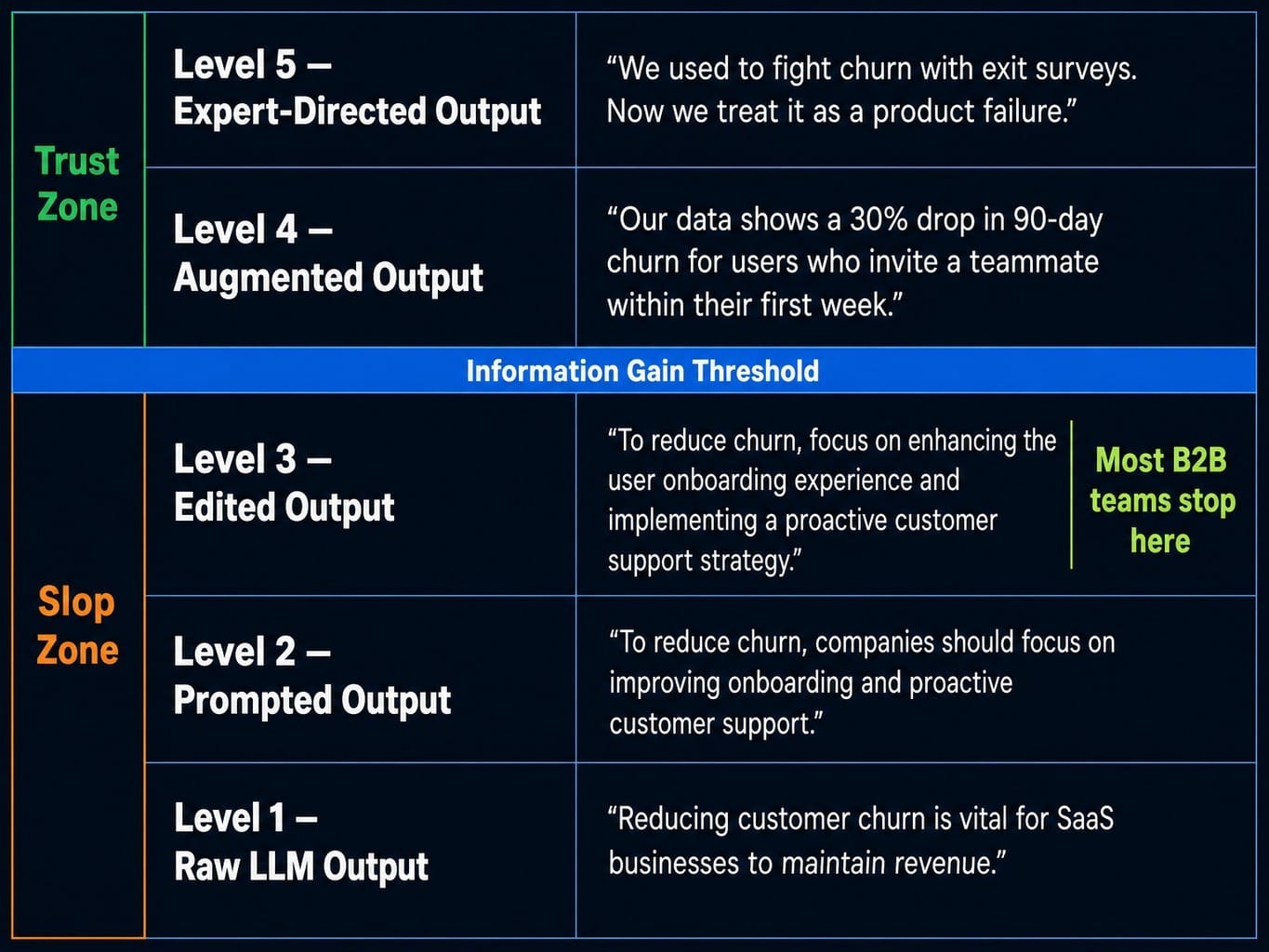
The Slop Spectrum: From Raw LLM Output to Expert-Edited Final Draft
The distinction between "AI" and "human" content is no longer useful. A better diagnostic is the Slop Spectrum, which measures the degree of human signal injected into the final output.
- Level 1: Raw LLM Output. Zero editing. Generic prompt. Default settings. This is pure, undiluted slop.
- Level 2: Prompted Output. A better prompt with some context, but no human review. It's more coherent slop, but the underlying arguments are still generic.
- Level 3: Edited Output. A human has reviewed for accuracy, flow, and grammar. Obvious AI patterns are removed. This is where most B2B teams stop. It's polished slop. It looks clean but still lacks information gain. Editing AI output for tone and flow at this stage actually makes slop harder to detect, because it removes the surface-level signals of synthetic content while leaving the structural emptiness intact.
- Level 4: Augmented Output. A human has injected proprietary data, a subject matter expert's (SME) perspective, original analysis, or first-person experience. The AI provided structure; the human provided the reason to read it. This is high-quality, AI-assisted content.
- Level 5: Expert-Directed Output. A human conceived the argument, gathered the evidence, and used AI primarily for drafting efficiency. The editorial fingerprint is unmistakable.
Let's trace a single topic—"reducing SaaS churn"—across the spectrum:
- Level 1: "Reducing customer churn is vital for SaaS businesses to maintain revenue."
- Level 2: "To reduce churn, companies should focus on improving onboarding and proactive customer support."
- Level 3: "To reduce churn, focus on enhancing the user onboarding experience and implementing a proactive customer support strategy." (Grammatically better, substantively identical to Level 2).
- Level 4: "Our data shows a 30% drop in 90-day churn for users who invite a teammate within their first week. We've re-engineered our onboarding to drive that specific action."
- Level 5: "We used to fight churn with exit surveys. Now we treat it as a product failure. If a user churns, we run a five-whys analysis on their last 30 days of activity to find the friction point we failed to resolve. That, not a survey, informs our roadmap."
Let's be honest, most teams are shipping Level 3 content and calling it a win. But in a world of infinite content, only Levels 4 and 5 build trust and drive action.
Why Your Prompts Are the Real Source of Slop
Most teams trying to fix AI slop focus on the output: editing, detection tools, style guides. This is a losing battle. Slop is manufactured at the input stage. If you give a model a generic prompt, you will get generic output. The model isn't failing; it's succeeding at exactly what you asked for.
The core problem is that most marketers treat AI like a search engine (ask a question, get an answer) instead of a junior writer (give a brief, provide source material, specify the argument, constrain the voice). Slop prevention is a prompting and briefing discipline, not an editing discipline.
Consider two prompts for the same task: writing a landing page section about integration capabilities.
- Lazy Prompt: Write a section about our product's integrations.
- Brief-Driven Prompt: Write a 150-word section on integrations for our landing page. Target persona: a RevOps leader who is skeptical of new tools. The goal is to overcome the objection that our tool will be another data silo. Reference our native integrations with HubSpot, Salesforce, and Marketo. Frame the benefit around creating a single source of truth for marketing performance data, not just "connecting tools." Use a direct, confident voice.
The output quality difference will be night and day, not because the model got smarter, but because the inputs got better.
Read more: 17 ChatGPT Prompts for Content Writing That Produce Non-Commodity Content
Input Poverty: What Happens When You Give the Model Nothing to Work With
The single biggest cause of AI slop is input poverty. When a prompt contains no proprietary information, no specific data, no customer language, and no defined argument, the model has no choice but to produce consensus content. That's all it has.
This is why prompting an AI to write a case study without providing the actual customer interview transcript, specific metrics, and desired narrative arc results in a useless template. The quality ceiling of AI output is set by the quality floor of your inputs. Modern techniques like retrieval-augmented generation (RAG) are built on this principle: grounding the model in your own data is what fundamentally changes output quality.
Delegation Without Constraints: The Missing Brief Problem
No competent marketing director would brief a freelance writer by saying, "Write a blog post about demand gen," and expect quality. Yet this is how most teams prompt AI. This "missing brief" problem means the model receives no constraints on argument, audience, or differentiation, so it defaults to the median of its training data—which is, by definition, generic. Prompt length and prompt quality are uncorrelated; a 2,000-word prompt of background context will produce more slop than a 200-word prompt with a specific editorial thesis.
Your prompts should function as a brief. At minimum, they must answer:
- Who is the reader and what do they already believe?
- What is the one argument this piece must make?
- What proprietary data or experience supports it?
- What should the reader do or believe differently after reading?
- What voice constraints apply? (e.g., direct, technical, no hedging)
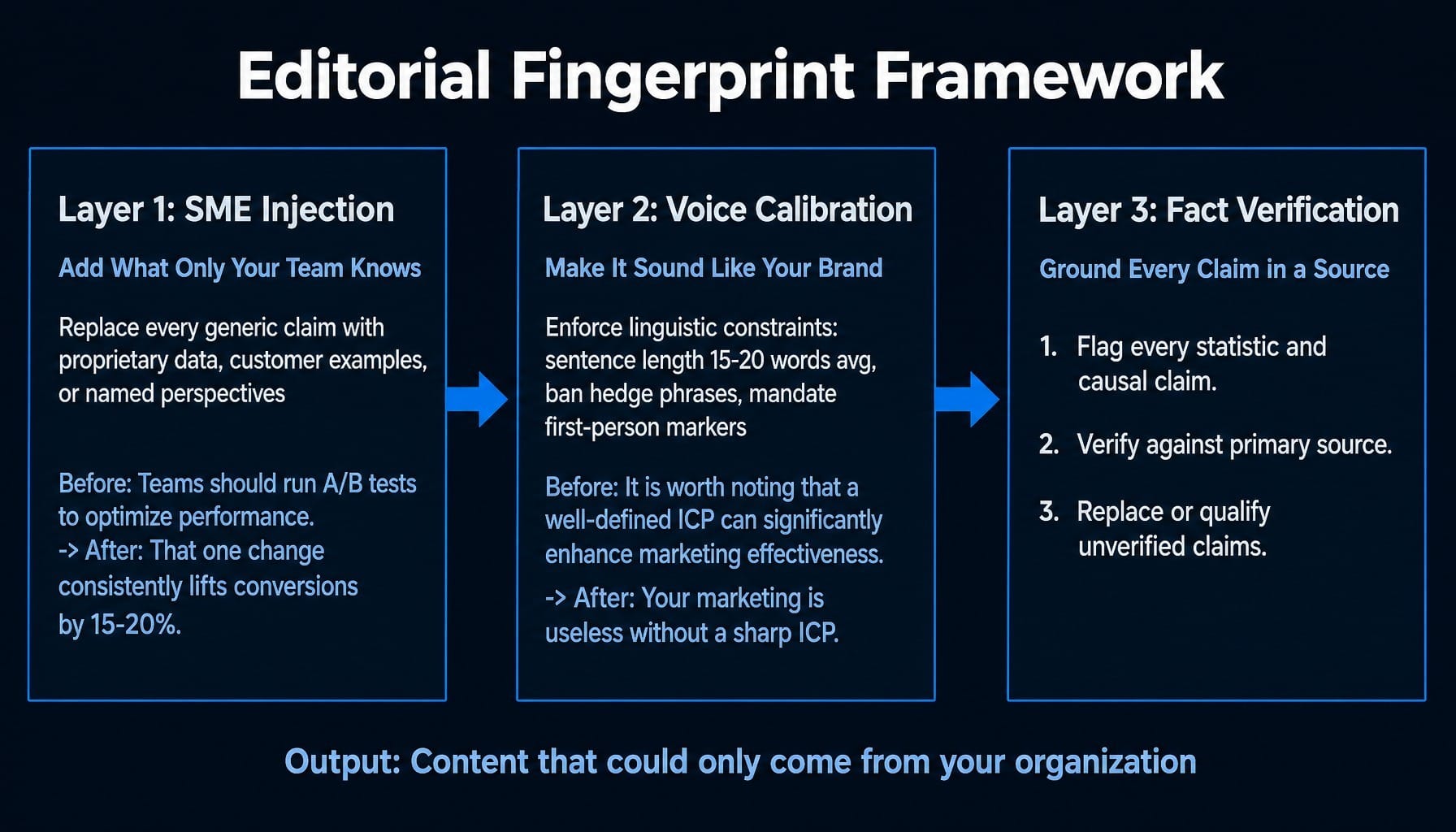
The Editorial Fingerprint Framework: A Repeatable Process for Injecting Human Signal
The "editorial fingerprint" is the set of signals that distinguish content produced by your organization from content that could have been produced by anyone. It's what readers and search engine quality systems (like E-E-A-T) unconsciously scan for when deciding whether to trust a source. AI strips this out by default. This framework gives you a three-step process to put it back in.
Layer 1: SME Injection — Adding What Only Your Team Knows
SME injection is the deliberate insertion of your team's unique perspective into an AI-generated draft. After generating a first draft, identify every claim that could appear in a competitor's content. For each one, either replace it with a proprietary data point, a specific customer example, or a named internal perspective—or cut it.
- Before (Slop): "Improving landing page conversion rates is crucial. Teams should run A/B tests on headlines, calls-to-action, and form fields to optimize performance."
- After (SME Injection): "We've run over 200 landing page tests, and the single highest-leverage change isn't the headline—it's replacing the generic 'Submit' button with a value-specific CTA like 'Get My Free Audit.' That one change consistently lifts conversions by 15-20%."
This is not optional polish. It is the minimum threshold for non-slop content.
Layer 2: Voice Calibration — Making It Sound Like Your Brand, Not a Model
Voice is the most underestimated anti-slop mechanism. AI models default to a recognizable register: slightly formal, relentlessly balanced, and hedged on every claim. Readers now pattern-match this synthetic tell instantly. Voice calibration means enforcing specific linguistic constraints.
Establish and enforce rules like:
- Sentence Length: Average 15-20 words, with occasional short sentences for emphasis.
- Banned Phrases: Prohibit common AI hedges like "it is crucial," "moreover," and "in conclusion."
- Perspective Markers: Mandate the use of "we believe," "our perspective is," or other first-person plural markers.
- Tonal Boundaries: Define your voice. Are you direct? Analytical? Provocative?
- Before (Slop): "It is worth noting that a well-defined Ideal Customer Profile can significantly enhance marketing effectiveness."
- After (Voice Calibration): "Your marketing is useless without a sharp ICP. If you can't describe your ideal customer in a single sentence, you don't have one."
Layer 3: Fact Verification and Source Grounding
AI models have a large "hallucination surface area." They generate plausible-sounding claims that may be fabricated or outdated. In B2B, a single hallucinated statistic can destroy credibility with a sophisticated buyer.
This verification step isn't just about catching errors; it's about replacing model-generated claims with verifiable, linked sources. The workflow is simple:
- Flag every statistic, named study, or causal claim in the draft.
- Verify each one against a primary source.
- Replace any unverified claim with a verified alternative or an honest qualification (e.g., "While exact figures vary...").
This discipline transforms your content from a trust liability into a trustworthy asset.
Organizational Slop Debt: The Compounding Cost of Publishing Without a Quality Gate
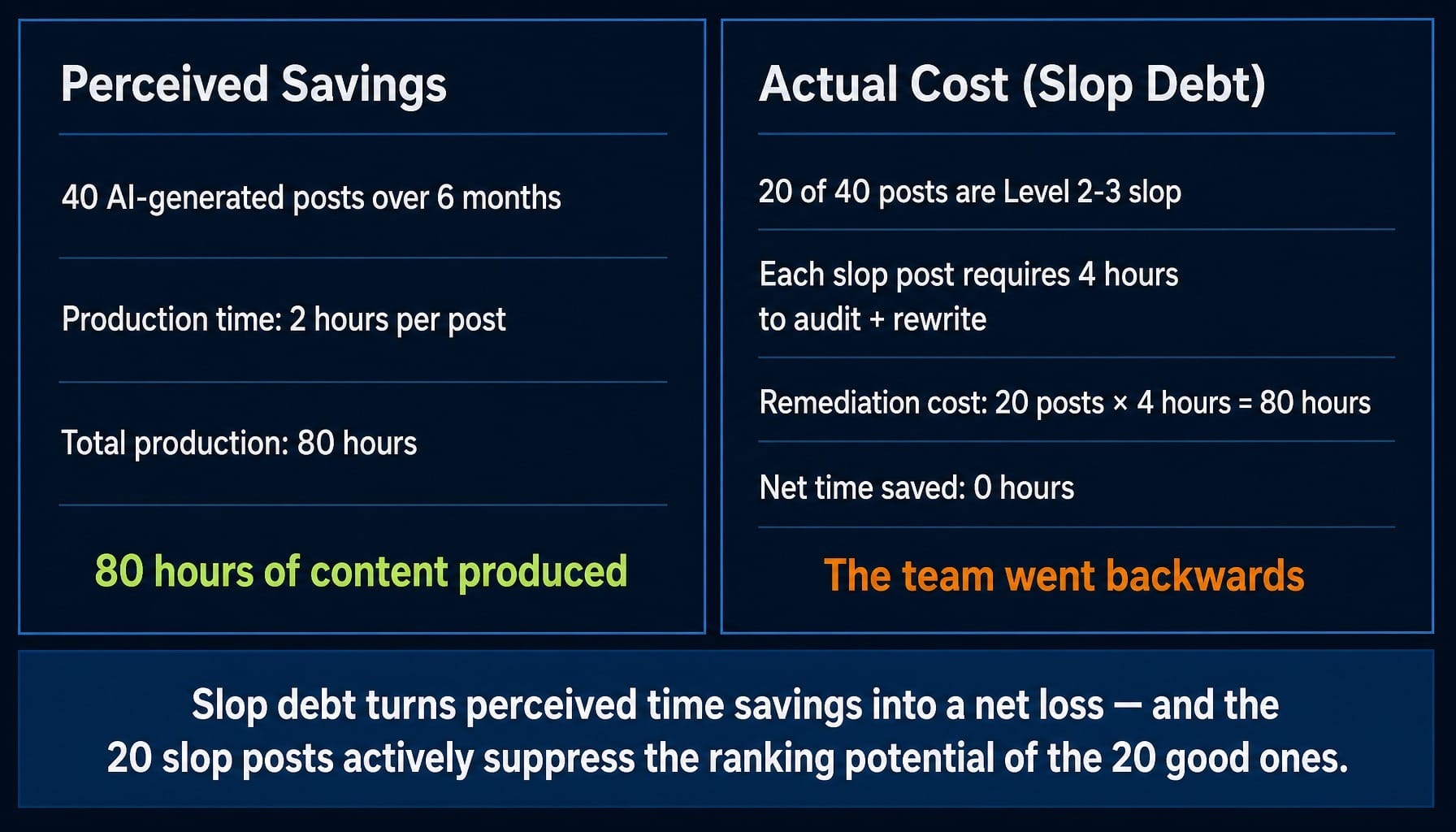
Every piece of AI slop you publish doesn't just fail to help—it actively creates "slop debt." Like technical debt in software engineering, slop debt is a compounding liability. It degrades your domain's trust signals, dilutes your topical authority, and creates a growing library of pages that must be audited and rewritten.
When a B2B domain accumulates dozens of interchangeable, low-signal pages, search engines can begin compressing visibility across the entire topic cluster, not just on the weak pages. The compounding effect means that by the time organic traffic declines are visible in dashboards, the damage is already done.
Imagine a team publishes 40 AI-generated posts over six months. Twenty of them are Level 2-3 slop. Those 20 posts aren't neutral; they're actively pulling down the ranking potential of the 20 good ones by lowering the site's overall quality assessment. If each post took 2 hours to produce but now requires 4 hours to audit and rewrite, the team hasn't saved 80 hours—they've created an 80-hour marketing backlog. They've gone backwards.
The core constraint is that lean marketing teams cannot afford to both produce content at scale and continuously audit it for this kind of quality degradation. This is the tension that modern marketing systems must resolve.
Read more: B2B SaaS Content Writing: How to Write Content That Moves Pipeline, Not Just Traffic
How Spike AI Prevents Slop Debt From Accumulating in the First Place
The frameworks above give you a process for preventing slop in new content. But what about the dozens or hundreds of pages you've already published? The cruel tradeoff for lean teams is that the manual work of auditing and fixing existing content is exactly the kind of bandwidth-intensive project you can't afford.
This is where a continuous optimization system changes the equation. Spike AI resolves this tension not by being another AI writing tool, but by functioning as a performance layer across your entire website. It continuously evaluates every page against conversion goals, identifying where content is underperforming—a direct proxy for low-trust slop.
Instead of running a painful, manual content audit every quarter to find problems months too late, Spike AI identifies the highest-impact fixes across your site and prioritizes them as part of a weekly release cycle. This replaces one-time cleanups with a compounding quality system. It ensures that every page on your site is continuously measured and improved, preventing slop debt from ever accumulating in the first place.
See how Spike AI keeps your website converting — not just publishing
Moving from Slop Production to Quality Systems
The single most important belief shift is this: AI slop is not an editing problem. It is a process and systems problem that starts upstream and compounds downstream.
The Slop Spectrum shows that most teams are producing Level 3 content and calling it AI-assisted. The Editorial Fingerprint Framework provides the process to reach Levels 4 and 5. And the concept of organizational slop debt proves that the cost of not implementing that process grows every week you delay.
The teams that win in 2026 and beyond won't be the ones that publish the most AI content. They will be the ones whose AI-assisted content is indistinguishable from expert-written content because their process ensures it.
Frequently Asked Questions
Can AI detection tools like Originality.ai or GPTZero reliably identify slop in 2026?
AI detection tools are a useful screening signal but an unreliable final judgment. They measure statistical patterns, not content quality. Use them to spot-check for obvious synthetic tells, but don't treat a clean score as proof your content has information gain. The real test is whether your content says something a competitor's AI couldn't have generated.
Does Google penalize AI slop differently from traditional thin content?
Google doesn't penalize content for being AI-generated; its helpful content system penalizes content for being unhelpful, regardless of origin. AI slop triggers the same negative quality signals as thin content: low information gain and weak E-E-A-T. The practical effect—suppressed visibility—is the same, but the mechanism is quality-based, not AI-detection-based.
How much human editing does AI-generated content actually need to escape the slop category?
This question reveals the wrong mental model. Editing for flow and grammar doesn't fix slop; it creates polished slop. The threshold isn't editing time but information injection. Has a human added proprietary data, a specific argument, or first-person experience that the model couldn't have generated? If not, more editing won't help.
What content formats are most susceptible to AI slop in B2B marketing?
Listicles and definition-style explainers are the most vulnerable because their structure is templated and their information is widely available in training data. Case studies and original research are the least susceptible because they require proprietary inputs. Landing page copy is in the middle—templatized, but the consequences of slop are immediate and measurable via conversion rates.
How do I audit my existing content library for AI slop I have already published?
Start with performance data, not detection tools. Identify pages with declining engagement (time on page, conversions) over the last 6-12 months. For each, ask: does this page contain any claim or perspective that couldn't appear on a competitor's site? Pages that fail that test are slop candidates. Prioritize rewriting pages targeting high-commercial-intent keywords first.
Is AI slop getting worse as more companies adopt large language models for content?
Yes, and the mechanism is self-reinforcing. As more AI-generated content pollutes the web, models trained on that content produce output that is increasingly a summary of summaries—a phenomenon known as model collapse. This means the baseline quality of default AI output will continue to decline, making your editorial fingerprint—proprietary data and expert perspective—an even more valuable differentiator.