How to Build a SaaS Marketing Playbook That Compounds, Not Collects Dust

TLDR
- Stop building playbooks based on aspirational channel coverage. Scope your playbook to your team's actual weekly shipping capacity.
- The test for a useful ICP definition is simple: if it doesn't change your channel allocation, it's not specific enough.
- Organize your playbook around a weekly shipping cadence (review, execute, measure, re-prioritize), not by channel or campaign. The cadence itself is the growth engine.
- Track compounding metrics like MQA-to-SAL conversion trends and influenced pipeline per shipped change, not snapshot metrics like monthly traffic or lead volume.
- The sales-marketing handoff rules (MQA definition, SDR response SLAs, closed-lost recycling cadence) belong inside the playbook, not a separate, forgotten document.
You've been there. As the new marketing lead at a Series A SaaS, you spend two weeks architecting the perfect marketing playbook in Notion. It's a 40-page masterpiece covering SEO, paid search, account-based marketing, content, email, community, and partnerships. The leadership team loves the ambition; they sign off.
Three months later, you've executed maybe 15% of it. The playbook isn't wrong—it's just unshippable.
This is the silent failure point for most B2B SaaS marketing playbooks. The problem isn't bad strategy; it's a fundamental mismatch between documented ambition and your team's actual shipping capacity. A playbook designed around seven channels for a three-person team isn't a plan; it's a backlog that grows faster than it shrinks.
A playbook that isn't executed weekly isn't a playbook. It's a wish list.
This guide walks through how to build a SaaS marketing playbook architected around what your team can actually ship each week. It's a system designed to ensure your results compound week-over-week, instead of stalling between heroic quarterly pushes.
What a SaaS Marketing Playbook Actually Is (and Why Most Are Just Wish Lists)
A SaaS marketing playbook is a living operational document that defines who your team targets, which channels you prioritize, what you ship each week, and how you measure compounding impact on pipeline and revenue. It is not a static strategy document.
Most teams build the latter: a beautifully formatted PDF that lists every possible channel and tactic but includes no shipping cadence, no prioritization model, and no feedback loop. It's a document of beliefs, not behaviors. The playbook you find from Madison Logic ranking on page one for this topic is literally from 2013—a perfect artifact of a time when marketing could afford to be a set of static plans. That era is over.
Think of a professional sports team. A football playbook doesn't list every theoretical play known to the sport; it contains the 15-20 core plays the team has drilled relentlessly and can execute under pressure. The same principle applies to your marketing.
The critical distinction is between your marketing strategy (what we believe will win) and your marketing playbook (what we will ship, when we will ship it, and how we will know it worked). Your strategy can be ambitious and wide-ranging. Your playbook must be ruthlessly scoped to your team's shipping capacity. If you cannot execute it consistently, it has no value.
Prerequisites: What You Need Before You Build the Playbook
Before writing a single playbook page, two inputs must be non-negotiable: your Ideal Customer Profile (ICP) and your competitive positioning. Without these locked, every channel decision, content angle, and ad creative you design downstream is a high-cost guess.
Most teams rush past this step, assuming it's "already done." But the operational specificity of these inputs determines whether your playbook compounds or just creates motion. With Gartner reporting that 77% of B2B buyers describe their last purchase as complex, a vague understanding of a 6-10 person buying committee is a recipe for wasted spend. The foundation has to be solid.
Lock Your ICP to a Specificity That Changes Channel Decisions
Most ICP definitions are too broad to be operationally useful. "B2B companies with 50-500 employees" is not an ICP; it's a demographic bucket. The test for a useful ICP is simple: does the definition change which channels you prioritize and which you ignore? If the answer is no, it's not specific enough.
Consider a SaaS selling to RevOps teams. A vague ICP—B2B companies with 50-500 employees—tells you nothing.
Now, sharpen it: Series B SaaS companies with $5M–$20M ARR, using HubSpot as their CRM, with a dedicated RevOps lead (not a sales manager doing RevOps), and an average sales cycle over 45 days.
This definition immediately makes decisions for you. A 45+ day sales cycle means the buying committee does deep research, so long-form, problem-focused content on your blog is more important than short-form social. The HubSpot requirement means you can target them with specific integration messaging. The dedicated RevOps lead tells you that LinkedIn is a primary channel, and you can use tools like Clay or Apollo.io to enrich leads and confirm their tech stack. If your ICP doesn't force these kinds of choices, go back and sharpen it until it does.
Define Positioning That Survives a Competitor's Feature Launch
Positioning built on features is fragile. A competitor ships the same feature next quarter, and your playbook's entire messaging framework collapses. Strong positioning is built on the problem you solve and the worldview you hold, not your feature list. It must be durable.
Imagine a SaaS analytics tool. If your positioning is "the fastest dashboard," you're one competitor release away from being obsolete. But if your positioning is "the only analytics tool that tells you what to do next, not just what happened," you've built a defensible moat. That point of view on the problem survives a competitor's performance update.
This isn't just a branding exercise; it's a critical playbook input. Your positioning determines every content angle, every piece of ad copy, and every sales talk track. For companies with true differentiation, it can even become the foundation for category creation. Your playbook codifies how you execute this positioning across every channel, ensuring every touchpoint reinforces the same core message.
Step 1: Choose Channels by Shipping Capacity, Not Aspiration
The single biggest mistake in SaaS marketing playbooks is listing every channel the team should be on. A three-person team that tries to run SEO, paid search, content, email, ABM, community, and partnerships simultaneously will ship nothing meaningful in any of them. The operational drag of context-switching and shallow execution guarantees failure.
The correct approach is to select only two or three core channels based on two strict criteria:
- ICP Habitat: Where does your sharply-defined ICP actually research problems and discover solutions?
- Shipping Capacity: What can your team ship weekly with high quality in that channel?
Sustained, high-quality execution in one channel has a compounding return—a high channel coefficient—that scattered, low-quality effort across five channels will never match. A two-person marketing team that tried to run six channels and shipped sporadically generated a fraction of the pipeline of a team that focused only on SEO and LinkedIn content, but shipped meaningful updates every single week. The focus is what created the leverage.
Read more: How to Prioritize Marketing Channels With a Limited Budget And Resources (Framework for Lean Teams)
PLG Playbooks vs. Sales-Led Playbooks Require Different Channel Stacks
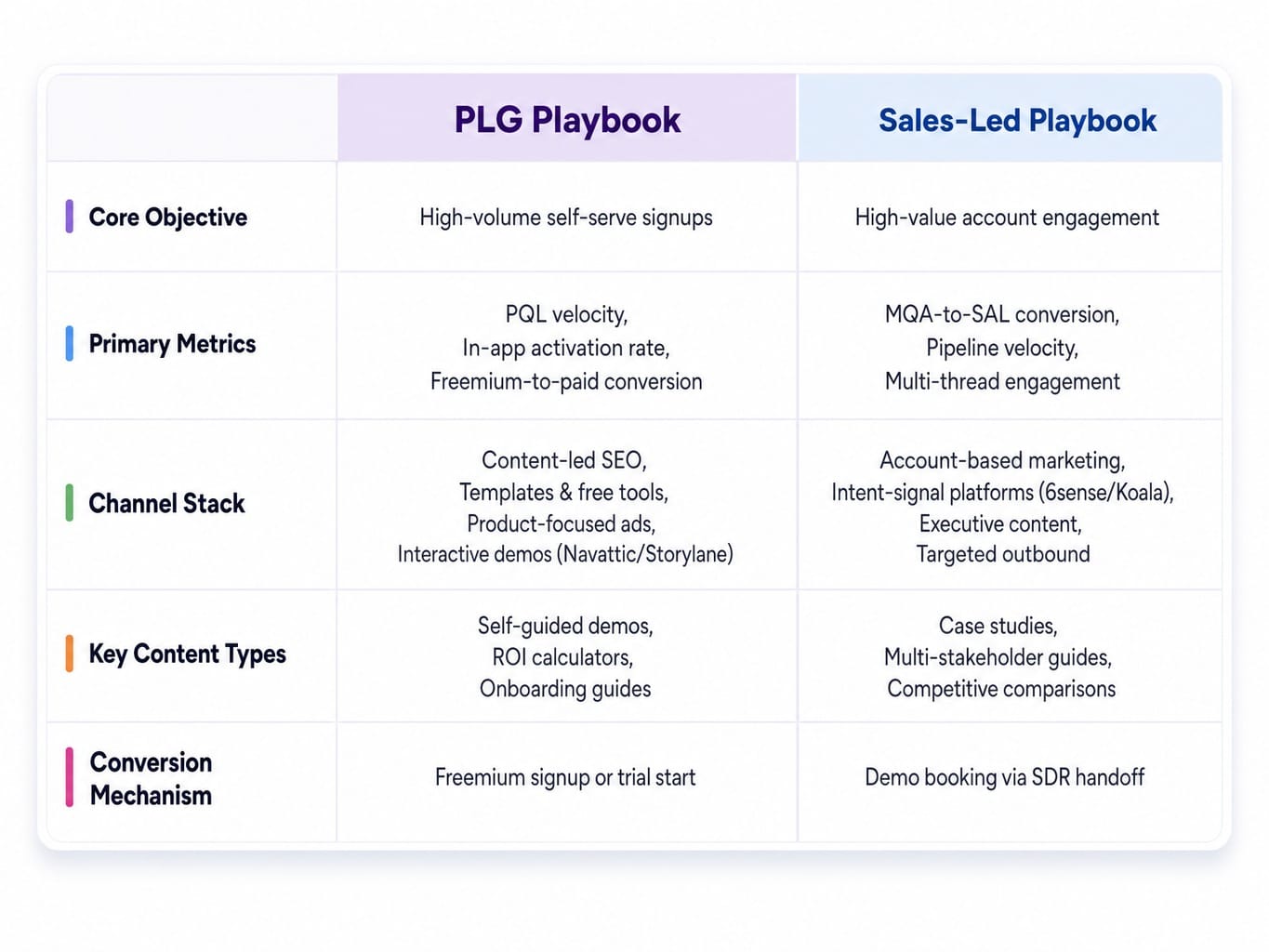
A common error is building a single, blended playbook for two fundamentally different go-to-market motions. A product-led growth (PLG) SaaS and a sales-led SaaS need different playbook architectures.
PLG playbooks prioritize channels that drive efficient, high-volume signups. The core metrics are product-qualified lead (PQL) velocity and in-app activation rates. The channel stack leans heavily on content-led acquisition (SEO, templates, free tools) and product-focused ads that drive users to an interactive demo (using tools like Navattic or Storylane) or a freemium signup.
Sales-led playbooks prioritize channels that engage high-value accounts. The core metrics are marketing qualified accounts (MQAs) and pipeline velocity. The channel stack is built around multi-threaded account-based marketing, leveraging intent signals from platforms like 6sense or Koala to target buying committees, paired with executive-level content and targeted outbound plays.
Many companies run both motions. Your playbook must have separate, dedicated modules for each. A blended approach that tries to serve both will underperform in both.
The Common Failure: Calling a Test After Two Weeks on a New Channel
Here's a failure pattern I've seen repeatedly. A team adds a new channel—say, LinkedIn Ads via Metadata.io—to their playbook. They run it for two or three weeks, see no immediate pipeline impact, and declare, "This channel doesn't work for us."
The problem isn't the channel; it's the evaluation window. Two weeks is not enough time to gather meaningful data. Any new channel test requires a disciplined approach:
- Hypothesis: Define what you expect to happen (e.g., "We believe we can generate MQAs from our target ICP at a cost per MQA under $500").
- Timeframe: Commit to a 90-day test window.
- Budget: Allocate a budget sufficient to reach statistical significance.
- Criteria: Pre-commit to the success metrics before you launch.
Even a winning ad set suffers from creative fatigue decay curves after a few weeks, so early results can be misleading. A good rule of thumb for your playbook: no channel test is killed before 90 days of consistent execution and a minimum threshold of qualified impressions. Anything less is just reacting to noise.
Step 2: Build a Content Engine That Feeds Pipeline, Not Just Traffic
A SaaS content engine inside a marketing playbook should be organized by buying stage and ICP pain point, not by keyword volume or editorial calendar convenience. Most SaaS content playbooks default to a tactical mandate like "publish four blog posts per month," completely disconnected from pipeline stages. This approach generates traffic, but rarely revenue.
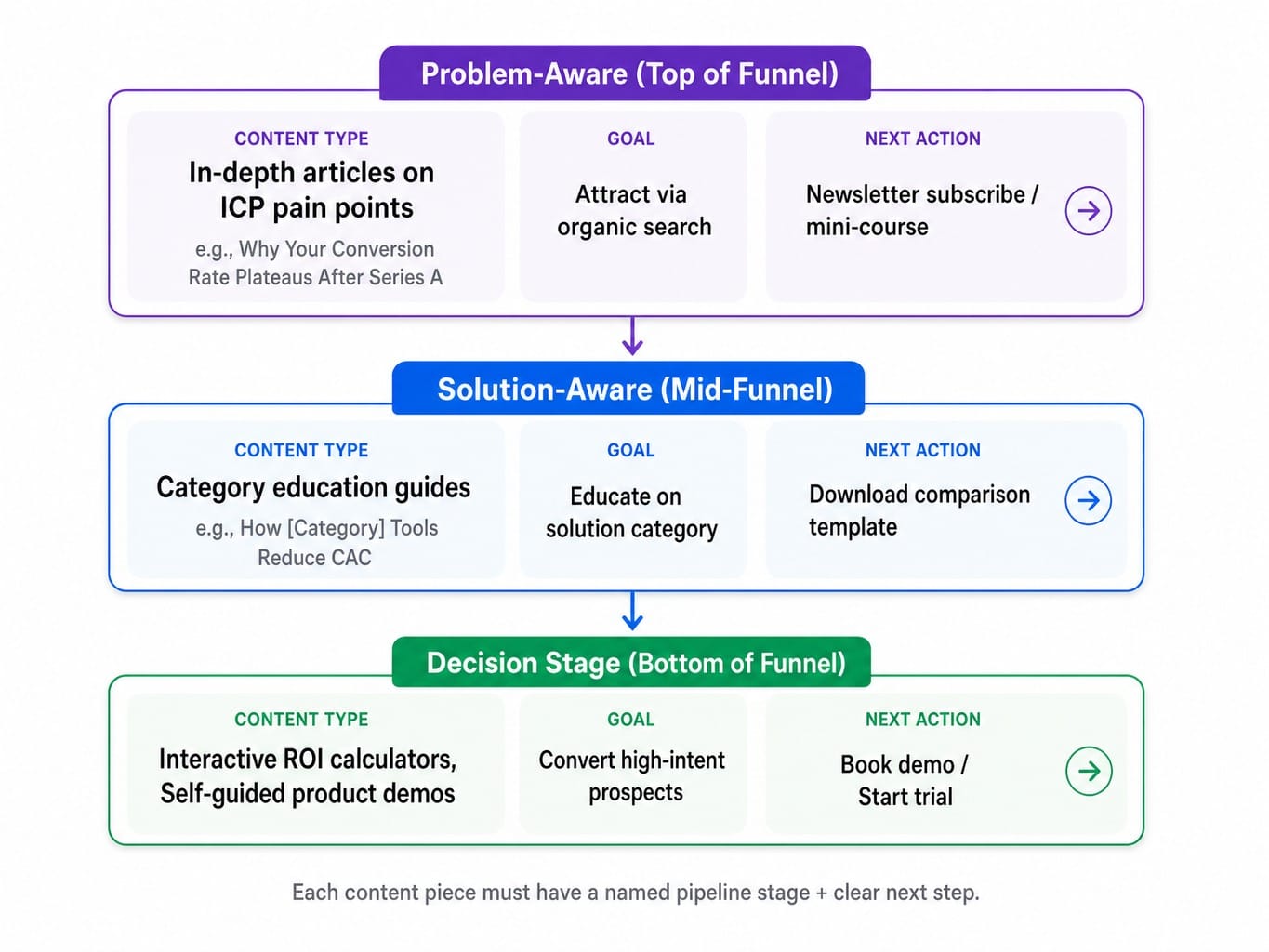
The content section of your playbook must map every asset to a stage in the buyer journey and a measurable next action.
For example, consider a SaaS selling to growth marketers. Your content playbook isn't a list of keywords; it's a journey map:
- Problem-Aware Stage (Top of Funnel):
Content: An in-depth article titled, "Why Your Conversion Rate Plateaus After Series A."
Goal: Attract marketers experiencing this specific pain point via organic search.
Next Action: Subscribe to a newsletter with a mini-course on breaking growth plateaus.
- Solution-Aware Stage (Mid-Funnel):
Content: A guide on "How [Your Category] Tools Reduce CAC by Consolidating Your Martech Stack."
Goal: Educate prospects on the solution category, positioning your approach as superior.
Next Action: Download a comparison template for evaluating solutions.
- Decision Stage (Bottom of Funnel):
Content: An interactive ROI calculator or a self-guided product demo.
Goal: Convert high-intent prospects into qualified leads or trials.
Next Action: Book a demo or start a trial.
This structure acknowledges the reality of the dark funnel, where much of this consumption happens in private Slack channels, podcasts, and LinkedIn DMs. While you can't track it all, you can use tools like Common Room to surface community signals or Dreamdata to build a more holistic multi-touch attribution model. The guiding principle for your playbook remains: if a piece of content doesn't have a named pipeline stage and a clear next step, it doesn't belong.
Step 3: Design the Playbook Around a Weekly Shipping Cadence
The single structural decision that separates playbooks that compound from those that stall is whether the team ships weekly or plans quarterly. Most playbooks are organized by channel or campaign. A high-performance playbook is organized by shipping sprints.
The cadence itself is the growth engine. Sporadic, heroic pushes create temporary lifts. A consistent, weekly shipping rhythm creates compounding momentum. Each week's release feeds data directly into the next week's prioritization.
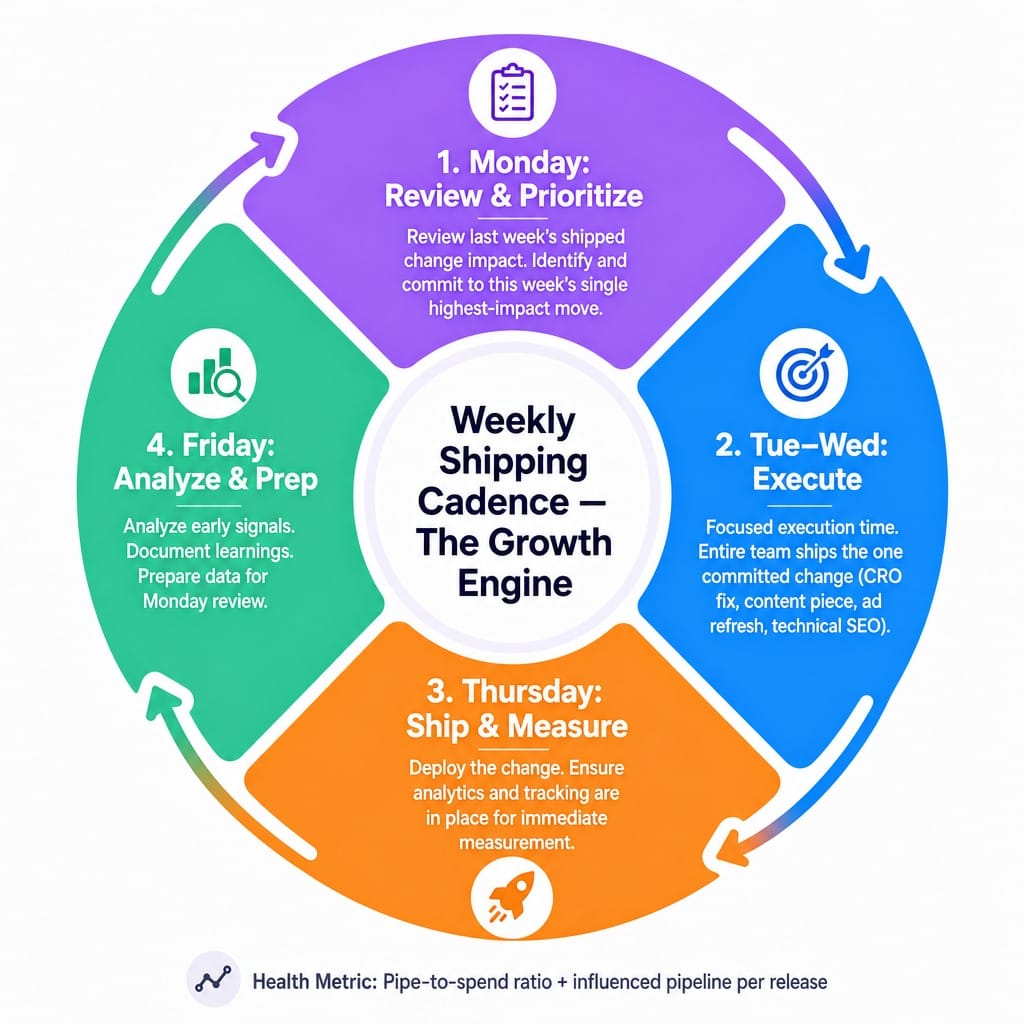
Your playbook should document this weekly operating rhythm. Here is a simple but effective structure for a lean team, documented in a Notion sprint board, not a static page:
- Monday: Review & Prioritize. Review the measured impact of last week's shipped change. Did the new landing page variant increase demo requests? Did the new ad creative lower CPC? Based on the data, identify and commit to this week's single highest-impact move.
- Tuesday-Wednesday: Execute. This is focused execution time. The entire team is dedicated to shipping the one change committed to on Monday. This could be a CRO fix on the website, a new content piece, an ad creative refresh, or a technical SEO improvement.
- Thursday: Ship & Measure. Deploy the change. Ensure analytics and tracking are in place to measure its impact immediately.
- Friday: Analyze & Prep. Analyze early signals from the shipped change. Document learnings and prepare the data for Monday's review meeting.
This loop transforms your playbook from a reference document into an active operational system. The weekly health metric isn't just activity; it's the pipe-to-spend ratio and the influenced pipeline generated by each release.
Read more: Marketing Task Prioritization for Lean Teams: A Framework That Actually Works
Step 4: Define Metrics That Expose Compounding (Not Vanity)
A SaaS marketing playbook should track compounding metrics—indicators that show whether each week's work builds on the last—not snapshot metrics that only report the current state. The average B2B website conversion rate has hovered around 2% for years, despite massive investment in tools. This stagnation shows that simply tracking the rate itself isn't enough; you must track the rate of change.
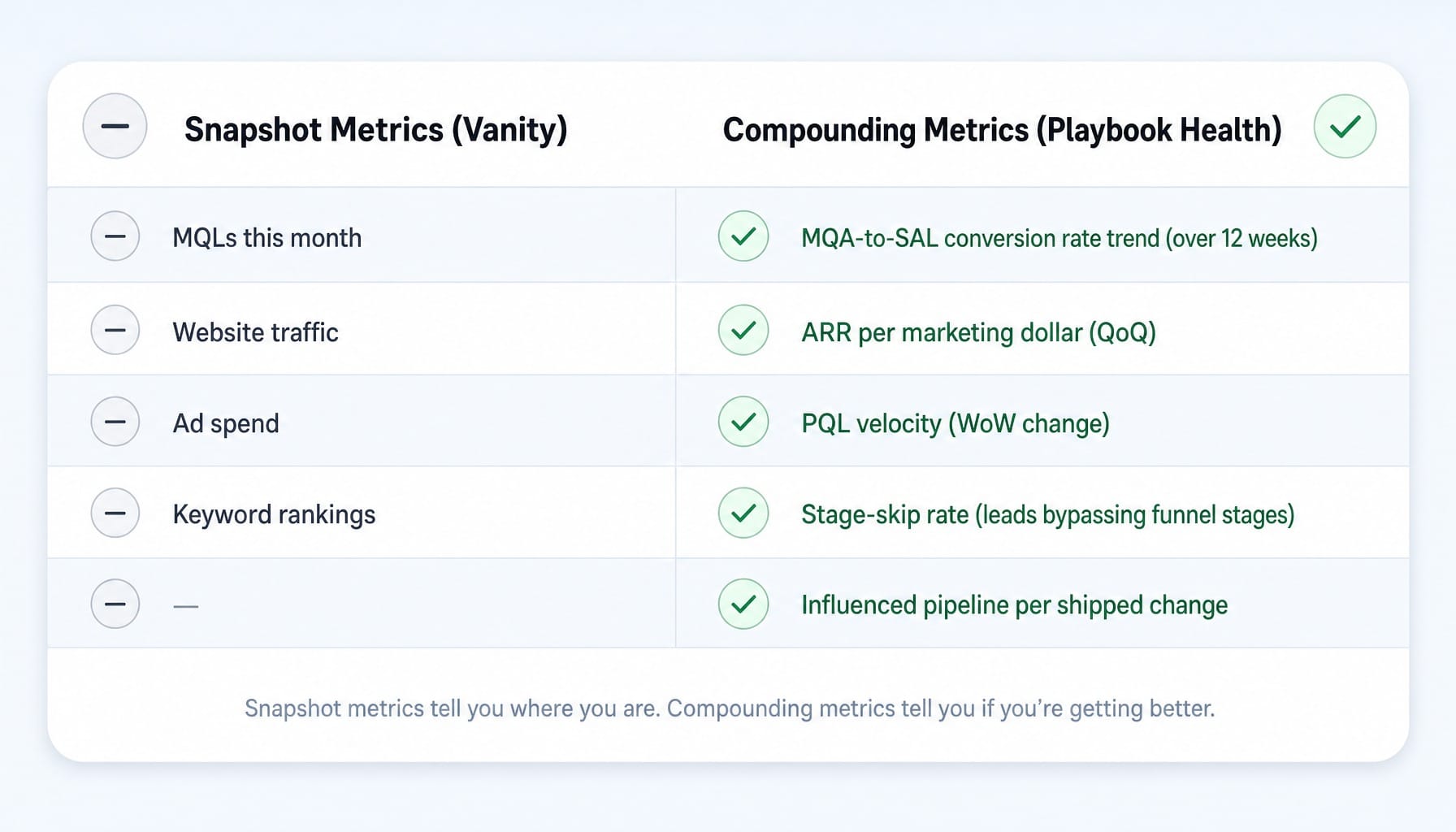
Your playbook needs to distinguish between two types of metrics:
Snapshot Metrics (What most teams track):
- MQLs this month
- Website traffic
- Ad spend
- Keyword rankings
These are useful for reporting but poor for diagnosing playbook effectiveness. They tell you where you are, not whether you're getting better.
Compounding Metrics (What your playbook should track):
- MQA-to-SAL conversion rate trend (over 12 weeks)
- ARR per marketing dollar (quarter-over-quarter)
- PQL velocity (week-over-week change)
- Stage-skip rate (how often leads bypass funnel stages, a sign of effective content)
- Influenced pipeline per shipped change
Imagine Team A tracks "leads generated" and sees a steady 200 per month. They feel fine. Team B tracks "influenced pipeline per shipped change" and sees that their last four weekly releases each added an average of $15k in new pipeline, and the trend is accelerating. Team B knows their playbook is working. Team A is just guessing. Use attribution tools like Dreamdata or your HubSpot dashboards to build these views.
Step 5: Build the Sales-Marketing Handoff Into the Playbook (Not a Separate Doc)
Most SaaS companies document the sales-marketing handoff in a separate SLA document that gets filed away and is never referenced after the first month. This is a critical mistake. The handoff is where the pipeline either accelerates or dies, and its rules belong directly inside your marketing playbook.
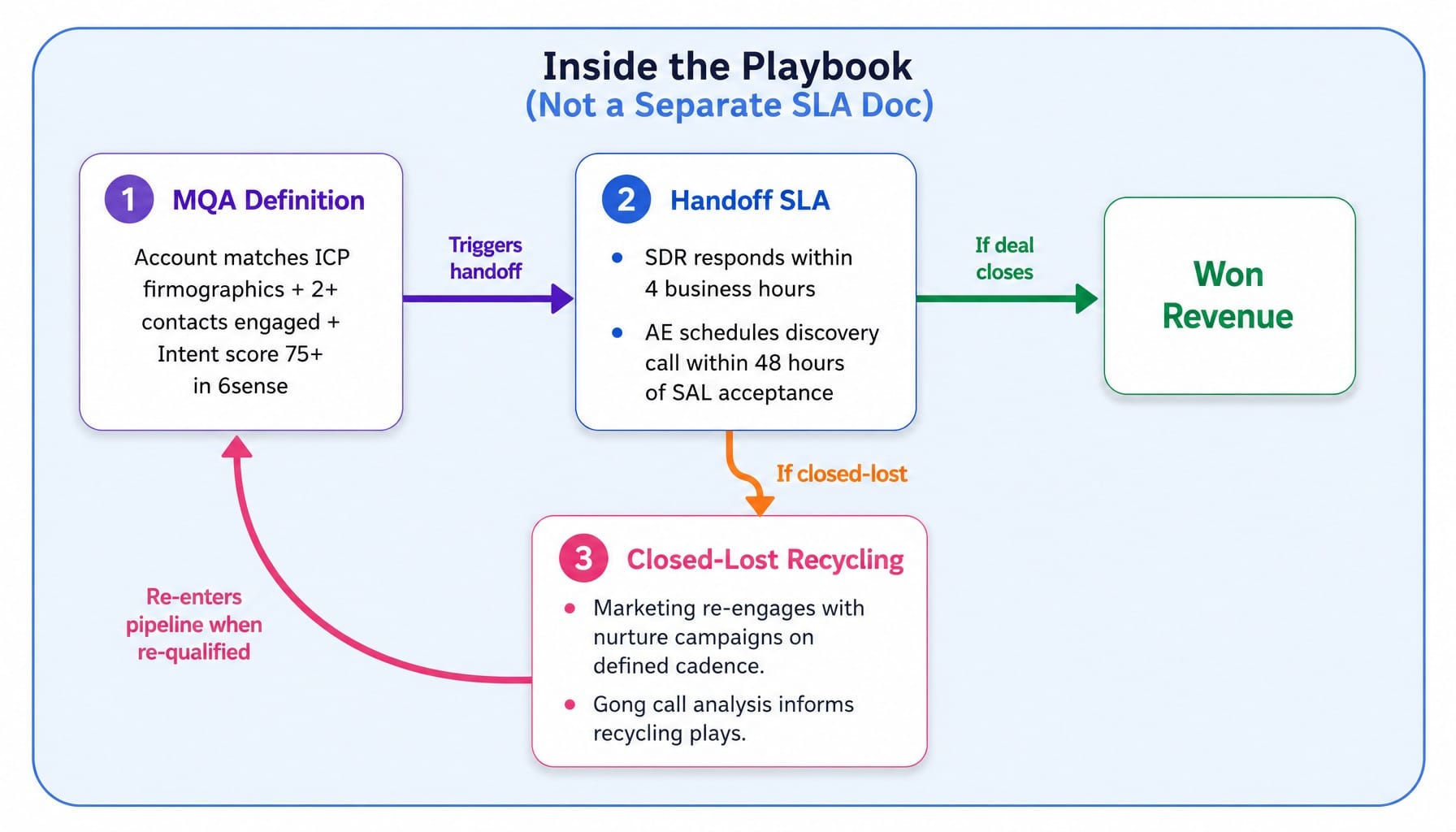
The playbook is not a marketing-only document; it is a revenue document. It must include:
- The MQA Definition: The exact, named criteria that define a Marketing Qualified Account versus a Sales Qualified Lead. No vague descriptions. For example: "Account matches ICP firmographics, has 2+ contacts engaged, and has accumulated an intent score of 75+ in 6sense."
- The Handoff SLA: Specific time windows for action. For example: "SDR must respond to a new MQA within 4 business hours. AE must schedule a discovery call within 48 hours of SAL acceptance."
- The Closed-Lost Recycling Cadence: What happens to deals that don't close? The playbook must define the process and timeline for how marketing re-engages them with nurturing campaigns. Analyzing call recordings in tools like Gong can reveal patterns in closed-lost deals that inform these recycling plays.
Consider a company where marketing generates 50 MQAs a month, but sales only works 30. The problem isn't a lack of leads; it's an ambiguous handoff. The fix isn't another lead gen campaign—it's a crisper MQA definition inside the one playbook that both teams reference weekly.
Step 6: Make the Playbook Anti-Fragile — Design for Channel Volatility
Any playbook that depends on a single channel for more than 60% of its pipeline is fragile. An algorithm update, a platform policy shift, or a flood of new competitors can collapse that channel's effectiveness in weeks. Your playbook must be designed as a resilience system, not just a channel plan.
I've seen this happen firsthand: a SaaS company built its entire playbook around Google organic search. A core algorithm update hit, and traffic dropped 40% overnight. Their playbook had no contingency plan.
Introduce the anti-fragile playbook principle: every quarter, the playbook must include a "channel stress test." Ask the question: "What happens to our pipeline if our top channel's effectiveness drops by 50%?" If the answer is "we're in serious trouble," the next sprint cycle must be dedicated to diversification.
This is where near-bound and ecosystem-led growth—partnerships, integrations, co-marketing—become critical playbook chapters. They are often harder to start but are nearly impossible for a single algorithm to disrupt. Incorporating real-time competitive intelligence loops from tools like Klue or Crayon also acts as a living layer of your playbook, helping you adapt to market shifts before they become crises.
When the Bottleneck Is Shipping, Not Strategy
You now have a framework for a playbook that is scoped, measurable, and resilient. But reading this, you might be thinking, "I understand the system, but my team still doesn't have the bandwidth to ship a meaningful change every single week."
You've correctly identified the true constraint. The gap isn't in your strategy; it's in your ability to execute.
This is the execution gap Spike AI is built to close. Where most tools give you insights and add to your backlog, Spike AI acts as your execution engine. It continuously identifies the highest-impact move across your website, SEO, and ads—then ships the fix.
The weekly sprint structure this article describes—the Monday review, the mid-week execution, the Friday re-prioritization—is the exact loop Spike AI runs for you. Your playbook transforms from a list of things to do into an approval queue of high-impact changes ready for deployment. Your team moves from being operators buried in tasks to orchestrators directing a system.
This is the capability that, until now, required either a large, specialized internal team or an expensive CRO agency. Spike AI provides the execution horsepower, so your lean team can finally run the playbook you designed.
See how Spike AI turns your playbook into weekly shipped results
Your Playbook Is a Shipping System
A SaaS marketing playbook is not a strategy document—it is a shipping system. The teams that win in 2026 and beyond won't be those with the most comprehensive playbooks. They will be the ones whose playbooks are ruthlessly scoped to what they can execute weekly, measured by compounding metrics, and stress-tested against channel volatility.
Open your current playbook. Count the number of items shipped in the last 30 days. If the answer is less than four, your playbook isn't broken—it's just too big. The next right action isn't to add another channel. It's to shrink the plan until every single item ships.
Frequently Asked Questions
How do you structure a B2B marketing playbook for a Series A SaaS company?
A Series A playbook should be radically scoped: two channels maximum, one ICP segment, and a weekly shipping cadence. Your team is likely one or two people, so the playbook must fit what they can execute in five-day sprints. Prioritize the channel with the shortest feedback loop to pipeline—usually content-led SEO paired with founder-led LinkedIn activity.
How do you incorporate account-based marketing into a SaaS playbook?
ABM becomes a playbook module when your ACV exceeds $25K and your sales cycle involves 3+ stakeholders. Add it as a separate motion alongside demand gen, not a replacement. Use intent signal scoring from tools like 6sense to trigger ABM plays only for accounts showing active buying signals, so your team doesn't waste shipping capacity on cold accounts.
How should a SaaS marketing playbook handle dark funnel attribution?
Accept that 50-70% of your buyer's research happens in channels you cannot track. Add a "How did you hear about us?" open-text field to every demo form and review responses weekly. Use tools like Common Room to surface community signals, but design the playbook to invest in dark-funnel channels (podcasts, communities) based on qualitative signal patterns, not just trackable attribution.
What does a marketing playbook look like for PLG versus sales-led SaaS?
A PLG playbook centers on self-serve activation: PQL velocity, freemium-to-paid conversion, and in-app onboarding. A sales-led playbook centers on MQA-to-SAL conversion, multi-threaded account engagement, and SDR handoff speed. Companies running both motions need two separate playbook modules with distinct metrics and priorities—blending them into one dilutes both.
When should a SaaS startup create its first marketing playbook?
Create a minimal playbook the moment you have a repeatable ICP and at least one channel generating pipeline. Before that, you're experimenting, not executing a playbook. The first version can fit on a single page: ICP definition, one primary channel, a weekly shipping commitment, and two or three compounding metrics. Expand it only as your shipping capacity grows.
How do you measure whether a B2B marketing playbook is actually working?
Track two things: your shipping rate (number of playbook items executed per week) and your compounding impact. If you ship four changes per month and the influenced pipeline per change is increasing quarter-over-quarter, the playbook is working. If your shipping rate is low or the impact per change is flat, the playbook needs to be re-scoped or re-prioritized.