
How to Prioritize Marketing Tasks for Lean Teams: A Framework That Actually Works

TLDR
- Prioritization fails not because of bad frameworks, but because teams apply them to a task list that is 3x their capacity. The first step is to permanently kill the 30-40% of tasks that don't produce pipeline.
- Stop using intuition for scoring models like ICE or RICE. Calibrate your "Impact" scores using historical pipeline data from your CRM to ground your decisions in reality, not hope.
- Shift from slow quarterly roadmaps to a weekly prioritization cadence. A 15-minute weekly reset to confirm top priorities prevents scope creep and keeps the team focused on what ships this week.
- Communicate capacity constraints by framing every new request as a trade-off. Instead of saying "no," ask, "We can do X, but it means Y ships two weeks later. Which is the priority for pipeline this quarter?"
- For teams under five, favor T-shirt sizing (S/M/L) over complex numerical scores. The goal is relative ranking and speed, not absolute precision that leads to decision fatigue.
It's Monday morning. A Slack message from the CEO lands: "Why aren't we ranking for [competitor's vanity keyword]?" At the same time, sales needs a new one-pager for a prospect call on Wednesday, a half-finished blog post from last sprint is gathering dust, and a paid campaign's creative is fatiguing. For a two-person marketing team, this isn't a strategy problem. It's a shipping capacity problem disguised as a prioritization problem.
The hard truth about how to prioritize marketing tasks with limited resources is that it's not about ranking your to-do list better. It's about building a system to permanently eliminate the 40% of tasks that shouldn't exist, then creating a repeatable cadence around what remains. This guide provides that system. We'll cover what to kill, how to score what survives, and how to communicate constraints to stakeholders without damaging your credibility.
Why Most Marketing Prioritization Fails Under Resource Constraints
Prioritization frameworks fail lean marketing teams not because the frameworks are flawed, but because teams apply them to a task list that is three times larger than their capacity can support.
Consider a typical three-person B2B SaaS marketing team. They use an ICE scoring model on a backlog of 40 items, diligently rank them, and start work on the top five. By Wednesday, a fire drill from sales derails two of those tasks. By Friday, a new product feature announcement consumes the rest of the week. They end the quarter having completed eight tasks from the original list, most of them reactive.
The issue here isn't the sequencing of the 40 tasks. It's the existence of the 40 tasks in the first place. Every item added to a backlog without removing another creates capacity debt—a hidden overhead of context-switching, status updates, and decision fatigue. Research from the American Psychological Association shows that switching between tasks can cost up to 40% of a person's productive time. For a small team juggling five workstreams, that's nearly two full days of lost output every week. You don't need a better ranking system; you need a smaller list.
The Anti-Prioritization Audit: Identifying the 40% of Marketing Tasks You Should Permanently Kill
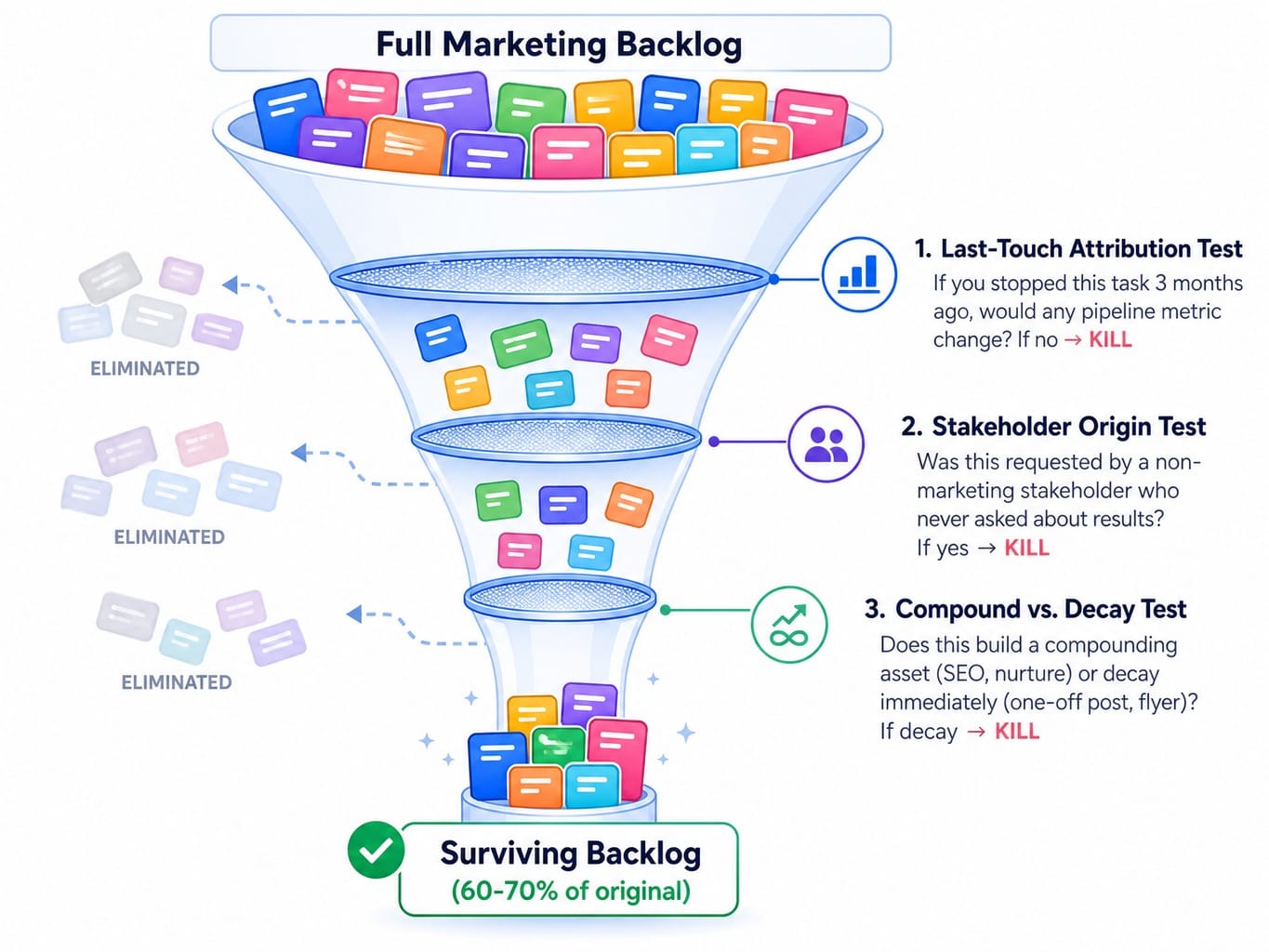
The highest-leverage prioritization move for a resource-constrained marketing team is not ranking tasks—it is permanently removing the 30–40% of recurring activities that consume time without producing measurable pipeline or revenue impact. This is the 'anti-prioritization audit,' a one-time exercise to shrink the backlog before any scoring framework is applied.
Deprioritizing a task doesn't eliminate it; it just moves it to a list where it generates guilt instead of results. These tasks linger on backlogs, create noise in planning meetings, and get resurrected by stakeholders months later. Elimination is different. It means deciding, with evidence, that a task category no longer exists for your team. This requires confronting sacred cows, like monthly social media reports nobody reads or maintaining a blog cadence on topics with zero search demand.
How to Identify Kill Candidates in Your Marketing Backlog
Use three filters to find tasks that can be permanently eliminated:
- The Last-Touch Attribution Test: If you stopped doing this task three months ago, would anyone outside the marketing team notice or care? More importantly, would any pipeline metric change? If the answer is no, it's a kill candidate.
- The Stakeholder Origin Test: Was this task requested by a non-marketing stakeholder who has never once asked about its results? This is often an "air cover" request, designed to make a department feel supported, rather than a genuine business need.
- The Compound vs. Decay Test: Does this task build an asset that compounds over time (e.g., SEO content, an email nurture sequence) or does it decay immediately (e.g., a one-off social post, a trade show flyer)? Lean teams must ruthlessly favor compounding activities. For example, one team killed their bi-weekly email newsletter (12% open rate, zero attributable pipeline) and redirected those 8 hours/month to optimizing their three highest-traffic landing pages, resulting in a measurable conversion lift.
How to Execute the Kill Without Creating Organizational Friction
You can't just stop doing things without communication; that creates chaos. The key is to reframe elimination as reallocation. Use a 'sunset memo'—a brief, data-driven internal communication that justifies the change.
It should name the task being eliminated, state the data behind the decision, and explicitly redirect the freed-up capacity to a named, higher-impact initiative. This approach shifts the conversation from "we're stopping work" to "we're reallocating resources to a higher-value target."
Here's a phrasing example you can adapt:
> "Team, we're sunsetting the monthly competitive intelligence newsletter. Data from the last six months shows it takes 4 hours/month to produce and has not generated any pipeline-attributed leads. We are redirecting that capacity to A/B testing on our pricing page, which currently loses 68% of visitors before the CTA."
This gives stakeholders the "why" and connects the decision directly to a revenue-focused outcome, making it much harder to argue against.
Building a Marketing Prioritization Scoring Model That Isn't Fiction
Most marketing teams using ICE or RICE scoring are assigning confidence and impact numbers based on intuition. This means their 'data-driven' prioritization is just gut feel with a spreadsheet. And let's be honest, for a team of two, calculating 'Reach' for every task is an exercise in creative fiction.
Frameworks like ICE (Impact, Confidence, Ease) and RICE (Reach, Impact, Confidence, Effort) are standard for a reason, but their value collapses when the inputs are uncalibrated. A team that has never measured the actual conversion impact of a landing page redesign will score its "Impact" as an 8 out of 10 based on hope, not evidence. Scoring models only work when calibrated against your own historical performance data. A team that scored a new blog initiative as "Impact: 9" but found their last five posts generated a combined 12 leads in six months could recalibrate that score to a more realistic "Impact: 3," freeing them to focus on webinar repurposing which historically converted at 4x the rate.
How to Calibrate Scoring Inputs with Pipeline Data Instead of Intuition
To ground your scoring in reality, you must reverse-engineer prioritization from pipeline data. Pull the last six months of closed-won opportunities from your CRM (like HubSpot). Trace them back to the marketing activities that generated them—not just MQLs, but qualified opportunities. These conversion rates become your baseline for "Impact" scores.
For example, if you find that webinars historically convert leads to opportunities at 5%, while blog posts convert at 0.5%, any new webinar idea gets a much higher baseline Impact score than a new blog post idea.
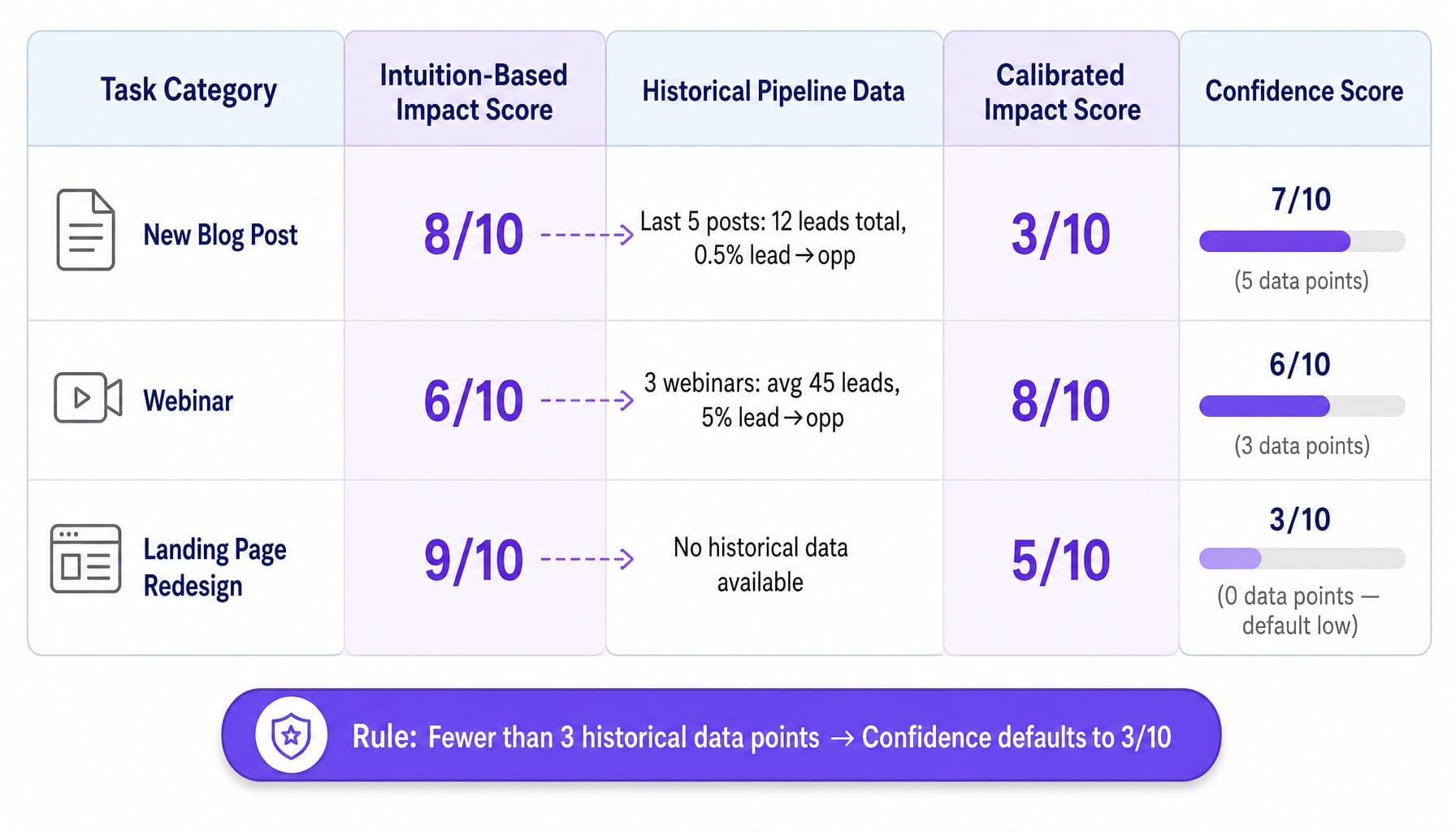
A simple rule of thumb: If you can't point to at least three historical data points for a task category (e.g., "we ran three landing page tests last year and the average lift was 15%"), your Confidence score should default to 3/10, not 7/10.
Read more: Data-Driven CRO Strategies: Identifying Marketing Opportunities for True Conversion Optimization
When to Use T-Shirt Sizing Instead of Numerical Scores
For teams with fewer than five people, a full RICE model can be counterproductive overhead. The time spent debating whether an effort score is a 3 or a 4 is time not spent shipping. In this environment, T-shirt sizing (S, M, L, XL) for effort estimation is a faster, more effective alternative.
What matters for a small team is relative ranking, not absolute precision. A team that spends 30 minutes T-shirt sizing 15 tasks and immediately starts on the "High Impact / S Effort" items will always outperform a team that spends two hours building a weighted scoring spreadsheet and ships nothing. Combine this with WIP limits (Work In Progress limits) from agile methodology. Set a hard cap of three active initiatives at any one time to enforce focus and prevent the productivity drain of context-switching.
How Often Should a Lean Marketing Team Re-Prioritize Its Backlog?
Lean marketing teams should re-prioritize their active task list weekly and their full backlog bi-weekly. Quarterly planning cycles are far too slow for teams where a single stakeholder request can consume 20% of the available capacity for a month.
Think of the team that locked in their Q1 roadmap in January. By mid-February, they've absorbed three unplanned "fire drills" from sales and product, displacing two of their four planned initiatives without ever formally re-prioritizing. The result is predictable: they deliver neither the planned work nor the reactive work well. The quarterly roadmap becomes fiction by week three.
Instead, implement a zero-based calendar approach. Every Monday, the team holds a 15-minute marketing kanban review to look at active WIP, confirm the top 1-3 priorities for that week, and explicitly name what is not being worked on. This isn't a status meeting; it's a prioritization reset. This cadence allows a team to catch scope creep within days instead of months, leading one team we know to complete 60% more of their planned initiatives per quarter.
Read more: Stop Syncing Strategy and Execution: Platforms That Unify Marketing Goals With Task Management
How to Communicate Marketing Capacity Constraints to Leadership Without Losing Credibility
The most effective way to communicate marketing capacity constraints is to present every new request as a trade-off against a named, existing initiative—not as a refusal. We've all been there: the dreaded drive-by request from a VP. Most marketing leads avoid capacity conversations because they fear being seen as incapable or because saying "no" feels career-limiting.
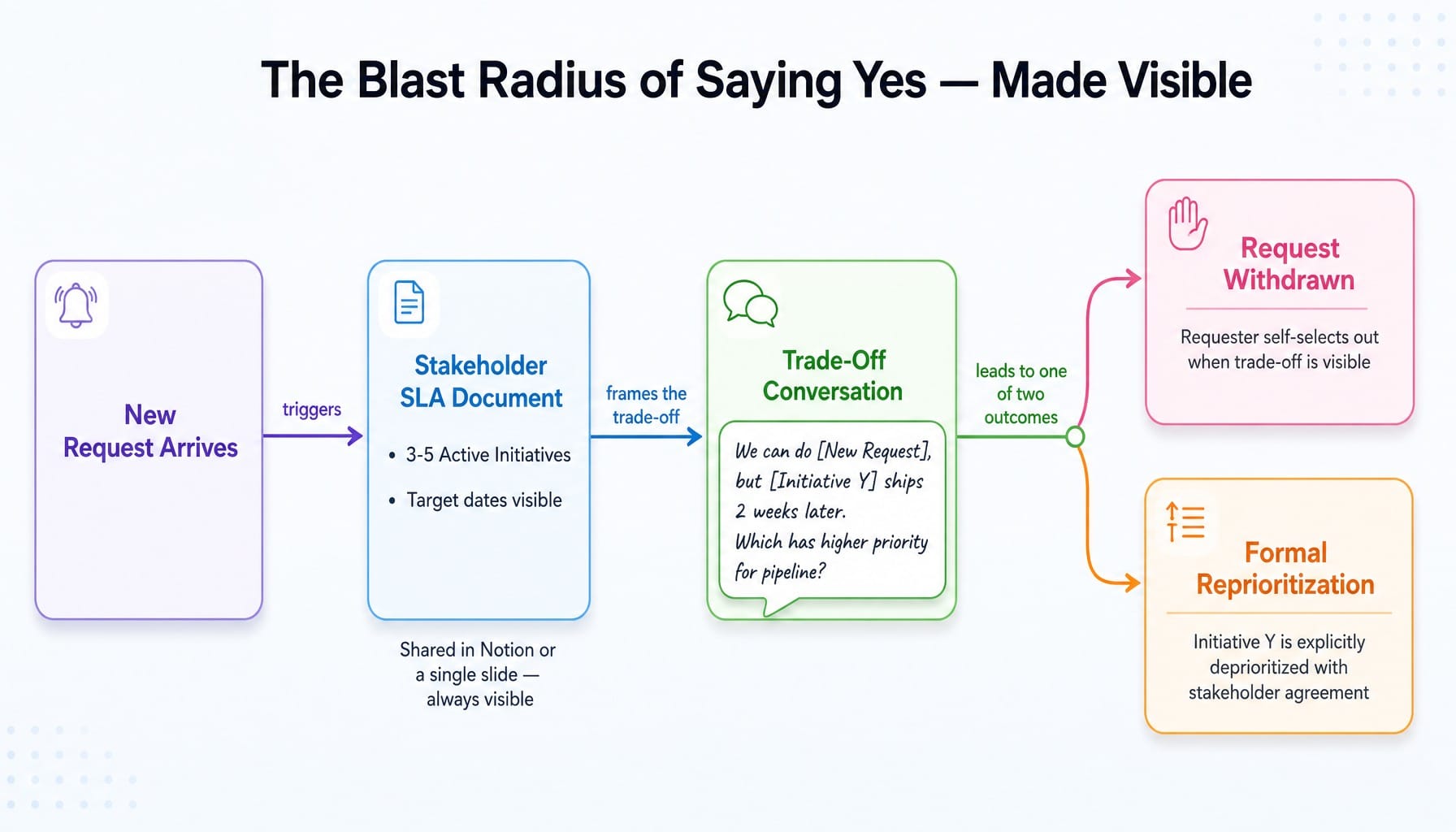
The problem isn't saying no; it's presenting capacity as a vague feeling ("we're stretched thin") instead of a concrete choice ("we can do X, but it means Y ships two weeks later—which do you prefer?").
Establish a simple stakeholder SLA for marketing requests. This can be a one-page document in Notion or a shared slide that lists the team's current 3-5 active initiatives and their target completion dates. When a new request comes in, you point to the list and use this language:
> "That's a great idea. Right now, our capacity is focused on [Initiative Y], which we prioritized to support the Q2 pipeline goal. We can absolutely pivot to your request, but it means [Initiative Y] will ship on March 15th instead of March 1st. Which has a higher priority for revenue this quarter?"
This reframes you from a blocker to a strategic partner. It makes the blast radius of saying yes visible. You'll find that once the trade-off is clear, many requests are voluntarily withdrawn by the requester themselves.
What Changes When the Effort Variable Drops to Near Zero
Every framework in this article—the kill lists, the scoring models, the stakeholder SLAs—is a tool for managing scarcity. Lean teams are forced into these difficult choices because human capacity is the ultimate fixed constraint.
But what if the effort side of that equation collapsed?
This is where the system-level thinking changes. When SEO fixes, CRO tests, and content optimizations can be identified, prioritized by impact, and shipped weekly without consuming your team's core bandwidth, the prioritization problem itself shrinks. You stop choosing between "fix the pricing page" and "optimize the blog for search" because a system like Spike AI can execute on both.
Spike AI is a marketing execution platform that turns prioritization from a constraint-management exercise into a throughput problem—and then solves the throughput problem. By fusing analysis, prioritization, and execution into a single closed-loop system, it allows lean teams to move from operators buried in backlogs to orchestrators who approve a weekly cadence of high-impact releases.
Your Operating System is Your Strategy
Prioritizing marketing tasks with limited resources is not a planning problem; it's an operating system problem. A plan is a static document created once a quarter. An operating system runs continuously, adapting to new inputs and optimizing for throughput every single day.
The path to higher output for a lean team is clear: start by killing the 40% of tasks that produce no value. Score what remains using pipeline-calibrated data, not intuition. Re-prioritize weekly, not quarterly. And make every new request a visible, data-driven trade-off.
The teams that win in 2026 won't be the ones with the most elaborate prioritization spreadsheet. They will be the ones who built a system that ships the right things every week—without needing a meeting to decide what those things are.
Frequently Asked Questions
How do I decide which marketing channels to focus on when I can only pick two or three?
Start with your pipeline data. Pull the last two quarters of closed-won deals and trace them back to their originating channel. The two channels that generated the most qualified pipeline—not just traffic or leads—are your focus. If you lack attribution data, default to the channel where you have the strongest existing asset base, as compounding an advantage is faster than building from scratch.
What framework should a solo marketer use to prioritize daily tasks?
A solo marketer should skip formal scoring models and use a single daily question: "Which one task, if completed today, makes the biggest difference to the pipeline this week?" Write that task down before opening email or Slack. Single-threaded ownership on one key task at a time is more productive for a solo marketer than any complex ranking method.
Should I prioritize quick wins or long-term brand building with limited resources?
Allocate roughly 70% of your capacity to initiatives with measurable results within 30 days (e.g., landing page tests, email sequence improvements) and 30% to compounding assets that build over 6–12 months (e.g., SEO content). The quick wins fund organizational patience for the long-term bets. Focusing only on one or the other will lead to either a loss of stakeholder support or a growth plateau.
When should a small marketing team outsource vs. do work in-house?
Outsource tasks that require deep specialist skills your team lacks and where the output is a defined deliverable, like a technical SEO audit or video production. Keep work in-house that requires ongoing context about your buyer, product positioning, or pipeline. The worst decision is outsourcing strategy; the best is outsourcing production.
What is the minimum viable marketing stack for a resource-constrained team?
A lean B2B team needs four core tools: a CRM with marketing automation (like HubSpot), a project management tool with kanban views (like Asana or Notion), an analytics platform (Google Analytics 4), and a landing page builder that doesn't require engineering. Justify anything beyond these four with a specific, measurable workflow gap, not a feature list.
Can AI tools reduce the need for marketing headcount in 2026?
Yes, AI tools in 2026 can meaningfully reduce headcount needs for execution-heavy functions like content production, SEO implementation, and basic CRO testing. They cannot replace strategic judgment or stakeholder management. A two-person team using AI-augmented workflows can ship at a volume that previously required four or five people, but only if the AI handles implementation, not just analysis.