
The Marketing Prioritization Framework That Replaces Gut Feel With Compounding Wins

TLDR
- Standard prioritization frameworks (RICE, ICE) fail marketing teams because they don't account for speculative impact estimates and cross-channel dependencies.
- Use a confidence-weighted scoring model: Score = (Revenue Proximity × Reach × Confidence) / Effort. The 'Confidence' variable penalizes gut-feel initiatives and depoliticizes decision-making.
- Before scoring anything, identify your single biggest marketing constraint. Improving anything that is not the bottleneck produces zero improvement to your overall system.
- Sequence initiatives so each one's output becomes the next one's input (e.g., optimize conversion on existing pages before building new ones). The order of execution matters more than the individual scores.
- Lean teams (<5 people) should enforce a WIP limit of one major initiative at a time, use a simplified 2-variable scoring model (Revenue Proximity, Confidence), and re-prioritize weekly.
The quarterly planning meeting ends. Your three-person marketing team has 14 "high-priority" initiatives on the board: an SEO content refresh, a landing page redesign, paid search expansion, a new case study series, AEO optimization, a homepage CTA test, a webinar funnel. You do what you're supposed to do: you force-rank them by gut feel, maybe using a basic impact-effort matrix borrowed from the product team. You start the top three.
Six weeks later, none are finished. Dependencies, scope creep, and urgent requests have consumed all available bandwidth.
The problem isn't that you lacked a framework. The problem is that product prioritization frameworks ignore three realities unique to marketing: impact estimates are largely speculative, initiatives interact across channels in ways that change their individual value, and the sequence you execute in matters as much as what you execute.
This is a marketing prioritization framework designed for those constraints. It uses a confidence-weighted scoring model, constraint-based thinking, and sequencing logic to build compounding results, not a longer backlog.
What a Marketing Prioritization Framework Actually Needs to Do
A marketing prioritization framework is a structured scoring and sequencing system that helps teams decide which initiatives to execute first based on projected revenue impact, resource constraints, confidence in estimates, and cross-channel dependencies.
Now, let's be direct. Most frameworks sold to marketing teams—RICE, ICE, simple impact-effort matrices—were designed for product feature backlogs. In product management, impact can often be measured with usage data and effort can be estimated with engineering story points.
Marketing has neither luxury.
Our impact estimates for a new content pillar or a landing page redesign are inherently speculative. Our effort estimates balloon because marketing initiatives touch multiple channels and stakeholders simultaneously. A simple LOE estimate rarely accounts for the back-and-forth with design, the dev ticket for tracking implementation, and the sales team's sign-off.
Consider a team scoring a "homepage redesign" as high-impact/high-effort on a 2x2 matrix. The score is a data point, but it's useless for decision-making. It tells them nothing about whether to do it before or after the SEO content refresh that would drive the traffic the new homepage is supposed to convert.
The gap isn't about which borrowed framework to pick. It's about building a system that accounts for the inputs product frameworks ignore: uncertainty, system constraints, and execution sequence.
How to Score Marketing Initiatives With a Confidence-Weighted Model
The standard RICE or ICE model fails marketing teams because the "Impact" variable is where all the uncertainty lives, yet it's treated as a single, reliable number. When a team compares the impact of a new webinar funnel versus a technical SEO audit, they are comparing a guess against a slightly-less-uncertain guess. The framework, however, treats both numbers as equally valid.
A more robust marketing prioritization scorecard requires four variables: Revenue Proximity, Reach, Effort, and Confidence.
The key is that Confidence acts as a multiplier that penalizes speculative claims. A high-impact initiative with low confidence will score lower than a moderate-impact initiative with high confidence.
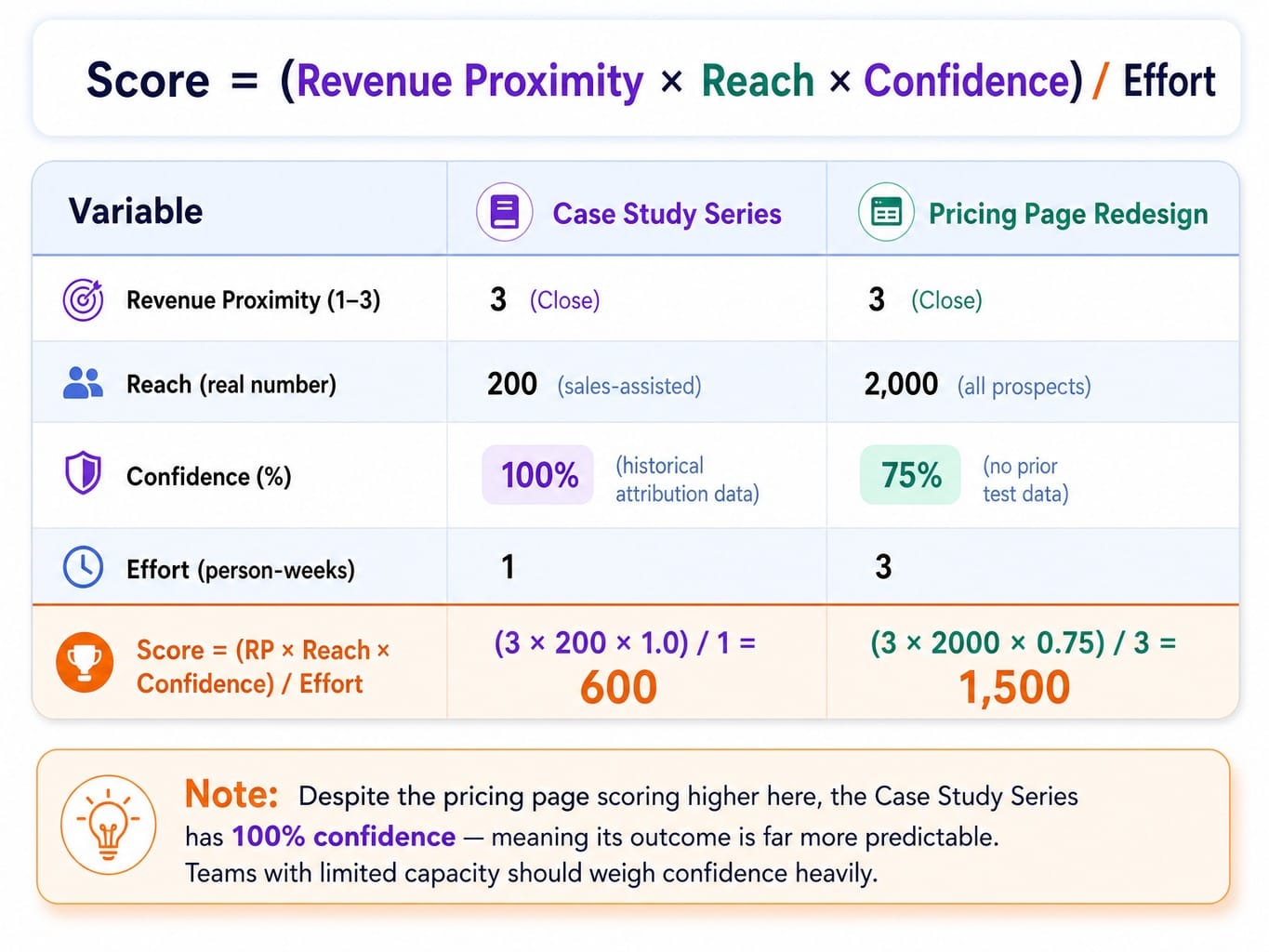
Let's walk through a common scenario: scoring 'launch a new case study series' vs. 'redesign the pricing page.'
- Case Studies: Moderate Reach (sales use), High Revenue Proximity (bottom-of-funnel), Low Effort, High Confidence (past case studies have pipeline attribution data).
- Pricing Page Redesign: High Reach (all prospects), High Revenue Proximity, High Effort, Medium Confidence (no prior test data exists for a full redesign).
The confidence-weighted score might reveal the case studies are the smarter, faster bet, even if the pricing page feels more important. It forces an evidence-based trade-off.
The Four Scoring Variables: Revenue Proximity, Reach, Effort, and Confidence
Define each variable with a marketing-specific lens. You can build this in a simple spreadsheet.
- Revenue Proximity: How many steps separate this initiative from a qualified lead or closed deal? A bottom-of-funnel landing page test has higher revenue proximity than a top-of-funnel blog series. Score it on a simple 1-3 scale (1=Far, 3=Close).
- Reach: How many qualified prospects does this touch in a given period? A webinar for 200 ICP attendees scores higher than a social campaign reaching 10,000 unqualified followers. Use real numbers from your analytics.
- Effort: Measure this in person-weeks, including all cross-functional dependencies (design, dev, content). If your team resists precise estimates, use t-shirt sizing (S=1, M=2, L=3, XL=5) to start.
- Confidence: How much evidence supports your impact estimate? Score this as a percentage multiplier:
High (100%): You have direct historical data or analogous results from a past test.
Medium (75%): You have directional signals (e.g., competitor success, user feedback) but no direct evidence.
Low (50%): Pure hypothesis. A good idea with no data to back it up.
The formula is: Score = (Revenue Proximity × Reach × Confidence) / Effort
Why Confidence Scoring Prevents the Loudest Voice From Winning
Let's name the biggest failure mode in marketing prioritization: HiPPO bias—the Highest Paid Person's Opinion. Without a confidence variable, a VP who "feels strongly" that a major brand campaign will drive pipeline can score it as high-impact with no evidence, and the framework validates their gut call. The decibel problem wins.
Confidence scoring forces the conversation most teams avoid: "What evidence supports this impact estimate?"
Imagine a CMO pushing for a major event sponsorship ($50k, 3 person-weeks of effort) based on "brand visibility." The team scores it:
- Reach: High
- Revenue Proximity: Low (1)
- Effort: High (3)
- Confidence: Low (50%)
The resulting score is low. Meanwhile, a $2k landing page A/B test has medium reach, high revenue proximity, low effort, and high confidence from prior test data. It scores significantly higher.
The framework didn't kill the sponsorship; it forced a conversation about evidence and opportunity cost. It surfaced the initiative debt you'd take on by choosing the sponsorship. Confidence scoring is the mechanism that depoliticizes prioritization by making subjectivity visible and debatable.
When Scoring Models Fail: Using Constraint Theory to Find the Single Highest-Leverage Move
Now for the contrarian view: sometimes, all scoring models are wrong.
Scoring models assume every initiative is independent and can be stack-ranked. But marketing is a system with bottlenecks. The highest-leverage move is always the one that relieves the binding constraint, regardless of its individual score.
This idea comes from Eli Goldratt's Theory of Constraints. In any system, one constraint limits total throughput. Improving anything that is not the constraint produces zero net improvement to the system's output.
Let's apply this. A B2B SaaS team scores eight initiatives and starts executing the top three. But their actual constraint is that the website's demo request page converts at 0.9%. The new blog content, the paid search expansion, and the webinar funnel all drive traffic into a leaky bucket. The work feels productive, but the pipeline doesn't move.
The single highest-leverage move was the CRO fix on that one page—an initiative that likely didn't score highest because it had "medium reach."
Read more: Data-Driven CRO Strategies: Identifying Marketing Opportunities for True Conversion Optimization
Constraint mapping asks a different question than scoring: not "Which initiative scores highest?" but "What is the one thing preventing our entire system from producing more qualified leads?" Everything else is noise until you fix it.
How to Map Your Marketing Constraint in 15 Minutes
You can run this diagnostic right now.
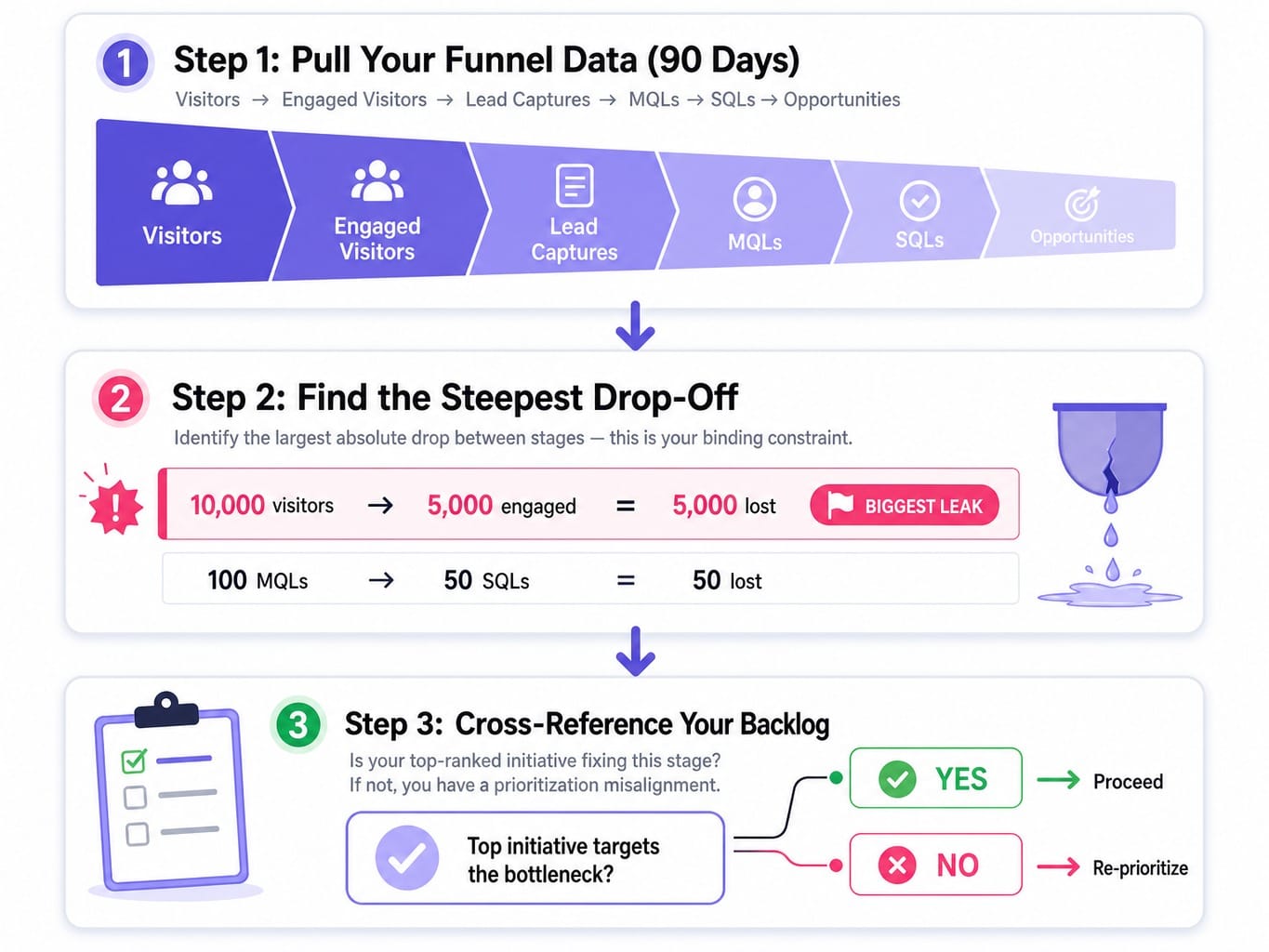
- Pull Your Funnel Data: Open Google Analytics and your CRM (HubSpot, etc.). Get the numbers for the last 90 days: Visitors → Engaged Visitors (e.g., >1 page view) → Lead Captures (form fills) → MQLs → SQLs → Opportunities.
- Find the Steepest Drop-Off: Look for the largest absolute drop in numbers between stages. A 50% drop from 10,000 visitors to 5,000 engaged users is a bigger problem than a 50% drop from 100 MQLs to 50 SQLs. The first leak is losing you thousands; the second is losing you dozens.
- Cross-Reference Your Backlog: Look at your prioritized initiatives. Is the top-ranked item designed to fix the stage you just identified? If not, you have a prioritization misalignment. Your scoring model is optimizing a part of the system that isn't the bottleneck.
Sequencing Over Scoring: Why the Order You Ship Initiatives Matters More Than Their Individual Rank
Even after scoring and constraint-mapping, most teams make a final error: they treat the ranked list as a parallel execution plan. But marketing initiatives have dependencies and compounding relationships that make order critical.
Here's a classic example. A team has two top-scored initiatives:
(A) Publish 10 new SEO-optimized landing pages.
(B) Run conversion rate tests on existing high-traffic pages.
If they execute A first, they create 10 new pages with untested conversion patterns. They've just scaled up their uncertainty. Then they have to go back and test everything.
If they execute B first, they establish a proven conversion template. They then apply that winning template to all 10 new pages. The second initiative is amplified by the first.
Same initiatives, same scores, radically different outcomes based on sequence.
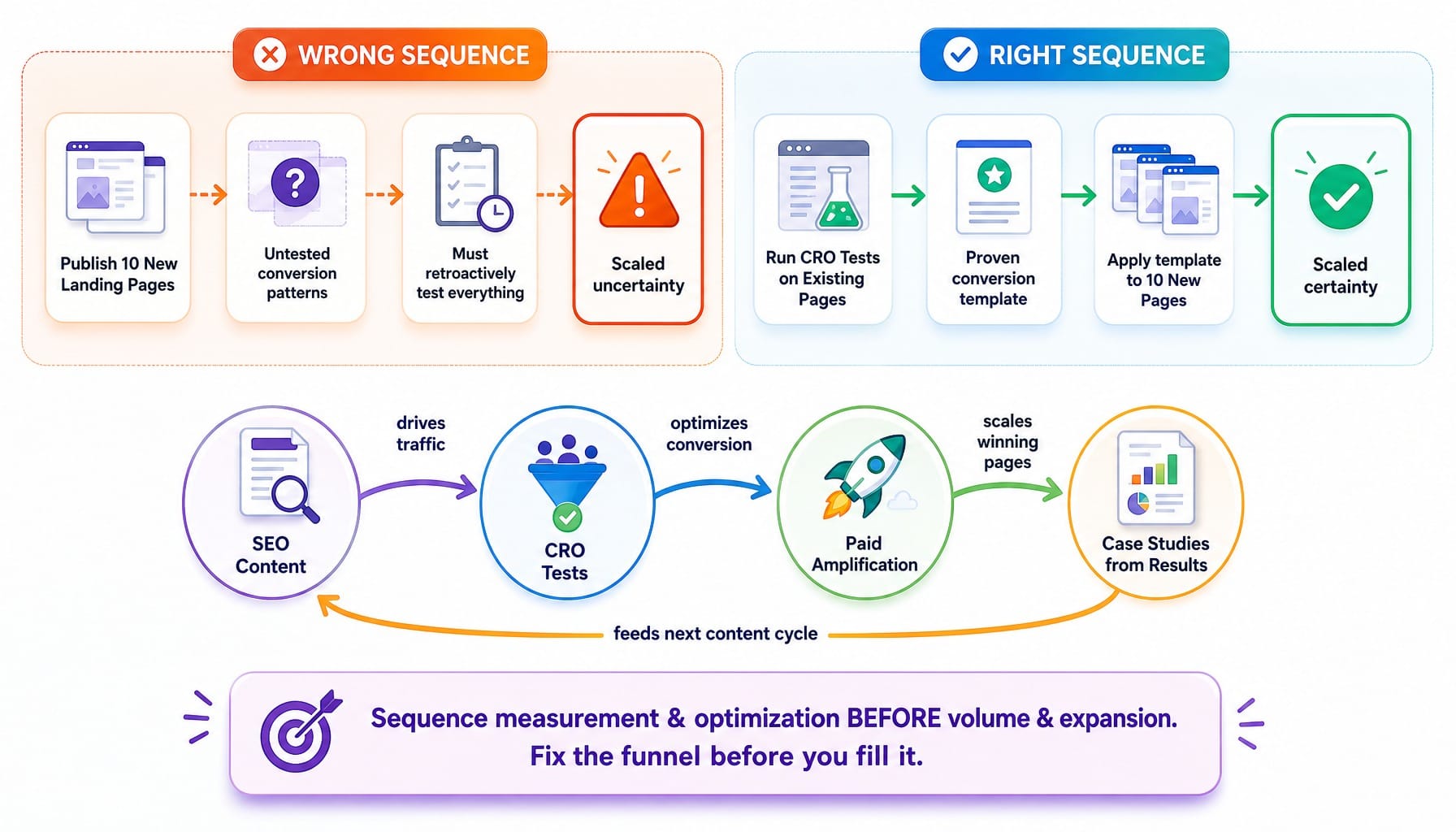
This is a compounding sequence: arranging initiatives so each one's output becomes the next one's input. SEO content drives traffic → CRO tests optimize that traffic → paid search amplifies the winning pages → case studies from the resulting customers feed the next content cycle.
Read more: The Revenue-Weighted Framework for Landing Page Conversion Rate Optimization
This isn't a framework you score; it's a logic you apply after scoring. A simple rule of thumb: always sequence measurement and optimization initiatives before volume and expansion initiatives. Fix the funnel before you fill it.
How to Adapt a Marketing Prioritization Matrix for a Team of Five or Fewer
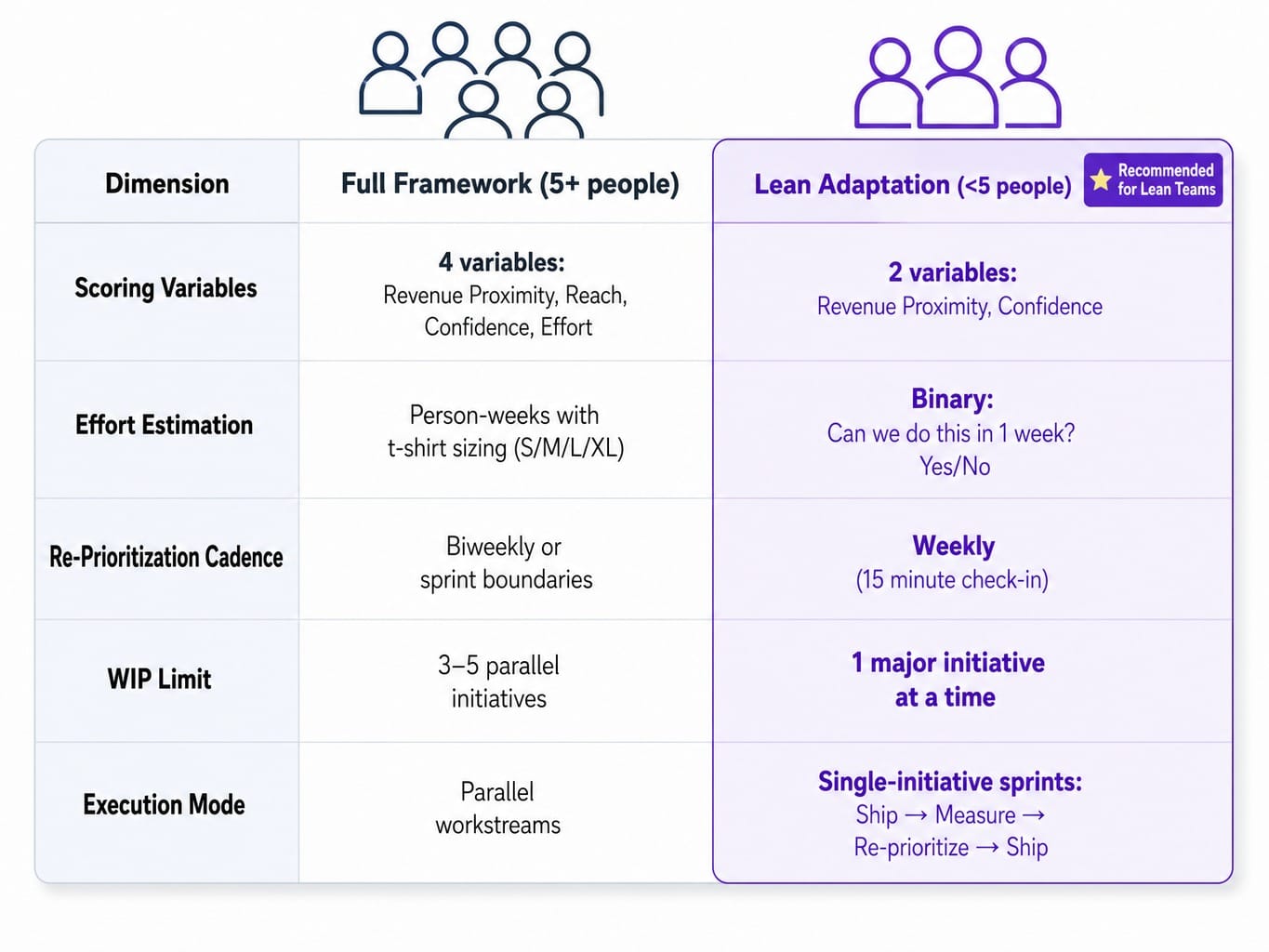
A marketing prioritization framework for a team of fewer than five people should reduce scoring dimensions, shorten re-prioritization cycles, and enforce a single-initiative-at-a-time execution rule.
Most frameworks implicitly assume a team large enough to run 3-5 initiatives in parallel. Lean teams cannot. Trying to do so is a recipe for a velocity-adjusted backlog where nothing ever ships.
For a small team, three adaptations are critical:
- Simplify Scoring: Reduce your model to two variables: Revenue Proximity and Confidence. Lean teams cannot afford to invest in low-confidence experiments or projects far from revenue. Drop Reach and Effort as separate scores; for a two-person team, effort is binary—can we do this in one week or not?
- Re-Prioritize Weekly: A quarterly cycle is a death sentence for a startup. Market conditions, campaign results, and customer feedback change the calculus daily. A weekly 15-minute check-in to re-stack rank your simplified list is all you need.
- Enforce a WIP Limit of One: This is the most painful but most effective change. A lean team running three initiatives simultaneously will finish none of them. Ship one major initiative, measure, re-prioritize, and ship the next. The solo marketing lead at an $8M ARR company who tries running SEO, CRO, and a webinar program at the same time sees all three stall at 40% completion. Switching to single-initiative sprints gets one thing shipped per week, and results begin to compound.
What Happens When Prioritization and Execution Collapse Into a Single System
The tension in this entire discussion is clear. Even with a perfect prioritization framework, lean marketing teams face a second, more difficult gap: the latency between deciding what to do and actually shipping it.
Your new framework identifies the highest-impact move. The constraint map confirms it's the right bottleneck. The sequencing logic puts it in the perfect order. And then... it sits in a backlog for three weeks while the team coordinates design, copy, and development.
Frameworks don't ship changes.
Spike AI is built to resolve this specific tension. It is the system that closes the gap between prioritization and shipped output. We use a similar logic to identify the highest-impact move across your website, SEO, and ads, but then we take the next step: we execute it. Every week.
The compounding sequence logic described in this article is precisely how Spike AI operates. Each week's release—a CRO fix, a new landing page, a technical SEO update—feeds the next week's re-prioritization. The system learns, adapts, and ships again. The cadence itself becomes the growth engine. You move from operator to orchestrator, approving the highest-impact move instead of getting buried trying to build it.
Platforms that unify marketing goals with task execution represent this shift from fragmented planning to continuous shipping.
See how Spike AI identifies and ships your highest-impact marketing move every week
Your Framework Is Not the Problem
A marketing prioritization framework is not a scoring exercise. It is a system that combines confidence-weighted scoring, constraint identification, and compounding sequencing to determine not just what to do, but in what order, and with what evidence.
Most teams borrow product frameworks that treat impact as a known quantity and initiatives as independent. Marketing has neither luxury. The framework that actually works is one that accounts for uncertainty with confidence scoring, identifies the binding constraint before ranking anything, and sequences initiatives so each one amplifies the next.
But the teams that compound results aren't the ones with the best strategy deck or the most elegant spreadsheet. They are the ones that ship the right thing, in the right order, every single week. The gap is never the framework. The gap is the distance between the framework and the first shipped change. Your job is to close it.
Frequently Asked Questions
What is the difference between RICE and ICE scoring for marketing prioritization?
RICE adds a 'Reach' variable and uses 'Confidence' as a percentage multiplier, making it better for teams that can estimate audience size. ICE is simpler—Impact, Confidence, Ease—and works well when reach data is unavailable or a faster scoring cycle is needed. For most lean marketing teams, ICE with a confidence haircut provides 80% of RICE's value in half the time.
How often should a marketing team re-prioritize its initiative backlog?
Teams with fewer than five people should re-prioritize weekly; it takes 15 minutes with a simplified model and prevents stale priorities from consuming bandwidth. Larger teams (5-15) can re-prioritize biweekly or at sprint boundaries. Quarterly re-prioritization is too slow for marketing, as campaign data and pipeline feedback change the calculus much faster than product roadmaps do.
How do you handle cross-functional dependencies when prioritizing marketing work?
Map dependencies before scoring. For each initiative, list every team it requires beyond marketing (e.g., design, engineering). If an initiative requires more than two cross-functional handoffs, increase its 'Effort' score by one tier, as dependencies reliably cause effort creep. Alternatively, break the initiative into a marketing-only phase (shippable independently) and a cross-functional phase to be scored separately.
Should marketing prioritization frameworks include budget constraints or just effort?
Include budget as a component of 'Effort,' not a separate variable. Adding more scoring dimensions creates false precision that slows decision-making. The exception: if one initiative requires discretionary budget approval (e.g., a $30k sponsorship), flag it as a gating constraint. Gating constraints are binary (approved or not) and should be resolved before the initiative enters the scoring model.
How do you prioritize brand marketing against demand generation in the same framework?
Score both on the same variables but adjust the 'Revenue Proximity' definition. Brand initiatives have low direct revenue proximity but may score high on 'Reach' and 'Confidence' (if you have brand lift data). The framework will naturally deprioritize brand work for resource-constrained teams—which is correct. If leadership mandates brand investment, allocate a fixed percentage of capacity to the brand (e.g., 20%) and prioritize only within that allocation.
What belongs in the high-effort, low-impact quadrant and should you ever execute those projects?
High-effort, low-impact initiatives—often called 'thankless tasks'—include maintaining legacy systems, manual reporting nobody reads, or vanity projects driven by internal politics. Execute them only when they are blocking a higher-impact initiative (e.g., a CRM data cleanup that must happen before lead scoring can work). Otherwise, explicitly deprioritize them and communicate the decision to stakeholders with the scoring data. Naming what you will not do is as important as naming what you will.