
How to Prioritize Search Marketing Channels for Growth (2026 Framework)
TLDR
- Stop evaluating search channels by potential reach or last-click attribution; prioritize based on marginal return on investment relative to your current constraints.
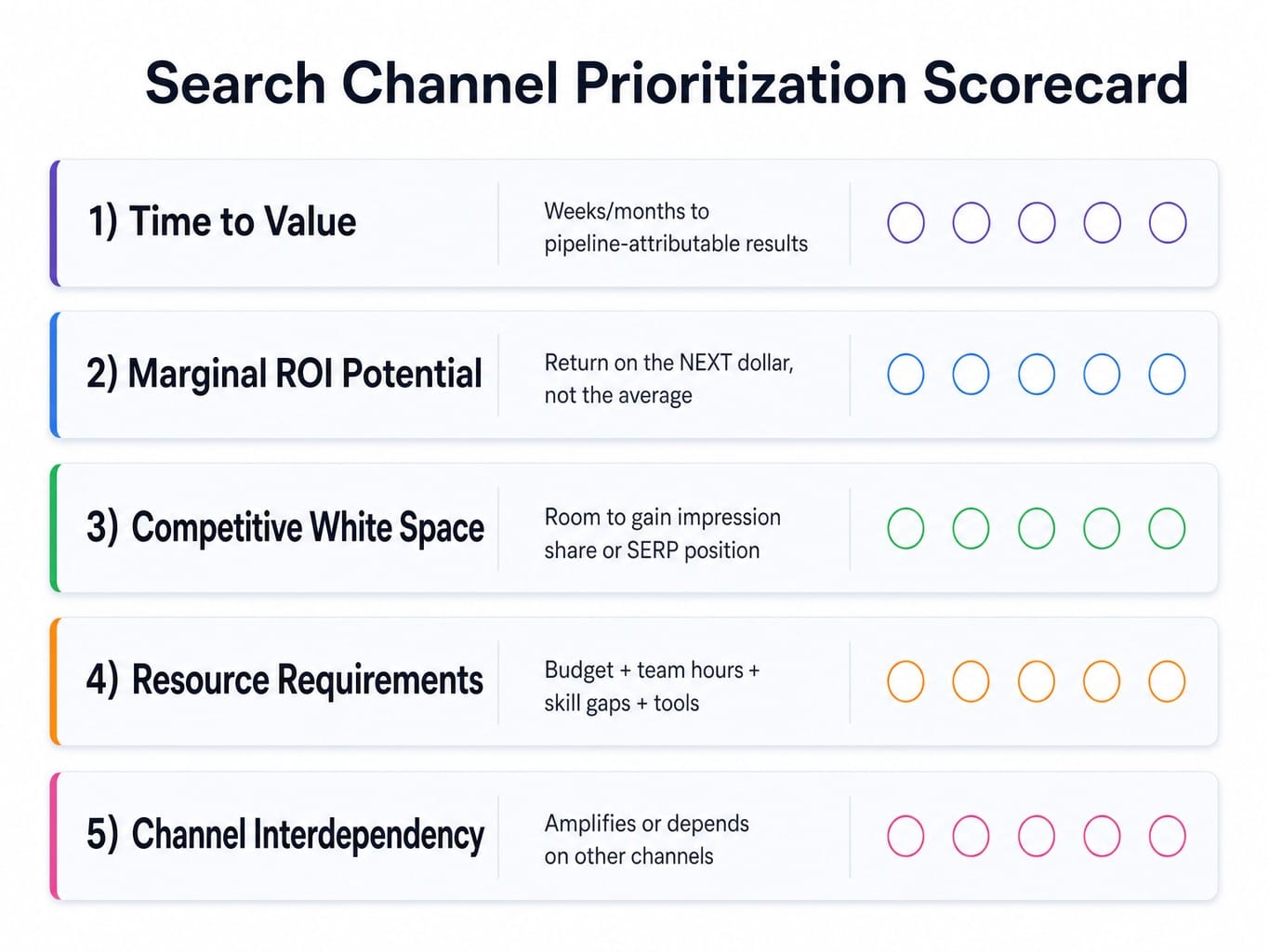
- Use a five-point scorecard to rank channels: Time to Value, Marginal ROI Potential, Competitive White Space, Resource Requirements, and Channel Interdependency.
- Treat branded and non-branded search as separate channels in your analysis. Blending them inflates your overall ROAS and masks poor non-branded performance.
- Factor in AI search (Google AI Overviews, Perplexity) as a new channel tier that is actively depressing organic CTR for many informational queries, changing the value of certain SEO investments.
- Replace static annual plans with a dynamic reprioritization cadence, using signals like diminishing returns (marginal CPA) and competitive density (impression share) to reallocate budget quarterly.

Imagine this: a three-person B2B SaaS marketing team splits their Q1 budget evenly across SEO content, Google Ads, and a new programmatic display experiment. By Q2, none of the three has reached the investment threshold needed to produce meaningful results. Organic rankings are stuck on page two, paid search CPA has climbed because the budget is too thin to win competitive auctions, and display produced impressions but zero pipeline.
The problem wasn't the channel selection; all three were viable. The problem was the absence of a prioritization system.
Knowing how to prioritize search marketing channels for growth isn't about picking the "best" channel. It's about sequencing investments based on where your next dollar produces the highest marginal return, given your current constraints. Most teams spread effort thin, guaranteeing mediocrity across the board. This guide provides a concrete scoring framework to stop the guesswork and start making focused, high-impact decisions for your search channel mix.
Why Most Search Channel Prioritization Defaults to Gut Feel
Search channel prioritization fails when teams evaluate channels by potential reach instead of marginal return relative to their current constraints. This leads to a few common failure modes that feel productive but ultimately dilute impact.
First is the attribution trap. Teams rely on last-click or even multi-touch attribution models in GA4 to judge a channel's value. But attribution models measure credit allocation, not incrementality. A channel can look like it's driving conversions while actually just capturing demand that would have converted anyway. The classic example is branded paid search. A B2B SaaS company spending $8K/month on its own brand name might see hundreds of conversions attributed to that campaign. However, practitioners report that when they run a holdout geo-test and pause those ads, 85-90% of those clicks and conversions simply come through the organic branded result instead. The paid campaign was only 10-15% incremental, but the attribution report made it look like a top performer.
Second is the volume fallacy. Teams prioritize channels with the highest total addressable search volume, often using tools like Semrush or Ahrefs to find big numbers. But a 50,000 monthly search volume keyword where you're competing against 15 entrenched domains with high topical authority is worth far less than a 2,000-volume keyword cluster where the SERP is weak and you can realistically rank in the top three. Competitive density and your ability to win impression share matter more than raw volume.
Finally, there's simple recency bias. The last conference talk, the latest industry report, or the most vocal team member's preference drives the next quarter's budget. The real question isn't "which channel is best?" but "which channel will produce the highest marginal return given our current traffic, conversion rate, competitive position, and team capacity?"
A Scoring Framework to Rank Search Channels by Growth Impact
A search channel prioritization scorecard evaluates each channel across five dimensions: time to value, marginal ROI potential, competitive white space, resource requirements, and channel interdependency. This isn't a one-time exercise. The market shifts, auction pressure changes, and your own performance evolves. Your scorecard should be a living document, revisited quarterly to ensure your budget is always flowing to the highest-impact initiatives.
The Five Scoring Criteria Explained
This framework moves the conversation from "what could this channel do?" to "what will this channel do for us, right now, with what we have?"
- Time to Value: How many weeks or months before this channel produces pipeline-attributable results? Paid search can deliver leads within days of launch. Organic SEO, especially for a new domain or topic cluster, often requires 4-8 months to gain traction and show a meaningful impact on qualified leads.
- Marginal ROI Potential: What is the expected return on the next dollar invested, not the average return? A channel with a high average ROI may have already hit a point on the diminishing returns curve where the next dollar in produces less than the last one did. This is about future potential, not past performance.
- Competitive White Space: How much room is there to gain share? Use SERP real estate mapping and impression share data to find gaps. If competitors have 90% impression share on your core non-branded keywords in Google Ads, that's a dense, expensive environment. If Microsoft Ads shows low auction pressure for the same terms, that's white space.
- Resource Requirements: This isn't just a budget. It's team hours, specific skill gaps, and tool costs. A channel that requires a specialist you don't have on your lean team is effectively more expensive than its sticker price. Be honest about your content velocity and technical SEO readiness.
- Channel Interdependency: How much does this channel's performance depend on or amplify others? Good SEO content feeds remarketing audiences for paid social. Paid search query mining uncovers high-intent keywords for your organic strategy. Channels don't exist in a vacuum.
Read more: Stop Syncing Strategy and Execution: Platforms That Unify Marketing Goals With Task Management
Worked Example: Scoring SEO Content vs. Microsoft Advertising
Let's apply this. A B2B SaaS company selling project management software has 15K monthly organic sessions, a 1.8% website conversion rate, and a 2-person marketing team. They're running Google Ads at a stable $45 CPA and have an extra $5K/month to invest. The choice: scale SEO content production or launch on Microsoft Advertising?
Here's how the scorecard might look (scoring 1-5, with 5 being most favorable):
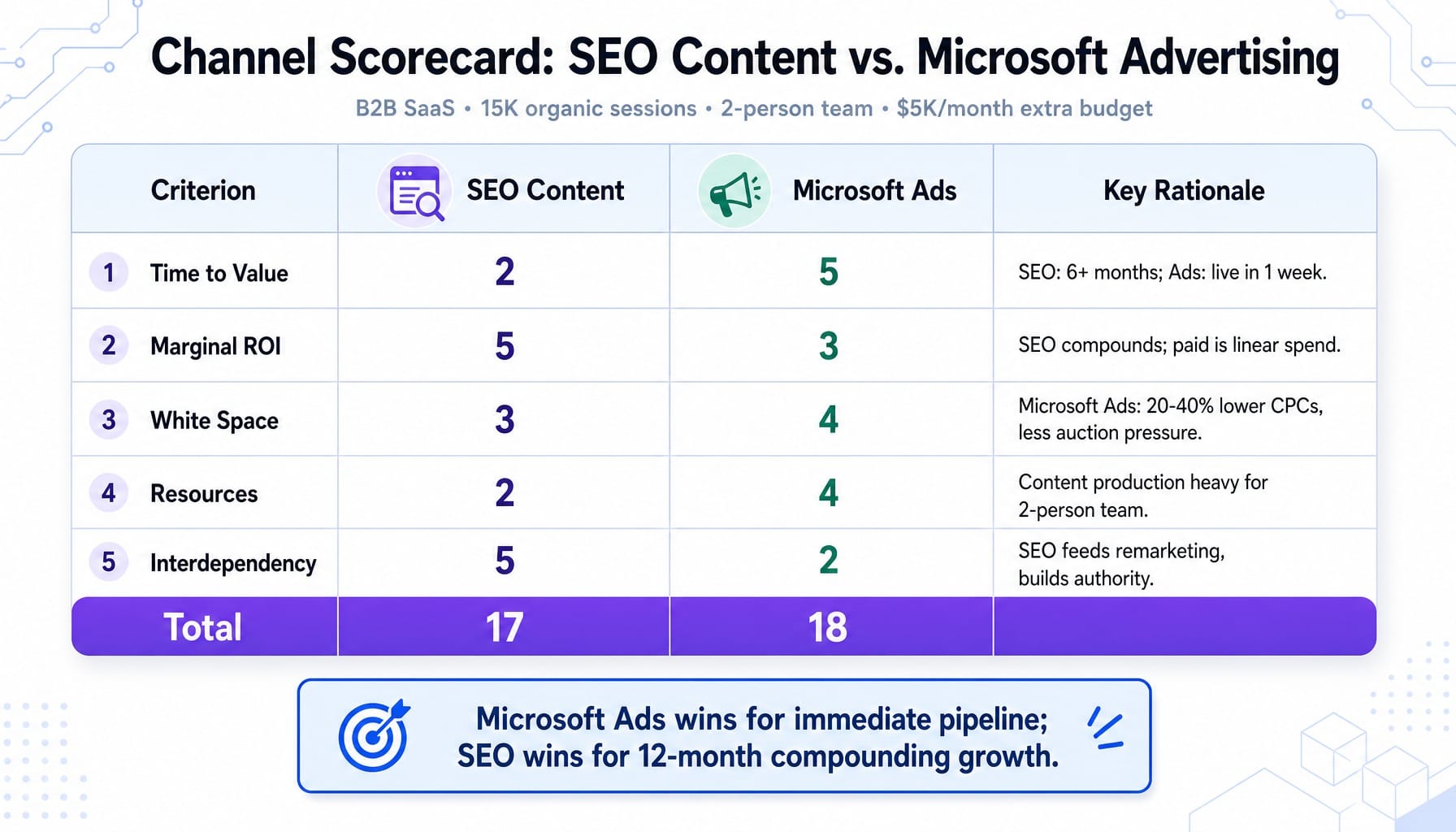
In this scenario, Microsoft Advertising edges out SEO content for the next investment. Why? It offers faster pipeline impact with a lower resource strain on the small team. The scoring reveals the tradeoff: if the team needs pipeline this quarter to hit a goal, Microsoft Ads is the right move. If they are building for compounding growth over 12 months and have a plan to manage content production, SEO is the better long-term bet. The framework doesn't give one "right" answer; it clarifies the strategic choice.
Channel Interdependencies Most Prioritization Models Miss
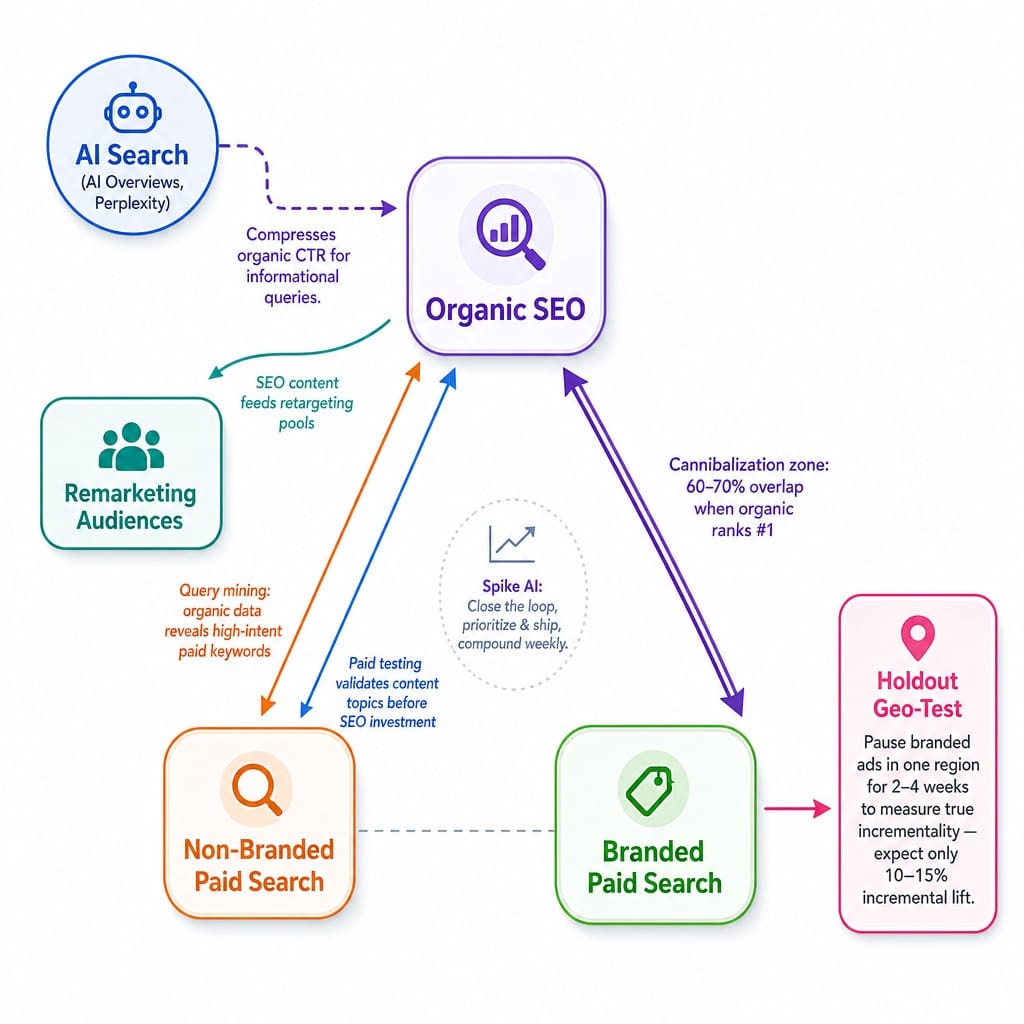
Evaluating search channels in isolation produces misleading priorities because organic search, paid search, and branded search interact in ways that change each channel's true incremental value. Most frameworks treat SEO and PPC as independent line items on a spreadsheet. In reality, they share the same SERP real estate, compete for the same clicks, and generate data that feeds each other.
The failure to map these interdependencies is why teams over-invest in channels that are cannibalizing each other and under-invest in channels that would amplify the entire portfolio. The most reliable way to measure this is through incrementality testing, often via holdout geo-tests, which isolates the true lift from a specific channel rather than relying on flawed attribution models.
How Organic and Paid Search Cannibalize and Amplify Each Other
Organic and paid search are not purely additive. When you rank organically in position #1 for a non-branded keyword and also run a paid ad above it, the combined click-through rate is not the simple sum of both. There is significant overlap and potential cannibalization.
The only way to know the true, incremental value of your paid spend is to run a holdout geo-test. Here's the methodology: pause your non-branded paid search campaign in one geographic region (e.g., California) for 2-4 weeks, while letting it run as usual in a control region (e.g., Texas). Then, measure the total conversions (organic + paid) in both regions. The difference reveals the true incremental lift from your paid ads.
Many B2B companies are shocked to find their paid search on core non-branded terms is only 30-40% incremental, meaning 60-70% of those "paid" conversions would have happened through their strong organic listings anyway. The implication for prioritization is clear: if your organic rankings are strong for a keyword cluster, the marginal value of layering paid search on those same keywords drops dramatically. That budget should be redirected to keywords where you have no organic presence.
Why Branded and Non-Branded Search Should Be Separate Channels in Your Stack Rank
Lumping branded and non-branded search together is one of the most common and misleading analytical mistakes. It distorts every metric you use for prioritization.
Branded search is demand capture. The user already knows your name. They have near-100% conversion intent, CPCs are extremely low, and the demand was generated by other marketing activities—content, word of mouth, events, social. It's the final step in a journey that started elsewhere.
Non-branded search is demand creation (or at least, early-stage demand capture). This is where actual growth happens, reaching people who have a problem your software solves but don't yet know your brand exists.
When you blend the two in your reporting, the high ROAS and conversion rate of branded search inflates the overall performance of "Paid Search" as a channel. This makes it look far more efficient for growth than it actually is. You might keep pouring money into "paid search" because the blended ROAS looks great, while in reality, you're just over-investing in branded keyword defense and starving your non-branded acquisition engine.
The fix is simple but non-negotiable: in GA4 or Looker Studio, create separate reports for branded and non-branded search performance. Evaluate them as two distinct channels in your scorecard. Your prioritization will instantly become sharper.
How AI Search Engines Change Channel Prioritization in 2026
AI search engines like Perplexity, ChatGPT Search, and Google AI Overviews represent a new channel tier that most 2024-era prioritization frameworks do not account for. Ignoring them risks misallocating budget toward channels whose click-through rates are actively declining.
AI Overviews are compressing organic CTR, especially for the informational queries where most B2B content marketing strategies have historically concentrated. For some query categories, these answer boxes now appear above all traditional organic results. This is creating what analysts call an "SGE displacement rate"—a measurable reduction in clicks to organic links. While estimates vary, practitioners report organic CTR reductions of 25-40% for affected queries.
This doesn't mean organic SEO is dead. It means the type of content that wins is shifting. As Google itself advises, the focus must be on creating non-commodity content with original data, unique frameworks, and first-hand experience. If your organic strategy is built on ranking for simple definitional "what is" queries, the marginal value of that investment is declining because AI is answering those questions directly. If your strategy is built on ranking for complex comparison, "how to choose," or experience-rich "how we solved X" content, organic remains incredibly powerful.
Meanwhile, platforms like Perplexity are emerging as new, albeit small, referral sources. The content attributes that earn citations in these systems—structured answers, direct statements, cited data—are the same ones that earn featured snippets in traditional search.
For your prioritization scorecard, this means you must adjust the "Marginal ROI Potential" of your organic SEO efforts based on your content focus. Commodity content's ROI is falling; expert, experience-driven content's ROI remains high.
Read more: Data-Driven CRO Strategies: Identifying Marketing Opportunities for True Conversion Optimization
Building a Dynamic Reprioritization Cadence Instead of an Annual Plan
A search channel prioritization plan loses accuracy within 90 days because competitive density, auction dynamics, and algorithm changes shift the marginal ROI of each channel continuously. The biggest mistake teams make is treating prioritization as an annual planning exercise that produces a static document.
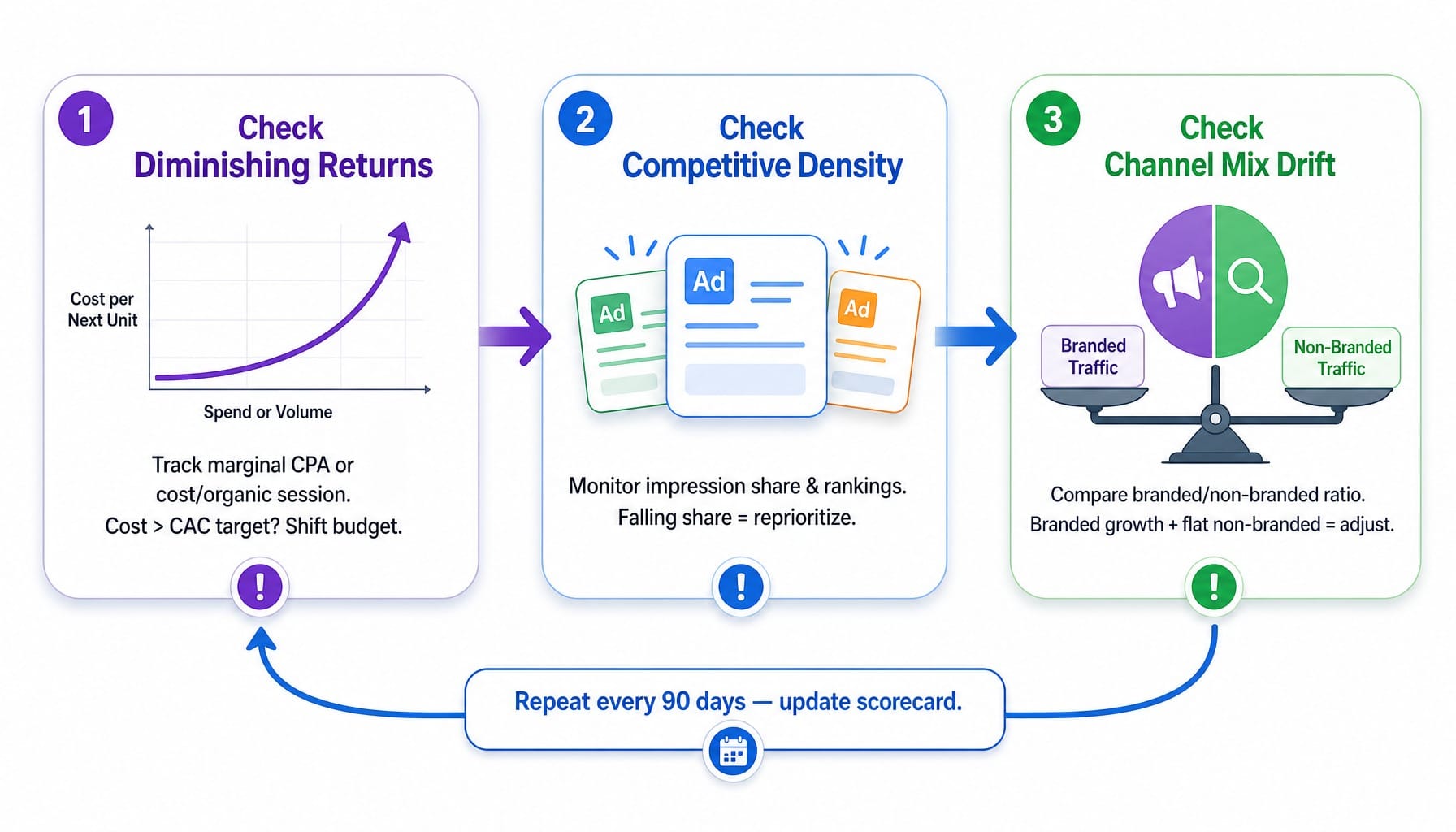
Instead, you need a lightweight reprioritization cadence—a quarterly check against three core signals to see if your channel mix is still optimal.
- Diminishing Returns Signal: Track your marginal CPA (for paid) or marginal cost per incremental organic session (for SEO) over time. When the cost to acquire the next unit of output rises above your blended CAC target, the channel is approaching its saturation point. It's time to consider shifting the budget. A channel that was a top priority in Q1 might be a poor investment by Q3.
- Competitive Density Signal: Monitor your impression share in Google Ads and your ranking position movements in Google Search Console monthly. If your impression share is declining despite stable bids, it means auction pressure is increasing and the channel's economics are worsening. For example, a growth marketer who set their plan in January might discover by April that CPCs in their category have risen 22% due to new competitors. Their original prioritization is now obsolete.
- Channel Mix Drift: Compare the ratio of branded vs. non-branded traffic quarterly. If your branded search traffic is growing while non-branded is flat, your growth engine is stalling, even if the top-line numbers look stable. It's a leading indicator that your demand creation efforts are losing steam.
Let's be honest: this kind of continuous monitoring is exactly what lean teams struggle to maintain. It requires cross-channel visibility and consistent analytical bandwidth that most 1-5 person marketing teams simply don't have.
What Happens When Prioritization Runs Continuously Without Adding Headcount
You now have the framework. You know the criteria, the interdependencies, and the cadence required to make sharp, data-informed decisions about your search marketing investments. The question is whether your team has the bandwidth to run this process every quarter while also shipping the SEO content, managing the paid campaigns, and optimizing the landing pages.
That operational gap is the problem Spike AI was built to solve.
Spike AI functions as a marketing execution engine that runs this prioritization logic continuously. It monitors performance across your SEO, paid search, and website conversion funnels, identifies where marginal returns are shifting, and surfaces the highest-impact move to make next. It closes the loop between prioritization intelligence and hands-on execution. You don't need to hire an analyst to run the scorecard or an agency to act on the findings. The system handles both, ensuring your team is always focused on the work that matters most.
See how Spike AI identifies and ships your highest-impact search marketing moves every week.
From Static Plan to Dynamic System
The most critical shift in thinking is this: search channel prioritization is not a planning exercise that produces a document. It is a continuous system that evaluates marginal returns, maps channel interdependencies, and adapts as market conditions change.
Most teams default to gut feel or flawed attribution models, which leads to diluted effort and stalled growth. The scorecard framework—evaluating time to value, marginal ROI, competitive white space, resources, and interdependency—provides a repeatable system for making smarter bets. But this framework only creates value if it runs continuously, adapting to new data from AI search displacement, auction pressure, and your own performance curves.
That requires either dedicated analytical bandwidth or a system that automates the process for you. The teams that win in 2026 won't be the ones who picked the "right" channel once. They will be the ones who built a system to reprioritize fastest as the entire search landscape shifted around them.
Frequently Asked Questions
How do I decide between investing in SEO or PPC first when the budget is under $10K per month?
If you need a pipeline within 60 days, paid search offers faster time to value. However, this assumes your landing pages convert above 2%. If your conversion rate is below that, invest in website optimization first; otherwise, you'll just burn the budget. If you can tolerate a 6-month horizon, SEO content targeting commercial-intent keywords will compound in ways paid spend never can, offering better long-term ROI.
Should I prioritize Google Ads or Microsoft Advertising for B2B growth?
Microsoft Advertising often has 20-40% lower CPCs than Google Ads for B2B keywords due to thinner auction competition, and its audience skews toward desktop-heavy professional users. A smart approach is to start with Google Ads to validate messaging and conversion rates at scale, then expand to Microsoft Advertising to capture incremental volume at a more efficient CPA. They serve different points on the diminishing returns curve.
How do I present a search channel prioritization plan to leadership when I have limited performance data?
Frame the conversation around opportunity and risk using competitive data. Use tools like Semrush or Ahrefs to create SERP real estate maps showing where competitors are visible and where white space exists. Pair this with estimated CPCs from Google's Keyword Planner to model cost-per-lead scenarios. This shifts the focus from your past performance to the market opportunity and the cost of inaction (letting competitors capture demand).
Should YouTube search be treated as a separate channel in my prioritization model?
Yes, especially if your product requires visual demonstration or explanation. As the second-largest search engine, YouTube is a key research tool for B2B buyers. However, video has significantly higher resource requirements than text content. Score it separately in your framework, and only prioritize it if you have the production capacity or can effectively repurpose existing assets like webinar recordings into search-optimized videos.
How do I account for branded search cannibalization when evaluating paid search ROI?
The best method is a holdout geo-test. Pause your branded paid search campaigns in one state or country for 2-4 weeks while keeping them active elsewhere. Compare the total conversions (organic + paid) in both regions. If the test region shows less than a 10-15% drop in total conversions, your branded paid spend is mostly cannibalizing organic clicks and that budget should be reallocated to non-branded campaigns.