
How to Prioritize Marketing Channels With a Limited Budget And Resources: A Framework for Lean Teams

TLDR
- Stop funding channels below their "minimum viable spend threshold"—the floor required to get statistically significant data. Underfunded tests are the #1 reason channel strategies fail.
- Use a five-point scorecard to rank channels: Audience-Channel Fit, Time-to-Impact, Minimum Viable Spend, Scalability Ceiling, and Internal Capability Match.
- Prioritize "compounding" channels (SEO, content) that build assets over "linear" channels (paid ads) that stop when you stop paying, but only if your business can survive a 4-6 month ramp-up.
- Create a "kill criteria" checklist for underperforming channels. Cut any channel that fails three of four tests for conversion volume, cost-per-acquisition, marginal returns, or team time investment.
- Treat team bandwidth as a budget item. A channel strategy is only as good as your team's capacity to ship the work consistently.
Prioritizing marketing channels with a limited budget requires concentrating spend above each channel's minimum viable threshold rather than distributing it evenly. Most lean teams underperform not because they chose the wrong channel, but because they never funded any channel enough to learn whether it works.
Consider a common scenario: a three-person B2B SaaS marketing team splits an $8,000 monthly budget across Google Ads, LinkedIn, content, and email. Each channel gets a small slice, and each produces mediocre results. The instinct is to ask, "Which channel should we cut?" But that's the wrong question. At $2,000 a month, most of those channels were below the learning floor, guaranteeing inconclusive data from the start.
This guide provides a practical framework for scoring channels, setting spend floors, and making structured cut-or-scale decisions. It's designed to replace gut-feel with a system for allocating limited resources where they can actually compound.
Why Most Channel Tests Fail: The Minimum Viable Spend Problem
Every marketing channel has a minimum viable spend threshold—the floor below which you cannot generate enough data to evaluate performance. Falling below this floor doesn't just mean slower results; it means you get no meaningful results at all, wasting both time and money.
Let's make this concrete. A team runs LinkedIn Ads at $1,500/month. With a B2B cost-per-click of around $7, that buys roughly 214 clicks, or about 7 per day. At a 2% landing page conversion rate, that's 4 leads for the entire month. Is the channel a failure? Or was the test doomed from the start? With only four data points, it's impossible to know. You haven't learned anything.
A good rule of thumb for paid channels is to budget enough to generate at least 50-100 conversions within your test window. This isn't arbitrary. Platforms like Google Ads explicitly state their Smart Bidding algorithms need around 50 conversions in a 7-day period to exit the initial "learning phase" and begin optimizing effectively. If your budget can't generate that volume, the algorithm never gets smart.
This concept applies differently to organic channels. For SEO or community, the "spend" is primarily time. The minimum viable investment isn't a dollar amount but a cadence—like publishing two well-researched articles per week or engaging in five relevant community threads daily. Anything less, and you're not giving the channel enough signal to work.
A Channel Prioritization Scorecard You Can Use This Week
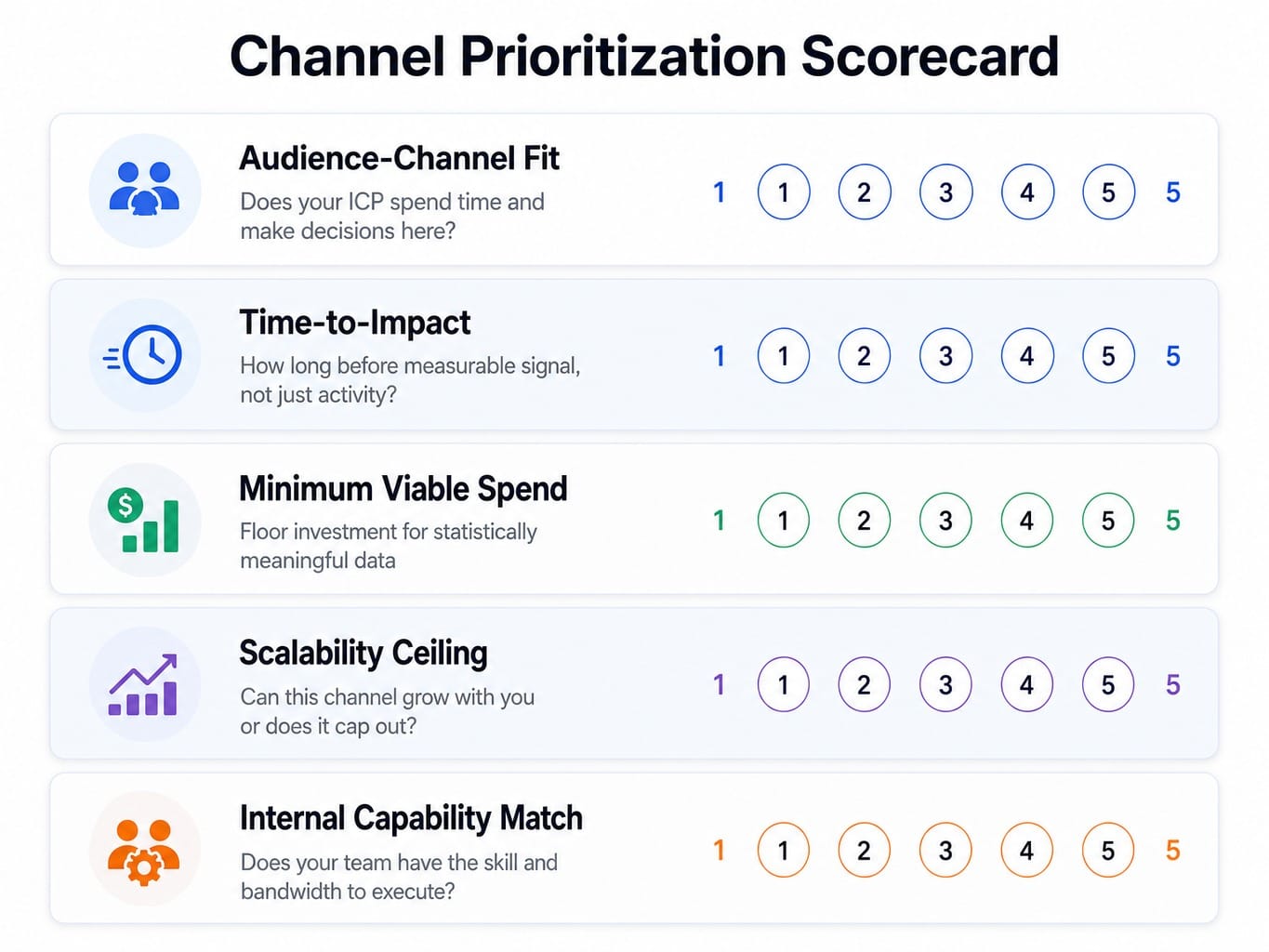
A channel prioritization scorecard ranks each candidate channel across five criteria—audience-channel fit, time-to-impact, minimum viable spend, scalability ceiling, and internal capability match—to produce a weighted score that replaces gut-feel decisions with structured comparison.
Most teams default to channels they know or trends they hear about ("We have to be on TikTok!"), not the channels with the highest strategic fit. You might have heard of the Bullseye Framework from Traction, which is great for brainstorming. But for budget-constrained teams, it's insufficient because it ignores the two most critical constraints: spend floors and team bandwidth. This five-criteria scorecard is a practical upgrade.
The Five Scoring Criteria Explained
Use a simple 1-5 scale for each criterion in a spreadsheet or a Notion table. The goal is structured thinking, not a PhD thesis.
- Audience-Channel Fit: Does your ideal customer profile (ICP) actually spend time and make decisions here? A high score means your audience is active and receptive on this channel.
- Time-to-Impact: How long before this channel produces a measurable signal, not just activity? Paid search can show results in two weeks; SEO might take six months. Be honest about your cash flow needs.
- Minimum Viable Spend: What is the floor investment (in dollars or hours) needed to get statistically meaningful data? A channel that requires a $10k/month minimum spend scores a 1 if your total budget is $8k.
- Scalability Ceiling: Can this channel grow with you, or does it cap out quickly? An email list has a hard ceiling; Google Search has a much higher one, but you'll eventually hit a channel saturation curve.
- Internal Capability Match: Does your team have the skill and bandwidth to execute this channel well? If you don't have a strong writer, a content-heavy channel will fail regardless of its potential.
Worked Example: Scoring Three Channels for a $6K/Month B2B Team
Imagine a 2-person B2B SaaS marketing team with a $6,000 monthly budget. Let's score three potential channels on a 1-5 scale.
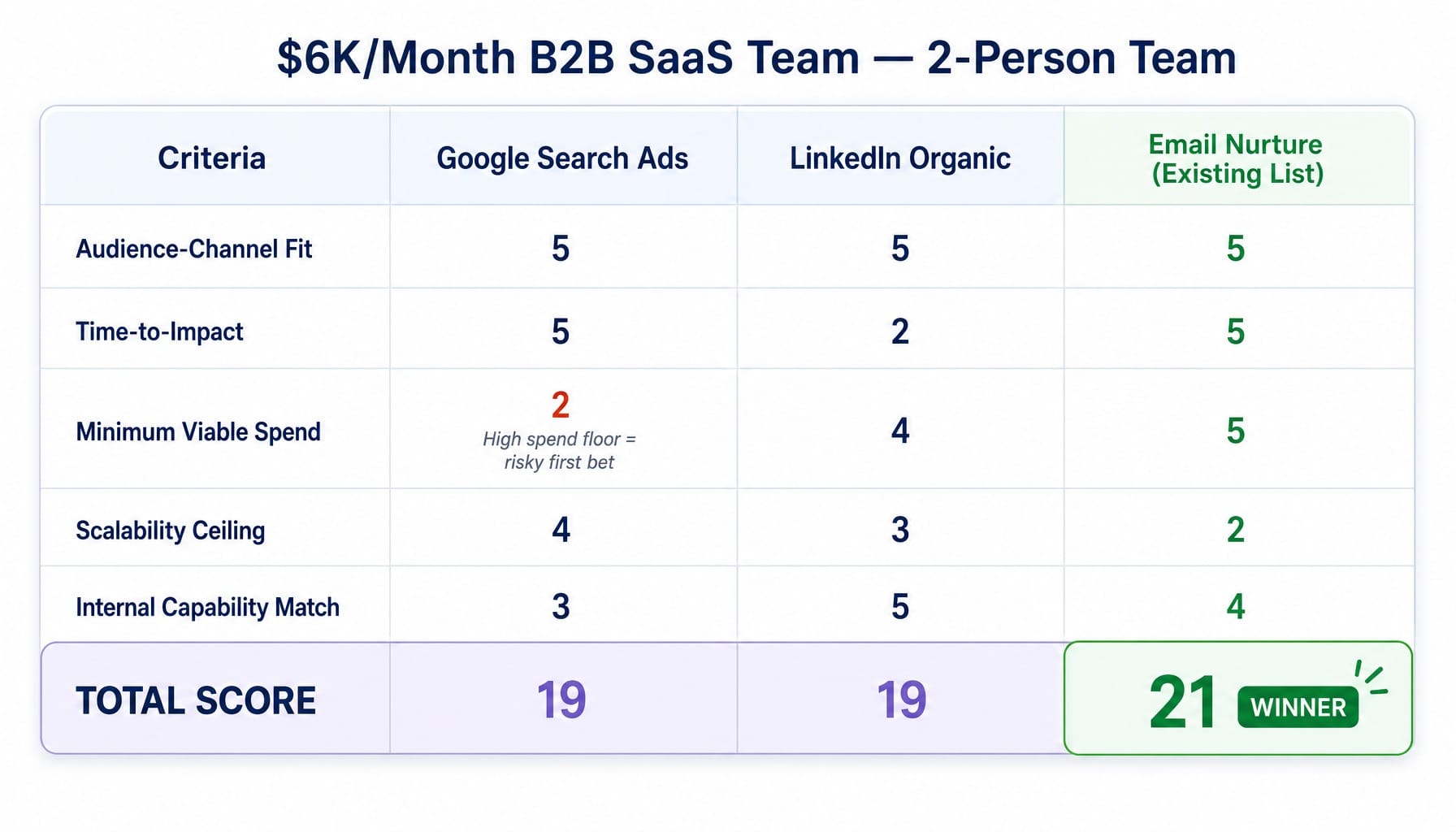
The scorecard reveals that while Google Ads looks good on paper, its high minimum viable spend for competitive B2B keywords makes it a risky first bet. Email nurture is the clear winner for immediate impact. LinkedIn organic ties with Google Ads on score, but its lower dollar cost and strong capability match make it a better secondary focus. This contradicts the common instinct to start with paid ads, demonstrating how the framework forces a more strategic allocation.
Compounding Channels vs. Linear Channels: Where Limited Budgets Win
Compounding marketing channels—like SEO, content, and community—build assets that generate returns long after the initial investment. Linear channels, like paid search and social ads, produce results only as long as you keep spending. This distinction is the single most important strategic lens for budget-constrained teams.
A blog post you write today can generate leads for three years, its LTV:CAC ratio improving over time as the marginal cost of each new lead approaches zero. A Google Ad you pay for today is gone tomorrow. This gives compounding channels an asymmetric advantage for teams with more time than money.
However, there's a critical tradeoff: compounding channels have a much longer time-to-impact. This creates a cash flow tension for teams that need pipeline now. The strategic choice isn't about which is "better," but which aligns with your business's financial runway.
When to Start With a Linear Channel Anyway
Compounding channels are not always the right first move. If your business has four months of runway and needs pipeline within 30 days to survive, starting with a linear, demand-capture channel like paid search is the only rational choice. The decision rule is simple:
- If your business can survive 4-6 months without channel-driven revenue, invest in compounding channels first.
- If you need revenue within 60 days, start with a high-intent linear channel (like paid search for bottom-of-funnel keywords) and layer in a compounding channel in parallel.
This isn't an excuse to chase short-term wins forever. It's a pragmatic approach to stay in business long enough for the compounding strategy to take root.
The Budget Split That Balances Both
For teams with a limited budget, a disciplined allocation model is crucial. A proven approach is:
- 60-70% to your single highest-scoring channel from the scorecard.
- 20-30% to a secondary, compounding channel to build a long-term asset.
- 10% maximum for experimental testing of one new channel.
This model avoids the common mistake of spreading budget too thin. But there's a critical caveat: this only works if the 60-70% allocation is above your primary channel's minimum viable spend threshold. If 70% of your budget still leaves you under the floor for your top channel, you must consolidate further—even to a 90/10 split. Discipline here is non-negotiable.
When to Kill a Channel: A Structured Decision Framework
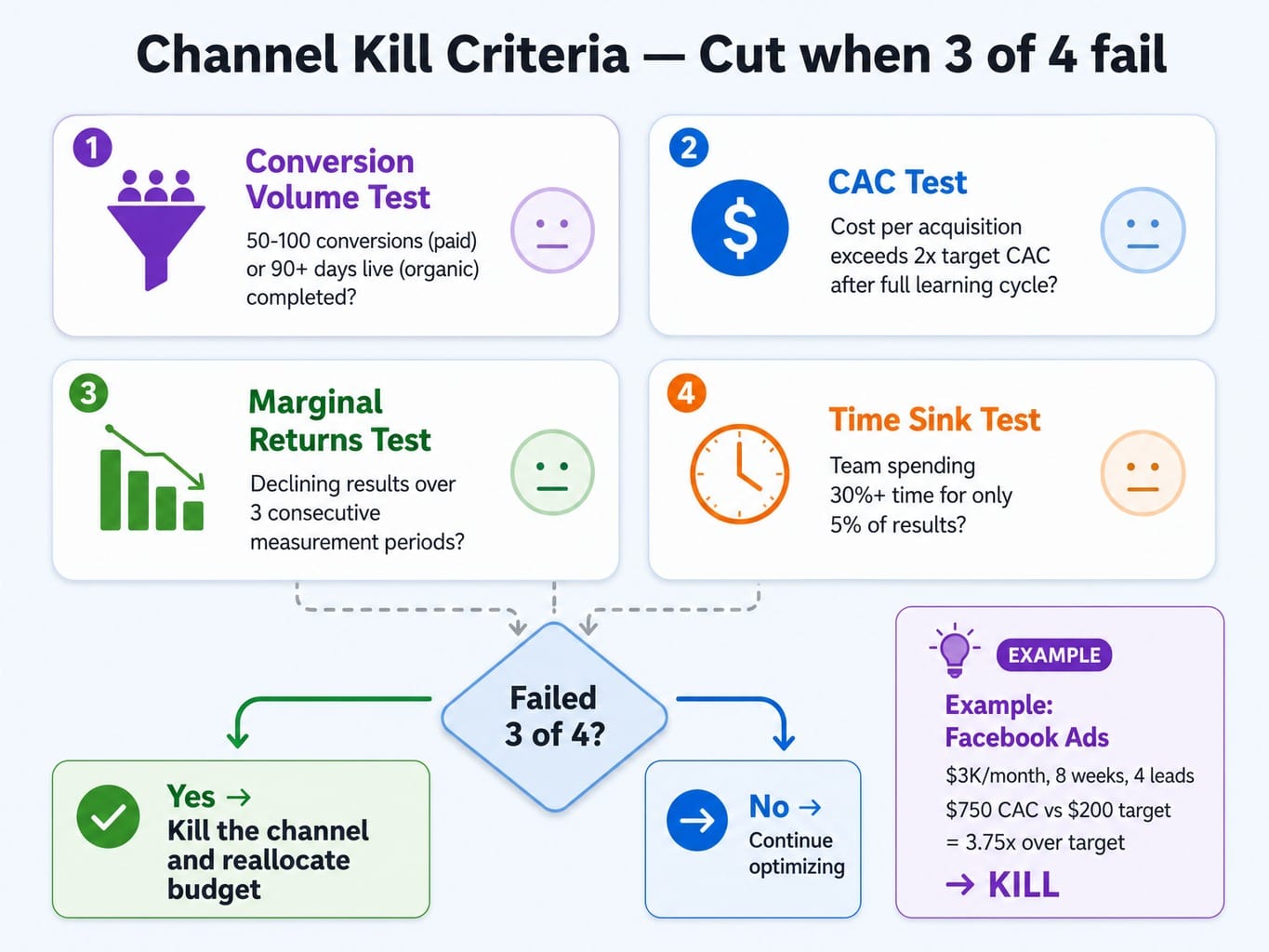
Cut a marketing channel when it fails three of four kill criteria: insufficient conversion volume after a full learning cycle, cost per acquisition exceeding 2x your target CAC, declining marginal returns, or disproportionate team time investment.
Teams hold onto underperforming channels for too long due to sunk cost bias. A structured framework replaces emotion with data. Applying data-driven CRO strategies to your channel evaluation ensures you're making decisions based on actual conversion performance rather than assumptions.
- Insufficient Conversions: Has the channel generated at least 50-100 conversions (for paid) or been live for 90+ days (for organic)? If not, the test isn't complete.
- CAC Exceeds 2x Target: Is your cost per acquisition more than double your goal after a full learning cycle? A little over target is room for optimization; 2x or more is a kill signal.
- Declining Marginal Returns: Are you spending more to get the same or fewer results over three consecutive measurement periods (e.g., month-over-month)? This indicates channel saturation.
- Time Sink: Is the team spending 30% of its time on a channel that's only producing 5% of the results? The opportunity cost is too high.
Consider a team running Facebook Ads with a $3,000/month spend. After 8 weeks, they've generated 4 leads at a $750 CAC against a $200 target. The channel isn't "not working yet"—it's 3.75x over target with enough data to make the call. Killing the channel isn't admitting failure; it's a strategic decision to reallocate that $3,000 to a channel with a higher probability of success.
Read more: Landing Page Conversion Rate Optimization: A Revenue-Weighted Playbook | Spike AI
Budget Is Only Half the Constraint: Prioritizing Around Team Bandwidth
Budget allocation models assume you have the team capacity to execute on every channel you fund. Most lean marketing teams don't. Time is the hidden budget, and it's often more constrained than cash.
A two-person team trying to run Google Ads, write weekly blog content, manage email nurture, and optimize landing pages isn't operating four channels; they are operating none of them well.
This goes back to the scorecard. Even if a channel scores highest on every other criterion, if your team lacks the bandwidth to execute it consistently, the channel will underperform. You'll then draw the wrong conclusion that "the channel doesn't work," when in reality, your execution cadence was too slow for it to ever gain momentum.
Imagine a solo marketer who correctly identifies SEO as their highest-leverage channel. But they can only publish one blog post per month and never get around to technical fixes. The strategy is right, but the execution bandwidth makes it functionally wrong. The real constraint isn't the channel plan; it's the latency between knowing what to do and actually shipping it. Teams that unify marketing goals with task execution close this gap far more effectively than those managing strategy and delivery in separate systems.
How Spike AI Closes the Gap Between Channel Strategy and Shipped Execution
The tension is now clear: you can have the perfect channel prioritization, but if you lack the bandwidth to ship the work—the SEO fixes, the landing page variants, the content cadence—the strategy stalls. This is the execution gap that most lean teams live in, and it's the problem Spike AI is built to solve.
Spike AI acts as the execution layer that turns a prioritized channel strategy into weekly shipped improvements. The solo marketer who correctly identified SEO as their top priority but could only ship one post per month? With Spike AI identifying the highest-impact move each week—whether it's a technical fix, a new piece of content, or a CRO test—and then deploying it, that same marketer can achieve a consistent shipping cadence. Each weekly release compounds on the last, finally allowing the compounding channel strategy to work as intended, without requiring additional headcount.
See how Spike AI turns your channel strategy into weekly shipped results — book a discovery call.
Conclusion
Effective channel prioritization with a limited budget isn't about finding a secret, high-ROI channel. It's a game of discipline. It's about having the courage to fund one channel properly instead of four channels poorly.
The winning formula is to score your channels honestly, concentrate your spend above minimum viable thresholds, and treat your team's bandwidth as the precious resource it is. The teams that win on constrained budgets aren't the ones who get lucky. They're the ones who go deep, execute with a relentless weekly cadence, and have the discipline to cut what isn't working. That focus is what turns a limited budget into a formidable growth engine.
Frequently Asked Questions
What marketing channels work best for B2B companies spending under $5K per month?
At under $5K/month, most paid channels fall below their minimum viable spend threshold for B2B. Prioritize email nurture to your existing list (near-zero cost, high conversion), LinkedIn organic content (high B2B audience fit, time-intensive), and SEO content targeting long-tail keywords with commercial intent. Only add paid search if you can allocate at least $3K/month to a single, tightly-scoped campaign.
How long should I test a marketing channel before deciding it doesn't work?
For paid channels, run the test until you've accumulated at least 50-100 conversions, which can take 6-10 weeks at modest budgets. For organic channels like SEO or content, allow a minimum of 90 days of consistent execution before evaluating performance. Ending a test early because results "look bad" simply wastes the spend you've already invested in learning.
Should I focus on one marketing channel or spread the budget across several?
Focus on one primary channel until it's performing above your target CAC and you've exhausted its immediate scaling headroom. Spreading budget across multiple channels before any single one is proven almost always produces inconclusive data from all of them. Add a second channel only when your primary channel is stable and you can fund the new channel above its minimum viable spend.
How do I account for organic and word-of-mouth when allocating paid budget?
Track your blended CAC (total marketing spend ÷ total new customers) alongside channel-specific CAC. If blended CAC is healthy but no individual paid channel hits its target, organic and word-of-mouth are doing the heavy lifting. In that case, invest paid budget to amplify that momentum—like retargeting blog visitors or promoting top organic content—rather than building a standalone paid engine from scratch.
How do I measure the halo effect of brand channels on performance channels?
Run a holdout test: pause brand activity (e.g., LinkedIn organic) for a defined period and measure if performance channel metrics (paid search CTR, direct traffic) decline. If they do, the brand channel has a measurable halo effect. More advanced teams can use Marketing Mix Modeling (MMM) tools like Google's open-source Meridian to model these cross-channel interactions without pausing activity.
How should AI tools change my channel prioritization approach in 2026?
AI tools dramatically reduce the execution cost of content-heavy channels like SEO and email, effectively lowering their minimum viable spend threshold. This means compounding channels that previously required a full-time specialist can now be operated by a lean team. Re-evaluate your scorecard: channels that scored low on "internal capability match" may now score higher if AI tools close the skill or bandwidth gap.