Should You Buy Jasper AI? The Cost, Limitations, and When It Actually Pays Off in 2026

TL;DR
- Jasper's value is no longer in AI writing quality (which is commoditized) but in its content operations layer: brand voice governance, workflow templates, and team collaboration.
- For B2B teams with 3+ contributors and high content volume (20-40+ assets/month), Jasper's Pro plan can justify its cost by improving brand consistency and reducing prompt engineering overhead.
- For solo marketers or small teams with low content velocity, Jasper is likely not worth it. A custom GPT in ChatGPT Plus with a well-maintained brand document achieves similar results for a third of the price.
- Jasper struggles with long-form, expert-driven content. If your primary need is thought leadership, you'll spend more time editing its generic output than writing from scratch.
- The real bottleneck for most marketing teams is not content generation but content execution. Tools like Jasper help you write faster, but don't solve the problem of shipping, testing, and deploying that content.
The question "is Jasper AI worth it" has fundamentally changed. When Jasper launched, it offered structured access to powerful AI that was otherwise inaccessible to most marketers. The value was obvious. Today, ChatGPT Plus costs $20/month, Claude offers a generous free tier, and nearly every marketing platform has embedded AI features. The underlying capability is a commodity.
So the question is no longer about access. It's about whether a tool costing $69 or more per seat, per month, justifies its price when the core technology is available for a fraction of the cost.
This is where most evaluations go wrong. They compare Jasper's output quality to ChatGPT's, missing the point entirely. Jasper's value proposition in 2026 is not about writing quality; it's about whether your team needs a content operations governance layer.
You're not just comparing AI writers. You're comparing Jasper to your team's ad-hoc combination of ChatGPT, shared Google Docs with brand guidelines, and a collection of saved prompts that live inside one person's head. This article provides a framework for making that decision, based on your team's specific operational profile.
What Jasper Actually Is in 2026 (And What It Isn't)
Jasper is a content operations platform that wraps large language models (LLMs) like GPT-4o and Claude inside a structured workflow layer. This layer includes brand voice training, a centralized knowledge base, reusable templates, campaign briefs, and team-based permissions.
It is not competing with ChatGPT on raw writing ability. It's competing with your entire manual content workflow.
The most common criticism leveled against Jasper is that it's just an "LLM wrapper." This is technically true but misses the point. Salesforce is a "database wrapper," but no serious company builds its own CRM from scratch. The relevant question isn't whether the underlying model is available elsewhere; it's whether the wrapper solves a real operational problem that justifies its cost.
With a Creator plan around $49/month and the Pro plan at $69/seat/month, Jasper is significantly more expensive than ChatGPT Plus or Claude Pro (both ~$20/month). The entire "is Jasper worth it" debate hinges on whether its operational layer delivers enough value to cover that cost delta. Evaluating Jasper on output quality alone is like test-driving a transport truck based on how comfortably it parks in a compact space—you're judging it on the wrong criteria. The real evaluation centers on whether the governance system justifies the per-seat investment.
Where Jasper Delivers Genuine Value
For certain teams, Jasper's operational layer solves two specific, costly problems far more effectively than a patchwork of raw LLM access and Google Docs. Its value is conditional, tied directly to your team's scale, content velocity, and brand requirements.
Brand Voice Consistency Across Contributors and Channels
Consider a typical four-person B2B SaaS marketing team. They produce blog posts, email sequences, LinkedIn ads, and landing pages. Each person uses ChatGPT, but the output is tonally inconsistent. The blog sounds academic, the emails are overly casual, and the ad copy is generic. The brand voice drifts with every new asset, freelancer, or campaign.
This is where Jasper's brand voice and knowledge base features create real value. By training Jasper on your style guides, best-performing content, and product documentation, you create a persistent governance layer. Every team member, regardless of their personal prompting skill, generates content through this centralized "brand brain."
The result isn't necessarily "better" writing in a creative sense. It's consistent writing at scale. It reduces the editorial overhead of manually correcting tone and ensures that a prospect's experience with your brand feels coherent from a LinkedIn ad to a sales follow-up email. For teams with two or more contributors, this consistency is where Jasper starts to earn its per-seat cost.
Workflow Templatization That Reduces Prompt Engineering Overhead
The hidden cost of using raw LLMs is prompt engineering overhead. An effective marketing manager using ChatGPT has developed complex mental models for how to get the right output—what context to provide, what constraints to set, what format to request. That knowledge is tribal, living in one person's head or a messy, unmaintained document. When that person is on vacation or leaves the company, the team's AI capability degrades significantly.
Jasper's template library and Campaign feature externalize this knowledge into a reusable, scalable system.
Imagine a product launch. Instead of each team member crafting prompts from scratch for the launch email, blog post, and social copy, a single campaign brief in Jasper can generate all of these coordinated assets from one source of truth. This isn't about convenience; it's about reducing the "bus factor" on your AI-assisted content production and standardizing your content ops stack. It turns a highly variable, individual skill into a repeatable, team-wide process.
Where Jasper Falls Short—And When to Walk Away
Honest evaluation requires acknowledging a tool's structural limitations. Jasper has two fundamental issues that make it the wrong choice for certain teams and use cases. Recognizing them is key to avoiding a wasted budget.
The Long-Form Content Quality Ceiling
Many writers who test Jasper for long-form blog posts conclude they could have written a better version faster than editing Jasper's output. This is a common and valid experience. Jasper's architecture excels at structured, short-to-medium-form content: ad copy, email subject lines, social media posts, and product descriptions.
For long-form thought leadership, technical tutorials, or any content requiring deep subject matter expertise, it produces competent but generic prose. The output often feels like a well-structured summary of existing information rather than a piece with a unique perspective or novel insight. The core issue is architectural: LLMs generate plausible text based on patterns; they don't perform expert analysis. Jasper's brand voice and templates improve consistency but cannot inject domain expertise that isn't already documented in its knowledge base.
If your primary content need is deeply technical articles or strategic thought leadership, Jasper will not meaningfully reduce your production time. It may even increase it due to heavy editing requirements.
Read more: Jasper vs. Copy.ai: A Practitioner's Breakdown of What Each Tool Actually Delivers in 2026
The Per-Seat Cost Problem at Scale
The math on Jasper's pricing is straightforward, and for many teams, it doesn't add up. The Pro plan costs $69 per seat, per month. For a solo marketer, it's a justifiable experiment. For a five-person marketing team, that's $345 per month, or $4,140 per year. For a ten-person organization, you're looking at $8,280 annually—and that's before considering the custom pricing of the Business plan.
Compared to ChatGPT Team or Claude for Work (both around $25/seat/month), the question becomes stark: does Jasper's governance layer deliver over $44 per seat, per month in additional value?
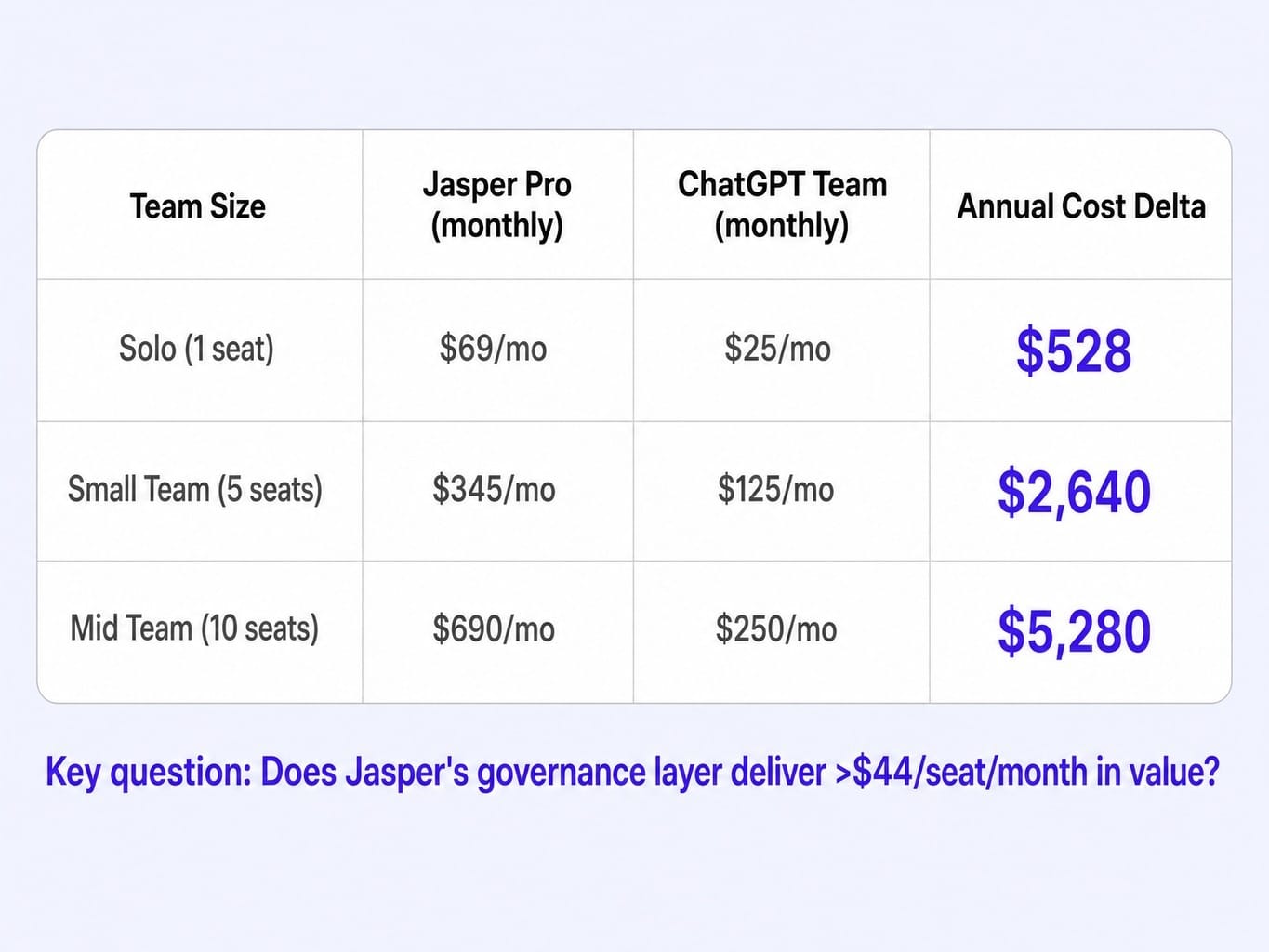
For high-volume content operations in larger teams, the answer can be yes. But for teams producing fewer than 15-20 content assets per month, the math rarely works. A simple way to decide is to calculate your current cost-per-asset and model whether Jasper can reduce it by at least 30% through efficiency gains. If it can't, the subscription isn't justified.
Build vs. Buy: Custom GPTs and Prompt Libraries vs. Paying for Jasper
Technically capable marketing teams are already building their own "Jasper-lite" solutions. They create custom GPTs in ChatGPT, uploading brand guidelines, tone examples, and product documentation as context files. For a solo operator or a tight-knit two-person team, this "build" approach is often sufficient—and it costs $20 a month, not $69 per seat.
A well-executed DIY setup can be surprisingly effective. It involves a custom GPT configured with a system prompt that includes your brand voice, audience personas, and content templates. But this approach has three predictable failure points as a team grows:
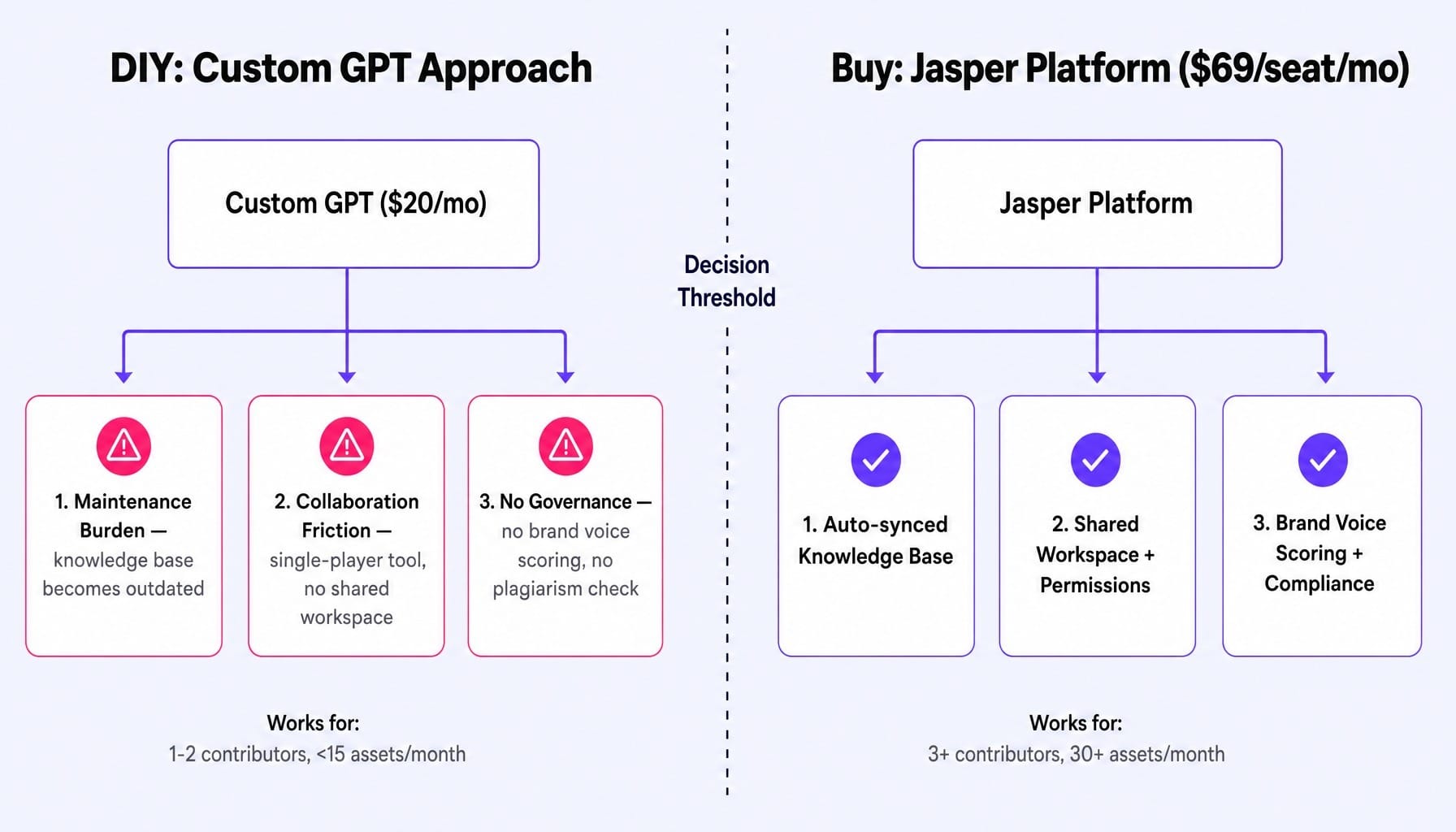
- Maintenance Burden: The custom GPT's knowledge base becomes outdated. As product messaging evolves and brand guidelines are updated, someone must remember to manually update the context documents. Most teams don't, and output quality degrades over time.
- Collaboration Friction: A custom GPT is a single-player tool. There is no shared workspace, no permissioning, and no way to coordinate a campaign across multiple team members. It's a collection of individual workflows, not a team system.
- Lack of Governance: There is no built-in plagiarism checking, no automated brand voice scoring, and no way to monitor output consistency. The quality assurance pass rate is entirely dependent on manual review.
The decision framework follows a maturity curve. If you have 1-2 contributors producing fewer than 15 assets per month, build your own system. If you have 3+ contributors producing over 30 assets per month, the governance and collaboration features of a platform like Jasper (or alternatives like Writer and Copy.ai) become worth the investment.
Read more: 8 Jasper Alternatives Worth Evaluating in 2026 (And What Most Comparisons Miss)
Is Jasper Worth It for B2B Marketing Teams Specifically?
B2B content has unique requirements. Sales cycles are long, meaning brand messaging must be consistent across dozens of touchpoints. Technical accuracy often matters more than creative flair, and maintaining a coherent voice across case studies, whitepapers, and landing pages directly impacts the trust required to build a sales pipeline.
With that in mind, here is a segmented verdict for B2B teams:
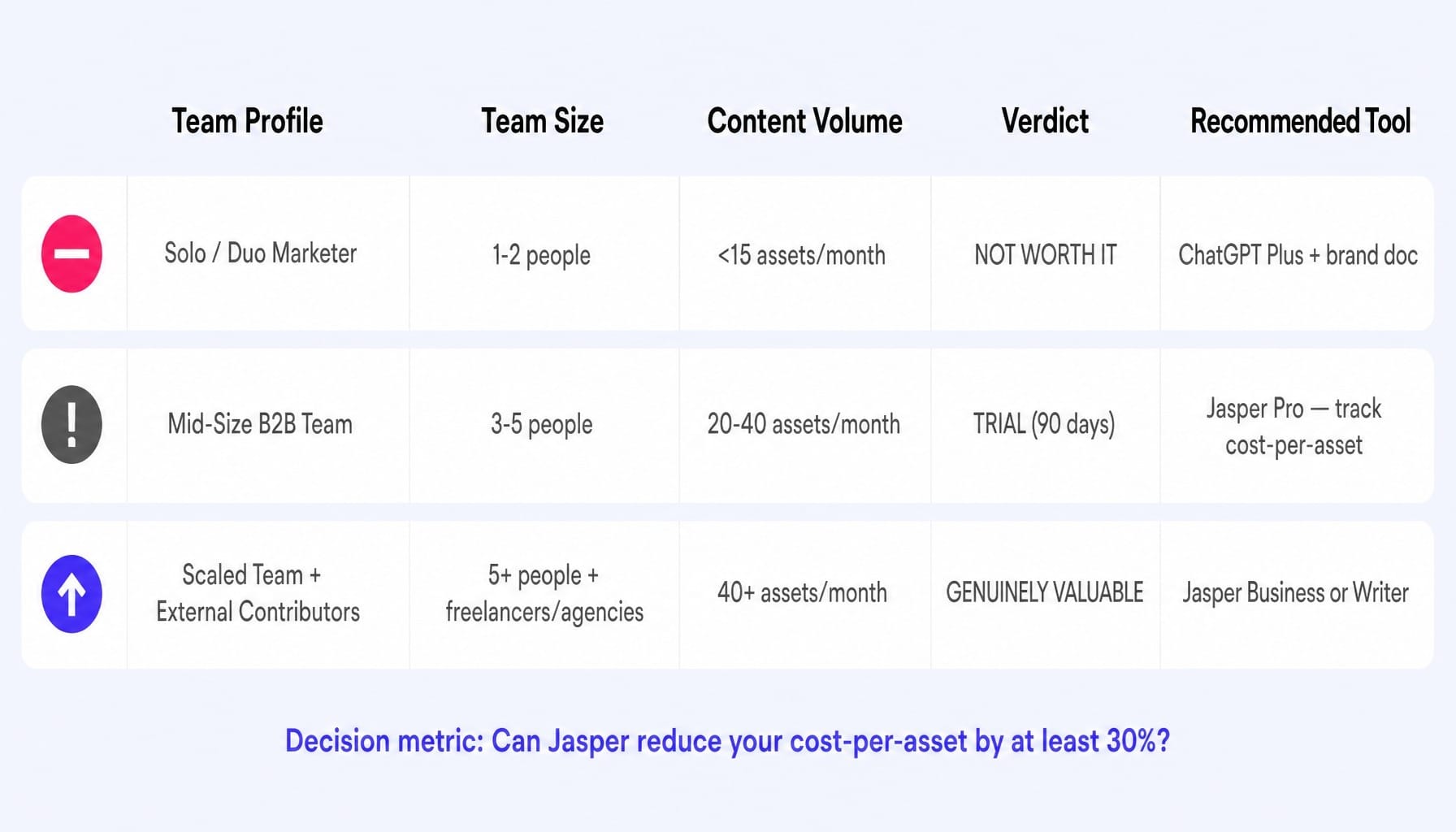
- Profile 1: The Solo Marketer or 2-Person Team (<15 assets/month)
Verdict: Not worth it. The cost is too high for the value provided. ChatGPT Plus or Claude Pro, combined with a disciplined process for using a master brand document, will cover your needs for a third of the price. The overhead of managing a full platform outweighs the benefits.
- Profile 2: The 3-5 Person B2B Marketing Team (20-40 assets/month)
Verdict: Worth a 90-day trial. This is the team profile that sits on the fence. The Pro plan could be a valuable investment if it demonstrably improves brand voice consistency and reduces the time spent on prompt engineering by at least 30%. Track your cost-per-asset and make a data-driven decision. Focus adoption on email sequences and landing page copy, where Jasper's templates provide the most immediate value.
- Profile 3: The 5+ Person Team with Agency/Freelancer Contributors
Verdict: Genuinely valuable. At this scale, the lack of a governance layer is a significant liability. Brand drift across external contributors becomes a real risk. The Business plan from Jasper—or an enterprise-grade platform like Writer—becomes a necessary investment in brand safety and operational efficiency. The value is less about content generation and more about risk mitigation.
When the Problem Isn't Content Generation — It's Content Execution
The entire debate around Jasper presumes the primary bottleneck is content creation speed. But for most lean B2B SaaS marketing teams, this isn't the case. The real problem is the execution gap.
You generate a new landing page variant, but it sits in a backlog for weeks waiting for an engineering ticket. You write five blog posts, but they never get published because the approval process stalls. You have a dozen A/B test ideas, but no system to deploy, measure, and iterate on them.
Jasper helps you write faster. It does not help you ship faster.
This is the gap Spike AI is built to close. Where Jasper is a content generation layer, Spike AI is a marketing execution engine. It doesn't just help you write content; it identifies the highest-impact change across your entire marketing funnel—from SEO and ads to website CRO—and then deploys it. Every week. The cadence itself becomes the growth engine.
For lean teams evaluating AI tools, the question shouldn't just be "Can AI write for me?" It should be "Can AI ship for me?" Because generating content is step one. Getting it live, measured, and compounded is where revenue actually moves.
See how Spike AI turns your marketing backlog into weekly shipped improvements
Conclusion
In 2026, Jasper's value is not in its ability to write—that's a commodity. Its true value lies in providing a content operations governance system for teams at scale.
If your team is large enough, produces a high volume of content, and struggles with brand consistency across multiple contributors, Jasper's per-seat cost can be a worthwhile investment in operational efficiency. For solo operators and small teams, it's an expensive solution to a problem that can be solved with cheaper tools and disciplined processes.
Ultimately, the debate over AI writing tools distracts from the more critical constraint most B2B teams face. The question isn't just about which tool to buy. It's about how you close the gap between generating a marketing asset and shipping it. That is the system that truly limits growth.
Frequently Asked Questions
Does Jasper reduce the need for freelance copywriters?
Jasper can reduce reliance on freelancers for high-volume, templated content like social posts or email sequences. It does not replace them for long-form thought leadership or technical content requiring subject matter expertise. Most teams find it shifts freelancer spend from volume work to higher-value strategic content.
How long does it take to onboard a marketing team onto Jasper?
Basic onboarding takes 1-2 days for users to learn the interface. The real investment is in brand voice training and knowledge base setup, which typically takes 1-2 weeks of iterative refinement to get quality output. Teams that skip this step consistently report disappointing results.
How does Jasper handle compliance and legal review for regulated industries?
Jasper's features can encode compliance guidelines, but it has no built-in legal review functionality. Regulated industries like fintech or healthcare must treat Jasper's output as a first draft that requires full human compliance review, the same standard applied to any AI-generated content.
Can Jasper replace a content strategist or just a content writer?
Jasper replaces neither. It's a tool that accelerates production for writers, but it cannot perform strategic functions like audience research, content gap analysis, or editorial planning. Teams that adopt Jasper expecting strategic guidance will be consistently disappointed.
What happens to my Jasper-trained brand voice and templates if I cancel?
Your trained brand voice models and custom templates are locked into the Jasper platform and cannot be exported. If you cancel your subscription, you lose the entire governance layer you've built. This creates significant switching costs and lock-in risk that should be factored into your evaluation.