
Is SimilarWeb Worth It in 2026? A B2B Practitioner Review

TL;DR
- SimilarWeb is a competitive intelligence platform, not an SEO tool. Buy it for market sizing and category analysis, not for rank tracking or site audits.
- Data accuracy is unreliable for sites under 50,000 monthly visits. Treat traffic estimates for smaller B2B competitors as directional rankings, not absolute figures.
- The price is only justified for two specific B2B workflows: TAM validation for board decks and adding digital behavior signals to sales intelligence stacks.
- The real cost is often 1.5-2x the sticker price after factoring in mandatory annual lock-in, extra seat licenses, and API access fees.
- If your primary need is SEO execution or all your competitors are niche players, Semrush or Ahrefs offer significantly better ROI.
A RevOps manager at a Series B SaaS company signs an annual SimilarWeb contract. For two months, it's the hero of the marketing department, fueling a board presentation with compelling TAM sizing and traffic share charts. For the next ten months, it gathers dust. Meanwhile, a growth marketer at a competitor uses their account daily, monitoring traffic share shifts and referral sources, considering it the most valuable tool in their stack. Who's right?
Both are. The value of SimilarWeb isn't in the tool itself; it's in the alignment between its unique capabilities and your team's daily execution system. After speaking with multiple B2B practitioners—growth marketers, SEO leads, RevOps managers, and agency strategists—a clear pattern emerged. The platform generates either fierce loyalty or expensive regret, with very little in between.
So, is SimilarWeb worth it for your B2B team? This isn't another feature walkthrough. This is a practitioner-grade assessment built from real-world usage. We'll cover what SimilarWeb actually does well, where its data breaks down, the specific B2B use cases that justify the cost, and exactly when you should walk away.
What SimilarWeb Actually Does Well—and What It Doesn't
Most disappointment with SimilarWeb stems from a single misunderstanding: it's a competitive intelligence platform, not an SEO execution suite. One agency strategist we consulted framed it perfectly: "SimilarWeb is the best tool for understanding a market you don't own data in, and a mediocre tool for optimizing a market you do." Buying it to replace Semrush or Ahrefs is the fastest path to buyer's remorse.
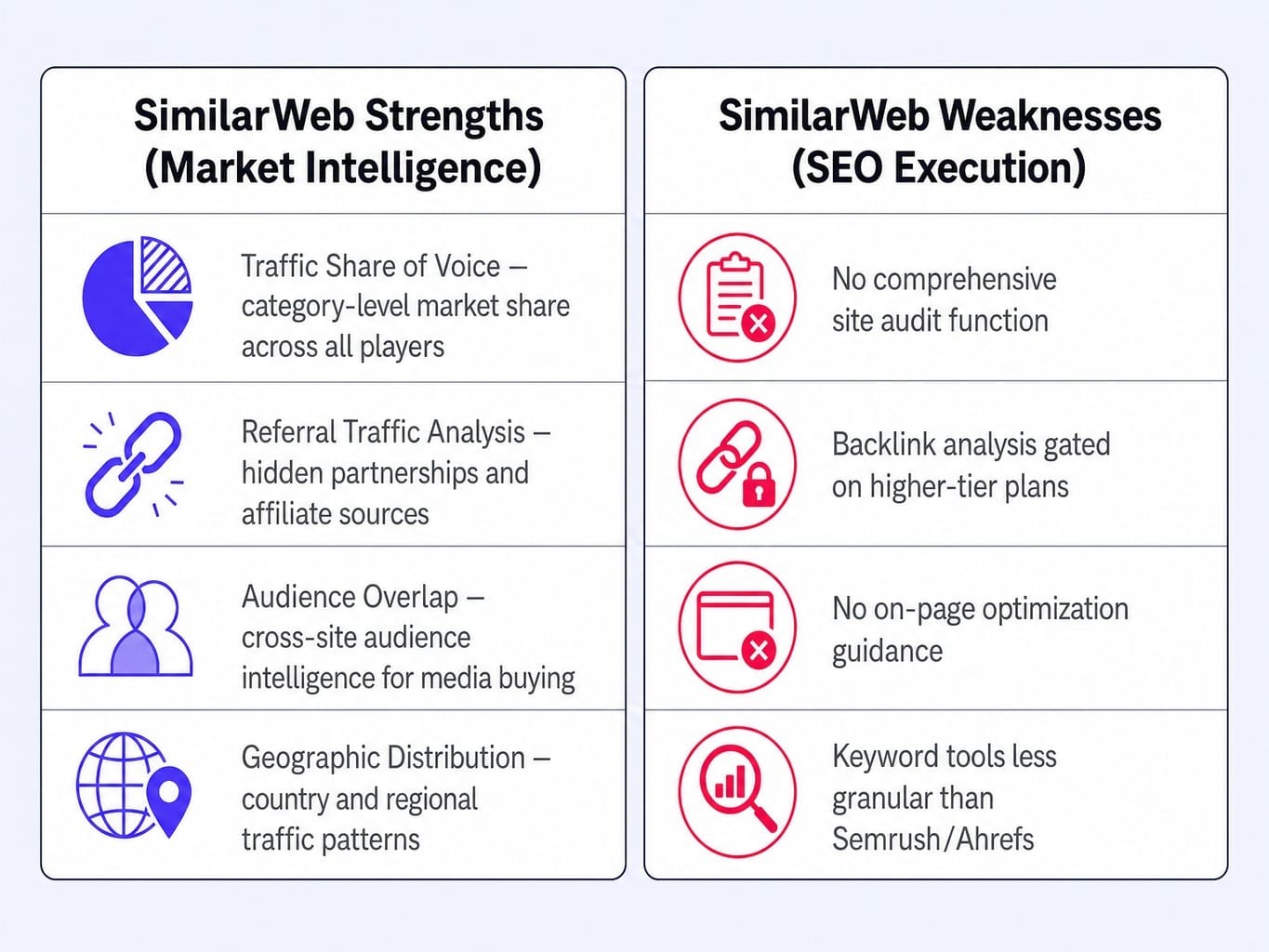
Where SimilarWeb excels is in providing a macro view of a digital landscape. It delivers insights that dedicated SEO tools can't, including:
- Traffic Share of Voice: See your market share of traffic across an entire defined category, not just for a list of keywords.
- Referral Traffic Analysis: Identify where your competitors are getting their traffic from, revealing hidden partnerships and affiliate strategies.
- Audience Overlap: Discover which other sites your competitors' audience visits, which is invaluable for media buying and audience intelligence beyond what a tool like SparkToro might show.
- Geographic Distribution: Understand traffic patterns at a country and even regional level.
This is market intelligence. In contrast, it's weak on SEO execution. It lacks a comprehensive site audit function, robust backlink analysis is gated on higher-tier plans, it offers no on-page optimization guidance, and its keyword tools are less granular than those of its SEO-focused peers. The common complaint that the $199/month plan lacks backlink data isn't a product flaw; it's a signal of its true purpose. For the actual work of SEO, practitioners overwhelmingly stick with Semrush or Ahrefs.
How Accurate Is SimilarWeb Data and When Does It Fail?
SimilarWeb's accuracy is not uniformly good or bad; it degrades predictably based on traffic volume, and understanding this pattern is key to knowing if the data is useful. The consensus among practitioners who have compared its estimates to their own Google Analytics is that the variance can range from a reasonable 30% to an alarming 200%.
One growth marketer shared data from a due diligence process where SimilarWeb estimated a competitor's traffic at 180,000 monthly visits. The actual number, confirmed via first-party analytics, was closer to 95,000. It was directionally correct—the competitor was a significant player—but the absolute number was nearly double the reality. While a SparkToro comparative study found SimilarWeb to be among the most reliable traffic estimators, "most reliable" still means directionally accurate, not precisely so. The data gets far more dependable for sites with over 50,000 monthly visits, a critical threshold for B2B marketers.
The 50K Threshold: Why Niche B2B Sites Get Unreliable Estimates
SimilarWeb's panel-based traffic estimation, which relies on a clickstream panel from browser extensions and ISP partnerships, inherently undersamples low-traffic sites. For B2B SaaS companies in niche verticals where top competitors might only see 15,000 to 30,000 monthly visits, the estimates can be off by more than 100%. This is a fatal flaw if your primary reason for buying is to monitor competitors of this size.
When the sample of users visiting a specific domain is small, the statistical extrapolation required to generate a traffic estimate amplifies any sampling bias. The numbers become, as one practitioner put it, "essentially fiction."
Here's the rule of thumb that emerged from our conversations: If the competitors you care about are below the 50,000 monthly visit mark, treat SimilarWeb's data as a relative ranking of who is bigger, not as an absolute count of their traffic. The distinction between directional accuracy and absolute accuracy is everything.
How SimilarWeb Collects Data and Why the Methodology Matters for Your Decision
SimilarWeb's data model is a blend of four sources: direct measurement from sites that share their analytics, consumer panel data from apps and browser extensions, ISP-level data ingestion, and public web crawling. This blended approach means data quality is asymmetric across the web. If your competitor happens to be a direct measurement partner, their data will be far more accurate. You have no way of knowing who is and who isn't.
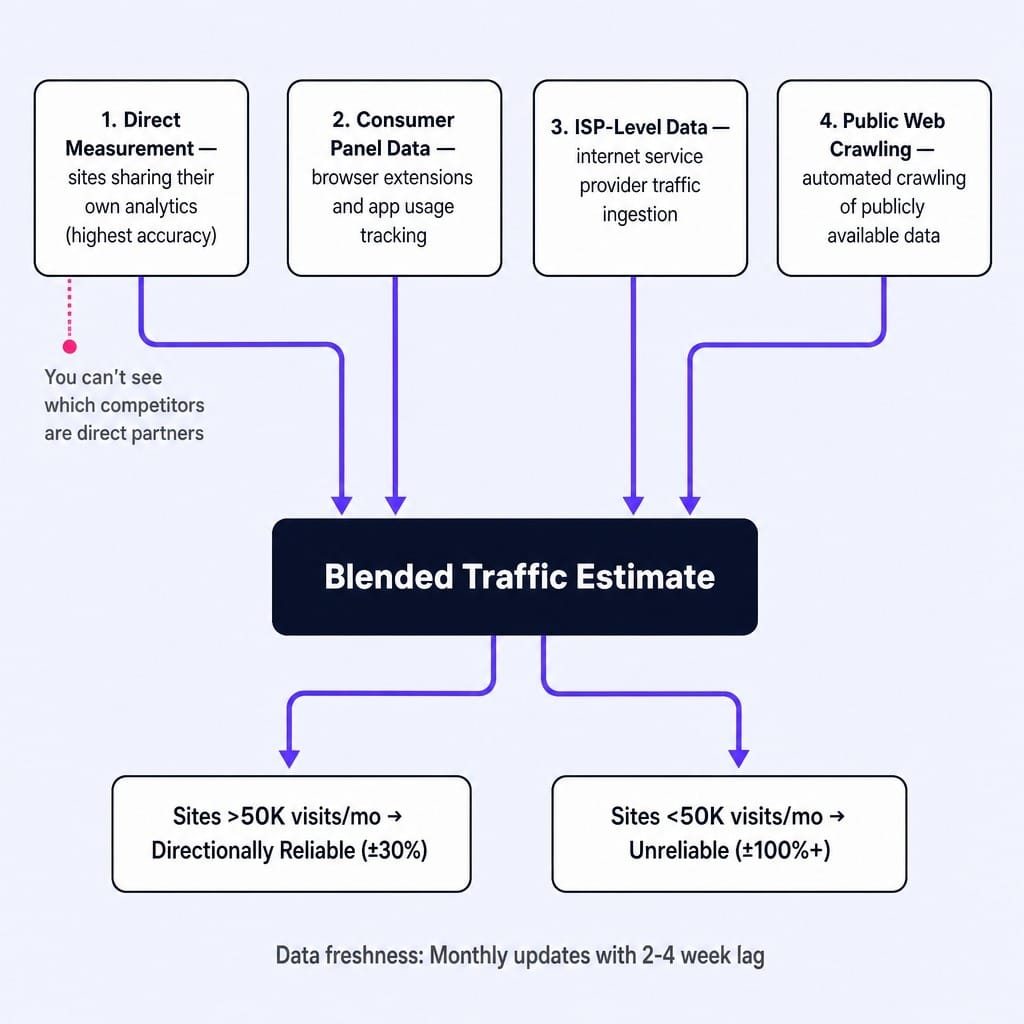
This creates a data confidence score problem you can't see. You're forced to treat all estimates with the same level of skepticism.
Furthermore, there's the issue of data freshness lag. The platform typically updates its traffic data monthly, meaning you are always analyzing last month's reality. For a growth team trying to measure the impact of a competitor's product launch or new campaign, a four-week delay is a significant constraint. This isn't a tool for real-time intelligence; it's for monthly or quarterly strategic review.
The B2B Use Cases That Actually Justify the Price
The practitioners who found SimilarWeb indispensable were not using it for SEO. They were running specific market intelligence workflows that other platforms simply don't support. We found two use cases in particular that consistently justified the annual contract for B2B teams.
One Series B SaaS company used SimilarWeb's category analysis to build a single, powerful slide for their board deck. It showed the total addressable search demand in their software category and visualized their traffic share against three key competitors. That one slide, grounded in third-party data, was worth the price of admission.
TAM Validation and Market Sizing for Board Decks and Investor Conversations
SimilarWeb's most defensible B2B use case is total addressable market (TAM) sizing. Its ability to define a custom market category and report on the total traffic and traffic share of voice for all players within it is unique. This is the workflow: select a category (e.g., "AI copywriting tools"), see the total monthly visits to all sites in that category, and instantly get a chart showing each competitor's share.
A VP of Marketing we spoke with called it "the only tool that lets me show the board how big our category is and where we sit in it, with data they actually trust." It transforms an abstract market sizing exercise into a concrete, data-backed conversation. However, this is often a periodic need—quarterly board meetings, fundraising cycles—not a daily one. This explains why some teams feel the annual contract is steep for what amounts to a few high-stakes reports per year.
Sales Intelligence and Account-Based Prospecting Signals
The second high-value use case is as a sales intelligence layer that complements tools like ZoomInfo or Apollo.io. RevOps and growth teams are using SimilarWeb's technographics and traffic trends as a powerful prospecting signal. The workflow involves filtering companies by industry, then sorting by website traffic growth rate to identify organizations that are actively investing in their digital presence.
This list of high-growth accounts becomes a seed list for ABM campaigns or an ICP scoring overlay in their CRM. A rapid spike in a prospect's website traffic can be a strong buying signal. It's important to be clear: SimilarWeb is not a ZoomInfo replacement. Its contact-level data is thin. But for identifying companies based on digital behavior signals, it provides a unique lens, especially if you don't already have an intent data platform like 6sense.
Read more: B2B RevOps in 2026: What to Measure, What to Build, and Where Most Teams Stall
When SimilarWeb Is Not Worth It—and What to Use Instead
Being honest, SimilarWeb is a waste of money for at least four common B2B team profiles.
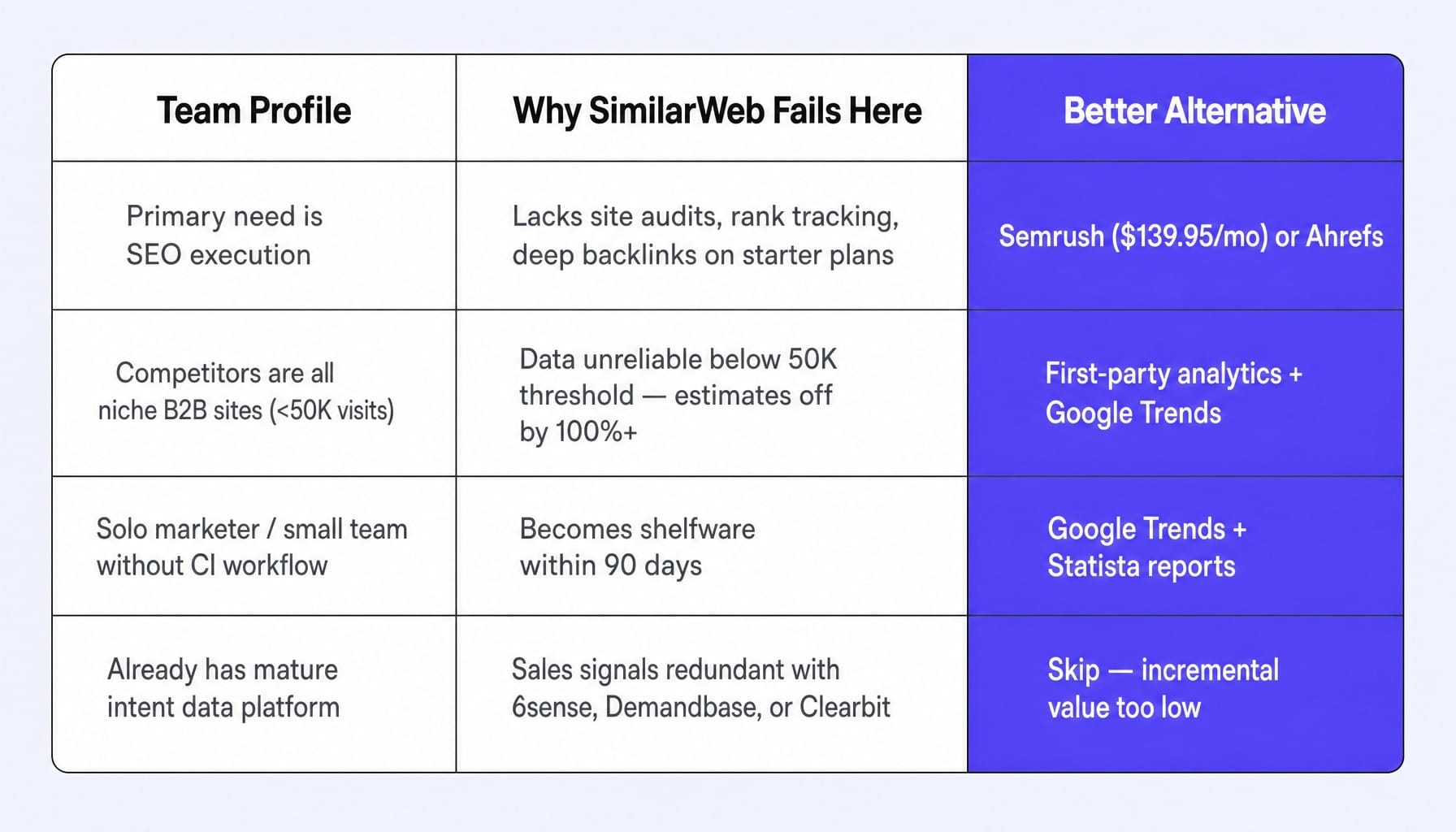
- If your primary need is SEO execution. For keyword research, site audits, rank tracking, and backlink analysis, Semrush (starting at $139.95/mo) or Ahrefs deliver far more value. SimilarWeb's starter plan at $149/mo lacks many of these core SEO features.
- If your competitors are all niche B2B sites. As discussed, if the domains you need to track are all under the 50,000 monthly visit threshold, the data will be too unreliable to base strategic decisions on.
- If you're a solo marketer or small team without a defined competitive intelligence workflow. You'll get excited, pull a few reports, and then it will become shelfware. The RevOps manager from our intro is a classic example. For high-level market sizing on a budget, a combination of Google Trends and reports from Statista is a more pragmatic choice.
- If you already have a mature intent data platform. If your team is already using 6sense, Demandbase, or Clearbit by HubSpot, the sales intelligence signals from SimilarWeb will likely be redundant. The incremental value may not justify another expensive subscription.
For teams that land in the first category, comparing Semrush vs Moz or evaluating Ahrefs pricing is a far better use of your budget research time.
The Hidden Costs That Change the Math
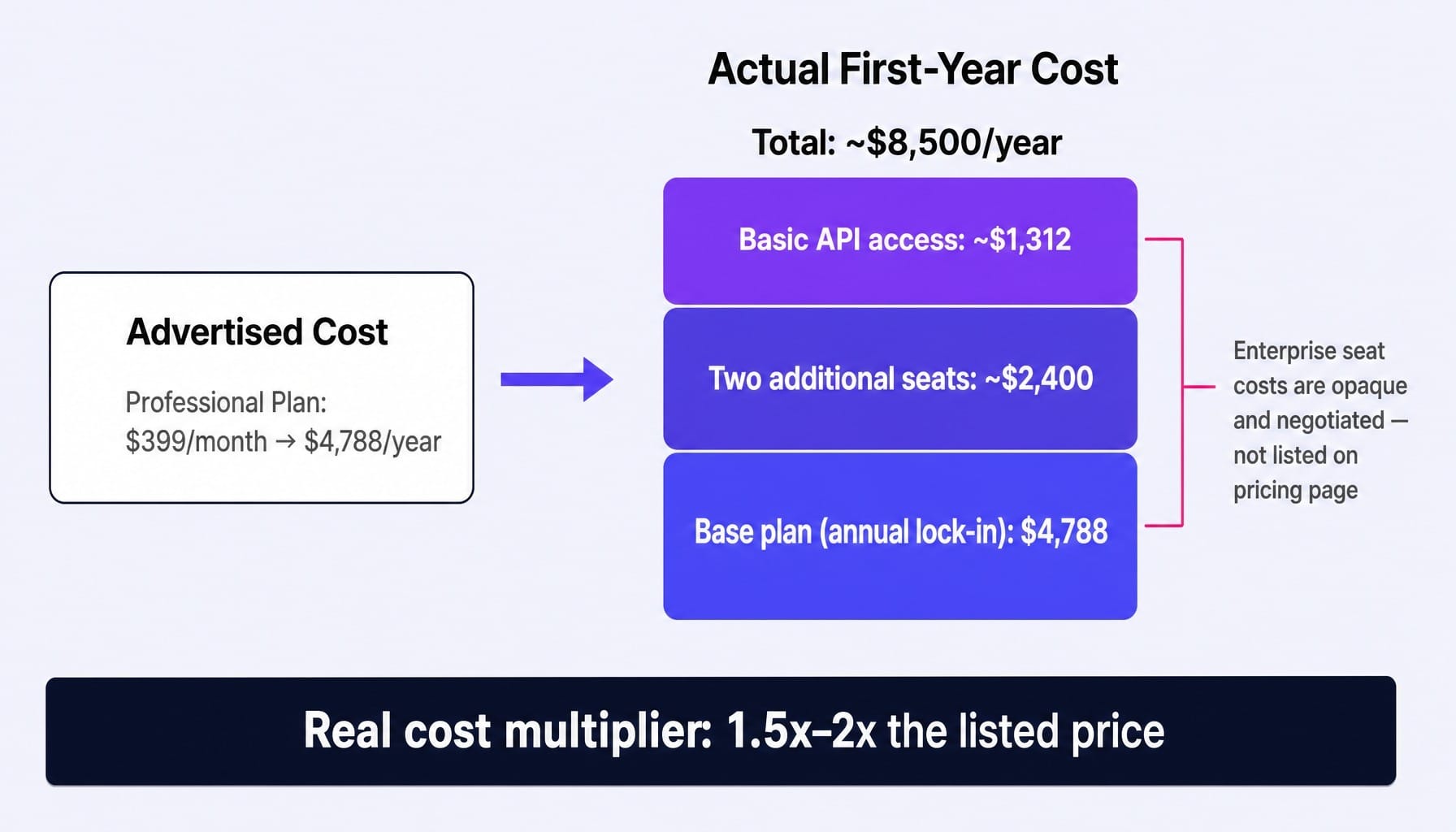
SimilarWeb's listed price is not the price you'll pay. The real cost structure, according to the practitioners we surveyed, significantly changes the ROI calculation. A four-person marketing team that budgeted $399/month for a Professional plan ended up paying closer to $8,500 for the year after adding just two seats and basic API access.
There are three hidden cost factors to model:
- Annual Lock-In: Enterprise plans are almost always sold as annual contracts, paid upfront. There is no monthly option to test the waters. This means you're committing to a minimum of $1,800–$4,800+ before you've confirmed the tool fits your workflow.
- Seat Creep: The base plans only include one user. Adding seats for your sales, marketing, and product teams gets expensive quickly. Unlike Semrush's transparent pricing for additional seats, SimilarWeb's enterprise seat costs are opaque and negotiated.
- API Access: If you want to pull SimilarWeb data into a BI tool, CRM like Salesforce or HubSpot, or a spreadsheet, API access is a separate, usage-based pricing tier. For many teams, this can double the effective cost of the platform.
A safe rule is to multiply the list price by 1.5x to 2x to estimate the real first-year cost for a small team.
Read more: SaaS Marketing Tools in 2026: How to Build a Stack That Ships, Not Just Reports
When the Bottleneck Isn't Intelligence—It's Execution
Even when SimilarWeb delivers genuine, high-value intelligence—a competitor is gaining traffic share, a new referral source is driving growth, a market category is expanding—that insight is worthless until you act on it. For lean B2B teams, this is where the system breaks. The intelligence sits in a dashboard while the execution backlog grows.
The gap in most marketing stacks isn't another analytics platform. It's the operational capacity to move from insight to a shipped change on a weekly cadence. This is the execution gap that Spike AI is built to close. While tools like SimilarWeb identify what might need to change, Spike AI functions as a marketing execution engine that identifies the highest-impact move across your website, SEO, or ads—and then helps you deploy it.
We close the loop that intelligence tools leave open. The problem for most teams isn't a lack of data; it's the latency between knowing what to do and getting it done. Spike AI turns that latency into a weekly shipping rhythm.
See how Spike AI turns your competitive intelligence into weekly shipped improvements
The Final Verdict
So, is SimilarWeb worth it? It is, but only if your primary use case is competitive intelligence and market sizing—not SEO execution. The platform's data is directionally useful for sites with over 50,000 monthly visits and uniquely valuable for TAM validation and category-level analysis. For almost everyone else, it's an overpriced tool that fails to deliver on the promise of its sticker price.
Before you sign that annual contract, define the three specific, recurring workflows you will use it for. If you can't name three that you'll run weekly or at least monthly, the tool will become shelfware within 90 days. The most expensive tool is the one you don't use.
Frequently Asked Questions
Can SimilarWeb replace Semrush or Ahrefs for SEO research?
No. SimilarWeb lacks core SEO features like site auditing, deep backlink analysis on entry-level plans, and granular rank tracking. It is a competitive intelligence platform. Use Semrush or Ahrefs for day-to-day SEO workflows and add SimilarWeb only if you need the category-level market analysis that those tools don't provide.
Does SimilarWeb integrate with CRM platforms like Salesforce or HubSpot?
SimilarWeb offers API access for enriching CRM records with website traffic and technographic data, but this is typically a separate, costly pricing tier. The depth of integration is also thinner than dedicated sales intelligence tools like ZoomInfo or Clearbit. You must factor API costs into your total budget before committing to the platform.
How often does SimilarWeb update its traffic and engagement data?
SimilarWeb typically updates its data on a monthly basis, with a lag of two to four weeks. This means you are always analyzing performance from the previous month. For teams that need to monitor competitive signals in real-time, such as the impact of a product launch, this data freshness lag is a significant limitation.
Is the SimilarWeb free version useful enough to skip the paid plan?
No. The free tier has been heavily restricted and now offers very limited data. While you can get a rough traffic estimate for a single domain, most historical trends, channel breakdowns, and competitive analysis features are locked. It is insufficient for any serious market research or competitive intelligence workflow.
Is SimilarWeb better suited for digital strategy teams or sales teams in B2B organizations?
Digital strategy and market research teams extract the most value, as their core workflows—category analysis, traffic share monitoring, and TAM sizing—align perfectly with SimilarWeb's strengths. Sales teams can benefit from prospecting signals like traffic growth, but dedicated sales intelligence tools provide deeper contact-level data and firmographics that SimilarWeb doesn't.