Jasper Price in 2026: A Breakdown of Plans, True Costs, and What You Actually Pay

TL;DR
- Jasper's publicly listed Pro plan costs $69/month per seat (or $59/month billed annually). The Business plan is custom-quoted and typically starts at $125+ per seat for teams of 10 or more.
- The subscription fee is only part of the equation. Your "true cost" includes operational overhead like prompt engineering, editing time, and supplementary tools (e.g., for SEO or plagiarism checks), which can easily double or triple the monthly spend.
- Per-seat pricing models create "seat bloat," where you pay for licenses that go unused. Before committing, run a pilot to measure actual team adoption rates.
- When comparing alternatives, analyze the cost per usable content asset, not just the monthly fee. ChatGPT Enterprise may be cheaper for teams with strong prompt discipline, while direct OpenAI API access is cheapest for those with engineering resources.
- Enterprise contracts often involve minimums of 10+ seats on an annual term (>$15,000), include 5-10% renewal uplift, and bundle features. Request an itemized quote and negotiate the renewal cap upfront.
A three-person marketing team signs up for Jasper Pro at $59 per seat, billed annually. The expected cost is a straightforward $177 per month. Six months later, the reality is different. They're still paying $177 for the seats, but they've also added a $89/month SEO tool to guide Jasper's output. More importantly, the team spends a collective eight hours every week on prompt engineering, fact-checking, and editing outputs to match their brand voice.
This invisible labor cost pushes their effective price per blog post above what a mid-tier freelancer would charge.
This scenario isn't a failure of the tool; it's a failure of cost analysis. Jasper's pricing page tells you the subscription cost, but it doesn't reveal the total cost of ownership. This article breaks down every Jasper pricing plan with the latest 2026 figures. Then it goes further, analyzing the hidden cost layers, comparing against key alternatives, and unpacking the enterprise procurement realities most guides ignore.
(All prices last verified Q3 2025.)
Jasper Pricing Plans in 2026: What Each Tier Costs and Includes
Jasper's pricing model is built around two publicly priced tiers for its Pro plan and a custom-quoted Business plan for larger teams. It's important to note that the popular "Creator" and "Boss Mode" plans were deprecated in early 2025; some guides still reference them, but they are no longer available for new customers. The core choice for most teams is between the monthly or annual Pro plan, or engaging with sales for a Business contract.
Pro Plan: Per-Seat Pricing and Feature Boundaries
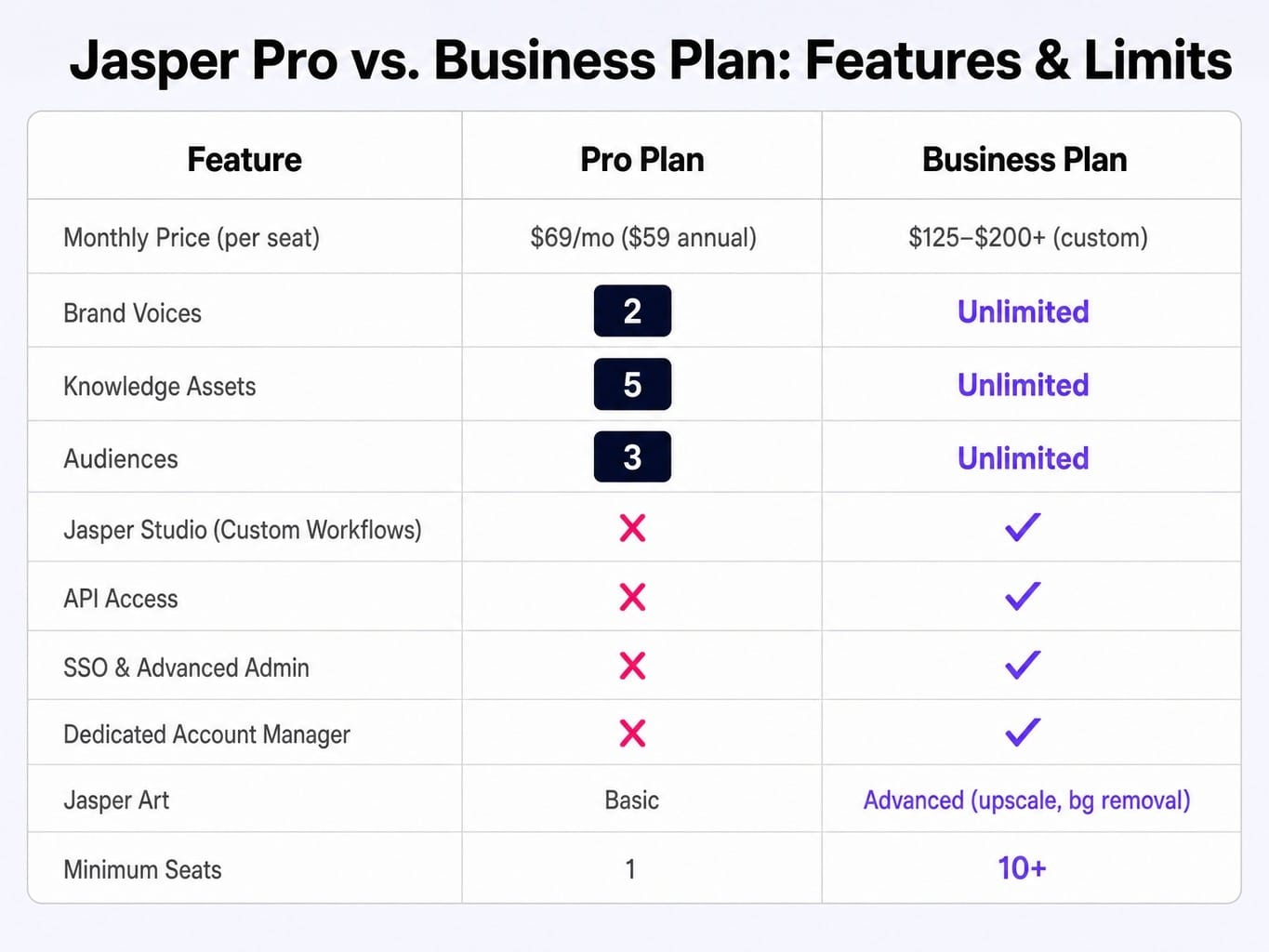
The Jasper Pro plan costs $69 per month when billed monthly, or $59 per month when billed annually—a discount of about 15%. This price is per seat.
This tier is designed for individuals and small teams getting started with AI content generation. It includes access to Jasper's core features: the content canvas, pre-built templates (called agents), the browser extension, and Jasper Art for AI image generation.
However, the real story is in the feature boundaries, which are designed to trigger an upgrade as your team's usage matures:
- 2 Brand Voices: A Brand Voice allows Jasper to learn your company's tone, style, and key facts from provided content. A limit of two means a marketing agency or a company with multiple product lines will hit this ceiling almost immediately.
- 5 Knowledge Assets: A Knowledge Asset is a repository of information—like product specs, case studies, or market data—that Jasper uses for factual accuracy. With only five available, you're forced to be selective, which can limit output quality across different campaigns.
- 3 Audiences: This feature lets you define and target specific personas. Three is adequate for a single-product company but restrictive for anyone with diverse customer segments.
The Pro plan, accessible via a 7-day free trial, is a capable entry point. But view it as such. If your content strategy involves more than two brands or a deep need for factual consistency across many topics, you will outgrow these limits.
Business Plan: Custom Pricing and What Triggers Enterprise Quotes
The Jasper Business plan has no public pricing. It's a custom solution requiring a sales conversation, designed for teams of 10 or more, or those needing advanced capabilities.
Based on industry procurement data, expect enterprise pricing to start in the range of $125 to $200+ per seat, per month, with discounts for higher seat counts and multi-year contracts. The final jasper cost depends heavily on your specific needs.
The features gated behind the Business plan are what separate casual use from systemic integration:
- Unlimited Brand Voices, Knowledge Assets, and Audiences: This is the most common reason teams upgrade. It removes the core constraints of the Pro plan.
- Jasper Studio: This allows you to create custom, reusable workflows and AI templates tailored to your team's specific processes, moving beyond Jasper's generic offerings.
- API Access: Essential for teams looking to programmatically generate content or integrate Jasper into their existing marketing automation systems. You cannot build automated content pipelines on the Pro plan.
- Advanced Security & Administration: Features like SSO, granular user permissions, and advanced analytics are enterprise table stakes.
- Dedicated Account Manager: A human contact for support and strategic guidance.
If your team needs to automate content workflows, enforce brand consistency across a large portfolio, or meet enterprise security requirements, the conversation inevitably leads to the Business tier.
The True Cost of Jasper: What the Pricing Page Doesn't Show
Your subscription fee is the most predictable part of the Jasper price. The real cost—your total cost of ownership—is a function of operational friction and workflow inefficiencies. It's the blended cost per asset that matters.
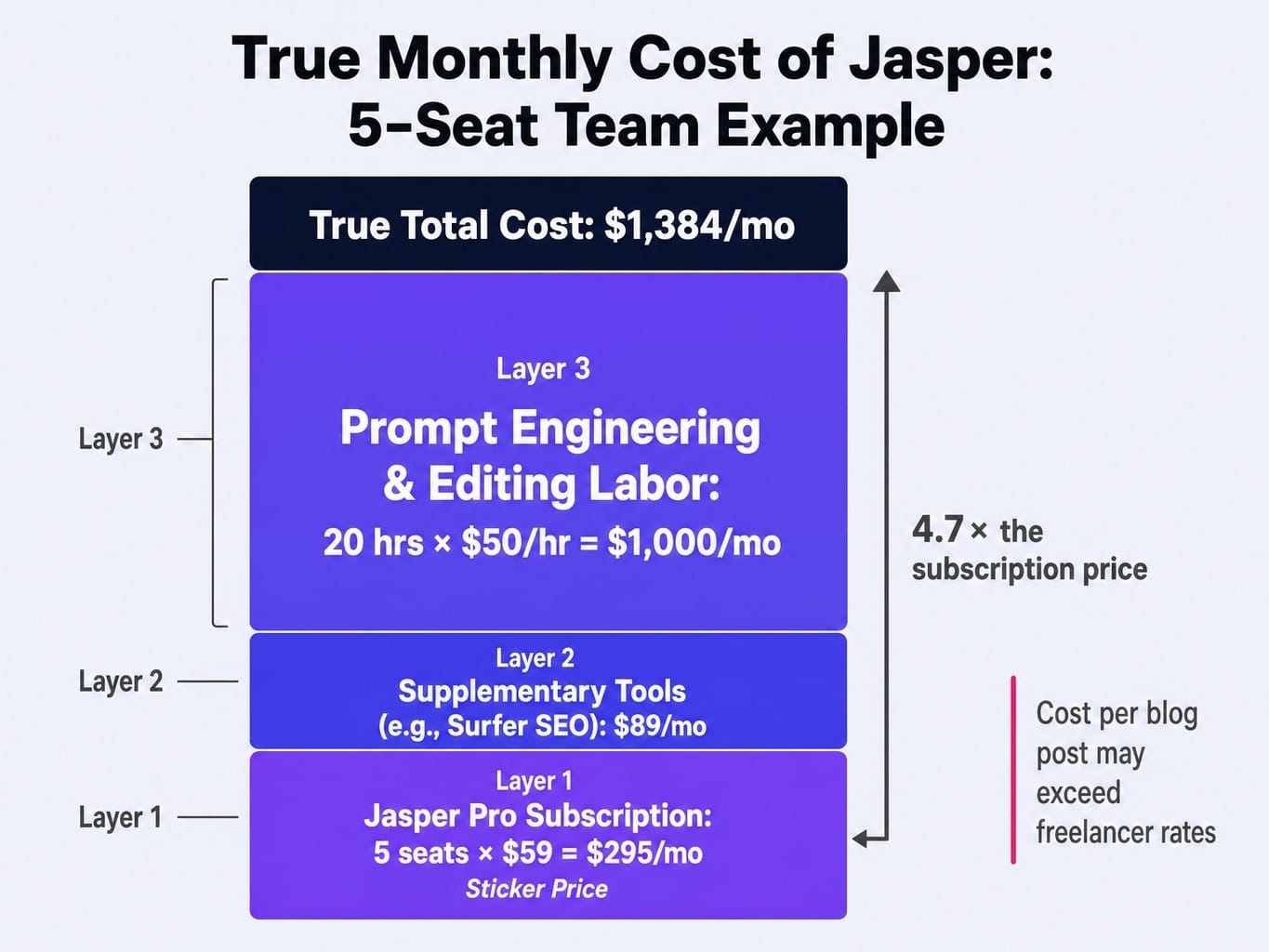
Consider a team with five Pro seats ($295/mo) and a Surfer SEO subscription ($89/mo) to guide content. If they spend 20 hours a month on prompt engineering and editing at an effective internal cost of $50/hour, their total monthly spend on the Jasper ecosystem is $1,384. The sticker price is $295; the reality is nearly 5x higher. Calculating this figure is the only way to know if you're getting a positive ROI.
Seat Bloat: Paying for Adoption That Never Happens
Per-seat pricing models are profitable for vendors because they punish teams with uneven adoption. We've all seen it: a marketing lead buys five Pro seats with high hopes. Sixty days later, two people are power users, one logs in weekly, and two have abandoned it completely, quietly reverting to their personal ChatGPT accounts because Jasper's workflow didn't stick.
The team is paying $295 per month for $177 worth of active use. This seat bloat is a structural risk of any per-seat SaaS tool. The presence of shadow AI spend—team members expensing other tools or using free accounts—is the leading indicator that your licensed platform isn't solving the right problem, and you're paying for both.
The only defense is to run a disciplined pilot. Use the 7-day free trial to equip your core team, then measure login frequency and output volume. Don't buy seats based on headcount; buy them based on demonstrated, consistent usage.
Prompt Engineering and Editing Overhead: The Invisible Labor Cost
AI content platforms don't eliminate writing time; they shift it from creation to refinement. Your team trades hours spent on a blank page for hours spent engineering prompts, verifying facts, and editing outputs for tone, flow, and accuracy. This is the invisible labor cost of AI.
For teams that don't properly configure their Brand Voice and Knowledge Base, the output quality per dollar plummets. They spend more time on revisions to fix generic or inaccurate content. Their token consumption rate also increases as they run multiple prompts to get a single usable output, burning time even if the subscription cost is fixed.
Jasper's ROI is directly proportional to the upfront investment in configuration. Teams that treat it as a plug-and-play tool pay the full subscription price but never realize the promised productivity gains. The manual execution bottleneck doesn't disappear; it just moves downstream.
Jasper vs. Alternatives: When the Price Stops Making Sense
The right question isn't "Which tool is cheapest?" but "Which tool delivers the lowest cost per usable content asset for my specific workflow?" A higher subscription price might be cheaper overall if it dramatically reduces the manual overhead of editing and fact-checking.
Here's how Jasper's price compares to three alternatives with different cost models:
- ChatGPT Enterprise: At roughly $60/user/month for unlimited GPT-4o access, it's competitively priced per seat. However, it lacks Jasper's marketing-specific workflows and deep brand voice integration. You trade a lower subscription cost for a much higher prompt engineering overhead. For a deeper look at this tradeoff, see our Jasper vs. ChatGPT comparison.
- Copy.ai: With a free tier and a Pro plan at $36/month, it's a cheaper entry point. It's effective for short-form content but offers less sophisticated workflow automation and brand management features, making it less suitable for complex B2B content. If you're weighing these two head-to-head, our Jasper vs. Copy.ai breakdown covers what each tool actually delivers.
- OpenAI API: Directly accessing models like GPT-4o is by far the cheapest option at scale, with costs tied directly to usage (tokens). But this path trades subscription costs for developer salaries. It's the right move for high-volume content operations with available engineering capacity, not for lean marketing teams.
Jasper Enterprise Pricing: Procurement Friction and Contract Realities
For B2B companies with a formal procurement process, the Jasper enterprise price isn't just a number; it's a hurdle. The lack of public pricing means marketing can't self-serve a budget estimate, delaying internal approvals. Enterprise pricing opacity is not accidental. It's a negotiation strategy. Prepare accordingly.
Here are three realities to anticipate:
- Minimum Contract Size: Jasper Business typically requires an annual commitment and a minimum of 10 seats. At a conservative estimate of $125/seat/month, you're looking at a minimum annual contract value of $15,000. This figure crosses the procurement approval threshold at most companies, requiring VP or finance-level sign-off.
- Renewal Uplift: Like most enterprise SaaS, expect a standard 5-10% renewal uplift percentage built into multi-year agreements. This is a negotiable term. The best time to cap future increases is during the initial contract negotiation, not 30 days before renewal.
- SKU Bundling: The final quote will likely involve SKU bundling, where core seat licenses are combined with add-ons like API access credits, premium support, or extra training. This makes it difficult to compare the per-seat cost against the Pro plan. Ask for an itemized quote that separates the cost of each component.
Your job is to enter the sales conversation prepared. Know your must-have features, your seat adoption estimates, and the renewal terms you're willing to accept.
When the Real Problem Isn't the Price of Your AI Tool
Calculating the true cost of your content stack is a critical exercise. But it often reveals a deeper, more expensive problem: the execution gap. The time lost between identifying what content to create, engineering the prompts, editing the output, and coordinating across SEO, CRO, and ad channels is the most expensive line item in any marketing budget. The tool subscription is trivial by comparison.
This is the system-level constraint that most AI content tools don't solve. They give you an interface to generate text, but you're still left to manage the entire workflow—the prioritization, the deployment, the measurement, and the next iteration.
Spike AI is built to close that execution gap. It's not another content generator; it's a marketing execution engine that operates as a closed-loop system. Spike AI identifies the highest-impact move across your website, SEO content, or ads, and then deploys the change. Instead of a backlog of ideas, you get a weekly release cadence. The manual overhead of prompt engineering and cross-tool coordination is replaced by an autonomous system that ships.
If you're calculating the cost of your content tools, consider that the highest price you pay is the latency between knowing what to do and actually getting it done.
See how Spike AI ships your highest-impact marketing changes weekly
Your Final Cost Is an Execution Problem
Jasper's pricing page shows you the subscription cost. The price you actually pay is determined by your team's adoption rate, your investment in configuration, and the operational overhead required to turn raw output into shipped content.
Choosing a Jasper plan is a procurement decision. Extracting value from it is an execution systems decision. The teams that generate real ROI from any AI tool are those who treat the subscription as one variable in a much larger equation. As AI content tools continue to commoditize and their pricing converges, the differentiator won't be the tool you choose. It will be the efficiency of the system you build around it.
Frequently Asked Questions
Does Jasper offer discounts for nonprofits or startups?
Jasper does not have a public discount program for nonprofits or startups. However, during enterprise sales conversations, there can be flexibility for early-stage companies committing to annual contracts. It's worth requesting a pilot program or a reduced-seat trial, as sales teams often have discretion for high-growth accounts.
How much does Jasper Art cost as a standalone add-on?
Jasper Art for AI image generation is included in both the Pro and Business plans; it is not a separate, priced add-on. However, advanced features like image upscaling and background removal are exclusive to the Business tier. If image creation is a primary use case, you must evaluate if Pro's basic capabilities are sufficient.
What happens if I exceed my Jasper usage limits on the Pro plan?
The Pro plan offers unlimited word generation, so there are no word-count overage charges. The functional limits are on Brand Voices (2), Knowledge Assets (5), and Audiences (3). Exceeding these requires an upgrade to the Business plan. Hitting a Brand Voice or Knowledge Asset ceiling mid-campaign can force an unplanned and urgent upgrade conversation with sales.
Does Jasper charge per user or per workspace?
Jasper's pricing is per seat (per user), not per workspace. The Pro plan includes one seat by default, and additional seats are added at the same per-seat rate. Business plans offer volume-based discounts for large teams, but the model remains the same: every individual user requires their own paid license.
How has Jasper's pricing changed since they restructured plans?
Jasper restructured its pricing in early 2025, discontinuing the legacy Creator and Boss Mode plans. The current model is simplified to Pro (publicly priced) and Business (custom quoted). This change consolidated features and effectively raised the entry-level price from the former Creator plan's $39/month to the Pro plan's $59/month (when billed annually). Existing customers on legacy plans were migrated.