
The Last Mile Problem in Marketing: 4 Ways Insights Die Before They Ship
TL;DR
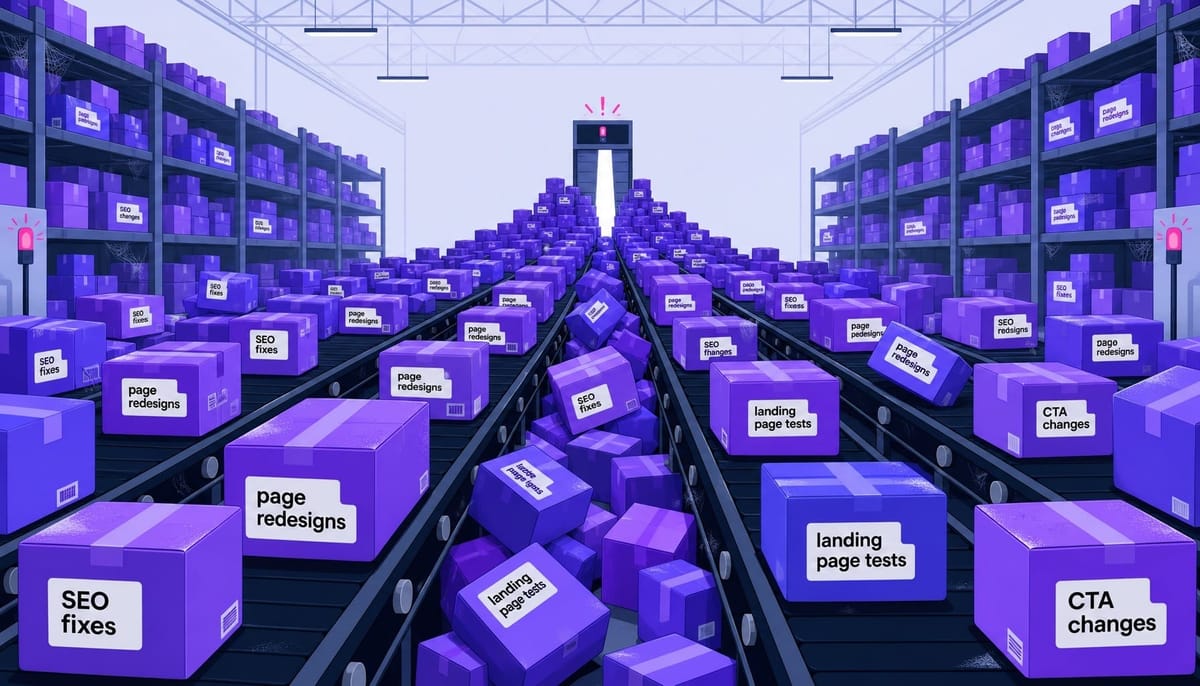
- The marketing execution gap is not a strategy or talent problem; it's a "last-mile" delivery failure between what a tool recommends and what actually gets shipped.
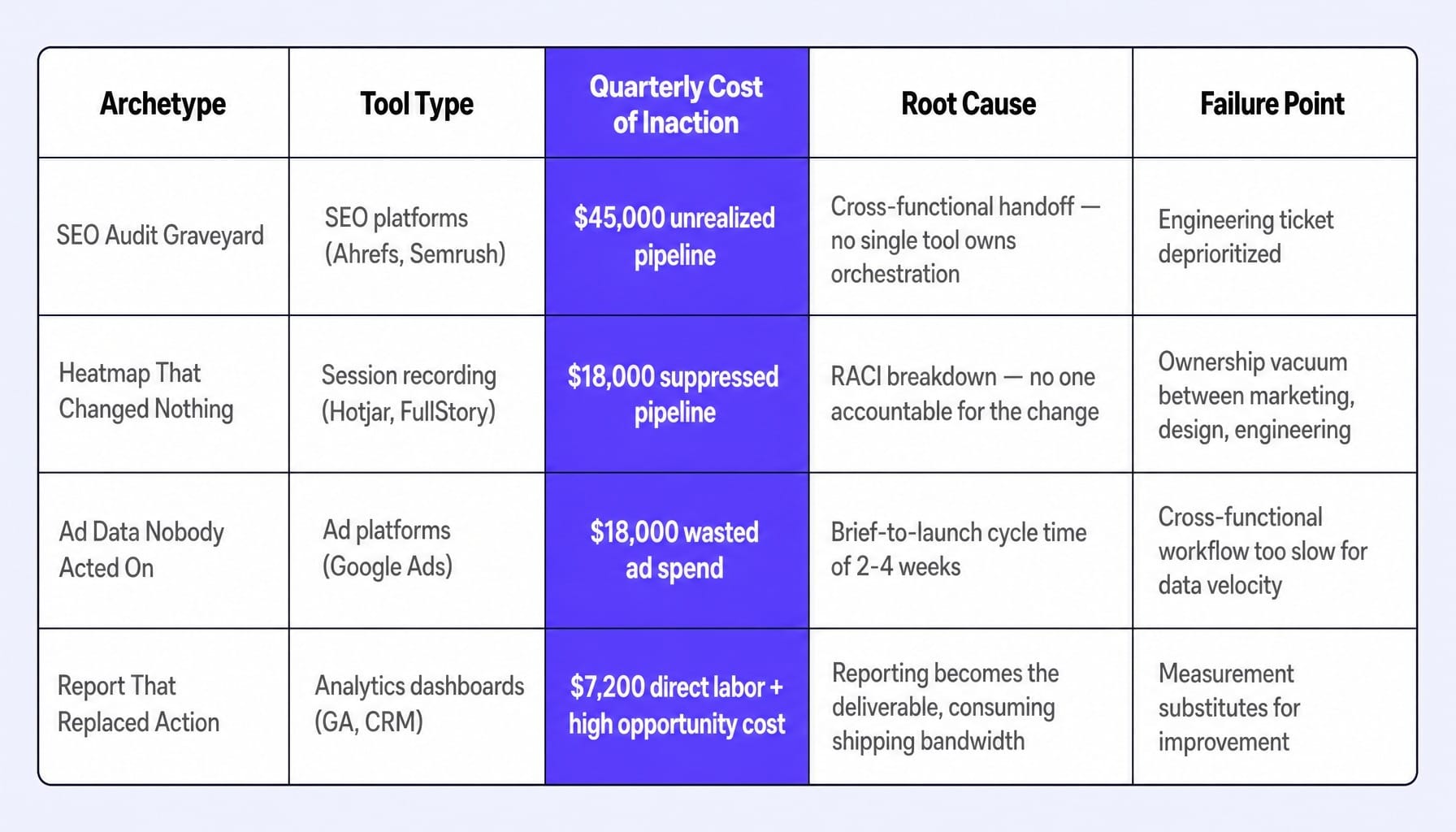
- Insights die in predictable patterns: the "SEO Audit Graveyard," the "Heatmap That Changed Nothing," "Ad Data Nobody Acted On," and the "Report That Replaced Action." Each carries a significant, quantifiable dollar cost in unrealized pipeline or wasted spend.
- This gap is an architectural feature of the martech industry. Tools are built to diagnose problems, not deploy solutions, because it's a more scalable business model.
- Practitioner backlogs are filled with high-value recommendations that have sat unactioned for months or even years, bottlenecked by cross-functional handoffs and limited shipping capacity.
- Closing the gap requires shifting focus from generating more recommendations to building a system that can actually ship them.
Your team just finished its quarterly tool audit. The SEO platform flagged 47 technical issues. The heatmap tool showed users abandoning a key conversion page at the exact same scroll depth. Your ad performance data identified three landing pages dragging down ROAS. The analytics dashboard took eight hours to build.
Three months from now, four of those issues will have been addressed.
The rest will sit in a backlog, a forgotten Slack thread, or a meeting note nobody reopened. This isn't a hypothetical; it's the default state for most marketing teams. It even has a name: the marketing execution gap. But that's too abstract. Let's call it what it is: the Last Mile Problem.
Every tool in the modern marketing stack excels at diagnosis—finding what is wrong. None of them close the loop. The insight surfaces, gets acknowledged, and dies somewhere between a Jira ticket and a stakeholder review.
This article walks through the four most common archetypes of these unshipped insights, estimates the real dollar cost of each, and explains why this gap is structural, not a failure of your team's effort or intelligence. We also asked real marketers to share the recommendation that has been sitting unactioned the longest. Their answers are uncomfortably familiar.
The Marketing Execution Gap Is a Last-Mile Delivery Failure
The marketing execution gap is not what most people think it is. It is not a strategy problem; most teams have clear priorities. It is not a talent problem; most teams have competent people. And it is certainly not a tools problem; the average B2B marketing team now uses more than a dozen tools, each one a firehose of recommendations.
The gap is the specific, measurable distance between what a tool recommends and what actually gets shipped to production.
While 90% of executives acknowledge a gap between strategy and execution, the failure point is more precise. It's the handoff. Every tool in the stack is built to stop at the recommendation layer. The distinction between an "actionable insight" and a "shippable change" is where nearly every tool's value proposition quietly breaks down: actionable means a human could theoretically act on it, shippable means the system can deploy it without further translation.
The SEO tool tells you what to fix. The heatmap shows you where users struggle. The analytics platform tells you what underperforms. But none of them change a single line of code, rewrite a single headline, or deploy a single test. That last mile from insight to shipped change is where value dies.
Four Archetypes of Insights That Die Before Production
The marketing execution gap isn't a vague organizational malaise. It manifests in predictable patterns of failure. These aren't edge cases; they are the four most common ways that good marketing insights, surfaced by expensive tools, die before they ever reach a customer.
Each archetype follows the same bleak trajectory: a clear finding, a costly delay, and a structural reason why it was doomed from the start.
The SEO Audit Graveyard
The scenario is a ritual. An SEO platform like Ahrefs or Semrush identifies 47 technical issues and 12 high-impact content gaps. The team diligently exports the list, triages it in a spreadsheet, and assigns priority scores.
Three months later, four items have been addressed. The other 55 sit in limbo. Some need engineering tickets that get bumped by product work. Some need content briefs that haven't been written. Some require stakeholder sign-off on URL changes. The SEO manager identifies the issue, writes a ticket, waits for engineering prioritization, gets de-prioritized, and eventually, the next quarterly audit arrives with a fresh list that buries the old one. The tool's own priority scoring rarely accounts for implementation complexity, so a "high priority" technical fix can sit untouched for months because the team correctly intuits the effort-to-ship is too high for their available WIP limits.
- What It Costs: Let's be conservative. If those 12 content gaps represent keywords with a combined monthly search volume of 15,000, a 2% CTR, and a $50 value per qualified visit, the three-month delay costs $45,000 in unrealized pipeline. That's before accounting for the compounding value of the technical fixes.
- Why It Happens Structurally: The SEO tool's job ends at the audit. Everything that follows is a cross-functional handoff problem that no single tool owns or orchestrates.
Read more: B2B SEO Audit: A Revenue-First Framework for SaaS Teams (2026) | Spike AI
The Heatmap That Changed Nothing
A session recording tool like Hotjar or FullStory shows it clearly: users consistently abandon a key conversion page—the demo request form—at the same scroll depth. The team watches the recording in a meeting. Everyone agrees the page needs work. The head of marketing says, "Let's redesign the below-the-fold section."
Then, nothing.
Why? The insight enters an ownership vacuum. The product marketer who wrote the copy doesn't control the CMS. The designer who could mock up a new layout is allocated to a product launch. The developer who could implement the changes is on the engineering team's sprint, not marketing's. The insight is clear, the fix is obvious, but the organizational wiring has no circuit for "marketing team needs a page changed this week." It's a classic RACI breakdown where no one is truly accountable for the change.
- What It Costs: Suppose the page receives 2,000 monthly visits and the abandonment pattern suppresses the conversion rate by just 1.5 percentage points. If each conversion is worth $200 in pipeline, the monthly cost of inaction is $6,000, or $18,000 per quarter.
- Why It Happens Structurally: The heatmap tool surfaces the user behavior perfectly. But it has no mechanism to assign ownership, create a brief, or deploy a fix. The insight is fired into a void between marketing, design, and engineering.
The Ad Data Nobody Acted On
The paid media manager pulls a monthly performance report. The data is unambiguous. Three landing pages are burning money with high CPCs, low conversion rates, and poor Quality Scores.
But iterating on those pages means navigating a maze of dependencies. A single landing page test requires a brief from the paid team, a design round, a copy review from the brand team, an approval, a dev ticket, and a QA check. The brief-to-launch cycle time for one simple page variation is two to four weeks. All the while, the underperforming ads keep spending, and the velocity drag on the whole program is palpable.
- What It Costs: If those three pages collectively receive $15,000/month in ad spend and their conversion rate is 40% below the account average, roughly $6,000/month in ad spend is being wasted on pages the team already knows are broken. Over a quarter, that's $18,000 in inefficient spend, not counting the lost pipeline.
- Why It Happens Structurally: The ad platform tells you exactly which assets underperform. But the fix requires a cross-functional workflow that moves at a fraction of the speed the data demands.
The Report That Replaced Action
This is the most insidious archetype because it feels productive. A marketing team spends eight hours every month building a performance dashboard. They pull data from Google Analytics, their CRM, their ad platforms, and their SEO tool. They format it into slides and present it in a monthly review. The meeting generates a few action items.
By the time the next monthly report is due, maybe one of those items has been completed. The team is already busy spending another eight hours building the next report. The report has become deliverable. The act of measuring performance has consumed the bandwidth that should have been spent improving it. This dark work of reporting masks the true lack of marketing throughput.
- What It Costs: If the marketing team's fully loaded hourly cost is $75/hour and they spend 96 hours per year on reporting that generates minimal action, that's $7,200/year in direct labor cost. This figure ignores the far greater opportunity cost of what those 96 hours could have produced if spent on the highest-impact changes the reports themselves identified.
- Why It Happens Structurally: Analytics tools are built to visualize data, not to act on it. The dashboard becomes a ritual that substitutes for the harder, messier work of shipping changes.
The Longest-Lived Unactioned Recommendation
To make this tangible, we asked marketers in B2B SaaS teams a single question: "What is the oldest recommendation a tool surfaced that you still have not shipped?" The answers were uncomfortably specific.
"Our SEO tool flagged a canonical tag issue across 200+ pages in January 2024. It's still in our backlog. Every quarter it shows up in the audit again, we re-prioritize it, and it gets bumped again. It has been 18 months."
– Growth Marketing Lead, 45-person B2B SaaS
"Hotjar showed us 18 months ago that nobody clicks our primary CTA on the blog because it's buried. We all agreed to move it. It requires a template change in the CMS that only one developer can do, and he's always on product sprints. It's still there."
– Content Marketing Manager, 70-person FinTech
"Google Ads has been telling us for over a year that our mobile landing page speed for our top campaign is 'poor' and it's killing our Quality Score. We know. We have a ticket for it. It's been in the 'nice to have' column of the engineering backlog for five quarters."
– Performance Marketing Specialist, 120-person company
"Our analytics platform showed a 40% drop-off on the second step of our signup form. That was Q2 of last year. We had a whole meeting about it. The consensus was to combine steps 1 and 2. We just... never did it. The intake process failure to get it on the roadmap meant it just died."
– Founder, 25-person startup
The pattern is identical. The tool did its job. The recommendation was sound. The team agreed it mattered. But the organizational machinery between "this should change" and "this has changed" is either broken or doesn't exist. These are not lazy teams. They are teams whose tools generate more actionable insights than their operational structure can absorb.
Why Every Marketing Tool Is Built to Stop at Recommendations
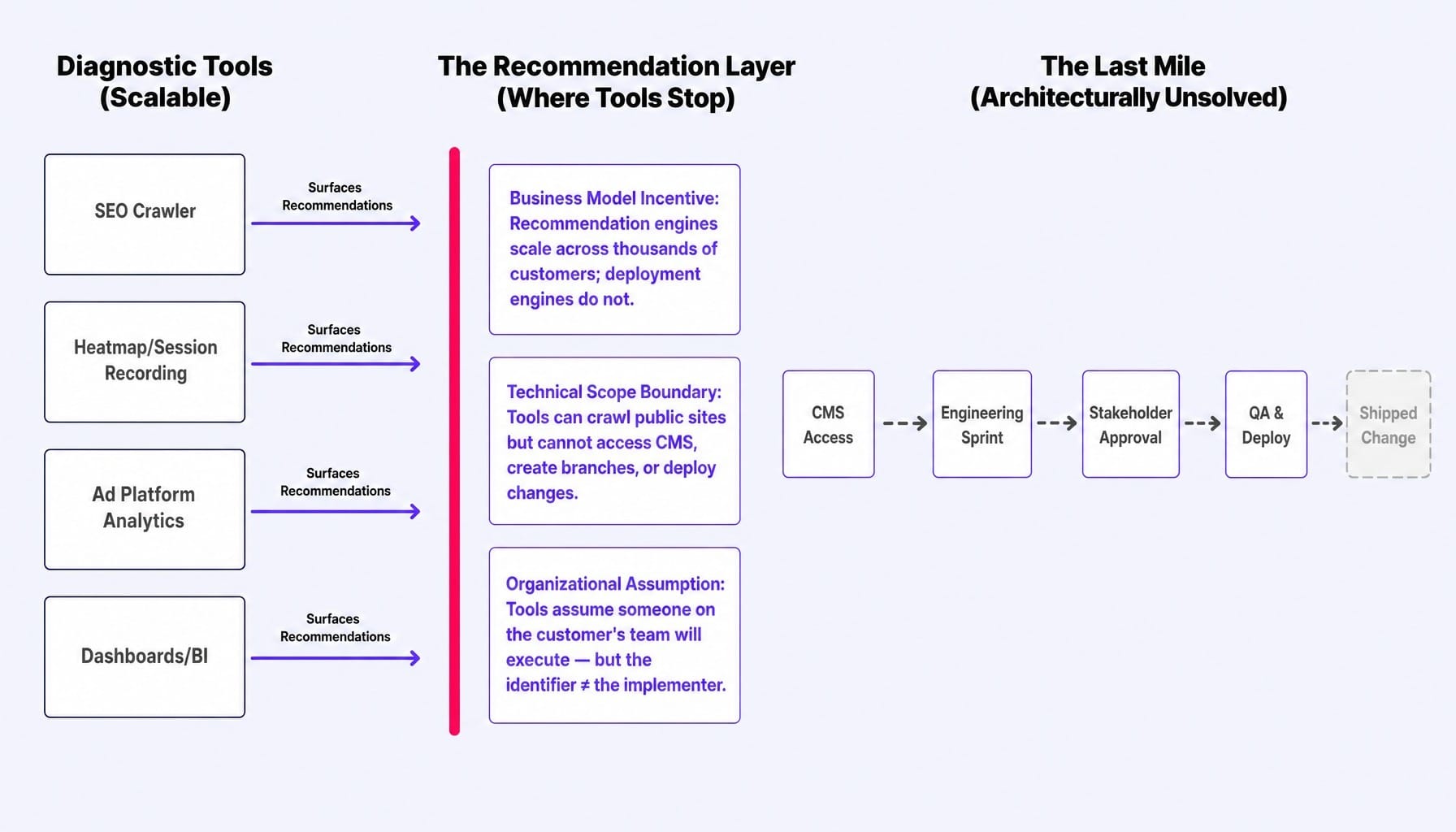
The marketing execution gap is not an accident. It is an architectural feature of how marketing technology is designed. When a B2B SaaS team pays for five or six diagnostic tools and each one surfaces actionable recommendations that never get shipped, the compounding cost is not the subscription fees but the unrealized conversion lift sitting in backlogs. This structural failure exists for three reasons.
First, the business model incentive. SaaS tools are built to be horizontal; they serve thousands of customers across different CMS platforms, tech stacks, and organizational structures. Building a recommendation engine is scalable. Building a deployment engine that works inside every customer's unique infrastructure is not. So, tools optimize for the part of the problem they can scale.
Second, the technical scope boundary. An SEO tool can crawl your public site and identify issues, but it cannot log into your CMS, create a branch, make a change, get it reviewed, and deploy it. That requires access, permissions, and context that live far outside the tool's intended scope. The "recommendation layer" is not a single failure point but a category of failure that recurs independently across every diagnostic platform.
Third, the organizational assumption. Every tool is sold with the implicit assumption that someone on the customer's team will take the recommendation and execute it. But that assumption shatters when the person who receives the recommendation is not the person who can implement it. The strategy-execution disconnect happens in that handoff. The SaaS marketing tools landscape is built around this exact dynamic—each platform excels at one diagnostic slice while leaving the deployment problem to someone else.
The marketing execution gap is not a bug in any individual tool. It is a gap in the category itself. The entire marketing technology ecosystem is built to diagnose. The last mile is architecturally unsolved.
What Happens When the System Ships the Fix, Not Just the Finding
The article has built a specific tension: every tool in the marketing stack diagnoses problems, but none of them deploy the fix. The last mile between recommendation and shipped change is where value dies. This is the precise structural failure that Spike AI was designed to eliminate.
Instead of surfacing a list of 47 issues and handing you homework, Spike AI identifies the highest-impact change across your website, SEO, and ads—and ships it. Every week. No engineering tickets. No cross-functional handoff failures. No backlog that grows faster than your team can process it.
Think back to the costs. The $45,000/quarter in unrealized SEO pipeline, the $6,000/month from heatmap inaction, the $18,000/quarter in wasted ad spend—this execution debt compounds when the gap stays open. Spike AI is designed to make that gap zero. The moment a highest-impact move is identified, it is in motion. This isn't another diagnostic tool; it's the architectural answer to the category-level design flaw this article just diagnosed, turning your marketing operating model from a series of bottlenecks into a continuous shipping engine.
See how Spike AI closes the last mile — from insight to shipped change — every week.
From Recommendation Backlog to Shipping Cadence
You do not have a strategy problem. You have a shipping problem.
The marketing execution gap is not caused by bad ideas, lazy teams, or insufficient tools. It is caused by a category-level architectural flaw: every marketing tool is built to stop at the recommendation layer, and the last mile between insight and shipped change has no owner.
The four archetypes—the SEO graveyard, the ignored heatmap, the unactioned ad data, the report that replaces action—are not four separate problems. They are the same problem wearing different masks: a structural gap between diagnosis and deployment that compounds every quarter it remains open.
The teams that win in the coming years will not be the ones with more dashboards or bigger budgets. They will be the ones that stop treating recommendations as deliverables and start measuring what actually ships.
Frequently Asked Questions
How do you measure the marketing execution gap in dollar terms?
Calculate the estimated revenue impact of each unshipped recommendation (using baseline traffic, potential conversion rate lift, and average deal value), then multiply by the number of months the item has sat unactioned. This gives you a conservative "execution debt" figure—the compound cost of delayed improvements. Most teams find this number is 2-5x larger than they expected.
Is the marketing execution gap worse for small teams or large teams?
It affects both, but for different reasons. Small teams (1-5 marketers) lack the bandwidth to act on recommendations; one person cannot run campaigns and implement deep SEO fixes simultaneously. Large teams have the headcount but suffer from cross-functional handoff failures. The person who identifies the problem is rarely the person who can deploy the fix, and the coordination cost between them is where insights die.
Can project management tools like Asana or Monday.com close the execution gap?
Project management tools improve visibility into what needs to be done, but they do not change the fundamental constraint: someone still has to do the work. Moving a recommendation from a dashboard into an Asana task doesn't reduce the engineering dependency or the approval cycle. The gap is not a tracking problem—it is a shipping problem.
How do you distinguish a strategy failure from an execution gap?
A strategy failure means you are optimizing the wrong things—targeting the wrong audience or investing in the wrong channels. An execution gap means you know exactly what to do and cannot get it done. The simplest diagnostic: if your team's backlog of agreed-upon improvements keeps growing quarter over quarter, you have an execution gap, not a strategy gap.
What is 'execution debt' and how does it compound?
Execution debt is the accumulated cost of recommendations that were identified but never shipped. It compounds because each unshipped improvement represents an ongoing drag on performance. The SEO fix that would have improved rankings six months ago would have been generating compounding organic traffic ever since. The longer the debt sits, the more future value it forecloses.