
MarketMuse Pricing in 2026: Plans, True Costs, and When It's Worth It

TL;DR
- MarketMuse removed public pricing; based on historical data, paid plans are estimated at ~$99/mo (Optimize), ~$249/mo (Research), and ~$499/mo (Strategy), but all are now quote-based.
- The subscription fee is only part of the cost. The true cost includes labor for content score iterations, team onboarding time, and the manual effort to act on the insights, which can easily double the monthly expense.
- For on-page scoring and briefs, Surfer SEO (~$89/mo) offers a better price-to-value ratio. MarketMuse's premium is only justified if you leverage its unique topic authority and competitive advantage modeling at scale.
- To break even on the Research plan, a B2B SaaS team needs to generate ~3-4 additional qualified leads per month from the content it influences. If your team's content velocity is low, the math doesn't work.
- The core problem with content intelligence tools isn't the insight; it's the execution gap. The most expensive part is the latency between finding an opportunity and shipping a fix.
You search for "MarketMuse pricing" and land on their pricing page. There are no prices. Since Siteimprove acquired MarketMuse in October 2024, the dollar figures have been replaced by "Book a demo" buttons. It's a standard move for enterprise-focused SaaS, but it creates a black box for the mid-market content teams who need to build a business case. Your evaluation process grinds to a halt.
This isn't just another review that tells you what the features are. This is a practitioner's guide to the total cost of ownership.
We'll break down the estimated MarketMuse price for each tier, based on historical and third-party data. More importantly, we'll analyze the costs that don't appear on any invoice: the credit consumption patterns, the content score iteration loops, and the team labor required to turn insights into assets. Finally, we'll provide a clear framework for when MarketMuse is a rational investment—and when a lighter, more cost-effective tool stack is the smarter system design.
What Each MarketMuse Plan Includes—and What It Likely Costs
MarketMuse currently offers four tiers: Free, Optimize, Research, and Strategy. While public pricing was removed after the Siteimprove acquisition, historical data from G2, archived pages, and third-party software directories provide a reliable baseline for the MarketMuse cost. Remember, these are estimates; your final quote will be negotiated.
Here's a breakdown of the plans and their estimated costs.
With over 200 reviews and a 4.6/5 rating on G2, MarketMuse is a well-regarded platform. But the value you get is entirely dependent on the tier you choose and your team's ability to use it.
- Free Plan: With only 10 queries per month and no content brief generation, this is a trial, not a functional tool for any serious content operation. It's designed to show you what you're missing.
- Optimize Plan (~$99/mo): This tier is built for a solo practitioner or a very small team publishing 5-10 pieces per month. You get access to the core content scoring and basic brief generation. The 100-query limit is the critical constraint here; it can be exhausted quickly with active research.
- Research Plan (~$249/mo): This is the first tier that feels built for a professional content team of 2-3 people. The unlimited queries remove the biggest bottleneck of the Optimize plan, allowing for deep competitive analysis and keyword research without rationing. You get more briefs but are still limited to the two basic brief types.
- Strategy Plan (~$499/mo): This is where MarketMuse's full power is unlocked. You get all nine brief types (Article, Comparison, FAQ, Guide, How-to, Listicle, Local, News, Product Review), a higher brief generation quota, and access to advanced features like Site Heatmap & Connect for internal linking analysis. This plan is designed for mature content operations or agencies managing substantial content inventories.
The Costs That Don't Appear on MarketMuse's Invoice
The subscription fee is the most visible cost, but it's often the smallest part of the total investment. The real expense of a tool like MarketMuse is the operational drag and human bandwidth required to translate its intelligence into shipped content. This is the execution gap, and it has a measurable cost.
- The Credit Burn Rate: A 100-query limit on the Optimize plan sounds generous until you map it to a real workflow. A single article might require 5-10 queries for initial research, competitive analysis, and SERP analysis. A team researching 20 target keywords for the month's content plan will burn through their entire allocation in the first week, creating a workflow bottleneck. You either halt research, upgrade your plan, or your content velocity cap is dictated by the tool's limits.
- Content Score Iteration Loops: Chasing a high MarketMuse Content Score is a common workflow. A writer submits a draft, the editor runs it through the Optimize application, and it comes back with a score of 35 and a target of 55. The writer then spends another 1-2 hours weaving in suggested topics. This loop can repeat 2-3 times. If a writer's blended cost is $75/hour, each iteration pass adds $75-$150 in labor to the cost of that single article. Multiply that across 10 articles a month, and you've added $750-$1500 in hidden labor costs.
- Onboarding and System Friction: MarketMuse uses proprietary metrics like Personalized Difficulty (PD score), Topic Authority, and Competitive Advantage. These are powerful but require your team to learn a new strategic language. Multiple G2 reviewers cite a steep learning curve. Realistically, you should budget 2-4 weeks of reduced output as your team gets up to speed. That's a direct cost to your content pipeline.
- The Insight-to-Action Gap: This is the most significant hidden cost. MarketMuse is excellent at generating a prioritized backlog. It tells you what content to update, what new clusters to build, and how to optimize individual pages. It does not do the work. The labor to execute on its recommendations—the writing, the updating, the publishing, the internal linking—is entirely on your team. You're paying for the diagnosis, but you're still responsible for the cure.
MarketMuse vs. Clearscope, Surfer SEO, and Frase: A Pricing Comparison That Actually Helps
Comparing content optimization tools by feature checklists is misleading. They are not interchangeable. A better framework is to compare them by the specific workflow problem they solve most efficiently for the price. Here, we compare MarketMuse's Research plan (~$249/mo) as a common baseline.
Interpretive Guidance:
- Surfer SEO is the most rational choice for teams whose primary goal is on-page optimization. It delivers 80% of the content scoring value of MarketMuse or Clearscope at a fraction of the price. If your workflow is "write article, optimize article," Surfer is the most efficient system.
Read more: Surfer SEO Pricing 2026: What Each Plan Actually Costs Per Article
- Clearscope excels in the writing and editing phase. Its Google Docs and WordPress integrations are smoother, and its reporting is built for giving writers clear, actionable feedback. It's the best investment when your bottleneck is editorial consistency, not strategic planning.
- Frase is the budget-friendly research assistant. It's incredibly fast at pulling SERP data and structuring it into a brief. It lacks the sophisticated topic modeling of MarketMuse but dramatically cuts down on manual research time.
Read more: Frase Pricing 2026: Plans, Real Costs, and Where Teams Overspend
- MarketMuse justifies its premium price only when your strategy moves beyond page-level optimization to domain-level topic authority. Its Personalized Difficulty and Topic Authority graph help you decide where to compete, not just how to win on a single page. If you aren't using these strategic features, you are overpaying for its on-page optimization capabilities.
When MarketMuse Pricing Stops Being the Rational Investment
A tool's value is not in its features; it's in the profitable action it enables. MarketMuse is a content intelligence tool, not a content execution tool. Its value proposition is strongest when you have the team bandwidth to act on its recommendations at scale. When you don't, you're paying for insights that accumulate in a dashboard.
Here is a simple break-even framework:
Total Monthly Cost = Subscription Fee + (Labor Cost of Iterations & Onboarding)
Let's model this for a team on the Research plan:
~$249/mo (Subscription) + ~$500/mo (Estimated Labor Overhead) = ~$750/mo Total Cost
To justify this ~$750 monthly investment, the content influenced by MarketMuse must generate more than that in return value. For a B2B SaaS company with a Customer Acquisition Cost (CAC) of $200, that means MarketMuse needs to help generate at least 3-4 new qualified leads from organic content every single month.
If your content operation isn't consistently producing at a volume that allows for that kind of attribution, the math doesn't work.
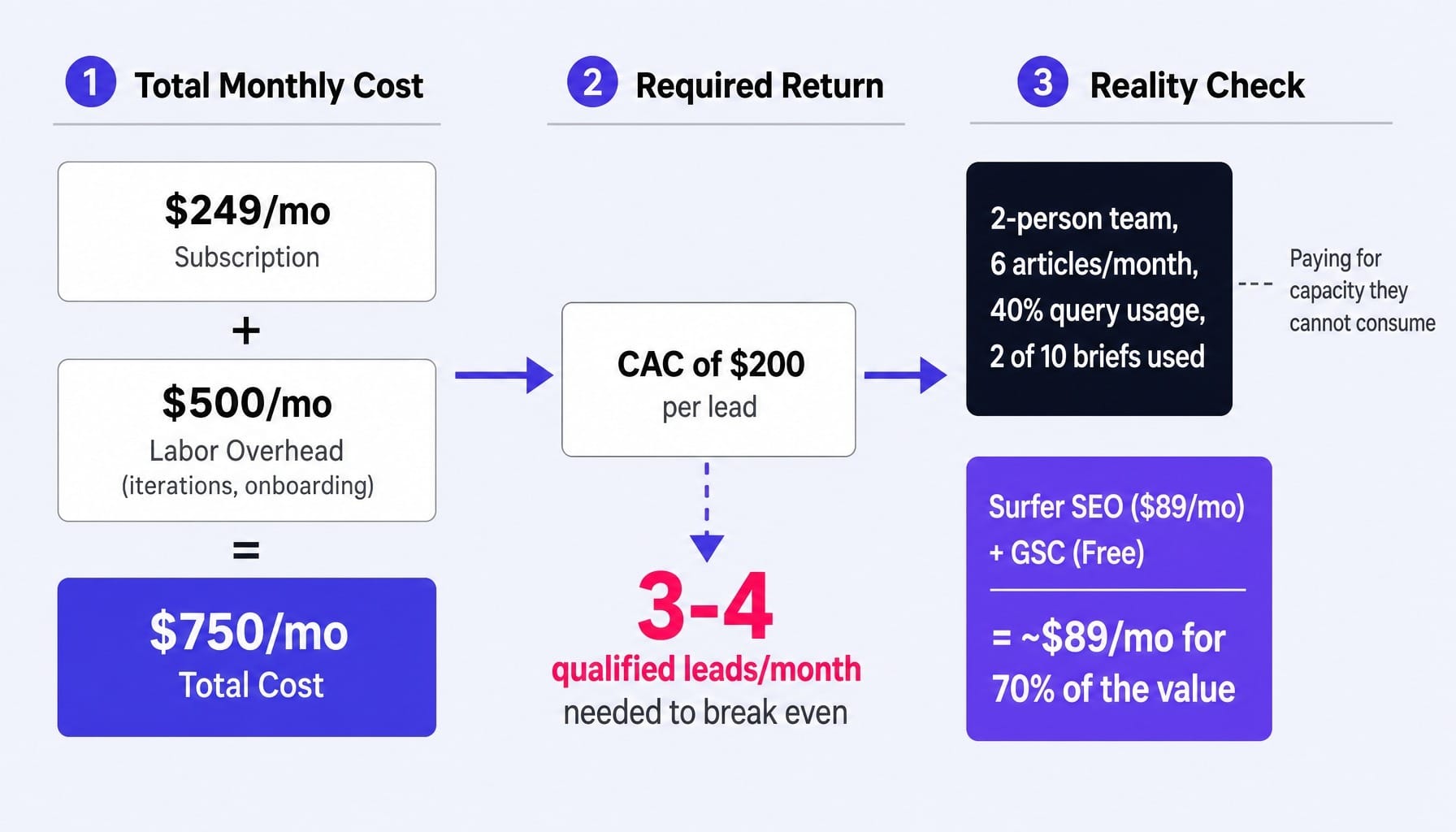
Consider this scenario: A 2-person marketing team at an $8M ARR SaaS company is on MarketMuse Research. They publish 6 articles a month. They only use 40% of their available query allocation and generate 2 briefs out of the 10 available. They are paying for system capacity they cannot consume. For this team, a lighter stack—like Surfer SEO for content scoring ($89/mo) paired with Google Search Console (free)—delivers 70% of the value at 20% of the cost. That is a more rational system design.
What If the Tool Also Did the Work?
This entire analysis highlights a fundamental friction in modern marketing: the gap between insight and execution. Tools like MarketMuse are powerful at identifying what needs to be fixed, but the cost and latency of acting on those insights fall entirely on your team. You pay for the subscription, then you pay again in labor, coordination, and the opportunity cost of a growing backlog.
This is the execution gap. What if it could be closed?
Spike AI is built on a different model. It's a marketing shipping engine that identifies the highest-impact move across your website, content, and SEO—and then executes it. The latency between identifying an opportunity and shipping the fix drops from weeks to days. The manual workflows that inflate the true cost of intelligence tools are replaced by a consistent, weekly release cadence.
For teams evaluating MarketMuse's $249-$499/mo price tag and wondering if they have the bandwidth to act on its recommendations, there's a more fundamental question to ask: what if the platform that identified the opportunity also deployed the fix?
See how Spike AI turns content insights into shipped results—every week
Is MarketMuse Worth the Cost?
The final verdict on MarketMuse pricing depends entirely on your team's operational maturity. Its content intelligence, particularly the Personalized Difficulty and Topic Authority modeling, is genuinely differentiated. It provides a strategic layer that tools like Surfer SEO lack.
However, that value only materializes if your team has the execution bandwidth to consistently act on its insights. For high-velocity content teams publishing 20+ pieces of content a month and building long-term topical authority, the premium can be justified.
For most lean teams, the total cost of ownership—subscription plus the labor to bridge the insight-to-action gap—makes it an expensive dashboard. For them, a lighter tool stack or a platform that closes the execution gap entirely is the more rational path. As the content optimization market continues to consolidate, evaluating tools based on their total cost of ownership, not just their sticker price, will be the defining skill of a successful content leader.
Frequently Asked Questions
Can you negotiate MarketMuse enterprise pricing, and what leverage do you have?
Yes. Since all paid plans are now quote-based, everything is negotiable. Your strongest leverage points are multi-year commitments (which can often unlock 15-25% discounts), annual prepayment, and the number of user seats you need. Arriving at the negotiation with a competing quote from a tool like Clearscope also provides a powerful price anchor.
What happens when you exceed your MarketMuse query credits mid-month?
On the Free and Optimize plans, you are simply locked out from running new analyses until your next billing cycle. There is no overage billing, just a hard stop that can halt your research workflow. On the Research and Strategy plans, this is not a concern as queries are unlimited.
Does MarketMuse offer annual billing discounts, and how much do you save?
Historically, MarketMuse offered a 15-17% discount for annual prepayment (e.g., the Optimize plan was $999/year instead of $1,188/year paid monthly). Post-acquisition, this discount is now part of the negotiated quote, but it's almost certainly still available. Always ask for both monthly and annual rates during your demo.
How much does MarketMuse cost for an agency managing multiple client domains?
MarketMuse's standard plans are designed for a single domain inventory. Agencies need a custom or enterprise plan to manage multiple client sites effectively. Historically, adding inventories was an add-on cost. For agencies with 5+ clients, the total cost can quickly become prohibitive, sometimes exceeding the cost of a dedicated content strategist.
How has MarketMuse pricing changed since the Siteimprove acquisition in 2024?
The most significant change is the removal of all public pricing from their website, shifting to a mandatory demo-and-quote model. The plan tiers were also renamed from "Standard" and "Premium" to the current four-tier structure. While features seem similar, the move suggests a push towards higher-value enterprise contracts, and the pricing floor has likely increased.