Best Profound Alternatives in 2026 — Matched to Your AEO Maturity Stage

TL;DR
- Choosing a Profound alternative is not a feature comparison exercise; it's a decision that must align with your team's AEO maturity stage.
- Profound's primary friction points are its tier-gated engine access, a growing insight-to-action gap for lean teams, and limited integrations that force manual work.
- Our AEO Maturity Framework helps you self-identify whether your bottleneck is visibility (Stage 1), prioritization (Stage 2), or execution (Stage 3).
- For many teams, combining a lightweight, affordable monitoring tool (like Otterly AI) with an execution-focused platform provides higher ROI than a single, mid-tier alternative.
- The teams that win in AI search won't have the most dashboards; they'll have the fastest, most consistent shipping cadence to act on the data those dashboards provide.
A growth marketer signs up for Profound's $99 Starter plan, eager to get a handle on their AI search visibility. They quickly discover a problem: they're only tracking a single AI engine. Visibility into what's happening on Claude, a critical engine for their audience, is locked behind an Enterprise paywall with no public pricing.
This is the tier-gating frustration that sends most teams searching for Profound alternatives. But the issue runs deeper than pricing. When AI visibility data sits in a dashboard that no one connects to content execution, the cost is not the subscription fee but the compounding opportunity loss as competitors answer the queries your brand should own. Many teams select tools based on feature parity, only to find the new platform creates the same problem: a dashboard full of data, and a backlog of recommendations that never get shipped.
This is not another list of ten tools with identical, templated reviews. It's a decision framework to match an alternative to your operational reality. We'll cover what Profound does well, where its design creates predictable friction, and which alternatives resolve those specific friction points based on where your team is today.
What Profound Does Well — And Why That Matters for Choosing an Alternative
You cannot evaluate alternatives intelligently without understanding what Profound actually does well. Most comparison articles, often written by competitors, conveniently skip this part.
Profound's primary strength is its proprietary prompt volume dataset, built from what they claim is over 400 million prompts from 1.5 billion real user conversations. No competitor can easily replicate this data moat, which gives Profound a unique, if directional, view into query trends.
Its second strength is the platform's ability to distinguish between URL citations and simple brand mentions within AI-generated text. This nuance helps analysts separate instances where an AI engine is directly sourcing from their content versus just referencing their brand name. For teams with Enterprise budgets and dedicated AEO analysts who can translate this data into action, Profound's high-end offering, which covers up to 10 AI engines, remains a formidable choice. Acknowledging these strengths is key, because it clarifies that Profound's weaknesses aren't bugs; they are deliberate design choices that you must weigh against your team's needs.
Where Profound Creates Friction That Sends Teams Looking Elsewhere
Profound's limitations are structural, creating predictable friction for specific team profiles. The issue isn't that the tool is "bad," but that its value is gated in ways that don't align with how most lean marketing teams operate.
Tier-Gating Locks Critical Engines Behind Enterprise Pricing
Profound's tiered model means most teams are making AEO decisions with incomplete data. A team on the $99/month Starter plan sees one engine. The $399/month Growth plan unlocks three. But what if your buyers are using Claude, Gemini Advanced, or Perplexity? Access to the full suite of 10 engines is reserved for Enterprise clients. The practical consequence is that you're optimizing for a fraction of your actual AI visibility surface, flying blind in the very channels you need to understand most.
The Insight-to-Action Gap Compounds Over Time
Profound is effective at telling you what's happening in AI search, but it stops short of helping you do anything about it. For a lean team, this creates a persistent state of "insight debt"—a growing backlog of visibility reports and optimization recommendations that nobody has the bandwidth to implement. You see the gaps, you know what needs to be fixed, but the dashboard just becomes another source of work your team can't get to. The problem isn't the data; it's the lack of an execution system connected to it.
Integration Gaps Force Manual Workflows
The platform's limited native integrations with common SEO, CMS, and analytics tools mean that acting on its insights is a fundamentally manual process. As many G2 reviewers note, teams are forced to export data into spreadsheets, cross-reference it with performance metrics from other tools, and spend hours triangulating signals. This "research tax" extends well beyond the subscription fee, consuming valuable operator hours that could be spent on higher-value work. An export format that organizes data by AI model, for instance, assumes an analyst is available to reshape it for an operator who needs to act on it.
Costs Scale Faster Than Value for Small Teams
This isn't just about price; it's a unit economics problem. For a two-person marketing team, paying $399/month for the Growth tier provides visibility data that still requires manual interpretation and execution in other tools. The total cost of ownership—the subscription plus the operator hours needed to make the data actionable—can quickly exceed the value derived. The tool's price tag is only the visible part of the expense; the real cost is the time spent trying to bridge the gap between its dashboard and your content calendar.
How to Match a Profound Alternative to Your AEO Maturity Stage
Most teams choose AI visibility tools based on feature grids and pricing pages. This is a mistake. The variable that actually determines success is your team's AEO maturity. I've seen this firsthand; when evaluating tools, a team with no AEO experience will gravitate toward the simplest dashboard, while a team with an established content ops cadence will reject that same tool because it doesn't feed into their existing automation. Same tools, opposite conclusions, dictated entirely by operational maturity.
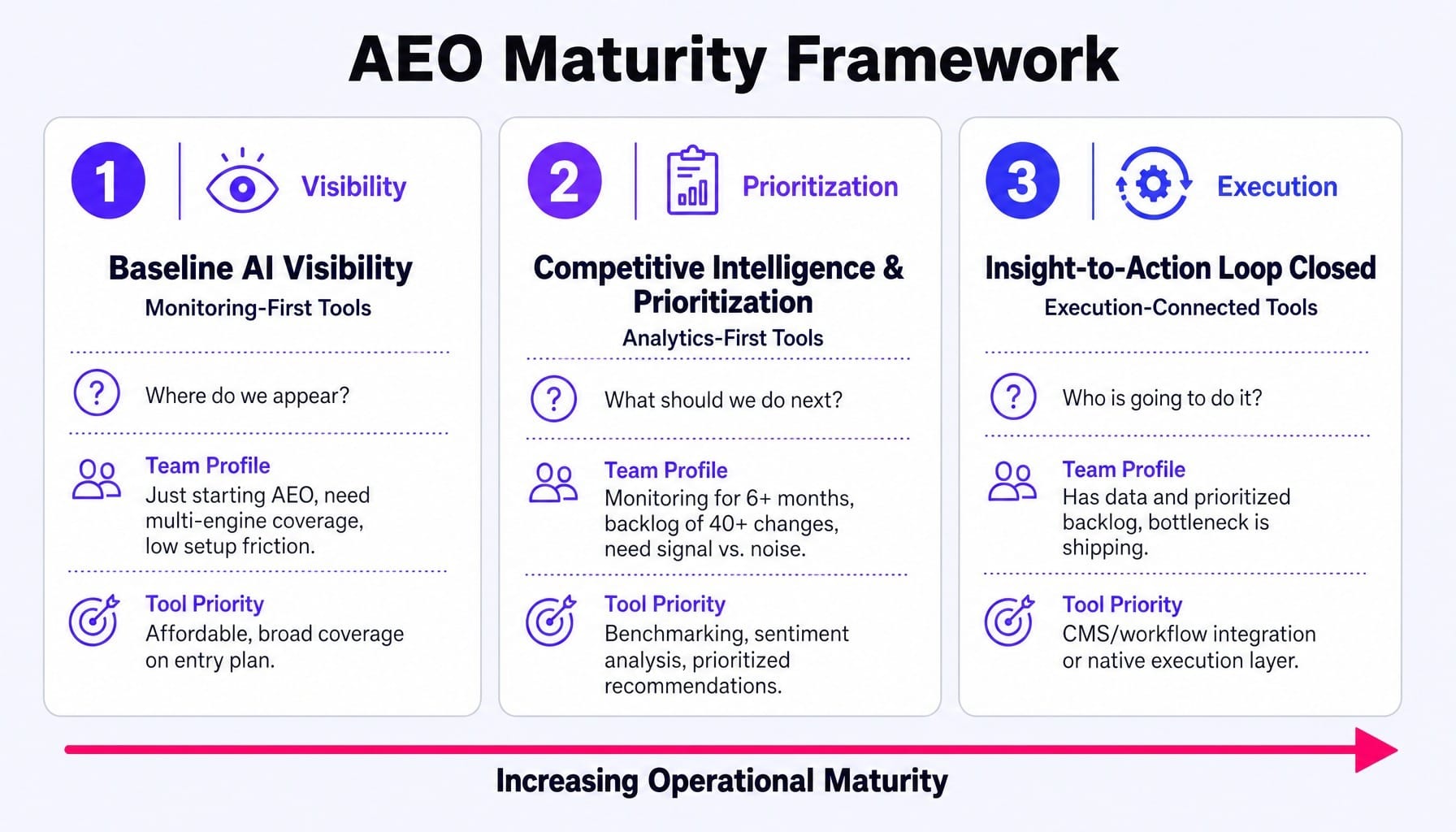
Use this framework to diagnose your stage and identify the right category of tool.
Stage 1: You Need Baseline AI Visibility (Monitoring-First Tools)
Your team profile is straightforward: you're just starting to explore AEO and need to answer the basic question, "Where does our brand appear—or not appear—across major AI engines?" You might be a Series A SaaS with one marketer who just realized your brand gets zero mentions in ChatGPT. At this stage, the right tool is lightweight, affordable, and focused purely on monitoring. Prioritize platforms that offer broad, multi-engine coverage on an entry-level plan and have low setup friction. Don't overpay for analytics or execution features you can't use yet.
Stage 2: You Need Competitive Intelligence and Prioritization (Analytics-First Tools)
You're already tracking AI visibility and have a baseline understanding of your presence. The problem now is signal vs. noise. Your team profile is a growth squad that's been monitoring for six months and now has a backlog of 40+ potential content changes with no clear sense of what to tackle first. The right tool at this stage moves beyond monitoring to offer competitive benchmarking, sentiment analysis, and some form of prioritized recommendations. The differentiator isn't more data; it's better logic for deciding what to do next.
Read more: How to Prioritize Marketing Channels With a Limited Budget And Resources (Framework for Lean Teams)
Stage 3: You Need the Insight-to-Action Loop Closed (Execution-Connected Tools)
You have the data. You even have a prioritized backlog. Your bottleneck is no longer "what should we do?" but "who is going to do it?" Your team feels the pain of insight debt daily. The right tool at this stage must either integrate deeply with your execution workflows (like your CMS or project management tool) or provide the execution layer itself. Most AI visibility platforms stop at Stage 2, which is why teams at this level of maturity often find that the solution isn't another monitoring tool at all. If your primary problem is shipping, not seeing, you've outgrown the category.
5 Profound Alternatives Worth Evaluating in 2026
The following tools are mapped to the maturity stage they serve best. This isn't a generic list; it's a curated set of options to resolve the specific friction points Profound creates.
Otterly AI — Best for Stage 1 Teams on a Budget
Otterly is the strongest entry point for teams that need multi-engine visibility without a $300+/month commitment. Its clear differentiator is affordability, offering tracking across four key AI engines for just $29/month. This makes it an ideal "Stage 1" tool for establishing a baseline understanding of your AI presence. However, its purpose is monitoring, not deep analysis. Teams will likely outgrow Otterly once they need competitive benchmarking, share-of-voice metrics, or prioritized action plans. Think of it as the right first tool, not the right only tool for your entire AEO journey.
- AI Engines: 4 (Google, Bing, Perplexity, You.com) on the entry plan.
- Pricing: Starts at $29/month.
- Free Trial: Yes, 7 days.
- Best For: Stage 1 teams needing affordable, baseline AI visibility.
Peec AI — Best for Stage 1-2 Teams Wanting Engine Flexibility
Peec AI's unique value is its flexible engine model. For a flat price starting around €89/month, you can pick any three AI engines to monitor. This gives you more control than fixed-tier platforms, which is useful if you know your audience over-indexes on specific engines like Perplexity or Claude. It also offers a Looker Studio integration, a practical plus for teams already using that ecosystem for reporting. The main limitation is the three-engine cap; you're still making coverage trade-offs. It provides more flexibility than a basic Stage 1 tool but lacks the analytical depth of a true Stage 2 platform.
- AI Engines: Choose any 3 on the entry plan.
- Pricing: Starts at €89/month.
- Free Trial: Yes, 14 days.
- Best For: Stage 1-2 teams that want to prioritize specific AI engines.
AthenaHQ — Best for Stage 2 Teams Needing Broad Coverage
For teams ready for Stage 2, AthenaHQ offers the broadest engine coverage available on a self-serve plan, tracking eight engines for $295/month. This makes it the strongest option for competitive intelligence across the full AI search landscape. You can benchmark your visibility against competitors and start to understand share of voice. The trade-offs are a high entry price and a credit-based billing system for certain actions, which can create unpredictable costs. With no free trial, it's a tool best justified when you have a clear AEO strategy and need comprehensive data to fuel it.
- AI Engines: 8 on the self-serve plan.
- Pricing: Starts at $295/month.
- Free Trial: No.
- Best For: Stage 2 teams focused on competitive intelligence and broad coverage.
Scrunch AI — Best for Stage 2 Teams with Technical AEO Needs
Scrunch AI differentiates on technical depth. Where other tools report on visibility outcomes, Scrunch provides crawler analytics and delivery controls to help you understand the mechanics of how AI systems access and process your content. This makes it the best choice for teams with deep technical SEO expertise who want to diagnose why they appear (or don't) in AI answers. Its limitations are significant for non-technical teams: it's Enterprise-only with no public pricing, and it diagnoses problems without offering any native execution capabilities. It's a powerful diagnostic tool, not a complete solution.
- AI Engines: Custom, based on Enterprise plan.
- Pricing: Enterprise only.
- Free Trial: Demo only.
- Best For: Stage 2 teams with technical SEO resources needing deep diagnostic capabilities.
SE Ranking — Best for Stage 1-2 Teams Already in an SEO Platform
SE Ranking's value proposition is consolidation. Its AI visibility tracking is an add-on to a broader SEO platform, reducing tool fragmentation for teams already using it for rank tracking and site audits. The key benefit is seeing correlations between your AI visibility and traditional SEO metrics within a single dashboard. The limitation is that AEO is an add-on, not the core product. The depth of AI-specific analytics is lighter than dedicated tools like AthenaHQ. It makes sense when you want AI data alongside your existing SEO workflow, not as a best-in-class standalone AEO platform.
- AI Engines: 5 with the AI Search add-on.
- Pricing: Core plan ($103/mo) + AI add-on (from $71/mo).
- Free Trial: Yes, 14 days.
- Best For: Stage 1-2 teams already using SE Ranking who want to consolidate tooling.
When Combining Two Specialized Tools Beats One All-in-One Platform
The search for "the one tool that replaces Profound" is often the wrong framing. For many teams, the more effective and economical approach is to combine a lightweight monitoring tool with an execution-connected platform.
Consider this: a lean marketing team pairs Otterly AI at $29/month for daily AI visibility tracking with an execution platform that can act on those insights. The combined cost is often significantly lower than a single $399/month Profound Growth subscription. More importantly, the insight-to-action loop is actually closed.
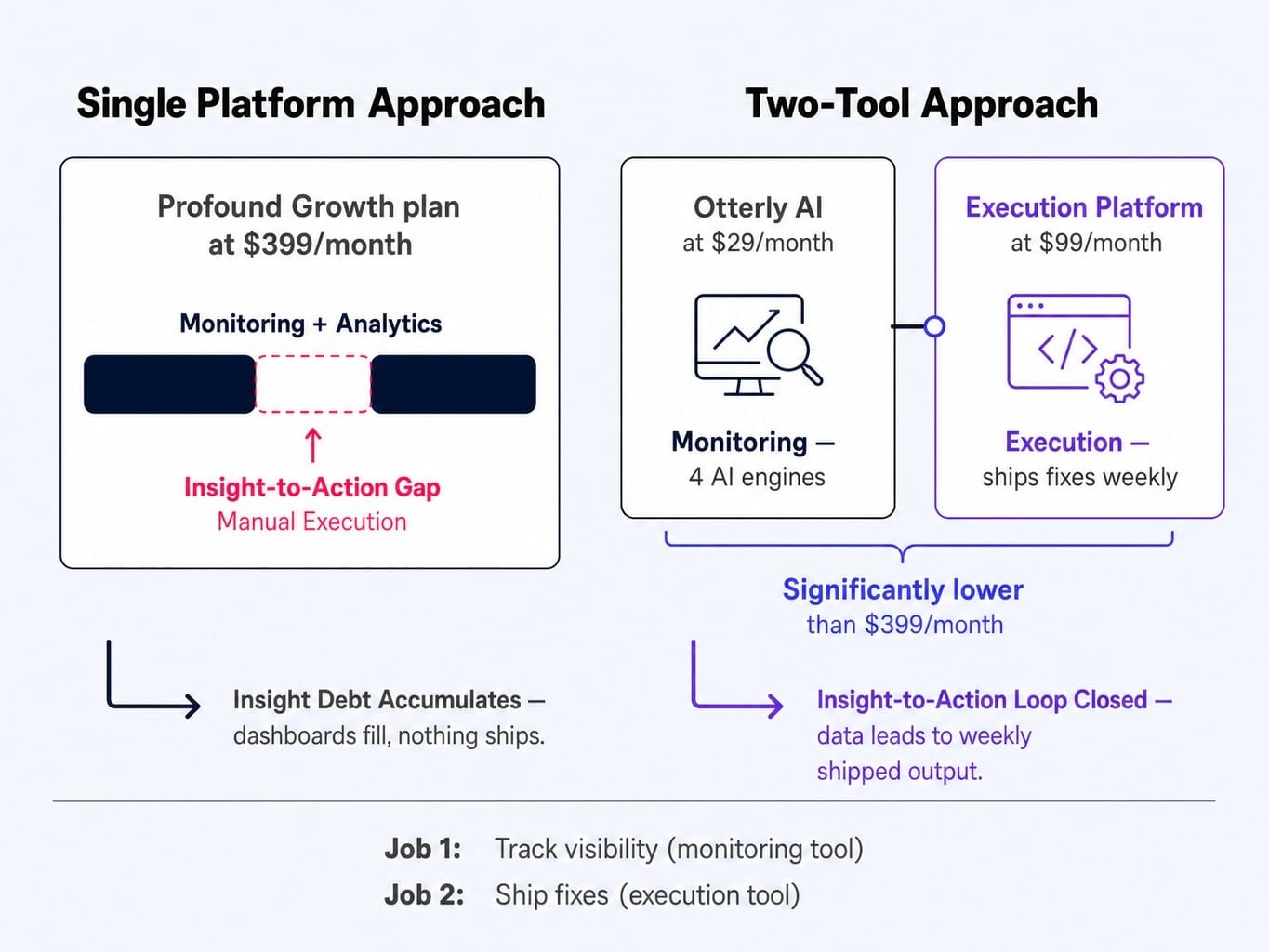
This model treats monitoring and execution as two distinct jobs requiring two specialized tools. The monitoring tool does what it does best: affordably track visibility across multiple engines. The execution platform does what monitoring tools can't: take the highest-priority visibility gaps—whether that's a missing citation, an underperforming piece of content, or conversion friction on a key landing page—and ship fixes. This approach directly attacks insight debt, ensuring that data leads to output, not just another dashboard.
Read more: B2B SaaS Marketing in 2026: The Execution Gap Most Teams Never Close
Closing the Gap Between AI Visibility Data and Shipped Changes
The tension is clear: AI visibility tools show you where you stand, but for lean teams, the bottleneck isn't seeing the data—it's acting on it. Insight debt accumulates. Dashboards fill up. Nothing ships.
Spike AI is designed to resolve this tension, not by adding another monitoring layer, but by providing the execution side of the equation. It's the Stage 3 complement to any AI visibility tool you use. Spike AI takes the prioritized gaps your monitoring tool surfaces—missing AI citations, underperforming content, conversion friction on pages getting AI-driven traffic—and ships fixes. Every week.
The platform functions as a marketing shipping engine. It identifies the highest-impact change to make across your website, SEO, or AEO, and then deploys it. The result is a closed-loop system where insights from your visibility tools are converted into a consistent shipping cadence. If the core problem is a backlog that never shrinks, the solution is a system that turns that backlog into weekly releases.
See how Spike AI turns your AI visibility gaps into weekly shipped improvements
Your Tool Should Match Your Bottleneck
Choosing a Profound alternative is not a feature-comparison exercise; it's a maturity-stage decision. Profound built a strong data moat, but its tier-gating and the insight-to-action gap it creates are real sources of friction. The right alternative depends entirely on whether your current bottleneck is seeing the landscape (Stage 1), prioritizing your next move (Stage 2), or actually shipping changes (Stage 3).
The teams that win in AI search over the next 12 months won't be the ones with the most comprehensive dashboards. They will be the ones that build the most consistent cadence for shipping improvements based on what those dashboards show. Your tooling choice should serve that cadence above all else.
Frequently Asked Questions
How do Profound competitors handle LLM hallucination risk in their AI visibility data?
Most tools mitigate this by running prompts multiple times and averaging results, but methodologies vary. When evaluating, ask if the tool distinguishes between verbatim citations (URL is sourced) and brand mentions (name appears without a link), as conflating the two can mask hallucinated references and inflate visibility scores.
Do any Profound alternatives integrate directly with existing research repositories or CMS platforms?
Most AI visibility tools offer limited native integrations. SE Ranking connects to GA and GSC, Peec AI integrates with Looker Studio, and AthenaHQ offers API access. None currently provide deep, out-of-the-box CMS integration. If this is critical, evaluate the tool's API to see if you can build a connection via middleware.
What does it actually cost to migrate away from Profound to an alternative?
The direct cost is low, as most tools generate their own data. The hidden cost is losing historical trend data, which is not portable. Before canceling, export your historical reports and plan for a 2-3 month overlap period where you run both tools to establish a comparable baseline in the new platform.
Are there any free or open-source alternatives to Profound for AI visibility tracking?
No fully open-source alternative replicates Profound's multi-engine monitoring at scale. For teams with engineering resources, it's possible to build a basic tracker by querying AI APIs directly, but maintaining this across model updates is a significant, ongoing engineering burden that rarely makes sense for a marketing team to own.
Which Profound alternative offers the fastest time-to-insight for ad hoc visibility checks?
Otterly AI and Peec AI offer the fastest setup-to-report experience, typically under 30 minutes. For a quick, one-off check without creating an account or starting a trial, some free rank-tracking tools offer limited AI visibility scans that can provide a directional snapshot in minutes.