Rytr Review 2026: What It's Actually Good For (And Where It Wastes Your Time)

TL;DR
- True Cost: Rytr's $9/month "unlimited" plan is misleading. After factoring in a 30-40% first-draft usability rate and the cost of your editing time, the true cost-per-publishable-word is significantly higher than the sticker price.
- Best Use Cases: Rytr excels at high-volume, short-form copy (social posts, ad headlines, email subjects) and as a content ideation/editing layer. Do not use it for long-form content.
- Architectural Flaw: Rytr fails at long-form content due to a limited context window. The "Continue Ryting" feature lacks memory, leading to repetition and incoherence that no amount of prompt engineering can fix.
- The Verdict: Rytr is worth it for solopreneurs and marketers needing a cheap, fast tool for formulaic short-form tasks. For SEO-driven content, factual accuracy, or team collaboration, you need a different tool.
- The Bigger Problem: Even with the perfect AI writer, the gap between published content and actual conversions remains. The real bottleneck isn't content production; it's optimizing that content to drive business outcomes.
Rytr's pricing is a masterclass in marketing. At just $9 per month for unlimited generations, it seems like an obvious, almost irresponsible-to-ignore choice for any content marketer. But that sticker price masks a hidden cost: your time.
The real question isn't whether Rytr can generate words—it can. The question is how much time you'll spend editing, restructuring, and fact-checking those words before they're publishable. Does it actually reduce your content production time, or does it just shift the bottleneck from writing to a grueling editing slog?
This is not another feature walkthrough. This is an honest assessment of whether Rytr is worth it in 2026, based on testing against real content briefs. We'll calculate its true cost-per-publishable-word, identify the specific use cases where it delivers genuine value, and show you exactly where it breaks down and wastes your time.
What Rytr Is — and What It Isn't
Rytr is a template-driven AI writing assistant built for high-volume, short-form content generation—not a long-form content engine. This distinction is critical. Unlike platforms like Jasper or Surfer SEO that aim to be end-to-end content solutions, Rytr is optimized for speed on small, specific tasks.
The workflow is straightforward: you select from over 40 use-case templates (like 'Email' or 'Product Description'), choose a tone, provide a brief input, and Rytr generates several short variants. With a claimed 8 million users, it has clearly found a market. But user count doesn't tell you about retention or satisfaction.
Under the hood, Rytr uses GPT-based models. However, it doesn't disclose the specific versioning or how frequently the model backbone is updated. This opacity matters. The quality and sophistication of any AI writer's output are directly tied to the freshness of its underlying model. You should understand that Rytr is a template-first tool designed for velocity on short-form copy, not a replacement for a content strategist or a writer tasked with creating in-depth articles.
Rytr Pricing — and the Cost Nobody Calculates
Rytr's pricing seems unbeatable, but the sticker price is misleading if you don't account for the human-in-the-loop editing ratio. Most reviews list the tiers and stop. We're going further to calculate what a publishable word actually costs.
What Each Plan Actually Includes
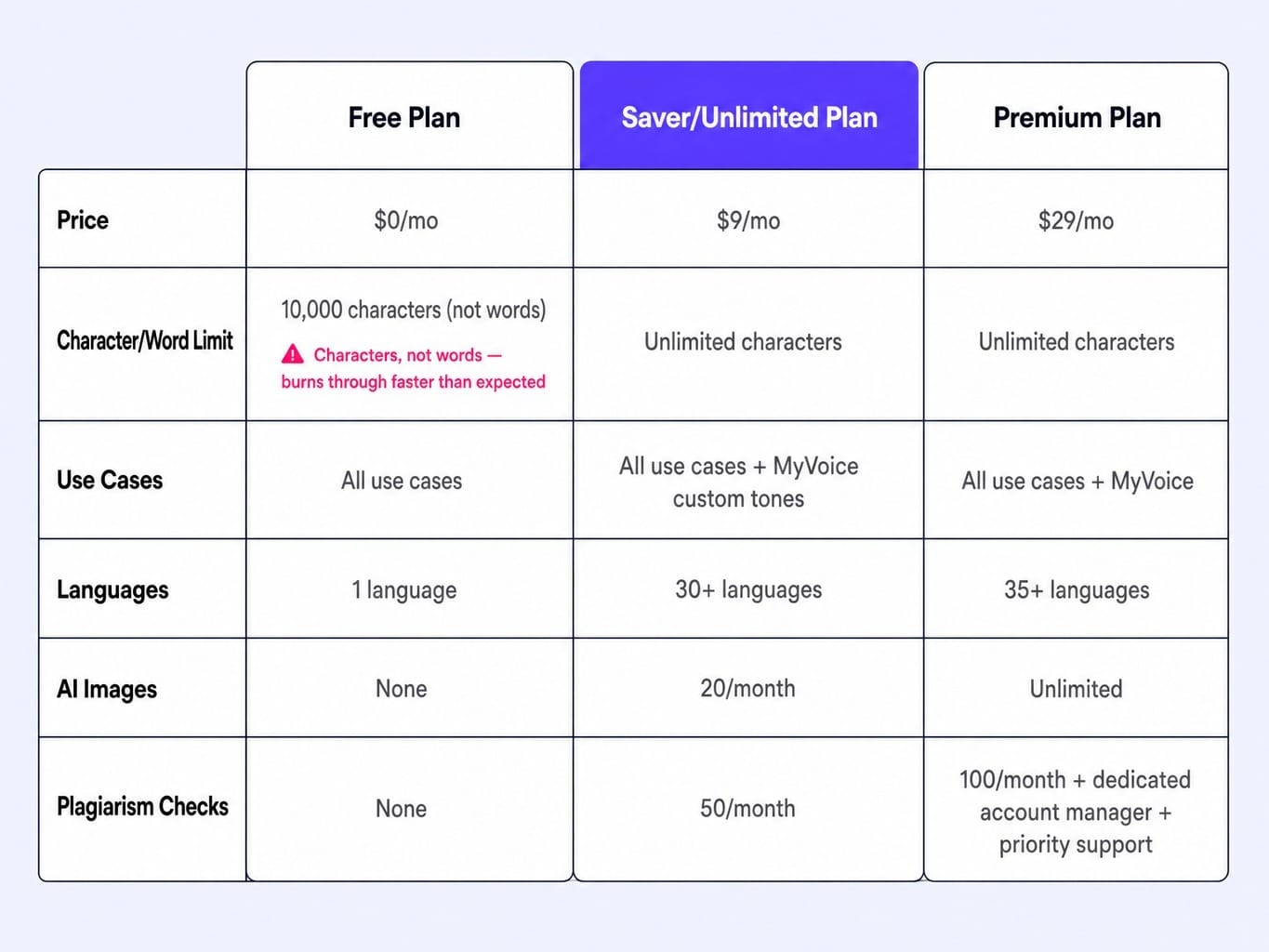
Rytr's pricing is broken into three main tiers. It's important to note that the free plan counts characters, not words—a small but significant detail that can burn through your limit faster than you'd expect.
- Free Plan: $0/month for 10,000 characters (not words) per month, access to all use cases, and 1 language. A decent trial, but the character limit is restrictive for anything more than occasional use.
- Saver/Unlimited Plan: $9/month for unlimited characters, the ability to create custom tones with the MyVoice feature, 20 AI-generated images, and 50 plagiarism checks per month. This is the plan most users consider.
- Premium Plan: $29/month adds support for 35+ languages, 100 plagiarism checks, a dedicated account manager, and priority support.
The Real Cost-Per-Publishable-Word After Editing
Here's the argument most Rytr reviews miss. "Unlimited generations" does not mean unlimited content. Our testing, consistent with findings across other hands-on reviews, shows that Rytr's first-draft usability for anything beyond simple ad copy hovers around 30-40%.
Let's do the math.
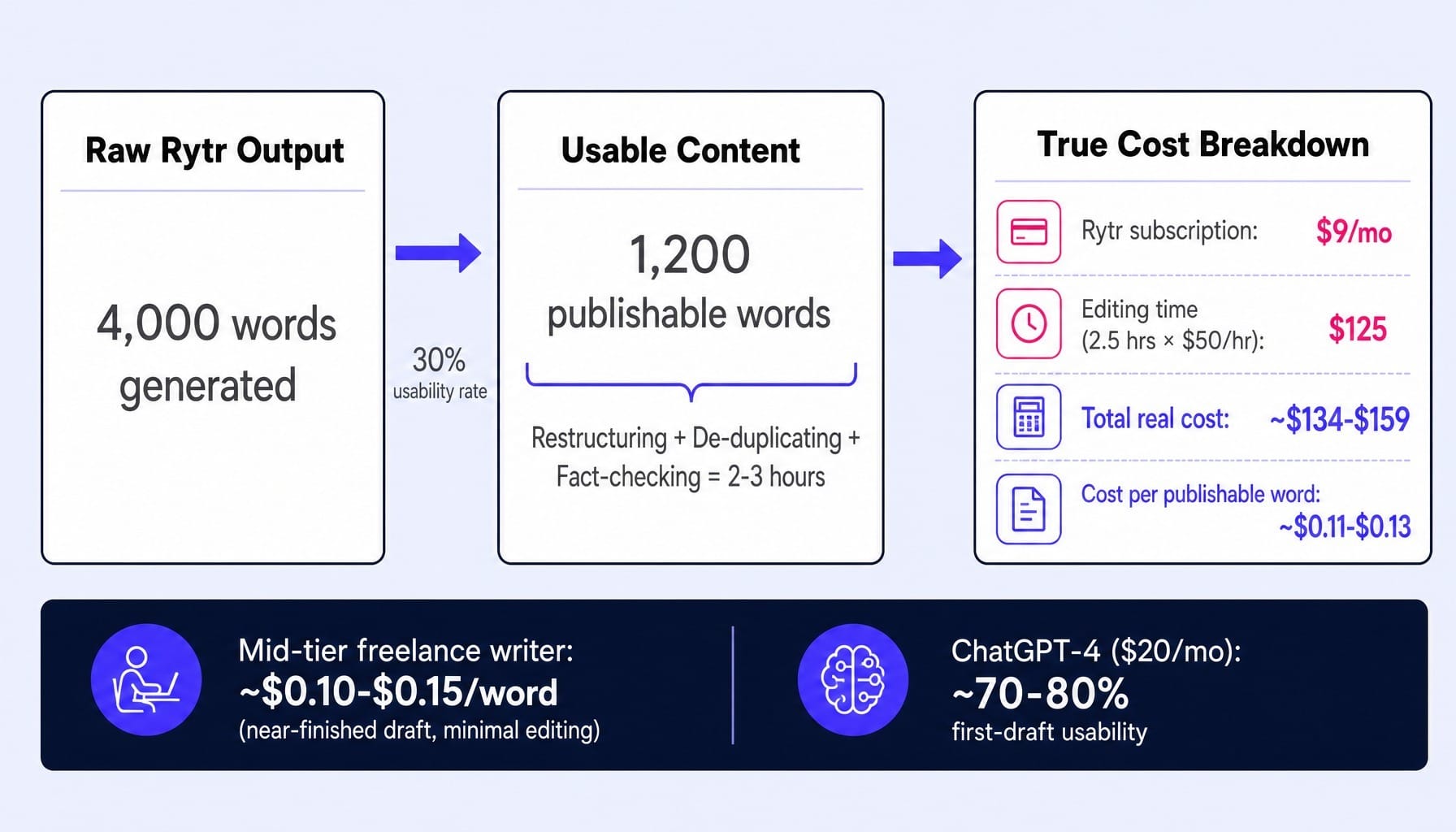
Imagine you need a 1,200-word blog post. To get that, you might generate 4,000 words of raw Rytr output. If only 30% is usable, that's your 1,200 words. But getting it there requires significant human intervention: restructuring disjointed paragraphs, fixing repetitive phrasing, and verifying every factual claim. This can easily take 2-3 hours.
If your effective hourly rate is $50, you've just spent $100-$150 in time on top of your $9 subscription. Your "cheap" 1,200-word article now has a real cost of over $159, or about $0.13 per publishable word.
Suddenly, that's on par with a mid-tier freelance writer who delivers a near-finished draft, and more expensive in terms of time than using a more advanced tool like ChatGPT-4 ($20/month) where better prompting can yield 70-80% first-draft usability. The sticker price is a lure; the real cost is in your editing time.
Where Rytr Genuinely Saves You Time
Rytr's value proposition is strongest when you stop trying to make it something it's not. The mistake most users make is evaluating Rytr against long-form content needs and then calling it bad. It's not bad—it's misapplied. When used for its intended purpose, it can be a genuine time-saver.
For a solopreneur who needs to generate 20 LinkedIn post ideas, 10 email subject lines, and 5 Google Ad headlines in an afternoon, Rytr's template-first approach is significantly faster than trying to craft perfect prompts in a general-purpose tool like ChatGPT. This is Rytr's sweet spot.
Short-Form Copy: Emails, Ads, Social Posts
Rytr's template library is genuinely effective for formulaic short-form content. Tasks like generating AIDA or PAS framework copy, email subject lines, social media captions, and basic product descriptions are where it shines. For these formats, the output is often 70-80% usable right out of the box because the templates act as guardrails, constraining the AI's tendency to ramble.
For example, using the 'Email' template with a 'Convincing' tone to generate three variants of a cold email intro produces serviceable drafts that only require light personalization. The 20+ built-in tone options, plus the ability to create custom profiles with MyVoice on paid plans, add real value here. They reduce the editing overhead required to align the copy with your brand voice, which is a tangible benefit for high-volume social media and email marketers.
Ideation and Editing: The Underrated Workflow
Perhaps the most underrated use case for Rytr isn't content generation at all—it's content ideation and refinement. Instead of asking it to be the writer, you use it as a brainstorming partner and an editing assistant.
The 'Blog Idea & Outline' template can produce decent structural starting points that you can then flesh out yourself. More powerfully, the 'Improve' and 'Rephrase' commands are surprisingly useful for tightening up existing prose. If you have a clunky paragraph you wrote, pasting it into Rytr and hitting 'Improve' often yields a more concise and readable version.
This reframes Rytr's limitations. If you're not asking it to produce a finished draft, its struggles with long-form coherence become irrelevant. Thinking of Rytr as an ideation layer and a polishing tool, rather than a drafting tool, is a workflow that many users miss.
Where Rytr Breaks Down — and Why
Rytr's limitations aren't bugs; they're architectural. The tool is designed to generate content in short, isolated bursts. Crucially, it struggles to maintain context across these generations. Every time you click 'Continue Ryting' to expand a piece of content, the AI essentially starts with a very limited memory of what came before.
Understanding this single architectural choice explains almost every common complaint about the tool's output quality. It's not just a list of separate problems; it's one root cause with multiple symptoms.
For instance, a marketer trying to generate a 1,500-word blog post will quickly run into trouble. By the fourth or fifth generation, the AI will start repeating points from earlier paragraphs, introduce a claim that contradicts something it said on the first screen, or shift its tone from professional to casual mid-sentence. The user then spends more time untangling the mess than they would have spent writing from scratch.
Long-Form Content: The Context Window Problem
Rytr fails at long-form content because of its narrow context window. Unlike conversational AIs like ChatGPT or Claude, where the model's memory grows with the conversation, Rytr's generation model processes each request with minimal memory of previous outputs. This is a deliberate design choice that prioritizes speed on short tasks over coherence on long ones.
This is the technical reason behind the hallmark failures of its long-form output:
- Topic Drift: The content veers off into unrelated sub-topics.
- Repetition: The same phrases or ideas appear multiple times.
- Contradictions: Claims made in one paragraph are contradicted in another.
- Tonal Inconsistency: The voice and style shift unpredictably.
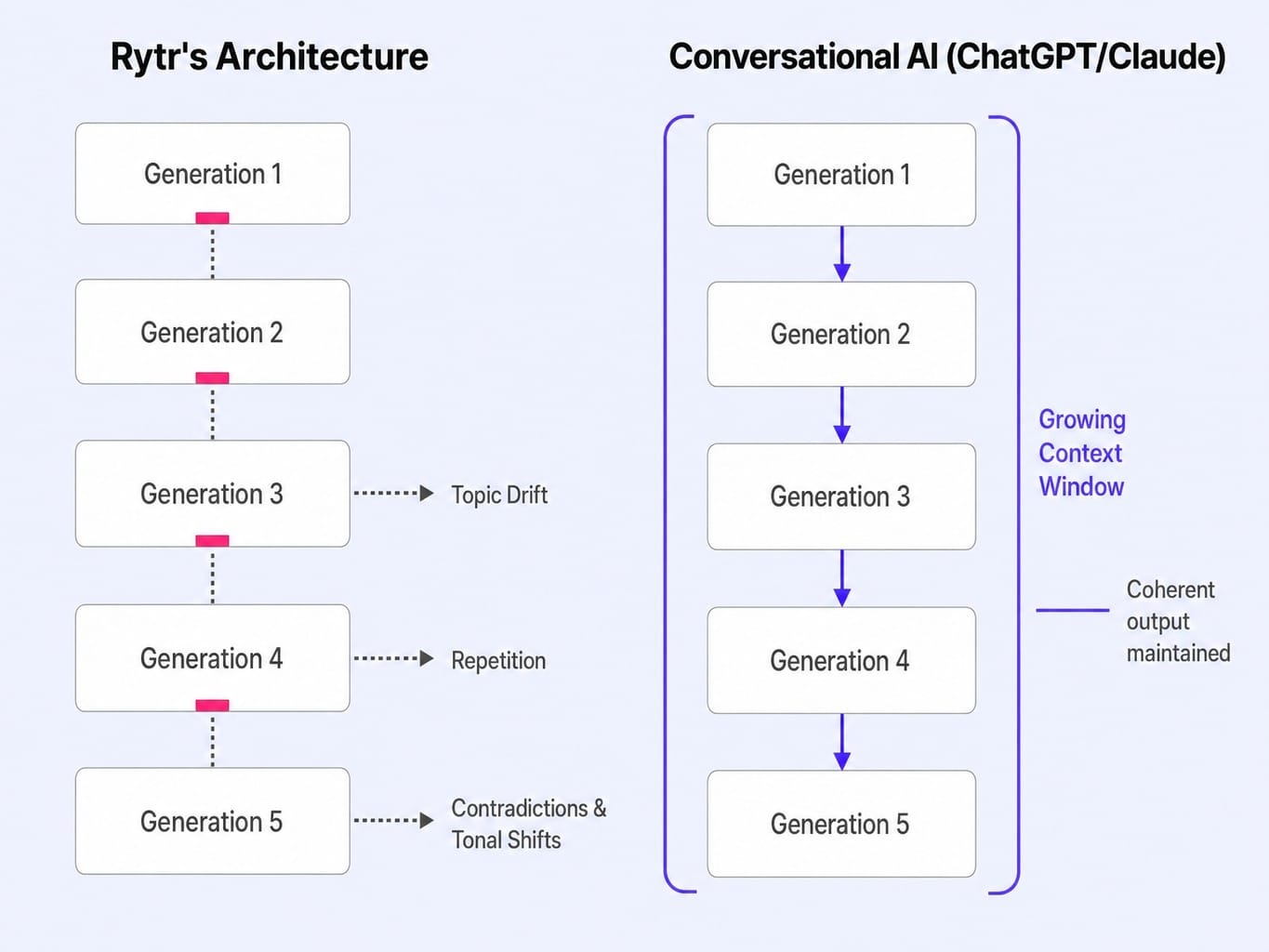
No amount of clever prompting within Rytr will fix this. The constraint is built into the tool's architecture. If you need a coherent article over 500 words, Rytr is not the right tool for the job.
Factual Accuracy and SEO Readiness: What's Missing
Two other critical gaps make Rytr a poor choice for serious content marketing. First, factual accuracy is a major concern. The tool provides no citation support, no source linking, and no internal fact-checking. The output hallucination rate is high enough that every statistic, date, or name requires manual verification, adding another layer to the editing burden.
Second, its SEO readiness is low. While Rytr has features like a 'Keywords Extractor', they are rudimentary. They lack essential data like search volume, keyword difficulty, and competitor analysis. One reviewer aptly described the SERP analyzer as "more like an afterthought than a core feature." To make Rytr's output competitive in search, you must pair it with dedicated SEO tools like Surfer SEO or Frase, further increasing your total cost and workflow complexity.
When the Problem Isn't the Writing Tool — It's the Gap Between Content and Conversions
This entire Rytr review highlights a critical tension. AI writing tools can help you produce more content, faster. But for B2B marketing teams, the real bottleneck isn't producing words—it's turning those words into measurable business outcomes.
Even with the perfect AI writer, you still face the execution gap. You have pages that rank but don't convert, copy that reads well but doesn't move visitors to act, and a growing backlog of optimization tasks that never get shipped. This is the problem that stalls growth, not a lack of content.
Read more: Data-Driven CRO: Evolve Your Marketing Strategy for Revenue | Spike AI
Spike AI operates on the other side of this gap. It's not another writing tool. It's the execution engine that works after your content is published. Every week, Spike AI identifies the highest-impact move across your website, SEO, and conversion funnel—then executes it. It closes the loop between your content and your revenue goals. Where Rytr helps you produce content, Spike AI ensures that content actually performs.
See how Spike AI turns published content into compounding conversions
Rytr vs. The Alternatives That Actually Compete With It
Comparing Rytr to every AI tool is pointless; they serve different needs. The real question is how it stacks up against the tools a prospective Rytr user is most likely considering.
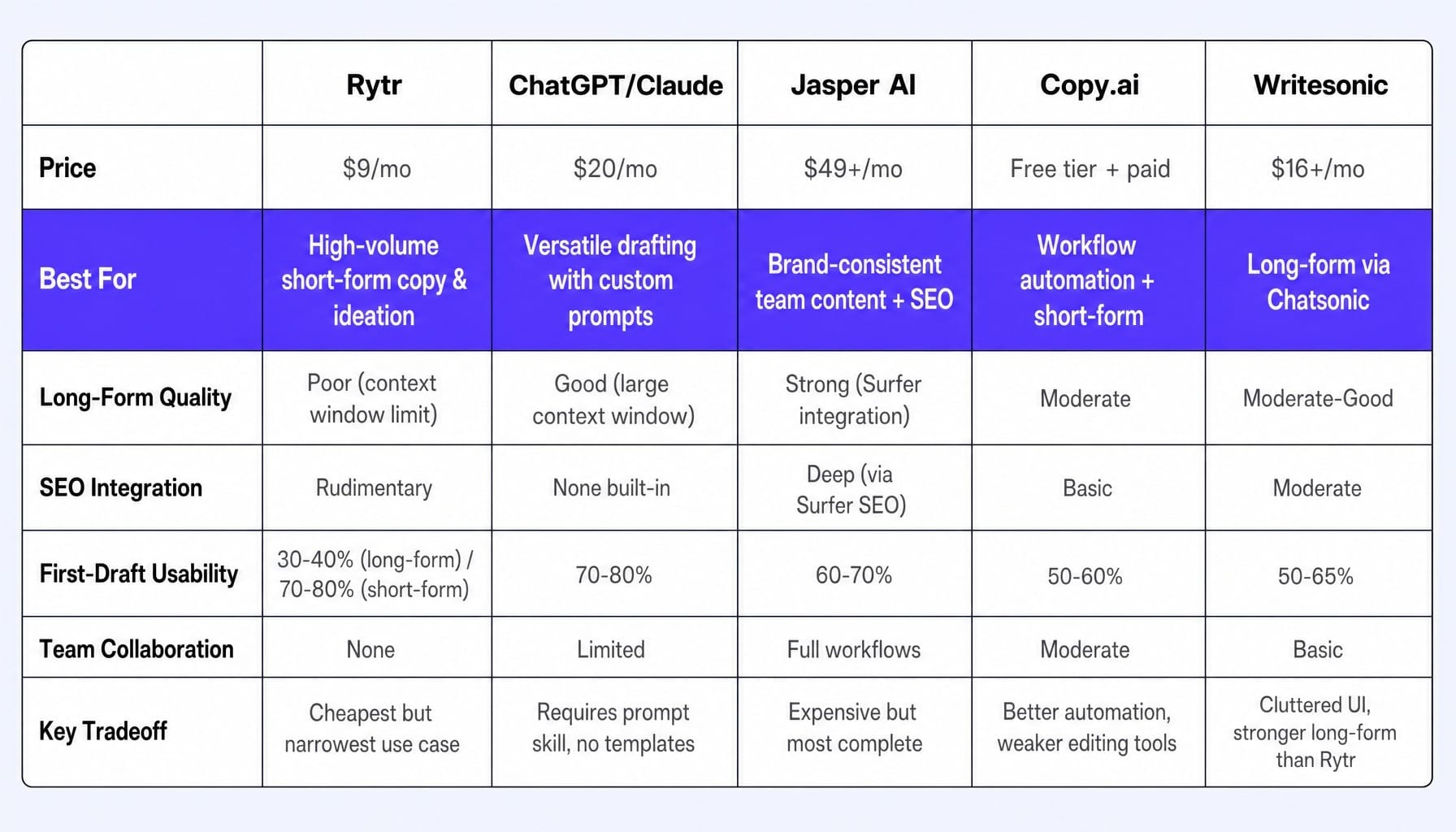
- vs. ChatGPT/Claude: If you're already paying $20/month for ChatGPT Plus or using Claude, Rytr's value is marginal. With custom instructions and better prompting, these general-purpose models offer higher first-draft usability and have the large context windows needed for long-form content that Rytr can't handle.
- vs. Jasper AI: This isn't a fair fight. If you need brand voice consistency across a team, deep SEO integration (via Surfer), and reliable long-form content, Jasper's higher price ($49+/month) is justified. Rytr simply doesn't compete in this category.
- vs. Copy.ai: This is Rytr's closest competitor. Copy.ai's free tier is slightly more generous, and its workflow automation features are more robust. However, Rytr's dedicated editing tools ('Improve', 'Rephrase') are better for refining existing content. It's a toss-up based on which workflow you prioritize.
- vs. Writesonic: At a similar price point ($16+/month), Writesonic offers stronger long-form capabilities through its Chatsonic feature. However, its interface is more cluttered than Rytr's clean, simple design.
Read more: Jasper vs. Copy.ai: A Practitioner's Breakdown of What Each Tool Actually Delivers in 2026 | Spike
The Decision Rule: Choose Rytr if you are a solopreneur or marketer who needs a fast, cheap tool for high-volume short-form copy and ideation, and you're already using a separate, dedicated tool for SEO and long-form content. If content quality, SEO integration, or long-form coherence is your primary need, choose something else.
The Verdict: Is Rytr Worth It in 2026?
The question was never simply "is Rytr good?" It was "is Rytr good for what you specifically need?"
Rytr is a useful tool with a narrow sweet spot. If you need to generate a high volume of short-form copy—social posts, ad headlines, product descriptions—and you treat it as an ideation and editing assistant rather than a finished-product engine, then the $9/month subscription is easily justified. Its simplicity and speed are its greatest assets.
But it is not a content strategy, not an SEO tool, and not a replacement for a writer who understands your audience. If you need long-form, SEO-ready, factually accurate content, you need a different tool or a different system entirely. For teams evaluating other options, exploring Writesonic alternatives or reviewing a thorough Jasper AI review can help clarify which tool fits your actual workflow.
As AI writing tools continue to converge on similar capabilities, the differentiator for marketing teams won't be which tool generates the words. It will be which system turns those words into measurable, compounding growth.
Frequently Asked Questions
Does Rytr content pass AI detection tools like Originality.ai in 2026?
Rytr's output is consistently flagged by modern AI detectors like Originality.ai and GPTZero. Its template-driven style produces linguistic patterns that these algorithms easily identify. If avoiding AI detection is critical for your work—for academic submissions or specific publication guidelines—plan on substantial manual rewriting, which erodes the tool's time-saving benefit.
Can Rytr handle multilingual content for international markets?
While Rytr supports over 30 languages on its paid plans, the output quality drops significantly outside of English. Our tests show that languages with smaller training data sets (e.g., Dutch, Polish, Thai) produce more awkward phrasing, grammatical errors, and factual inaccuracies. For serious multilingual campaigns, you must test the output quality in your target language before committing.
Has Rytr updated its underlying AI model recently?
Rytr does not publicly disclose its model versioning or update cadence, making it difficult to assess if output quality is keeping pace with the market. Competitors like Jasper and Writesonic are often more transparent about adopting newer model architectures. If using a frontier model is important to you, Rytr's opacity is a significant risk factor to consider.
Is Rytr good enough to replace a freelance copywriter?
For highly formulaic, high-volume short-form copy (like generating 50 ad variants), Rytr can replace a junior copywriter. For any task requiring deep audience understanding, strategic messaging, brand nuance, or factual research, it cannot. The more specialized your content needs are, the less useful Rytr becomes as a replacement versus a supplement.
Does Rytr scale for content teams or is it only for solopreneurs?
Rytr is built for individual use. It lacks the core collaboration features—such as shared workspaces, approval workflows, or role-based access—that are necessary for content teams. Platforms like Jasper and Copy.ai are designed for team environments. While Rytr's Premium plan offers a dedicated account manager, the tool itself will create friction and coordination overhead if used by a team.