7 SaaS Content Marketing Examples That Actually Drove Pipeline (Not Just Traffic)

TLDR
- The best SaaS content marketing examples are systems that drive pipeline, not just isolated assets that generate traffic. Prioritize content that directly replaces or shortens a sales conversation.
- Focus on bottom-of-funnel (BOFU) and middle-of-funnel (MOFU) content first. This includes comparison pages, use-case landing pages, and product-led blog posts that target users with buying intent.
- Build a content decay audit into your monthly cadence. Refreshing an existing, high-intent page that's losing traffic is almost always higher ROI than creating a new page from scratch.
- Programmatic SEO (pSEO), community-generated content, and free tools can be powerful content moats that are difficult for competitors to replicate with editorial content alone.
- Content marketing success is an execution problem. The difference between a content program that stalls and one that compounds is the consistency of the shipping cadence.
Most SaaS content marketing example articles celebrate the wrong things. They show you HubSpot's blog or Shopify's resource center and point to massive traffic numbers that, for the most part, never connected to a single closed deal. SaaS content marketing examples worth studying share one trait: the content directly influenced revenue, not just traffic.
The real wins are where content replaces a sales conversation, shortens a buying cycle, or becomes the product's primary acquisition channel. The pattern connecting them isn't a single brilliant article; it's a system. A repeatable process where every piece of content compounds on the last.
This isn't another roundup of vanity content. Here are 7 examples selected for their pipeline impact, the specific mechanic that made each one work, one expensive anti-example to learn from, and a 4-step process to build your own compounding content engine.
What Separates a Pipeline-Driving SaaS Content Example from a Vanity One
SaaS content marketing examples are real instances of software companies using content—blog posts, tools, comparison pages, educational resources—to attract, convert, and retain customers. But most roundups select examples based on traffic volume or brand recognition. Traffic without pipeline attribution is a vanity metric.
The examples in this article were selected based on three stricter criteria:
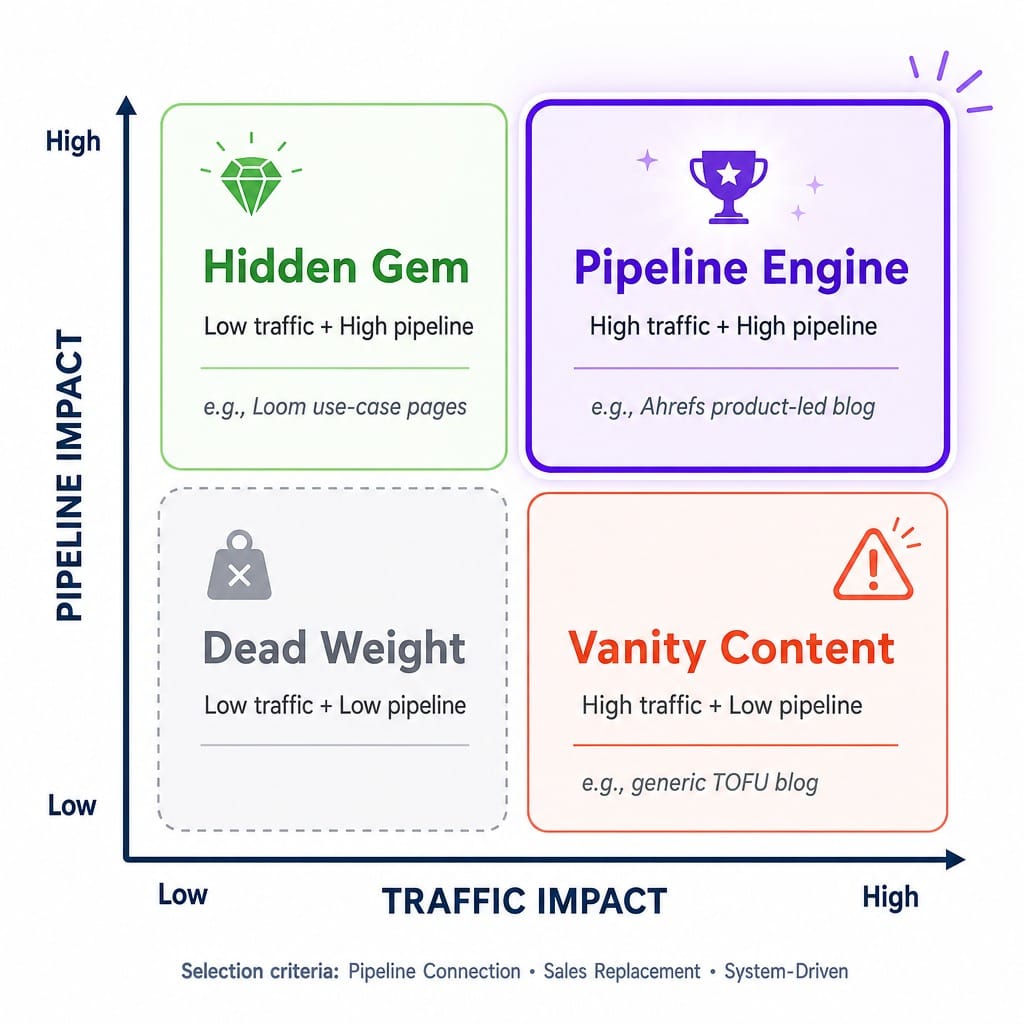
- Pipeline Connection: The content had a measurable connection to signups, pipeline, or revenue—not just organic sessions.
- Sales Replacement: The content replaced or shortened a human sales interaction by answering a critical buying question or demonstrating product value.
- System-Driven: The content was part of a repeatable system, not a one-time viral hit that couldn't be replicated.
Consider the contrast: Shopify's blog gets millions of visits, but a huge portion of that traffic comes from informational queries by people who will never buy Shopify. Compare that to Ahrefs' product-led blog posts, where every article demonstrates the tool solving a real problem, creating a direct and measurable path to signup. One is a traffic asset; the other is a sales engine.
7 SaaS Content Marketing Examples That Moved Pipeline
These seven examples were selected using the criteria above. Each represents a different content type and a different stage of the SaaS buyer journey, but all of them are built to do more than just attract eyeballs.
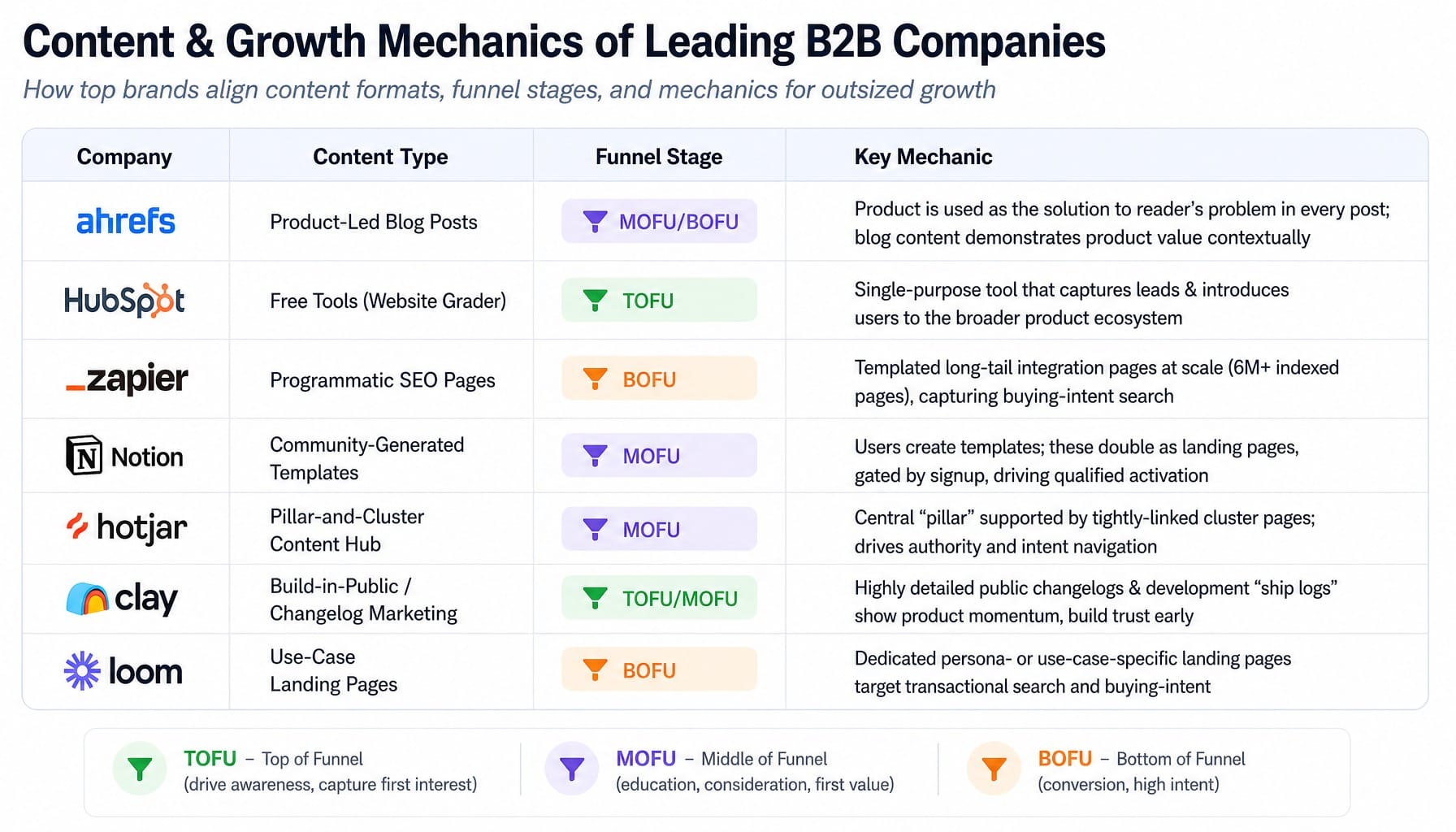
Ahrefs: Product-Led Blog Posts That Replace Sales Demos
Ahrefs built a business doing over $40M in ARR with virtually zero paid advertising. Their blog isn't just a marketing channel; it's their primary sales engine.
The mechanic is a masterclass in product-led content. Every blog post starts with a genuine problem their target audience faces (e.g., "how to do keyword research") and then walks through the solution using the Ahrefs tool. The content is filled with screenshots, step-by-step instructions, and real data pulled directly from the product. The reader doesn't just learn about a topic; they see the product in action and experience its value before they ever sign up. This isn't a sales pitch disguised as a blog post; it's a self-serve demo.
The transferable principle: If your content can show the product solving the reader's exact problem, you don't need a sales demo to convert them.
Read more: B2B SaaS Content Writing: How to Write Content That Moves Pipeline, Not Just Traffic | Spike AI
HubSpot: Free Tools as Top-of-Funnel Content That Captures Leads at Scale
While everyone knows HubSpot's blog, their most powerful content plays are their free tools. The Website Grader, which has been used by millions, is a prime example.
The mechanic is simple but profound: create a free tool that solves one narrow, high-value problem for your ideal customer profile (ICP) and requires an email to use. The Website Grader gives a free website analysis and, in exchange, captures a lead and introduces them to the HubSpot ecosystem. This single asset ranks for thousands of keywords related to website performance and generates leads passively, 24/7. It's a content asset that functions like a product. Canva's free design tools and suites follow this exact same pattern, creating a massive top-of-funnel that converts users into paying customers.
The transferable principle: Building a free, single-purpose tool that solves a tangible problem in your ICP's workflow is often higher-ROI than writing 100 blog posts.
Zapier: Programmatic SEO Pages That Own Long-Tail Intent
Zapier has over 6 million pages indexed in Google, and they didn't write them all by hand. They executed one of the most effective programmatic SEO (pSEO) strategies in SaaS.
The mechanic involved creating templated pages for every possible integration their product supports. A page for "Connect Slack to Google Sheets," another for "Connect HubSpot to Asana," and millions more. Each page is a unique landing page targeting a high-intent, long-tail search query. By creating a pSEO template that pulled in dynamic data for each integration (logos, descriptions, popular "Zaps"), they systematically captured a massive volume of BOFU search traffic that would be impossible to target with manual, editorial content.
The transferable principle: If your product connects to other tools or serves thousands of distinct use cases, programmatic pages targeting "[your product] + [integration/use case]" can capture demand at a scale you'll never reach with blog posts alone.
Notion: Community-Generated Templates as a Content Moat
Notion's template gallery is one of the most brilliant and underrated SaaS content plays. It's a content moat built by their own users.
The mechanic was to empower their community to create, share, and even sell Notion templates. This decision turned their user base into a massive, distributed content engine. Each user-submitted template became a unique piece of content, a landing page that ranks for specific use-case queries like "content calendar template" or "personal CRM for Notion." Because using the template requires a Notion account, every template page is a direct on-ramp to product signup. Notion didn't have to create this content; they just had to build the platform for it.
The transferable principle: If your product has a customizable output (templates, dashboards, workflows), enabling users to create and share their work turns your community into a scalable content engine.
Hotjar: Pillar-and-Cluster Content That Dominates Category SERPs
Hotjar has systematically built a content hub that allows them to rank #1 for the high-value category term "heatmaps" and dozens of related long-tail queries.
This is a textbook topic cluster strategy executed with extreme discipline. The mechanic is a single, authoritative pillar page on "What is a Heatmap?" that acts as the central hub. This pillar page then links out to dozens of cluster pages covering every conceivable subtopic: "heatmap examples," "how to read a heatmap," "best heatmap tools," etc. Each cluster page links back to the pillar. This tight internal linking structure signals to Google that Hotjar has comprehensive authority on the entire topic of heatmaps, lifting the rankings of all pages in the cluster.
The transferable principle: Pick the one category term your product must own, build the definitive pillar page for it, then surround it with 10-15 cluster pages that answer every question a buyer would ask before purchasing.
Clay: Build-in-Public and Changelog Marketing as a Growth Channel
This is a powerful SaaS content marketing example that most roundups miss because it doesn't look like traditional content. Clay, a data enrichment and sales automation platform, uses its development process as a marketing channel.
The mechanic is transparency as content. By publishing incredibly detailed public changelogs, sharing product development updates on social media ("build-in-public"), and highlighting what users are building, Clay creates content that resonates deeply with its technical, power-user audience. This content signals rapid product momentum, builds trust through transparency, and gives existing users reasons to re-engage, which in turn creates social proof that attracts new users. This works because the product actually ships improvements at a high velocity; a quarterly changelog is a PDF, not a content strategy.
The transferable principle: For products targeting a sophisticated audience, transparency content (changelogs, public roadmaps, build-in-public narratives) can outperform polished marketing because it builds trust through demonstrated momentum.
Loom: Use-Case Landing Pages That Capture BOFU Search Intent
Loom didn't just build a blog; they built a library of conversion-optimized landing pages for every single use case their product serves.
The mechanic is to create dedicated, high-intent landing pages like "Loom for Sales," "Loom for Engineering," and "Loom for Customer Support." These are not blog posts. They are conversion assets designed to rank for bottom-of-funnel (BOFU) queries like "video messaging for sales teams." Each page speaks the specific language of that persona, addresses their unique pain points, and showcases relevant social proof and templates. A sales leader landing on the "Loom for Sales" page feels understood and sees an immediate solution, creating a frictionless path to signup. This is pain-point SEO applied directly to conversion pages.
The transferable principle: If your product serves multiple personas, building dedicated use-case landing pages is one of the highest-converting content investments you can make.
The Anti-Example: What Expensive SaaS Content Failure Looks Like
It's important to see what failure looks like, too. Imagine a B2B SaaS company that invested over $200,000 in a content program. They hired two writers, published 80+ blog posts in a year, and built out a resource library. Their organic traffic charts showed impressive, hockey-stick growth. The marketing team celebrated in their dashboards.
The problem? Zero attributable pipeline. Not one demo request could be traced back to the content.
The diagnosis was simple: the content strategy was built on keyword volume, not buyer intent. They targeted high-volume, top-of-funnel informational queries like "what is project management" and "how to run a meeting." This attracted an audience of students and junior employees with no purchasing power and no immediate need for their software. The content was well-written and well-researched, but it was aimed at the wrong audience at the wrong time. It was a content cost center, not a content engine.
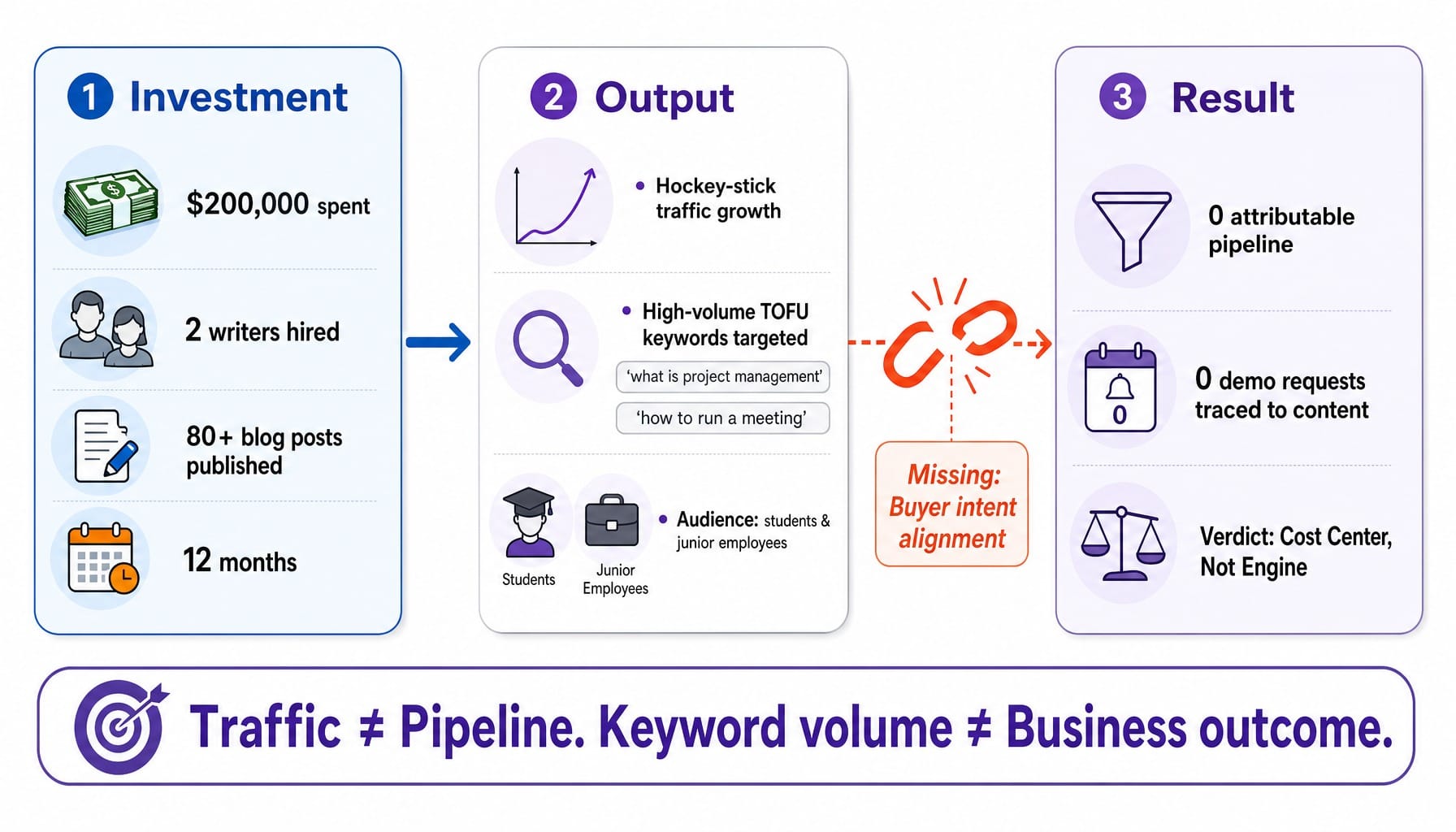
The transferable lesson: Traffic is not a business outcome. If you cannot trace a line from a piece of content to a pipeline outcome, the content is an expense, not an investment.
Read more: B2B SaaS SEO Strategy: How to Optimize for Pipeline, Not Just Traffic (2026) | Spike AI
How to Build a SaaS Content System That Compounds Instead of Stalling
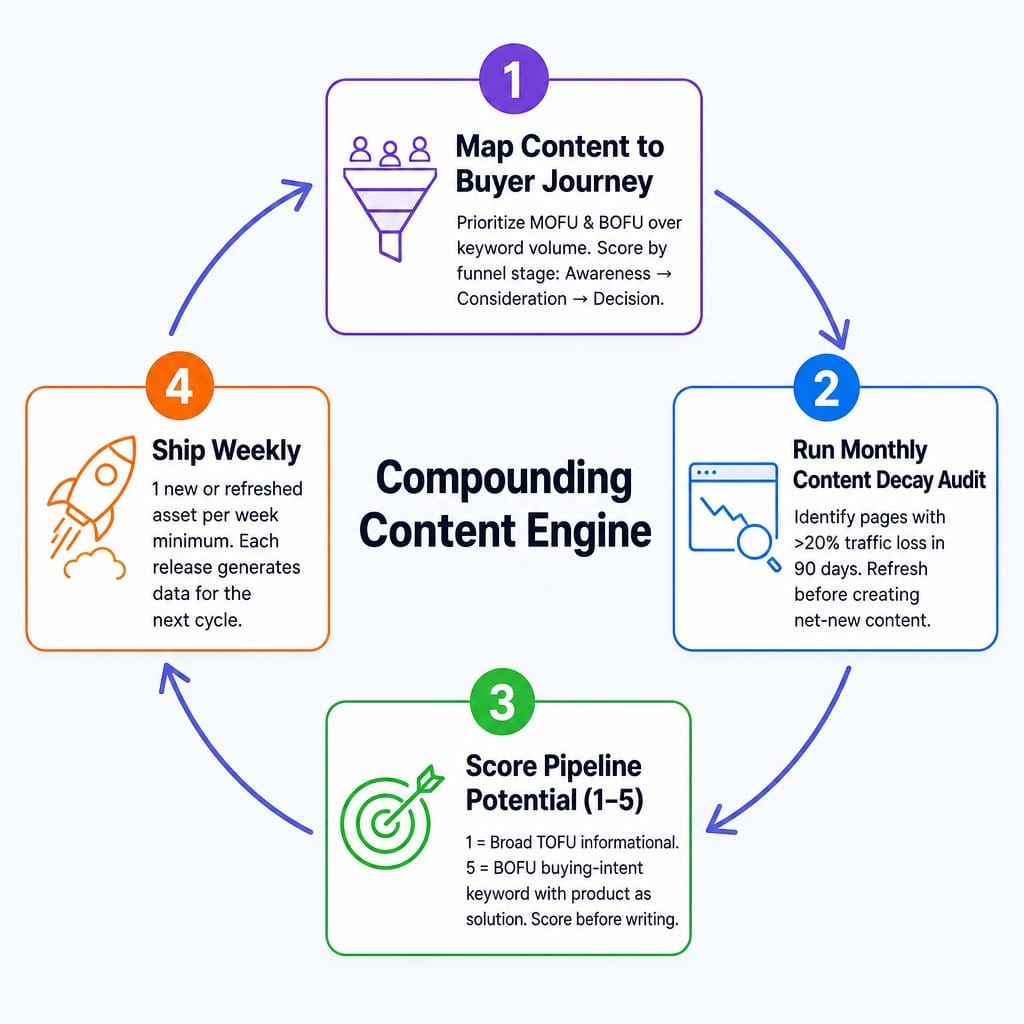
Every example above succeeded not because of a single brilliant article, but because the content was part of a system—a repeatable process of identifying the highest-impact work, shipping it, measuring its pipeline impact, and using that data to decide what to do next. Here is a 4-step process any lean SaaS team can use to build that system.
Step 1: Map Content to Buyer Journey Stages, Not Keyword Volume
The first step is to stop prioritizing content based on search volume. Instead, categorize every potential topic by its stage in the buyer journey—Awareness (TOFU), Consideration (MOFU), or Decision (BOFU)—and relentlessly prioritize MOFU and BOFU content first. For a hypothetical proposal software company, this means creating a "best proposal software for agencies" comparison page (BOFU) before writing "how to write a business proposal" (TOFU). The common failure mode is defaulting to TOFU content because the keywords have higher search volume, then wondering why the traffic doesn't convert.
Step 2: Build a Content Decay Audit Into Your Monthly Cadence
Most teams treat content as a "publish and forget" activity. But content decays. Rankings drop, information goes stale, and CTAs break. A compounding system requires maintenance. The second step is to run a monthly content decay audit: identify pages that have lost >20% of their traffic in the last 90 days and prioritize refreshing them before creating net-new content. For our proposal software company, updating a six-month-old comparison page to reflect a competitor's acquisition takes two hours and can immediately recover lost, high-intent traffic. That's almost always a higher-ROI activity than publishing a new blog post from scratch.
Step 3: Assign a Pipeline-Potential Score to Every New Content Idea
Before writing a single word, force your team to score each new content idea on a simple 1-5 scale for its potential to generate pipeline. A score of 1 is a broad, informational TOFU topic. A score of 5 is a BOFU topic that directly targets a buying-intent keyword and can feature the product as the solution (e.g., a "product vs. competitor" page). This simple scoring forces the team to justify every piece of content in terms of its business impact, not just its SEO potential. It shifts the conversation from "what can we rank for?" to "what can we publish that will generate a demo request?" This is the kind of marketing prioritization framework that separates compounding programs from stalled ones.
Step 4: Implement a Weekly Shipping Cadence
The final step is about rhythm. The SaaS companies with dominant content moats didn't get there with heroic, quarterly campaign pushes. They got there by shipping consistently, week after week. Whether it's one new blog post, one refreshed page, or one new landing page, establishing a weekly shipping cadence builds momentum. Each release provides new data that informs the next, creating a feedback loop that gets smarter over time. The cadence itself becomes the growth engine.
When the System Needs to Ship Faster Than Your Team Can Execute
The examples above succeeded because someone shipped consistently. A system that identifies the highest-impact move and executes it, week after week, is what separates a stalled content program from a compounding content engine.
But for most lean teams, that's the gap. You know what needs to be done—the content decay audit, the new use-case landing pages, the BOFU blog posts. The backlog is full of smart ideas. The problem is the bandwidth to execute.
Spike AI is built to close that gap. It's a marketing execution platform that turns your backlog into weekly releases. Every week, Spike AI identifies the highest-impact move across your website, SEO, and content—then helps you execute it. The prioritization guesswork is gone. The backlog shrinks into an approval queue. The weekly shipping cadence that drives compounding growth becomes your new reality.
See how Spike AI turns your marketing backlog into a weekly shipping cadence →
Your Content Is a System, Not a Library
The SaaS content marketing examples worth studying aren't the ones with the most traffic; they are the ones where content functioned as a pipeline-driving system that compounded over time. The pattern is consistent: product-led content that demos the product, relentless targeting of BOFU intent, leveraging community, and a shipping cadence that treats content as a continuous operation, not a series of one-off campaigns.
The difference between a company that uses content marketing and one that builds a content marketing strategy that compounds comes down to execution. Success isn't a strategy problem; it's a shipping problem. The question is whether your system ships every week or stalls every quarter.
Frequently Asked Questions
How does product-led content differ from traditional SaaS blog posts?
Product-led content embeds the product into the content itself—showing it solving the reader's problem with screenshots, walkthroughs, or interactive demos. Traditional blog posts educate on a topic and may mention the product in a CTA. Product-led content converts at higher rates because the reader experiences value before signing up.
What content formats work best at each stage of the SaaS buyer journey?
Top-of-funnel (TOFU) thrives on educational guides and thought leadership. Middle-of-funnel (MOFU) is best for comparison pages, use-case landing pages, and webinars. Bottom-of-funnel (BOFU) is driven by case studies, ROI calculators, and free trials. The highest ROI for most SaaS companies is MOFU and BOFU content, as it captures existing demand.
What is programmatic SEO and which SaaS companies use it successfully?
Programmatic SEO (pSEO) is the practice of generating large numbers of pages from templates and structured data to capture long-tail search queries at scale. Zapier, Wise, and Canva are notable practitioners. It works when each generated page provides genuine utility for a specific query; thin or duplicative programmatic pages get penalized by Google.
How do you measure whether SaaS content marketing is actually driving the pipeline?
Track content-attributed pipeline by connecting content consumption to downstream conversions using UTM parameters, CRM touchpoint tracking, and multi-touch attribution models. The key metric is not traffic but the number of demo requests, signups, or sales conversations that can be traced back to a specific content touchpoint within a defined attribution window.
How are SaaS companies using AI to scale content production in 2026?
Leading SaaS teams use AI tools like Jasper, Writer, and Clearscope to accelerate research, generate first drafts, and optimize for search intent. However, the highest-performing teams use AI for production speed while keeping strategic decisions—topic selection, positioning, editorial voice—human-led. AI-generated content without expert oversight consistently underperforms.
What is the difference between demand generation content and lead generation content in SaaS?
Demand generation content creates awareness and educates a market, often with ungated assets like thought leadership or research. Lead generation content captures existing demand by gating assets like ebooks or webinars behind forms. Effective strategies use both, but over-indexing on lead gen without strong demand gen creates a pipeline of low-intent leads.