SaaS Content Strategy: A Shipping-First Framework for B2B Teams (2026)

TLDR
- Most SaaS content strategies fail because of an execution gap, not a planning one. Shift your focus from building a content calendar to building a content shipping system.
- Start with bottom-of-funnel (BOFU) content like comparison and use-case pages. They have lower search volume but dramatically higher conversion rates, delivering faster pipeline impact.
- Prioritize what to create using a business-value-vs-difficulty matrix and pain-point scoring from sales call transcripts. Trust what buyers say they need over what keyword tools suggest.
- Measure content performance with funnel-stage KPIs (e.g., pipeline influenced for BOFU, branded search volume for TOFU) and use multi-touch attribution to understand content's true impact on revenue.
- Use AI to accelerate production (briefs, outlines, repurposing) but never to replace human editorial judgment and practitioner-specific insights. If an AI draft could be about any competitor, it's not ready.
A SaaS content strategy is a structured plan for creating, distributing, and measuring content designed to attract, convert, and retain software subscribers. Most SaaS teams have one—a spreadsheet of topics, a funnel diagram, maybe even buyer personas. Yet their blog hasn't been updated in six weeks, three comparison pages have been "in progress" since Q1, and nobody can tell you which content piece influenced a closed deal last month.
This is the execution gap: the chasm between a content plan and content that actually ships.
The teams that win at content don't have better strategies; they have better shipping systems. Their success isn't defined by the elegance of their editorial calendar but by the relentless cadence of their releases. This guide provides a framework for building a SaaS content strategy that prioritizes ruthlessly, ships weekly, and measures against pipeline—not pageviews. It's a system designed to close the execution gap for good.
Why Most SaaS Content Strategies Fail Before They Start
Picture this: a three-person SaaS marketing team runs a content strategy workshop in January. They produce a 40-topic editorial calendar, map everything to funnel stages, and assign owners. It feels productive. By March, they've published four of the 40 pieces. The other 36 are stuck in various states of limbo—waiting for SME input, blocked by design, or deprioritized for a product launch.
This happens because the strategy treated content as a planning exercise, not a production system. There was no shipping cadence, no prioritization model for what to publish first, and no feedback loop connecting published content to pipeline data. This leads to three common failure modes:
- Over-indexing on TOFU awareness content: Teams spend months writing top-of-funnel blog posts that generate traffic but never convert, while high-intent buyers are searching for "[competitor] alternatives" and finding nothing on their site.
- Building a strategy without content operations: A beautiful strategy document is useless without the workflows, tools, and defined roles to move content from idea to live asset. It's like designing a car with no assembly line.
- Measuring vanity metrics: Teams report on traffic, keyword rankings, and social shares because they're easy to track. This creates a feedback loop that optimizes for awareness, not revenue, leaving the C-suite to wonder if content marketing actually works.
A modern SaaS content strategy is not a document. It's a system that identifies the highest-impact content, ships it on a predictable cadence, measures its effect on revenue, and uses that data to decide what to ship next.
Start With Bottom-of-Funnel Content, Not Awareness
The highest-converting SaaS content targets buyers who already know they need a solution—bottom-of-funnel (BOFU) content like comparison pages, alternative pages, and use-case landing pages. This contradicts the common instinct to start with broad awareness content, but the logic is simple: BOFU content has lower search volume but dramatically higher conversion rates because it captures buyers in active evaluation.
As the team at Grow and Convert has pointed out, it's baffling that SaaS companies will bid aggressively on these keywords in paid ads but inexplicably ignore them in their organic content strategy. Every hour spent on a BOFU page that converts at 3-5% is worth more than ten hours on a TOFU blog post that converts at 0.1%. You get faster feedback, generate immediate pipeline, and earn credibility with your sales team.
Comparison and Alternative Pages That Actually Convert
There are two essential BOFU formats:
- Comparison Pages: Your product vs. a named competitor, structured with a feature-by-feature analysis.
- Alternative Pages: Content targeting "[Competitor] alternatives" keywords, capturing users looking for a replacement.
Ahrefs provides a masterclass in this. Their "Ahrefs vs Semrush" page ranks for a high-intent keyword and drives trial signups because it's framed with credible honesty. It acknowledges where Semrush has strengths before pivoting to where Ahrefs excels. This builds trust. A page that just trashes a competitor without acknowledging its own tradeoffs gets bounced immediately because buyers can smell a one-sided sales pitch from a mile away.
The failure case is a SaaS company that uses a template to create 15 comparison pages with identical copy structures and no genuine differentiation. This results in thin content that provides no real value to the reader and signals to Google that the pages exist only to rank, not to help. We've seen these plays get de-indexed entirely.
Read more: Serpstat Alternatives Compared: Which Tool Fits Your SEO Workflow (Not Just Your Budget)
Use-Case and Jobs-to-Be-Done Content
Use-Case Pages are content targeting keywords like "[specific job] software" or "how to [solve problem] with [product category]." These pages sit at the intersection of BOFU and middle-of-funnel (MOFU)—the buyer knows their problem but may not have committed to a specific product category yet.
HelloSign executes this well. They have dedicated pages for "electronic signatures for real estate," "e-signatures for HR onboarding," and more. Each page is tailored to a specific ICP's workflow, using their language and addressing their unique compliance or integration needs.
The transferable principle is that use-case content works because it lets the buyer see themselves in the product before they ever start a trial. The best way to identify these use cases is to apply the Jobs-to-be-Done framework. Interview your best customers and ask, "What specific job were you trying to accomplish when you started looking for a tool like ours?" The answers become your highest-priority use-case pages.
How to Prioritize Which Content to Create First
A lean SaaS team has identified 50 potential content pieces across the funnel. They can realistically ship four per month. Which four? Most teams default to gut feel, recency bias, or whatever the CEO mentioned in the last all-hands. This is a recipe for random acts of content. A structured prioritization approach is non-negotiable.
The Business-Value-vs-Difficulty Matrix
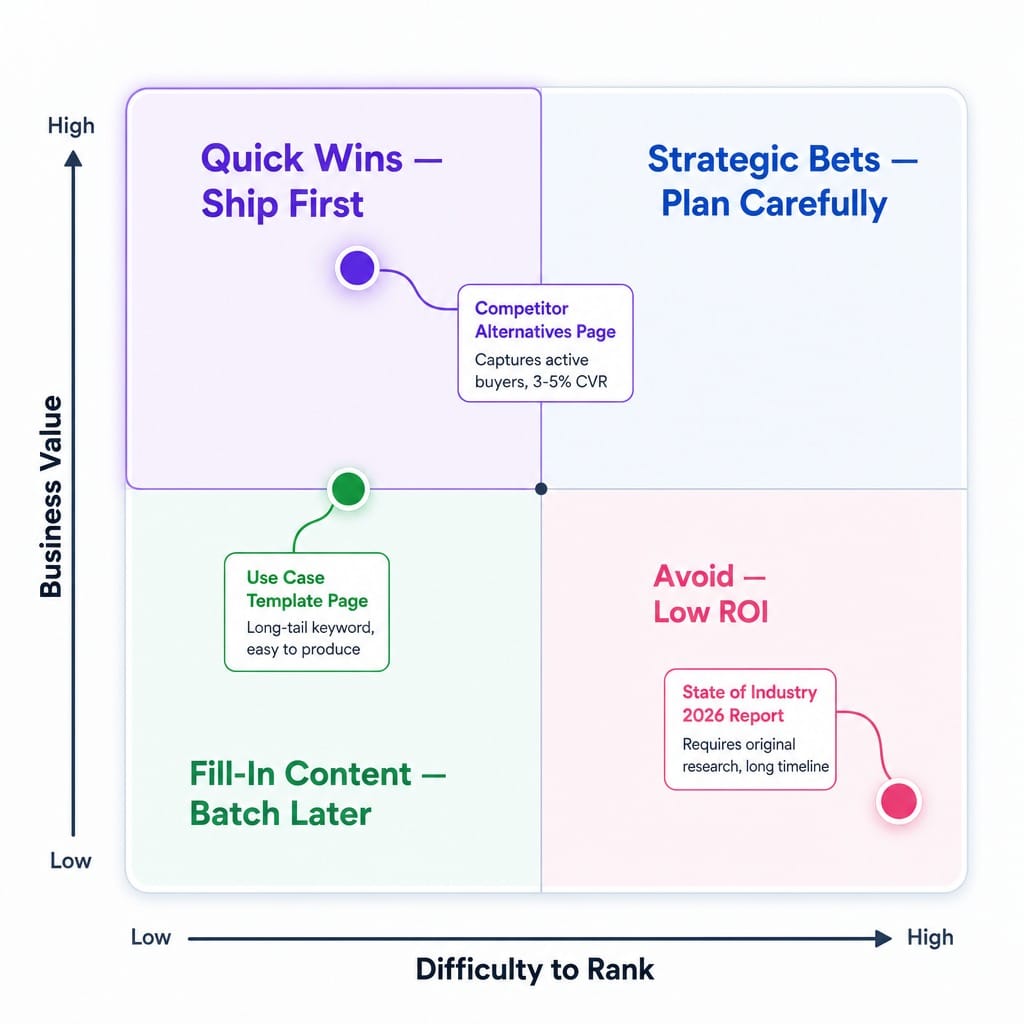
A simple 2x2 matrix can bring immediate clarity. The X-axis is "Difficulty to Rank" (a blend of keyword difficulty, your existing topical authority, and content production effort). The Y-axis is "Business Value" (a blend of proximity to purchase intent, ICP alignment, and estimated pipeline influence).
Let's score three potential content pieces:
- '[Competitor] alternatives' comparison page: High business value (captures active buyers), medium difficulty (competitive SERP but clear intent).
- 'State of [Industry] 2026' report: Low direct business value (generates leads, but few are sales-ready), high difficulty (requires original research, design, and a promotion plan).
- '[Use case] template' landing page: Medium business value (problem-aware audience), low difficulty (targets a long-tail keyword and is easy to produce).
Plotting these on the matrix, the comparison page is the clear winner for what to create first. It sits in the "High-Impact, Achievable" quadrant. The thought leadership report, despite its potential for high search volume, is a Q3 project at best. This model forces you to favor pipeline over pageviews.
Pain-Point Scoring From Sales Call Transcripts
The most potent SaaS content strategies start with sales call transcripts, not keyword research. And let's be honest, this feels like more work than just plugging keywords into Ahrefs, but the ROI is exponentially higher.
The method is straightforward:
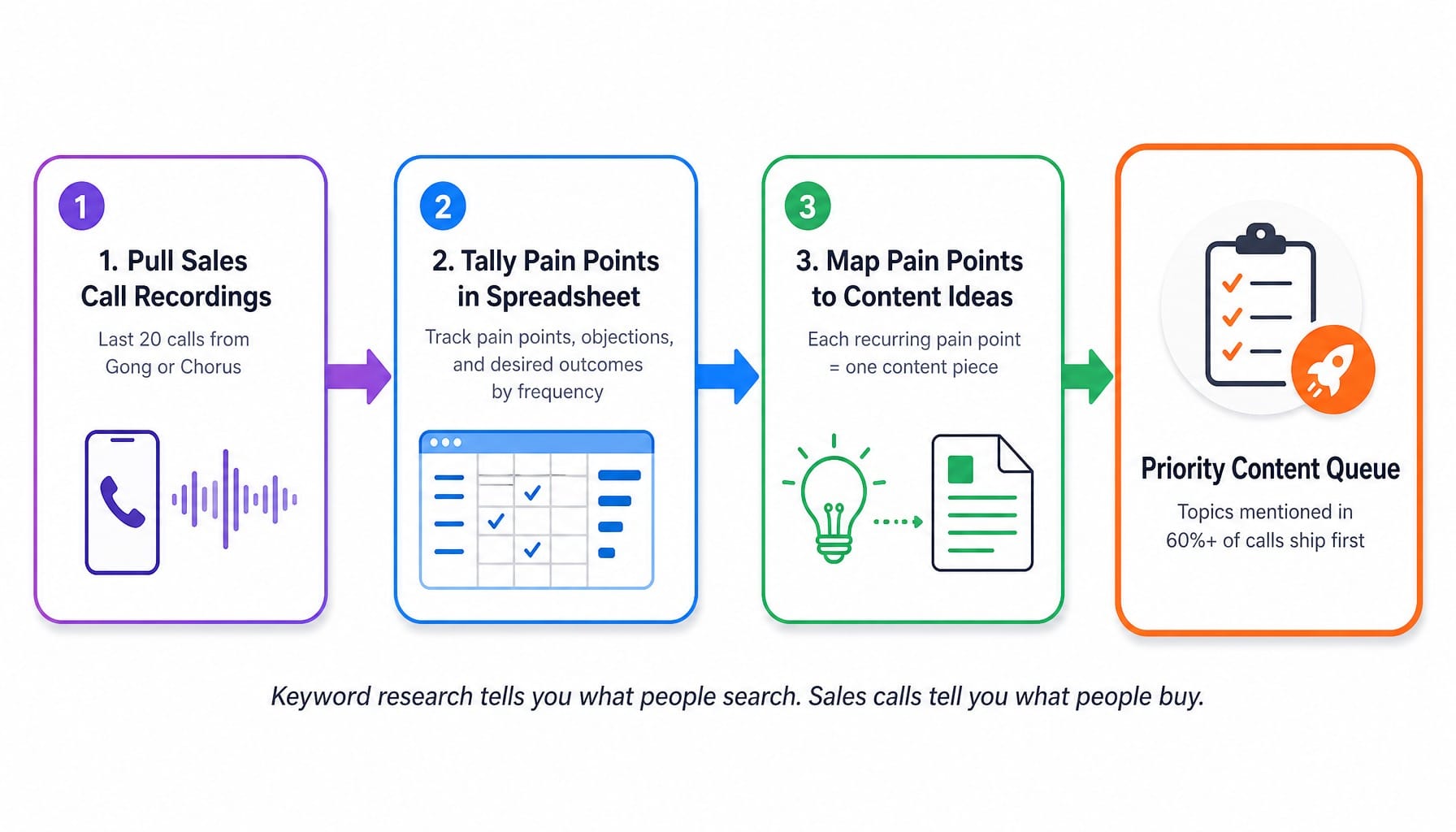
- Pull the last 20 sales call recordings from Gong or Chorus.
- In a simple spreadsheet, tally the specific pain points, objections, and desired outcomes prospects mention most frequently.
- Map each recurring pain point to a content idea that directly addresses it.
The pain points that appear in 60%+ of your calls become your highest-priority content. You now have empirical evidence that real buyers care about these topics, regardless of what keyword tools report for search volume. Keyword research tells you what people search; sales calls tell you what people buy. Use both, but when they conflict, trust the sales data.
Building a Content Strategy by SaaS Company Stage
A SaaS content strategy should look fundamentally different at $500K ARR than at $15M ARR. The team size, content focus, distribution channels, and key metrics all shift. Trying to emulate HubSpot's content machine when you're a two-person marketing team is a recipe for burnout and failure.
Contrast Notion's early content strategy (founder-written, community-driven, zero SEO focus) with HubSpot's mature content empire (HubSpot Academy, certifications, multilingual blogs). The strategy evolves with the business.
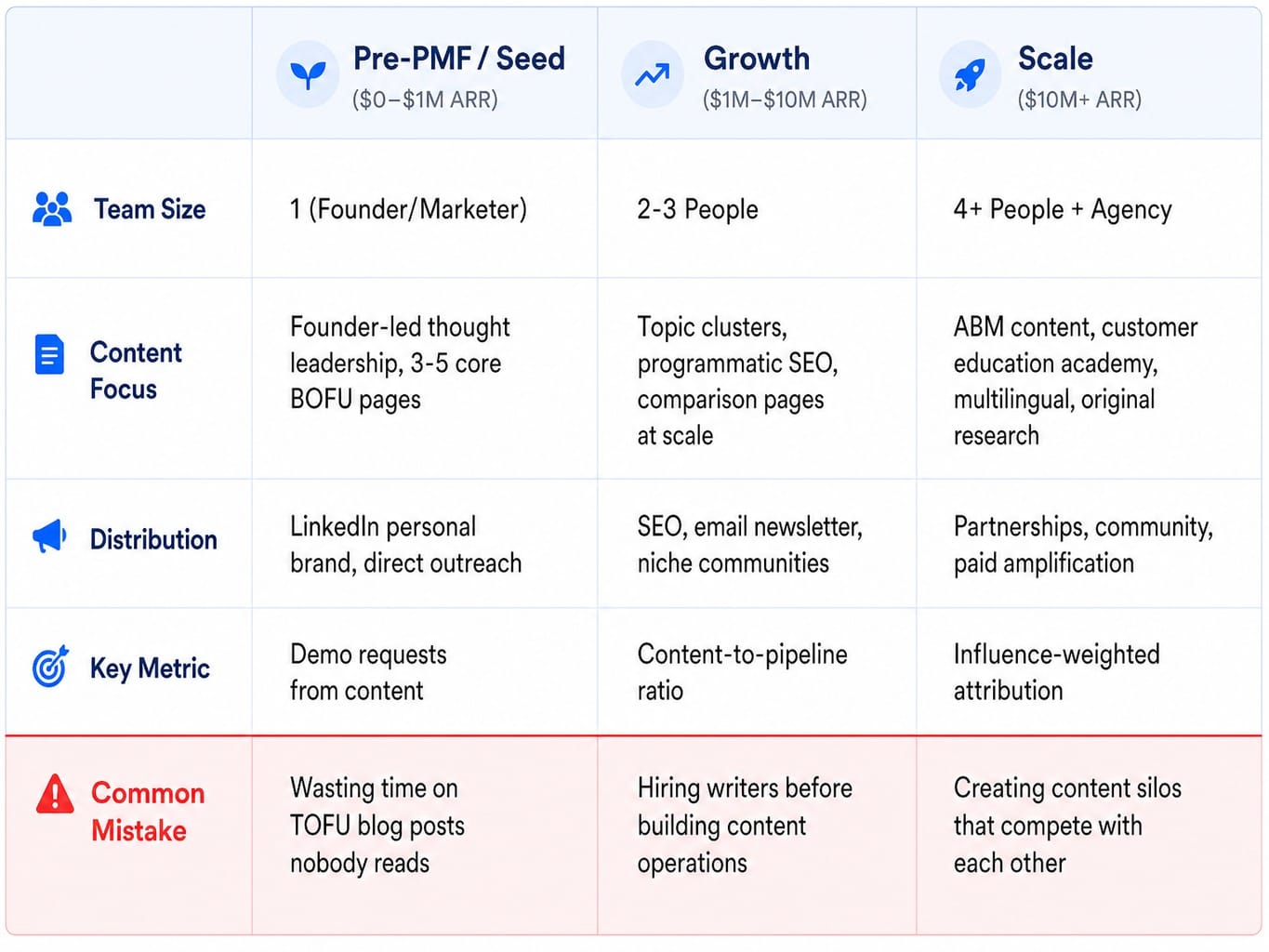
Identify your stage, and focus only on the activities that matter for that stage.
Read more: How to Prioritize Marketing Channels With a Limited Budget And Resources (Framework for Lean Teams)
How to Measure SaaS Content Performance by Funnel Stage
Measuring SaaS content ROI requires different KPIs at each funnel stage. Tracking only organic traffic conflates awareness with revenue impact. The shift from traffic metrics to pipeline metrics is the single highest-leverage change a content team can make. While the often-cited stat that average B2B website conversion rates hover around 2% is a decent benchmark, it's meaningless without segmentation. Your BOFU content should convert at 3-8%, while a TOFU post converting at 0.1% is perfectly normal.
Use this framework to measure what matters:
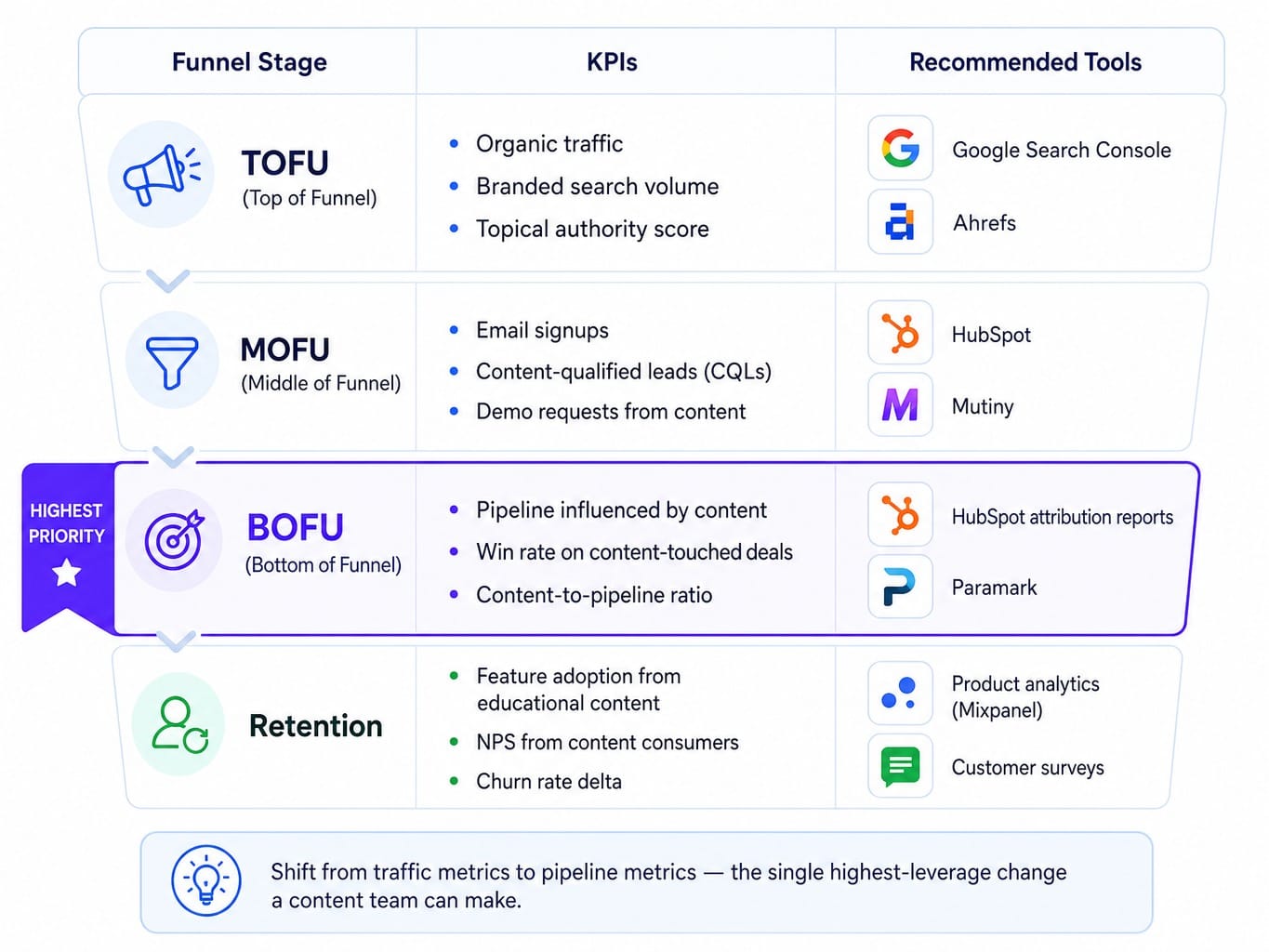
Why Multi-Touch Attribution Matters More Than Last-Click
Last-click attribution systematically undervalues content because a blog post is rarely the final touchpoint before a demo request. A prospect reads three articles, gets a recommendation in a Slack community, then Googles your brand name and books a demo. Last-click credits "branded search," ignoring the content that did the heavy lifting. This is the dark funnel problem.
Influence-weighted attribution models, available in tools like HubSpot or dedicated platforms like Paramark, are the solution. They assign proportional credit to every content piece a prospect touched before converting. But the simplest, most effective fix is often low-tech: add a mandatory "How did you first hear about us?" field to your demo and signup forms. The qualitative answers will reveal the true impact of your content far better than a flawed attribution model ever could.
Gated vs. Ungated Content: When Each Makes Sense for SaaS
The rule for 2026 is simple: gate content when the asset is so uniquely valuable that a prospect would consider paying for it—ungate everything else. Gating is increasingly counterproductive for most content. Google can't index what it can't see, and buyers are more resistant to form fills than ever.
This requires a clear decision framework:
- Ungate by Default: Blog posts, comparison pages, how-to guides, product documentation, and anything else that builds trust, drives organic traffic, or helps buyers self-educate.
- Gate with Intention: Original research reports with proprietary data (e.g., "The 2026 State of Remote Work"), complex ROI calculators, industry benchmark reports, and advanced templates that provide immense value.
The tradeoff is explicit: gating increases lead volume but tanks lead quality and kills organic reach. Ungating increases trust and traffic but requires a different conversion mechanism—like well-placed in-content CTAs, contextual demo prompts, or a seamless product-led signup flow.
Consider the SaaS company that ungated its annual industry report. They saw 10x more downloads, 3x more backlinks, and—counterintuitively—more demo requests than when it was gated. The report built so much credibility that readers actively sought out the product. This requires a leap of faith, I know. You're giving up the immediate MQL for a longer-term trust play. But it works. The ultimate failure is gating a generic "10 Tips" ebook. You train your audience that your gated content isn't worth their email address.
How AI Fits Into SaaS Content Production Without Destroying Quality
Lean SaaS teams need to produce more content than their headcount allows. AI tools like Jasper, Writer, and Claude can bridge that gap, but there's a tension. The companies that use AI to mass-produce generic blog posts are building a content liability, not an asset.
A practical, quality-controlled AI-assisted workflow looks like this:
- AI for Research & Outlining: Use AI to generate research briefs and detailed outlines from keyword data, SERP analysis, and even sales call transcripts.
- Human for Drafting & Judgment: A human writer—a subject matter expert—drafts the content or heavily edits the AI's first pass. They add practitioner insight, real-world examples, and editorial judgment that the AI cannot replicate.
- AI for Repurposing: Once the core piece is finalized, use AI to repurpose it into derivative assets: LinkedIn posts, email snippets, social threads, and internal sales enablement docs.
The quality control rule is this: if an AI-generated draft could have been written about any company in your category, it's not ready to publish. The differentiator is always specificity—your product's unique use cases, your customers' language, your team's operational experience. Google's helpful content system explicitly targets content that exists to capture traffic rather than help readers. AI-generated content that lacks this "information gain" will be algorithmically disadvantaged.
Use AI to increase your content velocity, but never to decrease your content specificity. If you're evaluating AI writing tools for your team, understanding the tradeoffs between platforms like Jasper vs. Copy.ai is a worthwhile starting point.
What Happens When the Strategy Is Right but the Shipping Capacity Isn't?
This article provides a framework for a modern SaaS content strategy: prioritize ruthlessly, start with the bottom of the funnel, measure against pipeline, and use AI intelligently. But a perfect strategy still confronts the original bottleneck: who actually ships the work? Who publishes the comparison page, updates the decaying blog post, deploys the CTA variation, and measures the pipeline impact—every single week?
This is the execution gap where most marketing teams stall. The strategy is right, but the human bandwidth isn't there.
This is where Spike AI closes the loop. It acts as the execution layer for your strategy, running your marketing like software. Spike AI's system identifies the highest-impact move across your website, SEO, and ads, then executes it on a weekly cadence. The marketing team moves from being operators buried in backlogs to orchestrators who approve high-impact releases. The framework in this article tells you what to prioritize. Spike AI is what makes that prioritization actionable—it ships the fix, measures the result, and re-prioritizes for the next week.
See how Spike AI turns your content backlog into weekly releases
Conclusion
A SaaS content strategy is not a spreadsheet of topics mapped to funnel stages. It's a shipping system with a prioritization engine, a weekly cadence, and a measurement loop tied directly to recurring monthly revenue (MRR). The teams that win at content in 2026 are not the ones with the best strategy decks; they're the ones that ship the most high-impact content per quarter and compound the results.
Audit your last quarter. How many content pieces did you plan versus how many did you actually ship? If that gap is wider than 50%, your problem isn't strategy. It's shipping.
Frequently Asked Questions
What is the right ratio of TOFU to BOFU content for a SaaS company?
There is no universal ratio, as it depends on your stage. Early-stage SaaS companies (pre-$5M ARR) should weigh their efforts 70% toward BOFU and MOFU content because they need pipeline, not just awareness. As organic traffic and brand recognition build, you can shift toward a 50/50 split. The mistake is starting with a TOFU-heavy strategy when you have no BOFU pages to capture the demand you might generate.
How often should SaaS companies refresh existing content?
Run a content decay audit quarterly using Google Search Console. Any page that has lost 20%+ of its clicks over 90 days is a candidate for a refresh. Prioritize pages that still rank on page one or two but have slipped, as refreshing a page from position #8 to #3 is far higher ROI than creating a new page from scratch. Focus on updating statistics, adding new examples, and improving internal linking.
How should a SaaS content strategy differ between product-led and sales-led motions?
Product-led (PLG) SaaS should invest heavily in product-led content—tutorials, templates, and use-case pages that drive signups and in-product activation. Sales-led SaaS should prioritize content that generates qualified demo requests: comparison pages, ROI calculators, and case studies. The distribution also differs; PLG content thrives on SEO and community, while sales-led content benefits from email nurture and ABM targeting with tools like 6sense or Metadata.io.
How do you build topic clusters when your SaaS product serves multiple buyer personas?
Create separate topic clusters for each persona, anchored by a pillar page that speaks to that persona's primary pain points. These clusters can share some supporting content (e.g., a "how to evaluate [category] software" page), but the pillar pages must be distinct. Use strategic internal linking to connect shared pages to multiple clusters without creating SERP cannibalization. Tools like Ahrefs' Site Audit can help identify problematic overlap.
What content distribution channels work best for B2B SaaS in 2026?
SEO remains the highest-leverage channel for compounding returns, but a "publish and pray" strategy is insufficient. LinkedIn, especially founder-led content, drives dark funnel awareness that attribution tools miss. Email newsletters build an owned audience you control. Reddit and niche communities drive high-intent referral traffic. A surround sound strategy matches channel to content type: SEO for evergreen, LinkedIn for thought leadership, and email for nurture sequences.