B2B Lead Nurturing That Moves Pipeline, Not Just MQLs

TLDR
- Stop optimizing for Marketing Qualified Leads (MQLs). Most MQLs are a measure of marketing activity, not buying intent. The correct metric to measure is pipeline contribution from nurtured contacts.
- Replace time-based drip sequences with signal-based nurturing. A prospect visiting your pricing page is a more important trigger than the fact that seven days have passed since your last email.
- Nurture the entire buying committee, not the individual contact. Map content to stakeholder roles (e.g., CFO, IT lead) and orchestrate engagement at the account level.
- Design nurture exit ramps that accelerate deals. High-intent signals should trigger an immediate handoff to sales, bypassing the remaining sequence.
- The primary failure point in lead nurturing isn't strategy; it's the execution latency between identifying what needs to change and actually shipping it.
A B2B SaaS marketing team runs a 12-touch email nurture sequence over eight weeks. The MQL numbers look healthy. Marketing reports a 22% increase in nurtured MQLs quarter-over-quarter. But the pipeline contribution from those MQLs is flat. Sales reports that most "nurtured" leads arrive no more ready to buy than they were before entering the sequence.
The problem isn't the content or the cadence. The problem is that the nurture program was designed to move contacts through a marketing automation workflow, not to respond to actual buying signals or engage the committee of stakeholders who collectively make the purchase decision.
Most B2B lead nurturing programs fail because they optimize for the wrong metric (MQL volume), target the wrong unit (individual contacts instead of buying committees), and run on the wrong trigger (calendar schedules instead of behavioral signals). This isn't a competence issue; it's a systemic failure rooted in how marketing automation platforms are designed. This guide diagnoses why this happens and provides a framework for building a nurture system that generates pipeline, not just activity.
Why Most B2B Nurture Programs Optimize for MQLs Instead of Pipeline
The default architecture of most B2B nurture programs is inherited from marketing automation platform templates: a linear sequence of emails triggered by a form fill, spaced on fixed intervals, and measured by engagement metrics like opens and clicks that correlate weakly with purchase intent.
Consider a common scenario: a demand gen manager at a mid-stage SaaS company builds a six-email nurture sequence in HubSpot. The sequence performs well on engagement metrics—a 28% open rate and a 4.2% CTR. But when they trace nurtured contacts through to closed-won deals, the conversion rate from MQL to SQL is 8%, and from SQL to closed-won is under 2%. The nurture program is generating activity, not pipeline.
This happens because the system is designed to measure the wrong output. Marketing automation tools incentivize sequence completion and content consumption as success metrics. The MQL threshold is typically a lead score based on these actions (e.g., downloaded three assets = MQL). This measures marketing engagement, not buying intent. A contact who downloads three blog posts is not equivalent to a contact whose company is actively evaluating solutions. This is the critical disconnect between engagement scoring and fit scoring.
The widely cited Forrester finding that nurtured leads produce 50% more sales-ready contacts at 33% lower cost is often misinterpreted. This stat typically measures sales-readiness as defined by a marketing-controlled lead score, not actual pipeline contribution or sales acceptance. The failure of most B2B lead nurturing is architectural, not tactical. The system is measuring marketing activity, and that is what it is optimizing for.
Read more: Data-Driven CRO Strategies: Identifying Marketing Opportunities for True Conversion Optimization
Signal-Based Nurturing Replaces Calendar-Driven Drip Sequences
The alternative to time-based drip sequences is signal-based nurturing, where the next action in a nurture flow is triggered by what the contact—or their account—actually does, not by how many days have passed since the last email. This isn't a minor tactical adjustment; it's a fundamentally different execution architecture.
The distinction matters because B2B buying behavior is non-linear. A prospect might go dark for six weeks, then visit the pricing page three times in one afternoon. A calendar-based drip campaign sends email #4, an educational blog post, regardless of this behavior. A signal-based system recognizes the cluster of high-intent activity around pricing, immediately routes the contact to a sales rep, and triggers a bottom-funnel case study.
This requires an execution system that can ingest signals from intent data platforms like 6sense or Bombora and execute actions through tools like HubSpot workflows with behavioral triggers. The goal is to shift the system's logic from "what's next on the calendar?" to "what does this prospect's latest action signify?"
What Behavioral Signals Actually Warrant a Nurture Action
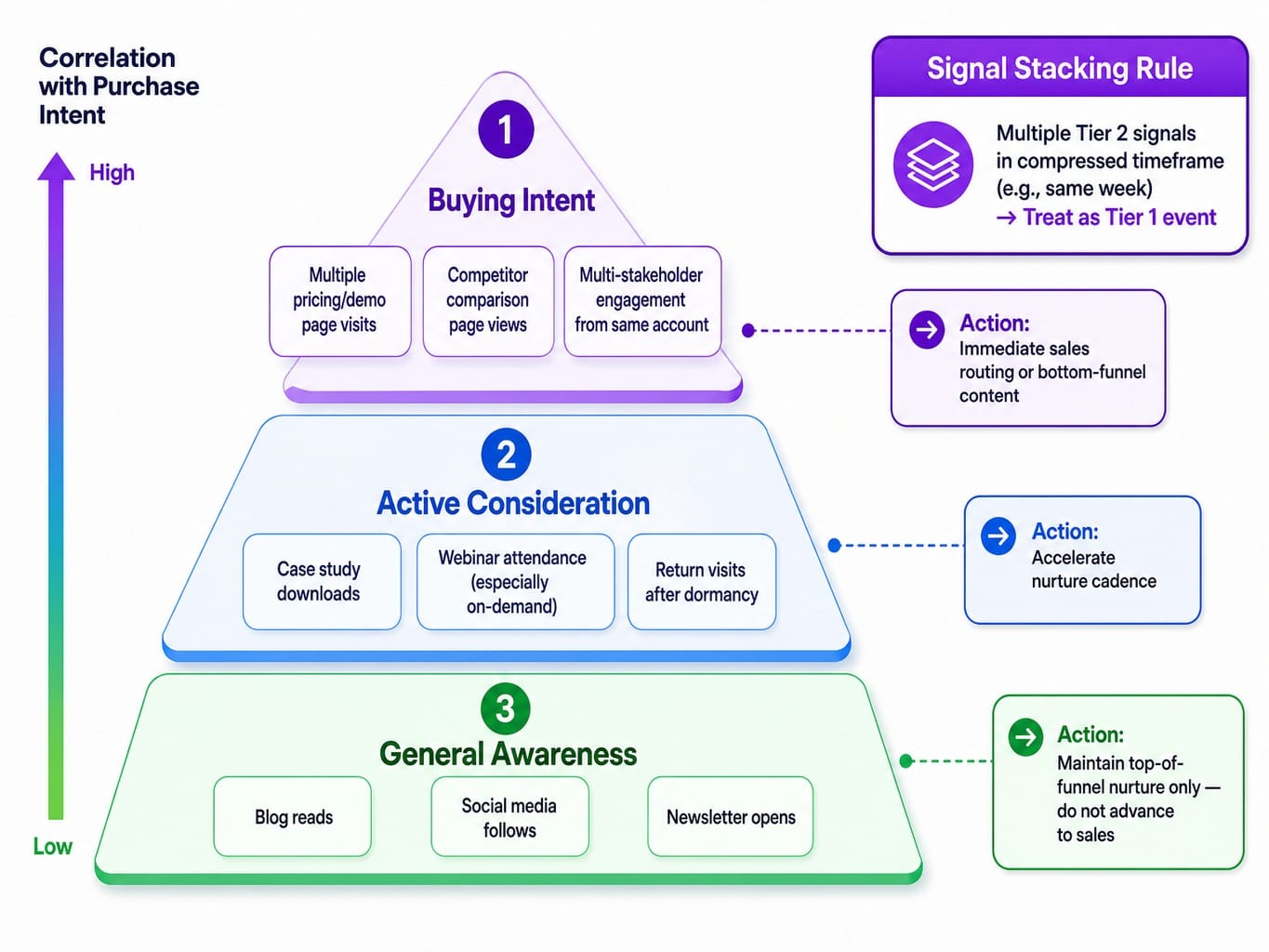
Not all signals are equal. Most teams over-index on email engagement (opens, clicks) while under-indexing on signals that correlate with buying intent. A more effective approach uses a hierarchy to prioritize actions:
- Tier 1 Signals (Buying Intent): These warrant immediate routing to sales or bottom-funnel content. They include multiple visits to the pricing or demo page, viewing competitor comparison pages, or multiple stakeholders from the same account engaging simultaneously.
- Tier 2 Signals (Active Consideration): These should accelerate the nurture cadence. Examples are case study downloads, webinar attendance (especially on-demand), or return visits to the site after a period of dormancy.
- Tier 3 Signals (General Awareness): These indicate top-of-funnel interest but should not advance a contact toward sales. This category includes blog reads, social media follows, and newsletter opens.
The concept of signal stacking is also critical. When multiple Tier 2 signals occur within a compressed timeframe (e.g., a contact downloads a case study and attends a webinar in the same week), the system should treat this as a Tier 1 event. Surfacing account-level intent from tools like ZoomInfo or Bombora provides an additional layer of prioritization.
How to Restructure Existing Drip Workflows Around Signals
You don't need to rebuild your nurture program from scratch. The highest-leverage change is to insert branch logic at key decision points in existing sequences, allowing behavioral triggers to override the calendar cadence.
Take a standard eight-email nurture sequence in a tool like Marketo Engage or HubSpot. You can transform its effectiveness by adding three branches:
- At Email #3: Before sending the next educational asset, check if the contact has visited the pricing page in the last seven days. If yes, skip the scheduled email and send a bottom-funnel case study or ROI calculator instead.
- At Email #5: Before sending the mid-funnel content, check if the contact's account shows multiple stakeholders engaging (requires contact-to-account matching). If yes, trigger a high-priority alert to the account owner in sales and pause the marketing sequence to avoid conflicting messages.
- At Email #7: Before sending the final touch, check if engagement velocity has dropped to zero for the last 30 days. If yes, move the contact to a low-frequency re-engagement branch instead of continuing a sequence they are ignoring.
This approach transforms a static drip campaign into a responsive system using the tools you already have.
Nurturing the Buying Committee, Not the Individual Lead
The default unit of nurture in most B2B programs is the individual contact. The default unit of purchase in B2B, however, is the buying committee. Gartner research shows the average B2B purchase involves 6-10 decision-makers, each consuming content independently. This mismatch means your nurture program is optimizing engagement with one person while the deal requires consensus from many.
The structural implication is clear: nurture programs must operate at the account level, not the contact level. This requires tracking engagement across all known contacts within a target account and tailoring content to each stakeholder's role-specific concerns. This is where account-based nurturing intersects with traditional lead nurturing, and it's where most programs fail because their marketing automation is configured at the contact level.
A marketing team might successfully nurture a VP of Marketing to MQL status, but the deal stalls because the CFO has unaddressed pricing objections and the IT Security Lead has concerns about compliance—stakeholders who were never in the nurture program. Nurturing a single champion without equipping them to sell internally is a systemic failure. Account-level orchestration tools like Demandbase One or the ABM features within HubSpot are designed to address this.
Mapping Content to Stakeholder Roles, Not Funnel Stages
The traditional content mapping model (awareness → consideration → decision) is insufficient for buying committee nurturing. Different stakeholders enter the evaluation at different stages and have fundamentally different concerns. A technical evaluator needs architecture documentation, while a financial stakeholder needs ROI projections.
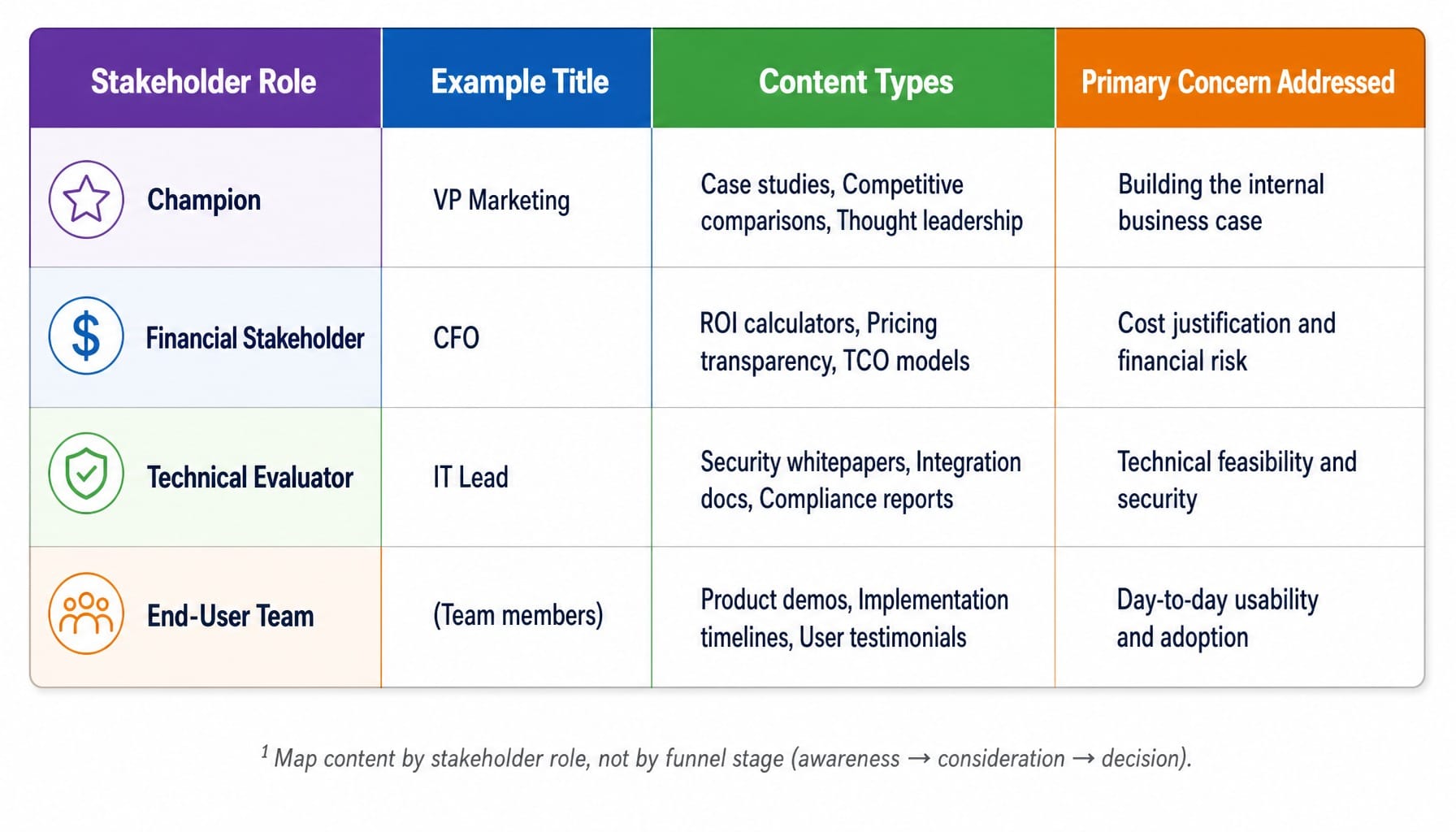
A more effective model maps content by role. For a typical B2B SaaS deal, this looks like:
- The Champion (e.g., VP Marketing): Gets case studies, competitive comparisons, and thought leadership to build the business case.
- The Financial Stakeholder (e.g., CFO): Gets ROI calculators, pricing transparency, and total cost of ownership (TCO) models.
- The Technical Evaluator (e.g., IT Lead): Gets security whitepapers, integration documentation, and compliance reports.
- The End-User Team: Gets product demos, implementation timelines, and user testimonials.
Content mapping by role is more effective than mapping by stage because it directly addresses the objections and questions of each person required to sign off on the deal.
Using Contact-to-Account Matching to Orchestrate Multi-Stakeholder Engagement
Account-level nurturing requires contact-to-account matching as a foundational capability. Without it, your marketing automation platform treats each stakeholder as an independent lead rather than part of a coordinated buying process.
The operational mechanic is straightforward: when a new contact from a target account enters your system (via a form fill, content syndication, or data enrichment from a tool like Clearbit), they should be automatically matched to the existing account record. From there, they are enrolled in a role-appropriate nurture track, not the default generic sequence.
This enables account-level engagement velocity scoring—tracking the aggregate engagement pattern across all contacts within an account. When account-level engagement spikes (e.g., multiple stakeholders engage with different assets in the same week), that is a powerful buying signal that should trigger sales involvement, regardless of any single individual's lead score.
Designing Nurture Exit Ramps That Accelerate Deals
Most nurture programs have detailed entry criteria (e.g., lead score threshold, form fill) but vague or nonexistent exit criteria. The result is that contacts either stay in nurture sequences indefinitely, leading to sequence saturation, or get handed to sales based on arbitrary scores that don't reflect buying readiness.
This miscalibration creates friction. A contact reaches the MQL threshold after downloading a whitepaper and attending a webinar. They're handed to sales. The SDR discovers the contact was just researching for a blog post they're writing—zero purchase intent. Meanwhile, another contact who visited the pricing page twice but didn't hit the score threshold sits in the nurture sequence for three more weeks.
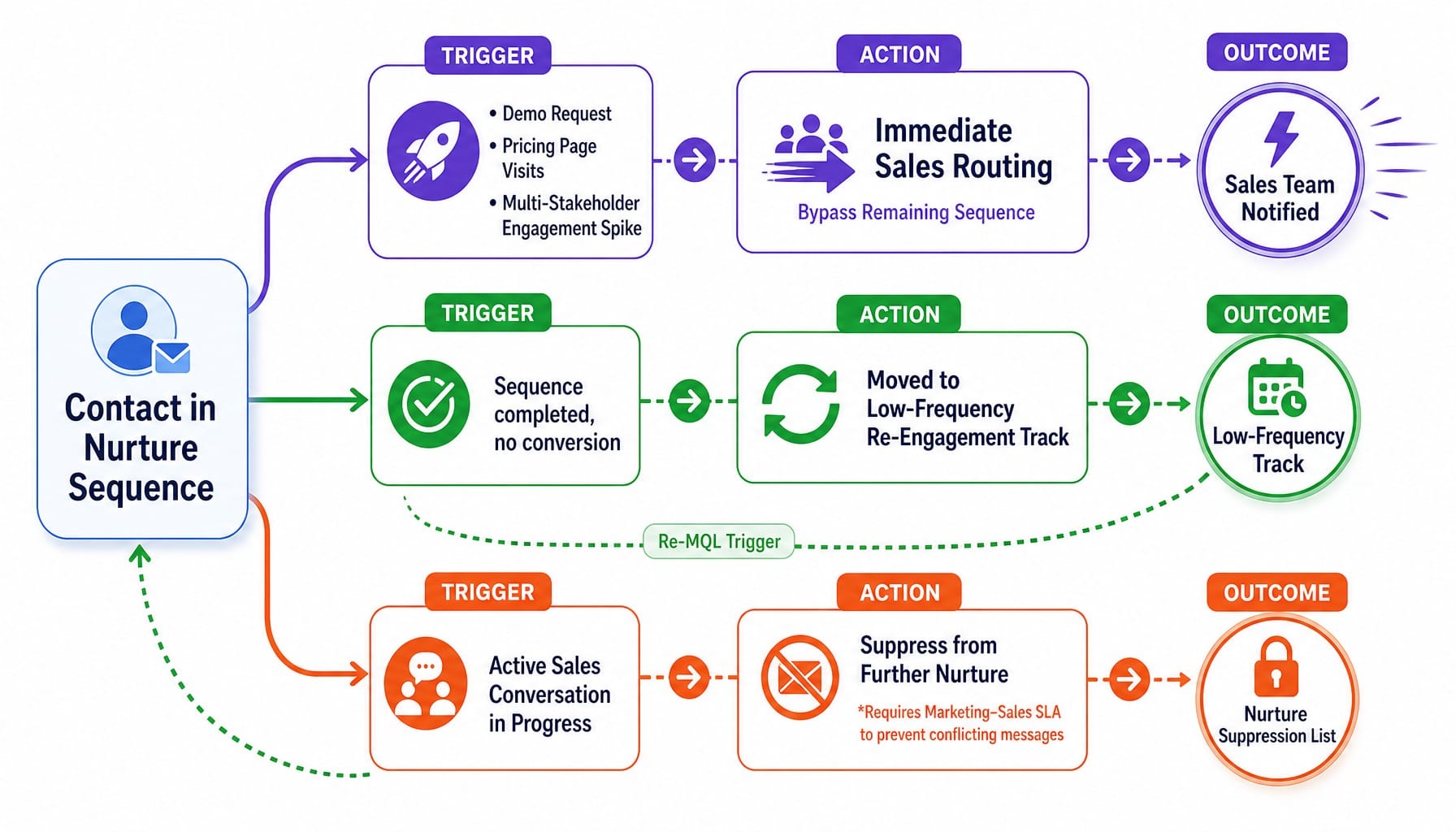
A well-designed system has three distinct exit ramps:
- Acceleration Exits: High-intent behavioral signals that should bypass the remaining sequence and route a contact directly to sales. This includes demo requests, pricing page visits, or a spike in multi-stakeholder engagement.
- Recycling Exits: Contacts who complete a sequence without converting should not be abandoned. They should enter a lead recycling program with a lower-frequency cadence, waiting for a re-MQL trigger (a specific action that re-qualifies them).
- Suppression Exits: Contacts who are already in an active sales conversation should be placed on a nurture suppression list. This requires a clear SLA between marketing and sales to prevent conflicting messaging and ensure a smooth customer experience.
The design of your exit criteria is more critical to pipeline velocity than the design of your entry criteria.
Read more: Landing Page Conversion Rate Optimization: A Revenue-Weighted Playbook
When the Bottleneck Is Execution, Not Strategy
The principles are clear: shift from calendar-driven drips to signal-based orchestration, nurture the buying committee, and design intelligent exit ramps. The strategy is sound. The bottleneck is execution.
Restructuring workflows, mapping content to roles, building exit logic, and monitoring account-level engagement velocity demands bandwidth that lean marketing teams simply don't have. The backlog of "should do" optimizations grows, while the nurture program continues to run on its outdated, activity-based logic. This is the execution gap where pipeline potential dies.
Spike AI is designed to close this gap. It's not another lead nurturing tool; it's the execution layer that turns your optimization strategy into weekly releases. Spike AI continuously identifies the highest-impact move across your entire marketing funnel—whether it's a nurture workflow adjustment, a landing page tweak, or a content change—and then deploys it. The improvements diagnosed in this article don't sit in a backlog for months; they become part of a continuous shipping cadence. The teams that win at B2B nurturing aren't the ones with the best strategy decks; they're the ones that ship changes every week.
See how Spike AI turns your optimization backlog into weekly releases
From Calendar Cadence to Execution System
The single most important shift in modern B2B lead nurturing is reframing it from a content or cadence problem to an execution system problem. The teams generating real pipeline from their nurture programs are those who treat nurturing as a responsive, account-level orchestration system triggered by behavioral signals—not as a fixed email sequence triggered by calendar dates.
The path forward is clear: diagnose the MQL trap, shift your architecture to signal-based triggers, expand the unit of nurture from the individual to the buying committee, and design exit ramps that accelerate deals instead of gating them. The gap between knowing what your nurture program should do and actually shipping those changes every week is where most marketing teams fail. Close that gap.
Frequently Asked Questions
How long should a B2B lead nurturing sequence run before handing off to sales?
There is no universal timeline. The handoff should be triggered by behavioral signals (pricing page visits, demo requests), not sequence completion. That said, if a contact receives 8-12 touches over 4-6 weeks without exhibiting buying signals, they should be moved to a low-frequency re-engagement track. The sequence length should be informed by your average sales cycle, not an arbitrary best practice.
How do you build a lead scoring model that actually predicts pipeline, not just engagement?
Separate fit scoring (firmographics like company size, industry) from engagement scoring (behavioral actions like page visits). Weight fit scores higher in your MQL threshold; a perfect-fit contact with moderate engagement is more valuable than a poor-fit contact who downloads everything. Validate your model quarterly by comparing MQL-to-closed-won conversion rates against score distributions, and adjust weights based on what actually converts to revenue.
What is the ideal email cadence for B2B nurture campaigns?
Start with one email per week for the first 2-3 weeks, then reduce to biweekly unless behavioral signals indicate acceleration. The more important factor is cadence variation by signal. If a contact visits the pricing page, the cadence should compress immediately, regardless of the schedule. Monitor for sequence saturation—if open rates consistently drop below 10%, the cadence is too aggressive for that segment.
How do you use intent data to prioritize leads inside a nurture program?
Layer third-party intent data from providers like Bombora or 6sense on top of your first-party engagement data. When intent data shows an account is actively researching your category (surging on relevant topics), contacts from that account should be moved to an accelerated nurture track with bottom-funnel content. Use intent data as a powerful prioritization signal for sales routing, not just as another input for a lead score.
What metrics actually measure B2B lead nurturing effectiveness?
Stop measuring nurture success by email open rates and MQL volume. The metrics that matter are pipeline-centric: MQL-to-SQL conversion rate (are nurtured leads accepted by sales?), pipeline contribution from nurtured contacts, sales cycle length for nurtured vs. non-nurtured leads, and pipeline velocity. Track these at the cohort level to understand the true impact of your nurture system on revenue.
How do you re-engage cold leads without restarting the entire nurture sequence?
Create a dedicated re-engagement branch distinct from your primary nurture sequence. Use a single high-value asset (new research, a relevant case study) as the re-entry trigger rather than dropping them into email #1. Set a re-MQL trigger: if the contact engages with the asset and takes a second action within 14 days, re-qualify them into an accelerated track. If not, suppress them for 90 days.