
B2B Sales Pipeline: Why Most Teams Have a Quality Problem, Not a Volume Problem

TLDR
- Stop building pipeline stages around your internal sales process. Reverse-engineer them from the buyer actions that consistently precede closed-won deals.
- The standard 3x pipeline coverage ratio is misleading. Replace it with a stage-weighted coverage metric that accounts for the historical probability of a deal closing from its current stage.
- Most pipeline shortfalls are quality problems, not volume problems. If deals are aging, win rates are declining, and reps can't name the next buyer action, you have a quality crisis.
- Prevent mid-pipeline stalls by making multi-threading (engaging 2+ contacts) and mutual action plans (shared buyer-seller timelines) non-negotiable stage-gate requirements.
- Your pipeline is only as good as the website conversions that feed it. The same execution gap that stalls deals also limits website performance, creating an upstream quality problem.
A VP of Sales walks into the Monday pipeline review. The dashboard in Salesforce looks healthy: 4x coverage against the quarterly target. The board deck is prepped. But by week ten, the forecast is in tatters. Half the "committed" deals have slipped. Three are single-threaded to a champion who went silent. The team is scrambling to pull in new opportunities that have zero chance of closing in time.
The pipeline was never 4x. It was 4x in name, but maybe 1.5x in reality.
This isn't a failure of effort; it's a failure of the system. Most B2B pipeline problems are quality and execution problems masquerading as volume problems. The stages are built on internal assumptions, the exit criteria are soft, and the metrics teams track reward activity over actual buyer progress.
This guide provides a framework for fixing that system. We'll cover how to build pipeline stages from actual buyer behavior, the metrics that predict revenue instead of just activity, and how to diagnose whether your pipeline has a hidden quality crisis.
What a B2B Sales Pipeline Actually Is (and What It Is Not)
A B2B sales pipeline is not a visual representation of deals. It is a system of stage-gate decisions. The distinction matters because most CRMs, from HubSpot Sales Hub to Salesforce, allow reps to self-report stage progression based on gut feel. A rep has a good call, feels positive, and moves the deal to the "Proposal" stage. The pipeline value inflates, but the deal hasn't actually met any objective criteria. It sits there for eleven weeks, a dead opp clogging the pipe.
A functional pipeline is a structured sequence of buyer-validated milestones, each with measurable exit criteria, that predicts whether revenue will arrive on time. It is not the same as a sales funnel. The funnel describes the buyer's journey from awareness to purchase; the pipeline is the seller's operational model for managing and progressing qualified opportunities through that journey.
The tool is not the pipeline; the discipline is. Your pipeline is only as good as its exit criteria, not its deal count. If deals can advance based on a rep's optimism, you don't have a pipeline—you have a list of hopes.
Pipeline Stages Should Come from Buyer Behavior, Not Your Internal Sales Process
Most B2B companies design pipeline stages around their internal sales process: Prospecting → Discovery → Demo → Proposal → Negotiation → Close. This architecture creates a fundamental mismatch because it tracks seller activity, not buyer progress.
In a consensus-driven B2B purchase involving 5 to 11 stakeholders (a Gartner-confirmed trend), a deal can be in your "Proposal" stage while the buyer hasn't even identified their full evaluation committee. The pipeline registers progress, but the deal is actually stalled because the buyer hasn't completed the decision steps that matter. Frameworks like MEDDPICC are the closest existing models that try to align with buyer behavior by focusing on champion testing and decision process mapping, but even MEDDPICC is a qualification overlay, not a stage architecture.
The real fix is to reverse-engineer your stages from closed-won deal data. Analyze your last 40 closed-won deals. What buyer actions preceded every successful close, in what sequence, and at what velocity? For one mid-market SaaS company, that analysis revealed every deal closing in under 90 days had three things happen before a proposal was ever sent: a technical evaluator completed a sandbox trial, a budget holder attended a second call, and the champion shared an internal business case document.
None of these were formal pipeline stages. They were the invisible buyer milestones that actually predicted a close. Those actions should be your stages.
Why Seller-Centric Stages Create Forecast Errors
Seller-centric stages measure rep activity, not buyer commitment. When a rep moves a deal from "Demo Completed" to "Proposal Sent," the pipeline registers progress, but the buyer may not have even socialized the solution with their team. This is the root cause of forecast inaccuracy. The pipeline is full of deals that passed seller milestones but not the critical buyer milestones that signal real intent.
This is where "happy ears" become a systemic risk—reps hear positive sentiment on a call and advance deals based on tone rather than tangible evidence of buyer commitment. Tools like Gong or Clari attempt to solve this by analyzing call signals for buyer sentiment, but the underlying problem is structural. The stages themselves don't require buyer-side evidence. Forecast inaccuracy isn't a rep-discipline problem; it's a stage-design problem. Your system is rewarding the wrong behavior.
A Buyer-Validated Stage Framework with Exit Criteria
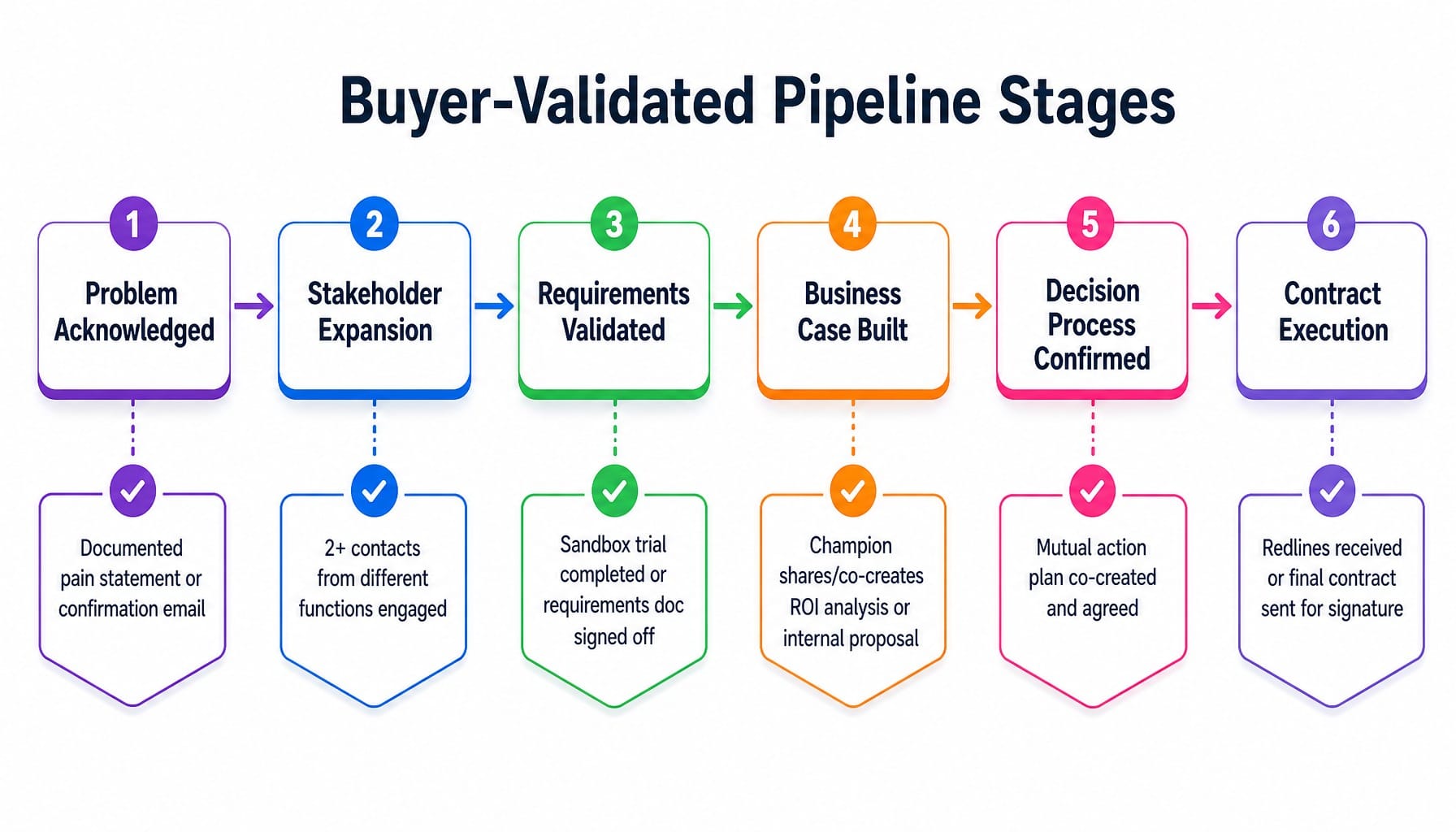
Here is a practical 6-stage framework defined by buyer actions, not seller actions. The exit criteria are non-negotiable; a deal cannot advance without this buyer-side evidence.
- Stage 1: Problem Acknowledged. The buyer confirms the problem exists, it's a priority, and it's worth solving.
Exit Criteria: Documented pain statement or confirmation email from the buyer.
- Stage 2: Stakeholder Expansion. The buyer introduces additional evaluators, signaling a move from individual interest to team evaluation.
Exit Criteria: Two or more contacts from different functions (e.g., technical, finance) are actively engaged in conversations.
- Stage 3: Requirements Validated. The buyer confirms your solution addresses their specific technical and business requirements.
Exit Criteria: A technical evaluator has completed a sandbox trial, or the buyer has signed off on a requirements-mapping document.
- Stage 4: Business Case Built. The buyer has an internal justification for the purchase, moving from "is this the right solution?" to "how do we get this approved?"
Exit Criteria: The champion shares or co-creates a business case, ROI analysis, or internal proposal document.
- Stage 5: Decision Process Confirmed. The buyer has identified the full approval path, the timeline, and the procurement/legal paper process.
Exit Criteria: A mutual action plan (MAP) outlining all remaining steps is co-created and agreed upon by both parties.
- Stage 6: Contract Execution. The deal is with legal and procurement for final sign-off.
Exit Criteria: Redlines are received from the buyer's legal team, or the final contract is sent for signature.
Historical conversion benchmarks from sources like Apollo.io can provide a starting point, but your own data is what matters. A deal that hasn't met these buyer-validated exit criteria hasn't earned its stage.
The Three Pipeline Metrics That Actually Predict Revenue
Most pipeline dashboards track descriptive metrics: deal count, total pipeline value, and stage distribution. They tell you what happened, not what will happen. In your weekly pipeline review, if you can only look at three numbers, they should be pipeline velocity, stage-weighted coverage ratio, and win rate by source. These are the predictive metrics that matter, and most teams track none of them correctly.
The standard benchmark of 3x pipeline coverage, for instance, is fundamentally flawed. It's a blunt instrument that tells you nothing about pipeline quality. A pipeline with 3x coverage where 70% of the value sits in early-stage deals is entirely different from one with 3x coverage where 60% is in late-stage deals. Two teams can both report 3x coverage; one will hit quota, and the other will miss by a mile. The raw coverage ratio was identical, but the quality was not.
Pipeline Velocity and Stage-Weighted Coverage
Pipeline Velocity tells you how much revenue your pipeline generates per day. It's a measure of your sales process's efficiency and throughput. The formula is:
(Number of Opportunities × Average Deal Size × Win Rate) ÷ Sales Cycle Length in Days
Walking through the variables operationally, if your velocity is declining while your deal count is increasing, you have a quality problem. You're adding more opportunities, but they are smaller, slower to close, or less likely to convert. You're working harder to generate less revenue.
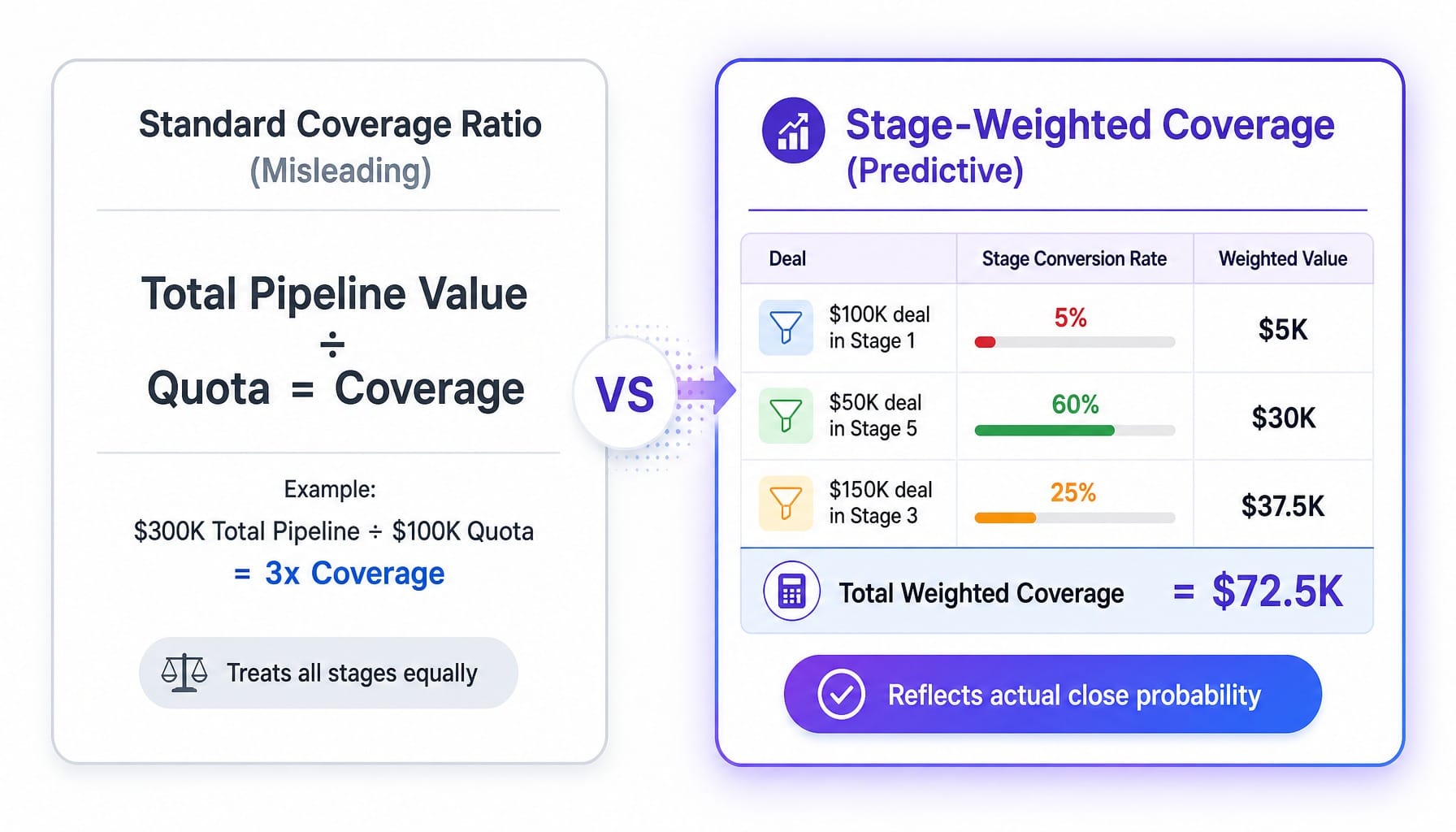
Stage-Weighted Pipeline Coverage is the corrective to the standard coverage ratio. The standard ratio (Total Pipeline Value ÷ Quota) treats a Stage 1 deal and a Stage 5 deal as equally likely to close. Stage-weighted coverage multiplies each deal's value by its historical stage-to-close conversion rate.
For example:
- A $100K deal in Stage 1 (5% historical close rate) contributes $5K in weighted coverage.
- A $50K deal in Stage 5 (60% historical close rate) contributes $30K in weighted coverage.
This is the number that actually predicts revenue. Tools like Clari or BoostUp can automate this, but the logic can be applied in any CRM with reliable historical conversion data.
Read more: 5 Best Predictive Conversion Optimization Tools for Pipeline Revenue in 2026 | Spike AI
Win Rate by Source Reveals Pipeline Quality
Aggregate win rate is a vanity metric. It averages together fundamentally different deal types, hiding critical insights about pipeline quality. A 25% overall win rate might mask a 40% win rate on inbound-sourced deals and a 12% win rate on cold outbound.
This doesn't mean outbound is "bad." It means outbound-sourced pipeline behaves differently and likely requires different stage-gate criteria, longer sales cycles, and more intense multi-threading to convert. The operational takeaway is to segment your pipeline reviews and forecast models by source. Apply different velocity expectations and qualification scrutiny to each. The pipeline architecture itself should account for these source-specific conversion patterns, whether the deals originate from marketing campaigns, outbound efforts with tools like Apollo.io or ZoomInfo, or partner channels.
Your Pipeline Has a Quality Crisis Disguised as a Volume Problem
Here's a scenario every sales leader recognizes: the quarter starts with a healthy-looking pipeline. By week 8, the forecast has been cut twice. The instinctive response is, "We need more pipe gen." The team doubles down on outbound, pressures marketing for more MQLs, and runs more events.
But the new pipeline has the same structural flaws as the old one: deals enter without proper qualification, advance without buyer-side evidence, and stall because no one mapped the buying committee. The team doesn't have a pipeline generation problem; it has a pipeline quality problem. A more low-quality pipeline just means more deals to lose.
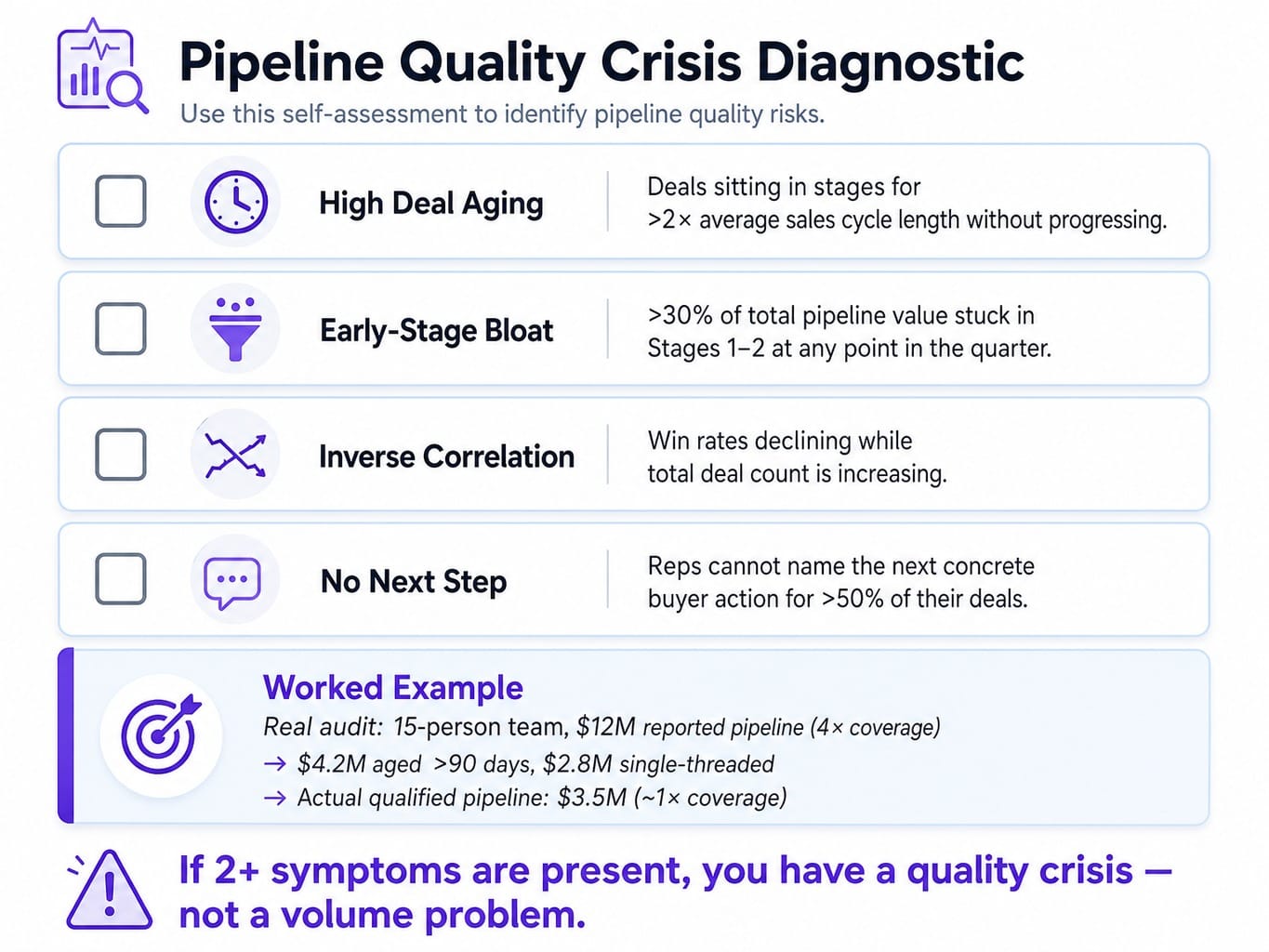
The symptoms of a quality crisis are clear:
- High Deal Aging: Deals are sitting in stages for more than 2x your average sales cycle length without progressing.
- Early-Stage Bloat: More than 30% of your total pipeline value is stuck in Stages 1-2 at any given point in the quarter.
- Inverse Correlation: Win rates are declining while your total deal count is increasing.
- No Next Step: Reps are unable to articulate the next concrete buyer action for more than half their deals.
This is the "dead opps clogging pipe" phenomenon. A pipeline audit of a 15-person sales team with a reported $12M pipeline (4x coverage) revealed $4.2M in deals older than 90 days with no buyer activity and $2.8M that were single-threaded to one contact. The actual qualified pipeline was closer to $3.5M—barely 1x coverage. The quality crisis was hiding in plain sight.
How to Prevent Deals from Stalling in the Middle of Your Pipeline
The vast majority of B2B deals—some studies say up to 86%—stall at some point. The two root causes in complex sales are almost always the same: single-threaded relationships and the absence of a shared execution plan.
These are not motivation problems; they are structural problems in how deals are managed. Most advice focuses on rep behavior ("be more persistent"), but the real fix is architectural. You must build multi-threading and mutual action plans into your stage-gate criteria so that deals cannot advance without them. A deal that reaches Stage 3 with only one contact engaged has not earned Stage 3, regardless of how positive the conversations feel. It's a high-risk liability, not a probable win.
Multi-Threading as a Stage-Gate Requirement
Multi-threading means having active relationships with two or more contacts across different functions at the buyer's organization. Single-threaded deals are the highest-risk assets in any pipeline. If your one champion changes roles, goes on leave, or loses internal influence, the deal dies instantly.
The fix is to make multi-threading a hard exit criterion for advancing past Stage 2. A deal cannot move to "Requirements Validated" unless at least two contacts from different functions have engaged directly. This is not a "nice to have"; it is a pipeline hygiene requirement. Reps can use tools like LinkedIn Sales Navigator to identify and map stakeholders, but the responsibility for building those relationships must be embedded in the sales process itself. If the deal isn't multi-threaded, it's not qualified to advance.
Mutual Action Plans That Create Buyer Accountability
A mutual action plan (MAP) is a shared document between buyer and seller that lists every remaining step to close, who owns each step, and the deadline for each. The key word is mutual. This is not a seller's close plan imposed on the buyer; it is a co-created document that establishes a shared commitment to a process.
MAPs prevent stalls by surfacing hidden blockers early—legal review timelines, budget approval cycles, competing priorities. They create buyer-side accountability for next steps and give the rep a legitimate, value-driven reason to follow up. The operational rule: no deal enters Stage 5 ("Decision Process Confirmed") without an agreed-upon MAP. If a buyer is unwilling to co-create a plan, that is a powerful signal. The deal is not as far along as it appears, and it does not belong in your commit forecast.
When Pipeline Execution Depends on Website Conversion, Manual Optimization Cannot Keep Up
A healthy pipeline depends on quality over volume, buyer-validated progression, and continuous execution discipline. But this entire system is downstream of a parallel execution problem: converting website visitors into qualified opportunities.
Every stage-gate framework, coverage ratio, and velocity calculation depends on your website's ability to turn the right traffic into the right kind of pipeline. And website optimization—testing CTAs, refining landing pages, adjusting messaging for different buyer segments—is exactly the kind of continuous, high-frequency execution work that lean marketing teams cannot sustain manually. The cadence breaks down.
Read more: Landing Page Conversion Rate Optimization: A Revenue-Weighted Playbook | Spike AI
This is where the execution gap that stalls deals in the sales process reveals its upstream origin. The same lack of continuous, disciplined optimization exists on the website that feeds the pipeline. Spike AI operates as a continuous website optimization layer, functioning as a marketing execution engine that identifies the highest-impact conversion improvements across your site and deploys them in weekly releases. This ensures the pipeline your sales team inherits is built on a foundation of qualified demand, not just traffic volume.
You can perfect your pipeline stages and metrics, but if the website feeding those stages is under-optimized and only reviewed quarterly, you're solving the wrong end of the problem.
See how Spike AI continuously optimizes your website to feed higher-quality pipeline
Conclusion
The single most important shift for any B2B revenue team is recognizing that your pipeline problem is almost certainly a quality and execution problem, not a volume problem.
Building stages from buyer behavior instead of seller activity, measuring stage-weighted coverage instead of raw ratios, and enforcing structural anti-stall mechanisms like multi-threading and mutual action plans—these are the differences between a pipeline that predicts revenue and one that predicts surprises. They transform the pipeline from a list of deals into a reliable forecasting system.
The teams that win in 2026 will not be the ones generating the most pipeline. They will be the ones whose pipeline converts most reliably because every single opportunity in it has earned its stage.
Frequently Asked Questions
How often should sales managers conduct pipeline reviews?
Conduct weekly deal-level reviews for active opportunities in Stage 3 and beyond, with a monthly full-pipeline audit examining stage distribution, deal aging, and the pipeline waterfall (created vs. lost vs. converted). The weekly review must focus on the next concrete buyer action. If a rep cannot name the specific next step the buyer has agreed to take, the deal requires immediate intervention or should be moved to an earlier stage.
How much pipeline do I need to hit my quarterly revenue target?
The standard 3x coverage ratio is misleading. Instead, calculate your stage-weighted coverage by multiplying each deal's value by its historical stage-to-close conversion rate, then summing the results. This gives you a probability-adjusted forecast. If your stage-weighted coverage is below 1.2x your target at the quarter's midpoint, you likely have a gap that the new, top-of-funnel pipeline cannot close in time, signaling a need to accelerate existing late-stage deals.
What is the difference between a sales pipeline and a sales funnel in B2B?
The funnel describes the buyer's journey from awareness to purchase—it's a demand-side model of a prospect's entire experience. The pipeline describes the seller's system for managing and progressing qualified deals through defined stages—it's a supply-side operational model. The best pipelines align their stages to key funnel milestones, ensuring seller activity is synchronized with actual buyer progress rather than running as a separate, internal process.
When should I remove a stale deal from the pipeline?
Remove any deal that has exceeded 2x your average sales cycle length without a buyer-initiated action in the last 30 days. Reps resist closing deals as lost, but stale deals distort coverage ratios, pollute forecasts, and consume valuable review time. Implement an automated aging rule in your CRM—both Salesforce and HubSpot support time-based stage alerts—so that removal is a systematic process, not a discretionary and often-delayed decision.
How should marketing and sales align on pipeline generation goals?
Align on pipeline value created by source, not on lead volume or MQL count. Marketing should own a pipeline contribution target measured in dollars of Stage 2+ qualified pipeline generated. This forces both teams to optimize for deals that pass initial qualification, not just contacts that inflate the top of the funnel. Run a shared monthly pipeline waterfall review to track how marketing-sourced pipeline converts compared to outbound and partner-sourced pipeline.