SaaS CRO: The Conversion Optimization Playbook That Actually Matches Your ACV and Motion

TLDR
- SaaS CRO fails due to execution bottlenecks, not a lack of ideas. The gap between identifying a fix and shipping it is where growth stalls.
- Your Annual Contract Value (ACV) determines your CRO strategy. Low-ACV PLG products should optimize the signup-to-aha path; high-ACV sales-led products must optimize demo requests and proof points.
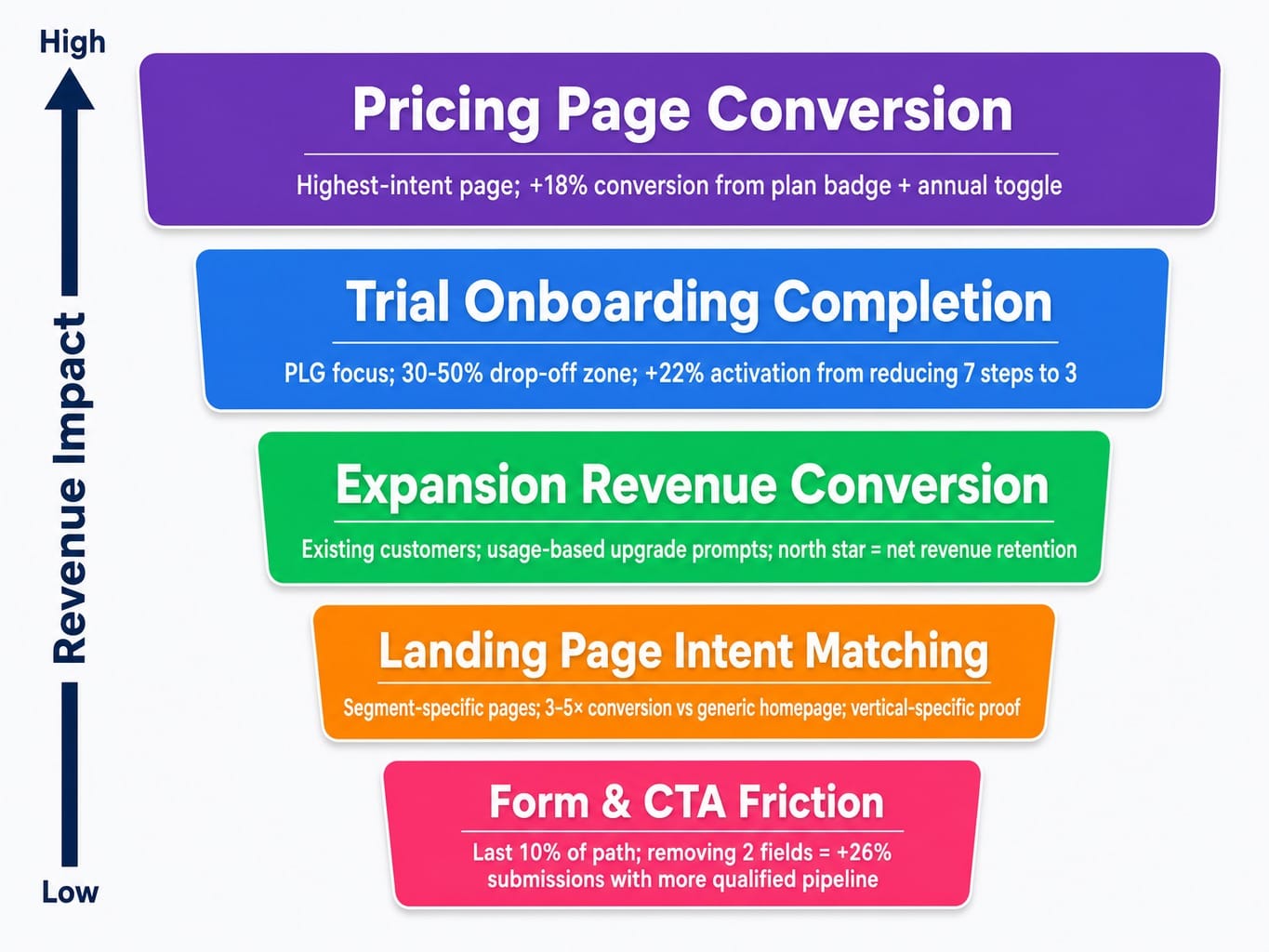
- Prioritize CRO targets by revenue impact: focus on pricing page conversion, trial onboarding completion, and expansion revenue paths before testing minor headline copy.
- Aggregate conversion rates hide the truth. Use cohort-based analysis to measure experiment lift by user segment (e.g., acquisition channel) to find hidden wins and losses.
- If you have limited traffic, ditch traditional A/B testing. Use sequential testing, qualitative CRO (session recordings, message testing), and high-impact deployments instead.
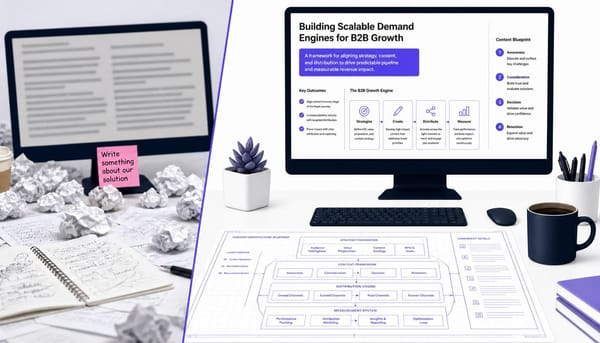
Your three-person marketing team just got the results from the CRO audit. The report is 47 items long, a backlog of "high-impact" recommendations from your new analytics tool. Six weeks later, you've managed to ship two of them—a headline change and a new button color. The result? No measurable lift. The other 45 items are stuck in a queue behind engineering tickets, design reviews, and stakeholder approvals.
If this sounds familiar, you're not alone. This is the default state for most B2B SaaS marketing teams. The problem with SaaS CRO isn't a lack of insight into what's broken. The problem is that the latency between identifying a conversion issue and shipping a fix is measured in weeks, not hours.
The CRO playbook that actually works depends entirely on your ACV tier and go-to-market motion. The biggest gains don't come from running more experiments, but from compressing the time between diagnosis and deployment. This guide explains why most SaaS CRO programs stall, how to select optimization targets for your specific motion, and how to run meaningful experiments even when you have limited traffic.
Why Most SaaS CRO Programs Stall at Diagnosis
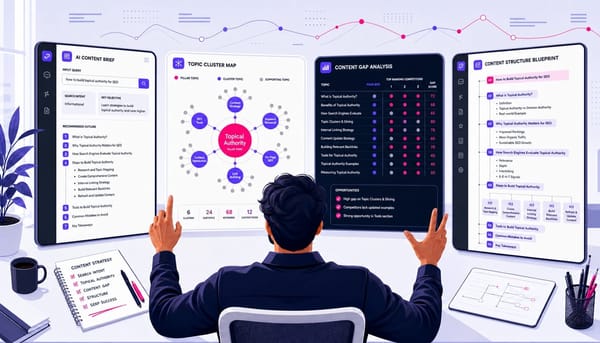
The SaaS CRO industry has an overproduction problem: too many audits, too many dashboards, too many backlogs, and not enough shipped changes. A typical B2B SaaS team uses Hotjar for heatmaps, runs a VWO or AB Tasty audit, and gets a prioritized list of 20+ recommendations. Then, reality hits. The team ships maybe two or three of those changes per quarter because every single one requires a cross-functional workflow of design, development, copy, QA, and stakeholder sign-off.
This operational drag is why, despite massive investment in CRO tooling, average B2B SaaS visitor-to-lead conversion rates remain stuck between 1.5-2.5%. This number has barely moved in five years. Meanwhile, top-decile performers convert at 8-15%. The difference isn't that they have better ideas; it's that they have a better execution system. The constraint isn't analytical—it's operational.
The gap between "we know what to fix" and "we fixed it" is where conversion gains die.
This is why the most critical metric for your CRO program isn't the number of tests you run, but your experiment velocity—the speed at which you can move from a hypothesis to a deployed change to a measured result. The teams that win are the ones that can close this loop in days, not quarters. Their cadence itself becomes the growth engine.
Your ACV Tier Determines Your CRO Playbook
Most SaaS CRO advice treats all SaaS companies as interchangeable. This is a critical error. A $29/month self-serve product and a $50K ACV enterprise platform have fundamentally different conversion architectures. The metrics that matter, the pages that matter, and the experiments that move revenue are completely different.
Your Annual Contract Value (ACV) is the single most important variable in determining which CRO tactics are viable—more important than traffic volume, industry, or tool stack. And let's be honest, the line between tiers can be blurry, but the archetypes are clear. Wasting effort on tactics designed for a different motion is the fastest way to burn resources with zero return.
Low-ACV PLG: Optimize the Signup-to-Aha Path
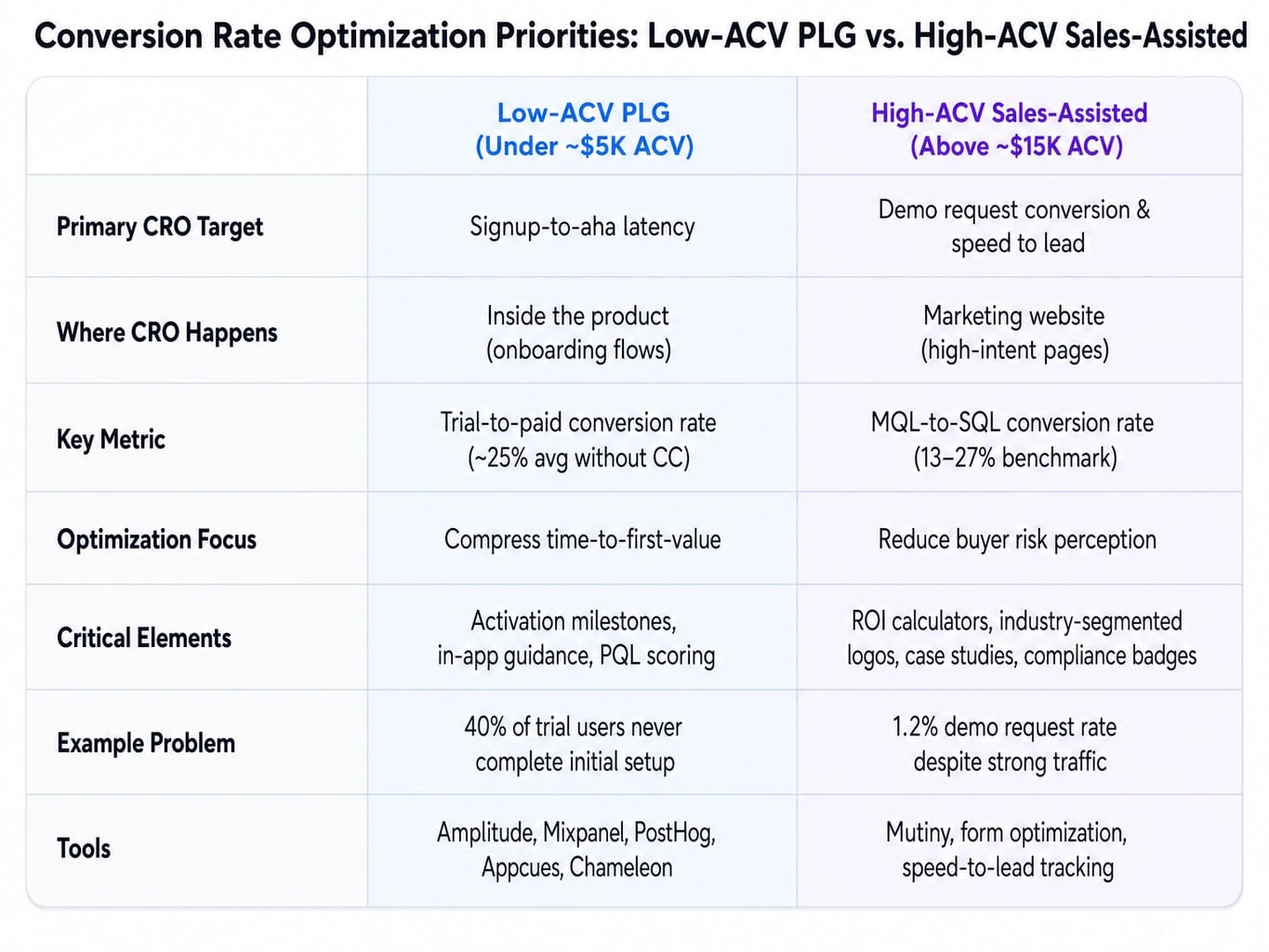
For products under ~$5K ACV with a self-serve or product-led growth (PLG) motion, the highest-leverage CRO target is not the marketing website. It's the signup-to-aha latency.
Consider a project management SaaS with a 14-day free trial. They see 40% of trial users never complete the initial project setup. The problem isn't getting visitors to sign up; it's that signed-up users never reach the activation milestone where the product's value becomes obvious. While free trial conversion rates without a credit card average around 25%, that number is meaningless if activation is broken.
Here, CRO happens inside the product. Your focus should be on compressing the time-to-first-value. Use tools like Amplitude, Mixpanel, or PostHog to analyze feature adoption curves and identify the "aha moment" that correlates with conversion. Is it creating the first task? Inviting a team member? Integrating with Slack? Once you know the key activation milestones for your PQL scoring model, you can use in-app guidance tools like Appcues or Chameleon to re-architect onboarding flows and guide every user to that moment of value as quickly as possible.
High-ACV Sales-Assisted: Optimize the Handoff and Proof Points
For products above ~$15K ACV with a sales-assisted motion, the game changes completely. The highest-leverage CRO targets are demo request conversion, speed to lead, and the quality of proof points on high-intent pages.
Imagine a cybersecurity SaaS with a 90-day sales cycle. They have strong traffic to their pricing and solutions pages but see a dismal 1.2% demo request rate. The issue isn't top-of-funnel interest; it's that the page lacks the specific proof points an enterprise buyer needs before engaging a sales team. They aren't just buying software; they're making a career-defining decision.
For this motion, your website's job is to reduce buyer risk perception. Your MQL-to-SQL conversion rate (which benchmarks between 13-27%) depends on it. Focus your CRO efforts on high-intent pages like pricing and enterprise contact forms. Add elements that build trust and quantify value for hand-raiser intent signals: ROI calculators, customer logos segmented by industry, detailed case studies, and prominent security compliance badges (SOC 2, ISO 27001, etc.). Reducing friction on the demo request form is crucial, but equally important is measuring and optimizing for speed to lead—how fast sales responds, which directly impacts whether that lead becomes an opportunity.
Five High-Leverage SaaS CRO Targets Ranked by Revenue Impact
CRO prioritization in SaaS should be driven by proximity to revenue, not ease of implementation. Most teams default to testing button colors or headline copy because those experiments are easy to ship—but they rarely move revenue. A more disciplined approach focuses on the moments that have a direct, measurable impact on pipeline and retention.
Read more: Data-Driven CRO: Evolve Your Marketing Strategy for Revenue | Spike AI
- Pricing Page Conversion: This is the highest-intent page on any SaaS site, yet most teams are afraid to test it. A small lift here has an outsized impact on revenue. For example, a B2B SaaS company found that adding a "Most Popular" badge to their mid-tier plan and an annual billing toggle that showed the discount upfront increased pricing page-to-checkout conversion by 18%. This single change outperformed a year's worth of blog optimization.
- Trial Onboarding Completion: For PLG motions, the drop-off between signup and completing onboarding is where trials go to die. This drop-off is often 30-50%. A workflow automation tool reduced its onboarding steps from seven to three and added a simple progress indicator. This seemingly minor change, tracked in Pendo, lifted their activation rate by 22% and directly improved their trial-to-paid conversion rate.
- Expansion Revenue Conversion: Optimizing for new customers is important, but optimizing for more revenue from existing customers is often higher leverage. Focus on in-app upgrade and expansion paths. This includes clear usage-based upgrade prompts, contextual upsell triggers when a user hits a plan limit, and targeted offers for annual plans. Aligning this effort with net revenue retention as your north star metric ensures you're working on the most profitable conversions.
- Landing Page Intent Matching: Sending all your traffic to a generic homepage is a massive waste of ad spend and user intent. Segment-specific landing pages for high-intent keywords can convert 3-5x better. A CRM company created two separate landing pages: one for "CRM for real estate agents" and another for "CRM for SaaS sales teams." Each page featured testimonials, use cases, and language specific to that vertical. Using a personalization tool like Mutiny, they saw demo request rates from these campaigns triple.
- Form and CTA Friction: The last 10% of the conversion path is where micro-friction compounds into macro-level drop-off. Audit every form field and CTA. A data integration platform removed the "Company Size" and "Phone Number" fields from their demo request form. They worried about lead quality but found that the 26% increase in total submissions yielded a more qualified pipeline overall, as the sales team could qualify prospects during the initial call.
Why Cohort Analysis Exposes Gains That Aggregate Conversion Rates Hide
Aggregate conversion rates are the most dangerous metric in SaaS CRO. They are a blended average that masks the crucial segment-level performance shifts that determine whether an experiment actually worked.
Here's a real-world example. A SaaS company runs a pricing page test and sees its aggregate trial-to-paid conversion rate hold steady at 12%. The team calls the test inconclusive and moves on. But when they break the data down into monthly acquisition cohorts using a tool like Amplitude or Mixpanel, they discover something startling. The test variant had increased trial-to-paid conversion for users who signed up via organic search by 31%, but it had decreased conversion for users from paid social campaigns by 15%. The aggregate number completely hid a massive win inside a segment-level loss. It's the kind of finding that makes you question every 'flat' result you've ever seen.
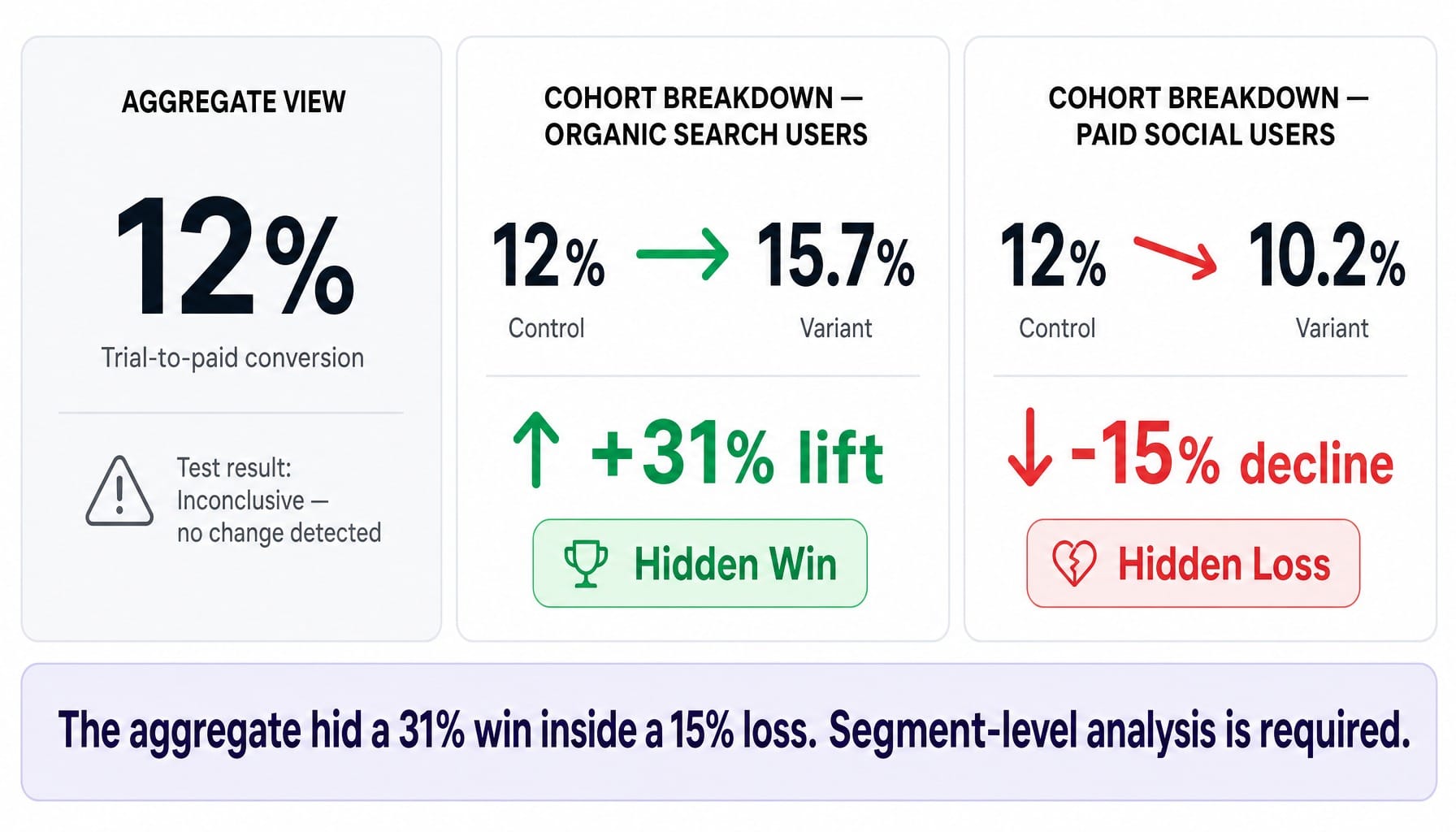
This is why MoM cohort decay—tracking how each month's signup cohort converts over time—is the correct measurement framework for SaaS CRO. It protects you from making bad decisions based on blended data and helps you avoid issues like holdout group contamination, where different intent profiles pollute your experiment results. Stop reporting aggregate conversion rates. Start running segment-level lift analysis on every experiment to find the gains and losses your top-line number is hiding.
How to Run Meaningful CRO With Limited Traffic
Most B2B SaaS companies do not have enough traffic to run statistically powered A/B tests on anything but their highest-traffic pages. A site with 5,000 monthly visitors cannot reliably detect a 10% lift on a pricing page that gets 800 visits a month. The statistical power budget simply isn't there.
But this doesn't mean you just give up on CRO. It means you get smarter about your methods. Here are three alternatives that work at low traffic volumes:
- Sequential Testing with Guardrail Metrics: Instead of a classic A/B test, deploy a change and monitor its performance over 2-4 weeks against a baseline period. While you may not reach statistical significance on your primary conversion metric, you can use guardrail metrics (like bounce rate, time on page, or scroll depth) to detect strong directional signals. Frameworks from tools like Statsig or Eppo can help structure these tests to give you confidence faster.
- Qualitative CRO: For low-traffic sites, qualitative research often produces higher-confidence insights than underpowered quantitative tests. Use Hotjar session recordings to see where users get stuck, run message testing on platforms like Wynter to see if your value proposition resonates, and conduct customer interviews to uncover objections. One B2B SaaS team used five session recordings to identify a confusing pricing tier, fixed it, and measured the before-and-after impact at the cohort level, confirming a lift without ever running an A/B test.
- High-Impact, Low-Risk Deployment: When you have strong qualitative evidence that a change will be an improvement, don't waste time testing it against a broken original. Ship the change you believe is better and measure the cohort-level performance. For lean teams that can only ship 1-2 significant changes per quarter, this approach delivers value much faster than waiting months for a statistically significant test result that may never arrive.
What Happens When CRO Runs as a Continuous System Instead of a Quarterly Project
Across every section, a single tension has emerged: SaaS CRO stalls because of the execution gap between diagnosis and deployment. Teams know what to fix but can't ship changes fast enough. You lack the bandwidth to run experiments continuously, the cross-functional coordination to deploy weekly, and the analytical infrastructure to measure cohort-level impact in real time. This is an execution system failure.
Spike AI is designed to resolve this tension. It functions as the execution layer that compresses the diagnosis-to-deployment cycle from weeks to days. Our system continuously identifies the highest-impact conversion opportunity across your website, SEO, and ads, and then helps you ship the fix.
Where this article showed that experiment velocity matters more than experiment volume, Spike AI provides the execution engine that makes a weekly shipping cadence possible without adding headcount. Where it showed that lean teams are constrained by resources, Spike AI acts as the prioritization and deployment system that replaces the slow, manual agency-consultant-dev ticket workflow. It's the third option between hiring a full CRO team and engaging an expensive agency—an autonomous system that does the heavy lifting while you stay in control.
See how Spike AI turns your CRO backlog into weekly shipped improvements
Your Growth Is Constrained by Execution, Not Strategy
The single most important shift in thinking is this: SaaS CRO is not an analytics discipline—it is a shipping discipline. The companies that consistently improve their B2B conversion rate are not the ones with the most elaborate dashboards or the longest recommendation lists. They are the ones that compress the cycle from insight to deployed change. They match optimization targets to their ACV and motion, and they measure results at the cohort level instead of the aggregate.
The gap between your current conversion rate and your top-decile potential is not a strategy gap. It is an execution gap. The only question is whether your marketing system is built to close that gap at the velocity your funnel demands.
Frequently Asked Questions
What is a realistic trial-to-paid conversion rate for B2B SaaS in 2026?
It varies by model. A free trial without a credit card averages around 25%, while requiring a credit card can push that to 40-60%. Freemium models typically convert 1-10% of free users. These benchmarks change significantly with ACV, so a $29/mo product will behave very differently from a $500/mo one.
Should B2B SaaS companies use reverse trials or freemium for higher conversion?
Reverse trials, which grant full-feature access before downgrading to a free tier, generally outperform freemium when your product's core value requires feature depth. Freemium works better if your product has a strong standalone free use case that creates natural upgrade pressure. The decision depends on whether your "aha moment" requires premium features.
What is the difference between MQL conversion rate and PQL conversion rate in SaaS?
MQL (Marketing Qualified Lead) conversion measures leads qualified by marketing engagement, while PQL (Product Qualified Lead) conversion measures leads qualified by actual product usage. PQLs typically convert to paid at 2-5x the rate of MQLs because in-product action is a much stronger signal of buying intent than downloading an ebook.
How do you identify the aha moment to improve SaaS activation rates?
Analyze the behavior of users who converted versus those who churned in their trial. Look for the specific feature interaction that correlates most strongly with retention and conversion. Tools like Amplitude or Mixpanel can run this analysis. Once identified, restructure onboarding to guide every new user to that milestone as fast as possible.
When should a SaaS company invest in CRO versus top-of-funnel growth?
Invest in CRO first if your conversion rates are below your ACV tier's benchmark and you have enough traffic to measure changes. Invest in top-of-funnel first if conversion is strong but volume is too low to hit revenue targets. The compounding math favors CRO: a 20% conversion lift on existing traffic is permanent leverage.
What role does instrumentation debt play in SaaS CRO accuracy?
Instrumentation debt—broken or inconsistent event tracking—silently corrupts every CRO measurement. If your 'Trial Started' event fires incorrectly, your entire funnel analysis is wrong. Before any CRO program, audit your event taxonomy in tools like Heap or PostHog to ensure every conversion event fires correctly and consistently. Bad data guarantees bad results.