SaaS GEO Strategy: Why Your Rankings No Longer Predict AI Visibility

TL;DR
- GEO is not SEO: Generative Engine Optimization (GEO) focuses on getting your SaaS product cited by AI engines like ChatGPT and Perplexity, which use different retrieval and trust signals than traditional search.
- AI engines retrieve passages, not pages: Your content must be structured with independent, "answer-first" sections. If an H2 section can't stand alone when extracted, it will likely be ignored.
- Entity consistency beats domain authority: AI engines trust brands that have consistent naming and positioning across the web (G2, LinkedIn, schema, etc.). This "entity salience" often matters more for citation than backlinks or organic rankings.
- Measure citations, not just clicks: Track metrics like citation yield rate (how often you're cited) and LLM brand recall (how accurately AI describes you), as traditional SEO metrics won't capture your visibility in zero-click AI answers.
- The execution gap is the real bottleneck: Knowing what GEO requires is different from implementing it continuously. The teams that win will build a system for shipping these architectural content changes weekly.
You've seen it happen. Your B2B SaaS company ranks #2 organically for its primary category keyword. You've invested years in building content and authority. Yet, when a buyer asks Perplexity or ChatGPT, 'What's the best [category] tool for mid-market teams?', your product is nowhere to be seen. Instead, the AI recommends a competitor with weaker rankings and a fraction of your domain authority.
These are not contradictory outcomes. They are governed by different systems.
Organic search rankings and AI search citations operate on increasingly divergent logic. As Gartner projects a 25% decline in traditional search volume by 2026, SaaS teams optimizing exclusively for Google's ten blue links are preparing for a world that is already disappearing. The new discipline is generative engine optimization (GEO): making your content, product, and brand retrievable and citable by AI systems.
This isn't about tweaking keywords. It's a fundamental shift in content architecture. This guide explains how AI search engines actually select which SaaS tools to recommend, why your current content likely fails that selection process, and what to change at the passage, entity, and schema level to fix it.
GEO, AEO, and SEO: What Actually Differs for SaaS Teams
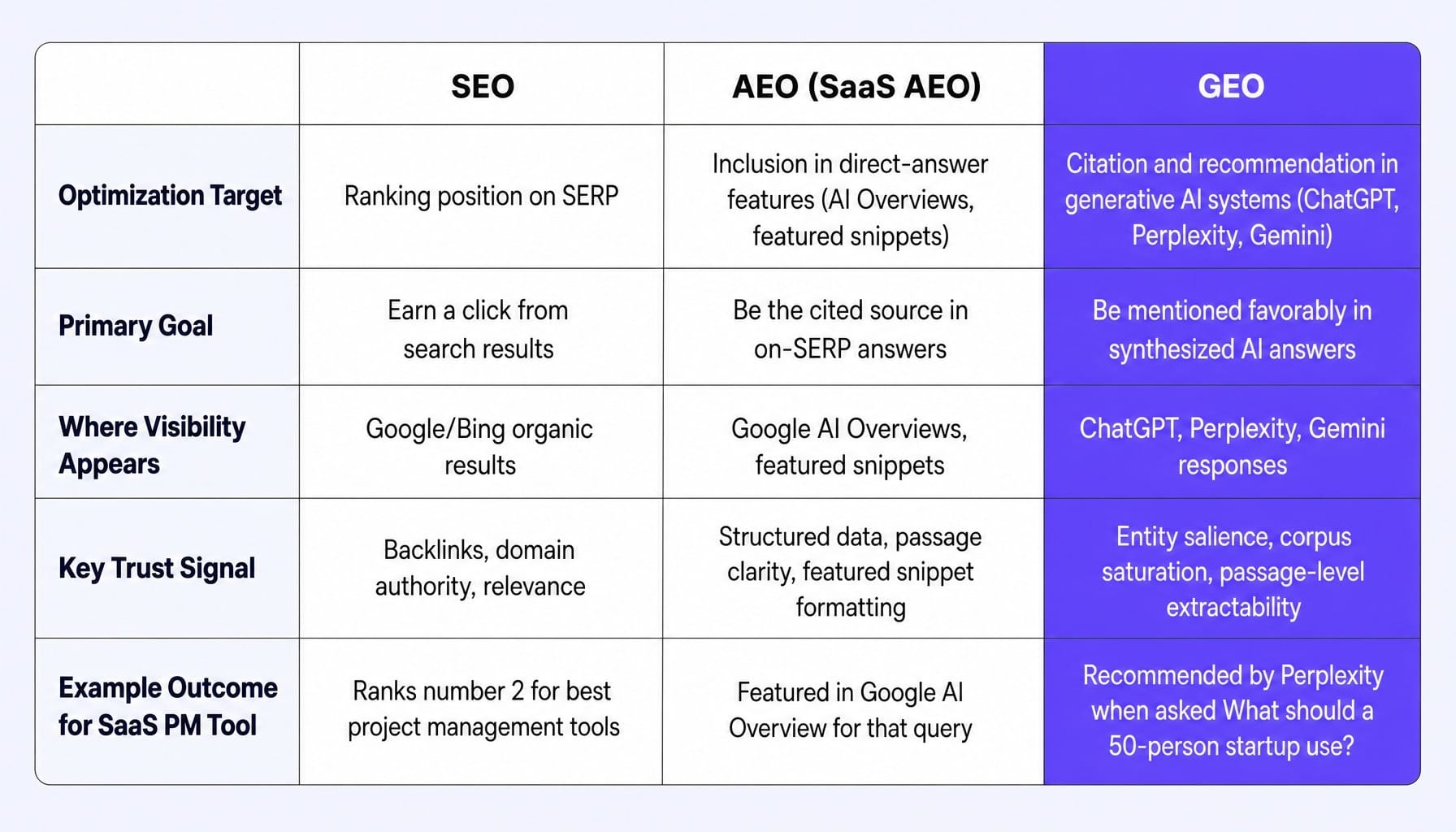
GEO, AEO, and SEO are not three separate strategies. They are three optimization targets within the same content system, and conflating them causes SaaS marketing teams to misallocate effort.
Let's define them precisely:
- Search Engine Optimization (SEO): Optimizes for ranking position in traditional search results. The goal is to appear high on the SERP and earn a click.
- Answer Engine Optimization (AEO): Optimizes for inclusion in direct-answer features within a search engine, like Google's AI Overviews and featured snippets. The goal is to be the cited source for an answer on Google's property.
- Generative Engine Optimization (GEO): Optimizes for citation and recommendation within standalone generative AI systems like ChatGPT, Perplexity, and Gemini. The goal is to have your brand or product mentioned favorably in a synthesized answer, which may or may not link back to you.
Consider a SaaS project management tool. Its comparison page might rank well for "best project management tools" (SEO success). It might even get featured in a Google AI Overview for that query (AEO success). But it could be completely absent when a user asks Perplexity, "What should a 50-person startup use for project tracking?" (GEO failure).
This distinction is critical. According to a 2026 G2 survey, 51% of B2B software buyers now start their vendor research with an AI chatbot, not a traditional search engine. While Google maintains that AEO and GEO are extensions of SEO, engines like Perplexity operate on different retrieval logic. The practical overlap is significant—structured content and entity clarity serve all three—but GEO is not just a rebrand of SEO. It's a distinct optimization surface with its own mechanics.
How AI Search Engines Decide Which SaaS Tools to Recommend
Most SaaS marketers operate under a flawed assumption: that AI engines are just Google with a chat interface. The reality is that the selection process is fundamentally different. AI engines don't rank pages; they retrieve passages, evaluate source trustworthiness, and synthesize answers.
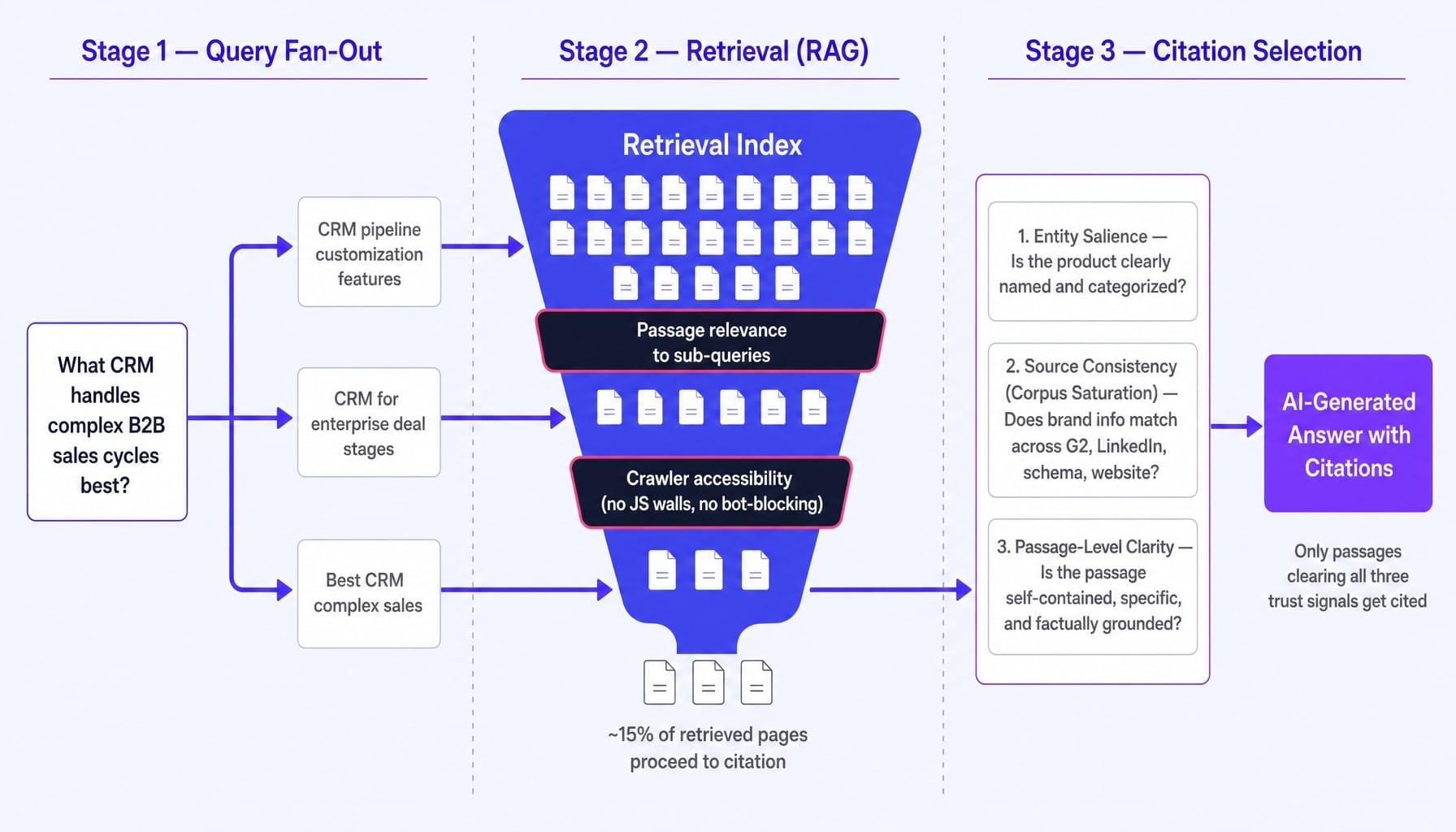
Understanding this pipeline is the prerequisite to any GEO tactic. A study by AirOps found that of the thousands of pages an AI engine might retrieve to answer a query, only 15% are actually cited in the final response. Your content must clear two hurdles: retrieval and citation.
Retrieval: Why Your Content Gets Skipped Before It's Even Read
When you ask an AI engine a question, it doesn't just search the web. It uses a process called retrieval-augmented generation (RAG). In simple terms, the system first generates a set of internal, more specific sub-queries (a "query fan-out"), retrieves a list of candidate web pages from its index based on those sub-queries, and then pulls relevant passages from those pages to "ground" its answer in facts.
Here's the critical insight for SaaS teams: your page is judged on its relevance to the AI's internal sub-queries, not the keyword you originally targeted.
If a user asks, "What CRM handles complex B2B sales cycles best?" the AI might generate sub-queries like "CRM pipeline customization features" or "CRM for enterprise deal stages." If your content doesn't contain distinct, passage-level answers to those derivative queries, you are invisible at the retrieval stage. Your page is filtered out before it even has a chance to be read. Furthermore, basic AI crawler accessibility matters. Content hidden behind complex JavaScript rendering, login walls, or aggressive bot-blocking may never even enter the retrieval index.
Citation: What Makes an AI Engine Trust Your Page Enough to Quote It
Getting retrieved is necessary but not sufficient. The AI must then trust your page enough to cite it over the other candidates. For SaaS content, this trust is built on three primary signals:
- Entity Salience: Does your page clearly establish what your product is, what category it belongs to, and how it relates to named alternatives? AI engines use entity disambiguation to confirm your page is about the right topic. Vague positioning is a liability.
- Source Consistency: Does your brand appear consistently across multiple authoritative sources? This is corpus saturation. If your product name, category, and features are described identically on your website, G2, Capterra, and industry publications, the AI's confidence in citing you increases. You can audit this consistency using tools like Kalicube Pro.
- Passage-Level Clarity: Is the specific passage the AI would quote self-contained and factually grounded? Hedging language, vague claims, and marketing fluff reduce citation probability. An AI is more likely to quote "Brand X integrates with HubSpot and Salesforce" than "Brand X offers a variety of powerful integration options."
The Citation Attribution Gap: Why You Outrank Competitors But They Get Recommended
Here is one of the most disorienting experiences for a modern SaaS marketing team: you have higher domain authority, more backlinks, and better organic rankings than a smaller competitor, yet they consistently appear in ChatGPT and Perplexity recommendations for your category.
This is the citation attribution gap. It's not a fluke; it's a systemic outcome. And yes, it's as frustrating as it sounds.
Practitioner audits consistently show that for SaaS content, traditional authority metrics like DA can even have an inverse correlation with AI citation rates. Smaller, focused domains often outperform larger ones. Here are the three most common reasons why:
- Architecture for Extraction, Not Dwell Time: Your content is likely optimized for human narrative flow and dwell time. It's a 4,000-word "ultimate guide" where the real answer is buried in the fourth paragraph of each section. Your smaller competitor's content is architecturally optimized for extraction. Their 1,500-word pages use short, answer-first sections, named entities, and self-contained passages—a "snippet bait architecture" designed to be quoted.
- Superior Entity Consistency: Your competitor has stronger entity consistency across the web. Their product name, category, and key differentiators appear identically on their G2 profile, their schema markup, and their blog content. Your company, having pivoted twice, might have inconsistent naming, vague positioning on review sites, and schema that doesn't match your marketing copy. The AI trusts their entity signals more because they are cleaner.
- Content Freshness and Focus: Your competitor's focused pages are updated monthly. Your "ultimate guide" was last updated 18 months ago. AI retrieval systems often favor fresher content, and studies suggest that for AI citation, pages under 2,000 words often outperform bloated, long-form assets.
Your SEO investment isn't wasted, but it's solving a different problem. You've built a system to win clicks. Your competitor has built a system to win citations.
Structuring SaaS Content for AI Retrieval and Citation
GEO is not a content strategy you layer on top of your existing work. It requires rethinking how pages are architecturally designed—at the passage level, not the page level. Most SaaS content is written to be read top-to-bottom. AI engines don't read that way. They extract individual passages, evaluate them independently, and assemble answers from the most citable chunks.
Imagine a SaaS product comparison page. The "before" version buries the recommendation in paragraph three after a long preamble about the market. The "after" version opens each H2 with a direct, 50-word answer, uses a clean comparison table, and includes FAQ schema that exactly matches the visible content. The latter is designed for retrieval.
Read more: SaaS Website Best Practices for 2026: From Static Pages to Continuous Optimization
Passage-Level Content Design: Writing for Extraction, Not Just Reading
The single most impactful GEO change is making every H2 section independently extractable. This means an AI could pull that section alone and present it as a complete, coherent answer without needing context from the surrounding page.
Here are the rules for this architecture:
- Answer First: Open every H2 section with a direct answer to the implied question in 40-60 words. No preamble.
- Use Named Entities: Refer to products, companies, and categories by their proper names. Avoid ambiguous pronouns like "it" or "this tool."
- Format for Extraction: Use comparison tables and numbered lists for any evaluative content. These are highly extractable formats.
- Keep Sections Focused: Aim for sections under 300 words. Longer sections dilute the passage-level indexing signals and make it harder for the AI to find the core point.
- Break Narrative Chains: Avoid writing where section three only makes sense if you've read sections one and two. Each section must stand on its own.
Tools like Clearscope can help evaluate the semantic completeness of your content, but the architectural discipline of making each passage independently useful remains a manual, strategic task.
Schema and Entity Markup That Actually Affects AI Retrieval
The common advice is to "add more structured data." That's not wrong, but it's imprecise. For GEO, it's not about quantity; it's about which specific types help AI engines disambiguate your entity and classify your content.
Prioritize these schema types:
- Organization Schema: Include sameAs links to your official profiles on LinkedIn, Crunchbase, G2, and Wikipedia/Wikidata. This is the single most important signal for entity disambiguation.
- FAQPage Schema: Ensure the JSON-LD content exactly matches the visible Q&A on your page. Mismatches are a common and easily avoidable failure mode.
- SoftwareApplication Schema: For product and solution pages, use this to specify your product category, pricing model, and key features. This provides direct, structured data for recommendation queries.
- Article Schema: Always include the dateModified property to signal freshness to retrieval systems.
While Google's own guidance states that structured data isn't a requirement for its AI features, for the broader ecosystem of non-Google AI engines, entity-level schema is a powerful tool for knowledge graph injection and reducing brand ambiguity.
Measuring SaaS GEO: What to Track When Rankings Don't Tell the Story
Let's be honest: GEO analytics is still the wild west. But that doesn't mean we're flying blind. Traditional SEO metrics—rankings, organic traffic, CTR—are insufficient for GEO because the value proposition of AI search is answering questions without a click. A successful GEO strategy might lead to flat organic traffic but increased inbound pipeline from un-attributed brand awareness.
Your dashboard will show the symptom (traffic decline) without the cause (AI visibility). To get a clear picture, track these four GEO-specific metrics:
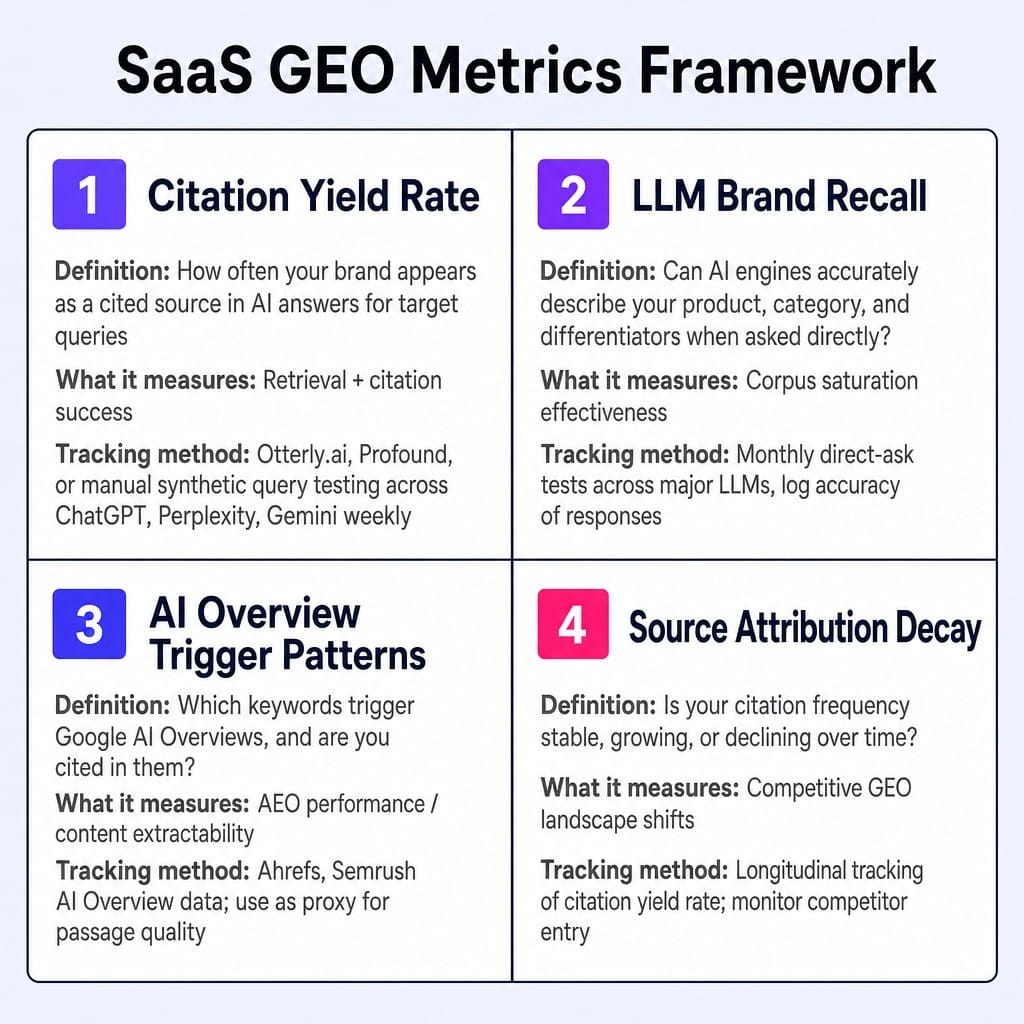
- Citation Yield Rate: For your target queries, how often does your brand appear as a cited source in AI-generated answers? You can track this with emerging tools like Otterly.ai and Profound, or manually through synthetic query testing—running queries through ChatGPT, Perplexity, and Gemini weekly and logging the results.
- LLM Brand Recall: Can AI engines accurately describe your product, its category, and its differentiators when asked directly? Test this monthly to see if your corpus saturation efforts are working.
- AI Overview Trigger Patterns: Which of your keywords trigger Google AI Overviews, and are you cited? Tools like Ahrefs and Semrush now surface this data, helping you measure AEO performance as a proxy for your content's extractability.
- Source Attribution Decay: Is your citation frequency stable, growing, or declining over time? Tracking this helps you monitor the competitive landscape as others begin optimizing their own content for GEO.
Read more: B2B RevOps in 2026: What to Measure, What to Build, and Where Most Teams Stall
When GEO Becomes a Continuous System, Not a One-Time Audit
This guide has laid out the architecture for AI visibility: passage-level content redesign, entity consistency across the web, structured data alignment, and continuous measurement. Most SaaS marketing teams understand what needs to change. The problem is the gap between that understanding and continuously shipping those changes across dozens or hundreds of pages.
This is the execution bottleneck. The real challenge isn't knowing that your content needs to be more extractable; it's having the system to implement those fixes at the pace AI search demands. Teams that build their SaaS content marketing strategy around continuous shipping—not periodic audits—will pull ahead.
That is the problem Spike AI was built to solve. Our platform identifies which pages have the highest citation probability gap, prioritizes the highest-impact GEO fixes across content structure and schema, and ships those changes weekly. Where other tools give you a report, Spike AI closes the gap between knowing what GEO requires and actually getting it done.
See how Spike AI identifies and ships your highest-impact GEO fixes weekly
Conclusion
The most important shift in thinking is this: GEO is not an SEO checklist. It is a structural change in how your SaaS brand becomes discoverable. It requires treating every page as a collection of independently extractable, entity-grounded passages, not a monolithic document.
We've seen that AI engines retrieve passages, not pages; they trust clean entities, not just domain authority; and they cite content that is architecturally designed for extraction. The SaaS companies that build this thinking into their content operations now—as a continuous system, not a one-off project—will compound an advantage that becomes increasingly difficult for competitors to close. The window is open precisely because most of your competitors are still optimizing exclusively for a search landscape that is already behind us.
Frequently Asked Questions
Does generative engine optimization replace traditional SEO for SaaS companies?
No, GEO extends SEO. Most AI engines still disproportionately retrieve content from pages that rank well organically, so strong SEO remains the foundation for discovery. However, ranking alone no longer guarantees visibility. SaaS teams need both: SEO for retrieval probability and GEO for citation probability.
How should SaaS companies optimize product pages—not just blog content—for AI citation?
Product pages need SoftwareApplication schema with category and pricing attributes, a concise 40-60 word description stating what the product does and for whom, and named competitor comparisons. AI engines frequently cite product pages for recommendation queries, but only when the page provides extractable, entity-grounded facts instead of just marketing copy.
Can programmatic SEO content rank in AI-generated results for SaaS?
Only if each programmatic page provides genuinely differentiated value. AI engines are effective at detecting commodity content that is structurally identical with swapped variables. Programmatic pages that include unique data, localized insights, or category-specific comparisons can earn citations. Pages that are just interchangeable templates will not.
How does entity disambiguation affect SaaS visibility in AI search?
If your product name is generic, AI engines may struggle to associate your content with the correct brand. Consistent Organization schema with sameAs links, identical naming across G2 and LinkedIn, and explicit category labeling in your content all help AI engines resolve your brand identity confidently, increasing citation probability.
Should SaaS companies create content specifically designed for AI training data inclusion?
This is not a reliable strategy, as you cannot control what enters a model's training corpus. Focus instead on making your content consistently retrievable through RAG pipelines, which is how most AI engines source real-time answers. Well-structured, entity-rich, and frequently updated content will be retrieved regardless of its inclusion in training data.
How do multi-turn conversational queries change SaaS keyword strategy?
In multi-turn AI conversations, users refine questions from broad ("best CRM?") to specific ("does it integrate with HubSpot?"). Your content must answer not just the primary query but also likely follow-up sub-queries. Pages covering specific use cases, integrations, and pricing nuances are more likely to be retrieved in later conversational turns.