SaaS Keyword Research: The Revenue-First Framework for Pipeline, Not Just Pageviews

TL;DR
- Stop prioritizing keywords by search volume. Use a revenue-weighted Business Value (BV) score that combines ICP alignment, purchase proximity, and conversion potential.
- The highest-intent SaaS keywords are often found in support tickets and sales call transcripts, not by brainstorming with tools like Ahrefs or Semrush.
- Focus your initial efforts on five key categories, starting with Alternative & Comparison keywords (e.g., '[competitor] alternative'), as they have the highest conversion potential.
- Before writing, validate every keyword's intent by analyzing the SERP. If the dominant format (e.g., listicles, product pages) doesn't match your plan, deprioritize the keyword to avoid wasted effort.
- For lean teams, the biggest challenge isn't finding keywords; it's the lack of bandwidth to execute on the opportunities. The goal is a system for continuous shipping, not just a long list of keywords.
You've done the work. You fired up Ahrefs, exported thousands of keywords, filtered for a Keyword Difficulty under 30, and built a content calendar around the highest-volume terms. Three months later, traffic is up. But trial signups are flat, demo requests are stagnant, and your pipeline hasn't moved.
This is the most common failure mode in B2B marketing. It stems from a fundamental misunderstanding: SaaS keyword research is not a search volume exercise; it is an ICP alignment exercise.
The keywords that generate revenue for a SaaS product often have laughably low search volume. They are specific, nuanced, and tied directly to a job your ideal customer is trying to accomplish. Applying generic keyword logic built for e-commerce or publishing is a recipe for high-traffic, low-impact content.
This is not another guide telling you to "find long-tail keywords." This is a revenue-weighted framework for scoring, prioritizing, and validating the keywords that actually drive pipeline. We'll cover the scoring model that replaces volume-difficulty matrices, the five keyword categories that matter most, and the unconventional sources that surface keywords your competitors will never find in a tool.
Why SaaS Keyword Research Is a Different Discipline Entirely
Applying generic SEO advice to a SaaS business is like using a city map to navigate the ocean. The principles are recognizable, but the environment changes everything. SaaS keyword research differs from e-commerce or affiliate SEO in three structural ways that demand a different approach.
First, SaaS buyers research solutions over weeks or months, not minutes. A single user might search for problem-aware informational content, solution-focused feature comparisons, and bottom-of-funnel pricing queries across a dozen sessions. This means your keyword universe must map to a long, complex decision journey, not just a single transactional impulse.
Second, the total addressable market for most B2B SaaS products is inherently small and niche. A keyword with 200 monthly searches might represent your entire buyer pool for a specific feature. Chasing a 10,000-volume head term is often a waste of resources, while a 50-volume query could be your most profitable keyword. In SaaS, low volume isn't a bug; it's a signal of precision.
Third, the relationship between a keyword and revenue is non-linear. Imagine you sell a B2B scheduling tool. The keyword "how to schedule meetings" gets 12,000 searches a month but attracts assistants, students, and individual users—mostly non-buyers. In contrast, "Calendly alternative for sales teams" gets just 90 searches, but nearly every click is a qualified prospect evaluating solutions. The latter drives ARR; the former drives vanity traffic.
Replace Volume-Difficulty Matrices With Revenue-Weighted Keyword Scoring
The standard keyword research workflow—sort by volume, filter by difficulty, pick what's left—is broken for SaaS. It systematically deprioritizes the keywords most likely to drive revenue because it mistakes search volume for business value.
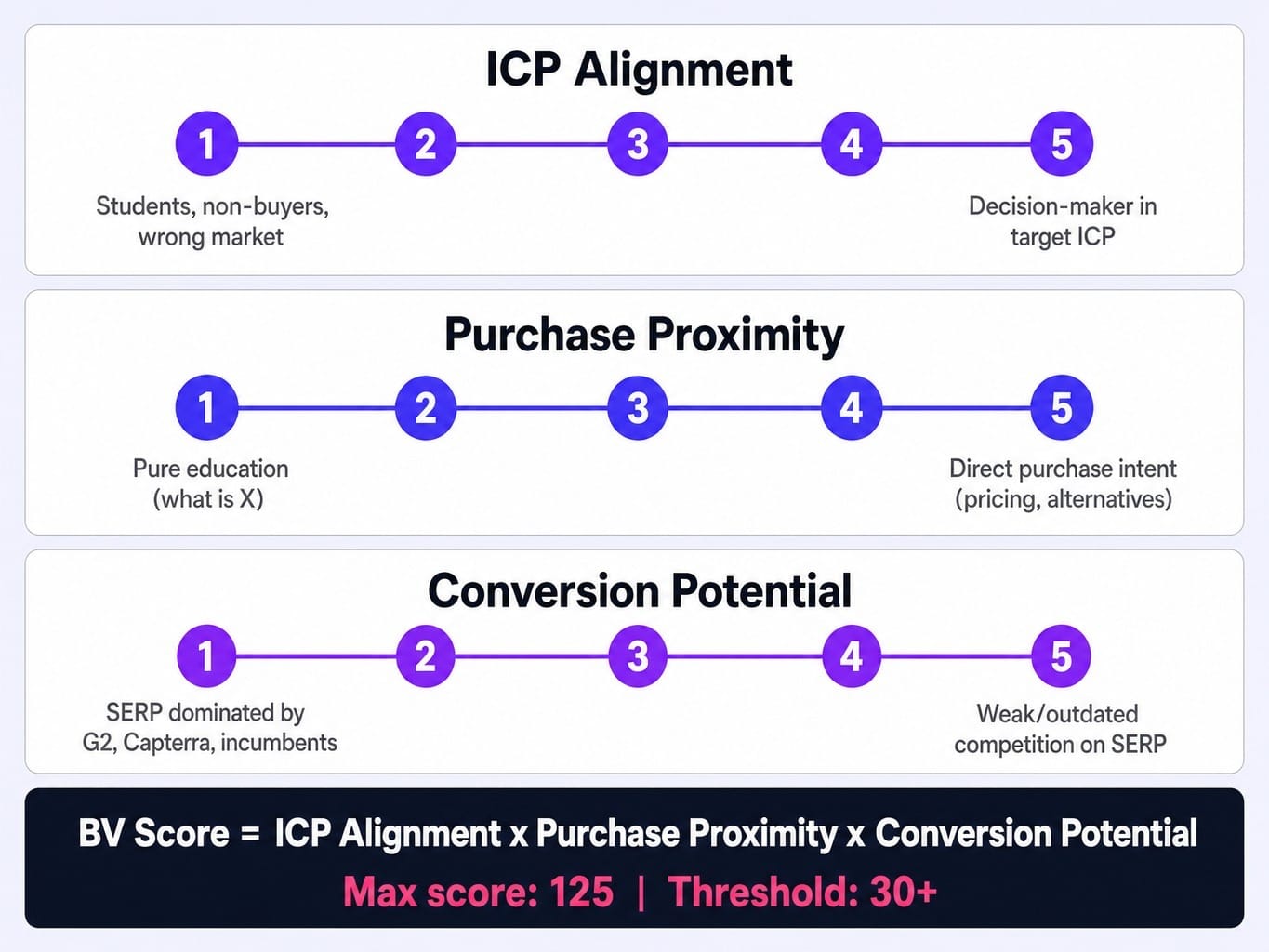
To fix this, you need to replace volume-based sorting with a Business Value (BV) score. This is a composite metric you can calculate for any keyword, forcing you to prioritize based on pipeline potential, not just traffic estimates. A BV score is a simple multiplication of three variables:
- ICP Alignment: Does the searcher match your Ideal Customer Profile?
- Purchase Proximity: How close is this query to a buying decision?
- Conversion Potential: How likely are you to convert the traffic you get?
This model shifts the focus from "Can we rank?" to "Should we rank?" It forces a strategic conversation before any content is written.
The Three Variables Behind Business Value Scoring
You can score any keyword against these variables on a simple 1-5 scale.
- ICP Alignment (1-5): Ask, "Who is the person searching this?" If the answer is mostly students, academics, or users outside your target market (e.g., B2C users for a B2B product), the keyword scores a 1, regardless of volume. If the searcher is squarely within your ICP, it scores a 5. Use tools like SparkToro or even just common sense to profile the searcher. Is this query coming from a decision-maker or an intern?
- Purchase Proximity (1-5): This maps to the buyer's journey. A score of 1 is pure education ("what is project management"). A 3 might be solution investigation ("project management software for remote teams"). A 5 is direct purchase intent ("Monday.com pricing" or "Asana alternatives"). The closer the query is to a commercial decision, the higher it scores.
- Conversion Potential (1-5): This is a reality check on the SERP. If the top 10 results are all powerful review aggregators like G2 and Capterra, or entrenched enterprise incumbents, your realistic click-through and conversion rates are lower, even if you manage to rank. If the SERP is filled with weaker blog posts or outdated content, your conversion potential is a 5.
Your final Business Value score is the product of these three numbers (e.g., 5 x 4 x 3 = 60). A simple heuristic: multiply the three scores to get a composite BV score out of 125. Any keyword scoring below 30 is likely not worth your time, no matter the volume.
A Worked Example: Why the 'Wrong' Keyword Wins
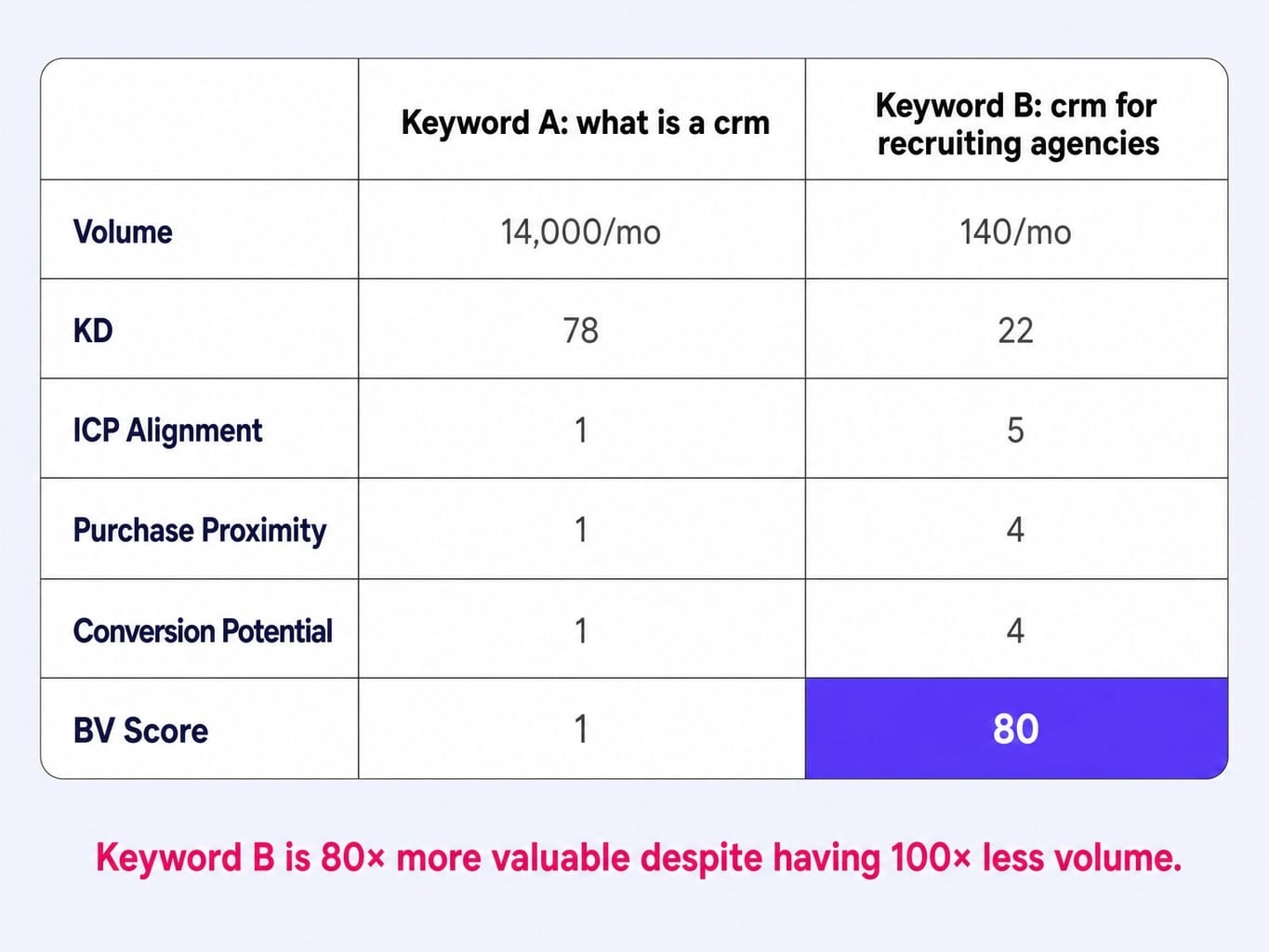
Let's take two keywords for a hypothetical CRM SaaS and score them.
Keyword A: "what is a crm"
Volume: 14,000/mo
KD: 78
ICP Alignment: 1 (Searchers are mostly students, junior employees, or curious non-buyers.)
Purchase Proximity: 1 (Purely educational, furthest from a buying decision.)
Conversion Potential: 1 (SERP is dominated by Salesforce, HubSpot, and Wikipedia. You will not outrank them, and even if you did, the traffic wouldn't convert.)
Business Value Score: 1 x 1 x 1 = 1
Keyword B: "crm for recruiting agencies"
Volume: 140/mo
KD: 22
ICP Alignment: 5 (The searcher is a specific, high-value buyer persona.)
Purchase Proximity: 4 (This is a commercial investigation query. They know they need a CRM and are looking for a specialized solution.)
Conversion Potential: 4 (The SERP likely has weaker, less-focused competition than the head term. A dedicated landing page has a high chance of ranking and converting.)
Business Value Score: 5 x 4 x 4 = 80
The traditional model, sorting by volume, would have you chase Keyword A. The BV score proves that Keyword B is 80 times more valuable to your business. Ahrefs and Semrush are essential for surfacing the raw data, but this scoring logic must come from your deep understanding of your customer. No tool can do it for you.
The Five SaaS Keyword Categories Worth Targeting
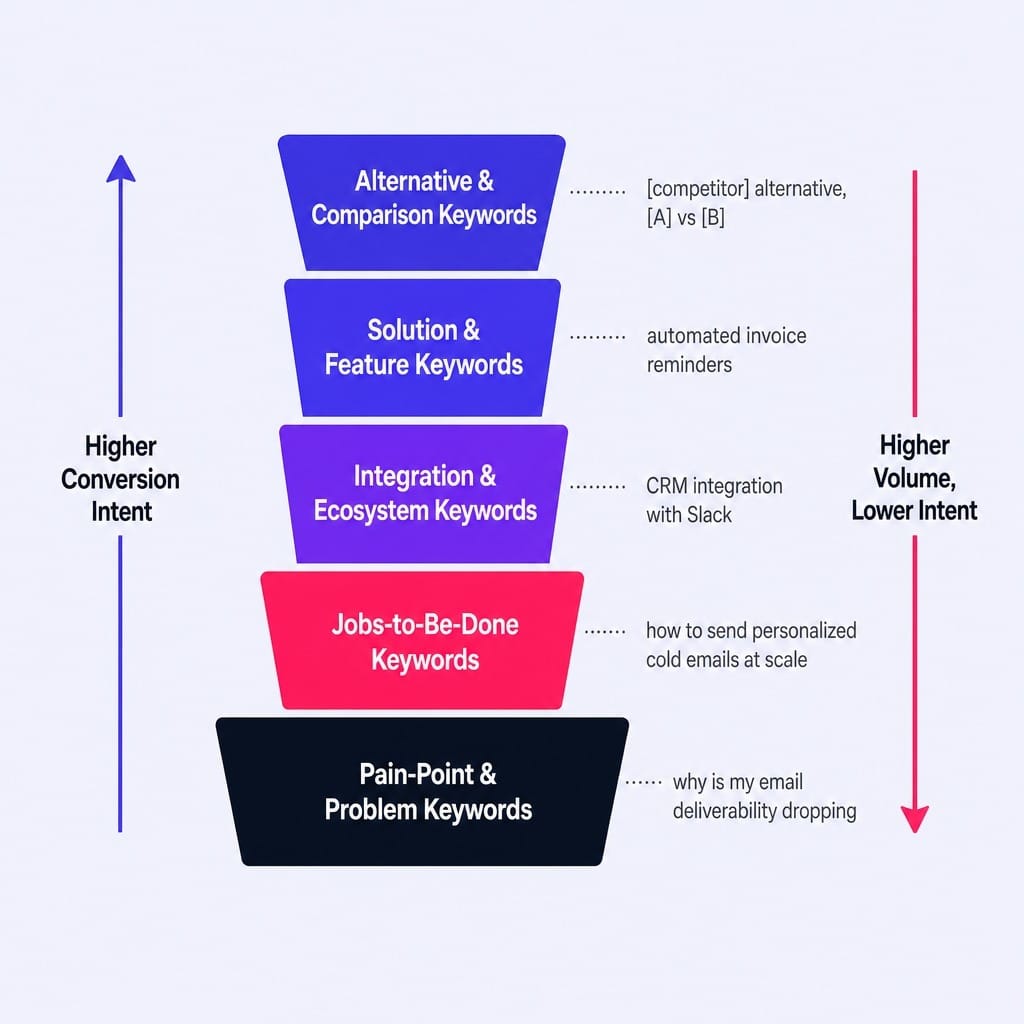
Not all keywords are created equal, and they don't all deserve your investment at the same time. For lean SaaS teams, the most effective strategy is to build your content foundation from the bottom of the funnel up. The five categories below are ordered by conversion proximity. Start here.
1. Alternative and Comparison Keywords
These are queries like "[competitor] alternative" or "[product A] vs [product B]". They are the single highest-converting keyword category in SaaS. The searcher has already identified their problem, is aware of solutions, and is now in the final stages of making a decision. Keywords like "Intercom alternatives for startups" or "Zendesk vs Freshdesk" may only have 50-300 searches a month, but their business value is immense. If you haven't built dedicated comparison and alternative pages, you are leaving your most qualified, ready-to-buy traffic for competitors and review sites to capture.
2. Solution and Feature Keywords
These are keywords that describe what your product does, phrased in the buyer's language—not your internal feature names. For an accounting SaaS, this isn't your "Smart Collections" feature; it's the keyword "automated invoice reminders." These keywords map directly to your core product and solution pages. Each of your key features should have a dedicated page optimized for the problem it solves. This allows you to capture users searching for a specific capability, signaling they are much further down the funnel than someone searching for a general problem.
3. Integration and Ecosystem Keywords
These are queries like "[your category] for [platform]" or "[tool A] + [tool B] integration". Think "CRM integration with Slack" or "email marketing for Shopify." These keywords are a powerful growth lever because they borrow intent and traffic from larger, more established ecosystems. The searcher is highly qualified; they already use a core tool in their stack and are looking for solutions that fit into their existing workflow. Listing your product in integration marketplaces like the Salesforce AppExchange is both a powerful ranking signal and a direct discovery channel.
4. Jobs-to-Be-Done (JTBD) Keywords
JTBD keywords describe the task or outcome the buyer is trying to achieve, not the tool category itself. Instead of "email outreach software," a JTBD query would be "how to send personalized cold emails at scale." These keywords capture users at the critical moment they realize their manual process is breaking. They haven't decided they need software yet, but they are actively feeling the pain your product solves. This is where content marketing shines, by creating content that explains the manual process (and its pitfalls) before introducing your product as the superior, automated solution.
5. Pain-Point and Problem Keywords
These are queries that express a specific frustration, often in the form of a question. Think "why is my email deliverability dropping," "too many spreadsheets for project tracking," or "CRM data is always outdated." These are top-of-funnel but incredibly valuable because they capture the raw emotional trigger that precedes a software search. They are also the hardest to find with traditional keyword tools, which is why your best source for them isn't a spreadsheet; it's your customer support logs. These keywords are the bridge between awareness-stage content and true demand generation.
Build Your Seed List From Sources Tools Will Never Surface
Keyword research tools are only as good as the seed terms you feed them. Every competitor article tells you to "brainstorm keywords," but that's where most teams fail. The real advantage comes from finding seed terms your competitors haven't even thought to search for. The two richest sources of high-intent SaaS keywords are not SEO tools at all; they are your own customer conversations and your competitors' marketing assets.
Mine Support Tickets and Sales Call Transcripts for the Language Buyers Actually Use
Your customers don't use marketing jargon. They describe their problems in their own words. Those words are your best keyword seeds. The process is simple: export your last 100 support tickets from Zendesk or your last 20 sales call transcripts from Gong. Search for recurring phrases that describe problems, desired outcomes, or how they refer to competitors.
A support ticket saying, "I need to send different follow-up emails based on which page someone visited on our site," is a goldmine. It gives you the seeds "behavioral email triggers" and "website-based email automation"—terms you'd never find by brainstorming alone. Feed these raw, customer-generated phrases into Ahrefs or Semrush to discover the actual search queries built around them. Then, use tools like AlsoAsked or KeywordInsights.ai to expand these seeds into entire clusters of related questions your buyers are asking.
Reverse-Engineer Competitor Free Tools and Resource Pages
Your competitors' top-ranking blog posts are only half the story. Their free tools, calculators, templates, and glossaries often reveal their most strategic keyword targets. Use Ahrefs' Site Explorer on 3-5 direct competitors and filter their "Top pages" report by organic traffic. Ignore the blog posts for a moment and look for the non-blog pages that are driving significant traffic.
If a competitor's "free invoice template" page drives 8,000 visits a month, that's a clear signal of a programmatic SEO opportunity. You can create a series of [industry]-specific invoice templates to capture the long-tail traffic. If their "CAC calculator" ranks #1, it exposes a high-intent keyword cluster you might have missed. Use a crawler like Screaming Frog to systematically map out your competitors' site structures and find these hidden-in-plain-sight resource hubs. This isn't just about finding their keywords; it's about uncovering the content formats and page types that win in your market.
Validate Keyword Intent Before You Commit Resources
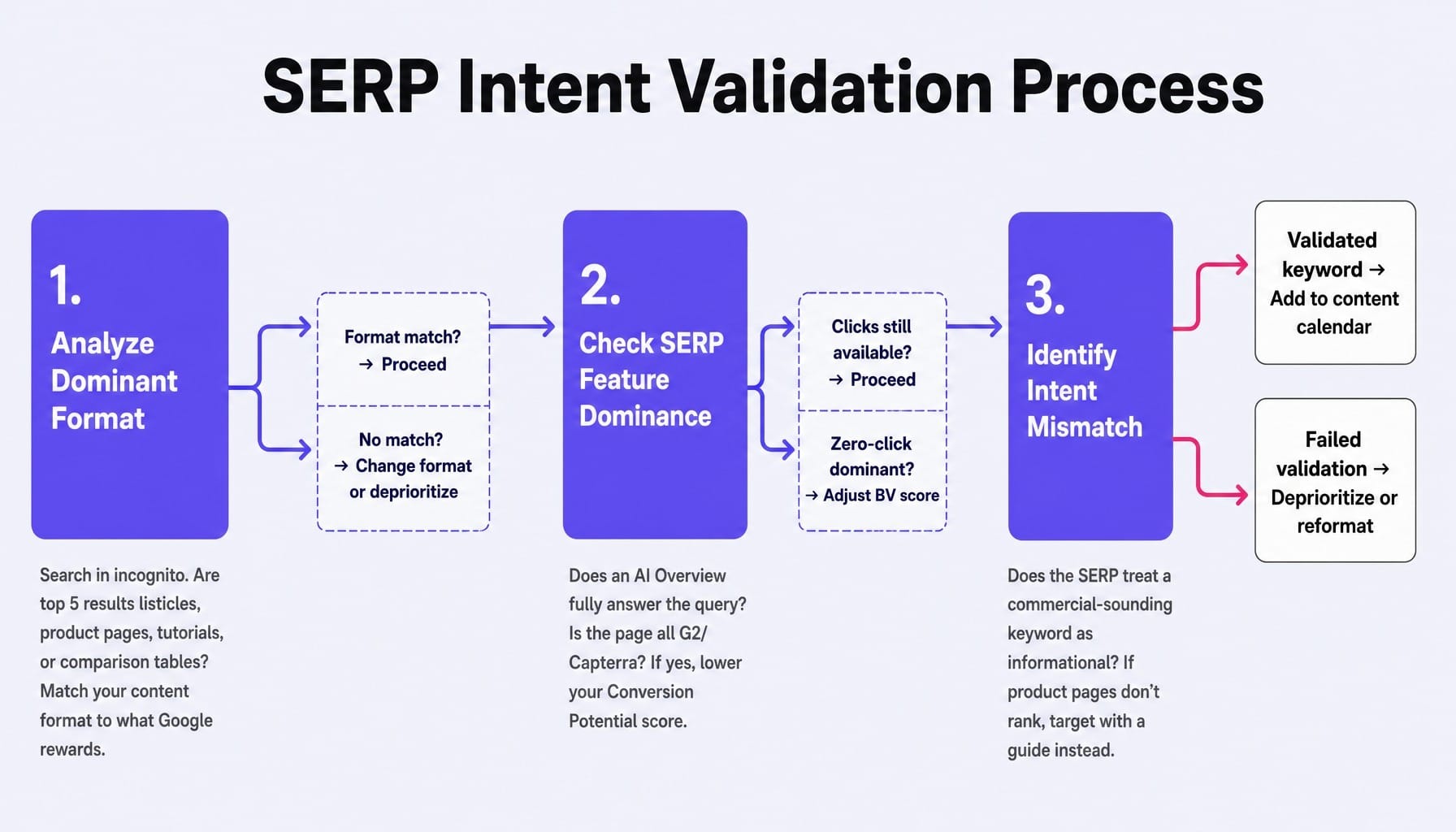
There is no greater waste in content marketing than spending a month creating a page only to discover the SERP is dominated by a completely different content format. This is a preventable error. Before any keyword makes it onto your content calendar, it must pass a simple, five-minute intent validation process.
Step 1: Analyze the Dominant Format. Search the keyword in an incognito browser and look at the top 5 organic results. What format is Google rewarding? Are they listicles? In-depth tutorials? Product pages? Comparison tables? If you planned to write a blog post but the SERP is all product pages, your blog post will fail. Either change your content format to match the SERP's expectation or deprioritize the keyword.
Step 2: Check for SERP Feature Dominance. As of 2026, this is non-negotiable. If an AI Overview provides a complete, satisfying answer to the query, your realistic click-through rate plummets. The same is true if the entire first page is review aggregators like G2 and Capterra. This doesn't mean the keyword is worthless—it might still have branding value—but it means your conversion potential is lower. Adjust your BV score accordingly. This zero-click search adaptation is critical.
Step 3: Look for Intent Mismatch Signals. Some keywords sound commercial but are treated as informational by Google. A classic example is a query like "project management tool." You might assume it's commercial, but the SERP is often filled with "What is..." guides and listicles, not product homepages. If you see this intent mismatch, you know your product page won't rank. You need to target it with a top-of-funnel guide instead. Checking the SERP volatility in Ahrefs can also reveal if a keyword's intent is stable or in flux.
This five-minute ritual is the firewall between a content calendar that drives pipeline and one that burns resources on traffic you can't convert.
Read more: SaaS Marketing Metrics That Actually Inform Decisions (Not Just Dashboards)
When the Framework Is Right but the Bandwidth Isn't
This framework creates a clear path to finding revenue-driving keywords. But it also reveals a difficult truth for lean marketing teams: doing this right creates a massive execution backlog.
The research uncovers dozens of high-BV keyword opportunities. You need to build the comparison pages, optimize existing solution pages, ship the new integration landing pages, and write the JTBD content. And all of this happens before you even start on the next round of research and re-prioritization. The system works, but it's constrained by human bandwidth. The insight is that keyword research isn't a one-time project; it's an ongoing system of prioritization and execution.
This is the execution gap Spike AI was built to close. Instead of letting high-impact opportunities pile up in a backlog, Spike AI's marketing execution engine identifies the single highest-impact move across your website, content, and SEO—then deploys the fix. It turns your keyword strategy into weekly shipped improvements that compound over time. You get the benefit of a rigorous, data-driven process without the execution bottleneck that paralyzes most teams.
See how Spike AI turns your keyword strategy into weekly shipped improvements
Your Keyword List Is Not the Goal
The most important shift you can make is to stop seeing a long list of keywords as the output of your research. The goal is not to find high-volume keywords with low difficulty. It's to find the specific queries where your ICP is actively looking for a solution and to score those opportunities by their potential business value.
We've moved from understanding why SaaS keyword research is a different discipline, to building a revenue-weighted scoring model that prioritizes pipeline. We've identified the five keyword categories that actually drive conversions, sourced seeds from places your competitors ignore, and built a validation process to prevent wasted effort.
The teams that win in SaaS SEO in 2026 won't be the ones with the biggest keyword lists. They'll be the ones who score ruthlessly, validate relentlessly, and ship continuously. Your next action is simple: take your top 20 target keywords and run them through the Business Value scoring framework. Be honest. And cut anything that scores below 30.
Frequently Asked Questions
What keywords should a SaaS startup with low domain authority target first?
Start with alternative and comparison keywords (e.g., '[competitor] alternative'). They have the lowest volume but the highest conversion intent, and the competition is often beatable with a well-structured page. Avoid high-volume informational keywords until you've built topical authority with bottom-of-funnel content that actually converts. Your first 20 pages should all target keywords with a Business Value score above 60.
How do you avoid keyword cannibalization between SaaS product pages and blog posts?
Assign each keyword a single page type based on validated SERP intent. If the SERP shows product pages ranking, target it with a product page, not a blog post. Use Google Search Console to find queries where multiple pages are competing, then consolidate by redirecting or differentiating the intent each page serves. A simple keyword map in a spreadsheet with one URL per primary keyword prevents this proactively.
Should SaaS companies target high-volume informational keywords or low-volume high-intent keywords?
Low-volume, high-intent keywords first, always—especially for lean teams. A 90-search-per-month comparison keyword that converts at 5% is worth more than a 10,000-search informational keyword that converts at 0.1%. Informational keywords are for building topical authority, but only after your bottom-of-funnel pages are built, ranking, and converting traffic-to-trial.
How do you adapt SaaS keyword research for AI overviews and zero-click searches?
For each target keyword, check if an AI Overview appears. If it does, evaluate whether it fully answers the query (reducing clicks) or creates curiosity that drives clicks. For fully-answered queries, deprioritize them unless you are confident you can earn the citation. Focus on queries where the searcher needs to compare, configure, or decide—AI can't do that for them, so those clicks are still valuable.
How do you use the jobs-to-be-done framework specifically for SaaS keyword ideation?
Interview 10 customers and ask: "Before you found us, what were you trying to accomplish?" Their answers are the jobs, like "track which content drives signups" or "send follow-ups without forgetting." Then, brainstorm how someone would Google that task if they didn't know your product category existed. Those queries, phrased in natural language, are your JTBD keyword seeds.
What tools are best for SaaS keyword research in 2026?
Ahrefs and Semrush remain core for volume, difficulty, and SERP analysis. Layer in AlsoAsked for question clustering, KeywordInsights.ai for intent classification at scale, and SparkToro for audience research to validate ICP alignment. Use Google Search Console to find queries you already appear for. ChatGPT is useful for brainstorming seed expansions, but always validate its output against actual search data from a dedicated SEO tool.