
SaaS SEO Tools in 2026: How to Build a Stack That Actually Drives Pipeline

TLDR
- Stop organizing your SEO tools by function (keywords, tech, links). The winning model for B2B SaaS is organizing your stack by funnel stage: Top-of-Funnel (Discovery), Mid-Funnel (Evaluation), and Bottom-of-Funnel (Pipeline).
- SaaS SEO has unique constraints that general-purpose tools miss, including the need for ICP-aligned keyword research over raw volume, attribution across long sales cycles, and optimization for product-led pages like comparisons and integrations.
- Most SaaS teams ignore the technical SEO tools that actually move the needle: log file analyzers (Botify, Screaming Frog) to manage crawl budget on programmatic sites and content decay detectors (Ahrefs, ContentKing) to prevent asset rot.
- Evaluate new tools based on "execution proximity"—how much faster they let you ship a change. If a tool only gives you another dashboard of insights without closing the gap to implementation, it's a cost center, not a growth lever.
- The ultimate bottleneck isn't insight; it's the latency between identifying an issue and shipping the fix. Your tool stack only compounds if you have an execution engine to act on what it surfaces.
Your SaaS marketing team—all three of you—is paying for Ahrefs, Semrush, Surfer, and a licensed copy of Screaming Frog. That's over $500 a month in tooling. You have dashboards tracking keyword positions, backlink velocity, content scores, and crawl errors. Yet when your CEO asks, "Which organic page drove the most pipeline last quarter?" the answer is a week of spreadsheet wrangling and educated guesses.
The tools are excellent. The problem is they've been organized by function—one for keywords, one for links, one for content—mirroring how vendors market them, not how a SaaS business actually grows. The result is dashboard fatigue, redundant spending, and zero execution leverage.
The fundamental issue with most SaaS SEO tool stacks isn't the choice of tools. It's the absence of an organizing principle that connects tool capabilities to business outcomes.
This article provides that principle. It's a framework for building a B2B SaaS SEO tool stack that connects to pipeline, organized around your GTM motion and the stages of your funnel—not a generic feature checklist.
Why SaaS SEO Tooling Requirements Differ from General-Purpose SEO
General-purpose SEO tools were largely built for ecommerce and media sites, where success is measured in traffic and direct transactions. B2B SaaS SEO operates under a different set of constraints that most of these tools, by default, fail to address. Your evaluation criteria must be SaaS-specific.
Here are four dimensions where general-purpose defaults fall short:
- ICP-Aligned Keyword Research: A keyword tool will tell you "project management software" (40k volume) is a better target than "project management for engineering teams" (400 volume). But if your Ideal Customer Profile is engineering leaders, the lower-volume query is infinitely more valuable. Most keyword tools are built to surface volume, not ICP fit, forcing SaaS teams to manually filter for relevance.
- Long Sales Cycle Attribution: A developer might read a TOFU blog post, forget about you for two months, see a retargeting ad, and finally request a demo 90 days after that first organic touch. Most analytics tools, including Google's own, are biased toward last-click attribution, making the organic touchpoint that started the journey invisible. Your tooling needs to account for multi-touch organic attribution, a feature rarely native to standard SEO platforms.
- Product-Led Page Types: SaaS companies don't just optimize blog posts. The highest-intent pages are often product-led: comparison pages ([Our Product] vs. [Competitor]), alternatives pages, and integration directory pages. Many content optimization tools are calibrated for informational, editorial content and fail to provide relevant guidance for these commercial-intent formats.
- AI Overview Displacement: B2B buyers use search to solve complex problems, and Google is increasingly answering their questions directly in AI Overviews. For many informational queries, traditional rank tracking is becoming a vanity metric. The tools that matter now are those that provide SERP feature tracking to identify where AI is displacing clicks, signaling a need to shift from a ranking strategy to a citation strategy.
Organizing Your SaaS SEO Stack by Funnel Stage, Not by Function
Most SaaS teams organize their SEO tools by vendor-defined categories: one for keyword research, one for technical audits, one for content optimization. This mirrors how vendors sell, not how growth happens. It leads to functional silos and a stack that can report on everything but influence nothing.
The more effective organizing principle is the marketing funnel. What tools do you need to attract ICP-fit strangers (Top-of-Funnel), convert researchers into evaluators (Mid-Funnel), and optimize decision-stage pages for pipeline (Bottom-of-Funnel)?
This reframing changes which tools matter most. This probably sounds familiar: your team has a $200/month rank tracker for TOFU visibility, but zero tooling to optimize the BOFU demo page where all the revenue is actually generated. A funnel-based audit reveals these gaps instantly.
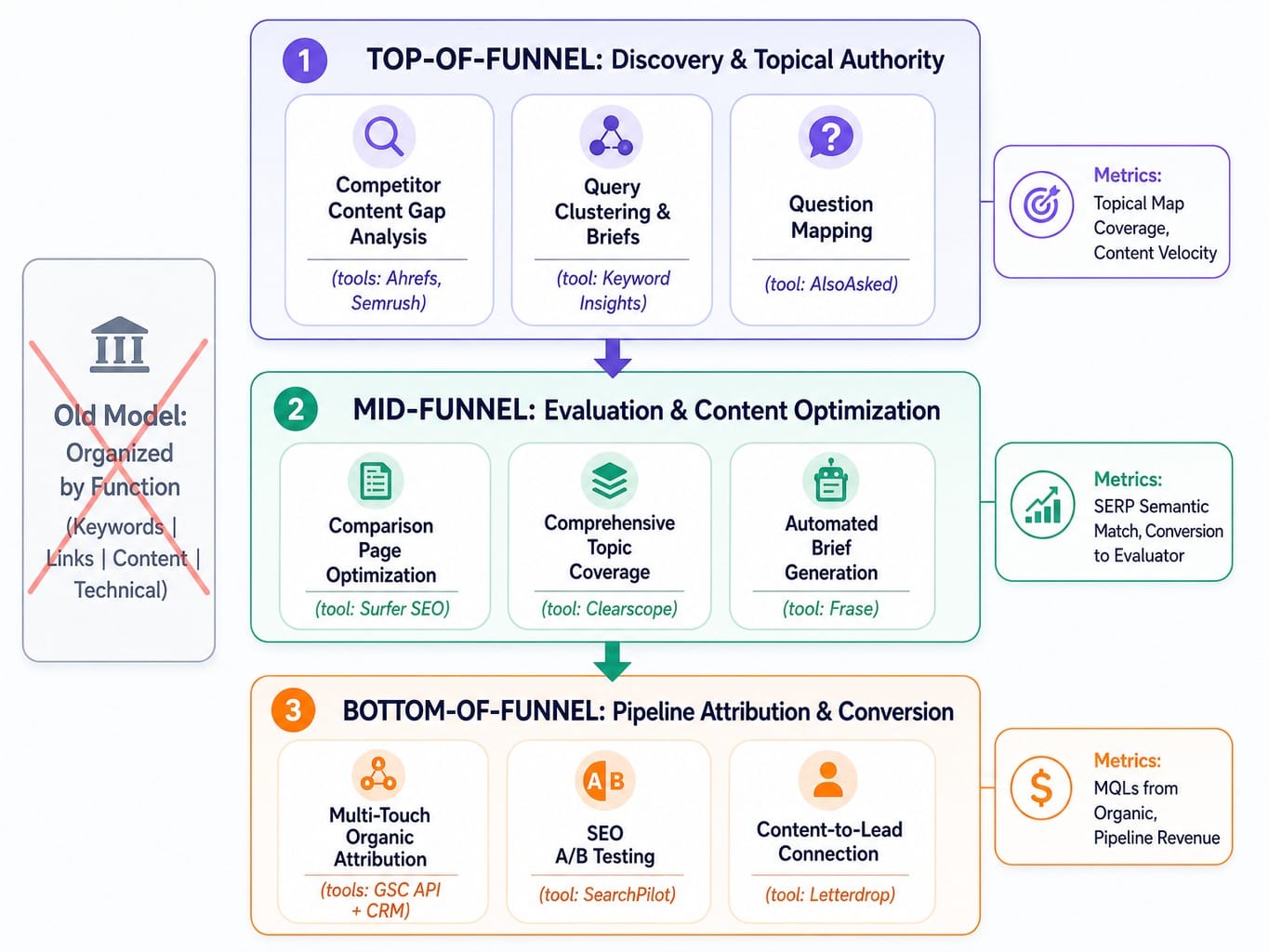
Top-of-Funnel: Discovery and Topical Authority Tools
The goal of TOFU SEO for SaaS is to build topical authority around the problems your product solves, attracting an ICP-aligned audience. The metrics that matter here are topical map coverage and content velocity, not just raw keyword volume.
Your TOFU tool stack should be built for clustering and gap analysis.
- For broad territory mapping: Ahrefs or Semrush are the standards for competitor content gap analysis and identifying high-level topic clusters.
- For building a content plan at scale: Keyword Insights is purpose-built for taking thousands of queries and clustering them into distinct content briefs based on search intent. This turns a massive keyword list into an actionable editorial calendar.
- For understanding user questions: AlsoAsked helps you map the entire ecosystem of questions around a core topic, ensuring your content covers the subject comprehensively.
A typical workflow: A SaaS company targeting "workflow automation" uses Keyword Insights to group 500 related queries into 20 distinct articles. They then use Ahrefs' Content Gap feature to see which of those 20 topics their top three competitors rank for, but they don't. This instantly reveals the highest-opportunity gaps to build topical authority. Semrush's SERP feature tracking can then identify which of these TOFU queries are dominated by AI Overviews, signaling where content needs to be optimized for citation, not just clicks.
Mid-Funnel: Content Optimization and Evaluation-Stage Pages
MOFU is where researchers become evaluators, and it's where most SaaS SEO tool stacks are weakest. The pages that do the heavy lifting here—comparisons, alternatives, and use-case guides—require content optimization tools calibrated for commercial investigation, not just informational blog posts.
- For direct competitor comparisons: Surfer SEO excels here. Its SERP analyzer and TF-IDF scoring are highly effective for optimizing pages like [Your Product] vs. [Competitor] because it analyzes the semantic profile of the pages that already rank for that specific, highly commercial query.
- For in-depth evaluation guides: Clearscope is better suited for longer-form, expert-driven content. Its grading focuses on comprehensive topical coverage and entity inclusion, making it ideal for "Best [Category] Software" guides.
- For scaling content briefs: Frase is excellent at analyzing top-ranking content for a given query and automatically generating a structured brief that outlines headings, topics, and questions to cover.
Read more: Surfer SEO vs Clearscope: Which Tool Fits Your Team's Actual Workflow in 2026
The workflow is direct: To optimize a [Your Product] vs. [Competitor] page, you run the query through Surfer. It provides a list of NLP-derived terms and entities that appear across the top-ranking competitor pages. Ensuring your page includes these terms helps you match the semantic expectations of both users and search engines for that evaluation-stage query.
Bottom-of-Funnel: Pipeline Attribution and Conversion Page Optimization
BOFU is the most critical and most neglected layer in SaaS SEO. This is where organic traffic turns into pipeline, yet most teams have no tooling that connects clicks on pricing, demo, or trial pages to revenue.
- For pipeline attribution: The most powerful tool is your own data. An integration between the Google Search Console API and your CRM (HubSpot or Salesforce) allows you to build multi-touch organic attribution models. By pulling GSC query data and joining it with deal data, you can finally see which keywords and pages are sourcing qualified leads and revenue, even with long sales cycles.
- For conversion page testing: High-traffic demo or pricing pages are too valuable for guesswork. SearchPilot is an enterprise-grade platform that allows you to run controlled SEO A/B tests (e.g., changing a title tag or H1 on your pricing page) to measure the impact on both traffic and conversions scientifically.
- For connecting content to leads: Letterdrop offers a unique workflow that connects your content publishing process directly to lead activity tracked in your CRM, closing the loop between content creation and pipeline generation.
A concrete example: A SaaS team uses a simple script to pull GSC data into a BI tool. They filter for queries driving impressions to their /pricing page. By cross-referencing this with lead source data from HubSpot, they can start to build a model of which organic search terms correlate with high-quality MQLs, finally proving the ROI of their SEO efforts. If you have no BOFU SEO tooling, you have a reporting function, not a growth engine. Teams looking to close this gap should also consider data-driven CRO strategies that connect optimization efforts directly to revenue.
The Technical SEO Tools Most SaaS Teams Ignore (and Shouldn't)
SaaS websites—with their JavaScript-heavy frontends, programmatic pages, and sprawling documentation—have technical SEO challenges that ecommerce and media sites don't. Yet for most SaaS teams, "technical SEO" consists of a quarterly Screaming Frog crawl that surfaces 500 issues, 480 of which have zero impact on revenue.
The tools that actually move the needle on SaaS technical SEO are often the ones no one is using. Getting access to server logs can sometimes be a political battle in itself, but the insights are non-negotiable for sites with any programmatic scale. These are the tools that diagnose the invisible problems silently killing your growth.
Log File Analysis and Crawl Budget for SaaS Sites
If your site has a large number of programmatic pages—integration directories, template galleries, partner listings—you have a crawl budget problem, whether you know it or not. Log file analysis is the only way to see it. You might discover Googlebot is spending 80% of its time crawling low-value parameterized URLs instead of your high-converting feature pages.
- For enterprise-grade analysis: Botify and Lumar (formerly Deepcrawl) are the market leaders. They ingest server log files and provide powerful visualizations of how search engines are crawling your site, highlighting wasted budget and indexing issues.
- For leaner teams: Screaming Frog has a built-in Log File Analyser that provides much of the same core functionality at a fraction of the cost.
The workflow: Export your server logs, upload them to your tool of choice, and analyze crawl frequency by URL pattern (e.g., /blog/ vs. /features/ vs. /integrations/). If there's a mismatch between crawl frequency and page value, use robots.txt directives and internal linking adjustments to guide Googlebot toward your revenue-critical pages. For JS-heavy sites, supplement this with rendered DOM diffing in Sitebulb or Screaming Frog to see what Googlebot's renderer sees versus what a user sees.
Content Decay Detection on Large SaaS Blogs
For a SaaS blog with hundreds of posts, content decay is a silent killer. An article that ranked #2 eighteen months ago slowly slips to #8 as competitors update their content and SERP intent shifts. Without a system for detection, your team keeps publishing new posts while your most valuable assets quietly rot.
- For broad detection: Ahrefs' Content Explorer has a filter to show pages with declining traffic over time. This is a great starting point for identifying assets at risk.
- For real-time monitoring: ContentKing actively monitors your site for on-page changes, indexing status shifts, and ranking drops, alerting you to decay the moment it begins.
- For manual diagnosis: The Google Search Console provides the most accurate data. Filter performance by page, set the date range to compare the last 3 months vs. the previous 3 months, and flag any important page with a >20% drop in clicks for a refresh.
A common scenario: Your "2024 Guide to X" is losing ground because competitors have published "2026" versions. Ahrefs' SERP position history for the target keyword would show this decline clearly. A systematic detection workflow turns this from a reactive panic into a proactive, scheduled content refresh, preserving the value of your existing assets.
How to Evaluate Whether a SaaS SEO Tool Is Worth the Cost
At the Series A-B stage, a typical SaaS marketing team spends $300-$800/month on SEO tools. The most common mistake is evaluating this spend by feature count rather than execution leverage. The right question isn't "How many features does it have?" but "How much faster does this tool let us ship a meaningful change?"
Here are five SaaS-specific criteria for evaluating any tool's ROI:
- Execution Proximity: Does the tool give you an insight, or does it get you closer to shipping a change? A tool that generates a content brief you can hand directly to a writer provides more leverage than one that just shows you a keyword difficulty score. Rule of Thumb: If the tool's output is a number on a dashboard, its execution proximity is low. If its output is an actionable artifact (a brief, a ticket, a suggested change), its proximity is high.
- ICP Alignment: Does the tool's logic map to how SaaS buyers search? Tools with features for intent classification, SERP feature analysis, and question-based research are more valuable for SaaS than tools optimized for high-volume, single-transaction ecommerce queries. Rule of Thumb: If you have to export data to a spreadsheet to filter for relevance, the tool is not aligned with your ICP.
- Integration Depth: Can the tool's data be connected to your CRM or CMS? If you can't tie organic performance to pipeline in HubSpot or Salesforce, the tool is a reporting layer, not a growth lever. Rule of Thumb: Prioritize tools with native CRM integrations or robust APIs over closed systems.
- Overlap Audit: Before you buy, list the new tool's top 5 capabilities. Does an existing tool in your stack already cover 70% of them? A Series A SaaS company evaluating whether to add Clearscope ($170/mo) when they already have Surfer ($89/mo) will find a ~60% feature overlap. The incremental value may be marginal unless content velocity is extremely high. Rule of Thumb: If you can't articulate three unique, high-value jobs the new tool will do, you don't need it.
Read more: Frase vs Clearscope in 2026: Which Tool Actually Improves Content Performance?
- Time-to-Value: How long does it take from signup to get a usable output? If a tool requires more than two hours of configuration and setup, it's built for enterprise teams with dedicated analysts, not lean SaaS teams that need to move quickly. Rule of Thumb: If you can't get a meaningful insight within the first session, the tool's friction will likely outweigh its benefits.
When the Problem Isn't Your Tools — It's the Gap Between Insight and Execution
You can build the perfect, funnel-aligned tool stack. You can identify content decay, diagnose crawl budget waste, and find high-intent keyword gaps. But the bottleneck in marketing is never the insight. It's the latency. It's the time between identifying what needs to change and actually shipping that change.
The content decay report sits in a spreadsheet for three weeks. The crawl budget analysis generates a Jira ticket that gets deprioritized by engineering. The content brief for your BOFU comparison page gets queued behind four other projects. Your tools did their job; the execution system failed. Teams that want to unify marketing goals with task execution need more than another dashboard—they need a system that closes the loop.
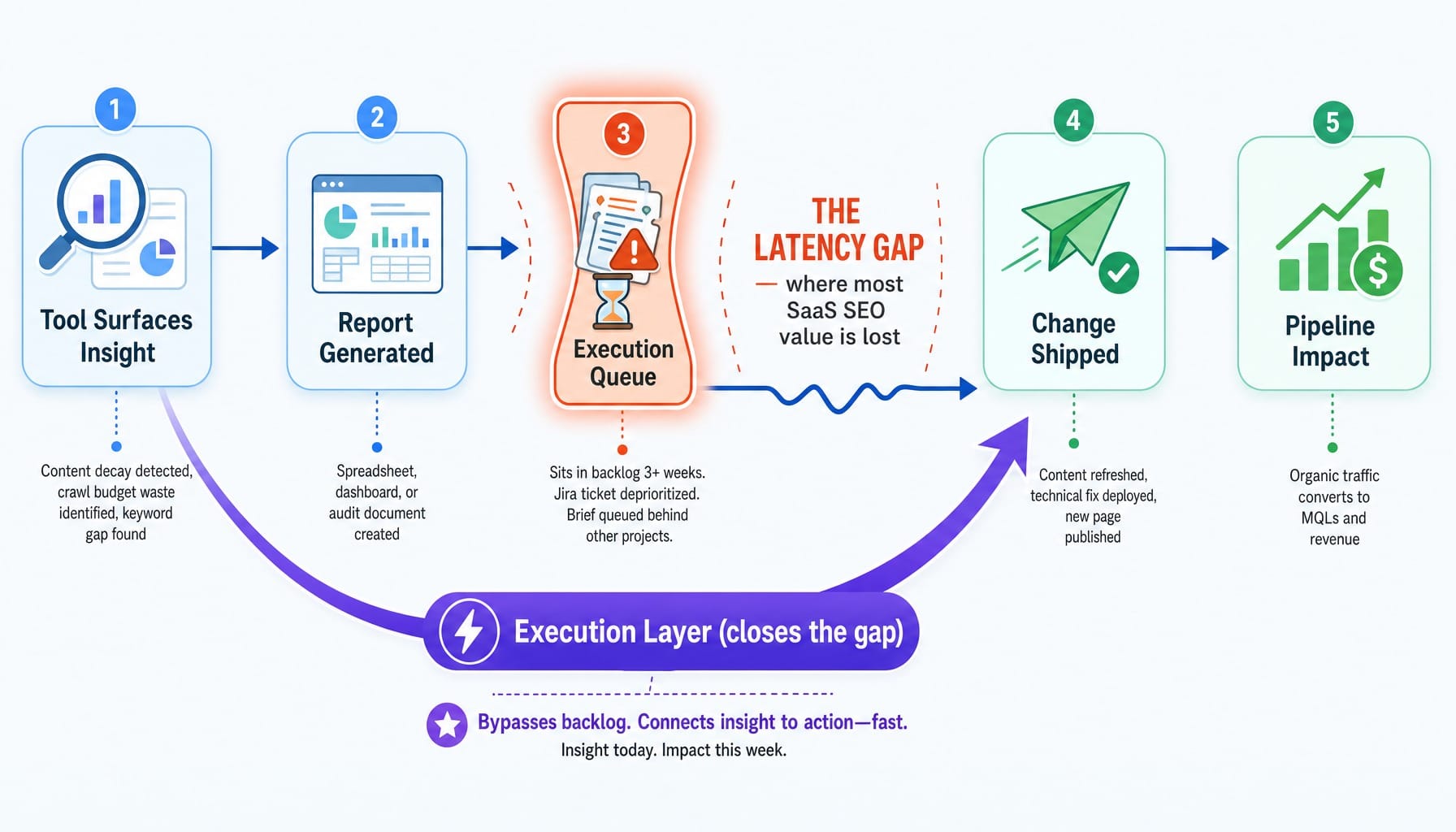
This is the gap Spike AI is built to close.
Spike AI is not another tool to add to your stack. It's the execution layer that acts on the insights your stack produces. Every week, Spike AI identifies the single highest-impact SEO, AEO, or CRO move across your entire marketing surface—then helps you deploy it. No engineering tickets. No agency briefs. No backlog anxiety.
It's the shipping engine that turns the outputs of your Ahrefs reports and Screaming Frog crawls into weekly, compounding gains. You've learned how to build a better tool stack. Spike AI is the system that ensures your investment in that stack actually pays off.
See how Spike AI turns your SEO backlog into weekly shipped improvements
From a Tool Stack to an Execution System
The fundamental shift for SaaS teams that win with organic is moving from collecting tools to building an execution system. The difference between generating dashboards and generating pipeline is not which tools you own, but whether that tooling is organized by funnel stage and connected to business outcomes.
As AI Overviews continue to reshape which queries drive clicks and which are answered directly on the SERP, execution velocity becomes the primary competitive advantage. The SaaS teams that thrive in this new landscape will be those whose stacks are built not for comprehensive reporting, but for a relentless cadence of shipping what matters.
Frequently Asked Questions
How should SaaS companies handle keyword cannibalization between product pages and blog posts?
This is a classic SaaS SEO issue, like when /features/workflow-automation and /blog/workflow-automation-guide compete. The fix is intent-based. Use Google Search Console to see which URL Google prefers for the target query. If it's oscillating, consolidate by merging the content or using a canonical tag to point the blog post to the feature page. Ahrefs' Site Audit and Screaming Frog's custom extraction of title/H1 tags are the fastest ways to diagnose this at scale.
Which SEO tools support programmatic page generation for SaaS integration and template directories?
Most SEO tools don't generate programmatic SEO (pSEO) pages; they help you optimize and validate them. Platforms like Letterdrop can support templatized content workflows for scaling integration pages. For validation, use Screaming Frog's list mode to crawl all generated URLs and Sitebulb's duplicate content detection to ensure they are unique enough to avoid thin content penalties. The primary risk with pSEO is index bloat, so monitoring crawl stats in GSC is critical.
How do you optimize SaaS content for AI overviews without losing click-through traffic?
The strategy is twofold. For Top-of-Funnel content, optimize for citation by placing a concise, extractable answer block in the first 60 words of each section. For Mid- and Bottom-of-Funnel content, provide depth that AI Overviews can't replicate, like detailed comparison tables, pricing breakdowns, or implementation guides. Use Semrush's SERP feature tracking to identify which of your target queries trigger AI Overviews, then adjust your content format accordingly. Foundational SEO remains the core lever.
What's the minimum viable SEO tool stack for a SaaS startup spending under $200/month?
A lean but powerful stack consists of three tools. First, Google Search Console (free) for all core performance data, rank tracking, and indexing diagnostics. Second, Ahrefs' new Webmaster Tools plan (free) or their Starter plan ($99/month) for keyword research, backlink analysis, and content gap identification. Third, the free version of Screaming Frog (crawls up to 500 URLs) for technical audits. This combination covers 80% of what a pre-Series A SaaS company needs to get started.
How do enterprise B2B SaaS teams manage SEO workflows across multiple product lines?
For multi-product companies, the key is a centralized topical map to prevent internal keyword competition. Use a shared keyword clustering tool like Keyword Insights to assign non-overlapping topic clusters to each product line's marketing team. Use Ahrefs' Site Explorer to audit which product subdirectory currently "owns" which keywords, then establish clear routing rules. Enterprise platforms like Botify also offer segmentation features that allow teams to monitor and report on SEO performance by individual product line.