Scalenut Pricing 2026: What It Really Costs Per Article

TL;DR
- Scalenut's standard pricing starts at $59/mo (Starter), $89/mo (Plus), and $199/mo (Professional), but promotional discounts can lower these significantly.
- The true cost per published article is not the platform fee. It's the platform fee plus your internal editing labor, which can range from $32 to $81+ per article depending on editing intensity.
- Annual billing offers savings, but only commit after validating your actual credit consumption and workflow fit during a trial and at least one monthly billing cycle.
- The key upgrade triggers are operational limits like workspaces and audit pages, not just content volume. Agencies and teams with large sites often need the Professional plan for this reason.
- Scalenut is most cost-effective for teams wanting AI writing and SEO optimization in one tool. If you only need one of these, dedicated tools like Frase or Clearscope might offer better value.
Scalenut's pricing plans start at $59 per month for the Starter plan, $89 per month for Plus, and $199 per month for Professional. But these sticker prices don't tell you what Scalenut actually costs your business. The real cost-per-published-asset is a function of credit limits, feature gates, and the human editing time required to get AI drafts to a publishable standard. Content teams that budget based on a tool's listed monthly price rather than its true cost per published asset routinely undercount spend by thousands of dollars per quarter.
This analysis goes beyond a simple recap of the scalenut pricing page. We'll break down each plan, calculate the actual annual savings, and model the true scalenut cost per article by factoring in editing overhead. We'll also analyze which gated features actually impact performance and compare the final scalenut price against key competitors like Surfer SEO, Frase, and Clearscope.
What Each Scalenut Plan Includes in 2026
Scalenut's plans are structured around AI prompt limits, GEO/AI article generation, and operational features like workspaces. It's worth noting the plan names were updated; reviews mentioning "Essential," "Growth," or "Pro" are referencing a deprecated structure. The current plans are Starter, Plus, and Professional.
Here's a direct comparison of the self-serve plans as of 2026.
Promotional prices are subject to change.
One critical distinction most buyers miss is that Scalenut's AI prompt system and its article generation limits are two separate constraints. You can exhaust one without touching the other, which means the plan's stated article count is not always the actual ceiling on production.
Plan Recommendations:
- Starter ($59/mo): Best for solo operators and bloggers testing the platform's core AI writing and optimization features on a single website.
- Plus ($89/mo): Fits small content teams managing 2-3 websites who need more content velocity and collaboration seats.
- Professional ($199/mo): Built for agencies, in-house teams managing multiple brands, or sites with large content libraries needing high-volume audits.
Scalenut also offers a 7-day free trial to test the core functionality, along with a custom-priced VIP Service that includes a dedicated strategist and execution team, but this operates as a managed service, not a self-serve plan.
Annual vs Monthly Billing: How Much Do You Actually Save?
Scalenut advertises significant savings for annual billing, often framed as "up to 60% off," but this number blends a temporary promotional discount with the standard annual discount. Calculating your true savings requires separating the two.
Let's look at the math for the Plus plan:
- Standard Monthly Billing: $89/month = $1,068 per year.
- Standard Annual Billing: The standard annual rate is $420/year, a saving of $648 (or ~61%) over standard monthly billing.
- Promotional Annual Rate: The heavily advertised promotional rate is often around $420/year.
The key takeaway is that the large discount is real, but locking it in requires an annual commitment. This presents a risk. Committing to an annual plan before you've validated the tool against your actual workflow is a common budgeting mistake. A 7-day trial is sufficient to test the UI, but it's not long enough to understand your team's true credit burn rate or editing overhead.
Our recommendation: Use the 7-day trial, then pay for at least one month at the standard rate. Track your usage closely. If the tool fits your workflow and the economics make sense, then upgrade to the annual plan to lock in the savings.
What Does Scalenut Actually Cost Per Published Article?
No pricing page tells you the cost-per-published-asset, but it's the only metric that matters for a content team's P&L. The platform subscription is just one line item in the total scalenut cost. The other, larger cost is the human editing labor required to make AI output publishable.
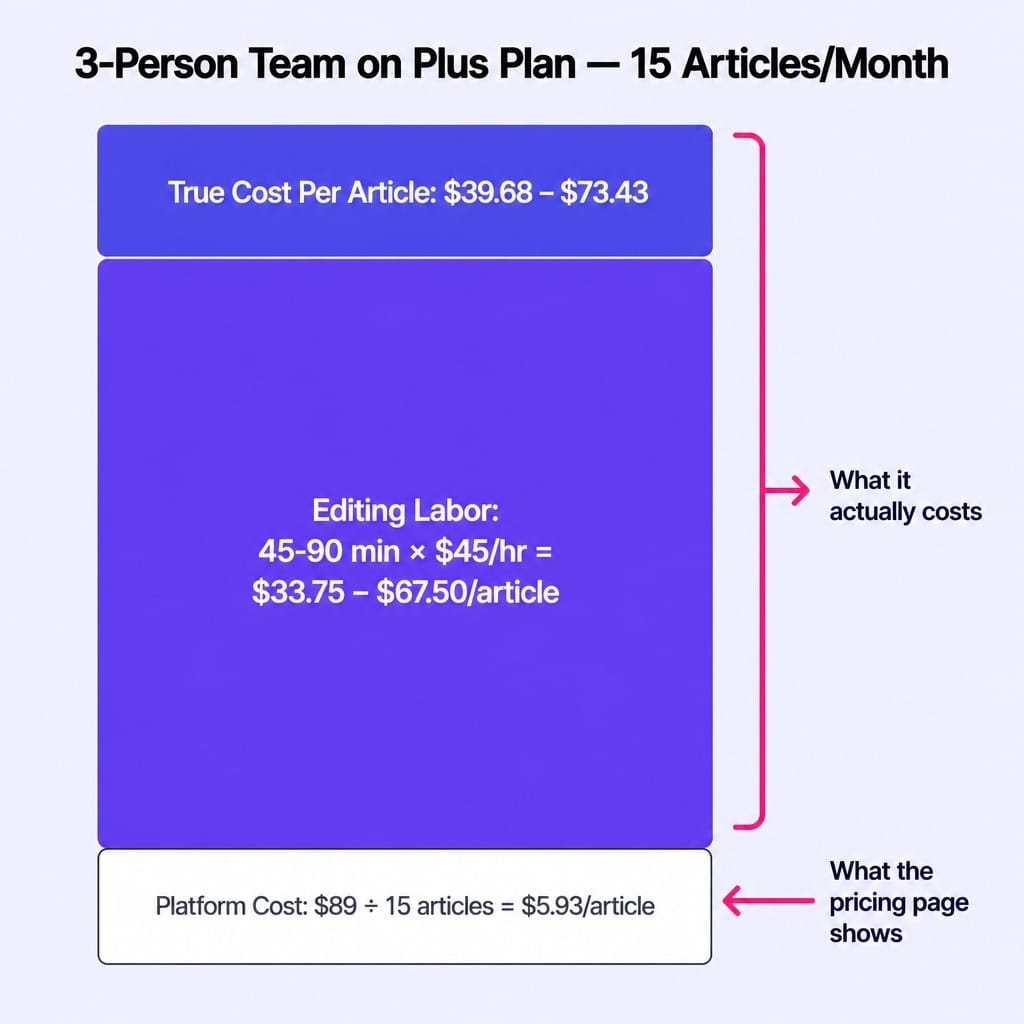
Let's run a scenario: A 3-person content team is on the Plus plan ($89/mo) and aims to produce 15 long-form articles per month.
- Platform Cost Per Article: The platform fee is simple: $89 ÷ 15 articles = $5.93 per article. This is the number most teams budget for.
- Editing Labor Cost Per Article: This is the hidden variable. An AI-generated first draft is never publish-ready. It requires human intervention for fact-checking, brand voice alignment, adding internal links, formatting, and layering in true E-E-A-T signals. A conservative estimate for this process is 45-90 minutes per article. At an average loaded cost of $45/hour for a content editor, that's $33.75 to $67.50 in labor per article.
- True Cost Per Published Article: Adding the platform and labor costs gives you a realistic figure: $39.68 to $73.43 per article.
This calculation reveals the core economic trade-off. If your editing process is efficient and your team can bring a draft to publish-ready in under an hour, Scalenut provides significant leverage. However, if every article requires heavy rework and extensive fact-checking, the "savings" compared to a freelance writer charging $200 for a clean, researched article quickly evaporate. Furthermore, credit-based AI writing tools penalize iteration; every regeneration or outline tweak consumes credits, which can increase the platform cost if not managed carefully.
Which Gated Features Actually Impact Content Performance?
Every SaaS tool uses feature gates to drive upgrades, but not every locked feature is worth the extra spend. The important question isn't "what's locked?" but "what locked feature would tangibly improve my content's outcomes or my team's workflow?"
Here's an analysis of Scalenut's key gated features:
- Workspaces (Unlimited on Professional): This is a hard gate for agencies. The Plus plan's limit of 2 workspaces means an agency managing four clients is forced to upgrade to the Professional plan, even if their content volume is low. For an in-house team managing one brand, this gate is irrelevant.
- Audit Pages (1000 on Professional vs. 200 on Plus): For sites with hundreds or thousands of pages, the audit limit on lower plans is a real bottleneck. It prevents you from running a comprehensive content decay refresh program, limiting your ability to systematically improve existing assets.
- Perplexity Tracking (Professional Only): This feature tracks your content's visibility and ranking within AI-generated search results. If your strategy is explicitly focused on Answer Engine Optimization (AEO), this is a critical feature. If you're still focused on traditional blue-link SEO, it's a nice-to-have, not a need-to-have.
- Dedicated CSM (Professional Only): A dedicated Customer Success Manager is valuable for teams who need strategic guidance and lack deep in-house SEO expertise. For seasoned practitioners, it's often an unnecessary layer of communication.
For most growing teams, the upgrade trigger isn't the AI prompt limit; it's an operational constraint like the workspace or audit page cap. Before upgrading, map the gated features to your actual workflow to ensure you're not paying for capabilities you won't use.
Scalenut Pricing vs Surfer SEO, Frase, and Clearscope
Scalenut's value proposition only becomes clear when compared to the alternatives. Here's how its pricing and capabilities stack up against other leading content optimization tools.
Interpretation:
- Scalenut vs. Surfer SEO: Scalenut's mid-tier plan is cheaper than Surfer's and includes AI writing, which Surfer sells as a separate add-on. Surfer's core strength is its deep NLP term optimization and correlation analysis, but Scalenut offers a more integrated end-to-end workflow from brief to draft. For a deeper look at what Surfer charges per article, see our Surfer SEO pricing breakdown.
- Scalenut vs. Frase: Frase is the budget-friendly option, with a very low entry price. However, its AI writing is also an add-on, and it lacks the GEO/AI visibility features that Scalenut is building into its platform. We've done a full analysis of Frase pricing plans if you want to compare the real costs side by side.
- Scalenut vs. Clearscope: Comparing Scalenut to Clearscope on price alone is misleading. Clearscope is a premium-grade optimization and grading layer, not an AI drafting tool. Teams use it to guide human writers or grade AI drafts from other tools. The true cost of a Clearscope workflow is the subscription plus the cost of content creation.
Read more: Surfer SEO vs Clearscope: Which Tool Fits Your Team's Actual Workflow in 2026 | Spike
The Verdict: Scalenut's pricing is most competitive for teams who want AI drafting and SEO optimization tightly integrated into a single platform. If you only need one or the other, a more specialized tool might offer a better cost-per-feature value.
When Scalenut Becomes More Expensive Than a Freelance Writer
There is a breakeven point where the "savings" from an AI writing tool disappear, making it more expensive than hiring a human writer. This threshold is almost entirely dependent on your internal editing time.
Let's revisit the math. If your total cost per AI-assisted article is hovering around $75 (including platform fees and editing labor), you are approaching the lower end of the market for freelance SEO writers. A competent writer might charge $200-$400 for a 2,000-word article, but that deliverable is typically publish-ready and requires minimal editing—perhaps 15-20 minutes for a final review.
The breakeven point occurs when your editing time per AI article consistently exceeds 60-75 minutes.
- Below this threshold: Your team is effectively leveraging AI to reduce content production costs.
- Above this threshold: You are paying for a software subscription and paying for human-level editing effort. The economics flip. You're essentially paying a writer's rate for a tool that's creating more work.
The only way to know where you stand is to track this metric. For two weeks, have your editors log their time on each AI-generated article. The average will tell you more about the tool's ROI than any feature list. Teams building out their broader SaaS marketing tools stack should factor this editing overhead into every tool evaluation, not just content generators.
What If Your Website Optimized Itself Instead of Waiting for Your Next Content Sprint?
Calculating the cost-per-article for a tool like Scalenut is a smart move. It optimizes one part of the marketing system: content production. But the bigger cost for most marketing teams isn't creating content—it's the enormous delay between identifying what needs to be fixed on their website and actually shipping the fix. The backlog of SEO tweaks, CRO experiments, and content updates grows, while execution stalls.
This is the execution gap that Spike AI is built to close. Instead of just helping you produce assets, Spike AI functions as a marketing execution engine. Every week, it identifies the single highest-impact move across your website—whether it's a technical SEO fix, a conversion rate optimization on a key page, or a content refresh—and then executes it.
The content Scalenut helps you create still needs to land on pages that convert. Spike AI ensures those pages, and your entire site, are continuously improving, turning your marketing strategy into weekly releases that compound.
See how Spike AI identifies and ships your highest-impact marketing fix every week
Conclusion: Price vs. Cost
The most important takeaway is that Scalenut's pricing page shows you what the platform charges, but it doesn't show you what Scalenut costs. Those are two different numbers. The true scalenut price is a function of your plan tier, your content volume, your actual credit burn rate, and—most importantly—your team's editing overhead.
The final scalenut cost can only be determined by testing. Use the 7-day free trial to produce 3-5 real articles for your website. Track your editor's time on each one. With that data, you can build a simple spreadsheet to calculate your actual cost-per-published-asset and make a decision based on your own numbers, not the marketing on a pricing page.
Frequently Asked Questions
Does Scalenut offer a free plan or just a free trial?
Scalenut provides a 7-day free trial with daily usage limits, allowing you to test core features like AI writing and content optimization. However, there is no permanent free-forever plan. Once the trial period ends, you must upgrade to a paid plan to continue using the service.
What happens when you exceed your Scalenut AI prompt or article limit?
Once you hit your monthly cap for AI prompts or GEO/AI articles, those features become locked until your next billing cycle begins. Scalenut does not currently offer per-prompt or per-article coverage charges. Your only options are to upgrade your plan mid-cycle or wait for the limits to reset.
Does Scalenut charge per user or per workspace?
Scalenut's pricing is primarily based on a per-workspace subscription model, not a per-seat model. However, each plan has a different limit on team members: Starter allows 1 user, Plus allows 4, and Professional allows unlimited users. For agencies, the workspace limit is often the more critical constraint.
Can I downgrade my Scalenut plan without losing data?
Yes, you can downgrade your plan at the end of your current billing period. All of your existing projects and content will be retained in your account. However, you will lose access to any features that are exclusive to the higher-tier plan, so be sure to export relevant reports before the downgrade takes effect.
Does Scalenut offer lifetime deals or AppSumo deals in 2026?
Scalenut did offer lifetime deals (LTDs) on platforms like AppSumo in its early stages. However, as of 2026, there are no active, official lifetime deals available. The company has transitioned to a standard monthly and annual SaaS subscription model. Be cautious of any LTDs found on secondary markets, as they may be deprecated.