What AI Marketing Intelligence Actually Requires (Beyond Better Dashboards)

TL;DR
- AI marketing intelligence isn't a better dashboard; it's a system that unifies cross-channel signals to produce prioritized, actionable decisions.
- Most implementations fail at the data plumbing layer. Inconsistent, fragmented data across your CRM, analytics, and ad platforms will cripple even the most advanced AI.
- The future of reporting is narrative intelligence—plain-language briefs generated by LLMs that explain what changed, why, and what to do next, replacing manual analysis.
- AI shifts the marketer's role from data-pulling and report-building to validating AI-generated hypotheses and directing strategy.
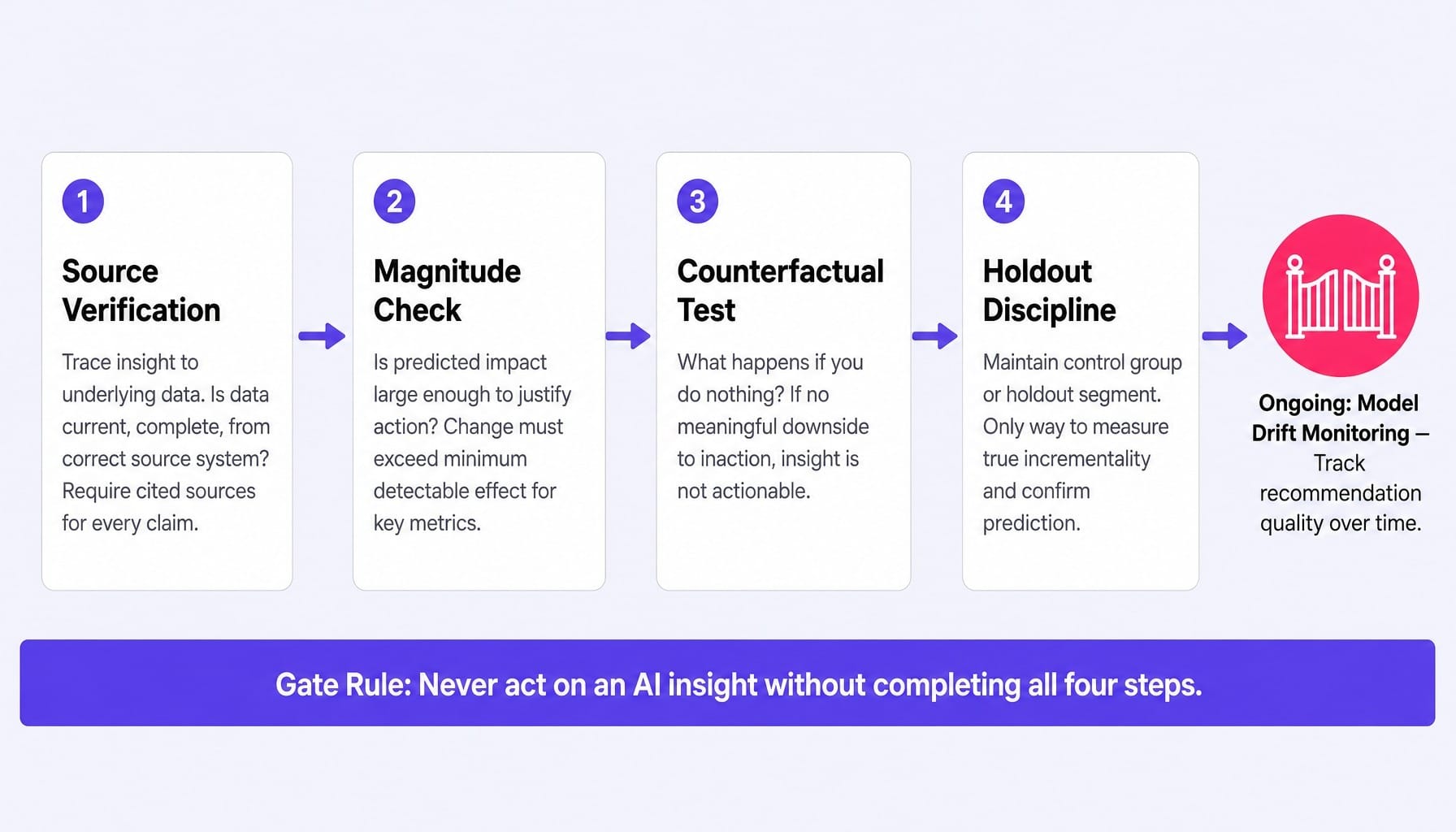
- Never act on an AI insight without validation. Always trace it back to the source data, check its magnitude, and run holdout tests to measure true incrementality.
Your team has more data than ever. You have dashboards for SEO performance, paid search analytics, and website behavior. Weekly reports are generated, metrics are tracked, and yet your conversion rate hasn't moved in two quarters. The dashboards might be green, but the pipeline is flat.
This is the state of modern marketing for many B2B teams: drowning in data but starved for clarity. The industry has confused data access with intelligence.
This is why the promise of AI marketing intelligence often falls short. It's not about a better dashboard or a faster report. It is the system-level capability to unify signals across channels, diagnose what is actually constraining growth, and act on that diagnosis before the window of opportunity closes. It's about closing the gap between insight and shipped action.
This article breaks down what that system requires. We will define what AI marketing intelligence actually is (and what it is not), explain why most implementations fail at the data plumbing layer, walk through the shift from dashboards to decision-driven intelligence, and provide a practical framework for validating AI-generated insights before you act.
What AI Marketing Intelligence Actually Means (and What It Is Not)
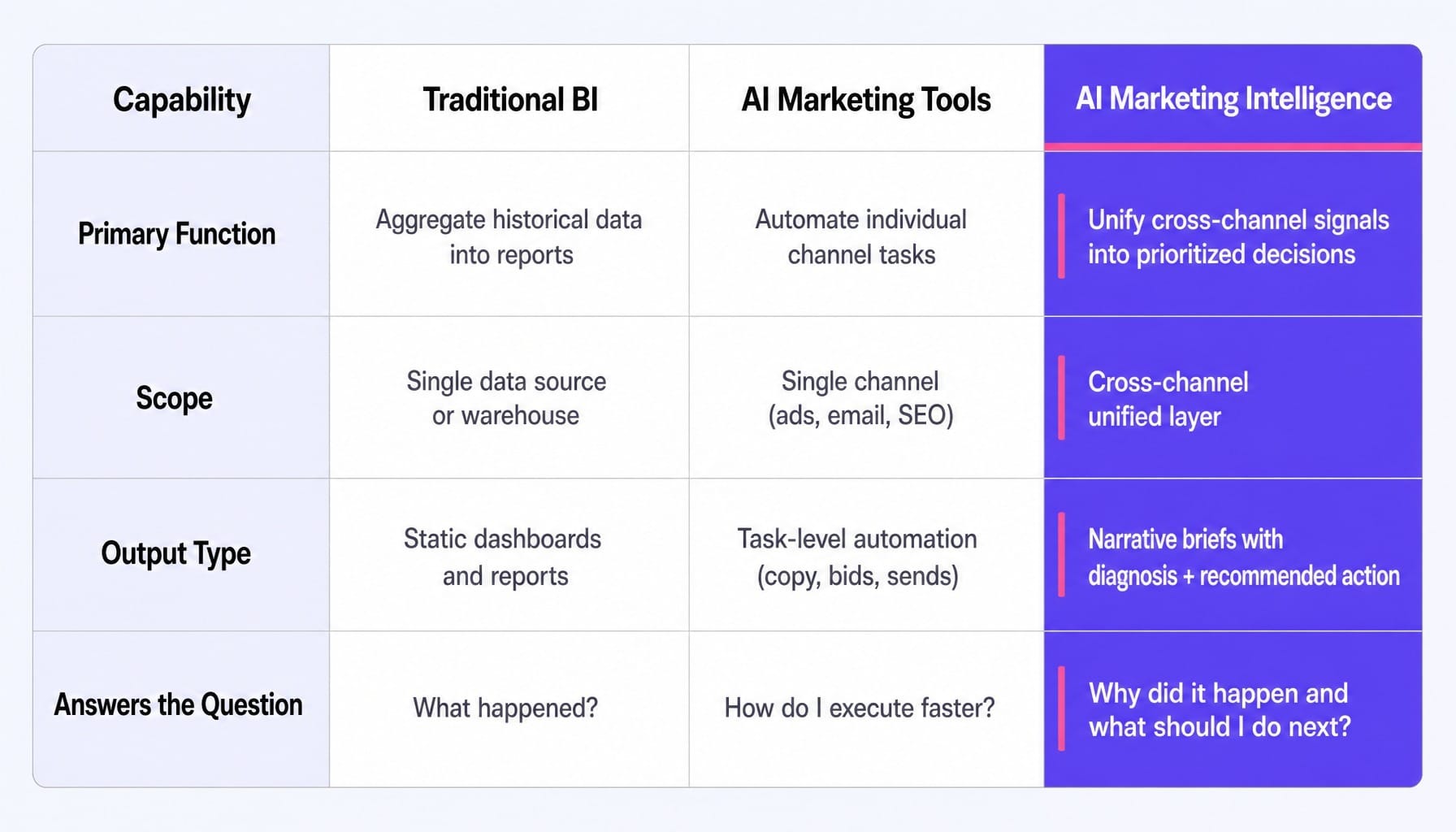
AI marketing intelligence is the use of machine learning, NLP, and predictive models to continuously ingest, unify, and interpret marketing signals across channels—transforming fragmented data into prioritized, actionable decisions.
This capability is often confused with three adjacent concepts:
- Traditional Business Intelligence (BI): BI platforms aggregate historical data into static reports and dashboards. They tell you what happened. An AI marketing intelligence system tells you why it likely happened and what to do next.
- AI Marketing Tools: These tools automate individual tasks like ad copy generation, keyword research, or email personalization. They are point solutions operating within a single channel, not a unified intelligence layer.
- Marketing Automation Platforms: These platforms execute predefined workflows. They are excellent for carrying out instructions but lack the ability to interpret performance and generate novel strategies.
Consider this contrast: a traditional BI dashboard tells you that organic traffic dropped 12% last month. An AI marketing intelligence system, drawing from competitive intelligence feeds like Crayon or Klue and intent data providers like 6sense or Bombora, tells you that the drop correlates with three specific pages losing featured snippet positions to a competitor who restructured their content two weeks ago. It then recommends which pages to prioritize for recovery based on their propensity scoring and potential revenue impact.
AI marketing intelligence is not a tool category—it is a capability layer that sits above individual tools and unifies their outputs into cross-channel decision logic.
Why Most AI Marketing Intelligence Implementations Fail at the Data Layer
When AI marketing intelligence projects fail, teams instinctively blame the AI. But in the majority of cases, the failure happens long before the AI layer is ever reached—at the data plumbing stage.
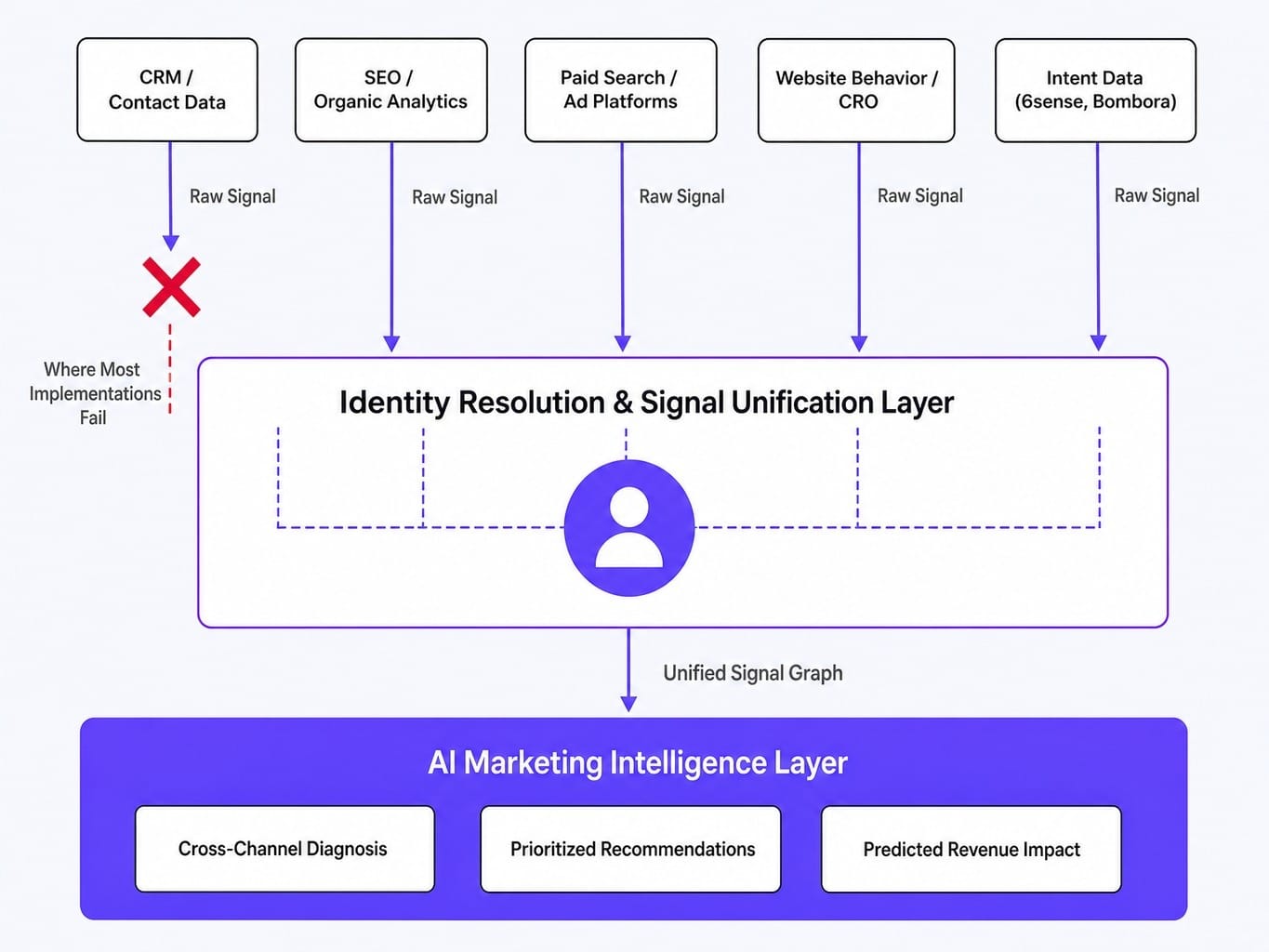
The models are only as good as the signal graph they ingest. Despite massive investment in analytics tools, average website conversion rates remain stubbornly low, around 2%, because the problem isn't a lack of data; it's a lack of unified, actionable signal. If your CRM data is stale, your analytics tracking is fragmented, and your SEO and paid search data live in separate silos with no shared identity resolution, then even the most sophisticated AI will produce shallow or misleading outputs. This is the hidden cost that vendors rarely surface.
Before you evaluate any AI marketing intelligence platform, you must audit whether your data infrastructure can actually feed it.
The First-Party Data Readiness Problem
Most B2B teams overestimate their first-party data readiness. There is a critical difference between data availability and data readiness; a warehouse can contain every field an AI model needs while still being unusable because timestamps are inconsistent or null-handling conventions vary across source systems.
I once spent three weeks debugging what a team believed was a faulty lead-scoring model. It turned out the CRM was ingesting UTM parameters inconsistently across four different form tools, meaning the model was training on attribution data that contradicted itself at the source. The AI was performing exactly as designed; the data layer was lying to it. Fixing the ingestion logic alone improved scoring accuracy by a measurable margin before anyone touched the model.
Stale contact records, broken event tracking, and inconsistent naming conventions mean the AI ingests noise, not signal. The highest-fidelity inputs often come from zero-party signal ingestion—data customers intentionally share via surveys or preference centers—which most teams underutilize. Platforms like HubSpot Breeze Intelligence attempt to enrich this data, but the core quality is a prerequisite you own.
Cross-Channel Signal Unification Is the Real Bottleneck
Even with clean channel data, the absence of a unified marketing data graph makes it impossible for an AI to identify cross-channel patterns.
A visitor who reads three blog posts, clicks a paid ad, and then bounces from the pricing page represents a single buyer journey. But if your SEO, paid, and CRO data live in separate tools, the AI sees three disconnected events. This is why most marketing attribution failures get misdiagnosed as model accuracy problems when the actual root cause is identity resolution. If the system cannot reliably stitch a single user across sessions and devices, every downstream prediction inherits that fragmentation.
Enterprise teams use platforms like Snowflake Media Data Cloud or Databricks Lakehouse for Marketing to build these unified data layers, but this requires engineering resources that most mid-market teams lack. Without a coherent identity resolution graph connecting anonymous sessions to known contacts, true cross-channel intelligence remains out of reach.
From Dashboards to Decisions: How AI Replaces Reporting with Narrative Intelligence
The era of dashboard-centric marketing reporting is ending. Dashboards are static representations of the past; they require a human to interpret charts, identify anomalies, form hypotheses, and decide what to do. AI marketing intelligence systems powered by LLMs can now generate narrative briefs—plain-language explanations of what changed, why it likely changed, and what the highest-priority response should be.
This is not just summarization. Narrative intelligence is not the same as natural language reporting; generating a sentence that says 'CTR dropped 12%' is a summary, while identifying that the drop correlates with a creative rotation that coincided with a competitor's product launch is actual intelligence. When a B2B SaaS team spends a quarter integrating an AI marketing intelligence platform and the outputs contradict what the demand gen team sees in-channel, the result is not just wasted budget but organizational distrust of AI that delays every subsequent automation initiative.
To be trustworthy, this generative insights synthesis must be grounded in verified performance data through retrieval-augmented generation (RAG) pipelines, using tools like the OpenAI API or Anthropic Claude for enterprise. This approach, with strong hallucination guardrails, prevents the model from inventing conclusions.
Imagine this workflow shift:
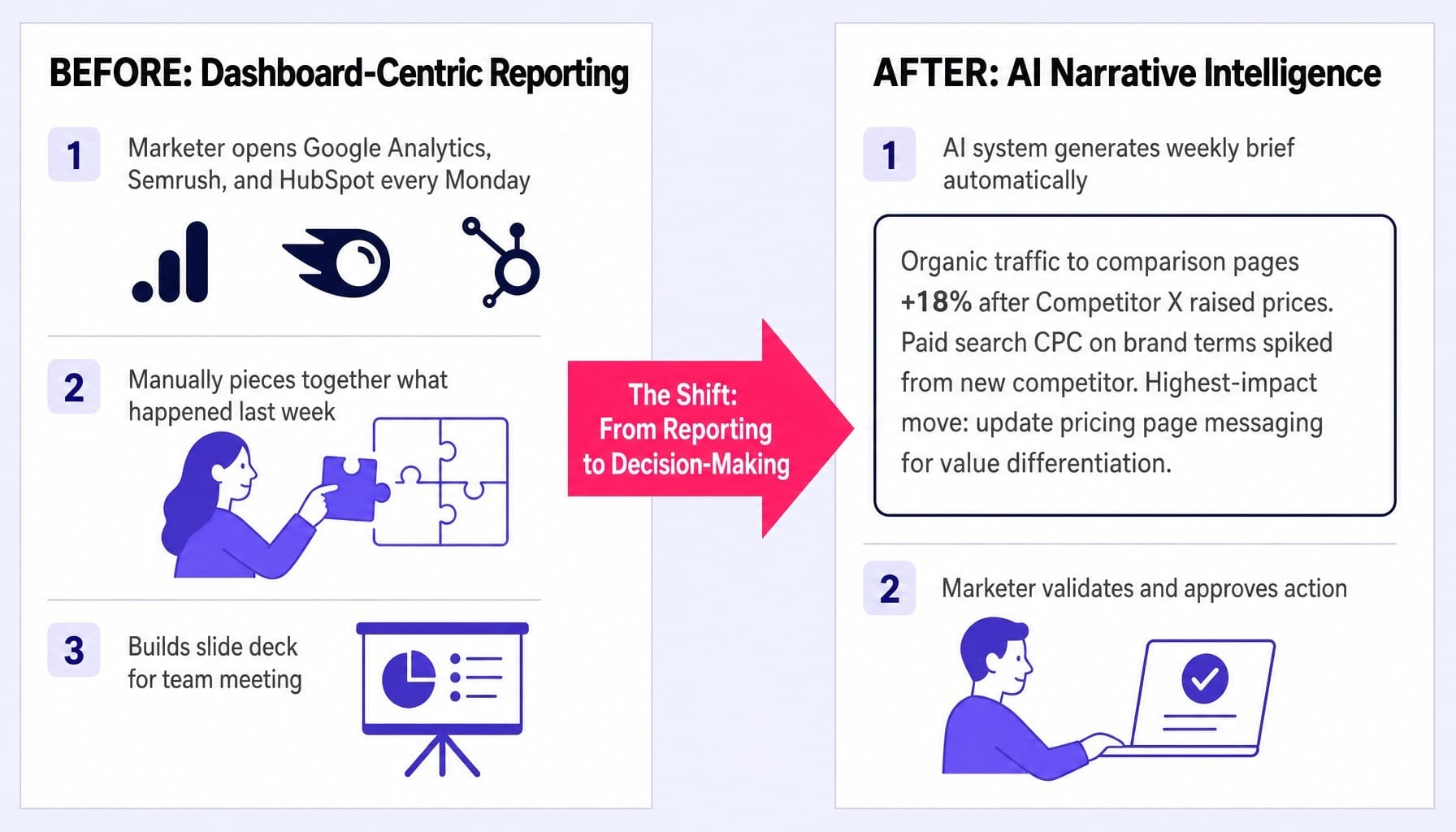
- Before: A marketer opens Google Analytics, Semrush, and HubSpot every Monday to manually piece together what happened last week.
- After: An AI system generates a weekly brief: "Organic traffic to your comparison pages increased 18% after Competitor X raised their prices. Your paid search CPC on brand terms spiked due to a new competitor. Your highest-impact move this week is to update your pricing page messaging to emphasize value differentiation."
The shift is not from manual to automated reporting. It is from reporting to decision-making.
Read more: SaaS Marketing Metrics That Actually Inform Decisions (Not Just Dashboards) | Spike AI
The Analyst-in-the-Loop Paradigm: Redesigning Marketing Roles Around AI Intelligence
Can AI marketing intelligence replace human marketing analysts? No, but it fundamentally changes what they do.
Instead of spending 60-70% of their week pulling data and building reports, the marketer's role shifts to validating AI-generated diagnoses, approving prioritized actions, and directing strategic focus. This is the analyst-in-the-loop paradigm. The model only works, however, when the human's role is explicitly redefined as hypothesis triage rather than hypothesis generation. Without that clarity, analysts default to rebuilding the AI's work manually, which negates any efficiency gain.
Consider a growth marketer at a small B2B SaaS company:
- Before: They spend Monday and Tuesday pulling SEO rankings, reviewing ad performance, checking conversion rates, and building a slide deck for the Wednesday team meeting.
- After: They receive a prioritized brief on Monday morning, spend two hours validating the top three recommendations, approve the highest-impact action, and spend the rest of the week on strategic initiatives—positioning, messaging, partnerships—that no AI can do.
This transition requires new competencies: understanding model confidence scores, knowing when to override AI recommendations, and developing the critical thinking to evaluate machine-generated hypotheses. AI marketing intelligence doesn't eliminate the need for marketing judgment; it eliminates the manual labor that prevents marketers from exercising it.
How to Validate AI-Driven Marketing Intelligence Before Acting on It
AI-generated insights can be confidently wrong. A model might recommend doubling spend on a keyword based on a trend that is actually seasonal noise. Validation of AI-generated marketing insights requires distinguishing between directional correctness and actionable precision; a model can correctly identify an underperforming segment without being reliable enough to dictate a specific budget reallocation.
Before committing resources, apply this four-step validation framework:
- Source Verification: Can you trace the insight back to the underlying data? Is that data current, complete, and from the correct source system? Require the system to cite its sources for every claim.
- Magnitude Check: Is the predicted impact large enough to justify action, or is the AI surfacing statistical noise? The change must exceed the minimum detectable effect for your key metrics.
- Counterfactual Test: What would happen if you did nothing? If the answer is unclear or the "do nothing" scenario has no meaningful downside, the insight is not actionable.
- Holdout Discipline: When acting on an AI recommendation, always maintain a control group or holdout segment. This is the only way to measure true incrementality and confirm the AI's prediction was correct.
Finally, implement model drift monitoring. AI systems degrade as market conditions change. You must track whether recommendation quality remains stable over time.
When Intelligence and Execution Live in the Same System
This article has built a specific tension: AI marketing intelligence fails when data is fragmented, when insights stop at dashboards, and when teams lack the bandwidth to act on recommendations. The gap is not between data and insight—it is between insight and shipped action.
This is precisely the gap Spike AI is built to close. It is not another intelligence dashboard. It is the system that connects diagnosis to deployment.
Spike AI ingests signals across your website, SEO, AEO, and paid search into a unified intelligence layer. It identifies the highest-impact move to make each week and then executes it—not as a recommendation in a report, but as a deployed change. This is built for the marketer who wants to approve and direct, not pull data and build decks.
Where other tools diagnose problems and hand you homework, Spike AI deploys solutions. It fuses intelligence and action into a single, closed-loop system. Intelligence that acts weekly compounds in ways that quarterly agency cycles never can, turning your marketing function into a true growth engine.
See how Spike AI turns marketing intelligence into weekly shipped improvements
Conclusion
The single most important belief shift is this: AI marketing intelligence is not a technology problem—it is a systems design problem. The AI layer is the easiest part. The hard parts are unifying fragmented data, replacing dashboard reporting with decision-driven intelligence, redesigning marketing roles around AI outputs, and building the discipline to validate before acting.
Most teams invest in better AI when they should be investing in better data plumbing and tighter feedback loops between insight and action. The teams that win in the coming years will not be those with the most sophisticated models. They will be those who most effectively close the gap between knowing what to do and actually shipping it.
Audit your current marketing intelligence stack this week—not for what it can analyze, but for what it can actually ship.
Frequently Asked Questions
How does AI marketing intelligence handle cookieless environments and evolving privacy regulations?
AI marketing intelligence systems are shifting to rely on first-party data enrichment and privacy-enhancing technologies like data clean rooms, rather than third-party cookies. This forces teams to invest in zero-party and first-party signal collection—surveys, product usage data, and authenticated sessions—as the primary intelligence inputs. Platforms like Snowflake Media Data Cloud enable this kind of analysis without exposing individual user data.
What does an AI marketing intelligence tech stack look like for a mid-market B2B company?
A practical mid-market stack typically includes a CRM (like HubSpot or Salesforce), an intent data provider (like Bombora or 6sense), and a competitive intelligence tool (like Crayon or Klue). The critical gap for most teams is not the tools themselves but the integration layer that connects their disparate signals into a single, unified decision graph, which is where a dedicated intelligence platform becomes necessary.
How do agentic AI systems differ from traditional marketing automation in intelligence gathering?
Traditional marketing automation executes predefined rules, like sending an email sequence when a lead score hits a certain threshold. Agentic AI systems can independently gather data, form hypotheses, and recommend or take actions based on real-time signals without predefined rules. This distinction matters because agentic systems can detect patterns and opportunities—like a sudden shift in competitor messaging—that no one programmed them to look for.
How do you measure ROI from an AI marketing intelligence investment?
Measure ROI through incrementality, not correlation. Compare business outcomes (pipeline velocity, conversion rate, CAC) during a holdout period against a period where AI-driven decisions are active. Track time-to-insight (how fast the team acts on opportunities) and decision quality (the hit rate of AI recommendations that produce measurable improvement). Avoid vanity metrics like the number of insights generated.
How do you prevent hallucinations in AI marketing intelligence outputs?
Ground every AI-generated insight using retrieval-augmented generation (RAG), which forces the model to pull from verified, current performance data rather than its general training corpus. Implement hallucination guardrails by requiring the system to cite the specific data source for every claim, flagging insights where confidence scores fall below a set threshold, and building human review checkpoints for any major recommendation.