Scalenut Review 2026: Honest Test Results, Pricing Breakdown, and Who It's Actually For

TL;DR
- Scalenut's Cruise Mode is a powerful first-draft engine that can cut drafting time, but expect to spend 45-60 minutes per article on substantive editing to fix generic phrasing and factual gaps.
- The content optimizer is adequate for basic on-page SEO but its NLP term suggestions are less granular than Surfer SEO or Clearscope, and its SERP data can lag by several weeks.
- The Growth plan at $79/month offers the best value for small content teams, but only if you don't already have a dedicated content optimization tool like Surfer SEO.
- Scalenut excels at accelerating the brief-to-draft pipeline for teams producing content at volume. It is not a good fit for teams needing publish-ready drafts or advanced SEO features like cannibalization audits.
- The tool stops at content production. It does nothing to optimize how that content performs on your live website, leaving the critical content-to-conversion gap wide open.
Searching for a current scalenut review feels like an exercise in futility. The top results are a mix of outdated articles from 2023, AI-generated puff pieces, and affiliate reviews that promise an honest assessment but conveniently bury the limitations. You deserve better.
This is a hands-on review based on actual testing. We're not just listing features. We're breaking down what Scalenut does well (Cruise Mode, content briefs), where it genuinely falls short (output quality, editing overhead, data freshness), and how it stacks up against Surfer SEO, Frase, and Clearscope. We'll also dissect the pricing to show you what each tier actually gets you.
Our verdict is simple: Scalenut is a solid brief-to-draft tool for teams that need to increase content velocity. But calling it a complete SEO content solution overstates what it delivers. Let's dig into why.
What Scalenut Actually Is (and What It Isn't)
First, let's position Scalenut correctly. It is a brief-to-draft content production tool with built-in SEO scoring. It is not a standalone keyword research platform like Ahrefs, a technical SEO auditor like Semrush, or a CRO tool.
Think of it as Surfer SEO's content editor merged with a GPT-powered first-draft generator, bundled with a basic keyword clustering feature.
Consider a typical 3-person B2B content team. Their workflow might involve Google Keyword Planner for research, ChatGPT for drafts, and Surfer SEO for optimization. Scalenut's value proposition is consolidating the drafting and optimization steps into a single interface. It's designed to replace the blank page and the manual process of checking your work against a separate optimization tool.
But it's critical to understand where it stops. Scalenut does not optimize existing pages on your live site. It does not run A/B tests, track conversions, or touch anything post-publish. Its entire function ends the moment you copy your draft into your CMS. For teams whose primary bottleneck is the initial creation of content, this is a compelling offer. For teams struggling with post-publish performance, it doesn't touch the core problem.
Cruise Mode: Where Scalenut Earns Its Keep
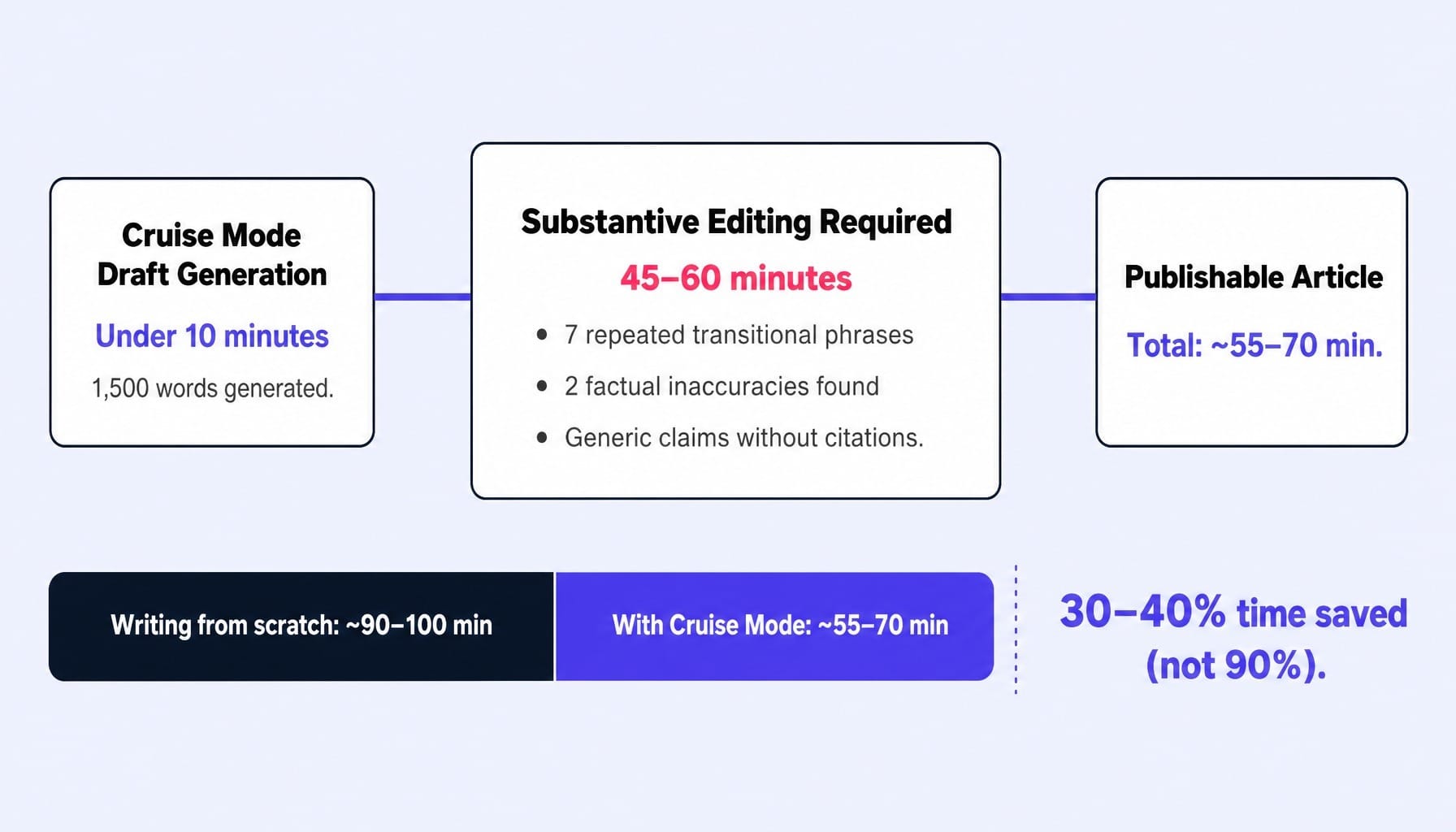
Cruise Mode is Scalenut's flagship feature, promising to take you from a single keyword to a full, SERP-informed first draft in under 10 minutes. In our testing, this promise is largely delivered. The workflow is genuinely fast and intuitive.
But workable and publishable are two different things.
We ran a test generating a draft for a mid-competition B2B keyword: 'best project management tools for remote teams.' The good news? The outline intelligently pulled from competitor H2 and H3 structures, and the initial NLP term coverage provided a workable skeleton. The draft was on-topic and structurally sound.
The bad news surfaced during the edit. The AI output was plagued by repetitive phrasing—we counted the same transitional phrase seven times in a 1,500-word draft. It made generic claims without supporting evidence and contained two minor factual inaccuracies that required manual verification.
This brings us to the hidden cost. A 1,500-word Cruise Mode draft consistently required 45-60 minutes of substantive editing to reach a publishable quality standard. While that's still a net time savings of roughly 30-40% compared to writing from scratch, it's nowhere near the 90% efficiency some marketing materials claim. Cruise Mode is a genuine time-saver for teams with strong editors, but it can become a liability for teams that expect to publish AI output with minimal review.
Content Optimizer and SEO Scoring: Useful but Not Best-in-Class
Scalenut's second pillar is its content optimizer, which provides a real-time content grading score as you write. The mechanism is similar to its competitors: it scores your draft against the top-ranking pages for your target keyword, evaluating NLP term density, word count, and heading structure based on TF-IDF weighting.
The interface is clean and the score updates responsively, which is a definite plus. However, when you look closer, the recommendations are less granular than best-in-class tools. When optimizing for a competitive keyword, we found that Surfer SEO typically surfaces 80-120 NLP terms with specific frequency guidance. For the same keyword, Scalenut provided 40-60 terms with less precise density targets. A high score in Scalenut means you've successfully mirrored the term usage of existing top pages, not necessarily that you've created a superior piece of content with higher information gain.
Read more: Surfer SEO vs Clearscope: Which Tool Fits Your Team's Actual Workflow in 2026
The more significant issue for advanced teams is data freshness. Scalenut's SERP analysis engine doesn't seem to update in real-time. If a SERP has reshuffled in the last few weeks, the tool's optimization targets might be based on outdated competitive benchmarks. For most niches this isn't a dealbreaker, but for fast-moving industries like SaaS or AI, it's a tangible risk.
The verdict: Scalenut's optimizer is a solid feature for teams that don't already pay for Surfer SEO or Clearscope. It is not, however, a compelling reason to switch from either.
Where Scalenut Falls Short: The Limitations Most Reviews Skip
Every AI tool has limitations. The useful question isn't whether Scalenut has flaws, but whether those flaws are dealbreakers for your workflow. Here are the two areas where we found the most friction.
AI Output Quality: The Editing Overhead Nobody Quantifies
The core problem with Scalenut's AI output is that it's competently generic. The drafts are grammatically correct and structurally sound, but they lack the specificity and evidence that build trust. You'll frequently encounter unsupported claims like "studies show" without a single citation, or recommendations that lack the "why" behind them. There's also a measurable LLM hallucination rate on factual claims, which becomes a serious risk on YMYL topics.
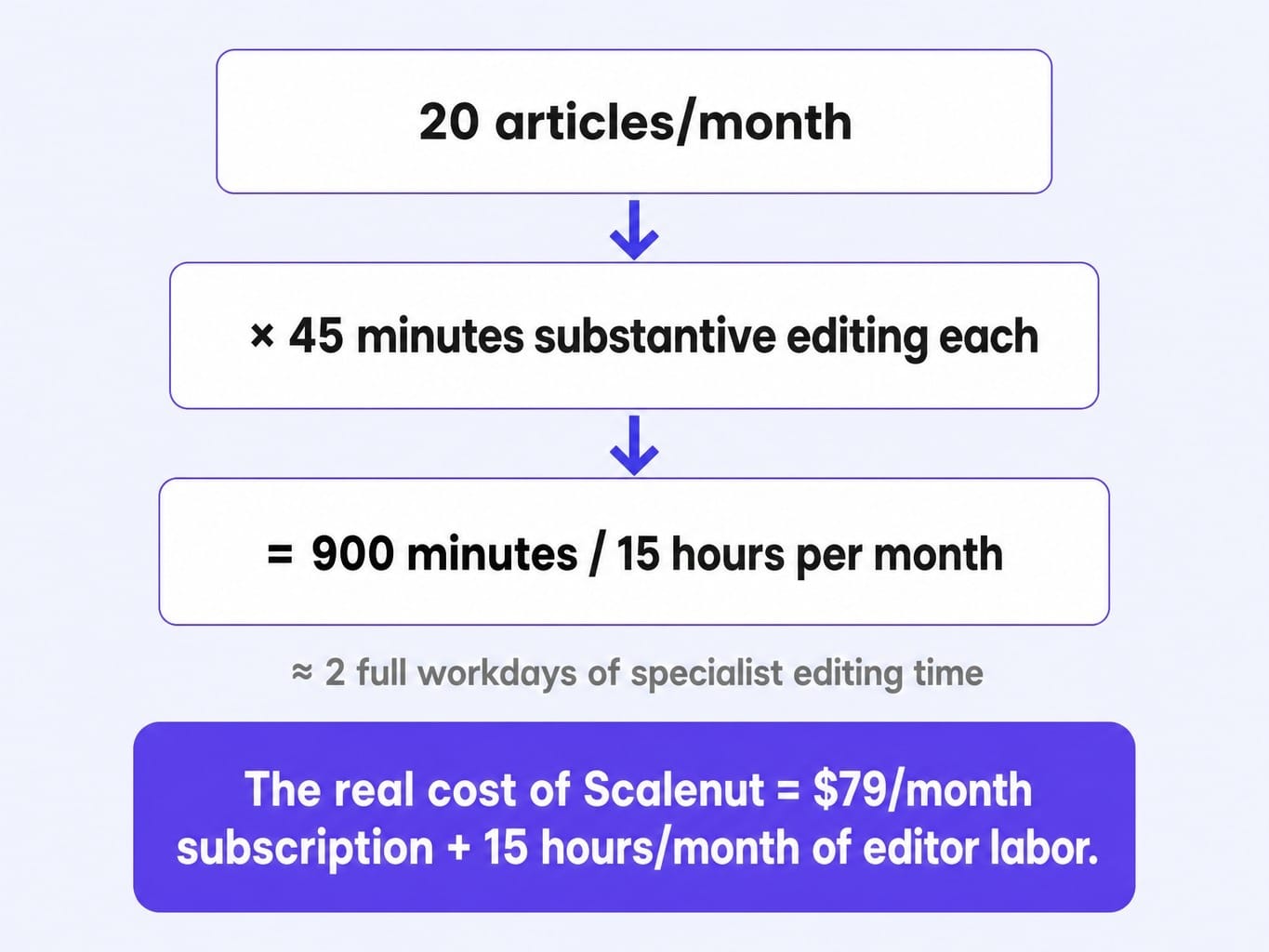
This creates an editing bottleneck. When a content team scales from 10 to 30 articles per month, that hidden editing overhead can consume more specialist hours than the drafting phase saved. Consider a team publishing 20 articles per month. At 45 minutes of substantive editing each, that's 15 hours of cleanup—nearly two full workdays spent fixing AI output. The real cost of the tool isn't the subscription; it's the downstream labor required to make the content trustworthy.
Data Freshness and Feature Gaps That Affect Advanced Teams
Beyond output quality, there are structural limitations. As mentioned, the SERP data can lag, which is a problem for competitive content gap analysis. But for advanced SEO teams, the missing features are more significant.
Scalenut has no content decay detection to flag underperforming pages, no cannibalization audit capability to identify keyword overlap, and no entity salience scoring to measure topical depth beyond basic keywords. Its keyword clustering feature is functional for grouping related terms, but it doesn't help with topical authority mapping in the way a more robust tool like Semrush does. It groups by semantic similarity, which can often mix informational and transactional queries into a single cluster, requiring manual separation.
For teams whose SEO strategy relies on these more nuanced analyses, Scalenut is an incomplete solution that will require supplementary tools.
Scalenut Pricing: What Each Tier Actually Gets You
Scalenut's pricing has shifted over time, so it's important to look at the current 2026 tiers.
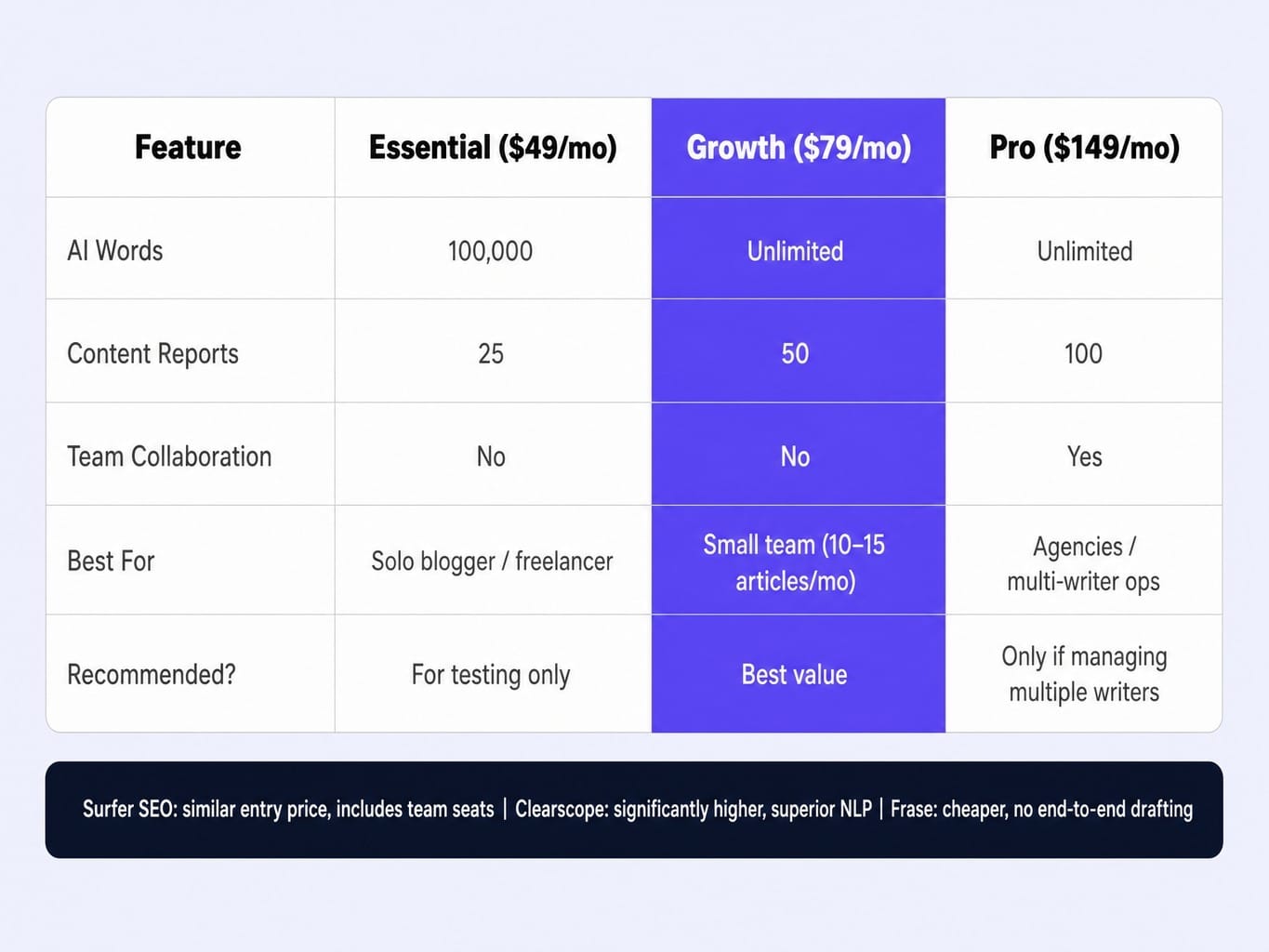
- Essential ($49/month): This tier gives you 100,000 AI words and 25 content briefs/optimizer reports. It's suitable for a solo blogger or freelance writer who wants to test the tool's core functionality without a major commitment.
- Growth ($79/month): You get unlimited AI words and 50 content reports. This plan is the sweet spot for small content teams producing 10-15 articles per month who need full access to the optimizer and Cruise Mode.
- Pro ($149/month): This offers 100 content reports and adds team collaboration features. It's aimed at agencies or larger content operations teams managing multiple writers and projects.
In context, Surfer SEO's entry-level plan is similarly priced but includes team seats, while Clearscope starts significantly higher but offers superior NLP accuracy. Frase is generally cheaper but lacks the end-to-end brief-to-draft pipeline of Cruise Mode.
Read more: Frase vs Clearscope in 2026: Which Tool Actually Improves Content Performance?
Our recommendation: The Growth plan at $79/month represents the best value, but only if you aren't already subscribed to Surfer SEO. Running both creates too much feature overlap to be cost-effective.
Who Should Use Scalenut and Who Shouldn't
So, is Scalenut worth it? It depends entirely on your team's bottleneck.
Scalenut is a good fit for:
- Content marketing teams producing 10+ articles per month who need to accelerate their content velocity metrics.
- Solo marketers at early-stage companies who can't afford separate subscriptions for an AI writer and an SEO optimizer.
- Agencies managing multiple client content calendars where the speed of Cruise Mode provides a clear workflow advantage.
Scalenut is NOT a good fit for:
- Advanced SEO practitioners who rely on entity salience scoring, topical authority mapping, or cannibalization audits. They will still need Semrush or Ahrefs.
- Teams that need publish-ready content with minimal editing. The editing overhead is real and requires dedicated resources.
- Any team whose bottleneck is not content production, but conversion. Scalenut produces content; it does nothing to optimize how that content performs on a live website.
This last point is the most important. Producing more content faster doesn't automatically translate to more revenue. If your core problem is a low-converting website, a content production tool won't solve it.
How Scalenut Compares to Surfer SEO, Frase, and Clearscope
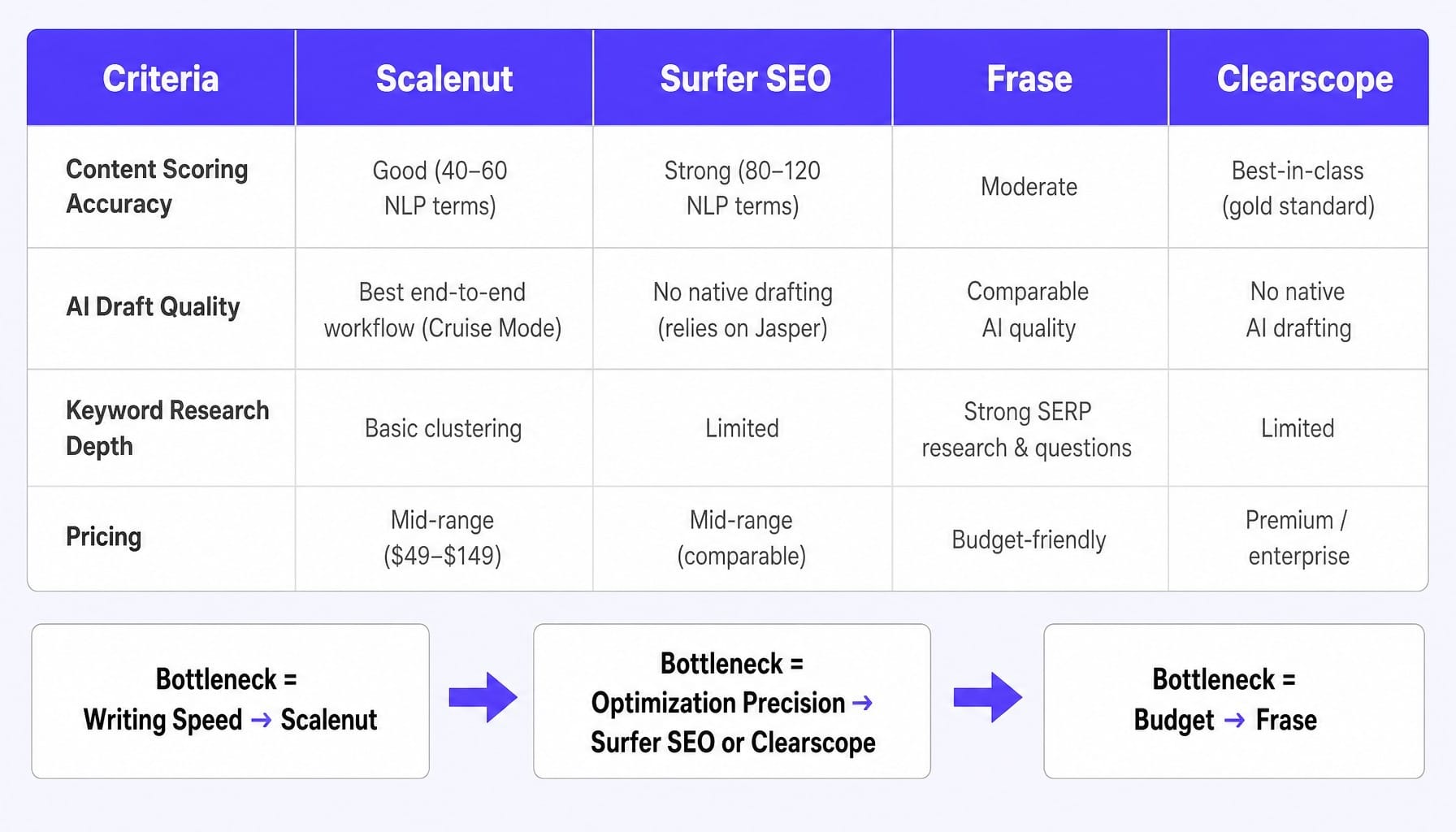
Here's a direct comparison based on the criteria that matter most to practitioners:
- Content Scoring Accuracy: Clearscope is the gold standard here, with Surfer SEO a close second. Scalenut's NLP analysis is less granular than both, making it good but not best-in-class.
- AI Draft Quality: Scalenut's Cruise Mode provides the most complete end-to-end drafting workflow. Frase's AI writing is comparable in quality, while Surfer SEO relies on third-party integrations (like Jasper) and doesn't have a native end-to-end drafting feature.
- Keyword Research Depth: None of these tools are dedicated keyword research platforms. Frase has strong SERP research and question-finding features. Scalenut's keyword clustering is a nice addition but shallow compared to what you get in Ahrefs or Semrush.
- Pricing: Frase is typically the most budget-friendly. Scalenut and Surfer SEO are priced competitively against each other. Clearscope is the premium option, aimed at enterprise teams.
The decision heuristic is simple: If your primary bottleneck is writing speed, Scalenut wins. If your bottleneck is content quality and optimization precision, Surfer SEO or Clearscope are better investments. If your budget is the main constraint, Frase is the pragmatic choice.
The Gap Scalenut Doesn't Close: From Content Production to Conversion
This entire discussion highlights a fundamental gap in the market. Tools like Scalenut are designed to solve the content production problem. They help you create more content, faster. But for most B2B marketing teams, the deeper problem isn't "we can't write fast enough"—it's "we publish content, but our website still converts at 2%."
Scalenut produces a draft. It doesn't test headlines, improve page speed, fix CTA placement, or run continuous on-site experiments to improve conversion rates.
This is the gap Spike AI is built to close. Where content tools stop, Spike AI begins. Once your content is live, Spike AI's marketing execution engine continuously identifies and deploys the highest-impact optimizations across your website—whether it's a CRO fix, an SEO improvement, or a structural change. It turns your static website into a system that compounds gains week over week.
See how Spike AI closes the content-to-conversion gap
The Final Verdict on Scalenut
So, is Scalenut worth it in 2026? For the right team, yes. It is a competent brief-to-draft tool that genuinely saves time for content teams producing at volume. Its Cruise Mode and integrated optimizer offer a consolidated workflow that many will find valuable.
But it is not a complete SEO solution, and it does not touch the post-publish optimization that actually drives conversions. The editing overhead is a real cost that must be factored into any ROI calculation, and its NLP accuracy still trails dedicated optimizers like Surfer SEO and Clearscope.
The teams that win in the coming years won't be the ones that simply produce the most content. They will be the ones who have a system to continuously optimize what's already live, compounding small gains into meaningful growth. Scalenut helps with the first part, but it leaves the second—and arguably more important—part entirely up to you.
Frequently Asked Questions
Is Scalenut accurate enough to replace a human SEO editor?
No. Scalenut's AI drafts require substantive editing for factual accuracy, phrasing repetition, and evidence gaps. It accelerates the first draft, but a human editor remains essential for publishable quality, especially on YMYL or technically complex topics.
Does Scalenut support multi-language content creation?
Scalenut supports multiple languages, but output quality drops significantly outside of English. Non-English drafts tend to sound more robotic and require heavier editing. Teams producing primarily non-English content should test extensively before committing to a paid plan.
Can Scalenut detect and fix content cannibalization issues?
No. Scalenut does not include cannibalization detection or audit capabilities. Teams concerned about keyword overlap across their pages will still need a tool like Semrush or Ahrefs alongside Scalenut to manage this effectively.
Does Scalenut integrate with WordPress and other CMS platforms?
Scalenut offers a WordPress integration and a Chrome extension for browser-based editing. However, the Chrome extension can conflict with other writing tools like Grammarly. Most teams still copy-paste from Scalenut's editor into their CMS.
How often does Scalenut update its SERP data and NLP models?
Scalenut does not publish a specific update cadence. In our experience, SERP data can lag by 2-3 weeks behind live Google results. This means optimization targets may reflect outdated competitor benchmarks in fast-moving niches.