
Serpstat Review 2026: Is It Actually Worth the Money?

TL;DR
- Best For Keyword Clustering: Serpstat's SERP-overlap clustering engine is its strongest feature, outperforming many standalone tools for mapping topical authority.
- Backlink Data is a Weak Point: The backlink index lacks the freshness and filtering depth of Ahrefs, making it inadequate for serious competitive link analysis.
- Watch the Credit Economy: The low monthly price is appealing, but the credit-based system for rank tracking and API calls can make it more expensive than Semrush for high-volume workflows.
- Strong for Non-English SEO: Its database coverage in Eastern European and CIS markets is a significant, underreported advantage over competitors.
- The Verdict: Serpstat is a capable mid-market tool, not a direct replacement for Semrush/Ahrefs. It's the right choice for specific workflows (clustering, audits, non-US markets) but a false economy for others (competitive link building).
Every SEO practitioner considering Serpstat faces the same tension. The tool costs a fraction of Semrush, claims to cover the same feature set, and boasts over a million users. So why does every experienced SEO you ask give a different answer about whether it's "good enough"?
The reason is that most Serpstat reviews are either written by competitors, agencies funneling you to their services, or affiliates who spent 20 minutes with the tool. They rarely answer the questions that actually matter to a practitioner.
This is a different kind of review. It's a practitioner-level assessment built to answer three specific questions:
- Is the data accurate enough to base strategic decisions on?
- Does the credit system actually let you work at the pace you need?
- And for which specific workflows is Serpstat the right tool versus a false economy?
This is not an affiliate review. It's an honest assessment of where Serpstat fits into a professional SEO stack in 2026.
Quick Verdict: Where Serpstat Lands in 2026
For those scanning for a fast answer, here's the bottom line. Serpstat is a capable mid-market platform that punches above its price for keyword research and site audits, but it is not a 1:1 replacement for premium alternatives.
Serpstat's database of 7 billion keywords is smaller than Semrush's (26B) or Ahrefs' (23B), but database size alone doesn't dictate usefulness. Serpstat's primary challenge isn't its database size, but its credit system, which can quietly erode the tool's cost advantage if you're running multiple projects or high-frequency tracking. It excels in specific areas but falls short in others, making it a strategic choice for some teams and a frustrating bottleneck for others.
Feature-by-Feature: What Actually Works and What Doesn't
A feature list doesn't tell you if a tool is reliable. This is an assessment of accuracy and usefulness, based on a typical B2B SaaS marketing team's workflow.
Keyword Research and Clustering: Serpstat's Strongest Module
Keyword research is where Serpstat most closely matches premium tools, and in one area, it's arguably better. Its Tree View and SERP-based clustering are genuinely differentiated. While many tools cluster keywords based on semantic similarity, Serpstat analyzes actual SERP overlap. This means it groups keywords that Google already considers topically related, which is a far more reliable method for building out a topical authority map. For a B2B team planning a content hub, this feature alone can save hours of manual analysis.
The limitation? Search volume estimates for low-volume, long-tail keywords (under 100 monthly searches) can be less reliable than Semrush's. For a SaaS company targeting a niche query, this matters. You'll want to cross-reference with your Google Search Console impression data for a more accurate picture. But for keyword discovery and grouping, Serpstat is genuinely strong.
Backlink Analysis: Where the Gap with Ahrefs Is Real
Here's the honest assessment: Serpstat's backlink index, while large on paper at over 1.1 trillion links, lacks the freshness and granularity of Ahrefs. Imagine you're trying to replicate a competitor's recent link-building success. In Ahrefs, you can easily filter for "new" referring domains acquired in the last 30-90 days and sort them by page-level authority to prioritize outreach.
In Serpstat, you can see new and lost links, but the filtering and sorting capabilities aren't deep enough to turn that data into an actionable outreach list. The data pull frequency seems slower. For monitoring your own link profile, checking for toxic links, or getting a high-level view of a competitor's domain authority, it's adequate. For a primary competitive link-building tool, it's insufficient.
Site Audit: Genuinely Useful for Most Teams
Serpstat's site audit is one of its most underrated features. It runs over 100 checks, intelligently categorizes issues by priority (high, medium, low), and completes audits quickly enough to run weekly without creating friction. For a small agency or an in-house team managing a few sites, this is incredibly practical. It reliably catches common problems like index bloat, duplicate meta descriptions, thin content flagging, and broken internal links.
It's not a replacement for a dedicated crawler like Screaming Frog if you need to do complex JavaScript rendering analysis or log file audits. And the page-crawl limits on the Individual plan (30,000 pages) can be restrictive for larger sites. But for ongoing monitoring and catching the 80% of technical issues that impact performance, Serpstat's audit is solid.
Read more: SaaS Technical SEO: Why One-Time Audits Kill Growth & What to Ship Instead
Rank Tracking: Reliable but Credit-Hungry
The rank tracking module is functionally strong. It offers daily updates, tracks desktop versus mobile ranks, covers over 230 countries, and supports local tracking down to the city level. It correctly identifies SERP feature ownership and gives you a clear position distribution histogram.
The tension comes from the credit system. Each position check consumes a credit. On the Individual plan, you get 10,000 checks per month. If you track just 200 keywords daily across both desktop and mobile, you'll burn through that entire allocation in under two weeks, leaving nothing for ad-hoc analysis or reporting. The tracking itself is accurate, but the math makes it expensive at scale unless you're on the Team plan or higher.
Competitor Analysis and PPC Research: Adequate, Not Best-in-Class
The competitor analysis tools cover the expected ground: organic keyword overlap, visibility trends, and a "Missing Keywords" report for gap analysis. It works. However, the database size limitation means you'll occasionally find gaps in coverage for smaller competitors or highly specialized verticals.
Similarly, the PPC research module shows competitor ad copy, keywords, and CPC estimates. It's useful for a quick overview. But it lacks the deep historical ad creative libraries of SpyFu or the detailed ad history and audience targeting insights you get from Semrush. For general competitive intelligence, Serpstat is fine. For deep-dive research that informs core strategy, the premium tools remain stronger.
The Credit Economy: What Serpstat Actually Costs Per Query
Serpstat's headline pricing ($50-$149/mo) is its main draw, but the credit-based system means the effective cost depends entirely on your workflow. Most reviews never do this math.
Let's run a scenario. You're a solo marketer at a B2B SaaS company. You need to track 150 target keywords, monitor 3 main competitors, and run audits on your 500-page website.
You sign up for the Individual plan at $50/month. You get 100 searches/day and 10,000 rank checks/month. Here's how that allocation disappears:
- Rank Tracking: 150 keywords x 2 devices (desktop/mobile) x 30 days = 9,000 position checks. You've just used 90% of your monthly allocation.
- Daily Competitor Checks: A quick look at 3 competitors might use 15-20 of your 100 daily searches.
- Keyword Research: A single deep-dive session can easily burn through 30-50 searches.
Within two weeks, you're out of rank tracking credits and hitting your daily search limits. The plan looks affordable until it gets in the way of your work.
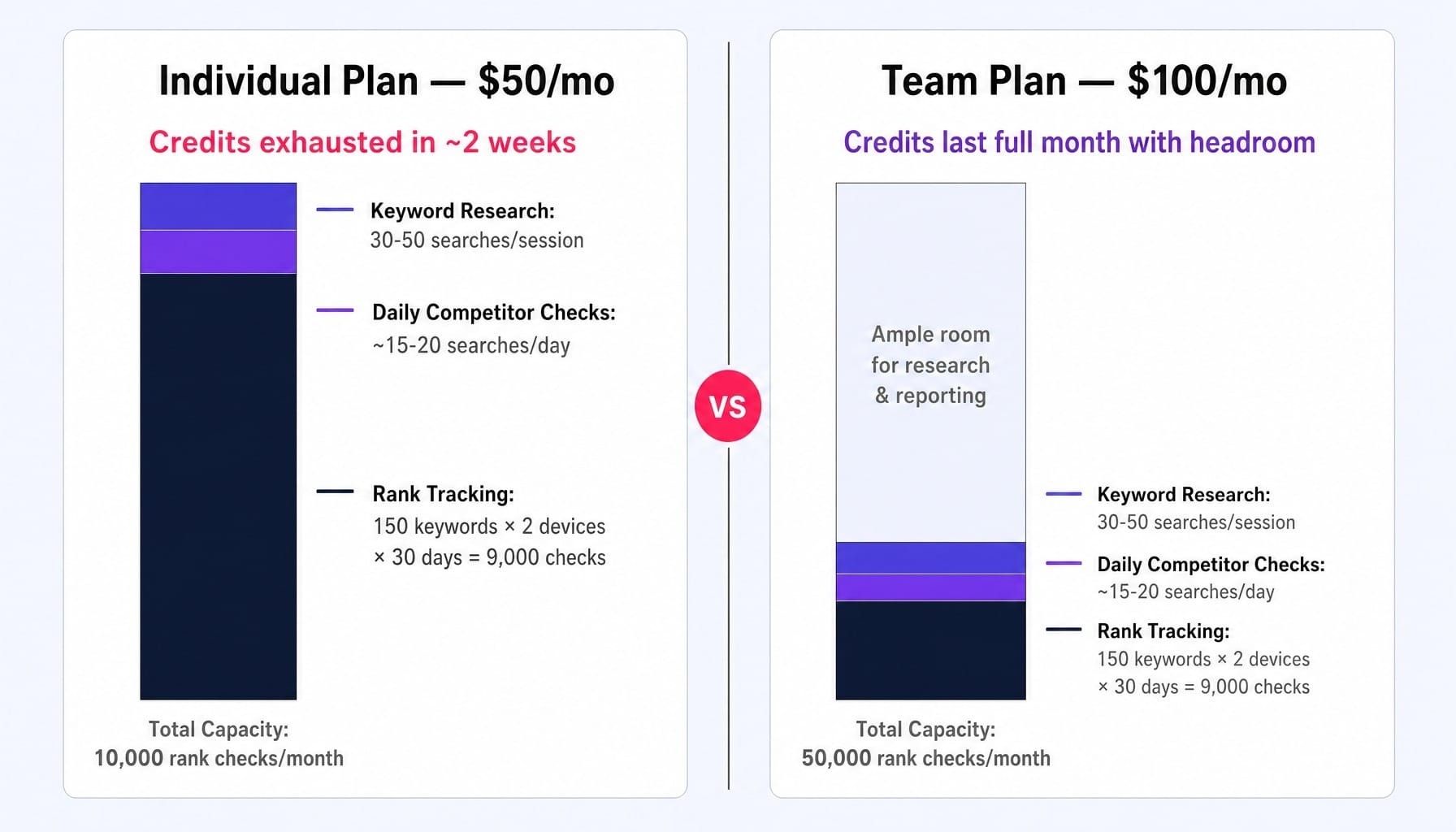
Now, compare this to the Team plan at $100/month (annual pricing). The limits jump to 500 searches/day and 50,000 rank checks. Suddenly, the math works. You have ample room for tracking, research, and reporting. At this tier, Serpstat becomes genuinely cost-effective, especially for small agencies. The lesson is clear: evaluate Serpstat's pricing against your actual query volume, not just the monthly fee.
Where Serpstat Wins—and Where It Clearly Doesn't
This isn't a generic pros and cons list. The real question is about workflow fit. Based on G2 reviews (4.6/5 from 464 reviews) and practitioner experience, here are the specific scenarios where Serpstat creates—or destroys—value.
Scenarios Where Serpstat Is the Right Choice
- Non-English Market SEO. This is Serpstat's most underreported strength. Its database has deep coverage in over 230 countries, with particularly strong data for Eastern European and CIS markets. For an agency serving clients in Poland, Ukraine, or Kazakhstan, Serpstat's data quality often matches or exceeds Semrush's at a lower price point.
- Keyword Clustering at Scale. The SERP-similarity clustering engine is best-in-class. It can process up to 50,000 keywords in a batch and produces more reliable topical groupings than many standalone tools. If building content hubs and establishing topical authority is a core part of your strategy, this feature is a massive time-saver.
- Small Agency Site Audit Workflows. For an agency managing 5-10 SMB client sites, the Team plan is a perfect fit. You can run weekly audits across all properties without hitting credit limits, and the priority-based issue categorization saves hours of triage time that would otherwise be spent manually sifting through Screaming Frog exports.
- API Access Without Enterprise Pricing. If you need to pull SEO data into Looker Studio or internal dashboards, Serpstat's API is significantly more accessible than competitors'. The Team plan includes 200,000-400,000 API credits per month, a value proposition that would require an enterprise-level plan with Semrush or Ahrefs.
Scenarios Where You Should Choose Something Else
- Competitive Backlink Analysis for Outreach. If your primary growth lever is link building and you need to dissect competitor link profiles to find opportunities, Serpstat is not the tool. The data isn't fresh enough, and the filtering isn't granular enough. Ahrefs' premium is justified here because its data directly enables the workflow. Using Serpstat for this is a false economy; you're not saving money, you're sacrificing accuracy.
- Enterprise-Scale Paid Search Intelligence. While Serpstat offers PPC data, it lacks the historical depth and audience intelligence of Semrush. If you're managing large paid search budgets and need to analyze years of competitor ad creative, landing page strategies, and audience overlap, Semrush provides a much deeper well of data.
- Content Teams Needing Integrated Optimization. Serpstat's AI content features are very basic. They don't come close to the real-time content scoring, brief generation, and optimization workflows of dedicated tools like Surfer SEO or Clearscope. If content optimization is a primary function for your team, Serpstat won't replace your specialized tool.
- High-Volume Agency Rank Tracking. The credit system becomes a bottleneck for agencies managing many clients. Tracking 1,000+ keywords across 20+ client projects will quickly exhaust credits, even on the higher-tier Agency plan, making dedicated rank trackers a more predictable and often cheaper solution.
Who Should Actually Buy Serpstat in 2026
"Is Serpstat worth it?" is the wrong question. The right question is, "Is Serpstat worth it for my specific situation?" Here's the breakdown for different personas.
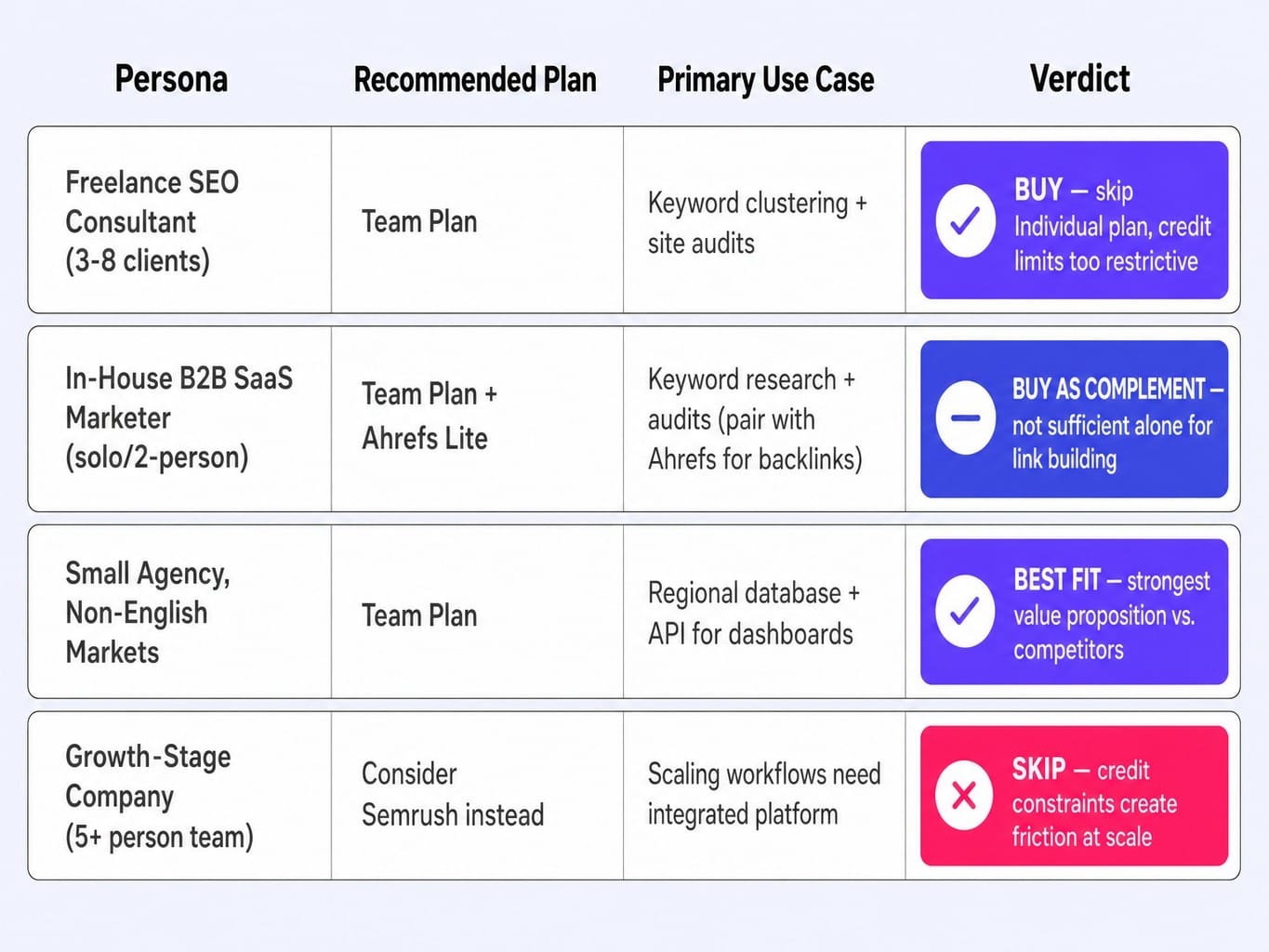
- The Freelance SEO Consultant (3-8 clients): Buy the Team plan. The credit allocation is generous enough for your needs, the keyword clustering will save you hours on content strategy, and the price-to-capability ratio is strong. Skip the Individual plan. You will hit the credit limits in the first week and spend more time managing your usage than serving your clients.
- The In-House B2B SaaS Marketer (solo or 2-person team): Serpstat is worth it as a primary keyword research and site audit tool. However, if competitive backlink analysis is a significant part of your growth strategy, you should budget for an additional Ahrefs Lite subscription ($129/mo). The combination gives you best-in-class capabilities where they matter most.
- The Small Agency Serving Non-English Markets: Serpstat is potentially your best primary tool. The strong regional database coverage, combined with cost-effective API access for client dashboards, gives it a clear edge over more expensive alternatives whose data is often thinner in your target markets.
- The Growth-Stage Company (5+ person marketing team): Serpstat is likely too constrained. As your needs scale, the credit system, database limitations, and lack of integrated content tools will create friction. Your team's time is more valuable than the subscription savings; invest in a platform like Semrush that can scale with your workflows.
Read more: Serpstat Alternatives Compared: Which Tool Fits Your SEO Workflow (Not Just Your Budget)
When the Tool Isn't the Bottleneck—Your Shipping Speed Is
This entire review centers on a critical assumption: that having the right data is the biggest barrier to growth. For most marketing teams, it isn't.
Serpstat can give you a prioritized list of 47 pages with thin content, 12 missing H1 tags, and a dozen opportunities for keyword cannibalization detection. But that report still sits in a browser tab. The keyword clusters still need to be turned into content briefs. The technical fixes still require engineering tickets that get lost in a Jira backlog.
The real bottleneck isn't insight; it's the gap between identifying a problem and shipping the fix.
This is the execution gap Spike AI was built to close. We don't replace your SEO tools; we make them productive. Where Serpstat identifies a high-priority audit error, Spike AI prioritizes it based on its potential to move qualified leads and then deploys the solution. Weekly. Without you writing a single ticket. We turn your tool's output into a continuous stream of shipped improvements that compound over time.
If you've ever looked at a 100-page audit report and felt overwhelmed, the problem isn't the tool. It's the manual execution system that follows.
See how Spike AI turns SEO insights into weekly shipped improvements
Conclusion
Serpstat's value isn't defined by its feature list or headline price. It's determined by whether your specific workflow fits within its credit economy and database coverage.
It has evolved from a simple budget alternative into a genuinely capable mid-market platform. It earns its place for its excellent keyword clustering, reliable site audits, and strong non-English market data. But its credit system demands careful calculation, and its backlink data gaps are real. It is not the universal, cheaper Semrush that marketing copy might suggest.
Ultimately, choosing the right tool isn't about finding the cheapest option. It's about finding the one that removes the most friction from your team's actual weekly workflow—from insight all the way to implementation.
Frequently Asked Questions
How often does Serpstat refresh its keyword database and search volume estimates?
Serpstat updates its keyword data monthly for most markets, with higher-frequency refreshes for top-volume queries. Its search volume estimates blend clickstream data with Google Ads API signals, which means low-volume long-tail keywords (under 100 monthly searches) can show rounded estimates or lag. For time-sensitive campaigns, always cross-reference with actual impression data from your Google Search Console.
Can Serpstat's API replace Semrush or Ahrefs for building custom SEO dashboards?
For many use cases, yes. Serpstat's API provides keyword research, rank tracking, site audit, and backlink data at a significantly lower cost than Semrush or Ahrefs. For agencies building Looker Studio dashboards or internal tools, it's a practical choice, especially on the Team plan with its generous credit allocation. The main limitation is backlink data depth; if your dashboards rely heavily on referring domain velocity or granular page-level metrics, Ahrefs' API remains stronger.
Does Serpstat support white-label reporting for agency client deliverables?
White-label reporting is available, but only on the Agency plan ($499/mo). Lower-tier plans allow for PDF exports and scheduled email reports, but they will include Serpstat branding. A practical workaround for teams on the Team plan is to use the Looker Studio connector to build branded dashboards that pull Serpstat data, bypassing the need for native white-labeled reports.
How does Serpstat's keyword clustering compare to standalone tools like KeyClusters?
Serpstat clusters keywords by SERP overlap, meaning it groups terms that already rank for similar top-10 results. This is the same reliable methodology used by standalone tools like KeyClusters. The key advantage is workflow integration. With Serpstat, you can move directly from clustering to rank tracking and content planning within a single platform, eliminating the manual export/import steps required with a separate tool.
Is Serpstat's LLM Brand Monitor worth evaluating separately from the core platform?
Yes, it should be evaluated as a separate product. LLM Brand Monitor (llmbrandmonitor.com) is a standalone tool that tracks how your brand is mentioned in AI responses from ChatGPT, Claude, and Gemini. It's priced independently from the core Serpstat SEO platform. For companies focused on AI visibility, it addresses a real emerging need, but it's a distinct purchase decision, not a Serpstat add-on.