
Best Smartly.io Competitors in 2026: Honest Comparison With Pricing, Gaps, and Migration Reality

TL;DR
- Smartly.io has pivoted from a paid social tool to a unified creative and media platform, making most direct comparisons outdated. Many teams now pay for enterprise capabilities they don't use.
- Genuine alternatives fall into distinct categories: creative production (Celtra), Meta-focused AI (Madgicx), rule-based automation (Revealbot), paid social suites (Hunch), and enterprise media management (Marin, Mediaocean).
- The biggest competitive threat isn't another vendor; it's platform-native AI like Meta Advantage+ and Google Performance Max, which now handle tasks that once required a third-party tool, at no extra cost.
- Switching costs are significant and go beyond the new subscription price. Plan for rebuilding campaign scaffolding, loss of historical performance data, and a 30-60 day gap in attribution continuity.
- The core challenge isn't picking the perfect ad tool but maintaining optimization momentum. A continuous improvement system across your website and conversion funnel provides stability regardless of your ad tech stack.
If you signed a contract with Smartly.io back in 2023, you likely chose it for best-in-class paid social automation. Today, you find yourself on a platform that has pivoted into a unified creative-and-media suite with enterprise pricing to match. You're not necessarily unhappy with the product; you're just paying for capabilities you don't use.
This is the real reason most performance marketing teams are searching for Smartly.io competitors. The product has outgrown their needs and budget.
This makes the search for alternatives tricky. Comparing Smartly to simple point solutions is misleading in 2026 because Smartly is no longer a point solution. This article provides a clear framework for evaluation. We'll analyze six genuine platforms like Smartly.io, covering pricing, creative depth, media scope, and readiness for a world with less signal.
Then, we'll cover two critical angles no other comparison addresses: the platform-native AI tools quietly replacing third-party ad automation and the real switching costs of leaving a platform like Smartly.
Why Comparing Smartly.io Competitors Is Harder Than It Used to Be
The simple answer is that Smartly in 2026 is not the same product teams evaluated in 2023, and most comparison articles have not caught up. After acquiring the data visualization platform Vizia and consolidating its creative, media, and intelligence suites, Smartly now positions itself as a unified advertising platform, not just a tool for paid social.
Their 2024 recognition as a Forrester Wave™ Leader was for "Creative Advertising Technologies," a clear signal of category redefinition.
Consider a mid-market e-commerce team spending $150K/month on Meta and Google. They adopted Smartly for its powerful DCO feed logic and creative matrix automation. Today, they sit on a platform with features for CTV, the open web, and conversational commerce they never asked for—and a contract that prices those capabilities in.
This shift is happening against the backdrop of two larger forces reshaping ad tech:
- Ad Tech Stack Consolidation: Standalone tools are being absorbed into larger platforms. Mediaocean's acquisition strategy and Innovid's expansion show that the market is moving toward integrated suites. The era of the single-channel point solution is ending.
- Signal Loss: With cookie deprecation and Apple's App Tracking Transparency (ATT), the value proposition of ad platforms is shifting. Raw media buying automation is becoming less important than sophisticated creative testing frameworks and reliable incrementality measurement.
A simple feature-by-feature comparison misses this structural shift. You're not just choosing a tool; you're deciding which part of a disintegrating ad tech stack you want to own.
How We Evaluated These Alternatives
Most comparison articles evaluate ad platforms on feature count—a flawed lens. A tool with 20 integrations isn't better than one with five if your team only runs campaigns on Meta and Google. We used a framework focused on what actually drives performance for a modern media buying team.
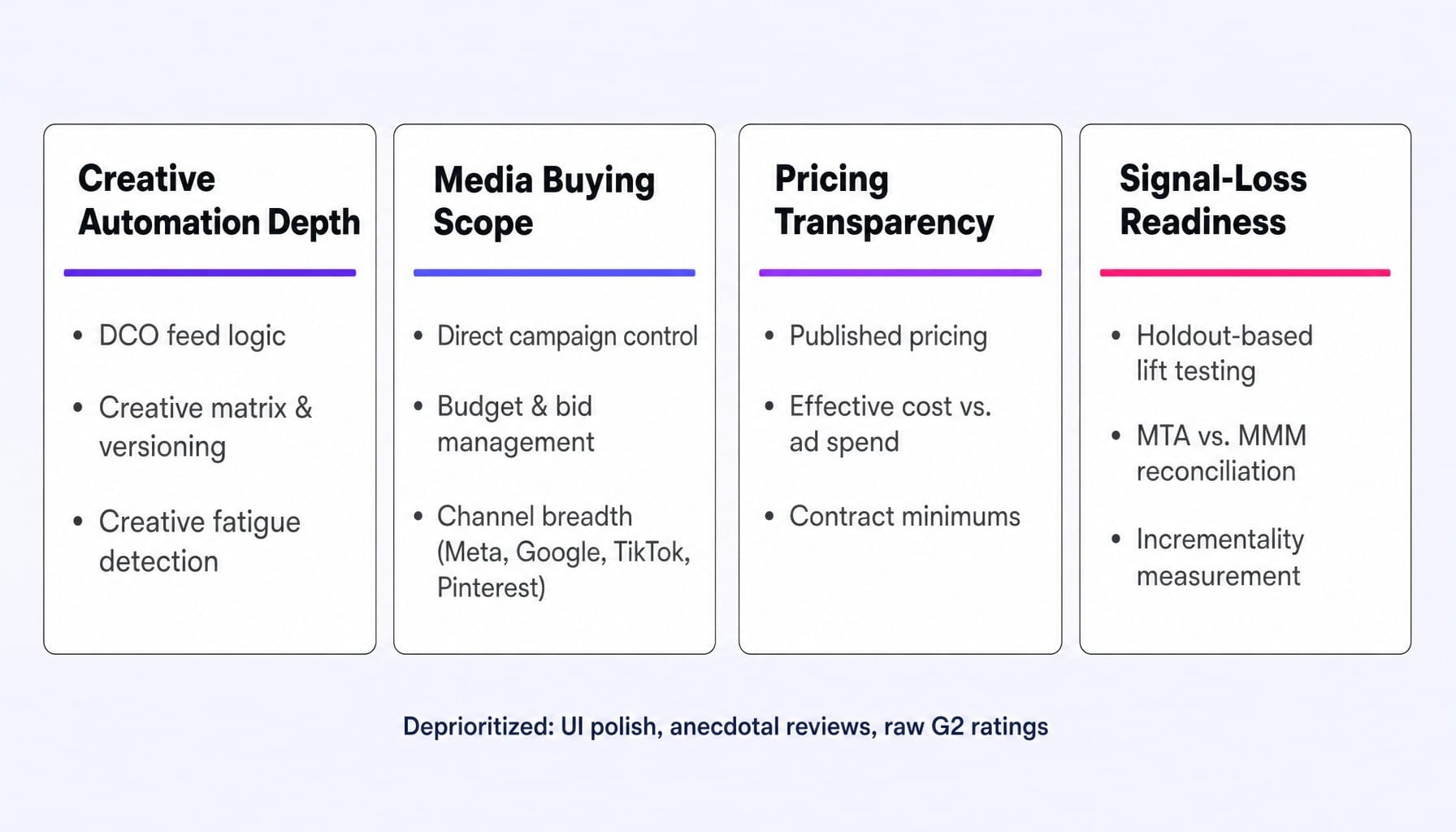
Here are the four criteria we used to compare Smartly.io alternatives:
- Creative Automation Depth: Does the platform truly support dynamic creative optimization (DCO) with complex DCO feed logic, or just basic asset templatization? We looked for the ability to manage a creative matrix, handle creative versioning at scale, and provide creative fatigue detection.
- Media Buying Scope: Which channels does the platform actually manage campaigns on, not just connect to for reporting? This means the ability to control budgets, set bids, and deploy campaigns directly within the platform for channels like Meta, Google, TikTok, and Pinterest.
- Pricing Transparency: Is pricing published, or does it require a lengthy sales cycle? We analyzed the effective cost relative to managed ad spend, noting where annual contracts and high minimums create a barrier for mid-market teams.
- Signal-Loss Readiness: In a post-cookie world, can the platform measure what's working? We looked for investment in holdout-based lift testing, tools for MTA vs. MMM reconciliation, or other forms of incrementality measurement that go beyond platform-reported attribution.
We deliberately deprioritized UI polish, anecdotal support reviews, and raw G2 ratings, which often reflect the volume of reviews over the quality of the product for a specific use case. This framework gives you a durable mental model for evaluating any ad platform.
6 Smartly.io Competitors Worth Evaluating in 2026
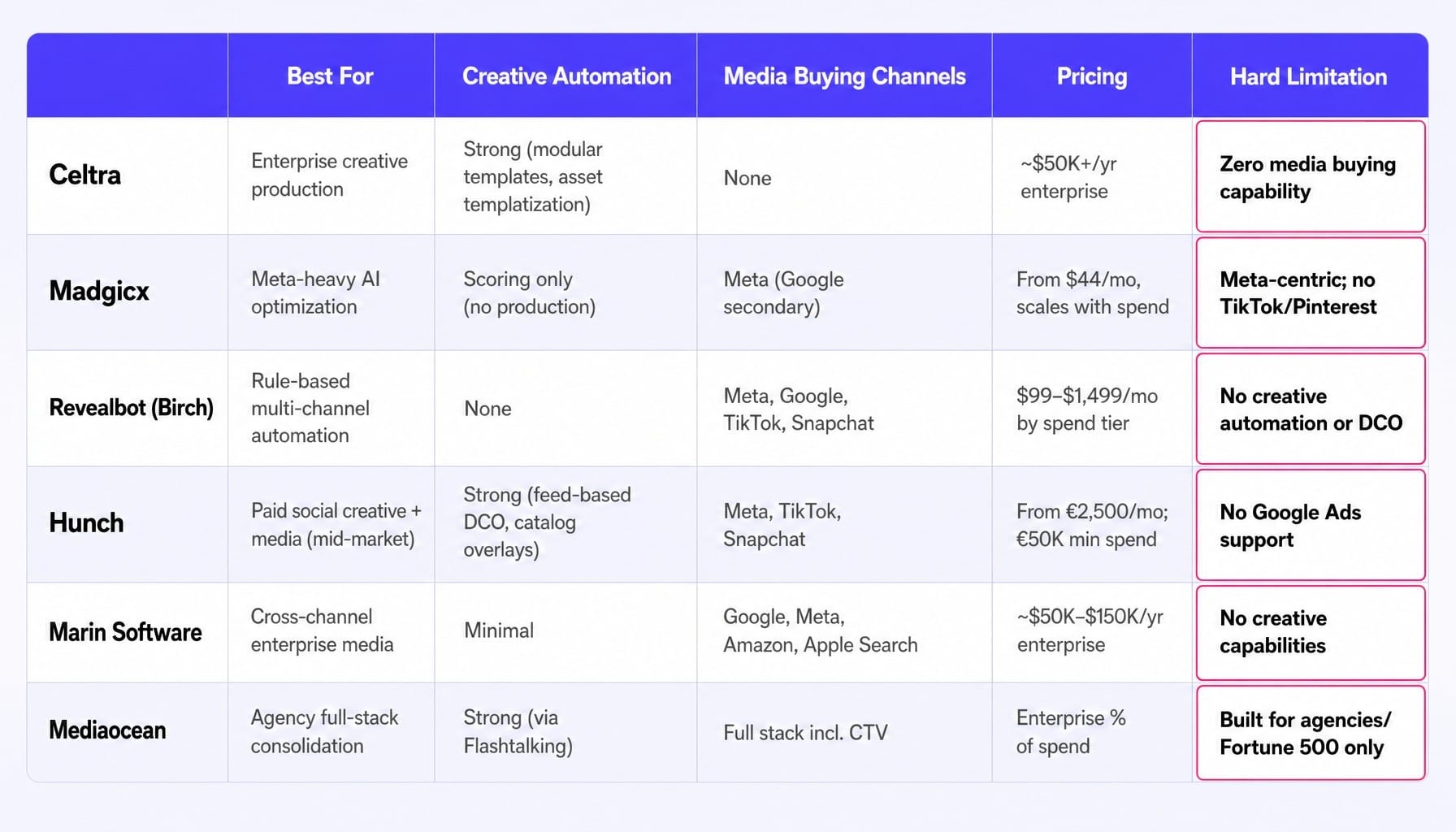
This is not an exhaustive list of every ad tool on the market. It's a curated selection of six platforms that represent genuinely different strategic choices for a team moving away from Smartly. They were chosen to represent distinct categories: creative-only platforms, Meta-focused AI, rule-based automation, direct paid social competitors, and full-stack enterprise plays.
Celtra — Best for Enterprise Creative Production Without Media Buying
Celtra is not a Smartly replacement; it's a standalone creative automation layer for teams that handle media buying elsewhere. Its core strength lies in managing a complex creative render pipeline. For a global CPG brand running campaigns across 40 markets and needing to produce 2,000 creative variants per quarter, Celtra excels. It provides modular creative templates and robust asset templatization that allows a central brand team to maintain consistency while enabling local markets to adapt creative quickly. The media team then uses native tools like Meta Ads Manager or a separate DSP for the actual media buying.
Pricing: Enterprise and quote-only. Expect annual contracts starting in the $50K+ range, scaling with usage.
The Hard Limitation: Celtra has zero media buying capability. It does not manage campaigns, set bids, or optimize spend. It is purely a creative production and management platform. If your goal is to find a single platform for both creative and media, Celtra is not it. It competes with the creative half of Smartly, not the whole platform.
Madgicx — Best for Meta-Heavy Teams That Want AI Optimization
For teams whose ad spend is 80%+ on Meta, Madgicx is the closest thing to Smartly's AI-driven optimization without the enterprise price tag. Its primary strengths are AI-powered audience targeting suggestions, automated budget allocation across ad sets (a feature they call "Autonomous Budget Optimizer"), and creative performance scoring to identify winning and fatiguing ads. It's a powerful tool for a DTC brand spending, say, $30K/month on Meta that wants ROAS floor bidding and automated creative rotation. While its G2 rating is strong, the caveat is crucial: Madgicx is Meta-first. Google Ads support exists but is secondary, and channels like TikTok and Snapchat are not natively supported for campaign management.
Pricing: Starts around $44/month for basic plans but scales with ad spend. At spend levels of $100K+/month, the effective cost begins to approach that of more comprehensive platforms.
The Hard Limitation: It's a Meta-centric tool. If you run significant spend on TikTok, Pinterest, search, or CTV and need to consolidate your stack, Madgicx cannot be your single source of truth.
Revealbot (Birch) — Best for Rule-Based Multi-Channel Automation
Revealbot (recently rebranded to Birch) operates on a fundamentally different philosophy than Smartly. Instead of AI-driven "black box" optimization, it offers granular, rule-based automation. And that's not a weakness; it's a design choice that puts control back in the hands of performance marketers. A growth team can set specific rules like "pause any ad set where CPA exceeds $45 for 3 consecutive days" or "increase budget by 20% on any campaign with ROAS above 4x." With over 15,000 connected ad accounts, it's a proven engine for this kind of logic-based management across Meta, Google, TikTok, and Snapchat.
Pricing: Transparent and tiered, ranging from $99/month to $1,499/month based on ad spend.
The Hard Limitation: Birch does not do creative automation. There is no DCO, no creative versioning from feeds, and no asset production. It is purely a media management and rules engine. If detecting creative decay and dynamically generating new creative variants are core needs for your team, Birch only solves half the problem.
Hunch — Best for Paid Social Creative Automation at Mid-Market Scale
Hunch is arguably the most direct Smartly.io competitor for mid-market teams, as it combines creative automation with media buying for Meta, TikTok, and Snapchat—the core channels most Smartly users actually care about. Its key strength is feed-based advertising with sophisticated catalog overlay rules. This enables an e-commerce retailer with 30,000+ SKUs to automatically generate thousands of localized dynamic product ads from a single product feed, complete with price overlays, sale badges, and seasonal creative. This is the exact DCO feed logic that made Smartly so powerful for retail and e-commerce in the first place.
Pricing: Starts at €2,500/month, requires a minimum ad spend of €50K/month, and does not offer a month-to-month option.
The Hard Limitation: Hunch does not support Google Ads. For teams with significant Search, Shopping, or Performance Max spend, this creates a major gap in the stack, requiring a second tool and preventing true cross-channel budget optimization. It's a powerful paid social suite, but not a unified ad platform.
Marin Software — Best for Cross-Channel Enterprise Media Management
Marin Software is a legacy enterprise option that has successfully reinvented itself around cross-channel budget optimization and automated bid management. Unlike Smartly, Marin's strength has never been creative; it's media buying intelligence across search, social, and e-commerce channels simultaneously. It's built for an enterprise team managing $500K+/month across Google, Meta, Amazon Ads, and Apple Search Ads that needs a unified view of spend pacing and ROAS. Its engine can automatically reallocate budget between these channels based on real-time performance signals, a capability few platforms offer.
Pricing: Quote-only and enterprise-tier. Expect annual contracts in the $50K-$150K range, typically calculated as a percentage of managed spend.
The Hard Limitation: Marin's creative capabilities are minimal. It does not compete with Smartly on DCO, creative versioning, or asset production. It is a media-side alternative, not a full replacement. You choose Marin for its cross-channel intelligence, not its creative tools.
Mediaocean — Best for Agencies Consolidating Their Entire Ad Tech Stack
Mediaocean isn't a Smartly alternative you'd evaluate for your in-house team; it's the platform that represents the end-state of ad tech consolidation. After acquiring Flashtalking (ad serving and creative personalization) and then merging with Innovid (CTV measurement and optimization), Mediaocean now offers a full-stack advertising infrastructure. It covers media planning, creative ad serving, cross-channel deployment, and incrementality measurement in a single ecosystem. This is the kind of platform a large agency managing $10M+/month for 50+ clients would use to run its entire operation. It's the only option on this list that truly covers the entire workflow from creative concept to final measurement.
Pricing: Enterprise-grade and opaque, typically negotiated as a percentage of total media spend under management.
The Hard Limitation: Mediaocean is built for global agencies and Fortune 500 enterprises. A five-person marketing team at a mid-market SaaS company will never be their customer. It's included here to illustrate the market's direction, not as a practical alternative for most readers.
The Shadow Competitors: Platform-Native AI Tools Eroding the Case for Third-Party Automation
The most dangerous Smartly.io competitors in 2026 are not other ad tech vendors—they are the ad platforms themselves.
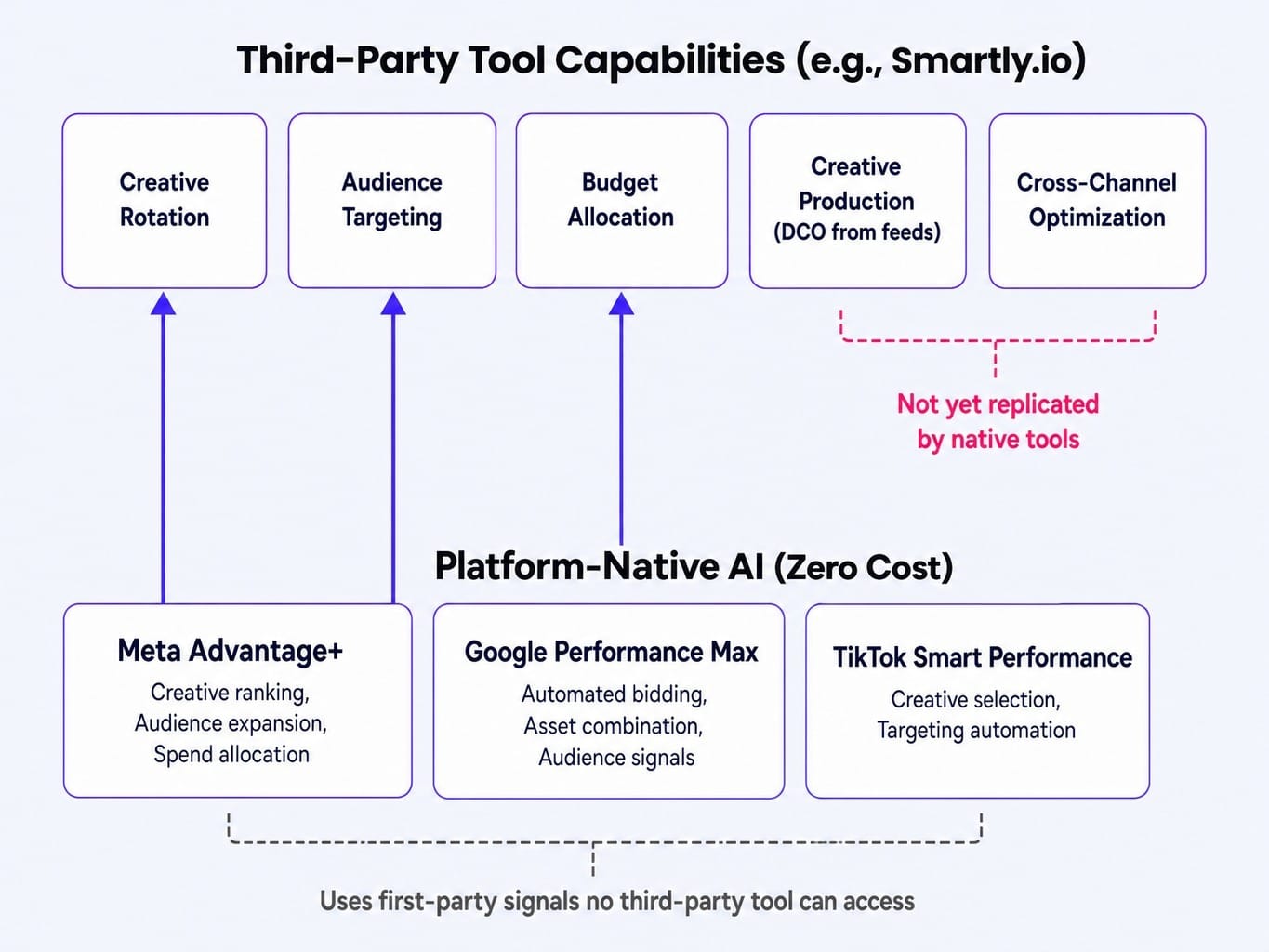
Meta Advantage+, Google Performance Max, and TikTok's Smart Performance Campaigns all automate creative selection, audience targeting, and budget allocation natively, at zero additional cost. Consider a team that previously used Smartly to manage creative rotation and budget optimization on Meta. Today, Advantage+ campaigns handle creative ranking, audience expansion, and spend allocation automatically. Crucially, they do so using first-party signals that no third-party tool can access.
You're probably asking: "How much of what I used Smartly for is now available natively?" That's the right question.
Platform-native tools are not better at everything. They lack sophisticated cross-platform creative production, cannot generate thousands of creative variants from product feeds with the same DCO feed logic, and offer no true cross-channel budget optimization.
But for a DTC brand that moved 60% of its Meta campaigns to Advantage+ and saw comparable ROAS with zero platform fees, the justification for a $90K Smartly contract for the remaining use cases gets harder to make. The platforms are systematically automating the core media buying tasks that third-party tools were built to solve.
Read more: The Trade Desk Competitors in 2026: 8 DSPs Worth Evaluating (With Decision Framework)
The Real Cost of Switching: What Nobody Tells You About Leaving Smartly
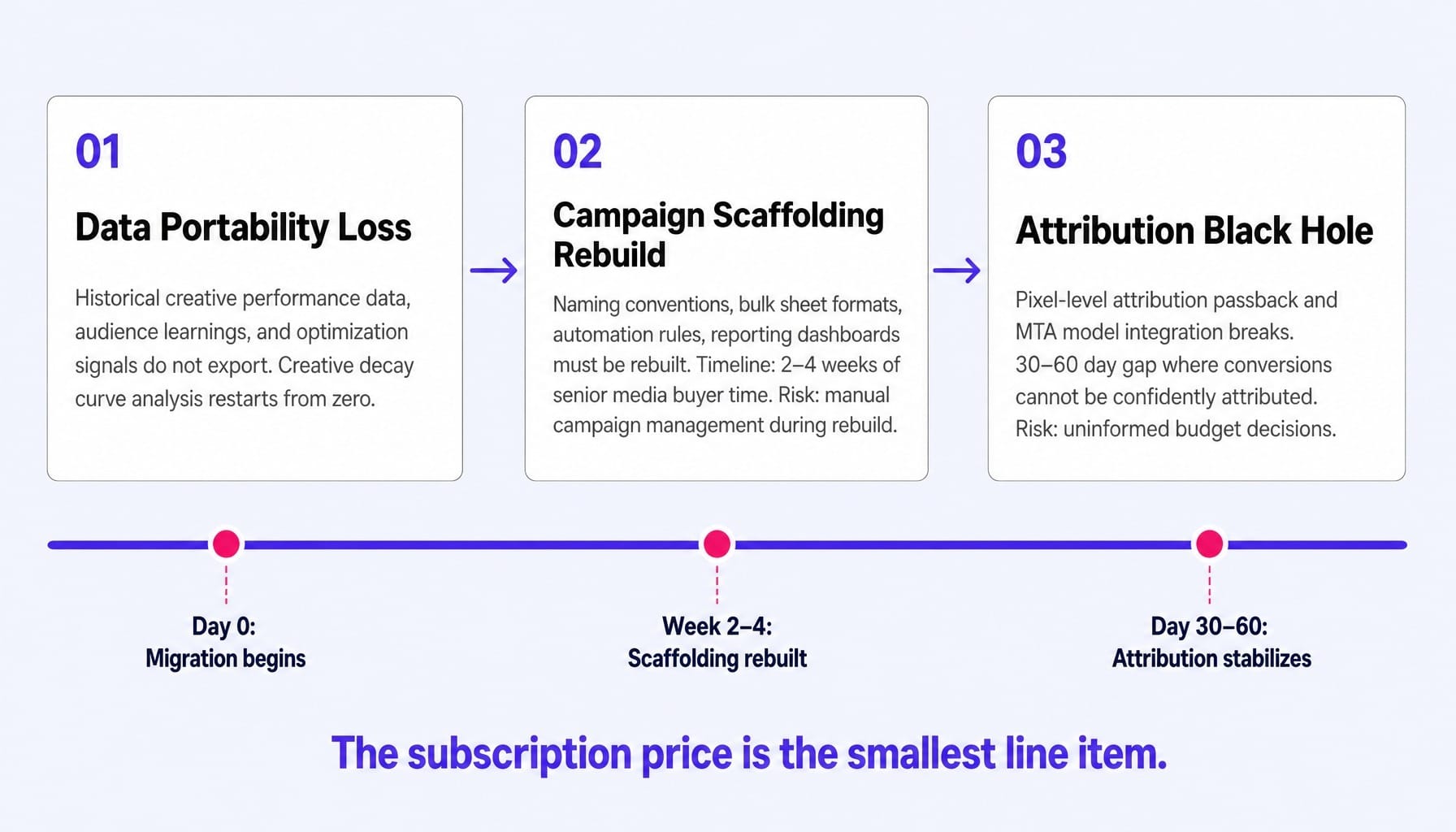
Every comparison article tells you what to switch to, but none address what it actually costs to switch. The subscription price of an alternative is the smallest line item. The real costs are the operational friction and performance gaps you encounter during the transition.
Teams discover these three costs only after they've committed:
- Data Portability: Your historical creative performance data, audience learnings, and optimization signals are locked within Smartly. This data does not export cleanly. When you move to a new platform, you are starting your creative decay curve analysis from zero. All the intelligence your system has built about which creative works for which audience is gone.
- Campaign Scaffolding: Your entire campaign structure—naming conventions, bulk sheet ingestion formats, automation rules, and reporting dashboards—is platform-specific. Rebuilding this campaign scaffolding in a new tool is not a trivial task. It can take 2-4 weeks of a senior media buyer's time, during which new campaigns are often managed manually, slowing down tests and optimizations.
- Attribution Continuity: If your team relies on Smartly's pixel-level attribution passback or its integration with your multi-touch attribution (MTA) model, switching platforms creates a measurement black hole. You will have a 30-60 day period where you cannot confidently attribute conversions to the new platform's activities, making it difficult to judge performance or make informed budget decisions.
A B2B SaaS team that switched from Smartly to a mid-market alternative experienced a three-week performance dip simply because their entire creative testing framework had to be rebuilt from scratch. Acknowledging these switching costs isn't a reason to stay; it's a prerequisite for planning a successful migration.
When the Real Problem Is Not Which Ad Tool You Pick
The search for a Smartly alternative reveals a deeper problem. Smartly has evolved beyond what many teams need, the alternatives each solve only a piece of the puzzle, and switching itself introduces optimization gaps. The real constraint on your growth isn't which ad platform you choose, but whether your overall marketing optimization system can maintain momentum through these transitions.
While your team spends weeks evaluating ad platforms, migrating campaigns, and rebuilding attribution models, what happens to your website? Your landing pages? Your conversion funnel? These are the parts of your marketing system that should be compounding improvements continuously, regardless of which ad tool is driving traffic.
Read more: Data-Driven CRO: Evolve Your Marketing Strategy for Revenue
This is where Spike AI provides a different kind of solution. It doesn't compete with Smartly or its alternatives on ad platform management. Instead, it acts as a continuous optimization layer across your website, SEO, and conversion paths—the assets that generate value after the click. While you navigate the complexities of your ad tech stack, Spike AI ensures your on-site experience is constantly improving, shipping weekly releases to fix conversion friction, improve page performance, and capture more value from the traffic you're already getting. It's the optimization that runs in parallel, without requiring a migration.
Conclusion
Evaluating Smartly.io competitors in 2026 is not a feature comparison exercise. It is a strategic decision about how much of your ad tech stack should live in third-party tools versus on the platforms themselves, and how to maintain optimization continuity through that transition.
The landscape has fundamentally changed. Smartly has outgrown many of its original users. The alternatives each solve a specific slice of the problem, but none are a perfect one-to-one replacement. Platform-native AI is quietly making entire feature sets redundant. And the real costs of switching are measured in lost momentum, not subscription fees.
The teams that will win in the coming years are not the ones that pick the "perfect" ad platform. They are the ones that build a resilient marketing system that compounds improvements across the entire funnel—a system that doesn't stall when one tool is swapped for another. Your task is not just to find the right Smartly alternative; it's to build a growth engine that doesn't depend on any single tool to function.
Frequently Asked Questions
Which Smartly.io alternatives support retail media networks like Amazon Ads and Walmart Connect?
Among the alternatives covered, Marin Software offers the deepest retail media integrations, including Amazon Ads, Walmart Connect, and Instacart. Skai (not on this list) is another strong enterprise-priced contender. Smartly itself has limited native support. If retail media is a primary channel, your evaluation should focus on platforms purpose-built for commerce media.
How do Smartly.io competitors handle creative versioning at scale compared to Smartly?
Smartly and Celtra lead on creative versioning through modular creative templates and feed-based dynamic assembly. Both can produce thousands of variants from a single master template using catalog overlay rules. Hunch offers similar feed-based creative automation for paid social specifically. Madgicx and Revealbot do not offer creative production; they optimize existing creatives but do not generate new ones.
What is the cheapest viable alternative to Smartly.io for a team spending under $50K/month on ads?
Madgicx (starting ~$44/month) and Revealbot/Birch (starting $99/month) are the most accessible for lower spend levels. However, neither includes creative production—they are media buying optimizers only. For teams needing both creative and media automation at this scale, the honest answer is that no single tool replicates Smartly's full scope cheaply. You would likely need to pair a creative solution with a media automation tool.
Do Smartly.io alternatives integrate with CDPs like Segment or mParticle?
Integration depth varies significantly. Smartly, Marin Software, and Mediaocean offer the most robust CDP integrations for activating first-party audience signals. Mid-market tools like Madgicx and Revealbot have limited or no direct CDP connections, as they primarily operate using data from ad platform APIs rather than ingesting external audience segments.
How do Smartly.io competitors compare on incrementality measurement and lift testing?
This is a major gap for most alternatives. Smartly offers some holdout-based lift testing capabilities. Among the competitors, only enterprise platforms like Marin Software and Mediaocean (via its Innovid capabilities) offer meaningful, independent incrementality measurement. Most mid-market tools rely on platform-reported attribution, meaning they can't tell you if your ads caused conversions or just took credit for them.