
Moz Pro Review 2026: An Honest Assessment for B2B Marketing Teams

TL;DR
- Best for Link Prospecting: Moz Pro's combination of Domain Authority (DA), Spam Score, and Link Intersect remains a practical workflow for B2B link-building and PR outreach, despite DA's known limitations.
- Weak for Competitive Intelligence: The platform's competitive analysis tools are unreliable for B2B companies with niche competitor sets, often surfacing irrelevant domains and lacking the granularity of Semrush or Ahrefs.
- Bottlenecks Fast Experimentation: The weekly rank tracking cadence creates a measurement gap, preventing B2B teams from correlating weekly content shipments with near-real-time performance changes.
- Approachable for Generalists: Moz's Keyword Explorer is more intuitive for lean B2B teams without dedicated SEO specialists, but its smaller keyword database struggles with niche, long-tail industry terms.
- The Real Problem is Execution: No SEO tool, including Moz, closes the gap between identifying an issue and shipping the fix. The real constraint on growth is execution bandwidth, not which dashboard you use.
Moz taught an entire generation of marketers what Domain Authority meant. For years, it was the default SEO tool, the educational bedrock of the industry. But in 2026, the market is fragmented, and the question is no longer whether Moz is a "good" tool. The real question is whether it's the right investment for your specific B2B team and, more importantly, your execution workflow.
Most Moz reviews are either affiliate-driven feature lists or outdated walkthroughs. This is not that. This is an honest, B2B-focused assessment of where Moz Pro genuinely earns its subscription and where it falls short for teams that need to turn insights into shipped changes. We'll analyze its core strengths, its critical limitations for B2B use cases, and how it stacks up against the competition—not on feature counts, but on the workflows that actually drive revenue.
What Moz Pro Actually Does in 2026
Forget the founding story. Today, Moz Pro is a keyword research, rank tracking, site auditing, and link analysis platform built around its proprietary Domain Authority (DA) metric. It's designed to be an all-in-one SEO toolkit, primarily for small-to-medium-sized businesses and marketing agencies.
Recent additions in 2025-2026 show Moz is adapting, with an AI Content Brief generator (beta), AI Research for tracking visibility in LLM-powered search, and a new Brand Authority score. However, it's crucial to understand the product boundaries. Moz Pro is the core subscription. Moz Local is a separate product for local SEO management. And STAT Search Analytics—arguably the best enterprise-grade rank tracker on the market—is sold independently at an enterprise price point, a fact often lost on B2B teams evaluating the core offering.
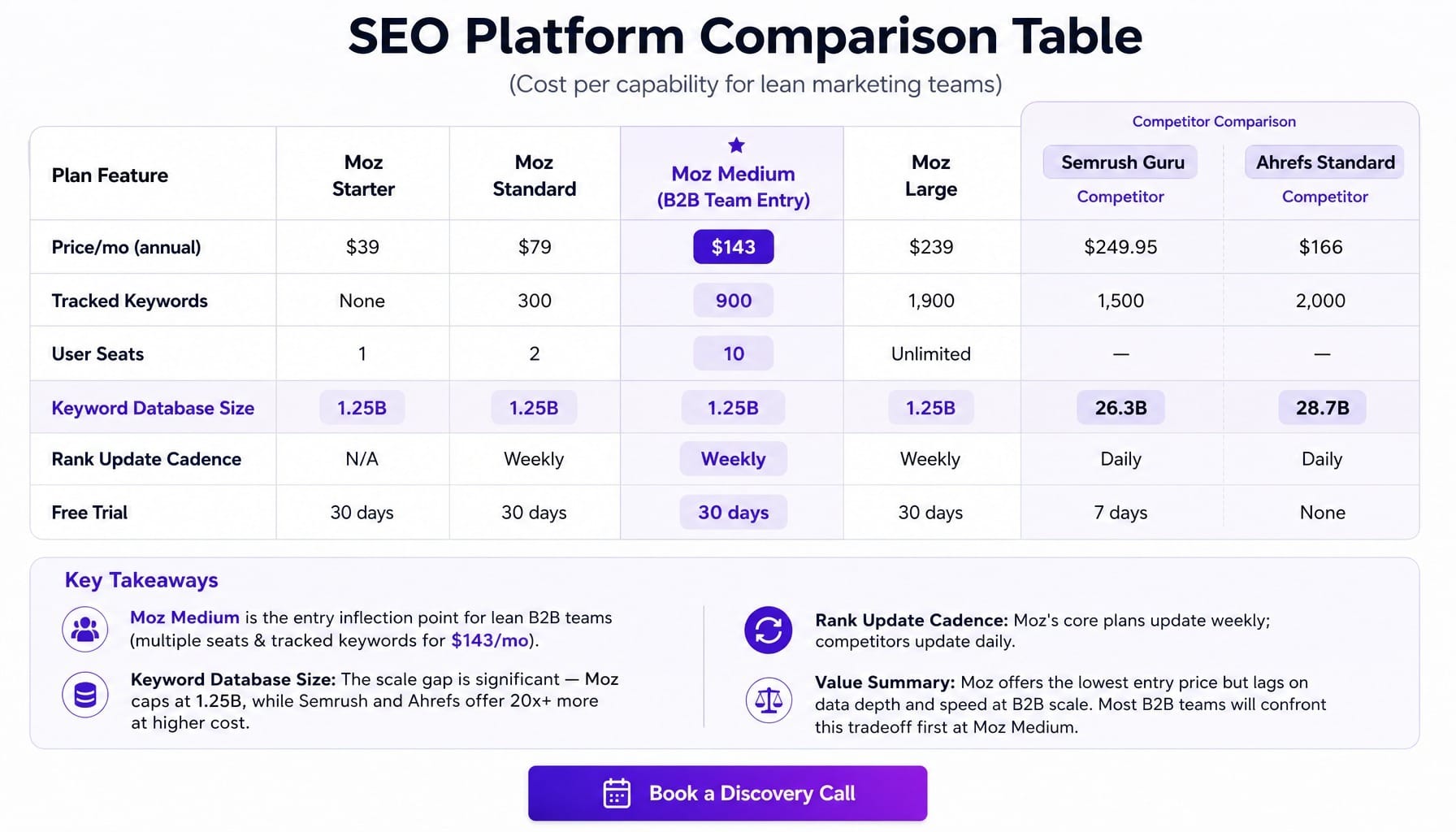
While its link index contains a massive 45.5 trillion links, its keyword database of 1.25 billion is significantly smaller than Semrush's (26.3 billion) and Ahrefs' (28.7 billion). For B2B companies in specialized verticals, this scale gap is not just a number; it's a tangible constraint on discovering niche, high-intent keywords.
Moz Pro Pricing: What You Actually Get Per Dollar
Moz Pro's pricing structure appears competitive on the surface but requires a careful look at the cost-per-capability. The entry-level Starter plan ($39/mo, paid annually) is the cheapest among the big three, but it's a research-only tool—it's missing the Rank Checker feature entirely.
The value curve sharpens with the other plans:
- Standard ($79/mo): Functional but limited to 300 tracked keywords and only 2 user seats.
- Medium ($143/mo): This is the inflection point where most lean B2B teams would land, unlocking 900 keywords, 10 seats, and branded reports.
- Large ($239/mo) & Premium ($479/mo): These primarily scale quotas without adding significant new features.
Here's the problem for a 3-person B2B marketing team. The $143/mo Medium plan seems reasonable until you compare it to the competition. Semrush's Guru plan ($249.95/mo) tracks 1,500 keywords and bundles a full content marketing platform, PPC data, and social media tools. Ahrefs' Standard plan ($166/mo, paid annually) tracks 2,000 keywords with access to a vastly larger data index.
The value proposition becomes a workflow question. Moz is cheaper at the entry point, but its mid-tier plans are harder to justify when competitors bundle more raw capability and data for a similar price. Its one clear advantage is a generous 30-day free trial, which provides ample time for evaluation compared to Semrush's 7-day trial and Ahrefs' lack of one.
Read more: SaaS Pricing Strategy That Compounds: Models, Value Metrics, and Governance for 2026
Where Moz Pro Genuinely Earns Its Subscription
Most of Moz Pro's features have direct equivalents in Ahrefs and Semrush. The question isn't whether Moz can perform a site audit—it can. The question is where it does something meaningfully better or provides a unique workflow that competitors don't. For B2B teams, this value is concentrated in two specific areas.
The Domain Authority Ecosystem Still Matters
DA's real value isn't its pinpoint accuracy—it's its ubiquity. It is the shared language of link building. When your B2B team evaluates link prospects or reports on PR outreach, DA is the metric that your agency, your freelancers, and your VP of Marketing all reference.
Let's be clear: DA inflation is real, and manipulated scores exist. But for a practitioner, Moz's ecosystem provides the most practical workflow for link building prospecting. The combination of DA, Spam Score, and the Link Intersect tool allows you to quickly filter outreach targets in a way no competitor fully replicates. Filtering out domains with a Spam Score over 30% is a standard, effective first-pass vetting process.
Furthermore, Moz is building on this authority concept. The new Brand Authority metric attempts to measure brand recognition beyond just links, which is useful for B2B companies investing in brand building. And a genuinely unique feature, Domain Search Theme, tells you what topics Google thinks your site is an authority on—an invaluable diagnostic after a content strategy pivot or major site restructure.
Keyword Research UX for Non-Specialist Teams
Moz's keyword research toolset isn't the most powerful; it's the most approachable. For a lean B2B team where the "SEO person" is a generalist marketer juggling five other channels, this is a critical distinction.
Keyword Explorer presents data—monthly volume, difficulty, organic CTR, and search intent—in a clean interface that supports decision-making without requiring deep SEO expertise. Contrast this with Semrush's Keyword Magic Tool, which can return over 30,000 suggestions for a single query. That's powerful for a specialist but paralyzing for a generalist.
The "minimum DA to rank" metric is a standout feature, offering a more actionable signal than an abstract 0-100 difficulty score. It tells a marketer, "Your site needs a DA of at least 40 to compete here," which directly informs strategy. However, this approachability comes at the cost of depth. The 1.25 billion keyword database means that for B2B companies in specialized verticals, long-tail technical queries often return thin or no data. If your niche is narrow, this is a serious constraint.
Where Moz Pro Falls Short for B2B Teams
Every tool has limitations. The important question is whether those limitations directly impact your team's most critical workflows. For B2B marketing teams, Moz Pro's gaps are concentrated in two areas that matter disproportionately: competitive intelligence and the speed of measurement. This isn't a feature checklist problem; it's an execution system failure.
Competitive Intelligence Is Moz's Weakest Module
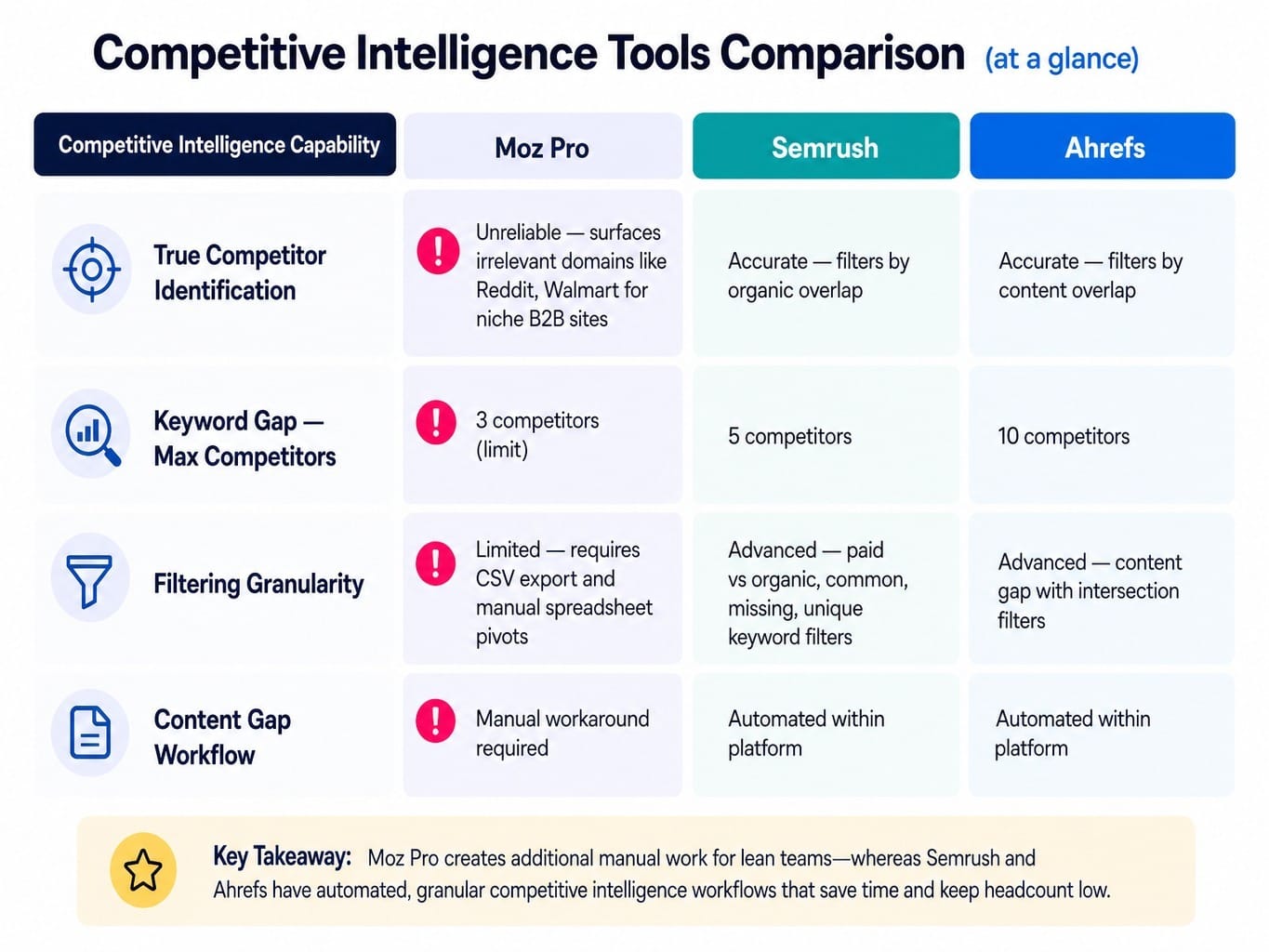
Moz's competitive intelligence tools are its weakest link, proving unreliable for B2B companies with well-defined competitor sets. The True Competitor tool, which is supposed to identify your rivals in the SERPs, is notoriously inaccurate for niche businesses. Multiple reviews have shown it listing massive, irrelevant domains like Reddit, Walmart, and Netflix as top competitors for specialized tech sites. For a B2B SaaS company competing against a handful of specific vendors, this feature is functionally useless.
The Keyword Gap analysis is similarly constrained. It limits you to comparing just three competitors at a time, whereas Ahrefs allows ten. More importantly, it lacks the filtering granularity that B2B teams need. Semrush allows you to filter by paid vs. organic keywords, common keywords, and keywords your competitors rank for that you don't. This allows for a true content gap analysis. With Moz, this process requires exporting raw data to a spreadsheet and running manual pivots—a workflow that other tools have automated. If competitive analysis is a cornerstone of your B2B growth strategy, Moz will be a source of constant friction.
Rank Tracking Cadence Doesn't Match B2B Experimentation Needs
Moz Pro's weekly rank update cadence creates a crippling measurement gap for B2B teams running at speed. When you publish a new landing page, launch a content cluster, or restructure a product section, you need to see rank movement within 24-48 hours to correlate your actions with outcomes. A weekly update means you're always looking at stale data. You launch a page on Monday, and you're flying blind for a week. By the time you see a rank change, you've already made the next change, making attribution impossible.
This bottleneck slows down your entire experimentation loop. It prevents you from learning what works and doubling down. This contrasts sharply with Semrush's daily updates.
The irony is that Moz owns STAT, the industry-leading enterprise rank tracker that offers daily updates and sophisticated SERP distribution reporting. But it's sold separately at a price point inaccessible to the lean B2B teams Moz Pro targets. To compound the issue, Moz's rank tracker doesn't yet effectively surface visibility within Google's AI Overviews, a critical data point for B2B content in 2026. If your team ships frequently and needs to measure impact quickly, Moz's rank tracking system will act as a brake on your velocity.
Moz vs. Ahrefs vs. Semrush: A B2B Decision Framework
The question isn't which tool is "best." It's which tool best fits your B2B team's execution model. Instead of a feature list, here is a decision framework based on the workflows that matter.
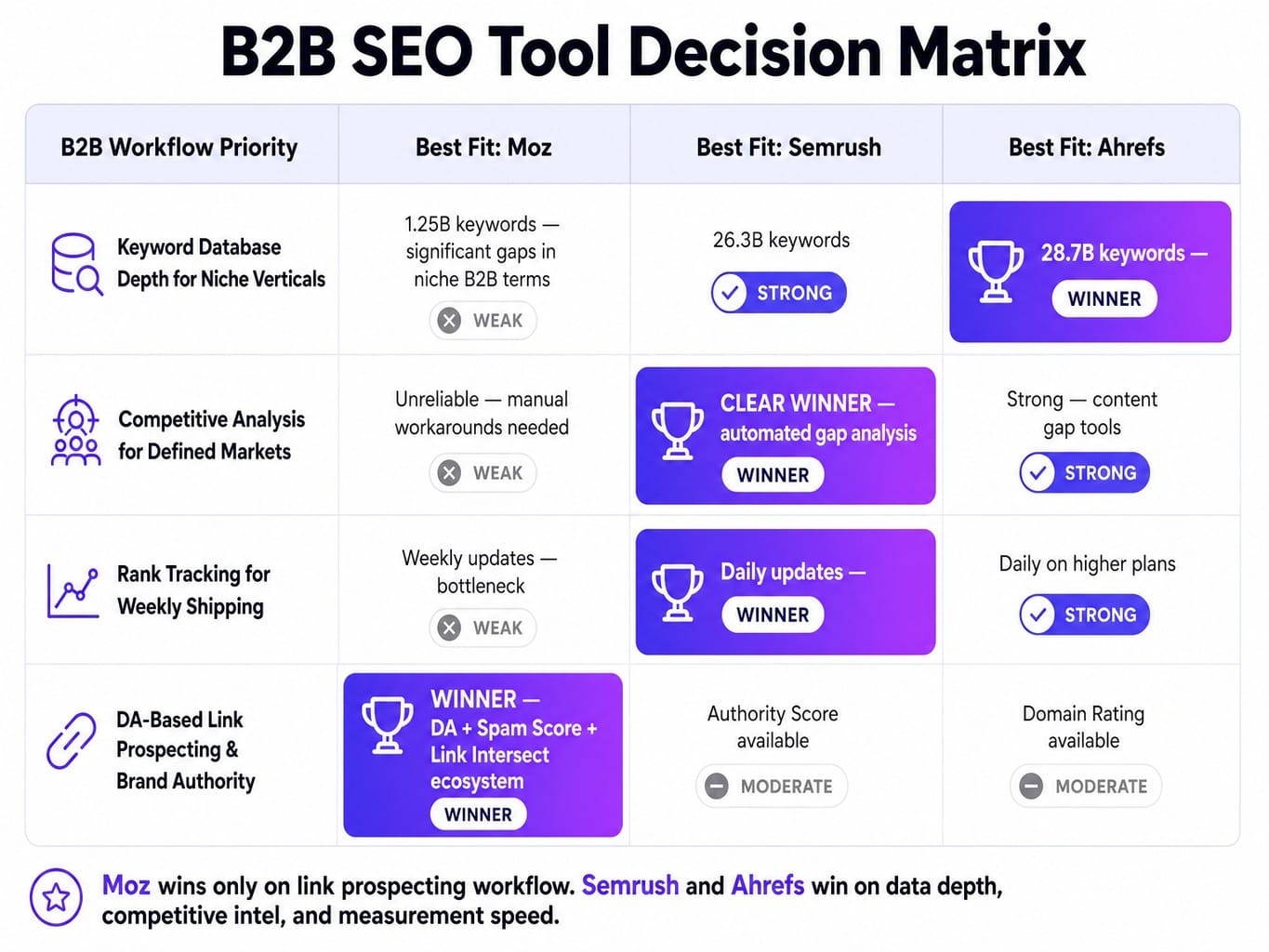
- Keyword Database Depth for Niche B2B Verticals: Ahrefs (28.7B keywords) and Semrush (26.3B) win decisively. If your product serves a specialized industry with unique terminology (e.g., a cybersecurity SaaS), Moz's 1.25B keyword database will have significant gaps. You will miss long-tail, high-intent queries your buyers are using.
- Competitive Analysis for Defined B2B Markets: Semrush is the clear winner. Ahrefs is strong. Moz is unreliable. For any B2B team that runs quarterly competitive content gap analyses or tracks a defined set of competitors, Moz's tools will require manual workarounds in spreadsheets.
- Rank Tracking for Teams Shipping Weekly: Semrush (daily updates) and Ahrefs (daily on higher plans) are built for faster feedback loops. Moz's weekly cadence is a bottleneck for any team trying to build a high-velocity experimentation program.
- Total Cost of Ownership: If you're already paying for Semrush or Ahrefs, adding Moz creates significant tool overlap. The only scenario where Moz makes sense as the primary tool is if DA-based link prospecting and brand authority tracking are your highest-priority workflows, and you can live with the limitations in other areas.
For most B2B teams, the choice is clear: Semrush for its all-around capability and competitive intelligence, or Ahrefs for its superior data depth. Moz is a legacy tool that excels at a few specific tasks but has been outpaced as a comprehensive system.
Read more: Ahrefs vs Moz (2026): An Honest Comparison for B2B Teams Who Need to Ship, Not Just Analyze
The Bigger Problem: SEO Tools Surface Insights, They Don't Ship Changes
Even after this analysis, a deeper problem remains. Picking the "right" SEO tool—whether it's Moz, Semrush, or Ahrefs—doesn't solve the core execution bottleneck. The tool surfaces a keyword opportunity, flags a technical SEO issue, or identifies a competitive content gap. Then what?
The finding goes into a backlog. It gets debated in a meeting. It waits for engineering resources or content bandwidth. The real constraint for lean B2B SaaS marketing teams isn't the dashboard they look at; it's the latency between identifying what needs to change and actually shipping it.
This is the execution gap. It's where marketing strategy dies. Instead of adding another tool that generates a longer backlog, Spike AI operates as an execution layer. It identifies the highest-impact move across your website, SEO, and ads, and then it deploys the change. Every week. The comparison isn't feature-vs-feature; it's a different category of solution. Moz tells you what to fix. Spike AI fixes it. For lean teams where the marketer is already the strategist, analyst, and operator, the bottleneck was never the tool—it was the shipping.
Should B2B Teams Still Invest in Moz in 2026?
The decision to invest in Moz Pro is a decision about your team's primary workflow. In 2026, Moz remains a viable tool for teams whose SEO efforts are centered on DA-based link prospecting and high-level authority tracking. Its approachable user interface also makes it a decent starting point for marketing generalists.
However, for B2B teams that require precise competitive intelligence, deep niche keyword data, or a fast experimentation cadence, Moz Pro's limitations are significant. Its weekly rank tracking and unreliable competitor analysis create bottlenecks that more modern platforms have solved. The deeper truth is that no SEO tool, Moz included, closes the gap between insight and implementation. The teams that win aren't the ones with the best dashboards; they're the ones that build a system to ship meaningful changes every single week.
Frequently Asked Questions
Is Moz Pro's Domain Authority metric still accurate enough to trust for link building decisions in 2026?
DA remains the most widely adopted authority metric, but it's a relative proxy, not an absolute truth. DA inflation is real, which is why practitioners pair it with Spam Score filtering (typically avoiding domains above 30%) and manual review. For a first-pass filter in B2B link prospecting, this combination is still the most practical workflow available.
Does Moz Pro's keyword difficulty score correlate with actual ranking difficulty?
Moz's KD score often diverges from Semrush and Ahrefs by 20-30 points for the same keyword due to different calculation methods. For B2B teams, Moz's "minimum DA" metric is often more actionable than the KD score itself, as it provides a concrete authority threshold your domain needs to meet to be competitive for a given term.
Can Moz handle multi-location SEO for B2B companies with regional offices?
Moz Pro supports over 200 country-level locations, but granular local tracking (by city or zip code) requires Moz Local, a separate product with its own pricing. For B2B companies needing local pack visibility for regional offices, dedicated tools like BrightLocal or Semrush's local SEO toolkit are often more integrated and cost-effective.
What does Moz's spam score actually measure and when should you act on it?
Spam Score estimates the probability that a domain is manipulative, based on 27 signals like thin content and suspicious link patterns. Most practitioners use a threshold: domains below 30% are generally safe, 30-60% require manual review, and anything above 60% should be disavowed or avoided. It's one of Moz's most genuinely useful proprietary metrics.
Is the MozBar browser extension still worth installing for day-to-day SEO work?
MozBar is still convenient for quick, SERP-level DA and PA checks during link prospecting or competitive analysis. However, it no longer provides the on-page optimization grading it once did, and Ahrefs' SEO Toolbar offers similar functionality with access to a larger dataset. It's a useful freebie, but not a competitive advantage.