Moz Pricing in 2026: Plans, Hidden Costs, and What B2B Teams Actually Need
TL;DR
- Moz Pro pricing ranges from $49/mo to $299/mo, but the Medium plan at $179/mo is the realistic minimum for most B2B marketing teams due to keyword slot and user seat limitations on lower tiers.
- The sticker price is misleading. Your total Moz cost will increase if you need Moz Local for business listings or Moz API for programmatic access, as these are billed as separate subscriptions with no bundle discount.
- Hidden costs include forced plan upgrades for additional user seats, per-unit charges for AI features like extra dashboards ($20/mo) and tracked prompts ($50/100), and the need for a separate STAT subscription for daily rank tracking.
- On a cost-per-tracked-keyword basis, Moz Medium ($0.12/keyword) is competitive with Ahrefs Standard ($0.12/keyword) and more efficient than Semrush Guru ($0.17/keyword).
- The most significant cost isn't the tool subscription; it's the operational latency between the tool identifying an issue and your team having the bandwidth to ship a fix.
Moz's pricing page presents four clean tiers, with costs ranging from $49 to $299 per month. This apparent simplicity is misleading for B2B teams trying to build a functional marketing budget. The real question isn't "how much does Moz cost?" but "which tier actually provides enough keyword slots, crawl budget, and user seats to run SEO for a scaling B2B website?" The answer is rarely the one with the lowest sticker price.
This guide moves beyond the marketing copy to provide a systems-level analysis of Moz's cost structure. We will walk through the pricing for every Moz product—Pro, Local, and API—and identify the feature gates that force most B2B teams into mid-tier plans. We will surface the add-on costs that don't appear on the main pricing page and compare Moz's cost-per-capability against Ahrefs and Semrush.
Here's what each plan actually costs and what you actually get for your investment.
Moz Pro Pricing Plans: Monthly and Annual Costs for Every Tier
As of Q3 2026, Moz Pro offers four primary subscription plans, plus a custom Enterprise tier. The pricing is structured to offer a roughly 20% discount for annual commitments.
The annual billing discount is a standard SaaS incentive, but its impact scales with the plan. A $120 annual saving on the Starter plan may not justify the lock-in, whereas saving over $700 on the Large plan makes the annual commitment a more significant financial decision.
The crucial insight here is how the plans are gated. The Starter plan, at $49/mo, is positioned as an entry point, but its 50-keyword cap and single-site limit make it functionally a trial for any serious B2B team, not a working plan. You'll burn through the keyword slots tracking just the core pages of a single product. The real decision-making process for a B2B team begins at the Standard tier. Enterprise pricing is available through a sales conversation and becomes relevant for agencies managing 25+ client domains or enterprises requiring advanced data access and support.
Moz Local and Moz API: Add-On Pricing Most Guides Skip
A common budgeting error is assuming the Moz Pro subscription covers the entire Moz ecosystem. It doesn't. Moz Pro, Moz Local, and the Moz API are billed as separate, non-bundled products.
Moz Local Pricing (per location):
- Lite: $20/month
- Preferred: $30/month
- Elite: $40/month
This per-location model means a B2B SaaS company with five regional offices listed on Google Business Profile will pay an additional $100 to $200 per month for Moz Local on top of their Moz Pro subscription. This cost is for managing local listings, reviews, and citations—it does not contribute to your Pro plan's keyword or crawl limits.
Moz API Pricing:
- Starter Tiers: $20–$75/month
- Growth Tiers: $125–$500/month
- Advanced: $2,000/month
- Enterprise: $10,000/month+
API access is not included in any Moz Pro plan. If your team needs to programmatically pull Domain Authority scores, link data, or keyword rankings, you must purchase a separate API subscription. The API uses a row-based billing model, and overages can lead to unpredictable costs if your query volume isn't tightly monitored. This is a critical detail for any team planning to integrate Moz data into internal dashboards or third-party tools.
Which Moz Pro Tier Do B2B Teams Actually Need?
Moz's pricing tiers are structured around resource limits—keyword slots and crawl credits—not feature access. Most core tools are available on every plan, but their practical utility is determined by your keyword universe size and site complexity. For most B2B SaaS companies, the decision comes down to a single question: is 300 keywords (Standard) enough, or do we need 1,500 (Medium)?
Solo Marketer or Early-Stage Startup
A solo marketer at a Series A SaaS company, managing one primary domain with 30-50 core target keywords and running monthly site audits, will find the Standard plan ($99/mo) to be the minimum viable option. Its 300 keyword slots provide enough capacity for core product pages, high-intent blog content, and a handful of competitor terms. The 400K pages crawled per week is sufficient for most early-stage sites. Even for this lean use case, the Starter plan's 50-keyword cap is too restrictive to be functional. The realistic floor for any B2B team doing meaningful SEO work with Moz is $99/mo.
Read more: How to Prioritize Marketing Channels With a Limited Budget And Resources (Framework for Lean Teams)
Small B2B Marketing Team (2–4 People)
Consider a three-person marketing team at a mid-stage B2B SaaS company. They track 200+ keywords across product pages, a deep content library, and competitor movements. They manage 5-8 tracked sites (the main domain, a blog subdomain, and a few key international versions) and require at least two user seats for concurrent access. For this profile, the Medium plan ($179/mo) is the only viable choice. It provides 1,500 keywords, 10 tracked sites, 2 user seats, and a 2M page crawl budget. This is why Moz labels the Medium plan as "Most Popular"—it's the first tier where the resource limits don't create constant friction for a functioning marketing operation. The jump from $99 to $179 buys a 5x increase in keyword capacity, which is where the cost-per-tracked-keyword math begins to look more efficient.
Agency or Multi-Brand B2B Operation
An agency managing 10-20 client domains or a B2B company with multiple product lines will look to the Large plan ($299/mo). It offers 25 tracked sites and 3,000 keywords. However, the binding constraint here is often not the keyword slots but the user seats. The Large plan includes only three seats. There is no option to add seats à la carte; adding a fourth user requires negotiating an Enterprise plan. For an agency with more than three team members needing dashboard access, the effective cost will be significantly higher than the advertised $299/mo.
Hidden Costs Beyond the Moz Pricing Page
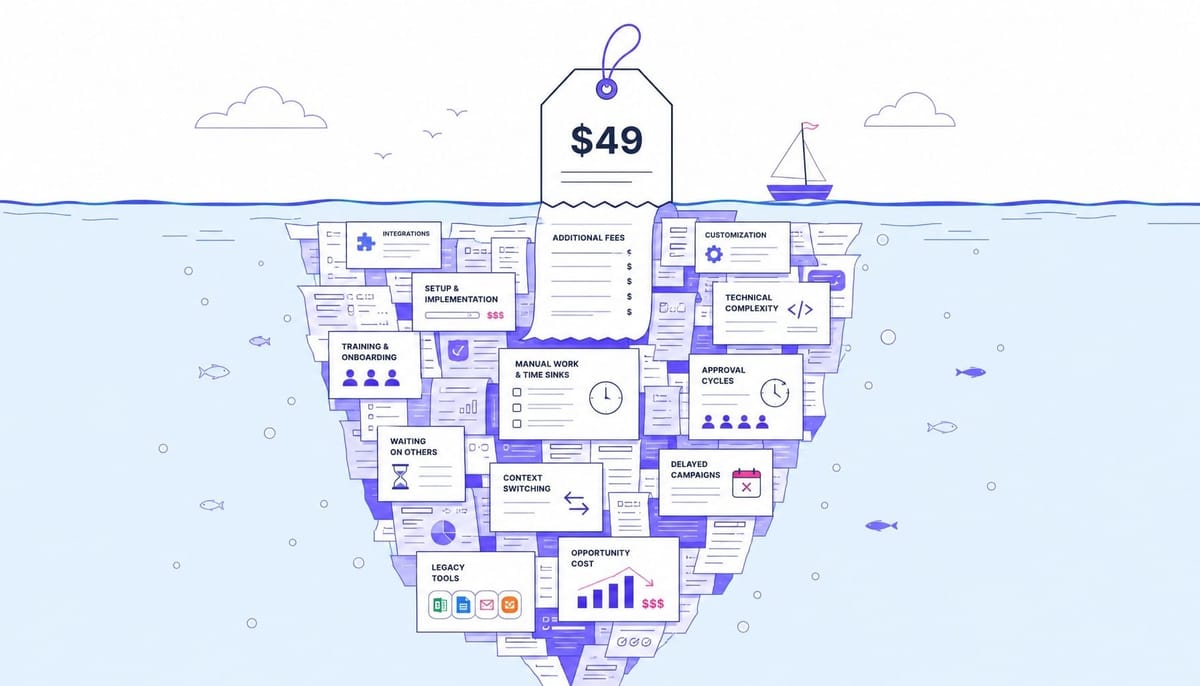
The list price on Moz's website represents the starting cost, not the total cost of ownership for a B2B team. Three specific cost drivers are not immediately apparent from the pricing cards.
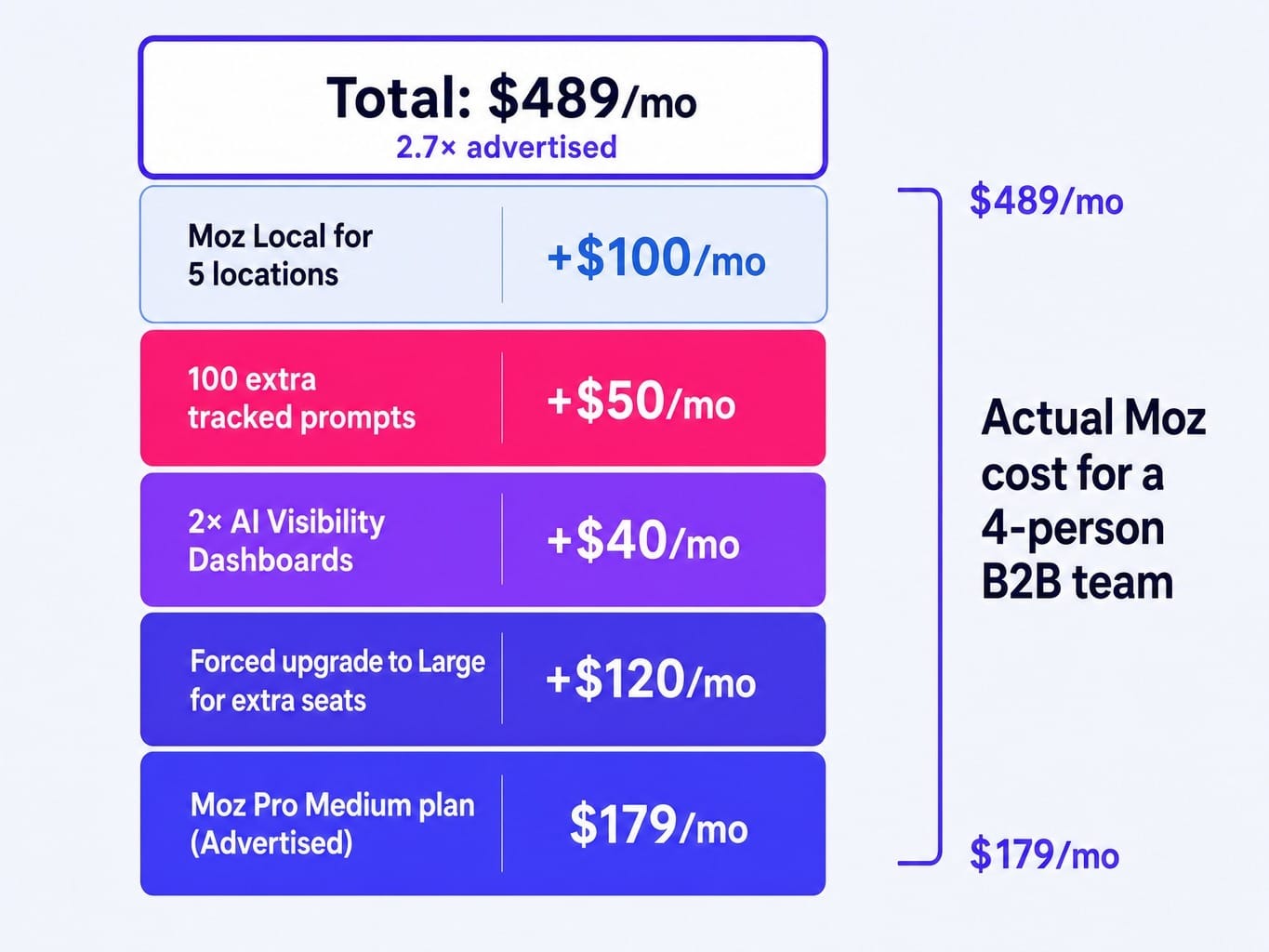
- Per-Seat Pricing Upgrades: Moz Pro plans include a fixed number of user seats (1-3). If a four-person marketing team is on the Medium plan (2 seats), their only option to add a third and fourth user is to upgrade to a higher plan or negotiate an Enterprise contract. To get a third seat, they must upgrade to the Large plan, effectively paying an extra $120/mo for that single additional user. This lack of an à la carte seat add-on makes scaling headcount within a tier impossible.
- AI Feature Add-Ons: As of 2026, Moz charges for expanded use of its AI features. Each plan includes a set number of AI Visibility Dashboards and tracked prompts for generative AI monitoring. Beyond that, it costs $20 per month for each additional dashboard and $50 per month for every 100 additional tracked prompts. For teams monitoring AI visibility across multiple product categories or keyword clusters, these add-ons can accumulate quickly.
- STAT Search Analytics Separation: Moz acquired STAT, a powerful tool for daily rank tracking at scale, but it is not bundled into any Moz Pro plan. Teams that need daily rank updates for thousands of keywords will find Moz Pro's weekly tracking frequency insufficient. STAT is priced as a separate enterprise product, with costs starting well above Moz Pro's highest tier.
Moz Pricing vs Ahrefs and Semrush: Cost-Per-Capability Comparison
Most B2B teams evaluating Moz are also considering Ahrefs and Semrush. Comparing sticker prices is a flawed analysis because each platform allocates resources differently. A more useful comparison focuses on the unit economics of core capabilities at comparable mid-tier plans.
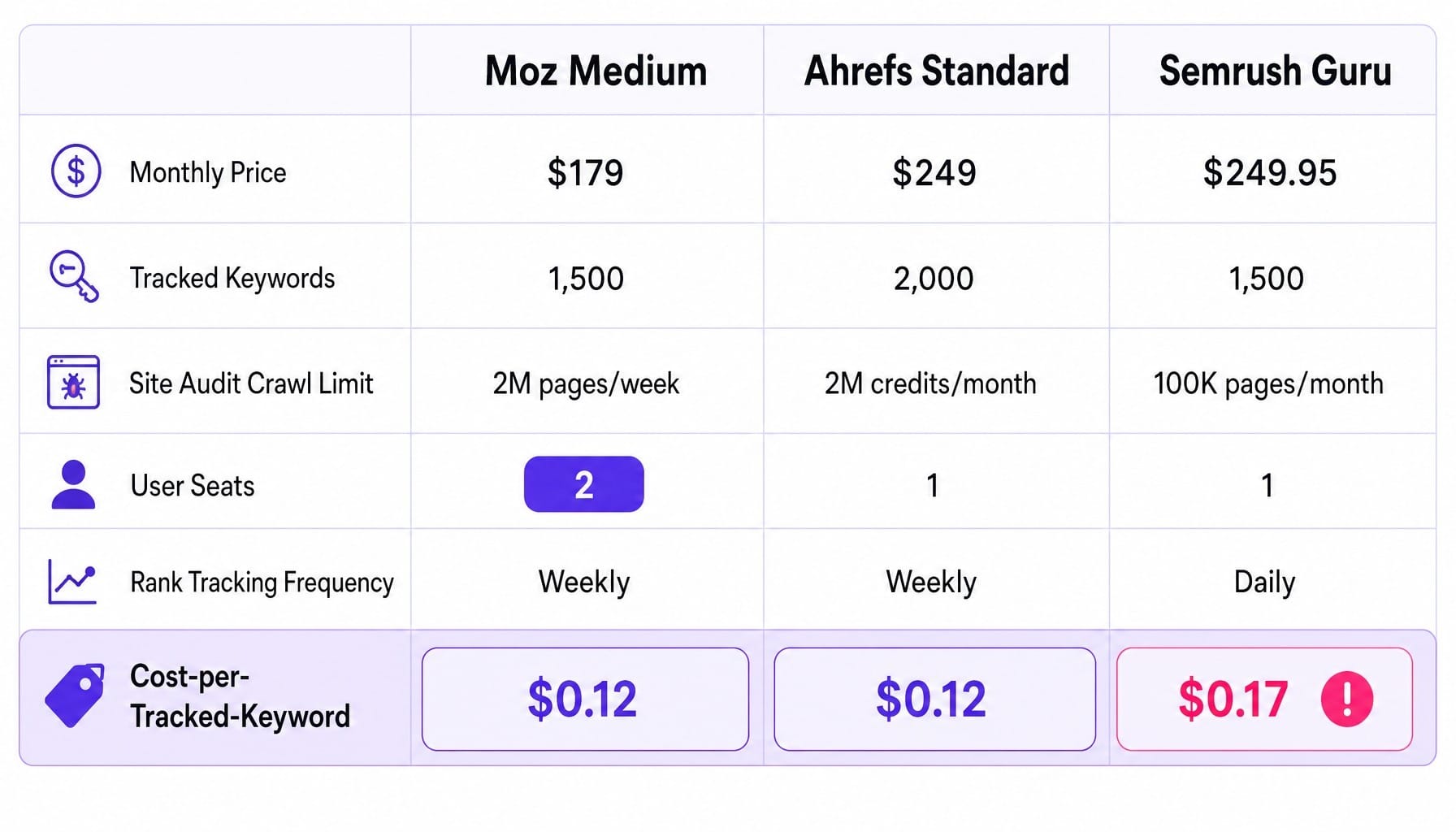
- Cost-per-Tracked-Keyword: On this metric, Moz Medium and Ahrefs Standard are functionally equivalent at $0.12 per keyword. Semrush Guru is significantly more expensive at $0.17. For teams whose primary constraint is the keyword universe cap, Moz offers competitive efficiency.
- Backlink Index Depth: It's widely acknowledged in the SEO community that Ahrefs maintains the largest and freshest backlink index. Moz's link index is smaller, but its Domain Authority (DA) metric, despite some DA inflation concerns, remains a widely used benchmark for high-level competitive analysis.
- The Execution Bottleneck: All three tools are fundamentally diagnostic. They surface keyword opportunities, crawl errors, ranking drops, and backlink gaps. But they stop there. The choice between them matters far less than whether your team has the execution bandwidth to act on the data they provide.
Read more: Semrush vs Moz (2026): Which SEO Tool Fits Your Team's Actual Workflow
When the Real Cost Isn't the Tool — It's the Execution Gap
The analysis of whether to spend $179 on Moz or $249 on Ahrefs misses the point. The critical cost for most B2B marketing teams is not the monthly subscription; it's the latency between insight and implementation.
An SEO tool surfaces a set of high-intent keywords. That data lands in a dashboard. From there, it enters a human-dependent workflow: a marketer interprets the data, a manager prioritizes it, a content team gets a brief, a developer gets a ticket for a technical fix. This cycle eats weeks. The cost that matters isn't the $179/mo subscription—it's the revenue lost during the weeks that a high-value landing page goes un-optimized or a critical crawl error sits in a backlog.
Spike AI is designed to close this specific execution gap. It functions as the execution layer that makes any diagnostic tool's output actionable. By ingesting signals across SEO, CRO, and paid channels, Spike AI's prioritization engine identifies the single highest-impact move for generating qualified leads and then deploys it. The cadence shifts from sporadic quarterly pushes to weekly releases.
This isn't about replacing Moz; it's about making its insights—or Ahrefs', or Semrush's—matter. Spike AI fixes the systemic failure in marketing: the shipping problem. It turns backlogs into a continuous weekly cadence of shipped improvements that compound over time.
See how Spike AI turns SEO insights into shipped improvements — every week
The Real Cost of SEO Intelligence
Moz Pro pricing appears to range from $49 to $299 per month, but a realistic budget for a B2B team starts at the $179/mo Medium plan to secure adequate keyword slots, user seats, and crawl capacity. That total cost climbs further when you factor in separate subscriptions for Moz Local, the Moz API, and per-unit charges for AI features.
While Moz is competitively priced against Ahrefs and Semrush on a cost-per-capability basis, the more important budget question isn't which SaaS marketing tools to subscribe to. It's whether your team has the execution capacity to act on what any of these powerful diagnostic tools will inevitably surface.
Frequently Asked Questions
Does Moz offer a free plan or just a free trial?
Moz offers a 30-day free trial of Moz Pro (credit card required) and a permanently free tier for its API, though it's limited to 50 rows/month. Free community tools like MozBar and the DA checker are available without a subscription but provide limited data compared to the full platform.
What happens if I exceed my keyword or crawl limits on a Moz Pro plan?
Moz Pro does not charge overage fees. Instead, you hit a hard cap. Once you've used all your tracked keyword slots or your crawl budget for the week, you cannot add more until the next billing cycle begins or you upgrade to a higher tier. This prevents surprise charges but means under-provisioning leads to gaps in tracking.
Does Moz offer discounts for agencies or multi-account setups?
Moz does not publicly advertise agency-specific discounts. Agencies managing multiple clients typically use the Large plan or negotiate an Enterprise pricing package through Moz's sales team. As of 2026, there are no publicly listed nonprofit, startup, or educational discounts available for Moz Pro.
Is annual billing on Moz Pro worth the commitment?
Annual billing saves approximately 20% across all tiers, translating to roughly $120/year on Starter and up to $720/year on Large. The savings are meaningful on higher tiers but require a 12-month lock-in. It's advisable to start with monthly billing to confirm the right plan tier before committing to an annual contract.
Can I use Moz Pro and Moz Local together, and how does bundled pricing work?
You can use both, but they are billed as completely separate subscriptions with no bundle discount. A B2B team would pay their Moz Pro plan cost plus the Moz Local per-location fee ($20–$40/mo per location). As of 2026, there is no unified billing dashboard or combined plan available.
How has Moz pricing changed compared to previous years?
Moz introduced the $49/mo Starter plan in 2024, lowering the entry point from the previous $99/mo minimum. AI-related features, including AI Visibility Dashboards and tracked prompts, were added as both included features and paid add-ons in 2025–2026. The core pricing for the Standard, Medium, and Large plans has remained relatively stable.