
SE Ranking Pricing 2026: What Each Plan Actually Costs
TL;DR
- SE Ranking's advertised price is a floor, not a ceiling. Essential features like AI search tracking and agency white-labeling are paid add-ons that can increase your monthly cost by 60% or more.
- The Core plan ($103.20/mo) is a solo-operator tier. Any team of two or more will likely need the Growth plan ($223.20/mo) due to its higher keyword, project, and manager seat limits.
- SE Ranking is cheaper than Semrush or Ahrefs for basic rank tracking and site auditing. The cost advantage disappears once you need 2-3 add-ons, pushing the effective price above Semrush's bundled offerings.
- Model your total cost before committing to an annual plan. Calculate your required keyword volume, user seats, and add-on modules to determine your true monthly subscription cost.
- The highest cost isn't the subscription; it's the human bandwidth required to execute on the insights the tool provides. An SEO tool's value is realized through shipping, not just reporting.
A three-person SaaS marketing team signs up for SE Ranking's Core plan, paying $103.20 per month on an annual contract. They expect to track 2,000 keywords across their 10 top-priority projects. Within six weeks, reality hits. They burn through their crawl page allowance running bi-weekly audits on a 15,000-page site. They need a third manager seat for their content lead, which isn't included. They realize the AI Search add-on they need to track AI Overview visibility costs an additional $71.20 per month. Their effective monthly cost is now over $190, not the $103 they budgeted for.
This scenario is common. The SE Ranking pricing structure is genuinely competitive, but the sticker price on the plan card is rarely the number that hits your invoice.
This guide breaks down the real cost. We will analyze each plan's actual limits, identify where costs escalate through add-ons and overages, and calculate the exact keyword volume where SE Ranking stops being cheaper than Semrush or Ahrefs.
SE Ranking Pricing Plans in 2026: What Each Tier Includes
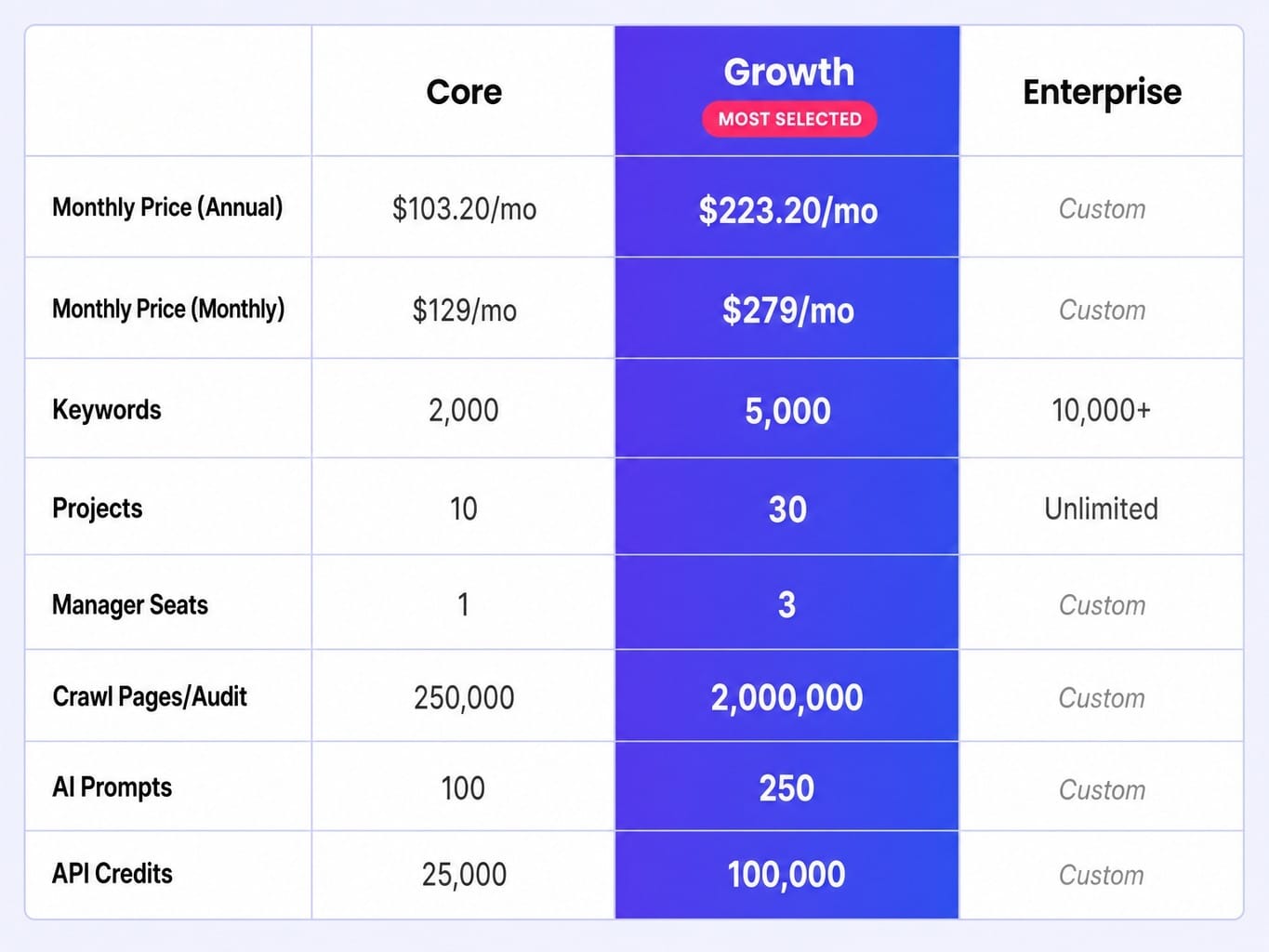
SE Ranking offers two standard plans—Core and Growth—plus a custom Enterprise tier. All plans are available with monthly billing or an annual contract that provides a 20% discount. Understanding these tiers isn't just about comparing features; it's about mapping the hard limits to your team's operational velocity.
Core Plan: $103.20/mo (Annual) — Who It Fits and Where It Caps Out
The Core plan costs $103.20/month when billed annually, or $129/month with a monthly subscription. It's positioned as the entry point, but its limits define it as a solo-operator plan.
Here are the hard limits:
- Keywords: 2,000
- Projects: 10
- Manager Seats: 1
- Crawl Pages/Audit: 250,000
- AI Prompts: 100
- API Credits: 25,000
A 2,000-keyword limit is sufficient for a single-product company tracking branded terms, core feature keywords, and a modest content cluster. However, a business with multiple product lines or operating in several geographies will exhaust this cap quickly. The most significant constraint is the single manager seat, which creates an immediate bottleneck for any team larger than one person. If your content lead and SEO specialist both need access, you're already looking at an upgrade. The Core plan is functional for a freelancer or a solo marketer, but it is not a team plan.
Growth Plan: $223.20/mo (Annual) — The Tier Most Teams Actually Need
The Growth plan, at $223.20/month (annual) or $279/month (monthly), is where SE Ranking becomes a viable system for a lean marketing team. The limits are expanded significantly to support more complex operations.
The key upgrades include:
- Keywords: 5,000
- Projects: 30
- Manager Seats: 3
- Crawl Pages/Audit: 2,000,000
- AI Prompts: 250
- API Credits: 100,000
This is the real starting point for most B2B SaaS teams and small agencies. The jump from 250k to 2 million crawl pages per audit cycle is critical; it means you can run comprehensive, full-site audits on sites up to ~60,000 pages without hitting your crawl budget. The 5,000 keyword slots and 3 manager seats accommodate a small team managing a primary domain, competitor tracking, and a few client accounts. However, a 4-5 person team will still find the seat limit tight, and agencies tracking competitors across multiple verticals may find the 5,000 keyword cap restrictive. Think of Growth as the baseline plan for any functioning team.
Enterprise Plan: Custom Pricing — What to Expect
SE Ranking does not publish its Enterprise pricing; it requires a sales conversation. Based on the Growth plan's ceiling and competitive benchmarking, you can frame your expectations. This tier is designed for larger agencies, multi-brand companies, and organizations with complex data needs.
Expect to negotiate on:
- Keyword Volume: 10,000+ keywords
- Projects: Unlimited
- Manager Seats: Custom number of seats
- Support: Dedicated account manager and custom SLAs
- White-Label: Often included natively rather than as an add-on.
When you approach this conversation, have your specific requirements documented: total keyword volume, number of domains, user seats, and API call needs. This prevents the discussion from anchoring on features you don't use. SE Ranking's Enterprise tier competes directly with Semrush's Business plan ($499.95/mo) and Ahrefs' Enterprise offering, so pricing likely falls in the $400-$600/month range, scaling up from there based on configuration.
Where SE Ranking's Actual Cost Diverges from the Sticker Price
SE Ranking's base plans are competitively priced. The platform's modular architecture, however, means that capabilities many teams consider essential are sold as separate add-ons. The price you see on the plan card is the floor, not the ceiling. This design choice allows solo operators to maintain a low subscription cost by avoiding features they don't need, but it forces teams to model their total cost carefully before committing to an annual contract.
Add-On Stacking: How Three Modules Push Growth Past $400/mo
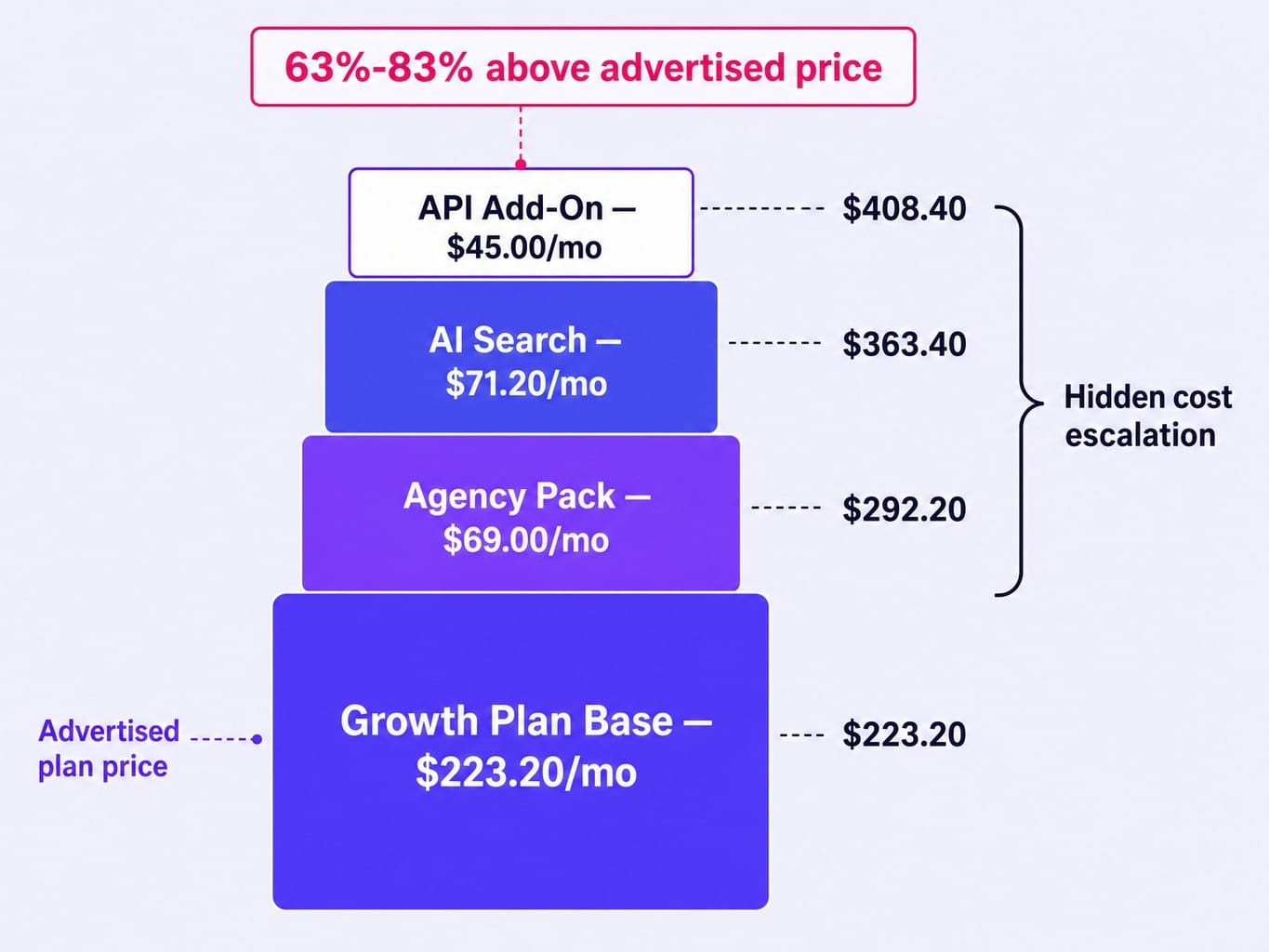
The true SE Ranking subscription cost is revealed when you start stacking add-ons. Here are the three primary modules that escalate the price (based on annual billing):
- Agency Pack (from $69/mo): Adds up to 30 client seats, white-label reporting via DNS CNAME setup, scheduled reports, and a lead generator widget.
- AI Search (from $71.20/mo): Unlocks the AI Results Tracker, which is necessary for monitoring visibility in Google's AI Overviews, AI Mode, Perplexity, and ChatGPT.
- API (from $45/mo): Provides 3 million additional API credits for integrating SE Ranking data into external dashboards and tools.
Consider a realistic scenario: a 4-person agency managing 15 clients. They need the Growth plan ($223.20/mo) as a baseline. For client reporting, the Agency Pack ($69/mo) is non-negotiable. To report on modern search visibility, the AI Search add-on ($71.20/mo) is also required. Their total monthly cost is now $363.40, a 63% increase over the advertised plan price. If they also need API access for custom client dashboards, the bill climbs to $408.40/mo.
Overage Mechanics: What Happens When You Hit a Limit Mid-Cycle
SE Ranking's approach to overages is a critical operational detail. For most limits, like keyword tracking or crawl pages, the system does not charge automatic overage fees. Instead, functionality degrades or halts. If you hit your keyword limit, you can't add more until you upgrade or the cycle resets. If you exhaust your crawl budget mid-audit, the audit stops.
The practical implication is a planning problem. If you're running a time-sensitive competitive analysis on day 20 of your billing cycle and hit your crawl limit, you have two choices: wait 10 days for the reset or upgrade your plan mid-cycle. This contrasts with Ahrefs' credit-based system, which allows more flexibility within a given month. For the API specifically, you can enable an overage option that charges per additional block of credits, preventing a hard cutoff. Teams that fail to model their usage accurately can find their workflows unexpectedly frozen.
The Crossover Point: When SE Ranking Stops Being Cheaper Than Semrush or Ahrefs
SE Ranking is often positioned as the affordable alternative to Semrush and Ahrefs. At the entry-level, this holds true. But affordability is a function of required capabilities, not just the base price. A cost-per-keyword-tracked analysis reveals the crossover point.
Let's do the math (on annual plans):
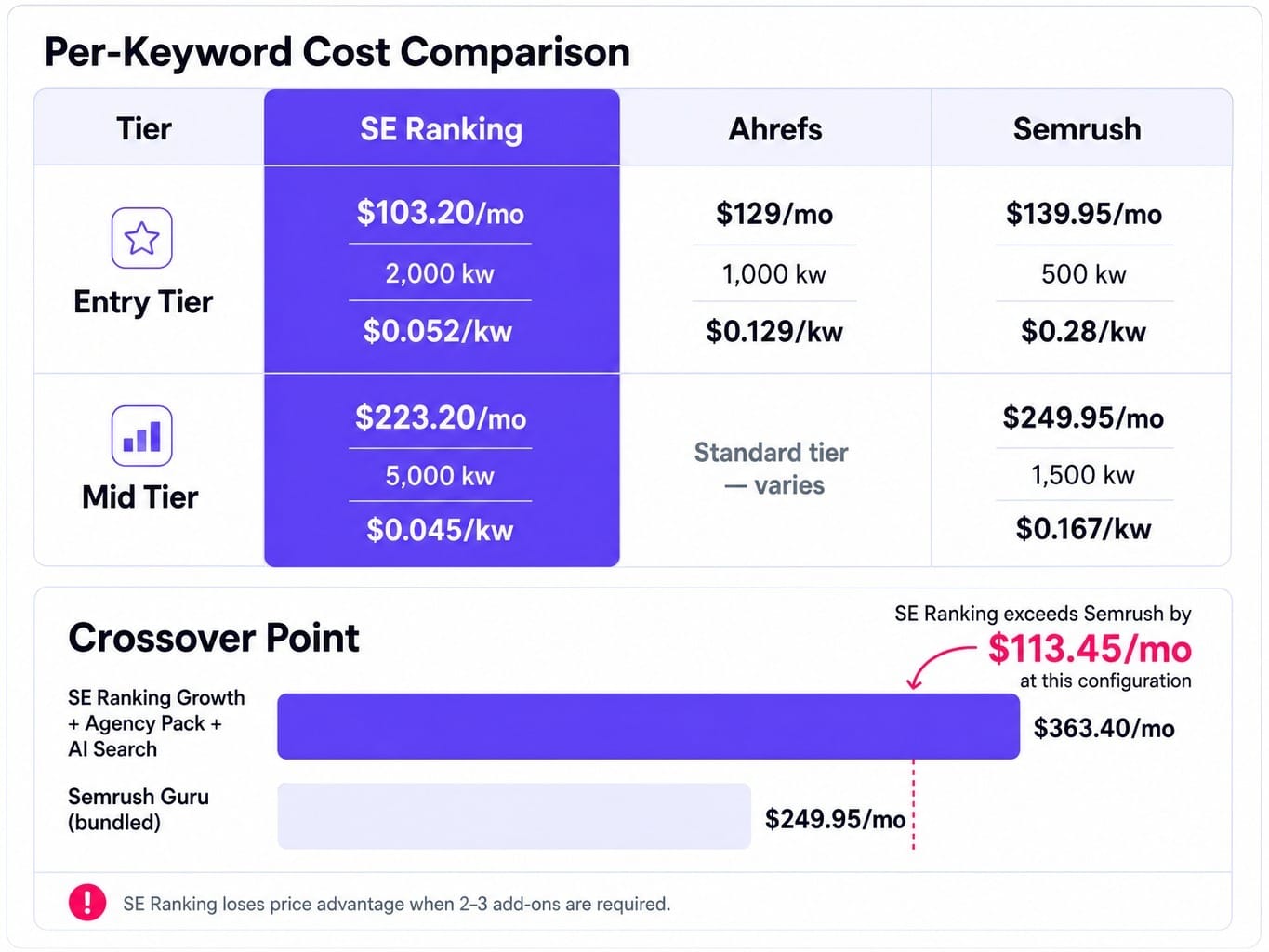
- SE Ranking Core: $103.20/mo for 2,000 keywords = $0.052 per keyword.
- Ahrefs Lite: $129/mo for 1,000 keywords = $0.129 per keyword.
- Semrush Pro: $139.95/mo for 500 keywords = $0.28 per keyword.
At this scale, SE Ranking is significantly cheaper on a per-keyword basis. Now let's scale up to the next tier:
- SE Ranking Growth: $223.20/mo for 5,000 keywords = $0.045 per keyword.
- Semrush Guru: $249.95/mo for 1,500 keywords = $0.167 per keyword.
SE Ranking still maintains a strong cost advantage. However, this calculation ignores bundled features. Semrush Guru includes multi-user access, a content marketing toolkit, and AI features natively. To get comparable functionality on SE Ranking, you must stack add-ons.
The crossover happens here:
- SE Ranking Growth ($223.20) + Agency Pack ($69) + AI Search ($71.20) = $363.40/mo.
This configuration, necessary for many agencies, is significantly more expensive than Semrush Guru at $249.95/mo. The conclusion is clear: SE Ranking is the cost leader for teams whose primary need is rank tracking and site auditing. The moment your workflow requires the full stack of agency reporting and AI visibility tools, its price advantage narrows or disappears entirely.
Read more: SE Ranking vs Semrush (2026): Real Tests, Hidden Costs, and Who Should Use Which
Check Frequency Tiers: The Pricing Variable Most Buyers Overlook
A tool's rank tracking check frequency—how often it re-checks your keyword positions—is more than a feature; it's a variable that dictates the reliability and freshness of your data. SE Ranking provides daily checks on its Core plan, which is the industry standard. However, the true cost is how this check cadence affects your decision-making speed.
Imagine your team launches a new landing page for a competitive keyword. You need to measure its ranking impact quickly to inform your next move, whether it's building more internal links or adjusting on-page elements. With daily checks on primary keywords, you see movement within 24 hours. But for certain SERP features or local pack tracking, the check frequency can be throttled on lower-tier plans. A 48-72 hour delay in a SERP where positions shift multiple times a day means your decisions are based on stale data.
This is effectively a data freshness tax. Teams that require near real-time competitive intelligence to drive rapid experimentation cycles may find that a lower-tier plan forces them to upgrade—not because they need more keyword slots, but because they need a faster rank delta alerting threshold to act on changes before competitors do. Your plan selection isn't just about volume; it's about how quickly the tool allows your system to react.
Which SE Ranking Plan Fits Your Workflow: Three Profiles, Three Recommendations
Pricing tables don't answer the real question: "Which plan do I need for the work I actually do?" Here are three common profiles with concrete recommendations.
- Profile 1: The Solo SEO Consultant/Freelancer
Workflow: Tracking 5-10 client sites with a total of under 500 keywords. Core needs are rank tracking and basic site audits.
Recommendation: The Core plan ($103.20/mo) is sufficient. Skip all add-ons. The single manager seat is not a bottleneck. Use the significant cost savings versus competitors to invest in a dedicated tool for another function, like Ahrefs Lite for its superior backlink index.
Expected Cost: ~$103/mo.
- Profile 2: The Lean SaaS Marketing Team
Workflow: A 2-4 person team managing one primary domain with 1,000-3,000 keywords across organic search and content marketing programs.
Recommendation: The Growth plan ($223.20/mo) is the minimum viable option. The 3 manager seats and 5,000 keyword limit provide necessary breathing room. Add the AI Search module ($71.20/mo) only if tracking AI Overview visibility is a mandated reporting requirement from leadership; otherwise, skip it.
Expected Cost: ~$223 - $294/mo.
Read more: SaaS Marketing Tools in 2026: How to Build a Stack That Ships, Not Just Reports
- Profile 3: The Small Agency
Workflow: Managing 10-20 client accounts requiring white-label reporting and separate project spaces.
Recommendation: The Growth plan + Agency Pack is your baseline. Budget for a realistic cost of $350-$400/mo. At this price point, you must evaluate if SE Ranking's total cost still undercuts Semrush Guru ($249.95/mo), given that Guru includes robust content marketing tools and multi-user access natively.
Expected Cost: ~$350 - $408/mo.
When the Bottleneck Isn't the Tool — It's the Bandwidth to Act on What It Finds
An SEO tool, regardless of its price, gives you a backlog. A $223/mo Growth plan that surfaces 47 technical audit issues and 12 high-impact content gaps is only valuable if your team has the operational bandwidth to act on those findings. The recurring cost problem isn't just the subscription fee; it's the latency between identifying what needs to change and actually shipping that change. Discussions, planning, approvals, and engineering tickets consume weeks, and the tool's value decays with every day of inaction.
This is the execution gap. Most marketing teams don't have a strategy problem; they have a shipping problem.
Spike AI operates in a fundamentally different category. Instead of adding another dashboard to your stack, it functions as a continuous execution layer. Spike AI identifies the highest-impact move across your website, SEO, or ads each week—and then helps you execute it. The subscription cost of an SEO tool is a line item. The revenue lost in the gap between what that tool finds and what your team ships is the real cost.
See how Spike AI turns SEO findings into shipped improvements every week
Conclusion
SE Ranking's pricing is built on a compelling premise: pay only for what you use. This modularity makes it a cost-effective choice for individuals and teams with straightforward needs. But the number on the plan card is not the number on your invoice, and the invoice is not the full cost of using the tool.
Before committing to an annual contract, model your actual usage: keyword volume, project count, user seats, and required add-ons. Use the crossover analysis to confirm that SE Ranking remains the cheaper option at your specific scale. Most importantly, recognize that the largest cost in any SEO tool stack isn't the subscription. It's the execution bandwidth required to turn data into deployed changes. The teams that win with SE Ranking—or any platform—are the ones that build a system to ship improvements weekly, not the ones who simply pay to track the most keywords.
Frequently Asked Questions
Does SE Ranking offer a free trial, and what are its limits?
Yes, SE Ranking offers a 14-day free trial with no credit card required. It includes access to 10 projects and 750 keywords, which is sufficient for evaluating core rank tracking and site auditing on a single domain but not for testing agency features or multi-project workflows.
Can I upgrade or downgrade my SE Ranking plan mid-billing cycle?
Upgrades take effect immediately, with the cost prorated for the remainder of your billing cycle. Downgrades take effect at the start of your next billing period, and you retain access to higher-tier features until then. Note that downgrading an annual plan mid-cycle does not trigger a partial refund.
Is SE Ranking's content marketing module included in all plans or sold separately?
The content marketing module, which includes the content editor and AI writer, is included in the Growth plan and above. It is not available on the Core plan, and there is no option to purchase it as a standalone add-on for that tier.
How does SE Ranking's white-label reporting work, and which plans include it?
White-label reporting is not included in any base plan; it is part of the Agency Pack add-on (starting at $69/mo). This feature enables custom branding via DNS CNAME setup, scheduled report delivery, and client-facing dashboards. The pack also adds client sub-accounts and a lead generator widget.
What is the cheapest SE Ranking plan that includes API access?
Both the Core (25K credits) and Growth (100K credits) plans include a baseline level of API access. For heavier usage, the dedicated API add-on provides 3 million credits starting at $45/mo (annual). SE Ranking also offers a standalone API product for teams needing API access without the full platform.