SE Ranking Review 2026: An Honest Assessment for B2B Marketing Teams

TL;DR
- Best For Lean Teams: SE Ranking is a powerful consolidation play for 1-3 person B2B marketing teams that need 80% of Semrush's capability at about 60% of the cost. Enterprise teams will hit their limits.
- Strongest Feature is Rank Tracking: Daily rank check frequency on all plans gives it an edge over competitors' lower tiers, which is critical for monitoring time-sensitive B2B campaigns.
- AI Overview Tracking is a Differentiator: The ability to track which pages appear in Google's AI Overviews is a forward-looking feature that most competitors are still building, giving you visibility into a critical new SERP battleground.
- Know the Tradeoffs: The biggest limitations are a clunky keyword gap analysis workflow, a backlink index that isn't as fresh as Ahrefs, and a content editor that can't replace dedicated tools like Surfer SEO.
- Diagnosis Isn't Execution: Like all SEO tools, SE Ranking identifies problems but leaves the execution entirely on you. The real bottleneck isn't finding insights; it's shipping fixes consistently.
Most SE Ranking reviews read like product documentation. They walk through features, show screenshots, and declare a verdict based on a checklist. But for a lean B2B marketing team running SEO alongside five other channels with two people, the question was never 'does it have a site audit tool?' The real question is whether the platform compresses the time between spotting a problem and shipping a fix.
SE Ranking has built its reputation as an affordable, all-in-one alternative to the duopoly of Semrush and Ahrefs. That positioning is accurate, but affordability only matters if the tool actually improves your team's output. A cheaper dashboard that surfaces the same backlog of un-actioned tasks isn't a win; it's just a less expensive way to document your execution bottleneck.
This SE Ranking review evaluates the platform through that lens. We're not just comparing features. We're assessing its capabilities for B2B marketing teams, focusing on where it genuinely accelerates your workflow and where it leaves critical gaps that most reviews don't mention.
Who SE Ranking Actually Serves Well (And Who It Doesn't)
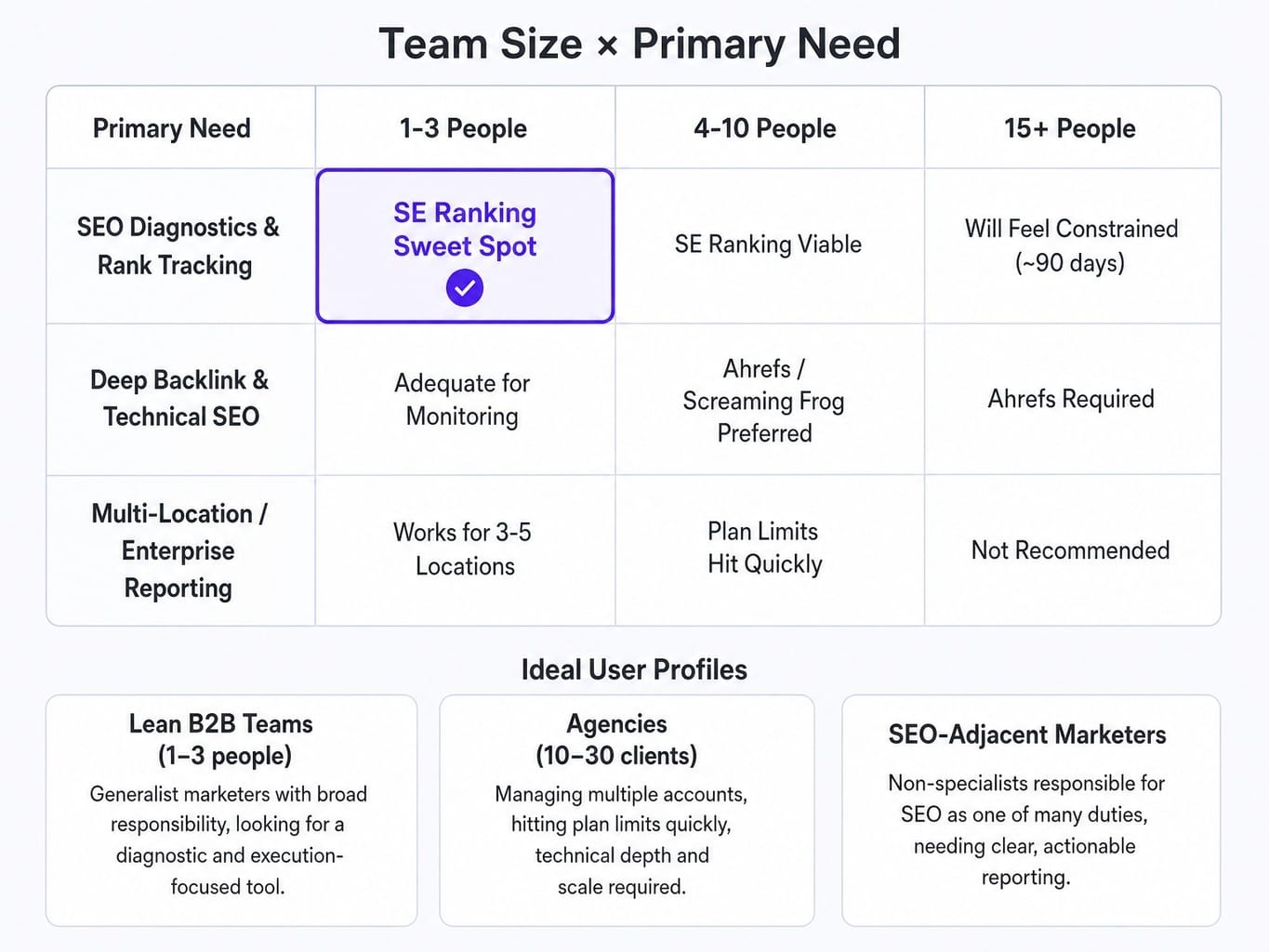
SE Ranking is not a universally correct choice, and any review pretending otherwise is doing you a disservice. The platform's value is highly dependent on your team structure, technical depth, and strategic objectives. In our assessment, it's strongest for three specific profiles.
- Lean B2B Marketing Teams (1-3 people): This is SE Ranking's sweet spot. If you're a small team needing reliable rank tracking, competitive monitoring, and site health checks in a single interface without paying $200+/month for Semrush, this platform delivers. It covers 80% of what you need, consolidating tasks that might otherwise require three separate tools.
- Agencies Managing 10-30 Clients: For agencies, profitability hinges on efficient tooling. SE Ranking's white-label reporting, sub-account permissioning, and client management dashboard are robust, all at a price point that doesn't destroy your retainer margins.
- SEO-Adjacent Marketers: Demand gen managers, content leads, and product marketers who need to monitor organic performance without becoming full-time SEO specialists will find the interface intuitive and the reports easy to understand.
Conversely, it does not serve enterprise teams needing deep backlink analysis at Ahrefs-level freshness, technical SEOs who live in Screaming Frog, or B2B companies with complex multi-location tracking needs across dozens of regions. A 2-person SaaS marketing team tracking 500 keywords can run their entire SEO program here. A 15-person growth team at a Series C company will feel constrained within 90 days.
Rank Tracking and Keyword Research: Accurate Enough, But the Real Question Is What You Track
The debate over rank tracking accuracy between SE Ranking, Semrush, and Ahrefs is mostly academic. In practice, the differences are marginal. The real question for B2B teams is whether the tool helps you track the right things—specifically, the low-volume, high-intent keywords that define niche markets. A database can have 7.3 billion keywords and still miss the 200 that matter most to a cybersecurity SaaS company.
For a B2B SaaS company tracking terms like 'SOC 2 compliance automation software,' the challenge isn't just position, but whether the tool even surfaces these queries and their variations reliably. SE Ranking holds its own here, but its strengths and weaknesses are distinct.
Rank Tracking: Daily Cadence Without the Enterprise Price Tag
Rank tracking is SE Ranking's strongest module. The platform offers daily rank check frequency on all plans, a genuine advantage over Semrush's weekly cadence on its lower tiers. For B2B teams running time-sensitive campaigns—like a product launch or a competitive displacement play—this daily data is crucial for measuring momentum.
The ability to track five keyword variations (e.g., mobile vs. desktop, different geographic locations) for each keyword without extra charges is also genuinely useful for B2B companies with regional offices or distinct buyer personas in different cities. The primary limitation we found is that historical ranking data retention is plan-dependent. This can be a point of friction for teams preparing quarterly business reviews that require deep lookback windows, forcing you to export data manually if you're on a lower-tier plan.
Keyword Research: Solid for Discovery, Weak for B2B Keyword Gap Analysis
SE Ranking's keyword research toolkit is competent for discovery. It provides the standard metrics: search volume, a proprietary keyword difficulty score, CPC data, and related keyword ideas. It gets the job done for building initial content briefs or exploring new topic clusters.
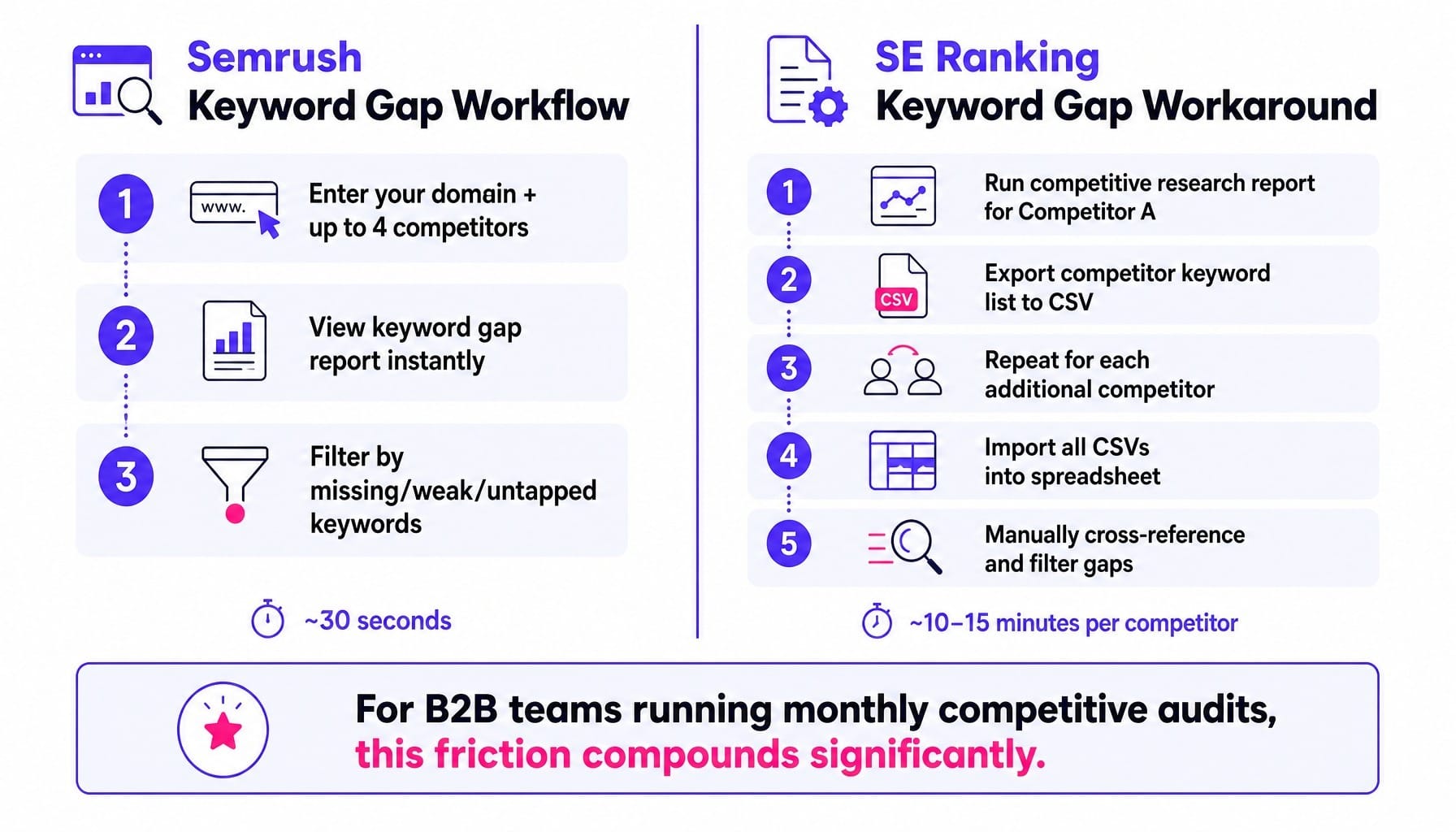
However, it falls short in a workflow that B2B teams run constantly: strategic keyword gap analysis. Unlike Semrush's dedicated Keyword Gap tool, which provides a clean, direct comparison, SE Ranking requires a multi-step workaround. You have to run a competitive research report, export the keyword list, and perform the comparison manually in a spreadsheet. This adds friction and time to a critical strategic task. Furthermore, its keyword difficulty scores appear to update less frequently than Semrush or Ahrefs, which is a minor issue for stable B2B verticals but can be misleading in emerging categories with shifting SERPs.
Read more: SE Ranking vs Semrush (2026): Real Tests, Hidden Costs, and Who Should Use Which
Site Audit: Useful for Hygiene, Not a Replacement for Deep Technical SEO
SE Ranking's site audit is best understood as a maintenance tool, not a deep diagnostic tool. It excels at catching the technical SEO issues that break quietly over time: 4xx errors, missing meta descriptions, duplicate content, slow pages, and Core Web Vitals regressions. For a B2B marketing team without a dedicated technical SEO specialist, this is incredibly valuable. It transforms the monthly "is anything broken?" check from a half-day Screaming Frog crawl into a 15-minute review of a clean, prioritized dashboard.
But it's crucial to understand its boundaries. Consider a B2B SaaS company with a 2,000-page React-based marketing site spread across a blog, product tours, and documentation. SE Ranking's crawler will reliably surface broken links and missing H1 tags. It will not, however, diagnose complex JavaScript rendering issues with the same depth as Screaming Frog. It won't help you identify index bloat caused by parameter-based URL generation, and it provides limited insight for crawl budget optimization on a site of that scale.
One standout feature is the Page Changes Monitoring, which alerts you when on-page elements get overwritten during a developer deployment—a painfully common occurrence on B2B sites with shared codebases. While the audit's comparison-over-time feature helps track progress, a small but annoying point of friction is that its data exports don't always include source URLs for issues like broken links, forcing manual work to locate the problem.
Competitive Intelligence and Backlink Analysis: Good Enough for Monitoring, Not for Strategy
SE Ranking's competitive research module will show you what your competitors rank for, their estimated traffic trends, and a high-level overview of where their backlinks come from. For a B2B team conducting monthly or quarterly checks on their competitive positioning, this is largely sufficient.
The gap appears when you move from monitoring to strategy. If you're building a competitive displacement campaign—aiming to unseat an incumbent for a core commercial term—you need more than high-level data. For instance, a B2B cybersecurity company trying to win the top spot for 'zero trust network access' can use SE Ranking to see the competitor's top keywords. A tool like Semrush or Ahrefs, however, can reveal the entire content cluster supporting that pillar page, its internal linking structure, and the referring domain velocity over the past 12 months. That strategic layer is what SE Ranking currently lacks.
On backlinks specifically, the platform's claimed index of 2.9 trillion links is impressive, but for B2B use cases, freshness and coverage matter more than sheer size. Our analysis suggests its backlink index freshness lags behind Ahrefs, sometimes by days or even weeks. For monitoring your own backlink profile—checking for lost links or identifying new referring domains—it's perfectly adequate. For active link prospecting or granular competitive backlink gap analysis, Ahrefs remains materially better.
AI Overview Tracking: SE Ranking's Most Forward-Looking Feature
In a rapidly changing search landscape, SE Ranking's AI Search Toolkit is the feature most likely to matter more in 12 months than it does today. For B2B companies, Google's AI Overviews are fundamentally reshaping how buyers encounter solutions during the research phase. Getting your product page or a key blog post cited in an AI Overview for a query like "best compliance automation platform" creates a new kind of visibility that compounds differently than a traditional ranking.
SE Ranking is one of the first major platforms to provide tools to navigate this shift. Its AI Overview Research and Tracker lets you monitor which of your pages appear in these generative AI results, how often, and in what context. This is data that larger competitors are still scrambling to integrate.
To be clear, the feature is still maturing. The LLM Tracker, which monitors brand mentions across different AI systems, is promising but feels early-stage; the data is more directional than comprehensive. The AIO Research tool, which shows which queries trigger AI Overviews and which domains get cited, is useful for identifying content opportunities. However, it doesn't yet provide the interpretive layer—the why a page gets cited—that would allow you to build a true optimization strategy. Even so, for B2B teams, tracking SERP features (including AI Overviews, featured snippets, and People Also Ask boxes) is becoming more important than raw rank position, and SE Ranking handles this better than its price point would suggest.
Pricing and Total Cost of Ownership: What You Actually Pay
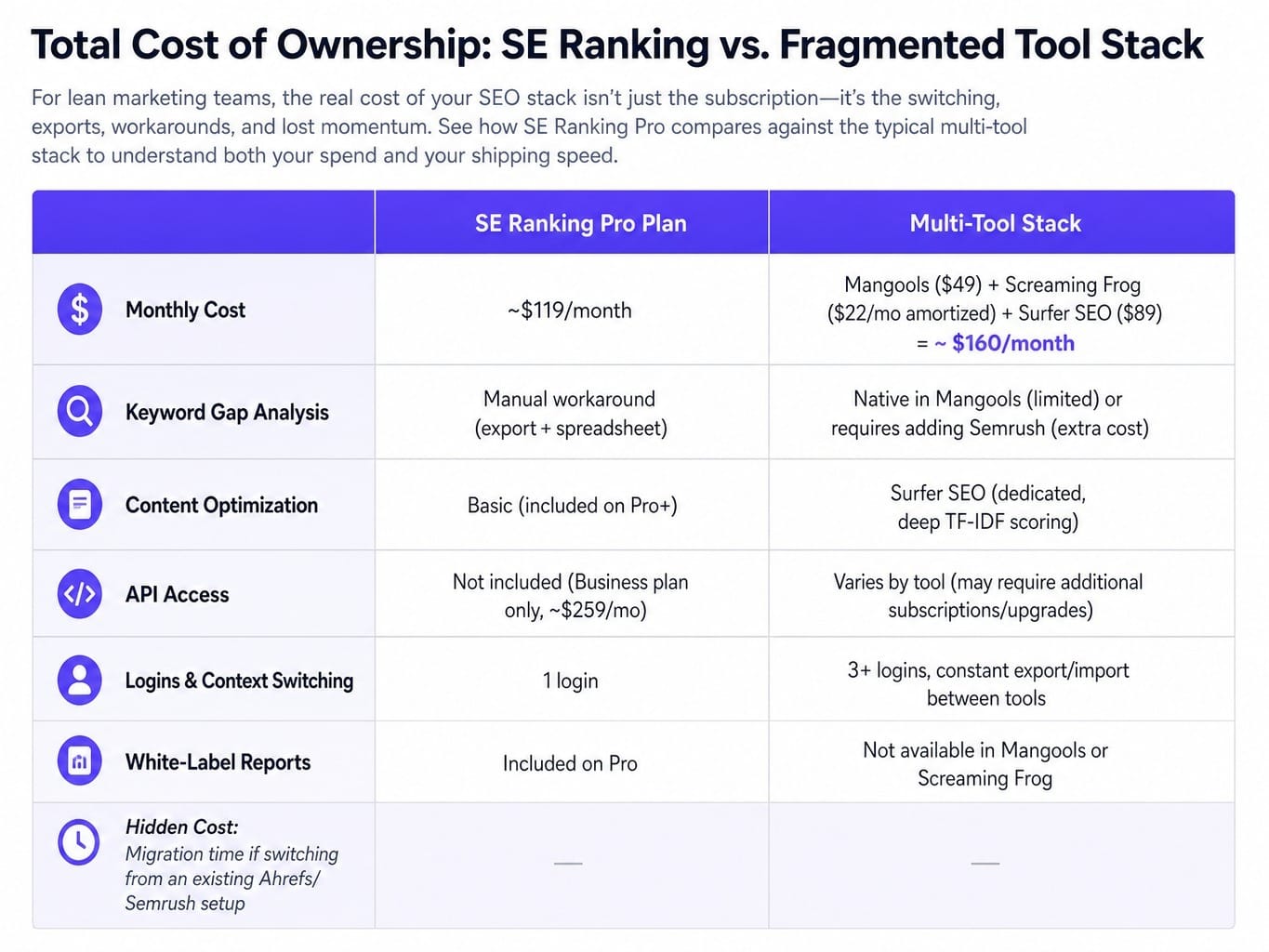
SE Ranking's sticker price is its most-cited advantage, but the sticker price is not the total cost of ownership. The three core plans—Essential (around $65/month), Pro (around $119/month), and Business (around $259/month)—are indeed competitive. But the real calculation for a B2B team must account for the costs that accumulate beyond the base price.
The Keyword Grouper requires additional credits. The full Content Marketing toolkit is only available on the Pro plan and up. API access, which is essential for feeding data into custom reporting pipelines like Looker Studio or a HubSpot dashboard, is gated to the Business plan. Historical data depth also varies by plan. For a B2B team that needs content optimization tools and API access, the effective entry point isn't the Essential plan; it's the Pro or Business plan.
When we compare TCO, the value proposition becomes clearer. A multi-tool stack of Mangools ($49/mo) + Screaming Frog ($259/year) + Surfer SEO ($89/mo) can easily exceed the cost of SE Ranking's Pro plan. More importantly, that fragmented stack introduces significant coordination overhead—more logins, more exports, and constant context switching. For a lean team, the consolidation SE Ranking offers has real, tangible value. The one hidden cost rarely discussed is migration: if your team is already embedded in Ahrefs or Semrush, the time spent re-learning workflows and rebuilding reports is a real factor.
What SE Ranking Cannot Do: The Limitations Most Reviews Skip
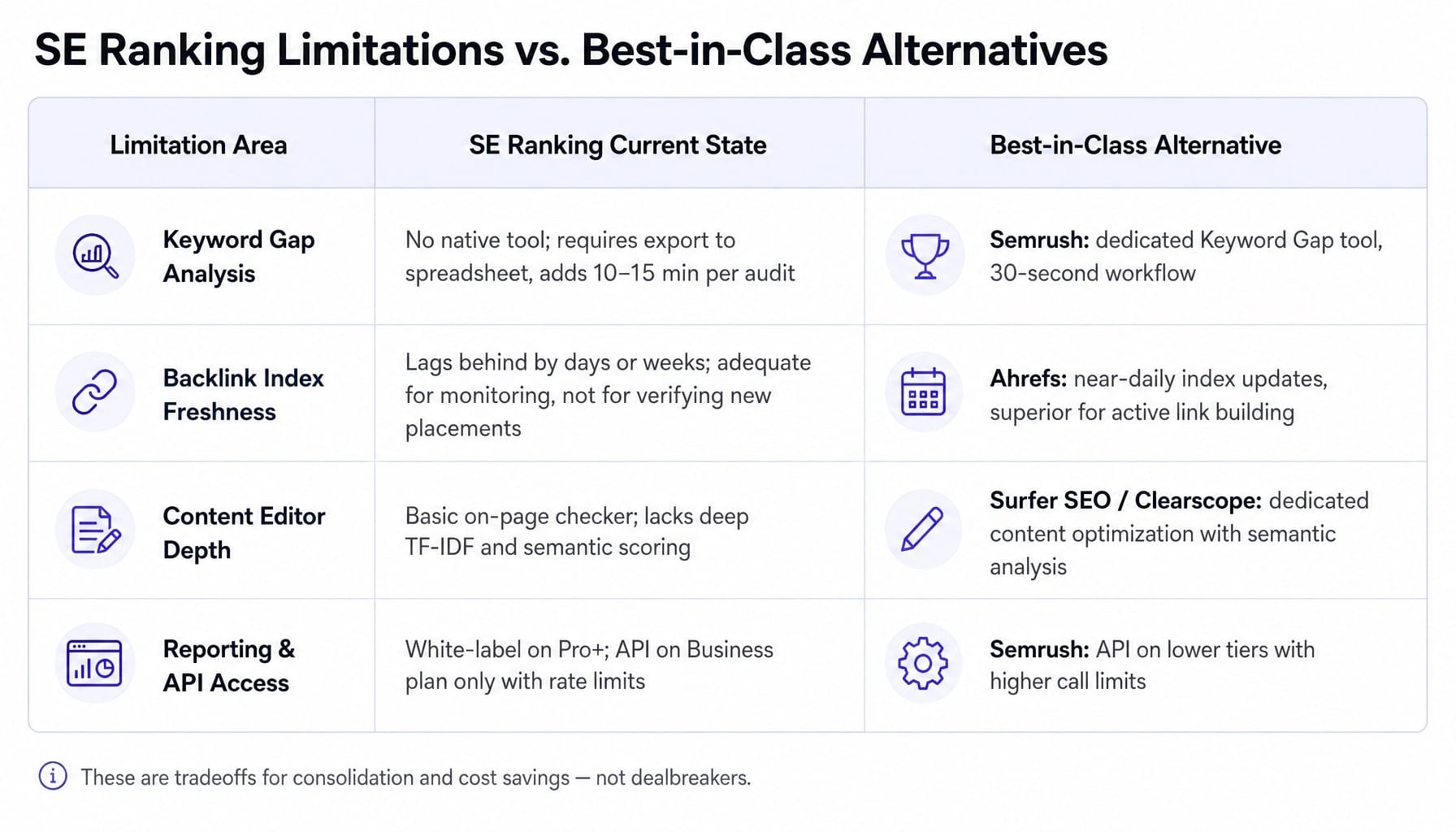
Every tool has boundaries. Knowing SE Ranking's before you commit saves you from discovering them six months in, mid-workflow and frustrated. Beyond the obvious (a smaller backlink database than Ahrefs), here are four specific limitations that surface after extended B2B use:
- No Native Keyword Gap Analysis Tool. A workaround exists, but it involves exporting competitor keywords and running a manual comparison in a spreadsheet. This adds 10-15 minutes to a workflow that takes 30 seconds in Semrush. For B2B teams running monthly competitive audits, this friction compounds.
- Backlink Index Freshness Lags. For general monitoring, it's fine. But for teams running active link-building campaigns who need to verify new placements within a day or two, the lag behind Ahrefs is a tangible gap.
- The Content Editor Is Functional, Not Strategic. The on-page SEO checker and content editor provide basic recommendations, but they lack the deep TF-IDF content scoring and semantic analysis of dedicated tools like Surfer SEO or Clearscope. If content optimization is a primary, high-volume workflow for your team, SE Ranking's tools will feel like an add-on, not a core capability.
- Reporting and API Constraints. While the report builder is strong, full white-labeling requires the Pro plan. The API, gated to the Business plan, has call rate limits that can constrain teams building automated, high-frequency dashboards.
These are not dealbreakers. They are tradeoffs you accept in exchange for consolidation and significant cost savings. But they should be visible before you sign up, not after.
The Gap Every SEO Tool Leaves Behind: Diagnosis Without Execution
This review, like every tool review, operates on a flawed premise. We've evaluated how well SE Ranking identifies ranking drops, surfaces technical debt, and shows you competitive gaps. But after the audit runs and the report is exported, the work hasn't ended—it has just begun. The marketer still has to interpret the data, prioritize what matters, plan the fix, get it approved, and ship it.
That execution latency is the real bottleneck in marketing, and no SaaS marketing tool on the market closes it. They are diagnostic engines, designed to generate a backlog of tasks that constrain your team's limited bandwidth.
This is where Spike AI offers a different approach. We are not a replacement for SE Ranking, but an execution layer that sits downstream. Where SE Ranking tells you your site audit score dropped, Spike AI identifies the highest-impact fix, prioritizes it against all your other SEO, CRO, and paid media opportunities, and deploys the change. The system is designed to convert the backlog every diagnostic tool creates into a continuous, weekly shipping cadence. The distance between identifying a problem and deploying a solution shrinks from weeks to days.
See how Spike AI turns your SEO backlog into weekly shipped improvements
Conclusion: A Powerful Tool That Still Requires an Execution System
This honest SE Ranking review leads to a clear conclusion: it is a powerful consolidation play for lean B2B teams that need a unified system for SEO diagnostics. It delivers 80% of what Semrush and Ahrefs offer at a fraction of the cost, with genuinely forward-looking strengths in areas like AI Overview tracking. Its limitations in backlink freshness and strategic analysis are real but are predictable and manageable tradeoffs for its target audience.
But the harder question—the one no tool review can answer for you—is whether your team has the execution bandwidth to act on what the tool surfaces. The B2B teams that win in 2026 won't be the ones with the most comprehensive dashboards. They will be the ones who have the highest execution velocity—the teams who ship the most meaningful improvements, week after week.
Frequently Asked Questions
How does SE Ranking handle multi-location rank tracking for B2B companies with regional offices?
SE Ranking supports postcode-level location targeting for rank tracking, which works well for B2B companies with 3-5 regional offices. Each location counts against your keyword quota (e.g., tracking 'managed IT services' in Dallas and Chicago uses two keyword slots). For companies with 15+ locations, the keyword limits on Essential and Pro plans can become constraining, likely requiring the Business plan or custom enterprise pricing.
Does SE Ranking provide enough historical data for B2B quarterly business reviews?
Historical data retention depends on your plan tier. The Essential plan retains limited historical ranking data, which can leave gaps when preparing QBRs that compare quarter-over-quarter performance. Pro and Business plans offer deeper history. If quarterly reporting is a core workflow, verify the retention period for your chosen plan before committing and consider exporting ranking data monthly as a backup.
What integrations does SE Ranking support for B2B marketing stacks like HubSpot?
SE Ranking integrates natively with Google Analytics, Google Search Console, and Google Looker Studio. To connect to a CRM like HubSpot or Salesforce, you'll need to use the API (available on the Business plan only) or a third-party connector like Zapier. The lack of native CRM integrations is a gap for B2B teams who want SEO performance data flowing directly into their revenue reporting systems.
Is SE Ranking's white-label reporting robust enough for B2B agencies managing 20+ clients?
Yes, for most use cases. White-label reporting is available on Pro and Business plans and supports custom branding, scheduled delivery, and multiple report templates. The platform's sub-account permissioning and multi-project management work well for agencies. The main limitation is dashboard customization; complex reports blending data from SEO, PPC, and CRO will require exporting to Looker Studio rather than building natively in SE Ranking.
How often does SE Ranking update its keyword difficulty scores, and should B2B teams trust them?
SE Ranking's keyword difficulty scores generally update on a monthly cycle, which is less frequent than the near-real-time updates from Semrush or Ahrefs. For stable B2B verticals where competitive landscapes shift slowly, this is acceptable. For emerging categories or fast-moving markets, treat SE Ranking's difficulty scores as directional rather than definitive and always cross-reference with manual SERP analysis before committing resources.