SpyFu vs. SEMrush (2026): Which Tool Fits Your Team's Actual Workflow?
TL;DR
- For PPC Intelligence: SpyFu is the superior tool for deep Google Ads competitor research, thanks to its 18+ years of historical ad data. For budget-constrained teams focused on this use case, it's the clear winner.
- For an All-in-One Platform: SEMrush justifies its higher price for teams needing a single system for SEO, content strategy, backlink auditing, and technical site health. Its data is generally more accurate for organic research.
- Data Accuracy Varies: SEMrush's organic traffic estimates are directionally more reliable, especially for larger sites. SpyFu's strength is its historical PPC data, which is unmatched. Neither is 100% accurate; the goal is reliable directional data.
- True Cost Isn't Sticker Price: The price gap narrows significantly when you factor in SEMrush's seat/project limits and SpyFu's need for supplementary tools for site audits and deep backlink analysis.
- The Real Bottleneck is Execution: Choosing the right tool is only half the battle. The bigger constraint for most lean teams is the bandwidth to consistently act on the insights generated.
Most SpyFu vs. SEMrush comparisons are feature checklists. They tell you which tool has more buttons but not which one you'll actually use. For a lean marketing team, the question isn't "which has more features?" but "which tool provides accurate enough data to act on, fits my workflow without becoming shelfware, and won't quietly double in cost once I need the features that matter?"
The endless debate between these platforms is a proxy for a deeper problem: resource allocation. Your choice reflects a bet on where your team's limited bandwidth is best spent.
This comparison evaluates SpyFu and SEMrush not on feature counts, but on the three dimensions that determine whether a tool actually generates a return: data accuracy, workflow fit, and true cost of ownership. We're moving beyond the spec sheet to help you decide which system aligns with the reality of getting work shipped.
Quick Verdict: SpyFu vs. SEMrush by Use Case
There is no single "winner." The right tool depends entirely on your team's primary execution loop and budget.
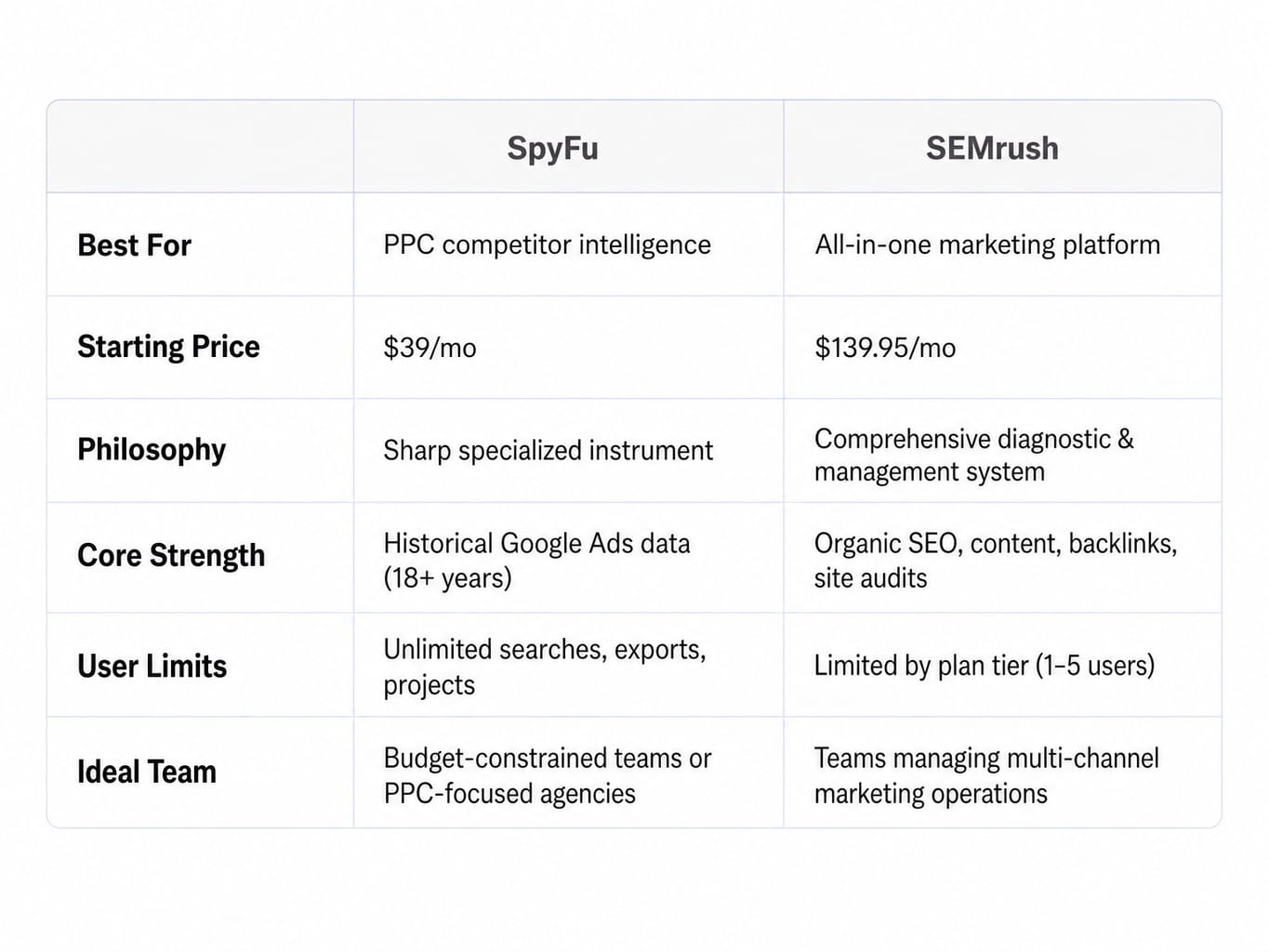
- Choose SpyFu if: Your core function is PPC competitor intelligence. For teams laser-focused on Google Ads history, ad copy research, and competitor keyword overlap, SpyFu delivers more actionable data per dollar. Its simple, unlimited-use model (starting at $39/mo) is ideal for budget-constrained teams or agencies that just need to answer specific competitive questions without the overhead of a full platform.
- Choose SEMrush if: You need a centralized, all-in-one marketing system. For teams and agencies managing multi-channel operations across SEO, content marketing, backlink management, and technical site audits, SEMrush is the more complete platform. Its higher price (starting at $139.95/mo) is justified by its broader feature set, more reliable organic data, and robust project management capabilities.
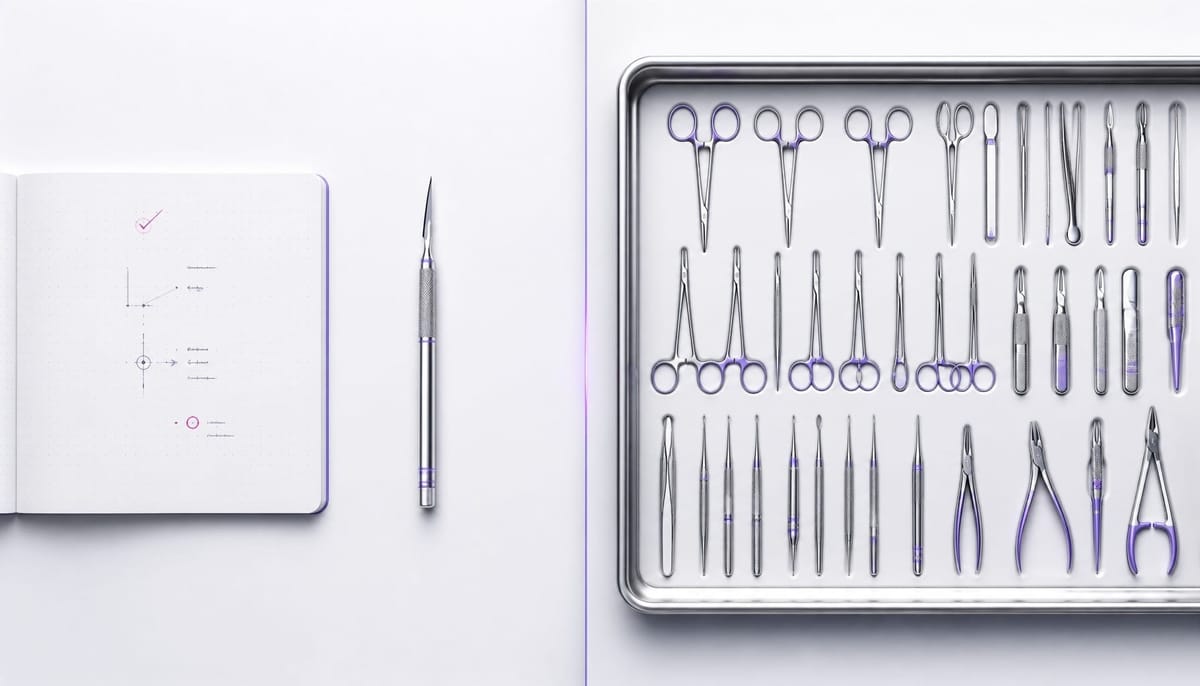
The fundamental difference between SpyFu and SEMrush is one of philosophy. SpyFu is a sharp, specialized instrument for competitive analysis. SEMrush is a comprehensive diagnostic and management platform. If your only job is PPC research, SpyFu is the better investment. If you run the entire marketing function, SEMrush is the more logical system of record.
Data Accuracy: What You Can Actually Trust from Each Tool
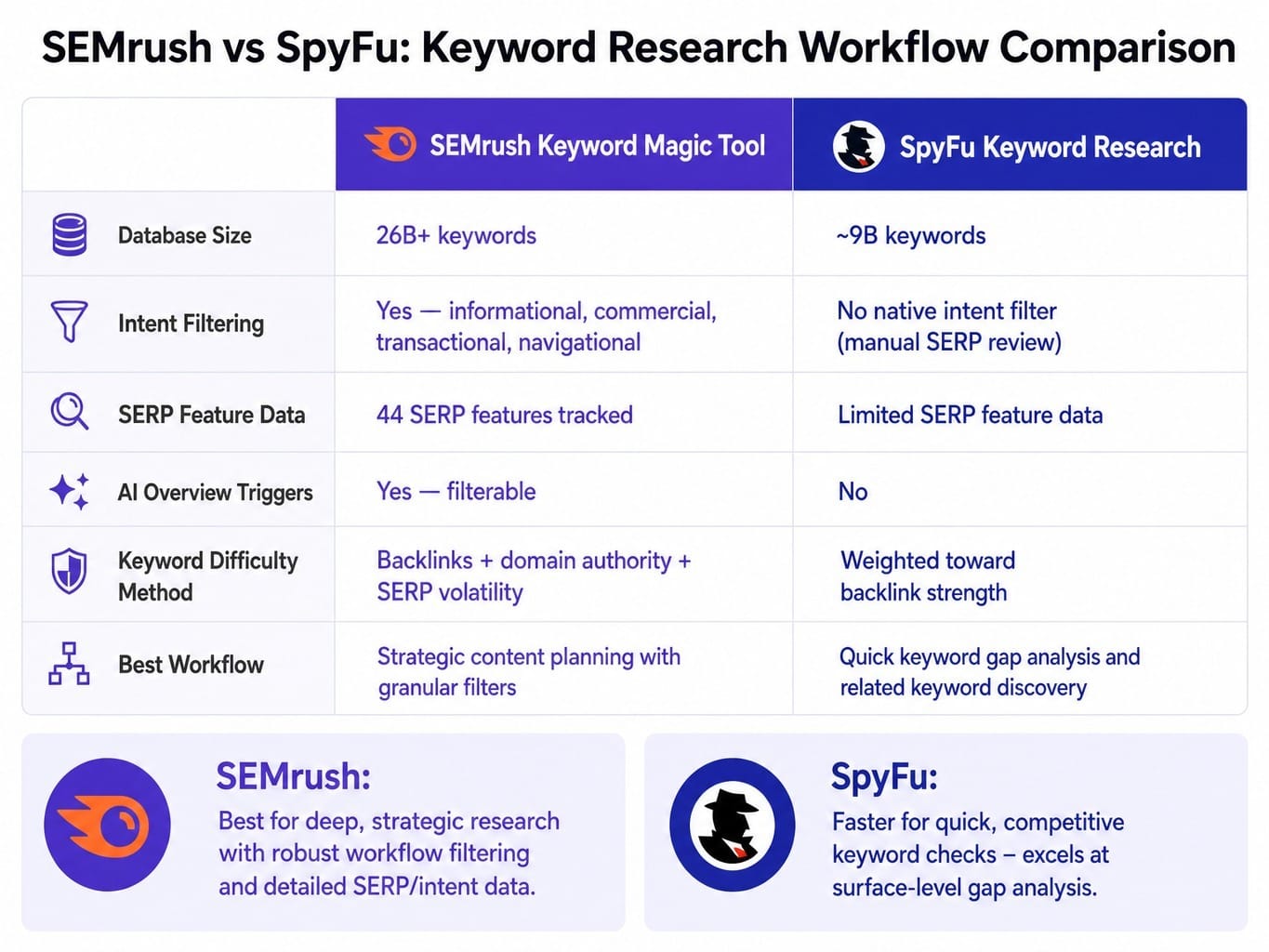
Database size is the most misleading metric in any tool comparison. SEMrush claims over 26 billion keywords; SpyFu cites around 9 billion. This means nothing if the estimates for your specific domain are wrong. The only honest way to evaluate accuracy is to compare each tool's estimates against first-party data from Google Search Console (for organic traffic) and Google Ads (for PPC performance).
No third-party tool will ever be 100% accurate. They rely on clickstream data panels and web crawling to model a search landscape they can't see directly. The real question is whether the data is directionally reliable enough to base strategic decisions on.
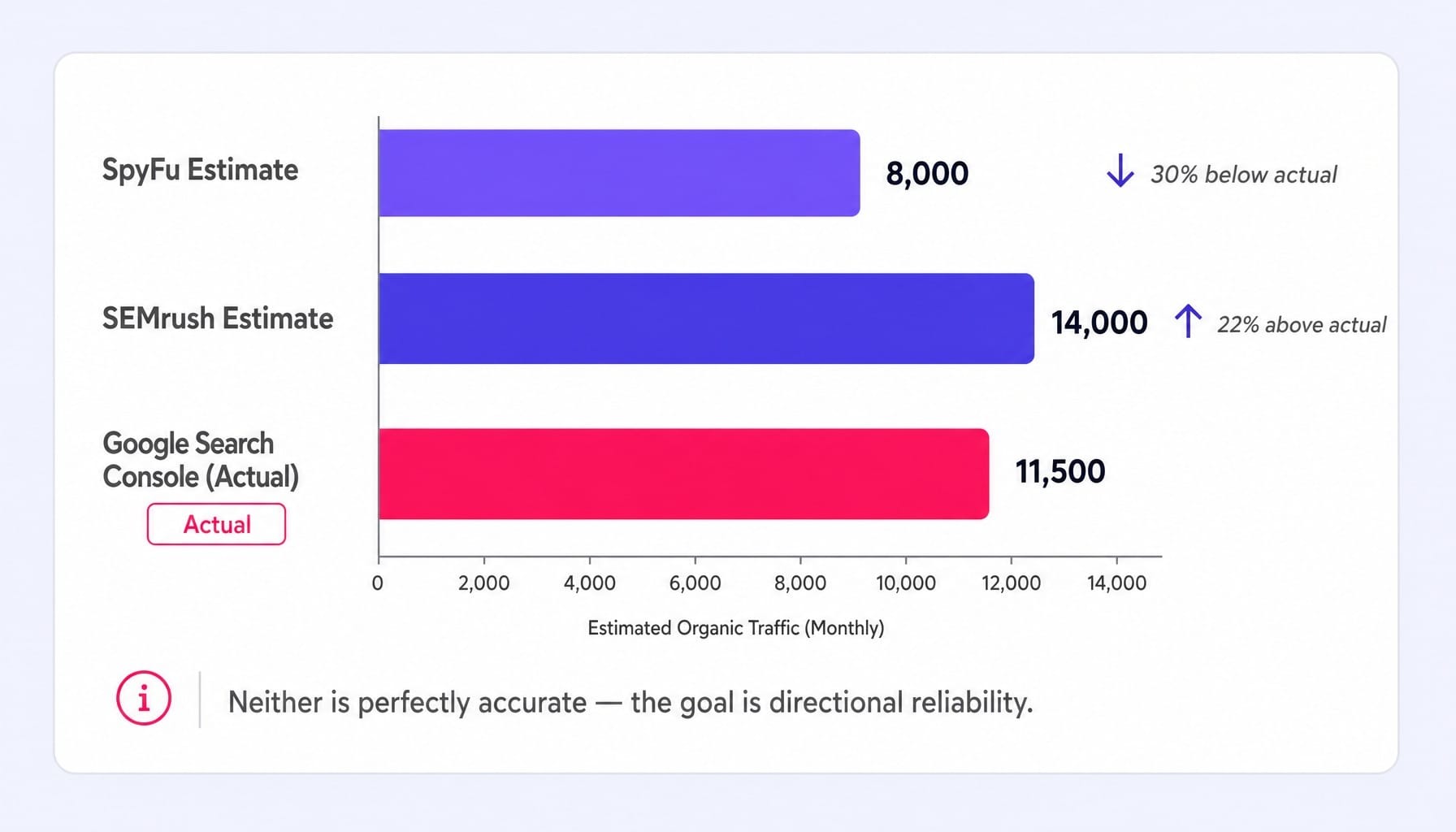
For example, you pull your own domain into both tools. SpyFu estimates 8,000 monthly organic visits, SEMrush estimates 14,000, and your GSC account shows the reality is 11,500. Neither is perfectly correct, but SEMrush is directionally closer. This is the level of scrutiny required. For competitive benchmarking, that directional accuracy is what prevents you from chasing phantom opportunities or underestimating a competitor's true share of voice.
Organic Traffic and Keyword Estimates
SEMrush's organic traffic and keyword estimates are generally more reliable for mid-to-large domains. This isn't just about database size; it's about data sourcing and freshness. SEMrush invests heavily in its clickstream data panel and uses machine learning to adjust search volume estimates, which tends to produce more accurate traffic models, particularly for sites with over 50,000 monthly visits. Its index update cadence is also more frequent, meaning it catches new ranking pages faster.
SpyFu's organic data is perfectly serviceable for high-level competitive views in the US market. However, its accuracy can degrade for smaller sites (under 10k monthly visits) and for international domains, where its data panel is less robust. For deep organic keyword research and content strategy, SEMrush's larger, more frequently updated keyword universe provides a more complete picture of the terms that actually drive traffic.
PPC and Google Ads Data
SpyFu's PPC data is genuinely superior for historical Google Ads competitor research. This isn't just a marketing claim; it's an architectural advantage. By archiving Google Ads SERPs since 2006, SpyFu has created an unmatched dataset for analyzing a competitor's long-term paid strategy. You can see which keywords they've bought consistently for years (a strong signal of profitability) and which ad copy variations they've tested and abandoned.
SEMrush's PPC data is broader—covering more countries and integrating social ads—but it's historically shallower. For a paid search manager whose primary task is deconstructing a competitor's Google Ads playbook, SpyFu's Kombat report and deep ad history provide more actionable intelligence per dollar. This is the one area where SpyFu has a data-backed, defensible lead.
Keyword Research: Database Size vs. Research Workflow
SEMrush has a significantly larger keyword database, but for most B2B SaaS teams, this is a vanity metric. The operative question is not "which tool has more keywords?" but "which tool helps me find the right 50 keywords faster?" This is a question of workflow, not volume.
The difference is in the execution. SEMrush's Keyword Magic Tool is built for strategic content planning. It allows you to filter keywords by user intent (informational, commercial, transactional), question-based queries, and by which of 44 different SERP features they trigger. This workflow allows a content strategist to quickly isolate high-intent keywords that also have a chance of appearing in an AI Overview.
SpyFu's keyword research tool is simpler. It's fast and effective for surfacing related keywords and "also ranks for" opportunities, making it great for quick-and-dirty keyword gap analysis. However, it lacks the granular intent filtering and SERP feature data needed for a sophisticated content strategy. A content marketer looking for "CRM onboarding workflow" keywords in SEMrush can filter for commercial intent and AI Overview triggers in seconds. In SpyFu, that same analysis is a manual process of reviewing SERPs.
This extends to keyword difficulty scores. SEMrush's calculation is more complex, factoring in backlink profiles, domain authority, and SERP volatility. SpyFu's score is weighted more heavily toward backlink strength. Neither is "wrong," but they answer different questions about the competitive landscape.
PPC Competitor Intelligence: Where SpyFu Genuinely Wins
If your primary use case is spying on competitors' Google Ads—their keywords, ad copy, bid estimates, and historical spend—SpyFu is the better tool. Full stop.
Its advantage is architectural. With ad history data going back over 18 years, SpyFu lets you function as a digital archaeologist for your competitors' campaigns. You can see every ad variation they've tested, identify keywords they've bought consistently (a proxy for profitability), and spot terms they've abandoned (an indicator of wasted spend). The Kombat report, which overlays the PPC keyword universes of up to three competitors, is ruthlessly efficient at finding gaps and overlaps in the paid landscape.
SEMrush's Advertising Research tool provides similar top-level data but lacks this historical depth. Its strength lies more in execution, with tools like the Ads Launch Assistant that let you build and deploy campaigns directly. This is useful, but it's a different job than pure competitive intelligence.
Consider this scenario: a paid search manager notices a key competitor has suddenly changed their ad messaging. In SpyFu, they can pull up the competitor's ad history and see the exact copy variations tested over the last six months, complete with estimated CPC and position data. This reveals the strategic narrative. In SEMrush, they see the current ad copy but have limited context on the evolution that led to it. For this specific workflow, SpyFu's data isn't just cheaper; it's fundamentally more complete.
Backlinks, Site Audits, and the Feature Gap That Matters
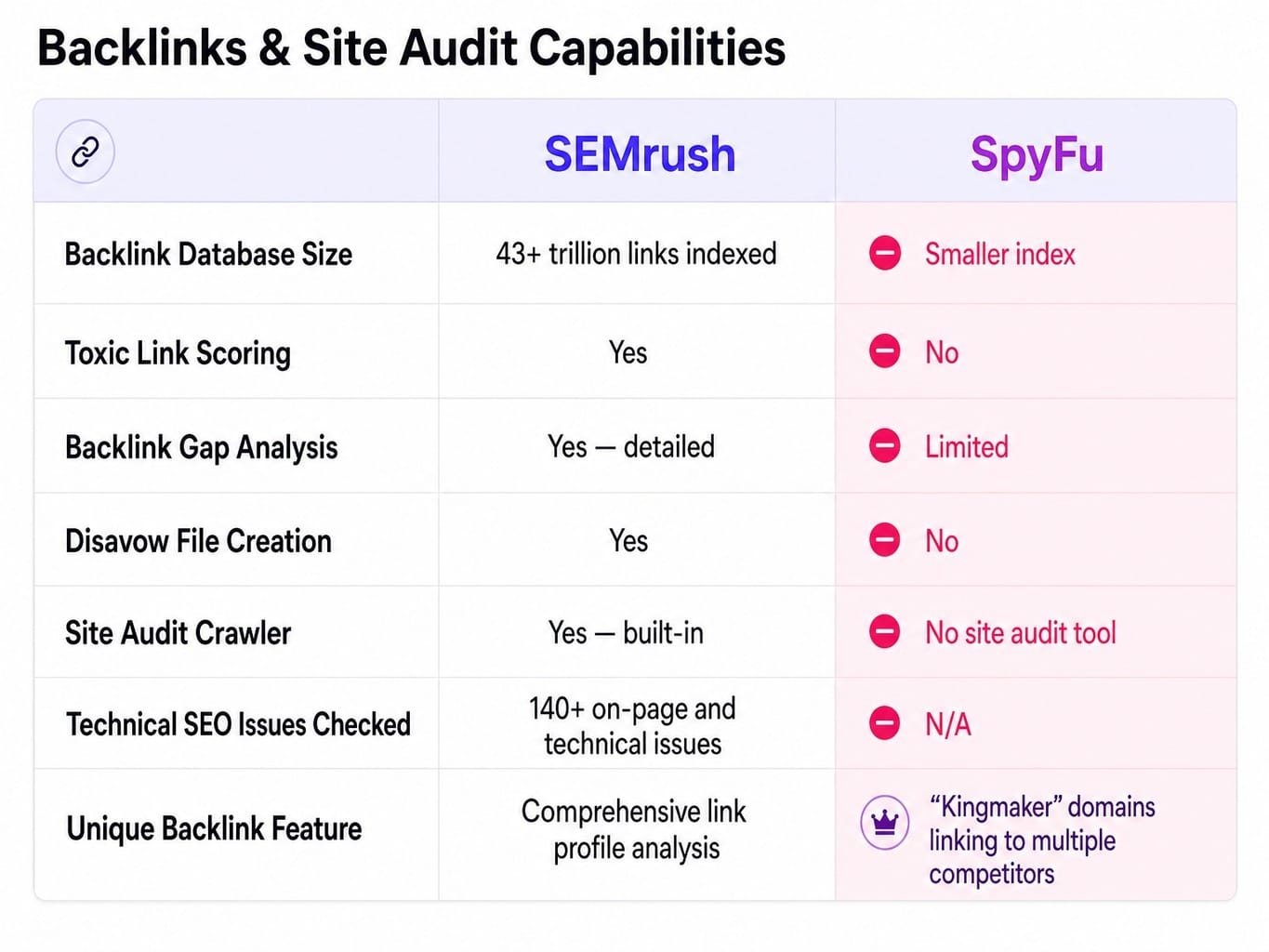
The comparison becomes lopsided here: SEMrush's backlink and site audit capabilities are in a different league. SEMrush's backlink database, with over 43 trillion links indexed, is one of the largest on the market. It supports toxic link scoring, detailed backlink gap analysis, and integrates with a full site audit crawler that checks for over 140 technical and on-page SEO issues.
SpyFu does not offer a site audit tool. Its backlink tool is designed around a specific workflow: identifying "kingmaker" domains that link to multiple competitors, making it useful for targeted outreach prioritization. However, it is not built for comprehensive link profile analysis, disavow file creation, or diagnosing technical issues like index bloat or poor crawl budget allocation.
If your team's responsibilities include backlink auditing, technical SEO monitoring, or running health checks for clients, SEMrush is the only viable option between the two. This feature gap alone can justify SEMrush's higher price, as you would need a separate tool like Screaming Frog to replicate its site audit functionality.
Read more: Semrush vs Moz (2026): Which SEO Tool Fits Your Team's Actual Workflow
True Cost of Ownership: Beyond the Sticker Price
Comparing SpyFu at $39/mo to SEMrush at $139.95/mo is a fundamentally flawed analysis. The true cost of ownership is shaped by three factors that most reviews ignore.
- Seat and Project Limits: SEMrush's entry-level Pro plan limits you to one user, five projects, and 500 tracked keywords. An agency managing ten clients or a marketing team tracking multiple product lines will immediately need the Guru ($249.95/mo) or Business ($499.95/mo) plan. Additional user seats cost $45-$100/mo each. SpyFu, by contrast, offers unlimited searches, data exports, and projects on every plan. For agencies, this predictable, flat-rate pricing is a significant advantage.
- Add-On Modules: Many of SEMrush's advanced features, like the .Trends competitive intelligence suite or the Agency Growth Kit, are paid add-ons. A fully loaded SEMrush subscription for a small team can easily surpass $400/mo.
- Supplementary Tool Cost: This is the hidden cost. If you choose SpyFu, you will almost certainly need another tool for technical site audits (e.g., Screaming Frog at ~$259/year) and potentially another for deeper backlink analysis (e.g., Ahrefs Lite at ~$129/mo).
Let's model this for a 3-person B2B SaaS marketing team.
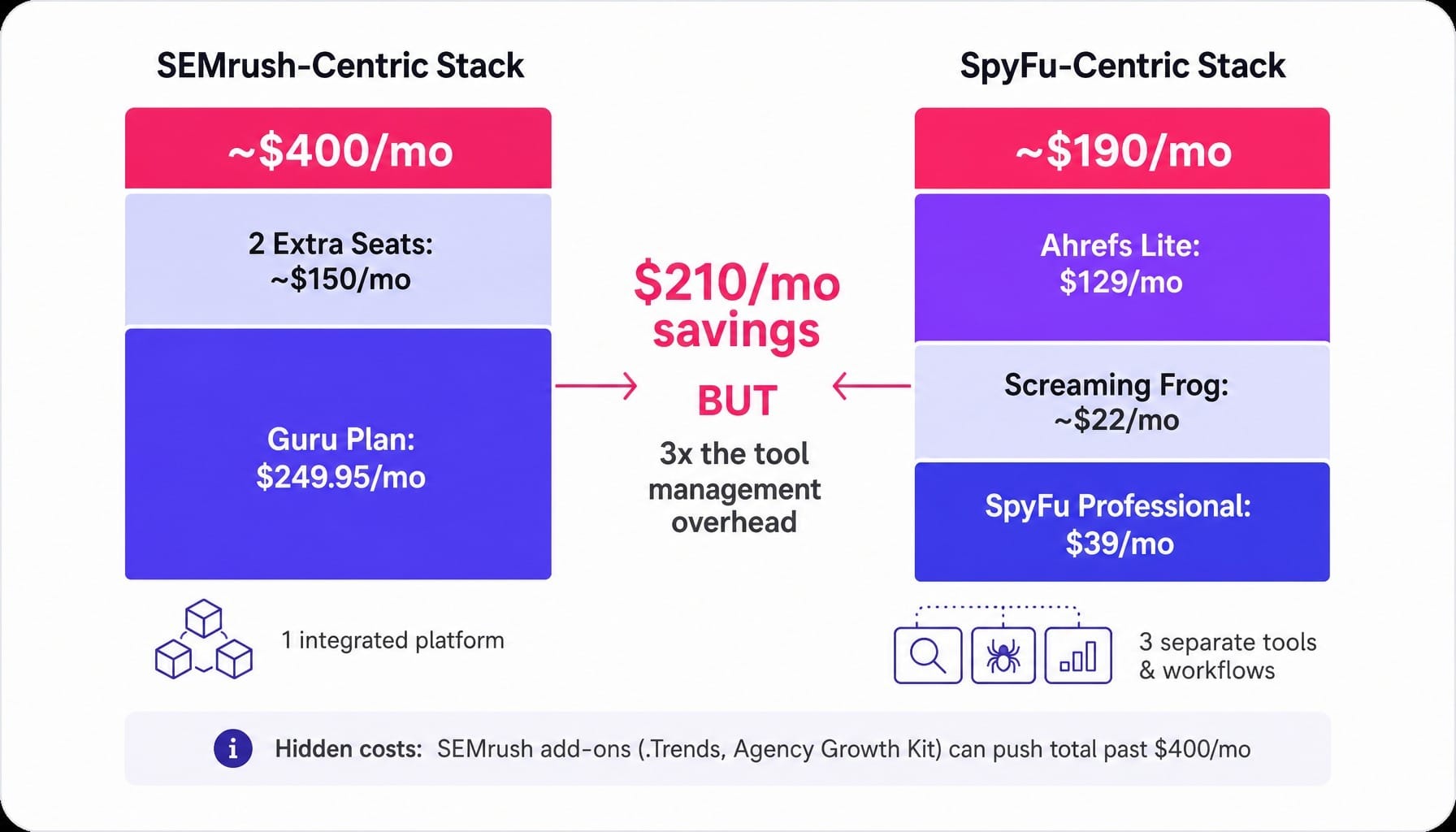
- SEMrush Stack: Guru plan ($249.95/mo) + 2 extra seats (~$150/mo) = ~$400/mo.
- SpyFu Stack: Professional plan ($39/mo) + Screaming Frog (~$22/mo) + Ahrefs Lite ($129/mo) = ~$190/mo.
The SpyFu-centric stack is still cheaper, but the gap narrows considerably, and now your team is managing three separate tools and workflows instead of one integrated system. The cost decision is ultimately a workflow consolidation decision.
Read more: SE Ranking vs Semrush (2026): Real Tests, Hidden Costs, and Who Should Use Which
When the Real Bottleneck Isn't the Tool — It's the Execution
Choosing between SpyFu and SEMrush feels like a high-stakes decision because it forces you to prioritize your team's limited bandwidth. But even after you've made the choice, the core constraint remains. Someone still has to connect the dots between the data, prioritize a course of action, get buy-in, and ship the change.
For most lean marketing teams, the bottleneck is never a lack of insights; it's the latency between identifying what needs to change and actually getting it done. This is the execution gap where marketing performance dies.
Spike AI is designed to close that gap. It functions as an execution layer that sits downstream of your analytics tools. Spike AI ingests signals from SEO, CRO, and paid search, identifies the single highest-impact move you can make, and then executes it for you. The backlog of "should-dos" from your SEMrush audit or SpyFu analysis transforms into a queue of weekly shipped improvements. The best tool in the world doesn't move the needle if its findings sit in a spreadsheet for three weeks.
See how Spike AI turns your marketing backlog into weekly shipped improvements
Conclusion
The SpyFu vs. SEMrush debate isn't about which tool is "better." It's about which system best fits the workflow you can actually sustain.
SpyFu is the sharper, more focused instrument for teams whose primary job is PPC competitor intelligence. It does one thing exceptionally well and offers it at a predictable price. SEMrush is the broader, more integrated platform for teams responsible for the entire organic growth function, from technical SEO to content strategy.
The right choice depends on your budget, your team's core responsibilities, and your tolerance for managing a multi-tool stack. But whichever you choose, remember that the tool only provides observation. The harder question is whether your team has the system and the bandwidth to turn that observation into execution. Data without deployment is just an expensive hobby.
Frequently Asked Questions (FAQ)
Can I use SpyFu and SEMrush together in the same workflow?
Yes, and many practitioners do. The most common pairing uses SpyFu for its deep PPC competitor and ad history analysis, while relying on SEMrush for organic keyword research, comprehensive site audits, and backlink monitoring. This only makes sense if your PPC intelligence needs are critical enough to justify the subscription overlap.
How do SpyFu and SEMrush API rate limits compare for programmatic workflows?
SEMrush offers API access starting with its Guru plan, with daily request limits scaling by tier (typically 3,000 to 10,000). SpyFu provides API access on its Professional and Team plans with usage-based pricing. For teams building automated reports in Looker Studio or integrating data into a CRM, SEMrush's API is generally more mature and better documented.
Is SpyFu worth keeping if I already pay for SEMrush?
Only if you rely heavily on Google Ads competitor intelligence. SpyFu's 18+ years of ad history and its Kombat report for multi-competitor PPC overlap analysis are capabilities that SEMrush does not match in depth. If your PPC research is occasional rather than central to your workflow, the cost is likely not justified.
Can SpyFu track local SEO rankings as effectively as SEMrush?
No. SEMrush's position tracking is far more robust for local SEO, supporting city- and zip-code-level monitoring across 120+ countries with device segmentation. SpyFu's rank tracking is primarily US-focused and lacks this granularity. For multi-location businesses or those targeting specific local markets, SEMrush is the significantly stronger option.
How does each tool handle AI visibility and AEO tracking in 2026?
SEMrush has a meaningful lead here. Its AI Visibility Score tracks your domain's presence in Google AI Overviews, ChatGPT, and other generative engines. SpyFu's SpyGPT feature offers basic AI brand monitoring but is less comprehensive. For teams prioritizing Answer Engine Optimization (AEO), SEMrush provides more actionable data.