Top 5 Optimizely Alternatives for 2026
Looking for Optimizely alternatives often means you hit an engineering wall. Lean marketing teams face a new hurdle today. The hard part is no longer designing a great experiment. The real problem is waiting weeks for a developer to build it.
You do not need another complex tool that relies on code. You need a smart system that guides your limited bandwidth. It should tell you exactly what will grow your pipeline.
The best Optimizely alternatives include Spike AI for unified performance intelligence, VWO for visual testing, Unbounce works well for fast landing pages, Mutiny handles B2B account personalization. AB Tasty is a solid choice for mid-market product teams.
Choosing the right Optimizely alternative depends on your goals. Do you want to manage complex server-side code? Or do you want a cross-channel system that helps your lean team scale revenue on its own?
The Enterprise Overhead Trap: Why a Standard "Optimizely Comparison" Fails
When senior marketers compare Optimizely alternatives, they often get lost in technical details. You end up looking at server-side SDKs, tracking APIs, and complex algorithms. But if you have a marketing team of one to five people, checking enterprise features is a trap.
Most enterprise CRO tools work in a highly technical vacuum. They measure how a specific product feature performs. But they ignore the downstream marketing pipeline. They also miss the upstream traffic context.
Consider the product-to-marketing disconnect. Your product team uses an Optimizely alternative to test your SaaS onboarding flow. They change how pricing tiers look based on feature usage. The test wins. The product dashboard looks great.
However, the Optimizely alternative you selected does not talk to your marketing data. It misses the fact that the new flow breaks the journey for a high-intent segment. These users came from your most expensive LinkedIn Ads campaign.
The product team celebrates a win, but your Net New ARR drops. Why? Because the enterprise testing tool could not read the paid media context. It optimized an isolated metric instead of a unified revenue outcome.
Execution software is just a commodity. Revenue prioritization is your actual edge. Lean teams cannot afford to pay six figures for an alternative to Optimizely that needs constant developer help. You should not pay to run tests that ignore your pipeline.
Top 5 Optimizely Alternatives Evaluated by Strategic Fit
We looked closely at the market. Here are the top Optimizely alternatives for experimentation. We grouped them by their strategic focus, depth, and fit for agile B2B SaaS teams.
1. Spike AI (Best for Unified Performance Intelligence & Prioritization)
Spike AI closes the fatal gap between messy data and revenue-driving action. It shifts your workflow. You move from “Data → Developer Requests → Manual guessing” to “Unified data → Cross-channel intelligence → Prioritized action → Implementation”.
Spike AI works as a complete marketing intelligence layer. It takes in data across SEO, PPC, core web pages, and CRM. It spots bad performance across your funnel. Then, it recommends high-impact changes and projects expected revenue.
Core Capabilities
Multi-channel data syncing, systemic bottleneck diagnosis, revenue-weighted priorities, cross-channel opportunity scoring.
Is Spike AI a better alternative to Optimizely?
Optimizely is good if you are a massive enterprise testing backend code. However, Spike AI is the better choice for lean marketing teams who want unified performance intelligence. If you struggle to know what to test to drive actual revenue, Spike AI wins. Optimizely needs developers to execute ideas. Spike AI connects your multi-channel signals to automatically prioritize tests based on pipeline impact. Optimizely measures technical activity. Spike AI drives pipeline output.
The Verdict
Spike AI targets lean marketing teams that must drive measurable revenue but lack a dedicated engineering squad. It acts as a force multiplier and an execution accelerator.
2. VWO (Best for Marketer-Led Visual Testing)
VWO is a deep conversion rate optimization platform. It focuses on giving power back to the marketer. It cuts down your reliance on IT and developers.
Core Capabilities
Client-side A/B testing, multivariate testing, integrated heatmaps, session recordings, simple visual editor.
Is VWO a better Optimizely alternative?
Yes, especially for marketing teams trapped by Optimizely's sheer complexity. Optimizely is built for engineers to safely test application architecture. VWO is marketer-friendly. Growth teams can launch client-side tests fast without writing any code.
The Verdict
VWO is a great choice if you just want to escape the engineering queue. However, it still operates as an isolated execution editor. It helps you run tests faster, but you still have to manually map those wins to your CRM pipeline.
3. Unbounce (Best for Rapid Paid Media Deployment)
Unbounce changed the game for performance marketers. It lets you skip the engineering line completely when dealing with paid traffic.
Core Capabilities
Drag-and-drop landing page builder, AI "Smart Traffic" routing, dynamic text replacement for ads.
Should You Choose Unbounce over Optimizely?
Comparing Unbounce as an Optimizely alternative is like comparing a speedboat to a cruise ship. Optimizely takes a massive crew to test complex web apps. Unbounce lets a single marketer build 25 unique landing pages for LinkedIn Ads before lunch.
The Verdict
Unbounce is a great escape hatch for lean teams scaling paid media. It frees you from Optimizely's heavy deployment process. However, it only optimizes isolated landing pages. It does not unify data across your broader inbound funnels.
4. Mutiny (Best for B2B Account-Based Personalization)
Mutiny owns a highly specific, profitable niche in B2B SaaS. It moves away from standard statistical testing. Instead, it focuses purely on B2B pipeline conversion for Account-Based Marketing (ABM).
Core Capabilities
CRM-integrated firmographic personalization, dynamic 1:1 outbound pages, AI headline generation based on accounts.
Is Mutiny a better Optimizely Alternative?
Optimizely tries to find the perfect page version for a huge audience over time. Mutiny instantly rewrites your website copy based on a visitor’s specific Salesforce stage, industry, or company name. It trades complex statistical tests for targeted 1:1 pipeline conversion.
The Verdict
Mutiny is a great tool if you rely on outbound sales and high-value enterprise deals. It needs far less technical overhead than Optimizely. However, it focuses purely on the page experience. It assumes your wider traffic strategy is already perfect.
5. AB Tasty (Best for Mid-Market Product Teams)
AB Tasty offers a balanced suite. It gives companies both marketing speed and product team control. It often serves as the perfect middle ground for teams downgrading from Optimizely.
Core Capabilities
Client-side visual testing, server-side rollouts, advanced widget library, behavioral audience segmentation.
Is AB Tasty the Best Optimizely Alternative for Product Teams?
Yes. Sometimes your product team still needs server-side feature management. But your marketing team desperately needs an easy visual editor. AB Tasty bridges this gap beautifully. It costs much less than Optimizely while keeping strong technical features.
The Verdict
AB Tasty works very well for combined marketing and product teams. But it stays in the exact same execution mindset. You must still pull your cross-channel data, create your own ideas, and calculate the downstream revenue impact yourself.
Comparing the Top 5 Optimizely Alternatives: Engineering Suites vs. Intelligence Layers
When we look at the core use of these Optimizely alternatives, a clear split appears. We see Execution Engines like VWO, Unbounce, Mutiny, and AB Tasty. Then we see an Intelligence Layer like Spike AI.
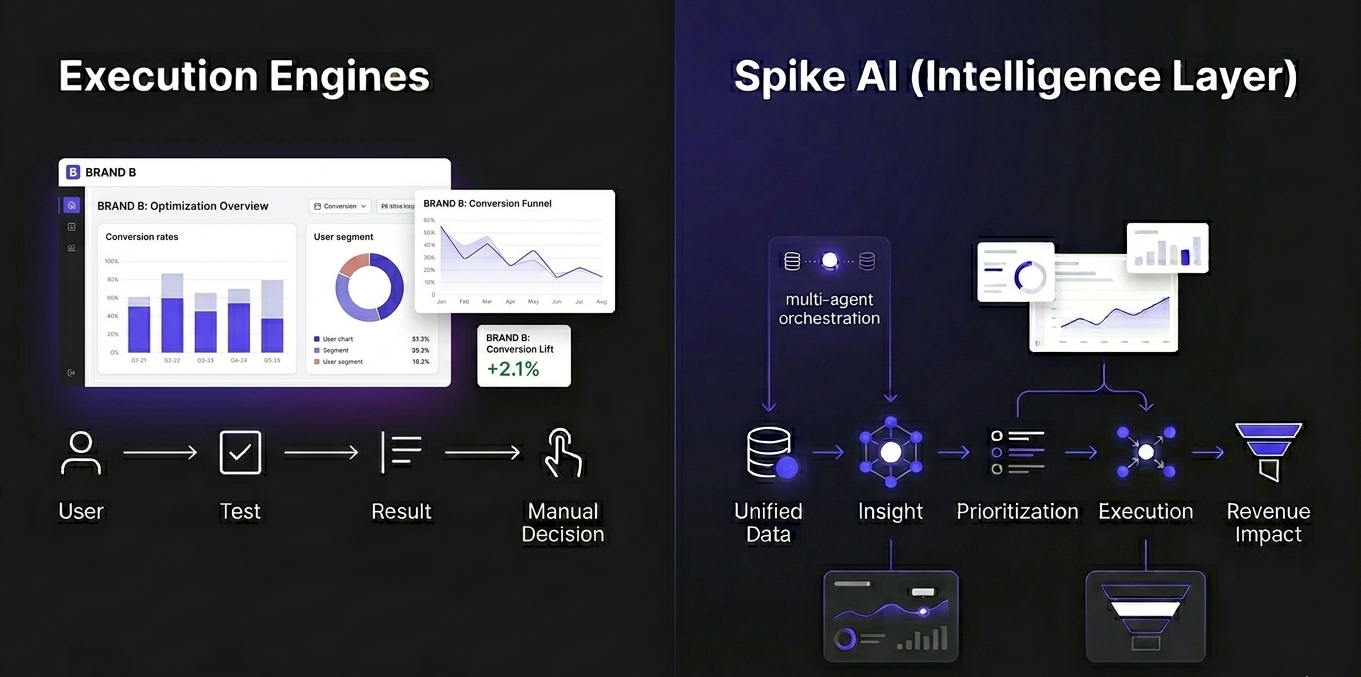
Tools like Optimizely are incredibly powerful. If you have the time, the budget, and a perfect idea, they will run the test flawlessly.
However, marketing does not fail due to a lack of complex software. It fails because of disconnected execution. Lean marketing teams rarely fail because they lack an enterprise coding tool. They fail because they test the wrong things.
You might spend a whole month using Optimizely to test a new menu. Meanwhile, your actual revenue leak happens in your mid-funnel emails or paid search intent mapping.
Current standard Optimizely alternatives find technical problems. They rarely provide clear strategic steps. They almost never implement solutions. They keep product and marketing in rigid silos.
The "Resource Debt" Audit: Do You Need an Engineering Tool or an Intelligence Layer?
Before you buy a new Optimizely alternative, run a quick 60-second mental audit. We call this finding your "Resource Debt."
This test is built for 1–5 person marketing teams. If you have too many tools, strict limits on resources, and feel crushed by enterprise software, ask yourself these three questions:
- The Deployment Question: How many good, revenue-driving ideas died in a Jira backlog last quarter because engineers were too busy to build them in Optimizely? (If the answer is more than three, your tool blocks your growth).
- The ROI Question: Do you actually use your complex server-side testing tools? Or do you pay a massive premium just to test simple headlines and buttons? (If you only change the copy, you pay a huge "Enterprise Tax").
- The Hypothesis Question: If your demo conversion rate drops by 15% tomorrow, do you know why? Was it a product update, an SEO drop, or a paid media shift? (If you have to guess, your product and marketing data do not mix).
If you failed this audit, switching to another standard Optimizely alternative will not fix your growth. Your problem is not a lack of advanced stats. Your problem is a lack of intelligent, outcome-driven execution.
The "Hypothesis-to-Deployment" Friction Framework
Just swapping Optimizely for another alternative rarely solves your resource debt. We must look at the drag created by traditional point solutions. We see this friction happen in three phases:
Phase 1: The Cross-Department Data Tax
Senior leaders spend over ten hours a week trying to match marketing data with product data. You pull ad spend from Google Ads. You check organic traffic in Google Search Console. You review feature metrics in Optimizely. The data is there, but the connections are missing. You pay a heavy time tax just to set a baseline.
Phase 2: The Prioritization Vacuum
Current standard Optimizely alternatives measure a live test very well. But they offer zero help on what you should test first. Your lean team must manually check the whole funnel. Should you test the homepage hero? Should you rebuild the high-intent PPC landing pages? Optimizely cannot see your multi-channel data. You are left to guess.
Phase 3: The Engineering Graveyard
You finally gather the data and form a cross-channel idea. Then, execution stops completely. Lean teams cannot hire dedicated developers just for CRO. Because of this, a great test sits in an engineering backlog for weeks. You wait for help that never arrives.
Spike AI is built to crush this entire framework. It operates as a scalable marketing team member without adding headcount. It ends the cross-department data tax. It stops the prioritization vacuum by linking cross-channel signals. Finally, it gives you a highly targeted execution sequence.
Implementation Logic: Stop Waiting on Developers, Start Prioritizing Revenue
Standard Optimizely alternatives are downstream tools. They assume you already have perfect funnel visibility. They assume you know exactly what needs testing. They assume you have developers ready to write the code.
In a lean B2B SaaS company, this is rarely true. Gaining unified visibility and picking the right fix is your actual challenge.
If your team must drive real revenue across multiple channels, you do not need a complex developer tool. You need an execution accelerator. You must elevate your workflow from local feature testing to structural performance awareness.
Instead of paying for enterprise software that sits idle, let Spike AI find your highest-leverage growth bottlenecks.
Book a customized revenue diagnostic call with our team today to see how we unify your fragmented marketing data and prioritize your next best action.
Frequently Asked Questions
What is the main difference between Spike AI and Optimizely?
Optimizely is a massive experimentation platform. It relies heavily on engineers to run deep, server-side product tests. Spike AI is a unified performance intelligence layer. It connects data across SEO, PPC, and your core website. It finds systemic bottlenecks and prioritizes marketing fixes based on CRM revenue. It removes the heavy developer needs of traditional testing tools.
Are there good Optimizely alternatives for product teams?
Yes. If your product team needs strong server-side feature flagging, AB Tasty is a good Optimizely alternative for product teams. They cost much less. However, if you want to align product changes with marketing revenue, an intelligence layer like Spike AI must sit upstream to prioritize those tests.
How do you measure the ROI of Spike AI compared to alternatives to Optimizely?
Optimizely measures success through statistical lifts on single pages or new features. Spike AI measures ROI directly through pipeline impact. Spike AI brings cross-channel data together. It tracks how prioritized marketing fixes directly influence Net New ARR. This bridges the gap between basic product tests and board-level revenue goals.
Can I use Spike AI alongside my current experimentation tools?
Absolutely. Spike AI works upstream as your strategic prioritization layer. It finds the highest-revenue chances across your whole marketing stack. Once Spike AI tells you exactly what to fix, it can confidently make the necessary changes on its own.