Writesonic Pricing 2026: Plans, Hidden Costs, and What You Actually Pay
TL;DR
- Writesonic's pricing has six tiers, but the real decision points are between individual plans (Lite/Standard) and team/GEO plans (Professional and above), which represent a 5x price jump.
- Your actual Writesonic cost is determined by your usage patterns. The platform meters articles, GEO prompts, and site audits separately, and hitting your cap mid-month means your content production stalls.
- Key features like GEO tracking, multi-seat access, and workflow automation are locked behind more expensive tiers. Your minimum viable plan is defined by feature gates, not just article volume.
- Annual billing saves ~20-25%, but locking in before you know your true monthly consumption can lead to wasted budget. Validate your usage on a monthly plan first.
- Compared to competitors like Jasper, Writesonic's higher price is for a bundled platform including GEO and SEO tools. If you only need a writing assistant, cheaper point tools exist.
Writesonic's pricing page shows you plan names and monthly rates, but it doesn't tell you what you'll actually spend. The real Writesonic cost—the effective figure that hits your budget—is shaped by factors the pricing page doesn't highlight.
The gap between the listed price and your total cost of ownership comes down to three variables most marketing teams don't evaluate until they're already subscribed:
- Credit Consumption: How quickly your workflow burns through separate allocations for articles, GEO prompts, and audits.
- Feature Gating: Which critical capabilities are locked behind more expensive tiers, rendering cheaper plans irrelevant for your needs.
- Model Selection: Whether the AI model required for quality output consumes credits at a higher rate.
This is the analysis Writesonic's own pricing page doesn't provide. It's not a feature tour; it's a cost-of-ownership breakdown to help you determine which plan, if any, truly fits your team's workflow and budget.
Writesonic Pricing Plans for 2026: What Each Tier Actually Includes
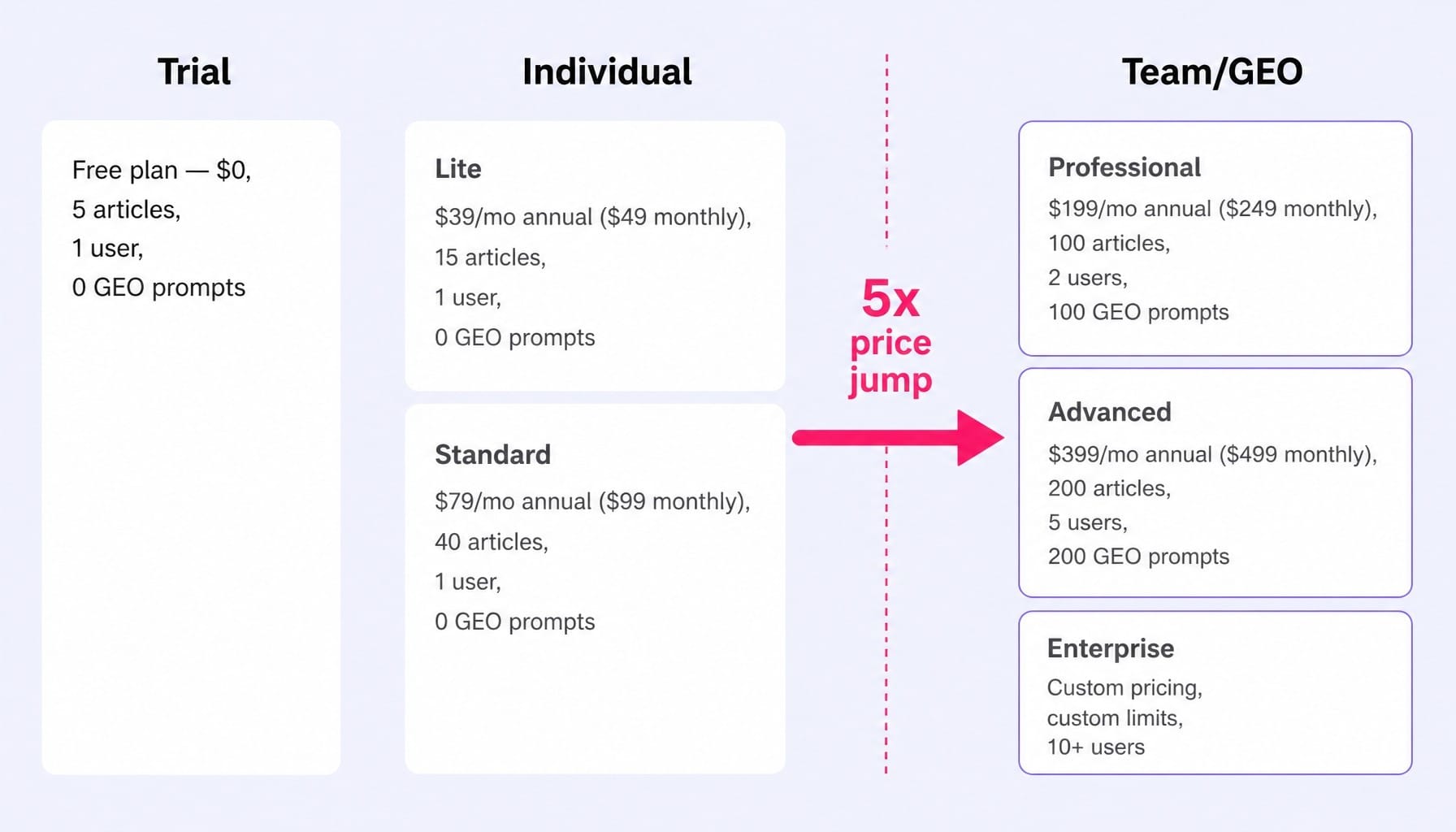
Writesonic offers six distinct pricing tiers, but for most marketing teams, the decision boils down to three clusters: the free trial tier, individual contributor plans (Lite and Standard), and team-focused plans with GEO capabilities (Professional and above). The jump between these clusters is where the most significant cost and capability shifts occur.
Understanding this structure is critical. When a B2B SaaS team budgets for an AI writing tool based on sticker price and then hits credit caps or feature gates mid-quarter, the resulting content gap doesn't just waste the subscription cost; it stalls pipeline velocity at the exact moment campaigns need fresh assets.
Here's how the plans break down as of Q3 2024.
The table shows the numbers, but the real story is in the workflow implications. For a solo content marketer producing 15 blog posts a month, the Lite plan seems perfect. But the moment they need to track AI search visibility with GEO or add a second team member, their required plan jumps from $39/month to $199/month. That's a 5x price increase for a capability unlock, not a volume increase. This is the real pricing decision most growing teams face.
Free and Lite Plans: What You Get and Where You Hit the Ceiling
Writesonic's free plan is a product demo, not a sustainable working tool. It provides a valuable way to test output quality and the user interface, but with a cap of just five articles and most advanced features locked, it's insufficient for any consistent content workflow. A startup founder can use it to get a feel for the AI model's tone, but they'll hit the ceiling trying to produce even a single week's worth of content.
The Lite plan ($49/mo, or $39/mo annually) is the true entry point for individuals. It offers 15 articles per month, which is viable for a solo marketer with very low-volume needs. However, it's strictly a single-player experience with no access to GEO, team collaboration, or advanced analytics. It's a capable AI writer, but nothing more.
Professional and Advanced: Where GEO and Team Features Unlock
The Professional tier ($249/mo, or $199/mo annually) is where Writesonic becomes a fundamentally different product. This is the first plan where Generative Engine Optimization (GEO) tracking, sentiment analysis, and multi-seat access become available. For any marketing team focused on visibility in AI Overviews and conversational search, the plans below Professional are effectively irrelevant.
The Advanced tier ($499/mo, or $399/mo annually) primarily offers more volume—doubling articles, GEO prompts, and increasing seats to five. While valuable for larger teams, the capability jump isn't as transformative as the one from Standard to Professional. A 2-3 person growth marketing team should start at Professional. Only upgrade if you consistently exhaust your 100 monthly GEO prompts and find that seat limitations are creating a workflow bottleneck.
How Writesonic's Credit System Actually Works (and Why Your Real Cost May Be Higher)
Your Writesonic cost isn't a simple flat fee. The platform doesn't charge per word but instead meters usage across three distinct categories: articles, GEO prompts, and site audits, each with its own monthly cap. This means your effective cost-per-output can vary dramatically depending on your workflow.
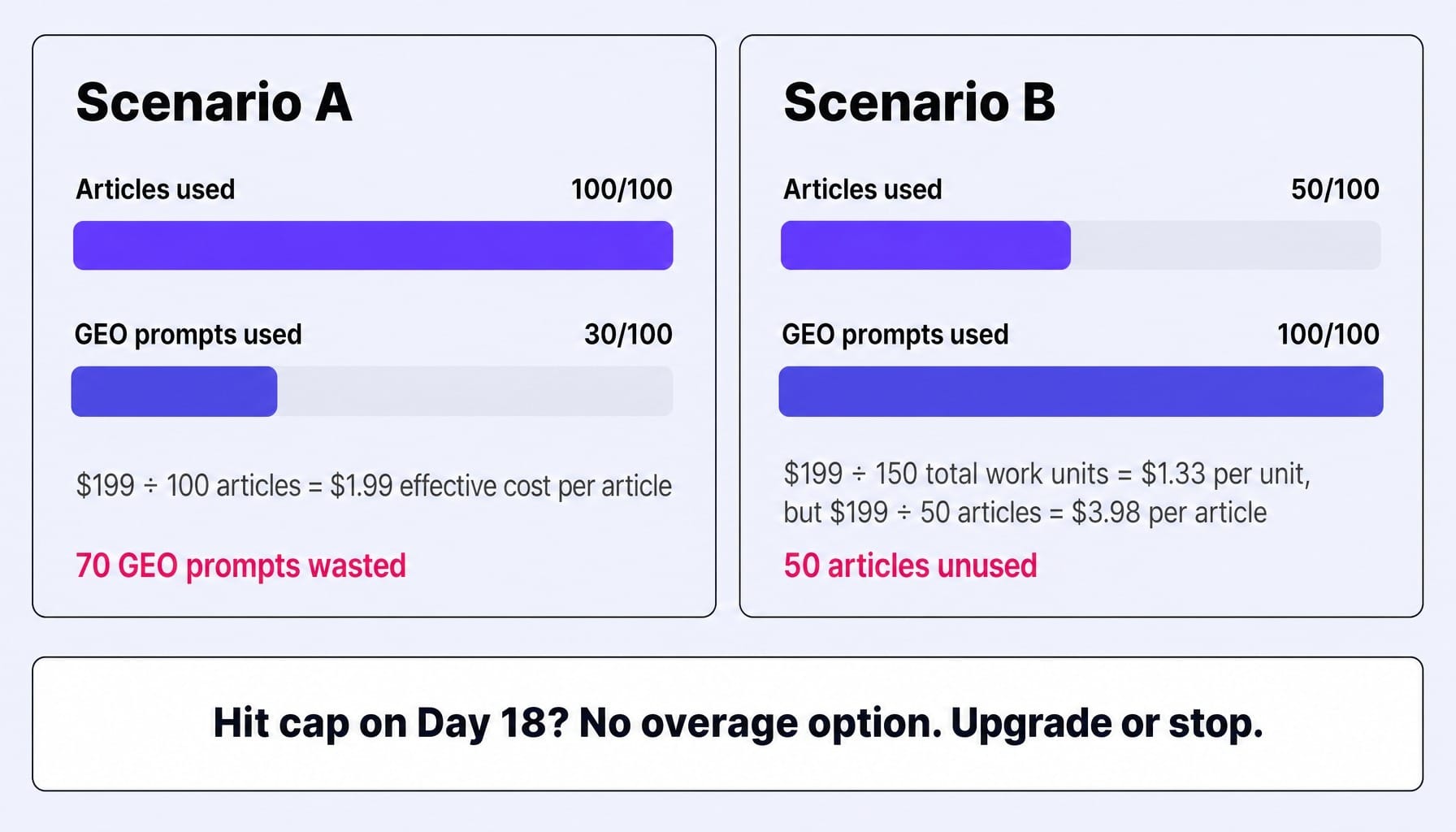
Consider a team on the Professional plan ($199/mo annually), which includes 100 articles and 100 GEO prompts.
- Scenario A: They use all 100 articles but only 30 GEO prompts. Their effective cost-per-article is ~$1.99.
- Scenario B: They publish only 50 articles but use all 100 GEO prompts to track SERP visibility. Their blended CPW (cost-per-work-unit) is now distributed differently, making each article "cost" more in the context of the total subscription.
I learned this the hard way. While running a content velocity test, I found that a tool advertising a low monthly rate ended up costing 40% more per published article. Its credit system consumed double the credits for long-form outputs, burning through the monthly allocation far faster than the headline "article count" suggested.
This highlights the most critical question most buyers miss: what happens when you hit the cap mid-month? Writesonic doesn't offer overage purchasing on most plans. You either upgrade to the next tier or you wait for the next billing cycle. This creates a hard cap—a throttling threshold that can stall content production entirely, often during a critical campaign push. A team hitting their article limit on day 18 of a product launch is left with two bad options: a budget-breaking mid-cycle upgrade or a complete halt to content shipping.
The practical implication is clear: your team's credit burn rate must be tracked weekly, not just glanced at monthly. The listed price is the floor, not the ceiling, of your actual investment.
Annual vs. Monthly Billing: How Much You Actually Save
Opting for annual billing with Writesonic offers a significant discount, typically between 20-25% depending on the tier. However, these savings are only valuable if you're certain about your long-term usage.
Here are the approximate annual savings you can expect:
- Lite Plan: Saves ~$120 per year.
- Standard Plan: Saves ~$240 per year.
- Professional Plan: Saves ~$600 per year.
- Advanced Plan: Saves ~$1,200 per year.
While the savings are tempting, committing to an annual plan is a bet on usage consistency. If your team is evaluating Writesonic for the first time, paying the monthly premium for two or three months is a smart investment. It allows you to validate your actual consumption patterns without being locked in. I've seen teams commit to an annual plan based on projected needs, only to find their actual usage was 50% lower, effectively doubling their cost-per-article compared to the flexible monthly rate.
The decision rule is simple: start monthly. Track your consumption for 60 days. Once you have a clear picture of your true usage, switch to the annual plan for the tier that matches your demonstrated needs.
Feature Gating: Which Capabilities Are Locked Behind Which Tiers
Writesonic's pricing isn't just about volume; it's about access. Several core capabilities are gated behind specific tiers in ways that fundamentally change the tool's utility. Understanding these gates is often more important than comparing article counts.
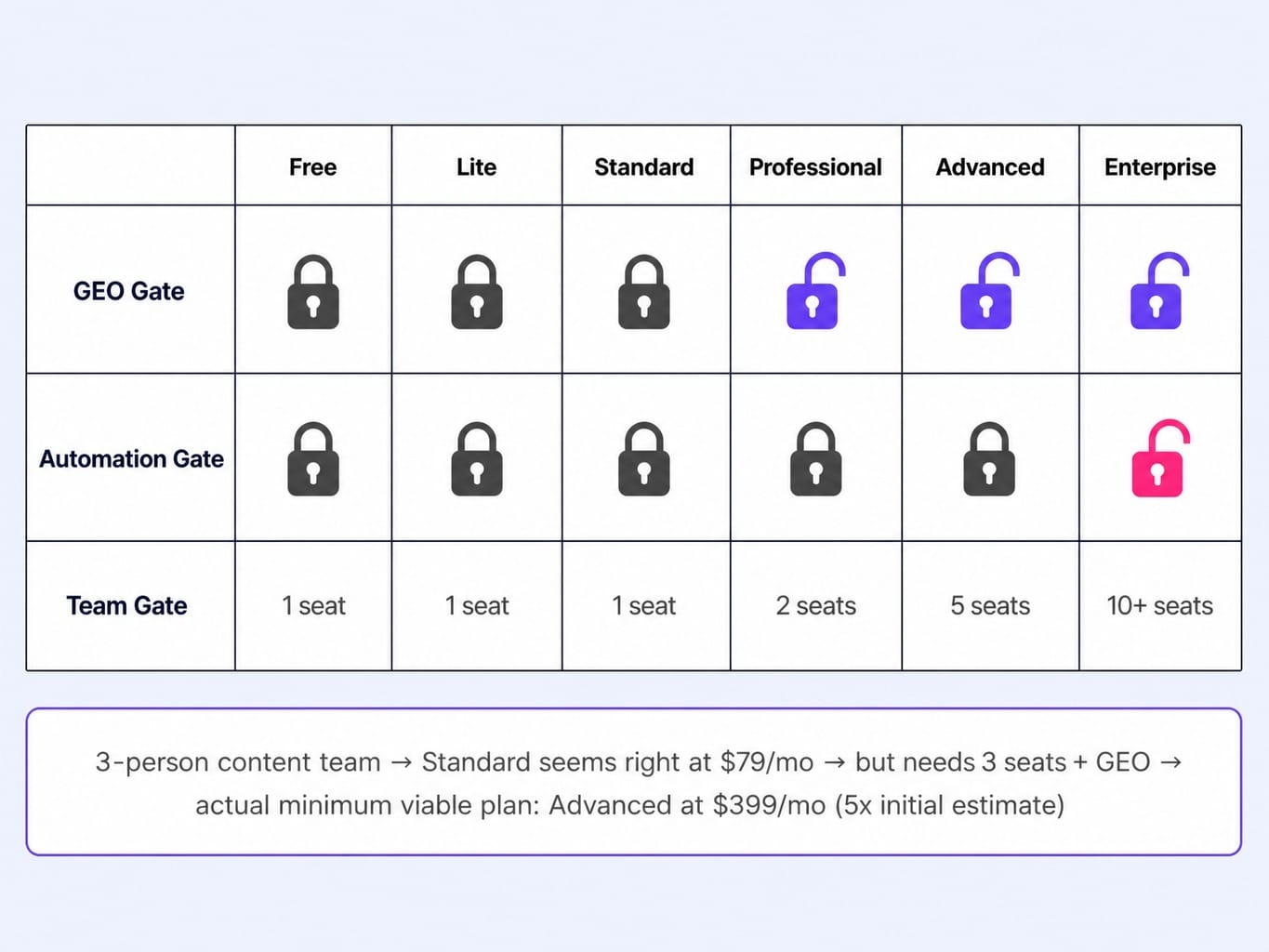
1. The GEO Gate: Generative Engine Optimization features—which track your brand's presence across ChatGPT, Gemini, Perplexity, and Google AI Overviews—are completely unavailable below the Professional tier ($199/mo annually). If optimizing for AI search is a primary goal, the Lite and Standard plans are non-starters.
2. The Automation Gate: The Action Center, Writesonic's workflow automation layer, is only fully unlocked on the Enterprise plan. While lower tiers may offer a trial, teams looking to build automated content pipelines will find that this feature gating is the most consequential lock, as it prevents the tool from being deeply embedded into a larger system.
3. The Team Gate: Seat limits are a major driver of cost. The Lite and Standard plans are for individuals only. Professional adds a second seat, and Advanced expands to five. This "seat sprawl" often forces an upgrade faster than article consumption does.
Imagine a three-person content team evaluating the Standard plan ($79/mo). It seems affordable until they realize only one person can use it, GEO is locked, and Action Center is unavailable. Their actual minimum viable plan is the Advanced tier at $399/mo—a 5x increase over their initial estimate, driven entirely by feature gating.
Writesonic Pricing vs. Jasper AI and Copy.ai: Where the Money Goes
Comparing AI writing tools on headline price is misleading. Each platform meters usage differently—by words, credits, seats, or articles—making a direct financial comparison difficult. The key is to compare the job-to-be-done.
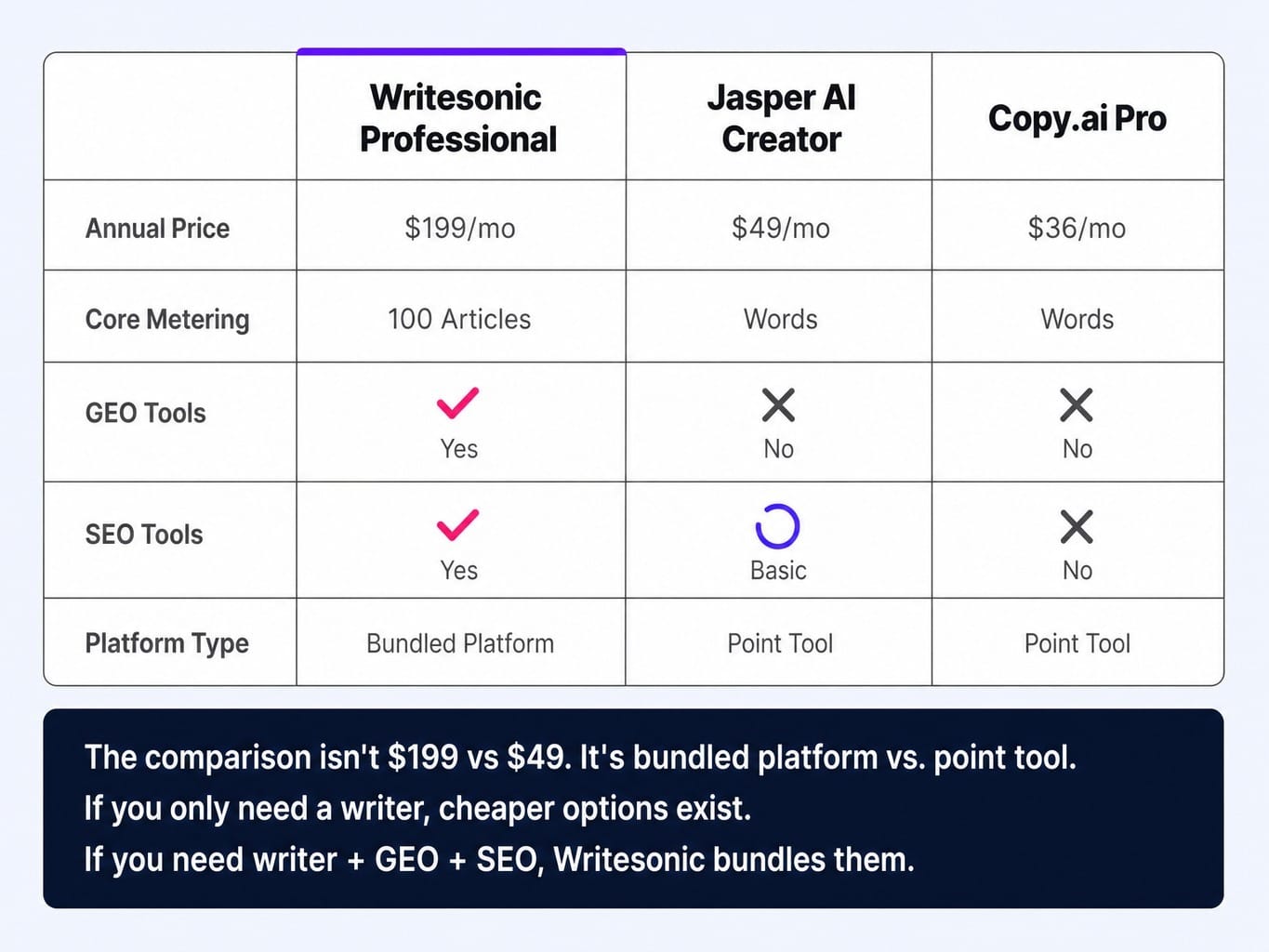
At first glance, Writesonic appears significantly more expensive. But the comparison isn't $199 vs. $49. It's a bundled platform versus a point tool.
If your team only needs an AI writing assistant for drafting copy, Jasper or Copy.ai offer that capability at a lower price. However, if your workflow involves content generation plus tracking AI search visibility and running on-page SEO audits, Writesonic's Professional plan bundles those functions. For a deeper look at how those two alternatives stack up against each other, see our Jasper vs Copy.ai breakdown.
The decision hinges on whether you will actually use the bundle. A team that subscribes to Writesonic Professional for its GEO features but discovers they only use the article writer is effectively paying a $150/month premium for a capability available elsewhere. For teams with development resources, it's also worth noting that model tier arbitrage is possible; using the OpenAI API directly for GPT-4o costs in the range of $5 to $10 per million input tokens and $15 to $30 per million output tokens, a calculation worth running for API-first teams.
Read more: Jasper vs Writesonic: An Honest Breakdown After Running Both on B2B Marketing Workflows | Spike
When the Real Cost Isn't the Tool — It's the Workflow Around It
The analysis of Writesonic pricing reveals a systemic truth about marketing tools: they charge for a single function, but the real cost to your team is the entire workflow that surrounds it.
Every dollar spent on Writesonic, Jasper, or Copy.ai covers content generation. But the full cycle—prioritizing what to create, optimizing the page for conversion, publishing it, measuring its impact on leads, and deciding the next highest-impact move—still falls entirely on your team. The AI tool frees up bandwidth from one task, but that bandwidth is immediately consumed by the manual management of all the steps before and after.
This is the execution gap that marketing teams live in. Instead of buying a content generation tool and then manually managing the ecosystem around it, a platform like Spike AI operates as a unified system. Spike AI identifies the highest-impact marketing action across your website, SEO/AEO, and ads, and then ships the improvement.
The cost comparison shifts from "how much per article?" to "how much per shipped improvement that moves qualified leads?" Writesonic generates content. Spike AI is designed to generate outcomes.
See how Spike AI ships weekly marketing improvements across your entire funnel
Final Verdict: Is Writesonic Worth the Price?
Writesonic's pricing isn't intentionally complicated, but your actual cost is. It's a variable figure determined by your credit consumption, the feature gates you can't avoid, and whether you truly leverage the bundled capabilities that justify its premium over simpler, cheaper point tools.
To find the right answer for your budget, follow this framework:
- Define Your Use Case: Do you need a writer, or a writer plus a GEO tracker?
- Identify Your Tier: Use the feature gating analysis to find your true minimum viable plan.
- Validate Your Usage: Start with a monthly plan to track your real consumption patterns.
- Commit to Annual: Only switch to an annual plan once you're confident in your long-term needs.
As AI platforms continue to bundle more capabilities, from content creation to analytics, the essential pricing question will shift from "What does it cost?" to "What am I actually using?" Answering that honestly is the key to making a smart investment.
Frequently Asked Questions
Does Writesonic offer a money-back guarantee or refund policy?
Writesonic offers a refund window for new paid plans, but specifics can change. Always check their current terms of service. Annual plans typically have stricter refund policies than monthly ones, so starting with a monthly subscription is the lower-risk option for evaluation.
Does Writesonic offer discounts for nonprofits or startups?
Writesonic does not publicly advertise specific discount programs for nonprofits or startups. However, Enterprise pricing is generally negotiable. Organizations with specific budget constraints should contact Writesonic's sales team directly to inquire about custom arrangements.
How much does Writesonic API access cost separately?
API access is included in premium plans like Professional and above but is not sold as a standalone product on lower tiers. For API-first workflows, compare Writesonic's bundled cost against direct OpenAI or Claude API pricing, which may be more cost-effective for high-volume programmatic use.
Can I add extra team seats without upgrading my entire Writesonic plan?
Writesonic's current structure ties seat counts to specific tiers; you cannot add individual seats à la carte on most plans. If you need more seats than your plan allows, you must upgrade to the next tier, which increases your total cost and credit limits simultaneously.
Does using GPT-4o in Writesonic cost more than using their default models?
Writesonic includes access to models like GPT-4o on its higher-tier plans without a visible per-use surcharge. However, premium models may consume credits or tokens at a faster rate. Monitor your credit burn when switching between models to see how it impacts your monthly allocation.