Writesonic Review 2026: What It Actually Costs You (Beyond the Subscription)

TL;DR
- Writesonic excels at accelerating first-draft generation for structured, formulaic content like product descriptions and basic listicles, saving hours on initial ideation and outlining.
- Its primary weakness is a hard quality ceiling on content requiring deep expertise or original analysis; it summarizes existing knowledge competently but creates no new insight.
- The true cost of Writesonic isn't the subscription price but the total cost of ownership, which includes the significant, often-underestimated labor cost of human editing and quality assurance.
- Brand voice controls are surface-level. While you can select a tone, the tool struggles to maintain a truly distinctive brand identity across dozens of articles, leading to output homogenization.
- It's a good fit for teams with strong editors who need a first-draft accelerator for high-volume commodity content. It's a poor fit for teams producing expert-level thought leadership or those without a rigorous editing workflow.
If you search for a writesonic review, you'll find a peculiar pattern. The top results are often written by direct competitors using the review to pivot to their own tool, or by affiliate marketers whose commissions depend on you signing up. Neither has a structural incentive to give you a straight answer. This leaves most marketing leaders with a distorted picture of what the tool actually does and, more importantly, what it actually costs.
Writesonic has evolved significantly. It's no longer just an AI copywriter but a sprawling platform that bundles content generation, SEO features, and a conversational assistant. But the core question remains the same for any practitioner evaluating it: will this make my content operation faster, cheaper, and better? Or will it just create a new category of work?
This is a practitioner's assessment. We're not evaluating features; we're evaluating workflow impact. This review breaks down what Writesonic delivers in 2026, what it costs you beyond the monthly subscription, and who should genuinely consider it versus who should look elsewhere. We're answering the question that matters: is Writesonic worth it?
What Writesonic Actually Is in 2026 (And What It Isn't)
At its core, Writesonic is a GPT-powered content generation platform that has wrapped a suite of marketing-specific workflows around a large language model. It runs primarily on OpenAI's GPT-4 and Anthropic's Claude models, with its own layer of fine-tuning and proprietary templates. This is a critical point: the ceiling for Writesonic's output quality is fundamentally tied to the capabilities of the underlying LLMs it uses.
The platform's value proposition isn't that its AI is inherently superior to prompting ChatGPT or Claude directly. The value is in the workflow wrapper. This includes:
- A structured Article Writer: Guides users from topic to outline to full draft.
- A broad template library: For short-form content like ads, emails, and social posts.
- Chatsonic: A conversational AI assistant for research and ideation.
- An SEO toolkit: Basic keyword research, content optimization scoring, and site audits.
When a scaling SaaS team evaluates content generation tools purely on subscription price, they systematically undercount the editing and QA labor that determines whether output actually ships. This is the same category of hidden execution cost that platforms like Spike AI are designed to eliminate on the conversion side of the funnel.
So, what isn't Writesonic? It is not a replacement for a content strategist. Its SEO tools are not a substitute for the data depth of an Ahrefs or Semrush. And despite having over 2,000 reviews on G2 with a 4.7/5 rating, the vast majority of that feedback focuses on the core writing tool—not the newer, less mature features. It's a component in a marketing stack, not the entire stack itself.
What Writesonic Does Well: Three Genuine Strengths
Despite its limitations, Writesonic provides genuine leverage in specific scenarios. For the right user with the right expectations, it solves real workflow problems.
1. Speed of First-Draft Generation for Structured Content
For a solo B2B content marketer tasked with producing weekly blog content, the initial drafting phase is often the biggest bottleneck. Writesonic's Article Writer genuinely collapses this timeline. The workflow—enter a topic, review a competitive analysis, approve an outline, and generate a draft—can produce a 1,500-word article in under 15 minutes. Manually, that same first draft could take 2-3 hours.
The key is that this works best for structured content: listicles, "how-to" guides, and simple explainers. The platform's claim of generating an article in seconds is technically true, but the metric that matters is the first-draft-to-publish ratio. For these simpler formats, Writesonic delivers a serviceable draft that dramatically cuts down the blank-page problem.
2. The Template Library for High-Volume, Formulaic Content
Some content requires volume and variation, not originality. Think Google Ad copy, hundreds of e-commerce product descriptions, or dozens of email subject line ideas. This is where Writesonic's template library shines. An e-commerce team can feed the tool a product name and key features and get back ten distinct descriptions in a minute. The output is formulaic, but for this use case, that's a feature, not a bug. It provides a baseline of acceptable copy at a scale that would be tedious and cost-prohibitive to produce manually.
3. Chatsonic for Quick-Turnaround Research
Chatsonic, Writesonic's conversational assistant, serves as a decent replacement for the constant tab-switching between a blank document, Google, and ChatGPT. For preliminary market research—identifying key competitors, brainstorming topic clusters, or summarizing a concept—it's a useful workflow consolidator. It isn't a substitute for deep, original research, and its sources require verification. But for a content strategist needing to quickly get the lay of the land on a new topic, it reduces friction and keeps the research process contained within a single interface.
Where Writesonic Falls Short: The Failure Modes That Matter
Writesonic's weaknesses aren't random. They are predictable, pattern-based failures that emerge from the fundamental limitations of the LLMs it's built on. Understanding these patterns is key to deciding if it fits your workflow.
The Content Quality Ceiling on Anything Requiring Expertise
Writesonic produces competent, plausible-sounding text on nearly any subject. The problem is that for content requiring deep domain expertise or original analysis, "plausible" isn't good enough. Imagine a B2B SaaS marketer using it to generate a thought leadership piece on enterprise pricing strategy. The output will be well-organized. It will use the right terminology—value-based pricing, usage tiers, feature gating. But it will read like a summary of the top five existing blog posts on the topic.
It will contribute zero information gain.
This isn't a flaw unique to Writesonic; it's a characteristic of current-generation LLMs. However, the tool provides no guardrails to signal when its output has crossed from "useful draft" to "generic filler." The quality gap between AI-generated first drafts and publishable content is narrowest for structured, formulaic formats but becomes a chasm for narrative or opinion-driven work. If your content strategy relies on originality, Writesonic will consistently disappoint.
Editing Overhead That Erases the Time Savings
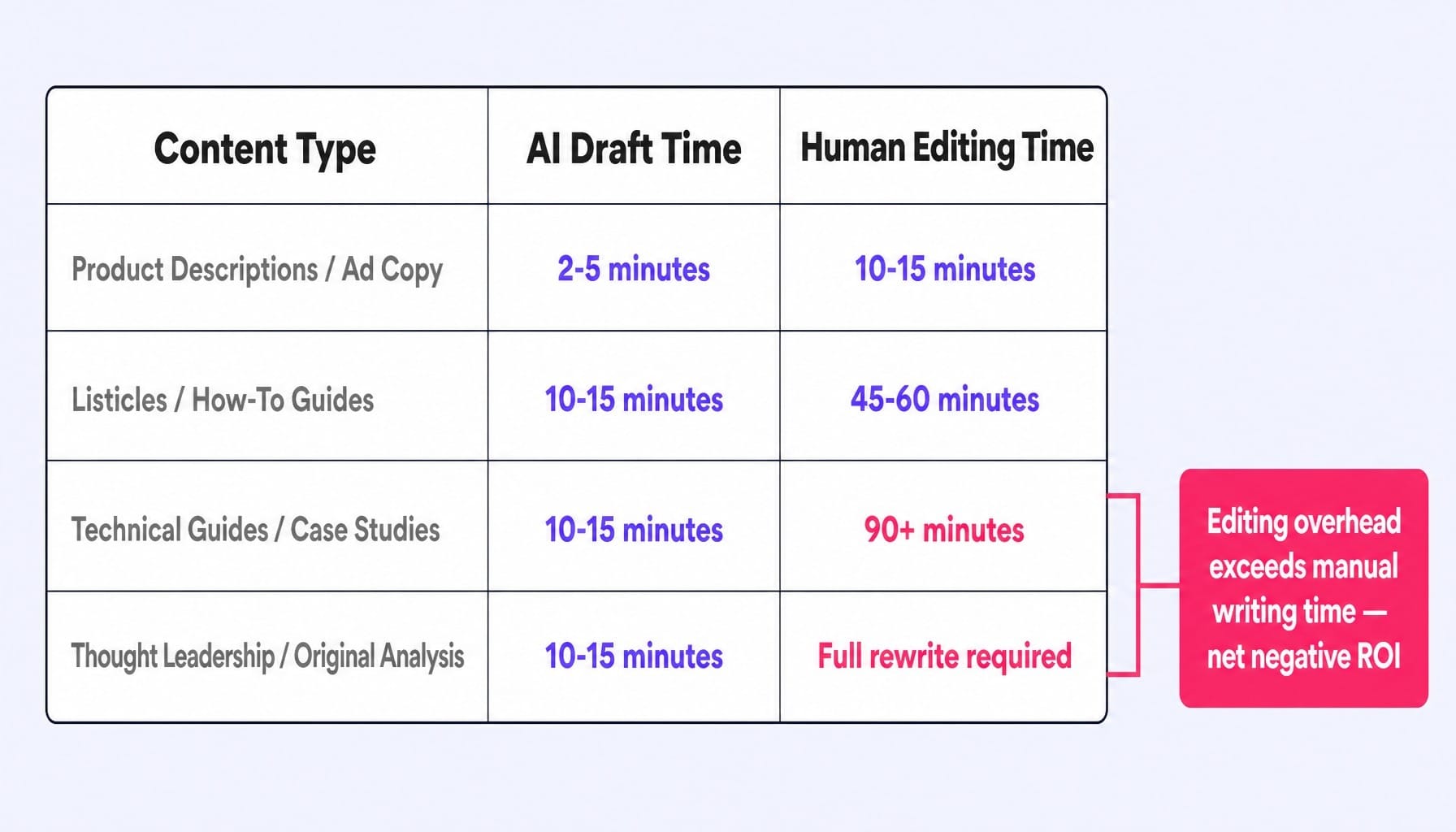
The most misleading metric for any AI writing tool is generation speed. A five-minute draft is irrelevant if it requires an hour of editing. The real metric is the first-draft-to-publish ratio: the total human time investment from generation to publication.
Consider a content team generating ten blog posts a week. Each draft takes minutes to create. But then the human-in-the-loop editing begins. An editor spends 45-60 minutes per post correcting factual inaccuracies, removing repetitive phrasing, checking for hallucinations, and aligning the tone. The net time saved compared to a human writer's 90-minute first draft is marginal—perhaps 20 minutes per article.
For high-stakes content like technical guides or case studies, the editing overhead can actually exceed the time to write from scratch. Editing time increases non-linearly as subject matter expertise requirements rise, because the editor's job shifts from stylistic cleanup to a full-blown factual verification and structural rethink. Every team using AI at scale needs a hallucination audit process, and Writesonic provides no tools to support one.
Brand Voice Consistency Across Scale
Writesonic offers "Brand Voice" features, allowing you to upload documents or provide a URL to "learn" your style. In practice, these controls are surface-level. They adjust tone (e.g., formal, witty, professional) but fail to capture the deeper patterns that constitute a truly distinctive brand voice: sentence rhythm, argument structure, vocabulary preferences, and the unique way a brand frames problems.
Imagine a marketing team generating 20 articles with these settings. Read individually, each might seem acceptable. Read together, they create a library of undifferentiated content. They all sound like "professional AI output with a slight tonal adjustment," not like your brand. The real differentiator between AI writing platforms is rarely single-generation output quality; it's how well the tool constrains output to reduce variance across hundreds of pieces. Writesonic's approach is a simple temperature dial where a comprehensive, enforceable style guide is needed.
The Hidden Cost Most Writesonic Reviews Never Quantify
Every Writesonic review you read will focus on the subscription price. But the monthly fee is a rounding error compared to the true cost driver: human labor. The total cost of ownership (TCO) is the only metric that matters.
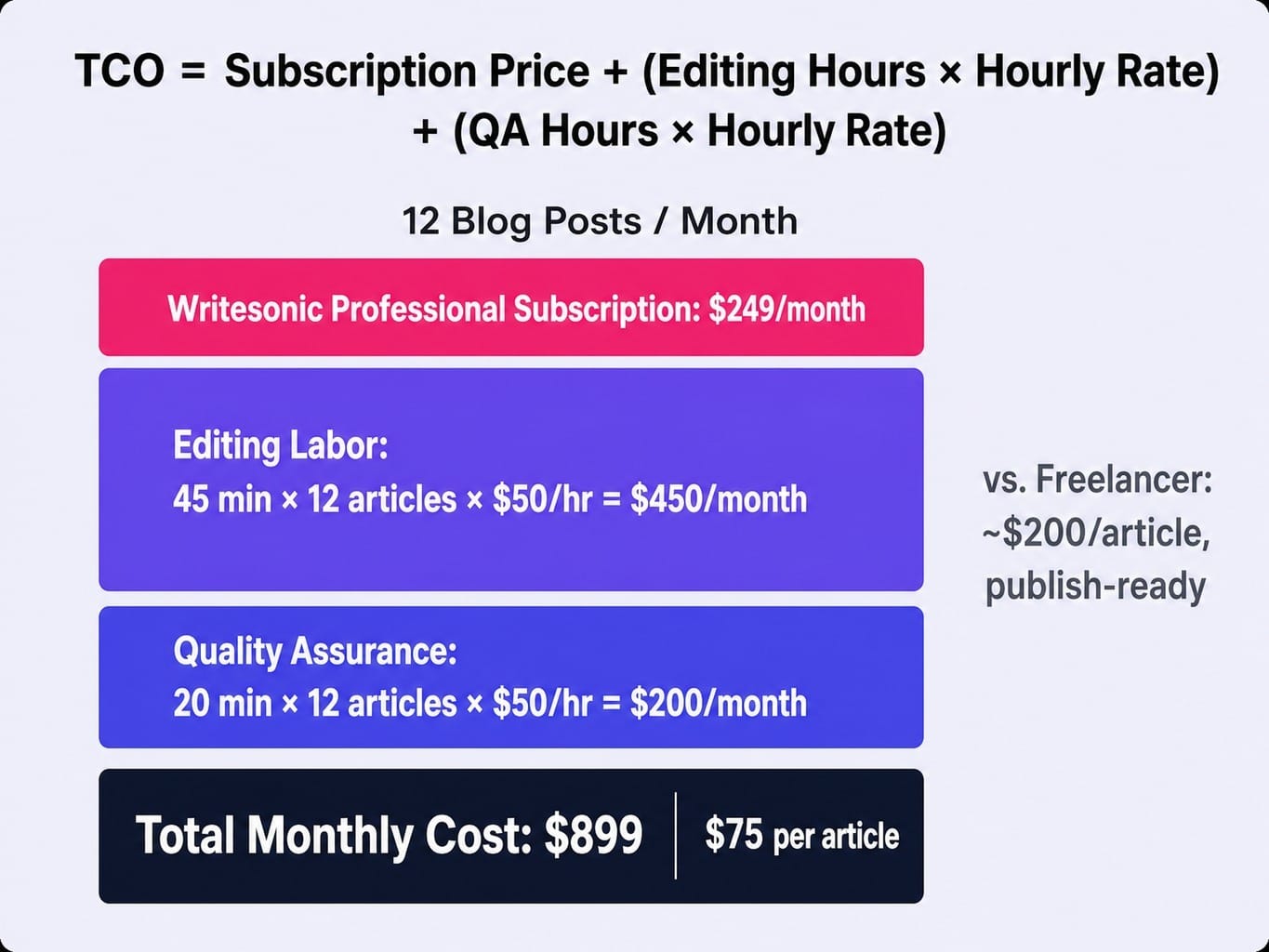
TCO = Subscription Price + (Editing Hours x Hourly Rate) + (QA Hours x Hourly Rate)
Let's run the numbers for a realistic scenario. A three-person marketing team aims to produce 12 blog posts per month.
- Subscription Cost: They choose the Professional plan to get enough credits. That's $249/month.
- Editing Labor: Based on our own tests and practitioner consensus, a 1,200-word AI draft requires at least 45 minutes of skilled editing. At a blended internal rate of $50/hour, that's $37.50 per article. For 12 articles, that's $450/month in editing overhead.
- Quality Assurance: This includes a final factual check, running it through an SEO tool, and a plagiarism scan. Let's be conservative and say 20 minutes per article. That's another $200/month.
Total Monthly Cost: $249 + $450 + $200 = $899
That's roughly $75 per article. This reframes the decision entirely. Is a $75 AI-assisted article that still requires significant oversight a better deal than a $200 publish-ready article from a reliable freelancer? For some, yes. For many, no. The point isn't that Writesonic is overpriced; it's that the subscription price is a dangerously incomplete signal of the actual resource commitment required to make it work.
Who Should Actually Use Writesonic (And Who Shouldn't)
With a clear understanding of the tool's strengths, failure modes, and true costs, the recommendation becomes simple and specific.
You should use Writesonic if:
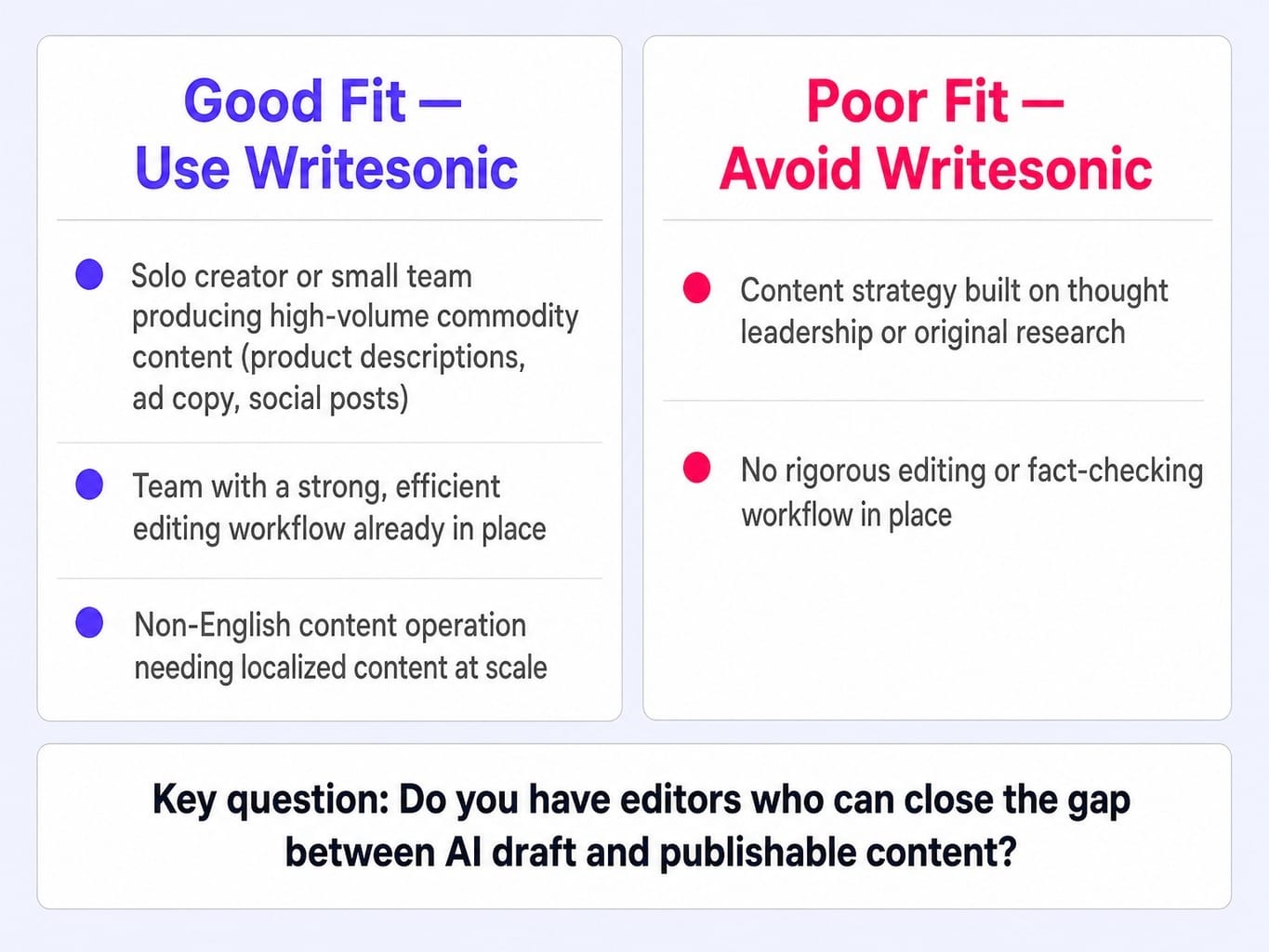
- You are a solo creator or small team producing high-volume commodity content. For product descriptions, ad copy, and basic social media posts where speed and volume trump originality, Writesonic is a powerful force multiplier.
- You already have a strong, efficient editing team. If you view Writesonic as a first-draft accelerator and have the human-in-the-loop process to handle quality control, it can successfully reduce the time spent on initial drafting.
- You are running a non-English content operation. Writesonic's support for over 30 languages is a genuine asset for teams that need to produce localized content at scale, though output quality varies and requires native-speaker review.
You should NOT use Writesonic if:
- Your content strategy is built on thought leadership or original research. The tool will generate plausible-sounding drafts that actively dilute your topical authority by contributing no information gain.
- You do not have a rigorous editing and fact-checking workflow. If your plan is to publish Writesonic output with minimal human review, you will inevitably publish hallucinations, generic advice, and content that damages your brand's credibility.
Writesonic vs. the Alternatives Worth Considering
The question isn't just "is Writesonic good?" but "is it the right tool for my specific workflow compared to the alternatives?" Here are three key comparisons based on decision criteria, not feature lists.
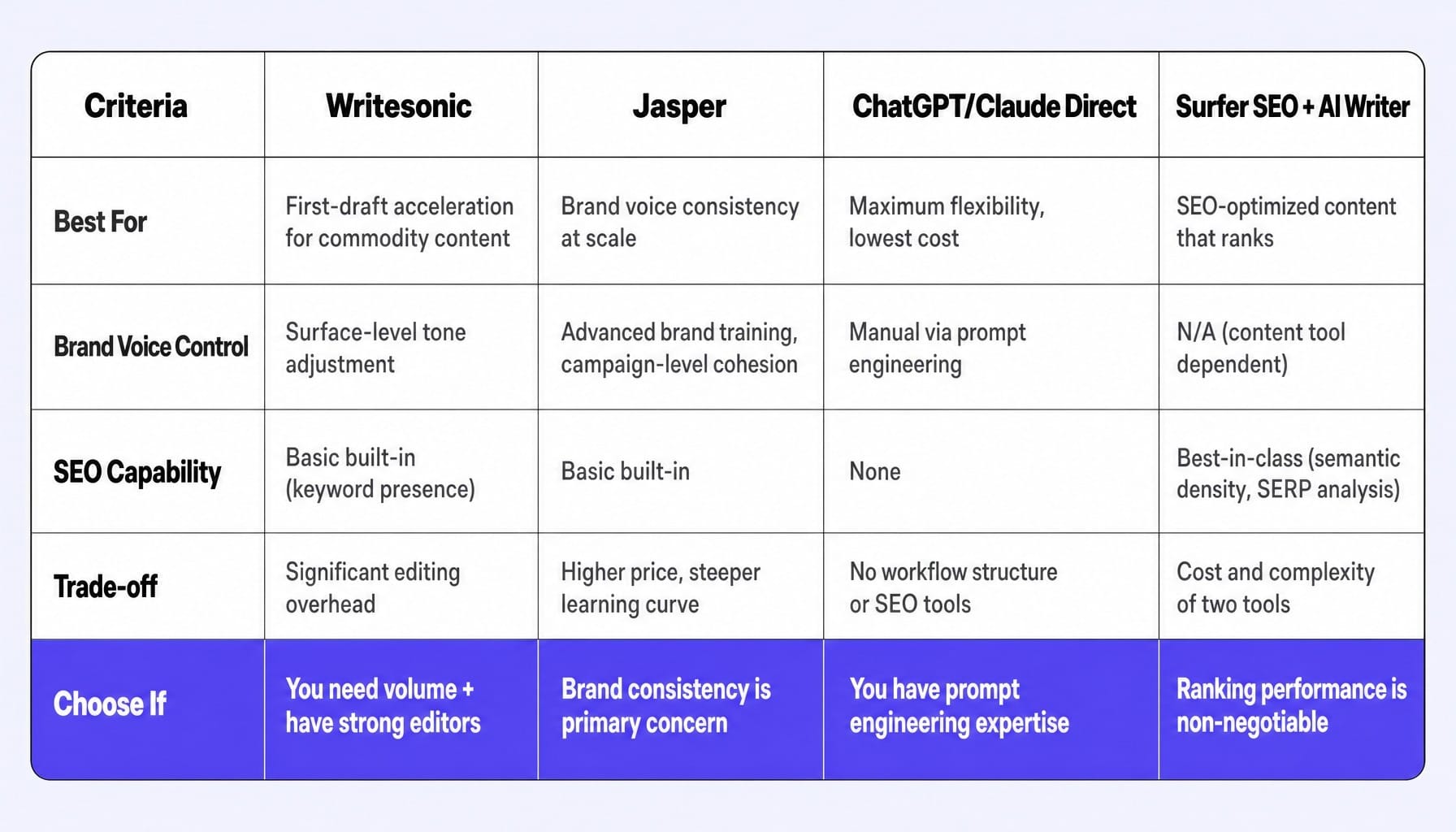
- Jasper: Better for teams prioritizing brand voice consistency at scale. Jasper's brand voice training and campaign-level features create more cohesive output across multiple assets than Writesonic's simpler tone controls. The trade-off is a higher price point and a steeper learning curve. For a deeper look at how these two platforms compare on real B2B workflows, see our Jasper vs Writesonic breakdown.
Choose Jasper if brand consistency across many content pieces is your primary concern.
- ChatGPT/Claude (Direct): Better for teams with strong prompt engineering skills who want maximum flexibility at a lower cost. If your team already knows how to write effective, multi-step prompts, paying $20/month for a direct LLM subscription gives you 90% of the output quality without the template overhead. The trade-off is a complete lack of integrated SEO tools or structured workflows.
Choose direct LLM access if you have in-house prompt expertise and don't need a workflow wrapper.
- Surfer SEO + Any AI Writer: Better for teams whose primary goal is creating SEO-optimized content that ranks. Surfer's SERP-informed content briefs and NLP-driven term recommendations produce more consistently rankable content than Writesonic's built-in SEO features. Combining Surfer with even a basic AI writer creates a more powerful SEO content machine. The trade-off is the cost and complexity of managing two separate tools. Teams weighing dedicated content optimization platforms should also consider the Frase vs Clearscope comparison.
Choose this combo if ranking performance is non-negotiable and you need best-in-class optimization guidance.
Read more: Jasper AI Review (2026): An Honest B2B Assessment of Cost, Quality & Alternatives | Spike AI
When the Problem Isn't the Writing Tool — It's the Gap Between Content and Conversions
This entire discussion has centered on a single problem: how to produce content more efficiently. AI writing tools like Writesonic can accelerate production, but for most B2B marketing teams, the real constraint isn't generating more articles. It ensures the content you publish actually converts visitors into pipeline.
The TCO analysis revealed that even with AI assistance, teams spend hundreds or thousands of dollars a month on the content-to-publish workflow. But what happens after you hit "publish"? For most, the page sits there. Its conversion rate stagnates. The backlog of "things we should test on the website" grows, but execution never happens.
This is the execution gap. For teams that have a handle on content generation—whether through Writesonic, Jasper, or manual writing—the next, more critical bottleneck is the continuous optimization of what's already live. Spike AI is built to close that gap. Every week, it identifies the highest-impact conversion improvements across your website and ships them, turning your static content assets into a compounding growth engine. It solves the output problem, not just the input problem.
See how Spike AI identifies and ships your highest-impact website improvements every week
The Final Verdict: Is Writesonic Worth It in 2026?
Writesonic is a competent tool for a narrow set of use cases. But asking "is it worth it?" is the wrong question. The right question is: "What is the total cost—in subscription, labor, and quality control—of turning an AI-generated draft into content that performs?"
When you frame it that way, the answer becomes clear. Writesonic is a first-draft accelerator for commodity content. It is a workflow component, not a workflow replacement. The editing overhead, brand voice limitations, and hard quality ceiling on expert content mean it requires significant human oversight to be effective.
For the right team, it can be a useful part of the content production machine. But the teams that win in 2026 won't be the ones that generate the most content the fastest. They will be the ones whose published content continuously improves, adapts, and converts. That's a challenge no writing tool alone can solve.
Frequently Asked Questions
Does Writesonic output pass AI detection tools like Originality.ai?
Writesonic output is consistently flagged by AI detection tools. The platform offers a 'Humanizer' feature to rewrite content to evade detection, but this often degrades readability and introduces awkward phrasing. If passing AI detection is a requirement, plan for substantial manual rewriting of any draft.
How does Writesonic handle factual accuracy and source citations?
Writesonic can include citations, but the sources are not always verifiable, current, or authoritative. Chatsonic pulls from web data but doesn't reliably distinguish high-quality sources from low-quality ones. Treat every factual claim and citation as unverified until you manually confirm it; this is a non-negotiable editing step.
What happened to Writesonic's pricing model — why are the best features Enterprise-only?
Writesonic has progressively moved its most differentiated features, particularly the AI Search Visibility suite, behind Enterprise-tier pricing. Basic content generation is available on lower plans, but meaningful SEO and AI visibility tools require a significant step up in cost, making the full platform less accessible for solo creators.
Can Writesonic generate SEO-optimized content without using a separate tool like Surfer or Clearscope?
Writesonic includes basic SEO scoring, but it's surface-level compared to dedicated tools. It checks for keyword presence but lacks the semantic density scoring and deep SERP analysis of Surfer SEO or Clearscope. For competitive SEO content, you will likely still need a specialized optimization platform.
Does Writesonic support bulk article generation for agencies producing content at scale?
Yes, Writesonic supports bulk generation via its API, but quality and originality degrade at scale. Generating dozens of articles from templates often produces repetitive phrasing and structural sameness. Agencies using it for programmatic content should budget for significant human review and expect a high rewrite rate.