AB Tasty Pricing in 2026: Real Costs, Hidden Fees, and How to Negotiate
TL;DR
- Real Costs: AB Tasty pricing ranges from $15,000–$45,000/year for mid-market teams, $40,000–$90,000 for growth stage, and $80,000–$150,000+ for enterprise, based primarily on Monthly Tested Visitors (MTV).
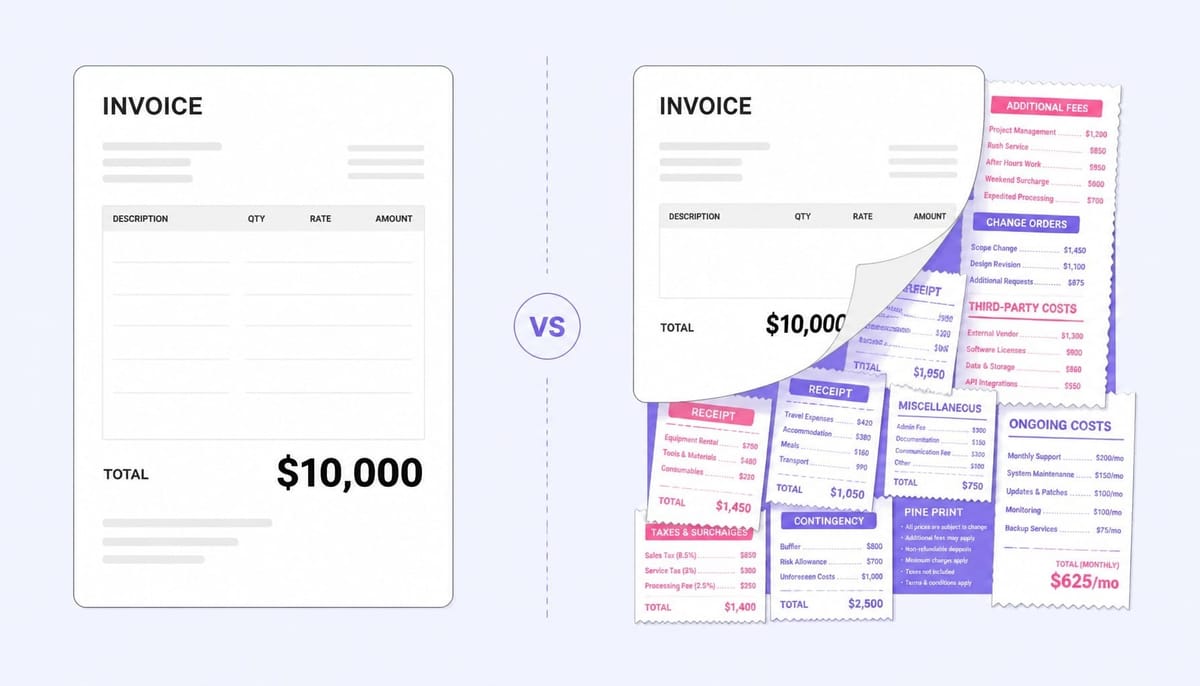
- Hidden Fees: Your total cost of ownership will be 25-40% higher than the license fee after accounting for paid implementation ($5K-$20K), traffic overages, and the internal engineering labor for SDK maintenance and QA ($18K-$36K/year).
- Negotiation Levers: You can cut 20–35% off your initial quote by leading with competitive bids, negotiating traffic caps and overage terms first, bundling implementation fees, and timing your purchase to their quarter-end.
- Pricing Model: The cost is a formula of four variables: your Monthly Tested Visitors (MTV) tier, your feature bundle (e.g., Web Experimentation vs. Full Platform), contract length, and any add-on modules like server-side testing.
- ROI Calculation: Before signing, calculate your total cost of ownership (license + hidden fees + internal labor). If your traffic is too low to detect a meaningful conversion lift within a few months, the platform may not generate positive ROI.
You search for "AB Tasty pricing" and land on a page that says "Contact us." You're not looking for a relationship; you're looking for a number to plug into a budget spreadsheet. This frustration is universal. AB Tasty, like most enterprise-grade experimentation platforms, uses a custom-quote model designed to get you into a sales conversation before you see a price.
Let's cut through the noise. Based on procurement data, user reports, and vendor benchmarks, AB Tasty pricing typically ranges from $15,000 to over $150,000 annually. The final number depends on your traffic volume, feature tier, and contract length.
But the license fee is only the beginning. The real number—the total cost of ownership—is often 25–40% higher once you factor in implementation, overages, and the internal engineering labor that never appears on the invoice. This guide breaks down the actual pricing model, the real costs by company size, the hidden fees most reviews miss, and a negotiation playbook to ensure you don't overpay.
How AB Tasty's Pricing Model Actually Works
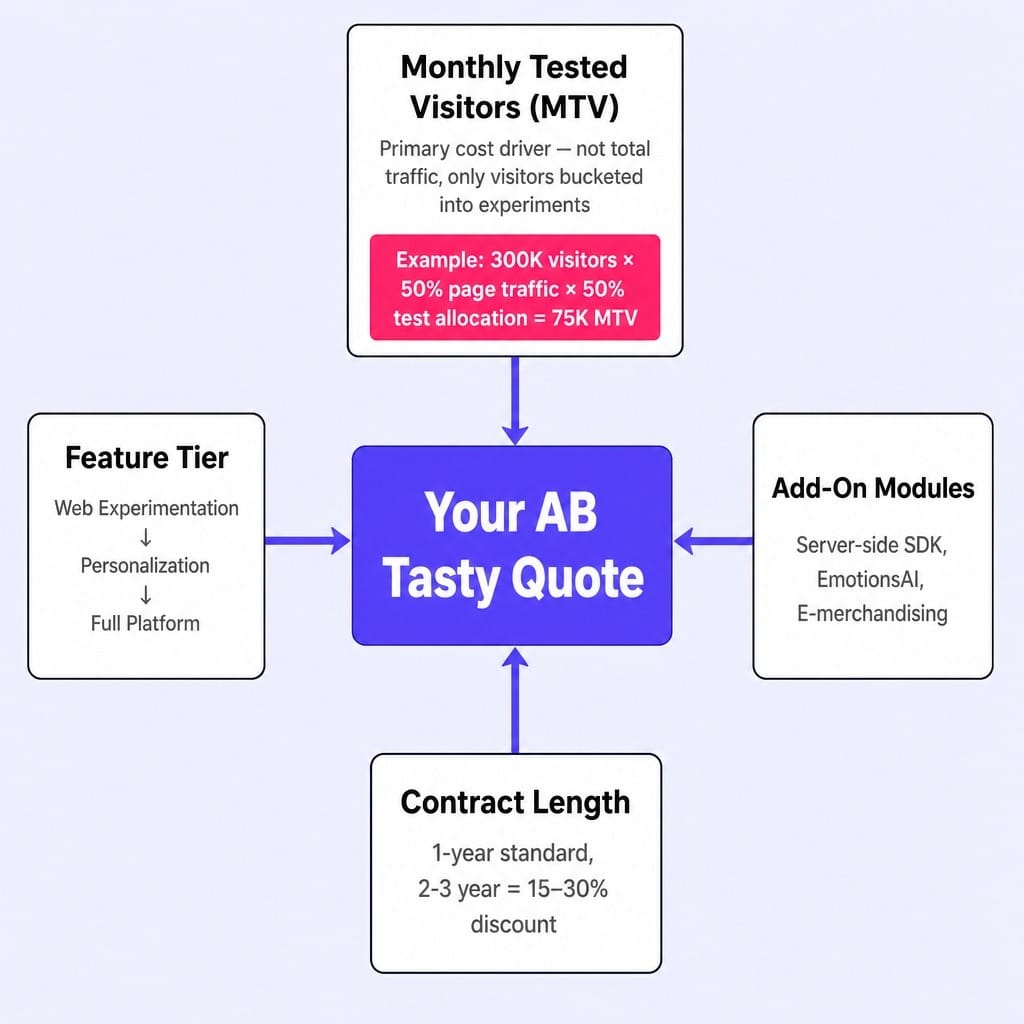
AB Tasty's pricing isn't arbitrary; it's a formula based on four main variables. Understanding this formula gives you leverage before you ever speak to a sales representative.
- Monthly Tested Visitors (MTV): This is the single most important metric. It's not your total website traffic or unique visitors. MTV is the number of unique visitors who are bucketed into an experiment or personalization campaign in a given month. This distinction is critical. For example, consider a site with 300,000 monthly visitors. If you run a test on a key landing page that gets 50% of your traffic and allocate 50% of that audience to the test, your MTV is 75,000 (300,000 0.5 0.5). That 75K figure, not your 300K total, determines your pricing band. Knowing your potential MTV prevents you from being quoted for a higher tier than you actually need.
- Feature Tier: The platform is bundled into tiers. The entry point is Web Experimentation, which covers standard client-side A/B/n and multivariate testing. The next tier, Personalization, adds more advanced audience segmentation and content targeting capabilities. The top tier, Full Platform, includes everything plus server-side testing and feature flagging. Each tier represents a significant price jump.
- Contract Length: The standard is an annual contract. Committing to a two- or three-year deal can secure discounts of 15–30%, but it also locks you into a specific MTV tier. This can be a risk for fast-growing companies that might outgrow their traffic cap mid-contract.
- Add-On Modules: Certain high-value features are priced separately and are not included in the main tiers. These typically include server-side experimentation (which requires an SDK integration), EmotionsAI for user feedback, and advanced e-merchandising tools.
Before you request a quote, map out your needs against these four variables. It's the difference between receiving a tailored quote and an inflated estimate.
What AB Tasty Actually Costs by Company Size
While every quote is custom, anonymized procurement data and user reports reveal consistent pricing bands for 2026. These are annual contract values; AB Tasty does not typically offer monthly billing.
Pricing by Traffic Tier and Feature Bundle
Here's a breakdown of what you can expect to pay based on your MTV and desired feature set.
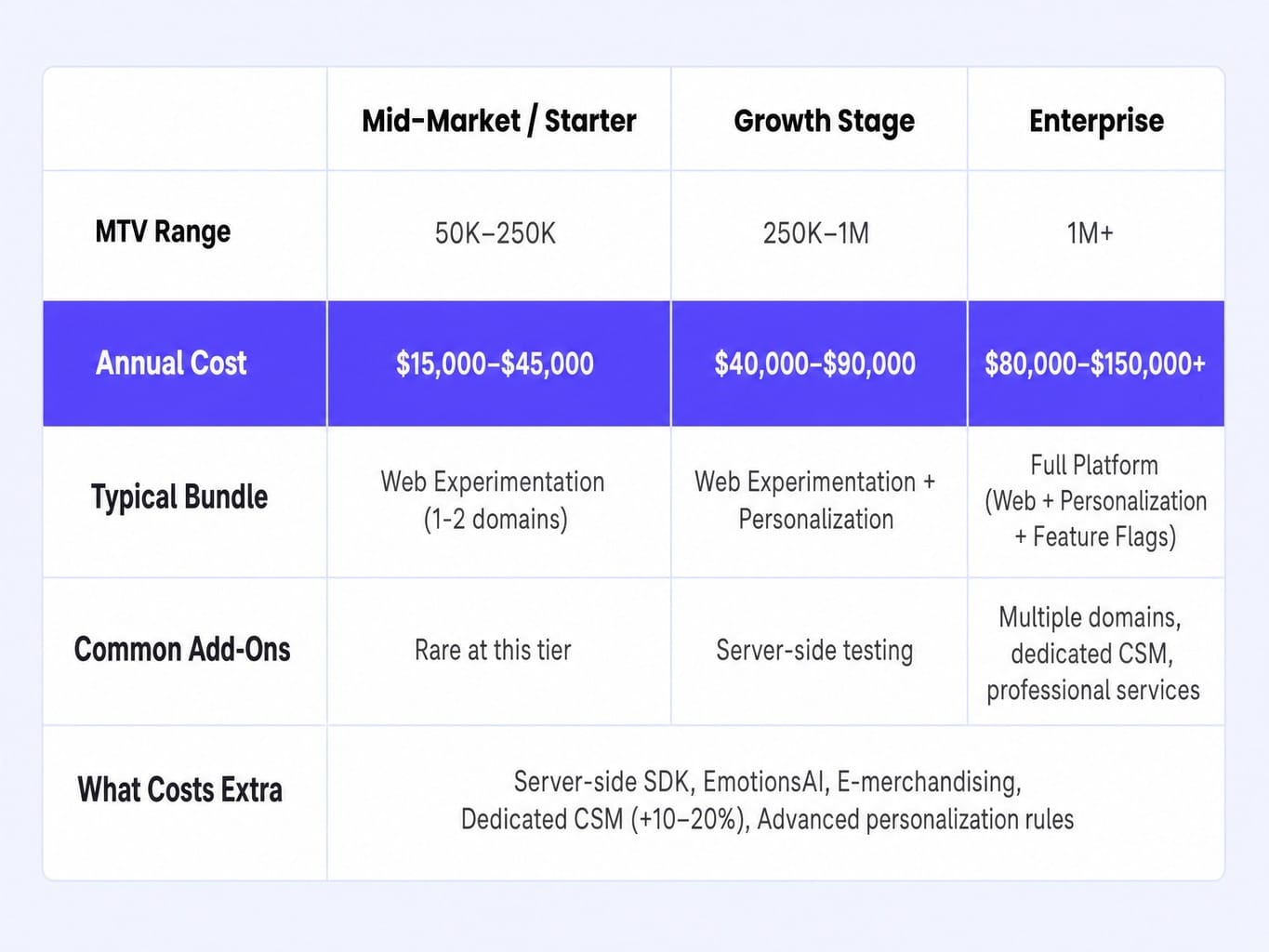
- Mid-Market / Starter (50,000 – 250,000 MTV): $15,000 – $45,000 per year. This tier typically includes the Web Experimentation package for one or two domains. It's a fit for companies just starting to build a formal experimentation program but who need more power than basic free tools. Multi-year discounts are available but less common at this tier.
- Growth Stage (250,000 – 1,000,000 MTV): $40,000 – $90,000 per year. At this level, contracts often bundle the Web Experimentation and Personalization tiers. This is for established marketing teams running multiple concurrent tests and looking to segment user experiences. This is also the tier where server-side experimentation becomes a common (and costly) add-on.
- Enterprise (1,000,000+ MTV): $80,000 – $150,000+ per year. This is the "full platform" territory, including web experimentation, personalization, and feature flagging for engineering teams. These contracts often involve multiple domains, dedicated support, and professional services, with the final price scaling based on complexity and extreme traffic volumes.
What's Included vs. What Costs Extra
A common point of confusion is what comes standard. AB Tasty's base plan includes the visual editor for creating tests, client-side A/B testing, a widget library for common modifications, and a built-in analytics dashboard.
What almost always costs extra?
- Server-Side Experimentation & Feature Flagging: This is a separate product module requiring SDK integration.
- EmotionsAI & E-merchandising: Niche features for specific use cases.
- Advanced Personalization: While basic targeting is included, complex, multi-step personalization rules often require a higher tier or add-on.
- Dedicated Customer Success Manager (CSM): Premium support tiers with a dedicated CSM can add another 10–20% to your annual contract value.
Many buyers assume personalization is part of the core A/B testing tool. With AB Tasty, it's an upsell, and that distinction can nearly double the cost.
The Hidden Costs Most AB Tasty Reviews Never Mention
The license fee is what AB Tasty quotes you. The total cost of ownership (TCO) is what you actually pay. For most teams, the gap between the two is a painful 25-40% surprise discovered after the contract is signed.
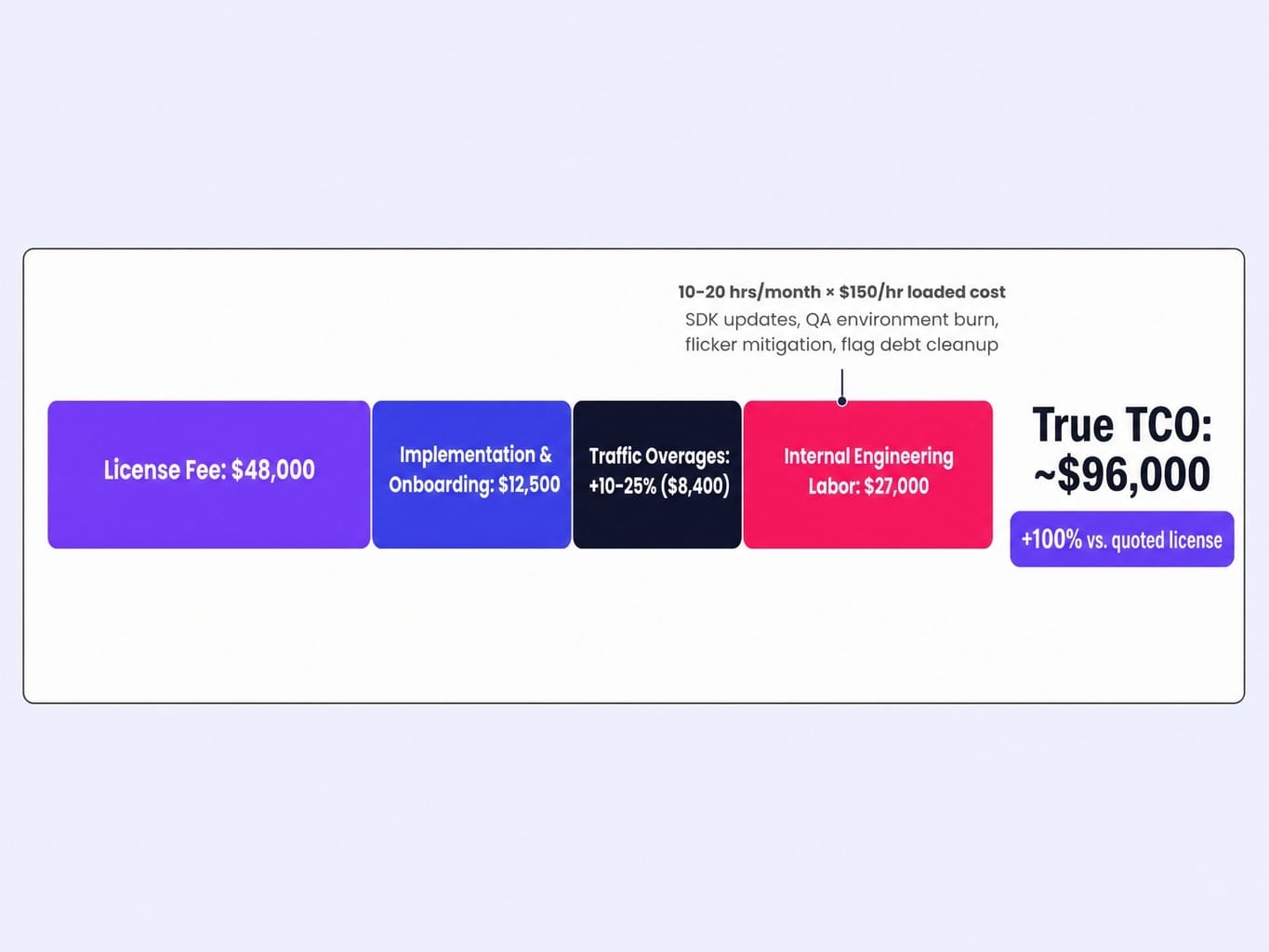
I once ran a TCO audit for a company renewing their experimentation platform. The license was quoted at $48K. But after we quantified the cost of the front-end engineer spending 12 hours a week maintaining custom flags and the QA team's regression cycles for every test, the real annual cost was closer to $79K. The renewal negotiation changed completely once that number was on the table.
Here are the three hidden costs that drive that gap.
Implementation, Onboarding, and Professional Services
AB Tasty charges a one-time fee for implementation, which typically runs $5,000 – $20,000. This covers technical setup, team training, and initial project configuration. The cost depends on the complexity of your site and the number of domains. Professional services, like having AB Tasty's team design your first few experiments, are an additional expense. Don't assume these are included; they are separate line items you need to budget for and negotiate.
Traffic Overages and How They Compound
Your contract will specify an MTV ceiling. If you exceed it, you'll be hit with overage charges, often at a premium per-visitor rate. For a business with seasonal traffic or a viral hit, this can unpredictably add 10–25% to your annual cost. This is a key area where traffic-based pricing models punish growth. A contract that feels reasonable in Q1 can become expensive by Q4 if you're successful.
The Engineering Cost Nobody Quotes: SDK Maintenance and QA Overhead
This is the most significant hidden cost, especially for teams using server-side testing or feature flagging. These features require an SDK integration that creates an ongoing maintenance burden for your engineering team. This includes:
- SDK Updates: Keeping the AB Tasty SDK current.
- QA Environment Burn: Every new experiment variation must be tested across staging and QA environments before deployment, consuming valuable testing resources.
- Flicker Mitigation: Client-side tests often produce a "flicker" effect (the original page appears for a moment before the variation loads). Mitigating this requires adding more code, which can impact site performance.
- Flag Debt: Cleaning up code from old experiments that were never properly archived.
Teams consistently report 10–20 hours per month of engineering time dedicated just to supporting the experimentation platform. At a loaded cost of $150/hour, that's $18,000 – $36,000 per year in labor that never appears on an AB Tasty invoice but is a direct consequence of choosing the tool.
AB Tasty vs. Alternatives: An Honest Pricing Comparison
AB Tasty isn't expensive or cheap in a vacuum; its value depends on your team's maturity and technical needs. The right comparison isn't about finding the lowest price but the best fit for your experimentation program.
Here's how AB Tasty stacks up against common alternatives at a 250,000 MTV scale:
A critical factor for 2026 buyers is the recent merger of VWO and AB Tasty under the private equity firm Everstone Capital. This consolidation will likely lead to shifts in pricing, product bundling, and support structures for both platforms over the next 12-24 months, creating a degree of risk for new multi-year contracts. If you're weighing Optimizely as an alternative, understanding Optimizely pricing in detail is essential before comparing quotes.
Read more: Optimizely vs AB Tasty (2026): A Practitioner's Guide to Choosing the Right Platform | Spike
How to Negotiate AB Tasty Pricing: 4 Levers That Actually Work
Opaque pricing models reward vendors who benefit from buyer confusion. Teams that enter AB Tasty negotiations without benchmarked cost data leave significant budget on the table. Based on procurement benchmarks, buyers who negotiate effectively pay 20–35% less than the initial quote. Here are four levers that work.
1. Lead with Competitive Quotes
Never enter a negotiation without alternatives. Get quotes from VWO and Convert Experiences before you even book the AB Tasty demo. Their sales teams expect you to do this and have competitive pricing tiers ready. You don't need to reveal the exact number.
- Use this script: "We're also evaluating VWO and Convert, and their proposals are in the [X to Y] range. We prefer AB Tasty's feature set, but we need the annual contract to come closer to that range to get budget approval. Can you help us bridge that gap?"
This simple move signals you've done your homework and can often unlock an immediate 15–25% discount.
2. Negotiate Traffic Caps and Overage Terms First
Most buyers focus on the license fee and gloss over the overage terms, which is a costly mistake. Push for favorable terms before you agree on a price.
Negotiate for:
- A 15% buffer on your MTV cap at no extra charge.
- Flat-rate overage pricing, not tiered premium rates.
- Quarterly true-ups on overages instead of monthly bills, which smooths out seasonal spikes.
This protects you from being punished for successful growth and can save 10-15% on your true annual cost.
3. Bundle Implementation into the Contract
The one-time implementation fee ($5K–$20K) is almost always negotiable, as AB Tasty is more focused on securing the multi-year recurring revenue.
- Use this tactic: Make waiving the implementation fee a condition of signing a two-year deal. If they won't waive it entirely, ask for it to be applied as a credit against the first year's license fee. This is standard practice in enterprise SaaS procurement, but many mid-market buyers don't know to ask.
4. Time Your Purchase to AB Tasty's Fiscal Calendar
This is the ultimate leverage. Sales teams are under immense pressure to hit quotas at the end of a quarter and especially at the end of their fiscal year. Deals signed during these windows consistently receive the deepest discounts.
- The tactic: If your timeline is flexible, start your evaluation 6–8 weeks before their quarter ends. Signal your intent to sign quickly if the pricing is right. With the VWO merger underway, sales reps may have extra incentive to lock in contracts before internal structures and pricing models change.
When the Real Question Isn't What AB Tasty Costs — It's What Manual Optimization Costs You
We've established that the total cost for AB Tasty—license, hidden fees, and internal engineering labor—can easily approach $80,000 to $120,000 a year for a growth-stage company. And that's before accounting for the largest cost: the slow, manual execution cycles. Most teams using a platform like this manage just a handful of experiments per quarter. It can take a year to find a few meaningful conversion lifts.
This is an execution system failure. The bottleneck isn't the tool; it's the human bandwidth required to operate it.
Spike AI is built on a different premise. Instead of paying for a platform and then staffing the expertise to run it, Spike AI acts as a unified marketing intelligence system. It identifies the highest-impact changes across your website, SEO, and ads, then executes them in weekly releases. The comparison isn't Spike AI vs. AB Tasty's license fee. It's Spike AI vs. the total cost of manual experimentation—the license, the labor, and the months of slow progress before you see compounding results.
Your Next Step: Build a Total Cost of Ownership Model
Ultimately, the price tag on an AB Tasty quote is not the real number. The true cost is the sum of the license, the one-time fees, the overages, the internal engineering labor, and the opportunity cost of slow, manual test velocity.
Understanding the pricing model gives you leverage. Knowing the hidden costs gives you a realistic budget. Negotiating effectively can save you 35%. But before you sign any experimentation platform contract, build a TCO model. Be honest about the internal labor and time-to-value. The platform that looks cheapest on paper rarely is.
Frequently Asked Questions
Does AB Tasty offer monthly billing or only annual contracts?
AB Tasty primarily sells annual contracts, with multi-year deals (2-3 years) often available at a 15–30% discount. Monthly billing is not a standard option for new customers. Some buyers have successfully negotiated quarterly payment terms on an annual contract, but this is an exception secured during negotiation.
Can I get AB Tasty pricing without sitting through a sales demo?
No. AB Tasty uses a value-based, custom-quote model that requires engaging their sales team directly. You will need to provide your monthly traffic volume (or estimated MTV), desired feature set, and primary use case before they will generate a formal proposal. Expect the sales cycle to take 2–4 weeks.
How do AB Tasty renewal price increases typically work?
Most multi-year contracts include a standard annual price escalator, typically between 5–10%. Critically, if your traffic has grown significantly, AB Tasty may also push to move you into a higher MTV tier at renewal, which can increase costs substantially beyond the contractual escalator. Always negotiate a renewal price cap during your initial contract.
Does the AB Tasty and VWO merger affect current pricing?
The January 2026 merger of AB Tasty and VWO under Everstone Capital introduces significant pricing uncertainty for new buyers. While existing contracts should be honored, renewal pricing and product bundles will likely change as the combined entity consolidates its offerings. If evaluating now, negotiate a firm renewal cap to protect against future volatility.
What ROI benchmark should I use to justify AB Tasty's cost?
A common benchmark is that the platform should pay for itself within 6–9 months through measurable conversion lifts. For example, if your site generates $2M in annual revenue at a 2% conversion rate, a 10% relative lift (to 2.2%) adds $200K in revenue, easily justifying an $80K platform cost. However, if your traffic is too low to detect a meaningful MDE (minimum detectable effect) within a month, the platform may not generate ROI fast enough.