
AdRoll Pricing in 2026: What It Actually Costs (With Real Budget Examples)

TL;DR
- AdRoll's total cost has three layers: a monthly platform fee, your media spend, and a hidden media markup (typically 15-30%) that increases your effective CPM.
- The sweet spot for AdRoll's self-serve plans is between $2,000–$8,000 in monthly ad spend. Below that, fees are disproportionate; above that, a dedicated DSP may be cheaper.
- Hidden costs like creative fatigue, attribution window inflation, and the manual labor required for campaign management can easily add $500–$1,500 per month to your real cost.
- For single-channel retargeting (e.g., display only), running ads natively on Google or Meta is almost always cheaper. AdRoll's premium is for cross-channel coordination.
- The real cost question isn't just what AdRoll charges, but what your team's time costs to manage it and optimize the landing pages those ads point to.
AdRoll's pricing page lists three tiers and zero dollar amounts—a deliberate choice, not an oversight. This opacity leaves every marketing team trying to budget for a new retargeting platform in the dark. The search for clear Adroll pricing information often ends in frustration because the number you're looking for doesn't exist as a single figure.
The real cost of AdRoll is never just the plan fee. It's a multi-layered calculation:
- The monthly platform subscription fee.
- Your actual media spend (the ad budget).
- A percentage markup on that media spend.
- The optimization labor your team invests to keep campaigns from decaying.
This article breaks down what AdRoll actually costs with real monthly budget examples. We'll surface the hidden cost layers most guides skip and provide a breakeven framework for deciding if AdRoll is the right investment, or if running natively on Google and Meta makes more sense for your business.
How AdRoll Pricing Actually Works: Platform Fee + Media Spend + Markup
AdRoll charges you in three distinct layers, but most pricing discussions only focus on the first two. Understanding the third layer—the media markup—is the key to calculating your true total cost of ownership. When a B2B SaaS team budgets for retargeting based on the subscription price alone, as is now widely recognized in B2B sales circles, the actual cost per acquisition can drift 30 to 50 percent above forecast within a single quarter, creating a gap between reported CAC and real CAC that distorts every downstream growth model.
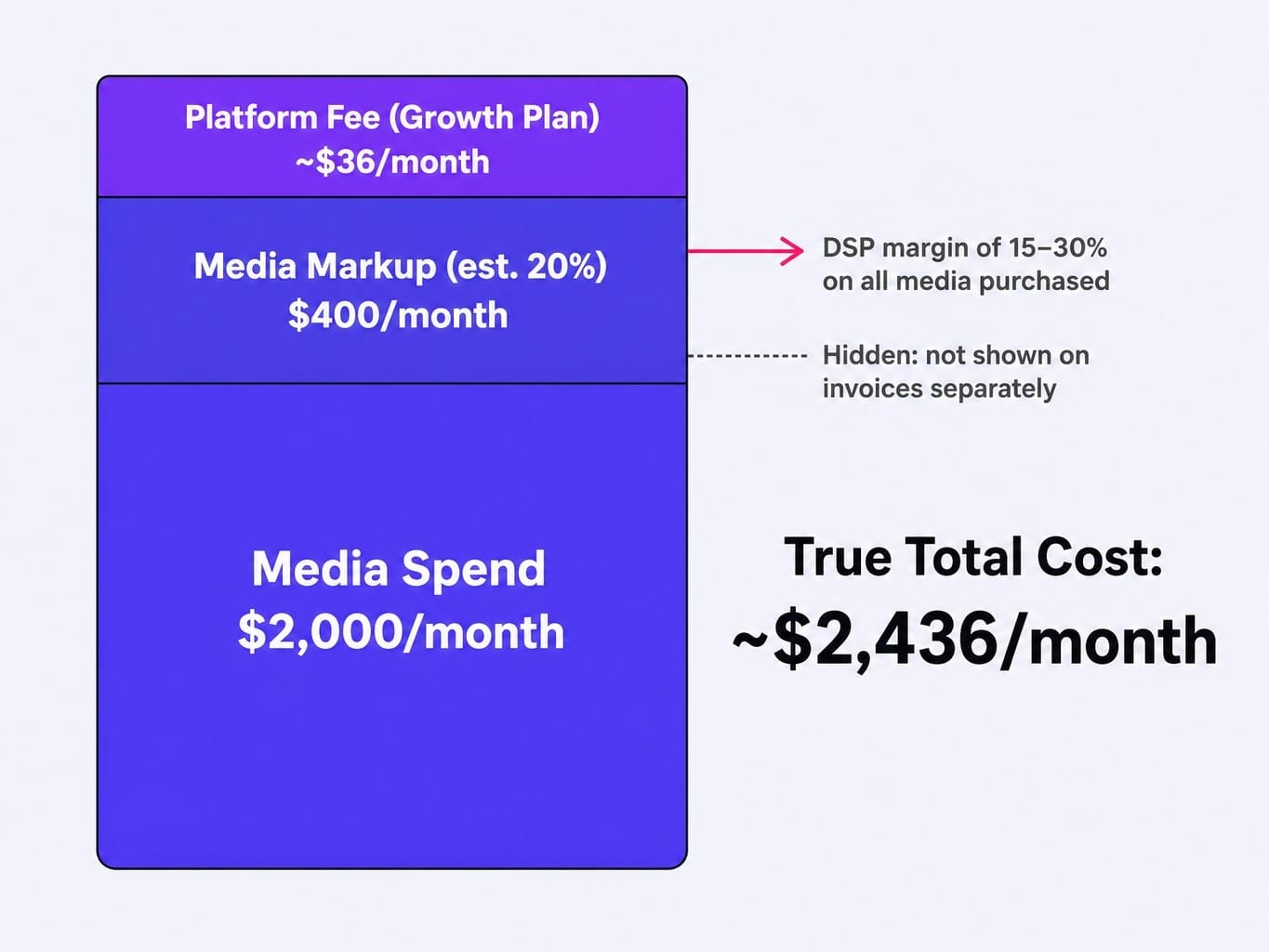
Let's use a concrete example. Imagine an ecommerce store on the AdRoll Growth plan spending $2,000 per month on their ad budget.
- Platform Fee: ~$36/month
- Media Spend: $2,000/month
- Media Markup: AdRoll takes a margin on the media it buys. While not publicly disclosed, industry consensus puts this DSP margin between 15-30%. Let's assume 20%. That's an additional $400.
Your total monthly Adroll cost isn't $2,036. It's closer to $2,436. This is the fundamental equation you must use to evaluate the platform.
The Platform Fee: What You Pay Before Any Ads Run
The platform fee is the most straightforward part of the Adroll cost. It unlocks features and access, but for any business with a meaningful ad budget, it's the smallest component of your monthly bill.
- Ads Plan (Free): This $0/month plan gives you access to the platform for web retargeting and email marketing. You still pay for all media at AdRoll's marked-up rates. There's no official minimum spend, but without a budget of at least $500-$1,000/month, you won't generate enough data for meaningful results.
- Growth Plan (~$36/month): This is the most common tier for small to mid-sized businesses. It adds crucial features like cross-channel reporting, attribution modeling, and the ability to run ads on social platforms like Meta.
- Advanced Plan (Custom Pricing): This tier requires an annual commitment and is priced via a sales conversation. It includes managed services, dedicated account management, and creative support. Pricing typically starts in the low thousands per month for the platform fee alone.
The Media Markup: The Cost Layer AdRoll Doesn't Advertise
AdRoll is a demand-side platform (DSP). It buys ad inventory on your behalf from various exchanges. Like all DSPs, it takes a margin on that media. This is a standard part of the programmatic advertising model, but it's rarely disclosed transparently on pricing pages.
The practical impact is that your effective cost per thousand impressions (CPM) is higher than the raw exchange rate. If AdRoll reports a $5 CPM for your campaign, they may be purchasing that inventory for a $3.50 CPM and keeping the $1.50 spread.
This isn't deceptive; it's the business model. But it means comparing AdRoll's "ad spend" to your spend on Google Display Network or Meta Ads is not an apples-to-apples comparison. You are paying a premium for AdRoll's technology, audience data, and cross-network reach, and that premium is baked into the media cost itself. A typical blended CPM for display retargeting on AdRoll can range from $3–$8, whereas buying similar inventory directly on an exchange might cost $1–$4.
What Each AdRoll Plan Includes (And Which One Fits Your Business)
Most of AdRoll's extensive feature comparison table is noise. The buying decision for most teams comes down to five key differences: managed services, cross-channel attribution, social media integration, dedicated support, and annual commitment.
Here's a simplified breakdown to help you decide:
For most scaling ecommerce and SaaS businesses, the Growth plan is the relevant tier. The free plan lacks the attribution features needed to measure retargeting performance accurately, while the Advanced plan is priced for mid-market budgets that can support a significant managed service fee.
The Hidden Costs Most AdRoll Pricing Guides Don't Mention
The plan fee and media spend are the visible costs. The factors that truly erode your return on ad spend (ROAS) are the ones that never appear on an invoice.
- Creative Fatigue & Refresh Labor: Retargeting audiences are small and see the same ads frequently. As a result, creative fatigue sets in fast—practitioner consensus suggests display ads in retargeting can lose effectiveness in just 2-4 weeks. AdRoll's dynamic creative helps, but it doesn't solve the core problem. If you aren't feeding the system fresh creative regularly, your effective CPM rises as you pay for impressions that no longer drive clicks. The cost is both the designer's time and the wasted media spend on a decaying asset.
- Attribution Window Inflation: The attribution window AdRoll uses by default is more generous than the windows Google and Meta apply to their own retargeting conversions. It often relies on a longer view-through attribution window, which can give AdRoll credit for conversions it merely influenced, not directly drove. If you make budget decisions based on AdRoll's dashboard without comparing it against your own last-click or multi-touch model, you risk over-allocating budget to a channel whose performance is inflated.
- Optimization Labor: On its self-serve tiers, AdRoll is not a "set it and forget it" platform. Someone on your team must spend time each week adjusting bids, monitoring spend pacing, reviewing audience segments, and analyzing performance. Consider a marketing team spending just 3-5 hours per week managing campaigns. At a blended labor cost of $60/hour, that's an additional $720-$1,200 per month in operational overhead that never shows up in a pricing analysis but directly impacts your total cost of ownership.
Read more: How to Prioritize Marketing Channels With a Limited Budget And Resources (Framework for Lean Teams)
AdRoll vs. Running Retargeting Directly on Google and Meta: A Cost Comparison
The comparison most pricing guides avoid is the one that matters most: Is AdRoll worth the premium over running retargeting natively on the platforms you already use? For many businesses, the answer is no.
I once ran a side-by-side test where the same retargeting audiences were served through AdRoll and natively through Google Display Network and Meta. The native campaigns delivered a blended cost-per-acquisition that was roughly 20% lower. However, they required nearly three times the manual touchpoints each week to manage frequency capping, audience refreshes, and creative rotation—exactly the kind of labor cost that never appears in a pricing comparison.
Let's model this for a business with a $3,000 monthly retargeting budget:
- AdRoll (Growth Plan):
Platform Fee: ~$36
Media Spend: $3,000
Estimated 20% Media Markup: $600
Total Monthly Cost: ~$3,636 (for inventory at a blended CPM of $5–$7)
- Native (Google + Meta):
Platform Fee: $0
Media Spend: $3,000
Media Markup: $0
Total Monthly Cost: $3,000 (for inventory at blended CPMs of $2–$5 on GDN and $6–$10 on Meta)
So, when does AdRoll earn its premium?
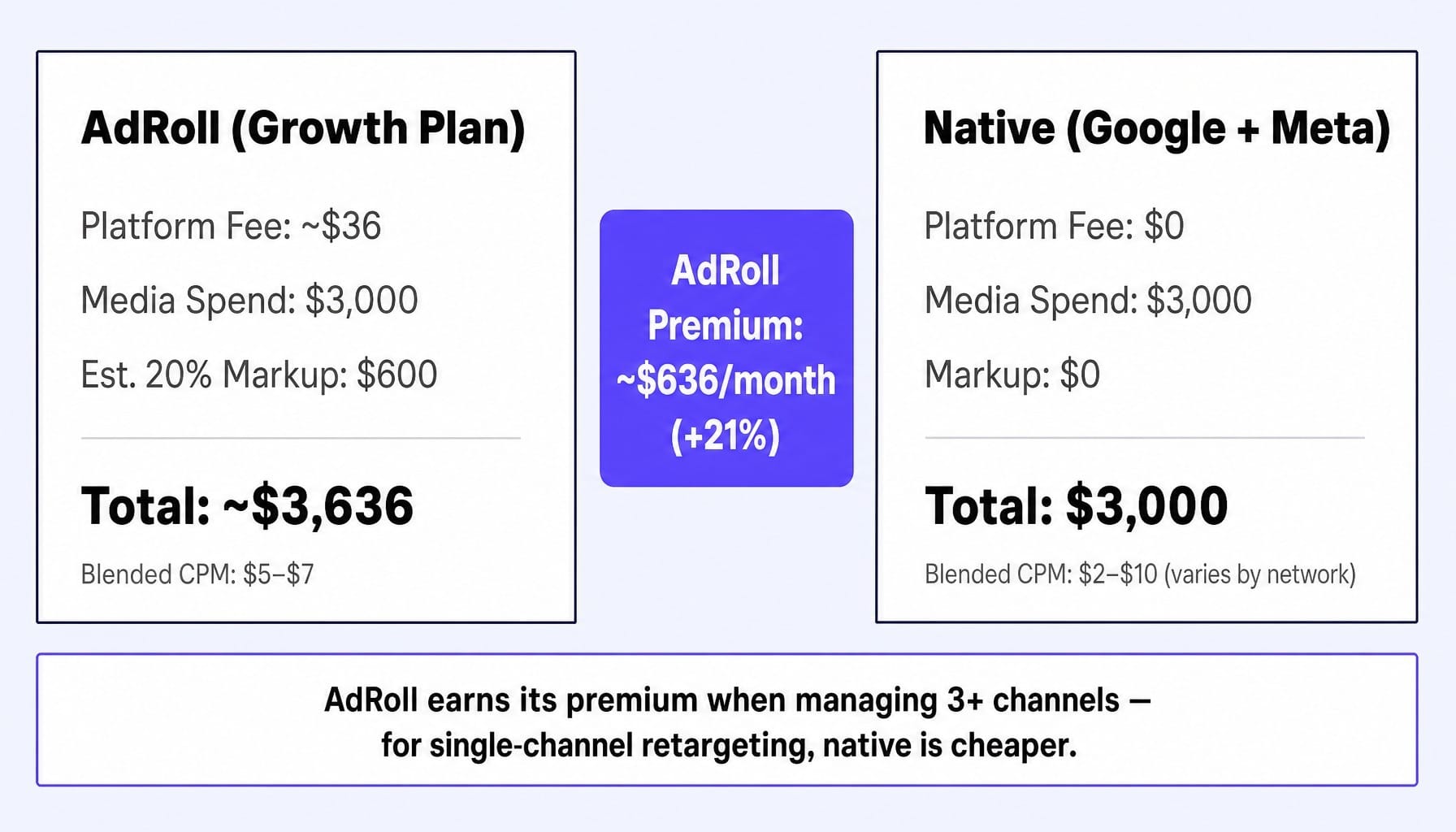
The value proposition rests on three pillars: cross-channel coordination (serving ads across web, social, and email from one dashboard), unified attribution (a single source of truth for performance), and reduced management complexity if you are running campaigns across three or more networks.
The breakeven point emerges when the time your team saves by managing everything in one place is worth more than the media markup premium. For single-channel retargeting (e.g., display only), native platforms are almost always cheaper and more efficient.
How AdRoll Costs Change as Your Traffic and Spend Scale
AdRoll's cost-effectiveness is not linear. There are two key inflection points where the economics of the platform shift dramatically.
Inflection Point 1: Below ~$1,000/month in spend.
At this level, the platform fee on paid plans represents a high percentage of your total cost. More importantly, if your site has fewer than 5,000 monthly visitors, your pixel fire rate is too low to build robust retargeting audiences. You end up with thin audience pools where you can't manage ad frequency effectively, leading to wasted spend. You're paying for infrastructure you can't fully utilize.
Inflection Point 2: Above ~$10,000/month in spend.
At this scale, the media markup becomes a significant absolute dollar amount. A 20% markup on a $15,000/month budget is $3,000—enough to hire a part-time specialist or license a more transparent DSP like The Trade Desk, where you control the margin yourself. This is the point where you either upgrade to AdRoll's Advanced managed plan or graduate to a more sophisticated in-house programmatic stack.
The sweet spot for AdRoll's self-serve plans is for businesses with 20,000–100,000 monthly site visitors spending $2,000–$8,000 per month on ads. In this range, the platform provides real value in simplifying cross-channel management without the markup being prohibitively expensive.
What If the Optimization Labor Wasn't Part of the Equation?
This entire analysis points to one systemic constraint: the real cost of any retargeting platform is inflated by the manual labor required to make it work. The weekly cycle of adjusting bids, refreshing creative, analyzing attribution, and optimizing landing pages is a hidden tax on your marketing budget.
Spike AI is built to eliminate this execution tax. It is a marketing execution platform that continuously identifies the highest-impact optimization moves across your website and marketing channels, then ships those fixes every week.
Instead of your team spending hours manually tuning campaigns and A/B testing the landing pages those ads point to, Spike AI handles the prioritization and execution. This isn't about replacing AdRoll; it's about making every dollar you spend on AdRoll—or any ad platform—work exponentially harder. By ensuring the pages your ads point to are continuously optimized for conversion, you fix the ROI equation at its source.
Conclusion: The Real Cost is Total Cost
Evaluating AdRoll based on its plan fee is like judging a car by its monthly payment without considering fuel, insurance, and maintenance. The central takeaway is this: AdRoll pricing is a total cost of ownership that includes the platform subscription, a variable media markup, creative refresh cycles, and, most significantly, the weekly optimization labor from your team.
Before committing, model your total monthly cost across all these layers. Compare it to the cost of running natively on Google and Meta. And most importantly, ask whether the landing pages those ads drive traffic to are optimized well enough to justify the spend in the first place. That is the question that ultimately determines your return.
Frequently Asked Questions
Does AdRoll offer discounts for annual billing?
The Advanced Package requires an annual commitment, which typically includes ad credits and managed services not available on monthly plans. AdRoll does not publicly advertise percentage discounts for annual billing on its lower tiers. The annual contract primarily serves as a gateway to the managed services tier rather than a direct cost-saving mechanism on the self-serve plans.
Can I set a daily spend cap on AdRoll to control costs?
Yes, AdRoll allows you to set daily and campaign-level budget caps on its self-serve plans. However, be aware that spend pacing can be uneven; campaigns may front-load spend early in the day or week depending on inventory availability and bid competition. It's wise to monitor your actual daily spend against the cap for the first few weeks to ensure pacing aligns with your expectations.
How does AdRoll charge for email retargeting campaigns?
Email retargeting features, like behavioral triggers and cart abandonment sequences, are included in AdRoll's paid plans without a separate per-email fee. However, the available email volume and audience segmentation capabilities vary by tier. If email is your primary retargeting channel, you should compare AdRoll's features against dedicated email automation platforms like Klaviyo or Mailchimp, which often provide deeper functionality.
What ROAS should I realistically expect from AdRoll at different budget levels?
AdRoll's case studies often cite 3–5x ROAS, but these figures typically use a generous view-through attribution model that can inflate results. Based on a more conservative last-click attribution model, a realistic ROAS for ecommerce retargeting ranges from 2–4x, assuming an average order value over $50. For B2B, where sales cycles are longer, ROAS is often lower. Below $1,000/month in ad spend, conversion volume is usually too small to measure ROAS reliably.
Is AdRoll effective for B2B retargeting or is it primarily for ecommerce?
AdRoll's platform is fundamentally built around ecommerce workflows, with deep integrations for Shopify, BigCommerce, and features like dynamic product ads. While B2B retargeting is possible, it's limited. The platform lacks native account-based targeting, and its CRM syncing is basic compared to specialized B2B platforms like LinkedIn Ads. B2B teams often achieve better results by running retargeting campaigns natively on LinkedIn and Google Display.