Agile Marketing Software: What the Category Must Actually Do in 2026
TLDR
- Most "agile marketing software" is repurposed project management software that visualizes work but doesn't accelerate it. The true measure of a tool is its ability to reduce marketing cycle time—the gap between insight and shipped result.
- A useful backlog isn't a flat to-do list; it requires epic-to-task hierarchy and a built-in prioritization model (like RICE or revenue-weighting) to ensure teams ship high-impact work first.
- Sprint boards fail when they copy developer workflows. Marketing-specific boards need correctly calculated WIP (Work-in-Progress) limits based on team constraints (like creative reviews) and strategic swimlane design.
- Retrospectives only create value if the software treats action items as first-class backlog items, preventing them from decaying in a separate document and ensuring accountability.
- The fundamental limitation of most agile marketing tools is that they solve the planning problem but leave the execution bottleneck untouched. The next evolution is systems that ship the work, not just track it.
Most tools sold as agile marketing software are project management platforms in disguise. You see them everywhere: monday.com boards with campaign templates, Asana timelines mapping content calendars, ClickUp views configured for marketing sprints. They were designed to manage software engineering workflows and have been repurposed for marketing.
This creates a fundamental disconnect. These tools help you visualize marketing work, but they do nothing to solve the system's actual constraint: the latency between identifying what needs to change and actually shipping it.
This article isn't another list of agile marketing tools. It's a functional breakdown of the four capabilities that determine whether a platform actually accelerates marketing throughput or just gives you a prettier view of your backlog. We'll cover the backlog view, the sprint board, retrospective tracking, and prioritization scoring—and what each must do to be useful rather than decorative.
What Agile Marketing Software Actually Needs to Do
The term agile marketing software is poorly defined, used by vendors to describe everything from a simple Kanban board to a full-blown Adobe Workfront suite. The only metric that clarifies the category is cycle time: the elapsed time between your team identifying a high-impact change and that change going live. Everything else is noise.
Consider a growth marketer who spots a key landing page with a dismal 1.2% conversion rate on Monday morning. They create a card for it on their sprint board, correctly marking it as high priority. The task is visible. The team discusses it in the standup cadence. Yet the fix—a simple headline and CTA rewrite—doesn't ship for three weeks.
The tool tracked the task but did nothing to accelerate its completion. It managed the project, not the execution. This is the critical distinction. The lead time (from idea to backlog) might be short, but the cycle time (from backlog to live) is where marketing velocity dies. The category splits cleanly into two types of systems: those that help you visualize marketing work, and the very few designed to compress the distance between a backlog item and a shipped result.
The Backlog View: Where Marketing Priorities Live or Die
The backlog is the single most neglected component in most agile marketing software. The tool gives you a list—cards, tickets, rows—but provides no system for deciding what to work on first. This is where execution either compounds or stalls. A poorly prioritized backlog means your team ships low-impact work with the same velocity as high-impact work, effectively neutralizing your efforts.
Imagine a three-person SaaS marketing team staring at 47 backlog items. SEO fixes, landing page tests, ad copy variants, and blog updates are all marked 'High Priority' because the tool has no mechanism for nuanced scoring. The team spends its planning sessions debating priorities instead of confirming them. The backlog has become a source of paralysis, not a driver of focus.
What a Marketing Backlog Should Actually Contain
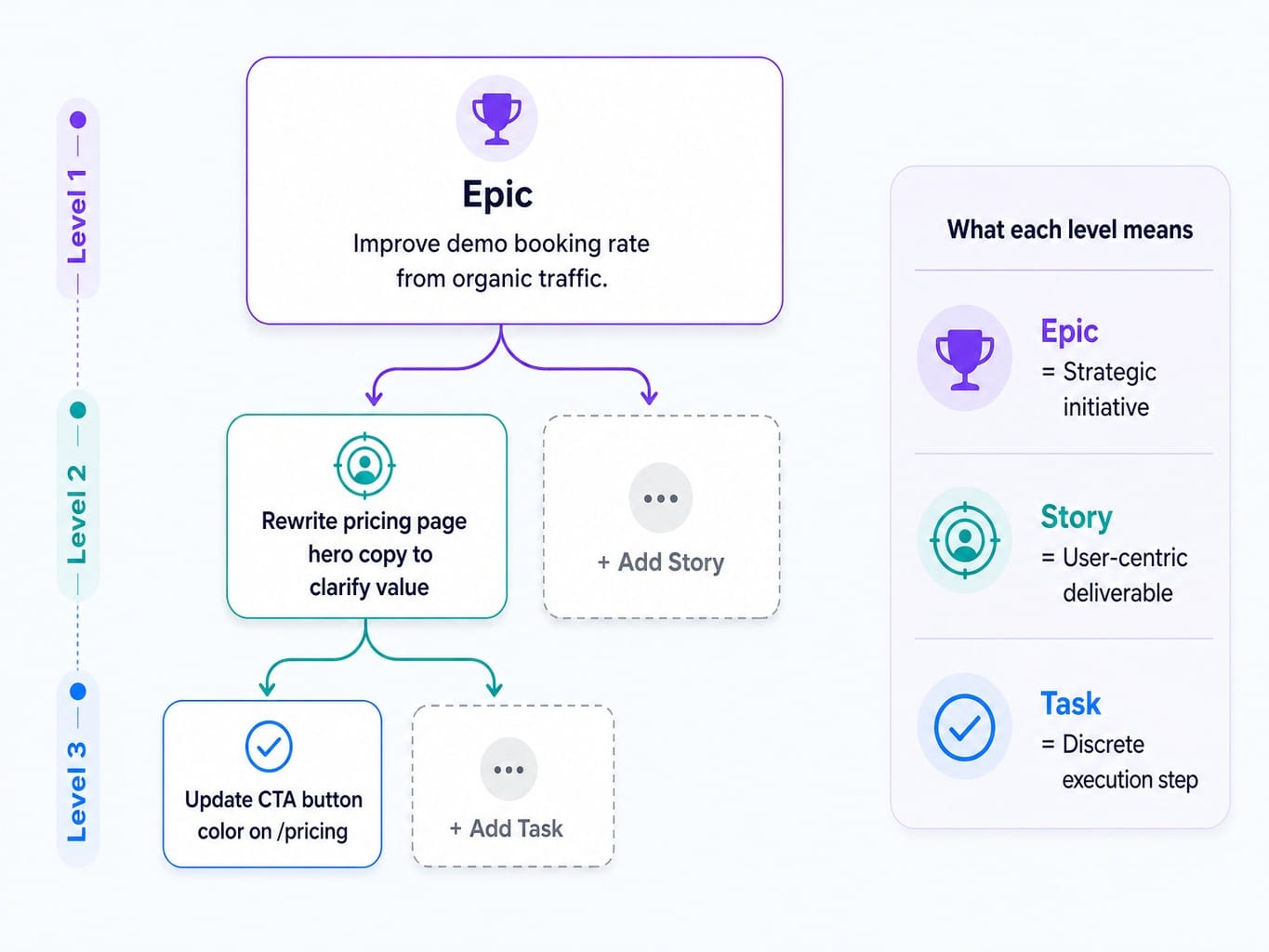
Most marketing backlogs fail because they are flat lists, mixing strategic initiatives with trivial tasks. A well-structured backlog in your agile marketing software must support hierarchy, distinguishing between:
- Epics: Large initiatives (e.g., "Improve demo booking rate from organic traffic").
- Stories: The user-centric work required to complete an epic (e.g., "Rewrite pricing page hero copy to clarify value").
- Tasks: The discrete steps to deliver a story (e.g., "Update CTA button color on /pricing").
When "Redesign homepage" (an epic) sits next to "Fix broken link on blog post" (a task) in the same list with no hierarchy, grooming sessions devolve into debates about scope. Proper epic decomposition ensures planning is about sequencing impact, not defining work. Tools like Jira Work Management are built for this, while simpler platforms like Trello flatten everything into a single layer of cards, forcing the hierarchy to live in your team's head.
Prioritization Scoring: ICE, RICE, or Revenue-Weighted Models
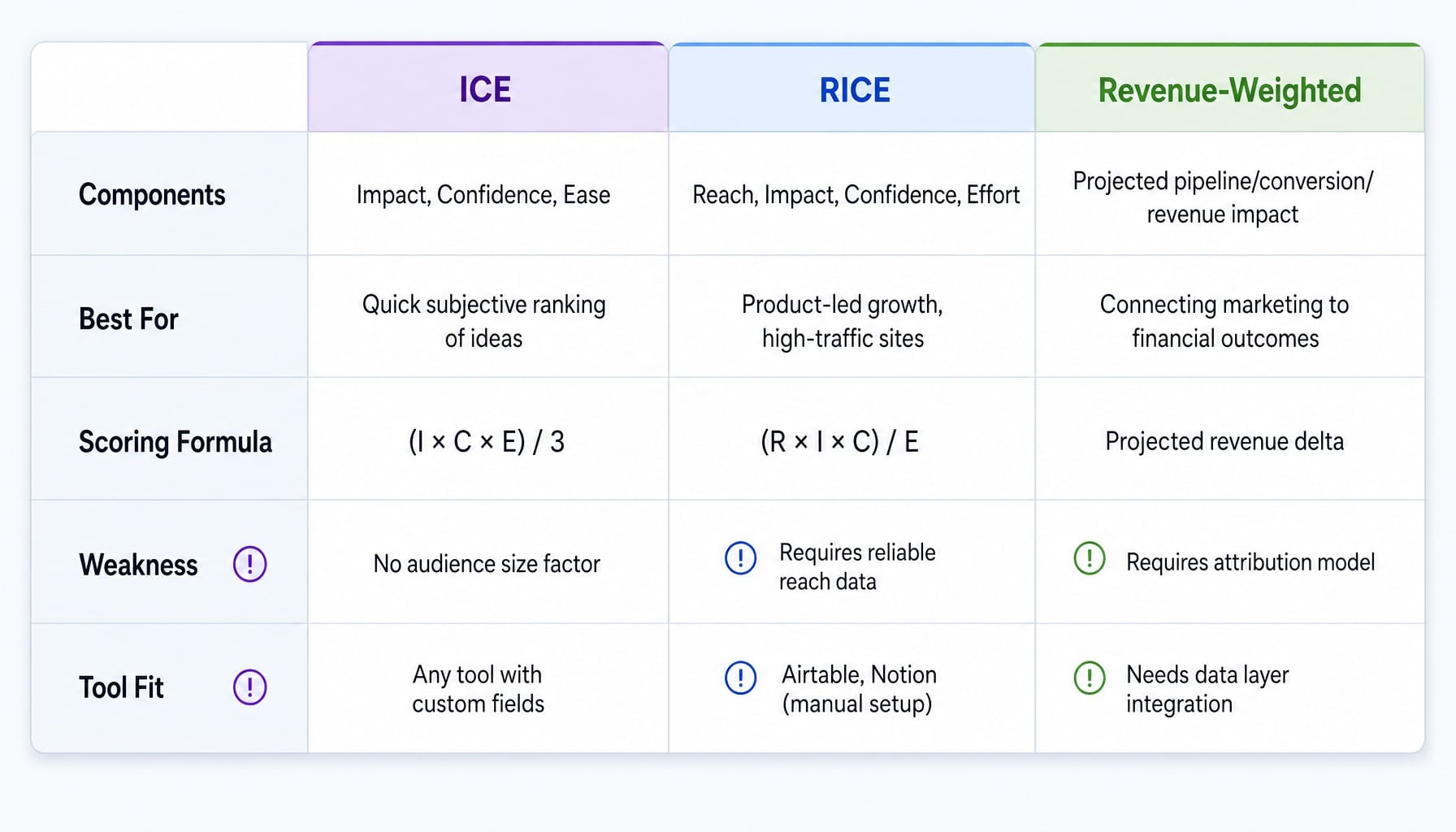
A structured backlog is only useful if it's ranked. The best agile marketing software supports—or at least doesn't obstruct—a prioritization framework. Three common models are:
- ICE (Impact, Confidence, Ease): A quick, subjective score for ranking ideas.
- RICE (Reach, Impact, Confidence, Effort): Adds a "Reach" component to quantify audience size, making it better for product-led growth or high-traffic sites.
- Revenue-Weighted: Ranks items by their projected impact on pipeline, conversions, or revenue, connecting marketing activity directly to financial outcomes.
The problem is when the scoring system lives outside the workflow tool. A marketing lead using a RICE score spreadsheet alongside their Asana board will find the friction is too high; the scores go stale within a week because manual updates are a tax on their time. Tools like Airtable and Notion can be configured for powerful scoring, but they require significant setup and maintenance. A true agile marketing system either has native prioritization scoring or integrates so tightly with a data layer that the backlog stays ranked without manual intervention.
The Sprint Board: Designing for Marketing Throughput, Not Developer Velocity
The sprint board is the most visible component of agile marketing, and also the most misunderstood. Most marketing teams copy a developer-style board (To Do → In Progress → Done) without adapting it for marketing-specific stages like creative review, stakeholder approval, legal sign-off, or content QA.
The result is either swimlane overload or, worse, a board that hides bottlenecks. When your "In Progress" column contains 12 items, but eight of them are actually stalled waiting on stakeholder feedback, your board is obscuring the truth about your workflow. It shows activity, not throughput. The board's design either reveals your system's constraints or it helps you ignore them.
WIP Limits That Actually Work for Creative and Campaign Work
Work-in-Progress (WIP) limits—the maximum number of items allowed in any single column—are the most powerful and underused feature in agile marketing software. Marketing teams either don't set them or set them so high they become meaningless.
Consider a content team that sets a WIP limit of 8 on their "In Review" column. This feels disciplined, but the team only has three people who can actually review content. The real constraint is reviewer capacity, not team ambition. The WIP limit should be 3, or maybe 4 at most. A limit of 8 isn't a limit; it's decoration.
Setting a tight WIP limit forces the bottleneck into the open. When the "In Review" column is full, the team can't pull new work into it. They are forced to swarm the problem—by helping with reviews or clearing blockers for the reviewers—to get work flowing again. Tools like Jira and Leankit (Planview AgilePlace) can enforce WIP limits with visual warnings. The diagnostic tool that proves if this is working is the cumulative flow diagram; if the "In Review" band on the chart widens over time, your WIP limit is too high or unenforced, and you're building a hidden queue of work that will lead to sprint spillover.
Swimlane Design for Cross-Channel Marketing Teams
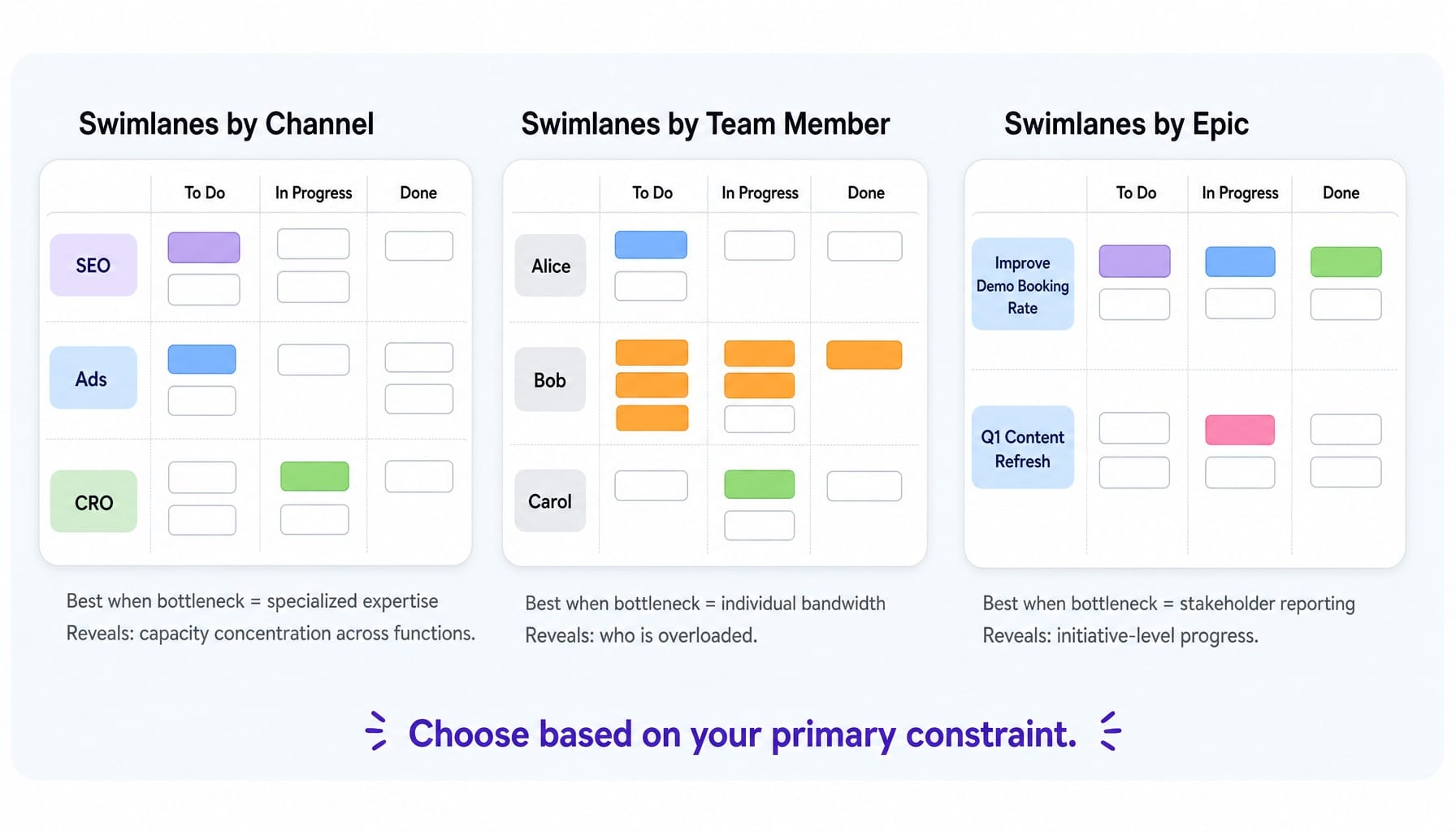
Swimlane design—how you organize the horizontal rows on your board—is where your agile marketing software either supports or sabotages a cross-functional team. For a team running SEO content production, paid ad creative, and CRO experiments on the same board, the choice of swimlane organization is strategic.
- Swimlanes by Channel (SEO, Ads, CRO): This shows where capacity is concentrated and helps with resource allocation across different marketing functions.
- Swimlanes by Team Member: This reveals who is overloaded and highlights individual bandwidth constraints.
- Swimlanes by Epic: This organizes all related work for a major initiative in one place, which is useful for reporting to stakeholders.
There is no single right answer. The correct design depends on your team's primary constraint. If your bottleneck is specialized expertise, use channel swimlanes. If it's individual bandwidth, use person-based swimlanes. For larger organizations, dependency mapping across pods becomes critical; the output of the content swimlane might be the input for the design swimlane. More robust platforms like Wrike and Adobe Workfront handle these complex cross-functional views well, while simpler tools struggle. This isn't a cosmetic choice; it's a decision about what part of your marketing system you need to see most clearly.
Read more: Marketing Channel Prioritization for 2026: Where Your Budget Actually Compounds
Retrospective Tracking: Why Retro Action Items Decay and How Software Should Prevent It
If you've ever sat through the same retro conversation three sprints in a row, you know this feeling. Most marketing teams diligently run retrospectives, the sprint-end ceremony to review what worked, what didn't, and what to change. Yet the action items from those meetings have a half-life of about one sprint.
The team identifies "stakeholder feedback is our biggest blocker" for the third consecutive time. The action item—"Create a feedback SLA"—is captured in a shared doc, a Miro board, or a Confluence page. It feels productive. But because it lives outside the team's primary execution system, it's immediately forgotten. By the next retro, the team is discussing the same blocker again because the fix was never prioritized or executed.
This is a failure of the system, not the team. Effective agile marketing software must treat retro action items tracking as a core function. An action item should be promoted directly from the retrospective into the backlog as a first-class citizen, with an owner, a due date, and a "definition of done." It enters the same prioritization queue as every other piece of work. Some tools like Teamwork.com can be configured to link retro outputs to the backlog, but it often requires manual setup. The value of a retrospective isn't the conversation; it's whether your system enforces follow-through.
Where Most Agile Marketing Tools Break Down
Here is the fundamental limitation of nearly all agile marketing software: it optimizes for visibility, not execution. The board shows you what's in progress. The backlog shows you what's prioritized. The retro shows you what's broken.
But not one of these components actually ships the work.
The gap between "this is our highest-priority item" and "this is live on the website" still depends entirely on human bandwidth and manual execution. A marketer has to write the copy. A designer has to create the asset. A developer might need to deploy the change.
Consider a lean, three-person marketing team. They run a disciplined two-week sprint cadence. Their backlog is groomed. Their WIP limits are enforced. Yet they only ship four or five meaningful changes per sprint. Their bottleneck isn't their process; it's their execution capacity. Sprint after sprint, they accumulate velocity debt—the gap between what the team plans and what it actually ships. Agile marketing software solved their planning problem but left their shipping problem completely untouched.
Read more: How to Prioritize Marketing Tasks for Lean Teams: A Framework That Actually Works
What Changes When the Software Ships the Work, Not Just Tracks It
The tension is clear: agile marketing software gives teams process discipline, but the execution gap remains because the tool only visualizes work. This is where the category must evolve. The solution isn't a better sprint board; it's collapsing the distance between the highest-priority backlog item and the shipped change.
Spike AI operates as an execution layer, not just a tracking layer. The system moves beyond visualization to close the loop. Every week, it identifies the single highest-impact move across your website, SEO content, or ads, prioritizes it using a revenue-weighted model, and then deploys the change.
The marketer's role shifts from operator to orchestrator. The backlog of ideas shrinks into a queue of approvals. The sprint board transforms from a static tracking tool into a compounding growth engine, fueled by a consistent weekly release cadence. This is the logical next step for the category: moving from tools that help you plan the sprint to systems that ship the sprint's output. The goal is no longer just to manage the work, but to get it done.
See how Spike AI turns your marketing backlog into weekly shipped results
Conclusion
Agile marketing software is only as valuable as the execution it enables. Most tools in the category today stop at visualization, providing a clearer picture of a system still constrained by human bandwidth. The four core capabilities—a prioritized backlog, a well-designed sprint board, accountable retros, and a clear scoring model—are necessary but insufficient. If the system still depends entirely on manual effort to ship, you've only optimized the planning phase. The category is now evolving from planning tools to execution systems. The teams that recognize this shift will compound results while others continue to compound their backlog.
Frequently Asked Questions
Can agile marketing software integrate with an existing martech stack without creating tool sprawl?
The true test of integration is whether the agile marketing tool becomes your orchestration layer—pulling data from analytics, CMS, and ads—rather than just another tab. Native integrations with HubSpot or Google Analytics are table stakes. The real differentiator is a tool that eliminates another system from your stack, rather than adding to it.
Is agile marketing software worth adopting if the team also runs waterfall campaigns?
Yes, because most marketing teams operate in a hybrid model. They manage continuous, always-on campaigns (like paid search or email nurtures) alongside time-boxed sprints for projects like CRO or content creation. The best agile marketing tools and software support these hybrid agile-waterfall workflows by separating workstreams on the same board, not forcing everything into two-week cycles.
What is the difference between Scrum and Kanban when choosing agile marketing software?
Scrum uses fixed-length sprints with defined ceremonies, while Kanban uses a continuous flow with WIP limits and no rigid time-boxing. For most marketing teams, Kanban is a more natural fit because work often arrives continuously. In practice, most teams adopt "Scrumban," a hybrid that combines Kanban's flow with Scrum's ceremonies like standups and retros.
How do you manage stakeholder requests in agile marketing software without derailing active sprints?
Establish a dedicated intake process. All new requests from stakeholders go into a triage column or a separate intake board, not directly into the active sprint. During backlog grooming, the team scores these requests against existing priorities. If a new request outscores a planned item, it can replace it, but the sprint's total scope remains constant. The tool should enforce this boundary.
Can agile marketing tools support AI-driven sprint planning and prioritization?
AI-assisted sprint planning is an emerging capability in 2026. The most practical application today is not auto-generating sprint plans but using AI to score backlog items by projected revenue impact based on historical performance data. While many tools offer AI for task summarization, few provide AI-driven prioritization that connects to actual conversion or pipeline data.
What is a realistic sprint velocity benchmark for a small marketing team?
External benchmarks are misleading; velocity is only meaningful relative to your team's own historical throughput. A three-person team might complete 15-25 story points per sprint, but that number is arbitrary. A more useful metric is the sprint spillover rate. If more than 20% of planned work consistently carries over, your team is overcommitting during planning.