
How to Structure a B2B SaaS Marketing Team That Actually Ships: A Stage-by-Stage Framework

TLDR
- Structure for Throughput, Not Titles: The best B2B SaaS marketing team structure isn't about roles; it's about maximizing execution throughput—the number of meaningful marketing changes (tests, content, campaigns) your team can ship per week.
- Sequence Hires by ARR: Don't hire a VP of Marketing at $2M ARR. Follow a specific hiring sequence: a generalist first, then a core pod (content, demand gen), then specialists like product marketing and marketing ops, and finally, leadership.
- Budget Non-Headcount Spend First: A marketer with no budget for tools and campaigns is a strategist who can't execute. Allocate 30-40% of your total marketing budget to non-headcount spend before you hire.
- Marketing Ops is Your Bottleneck-Breaker: The most under-hired role at the $3-8M ARR stage is marketing operations. Without it, your expensive specialists spend their time fixing HubSpot workflows instead of driving pipeline.
- AI Collapses Roles, Not Headcount: AI tools don't just mean you need fewer people. They mean one person can own what used to be two roles (e.g., content + SEO). This allows a lean team to increase its shipping cadence without increasing headcount.
Let's start with a familiar scene. A Series A SaaS company hits $3M ARR and follows the advice from every blog post on B2B SaaS marketing team structure. They hire a VP of Marketing, a content marketer, and a demand gen specialist. Six months later, the VP is writing blog posts, the content marketer is buried in HubSpot workflows, and the demand gen specialist is trying to build landing pages in Webflow. Nobody is doing the job they were hired for.
This happens because the structure was designed around titles, not around what the company actually needed to ship.
The right B2B SaaS marketing team structure isn't about which roles you fill—it's about the sequence in which you build execution capacity. The quality of your team isn't measured by headcount; it's measured by throughput: how many meaningful marketing changes can you ship per week?
This is a stage-by-stage framework for building a team that actually ships. It provides a hiring sequence tied to ARR milestones, specific headcount ratios, a worked failure example, and guidance on how AI is changing the math.
Why Most SaaS Marketing Org Charts Fail Within a Year
A B2B SaaS marketing team structure fails when it's designed around job titles instead of execution capacity—the ability to identify, prioritize, and ship marketing changes that move pipeline. The standard approach of drawing an org chart and filling the boxes produces teams that look complete on paper but are paralyzed by hidden dependencies.
This paralysis follows a predictable pattern. A company hires a 'demand gen manager' before they have a content engine to generate demand with. The new hire spends their first three months trying to write the blog posts and e-books they were hired to promote. Or a company hires a 'product marketer' before they have a repeatable sales motion to enable, leaving the new PMM to create sales decks for a process that changes weekly.
The root cause is simple: founders and VPs copy org charts from companies three times their size without understanding the sequencing that created those structures. They hire for a role without having the upstream dependencies in place.
The real metric for your team structure's quality is its execution throughput. Forget headcount or role coverage for a moment. How many meaningful changes—landing page tests, new content assets, campaign launches, conversion optimizations—does your team ship per week? If that number is flat or declining while your backlog of ideas grows, your structure is failing. The rest of this article provides the sequencing logic to fix it.
What to Decide Before You Hire a Single Marketer
Before structuring a B2B SaaS marketing team, you must lock two decisions: your GTM motion and your non-headcount marketing budget. Both fundamentally change which roles you need and in what order. Most companies skip this step, starting the hiring process before they know if they're building for product-led growth, sales-led growth, or a hybrid motion. The result is waste—like a PLG company hiring a field marketing manager, a role that's nearly useless in a self-serve motion.
The other critical input is budget. B2B SaaS companies typically allocate 10-20% of ARR to marketing. Of that, a healthy split is 60-70% for headcount and 30-40% for the tools, campaigns, and programs that give your team leverage. Hiring without budgeting for this non-headcount spend creates a team with people but no fuel.
Your GTM Motion Determines Your First Three Hires
Your go-to-market motion dictates your hiring sequence. A sales-led company needs to build a messaging foundation for its reps, while a PLG company needs to optimize its self-serve funnel. A hybrid motion needs a bit of both. Each path demands a different type of marketer with different skills.
Here's how the first three hires differ across each motion:
A PLG-first company that uses tools like Navattic for interactive demos needs a first hire who lives in the product, obsessing over activation rates and self-serve conversion. A sales-led company using a tool like Gong for call intelligence needs a first hire who can translate those customer conversations into compelling positioning and sales enablement assets. Get this first hire wrong, and you'll spend a year correcting the course.
Budget the Non-Headcount Spend Before You Budget Headcount
A marketer without tools and campaign budget is a strategist without execution capacity. Imagine a company allocates $250K to marketing. It hires two people at a fully loaded cost of $125K each, leaving zero dollars for a marketing automation platform like HubSpot, a capable CMS like Webflow, paid channel spend, or SEO tools. The result is two smart people writing organic LinkedIn posts and hoping for the best.
This is the most common structural mistake at the $1-5M ARR stage.
A better allocation of that $250K would be one strong hire at $130K, supported by $120K in tools and program spend. That single person, armed with the right infrastructure, can actually ship work across multiple channels. They can run paid search campaigns, build landing pages, and analyze performance because they have the budget to do so. Before you decide who to hire, decide how much fuel you're giving them to do their job.
The Five-Stage Hiring Sequence: From Founder-Led to Full Team
A B2B SaaS marketing team structure should evolve through five stages tied to ARR milestones. The trigger to move between stages isn't just revenue; it's when the current team's shipping cadence can no longer keep up with the opportunities the business is identifying. This growing backlog of unfixed issues is your "execution debt," and it's the signal to invest in more capacity.
As a benchmark, most scaling B2B SaaS companies maintain a ratio of 1 marketer per $500K-$1M in ARR. PLG-heavy companies often lean toward the higher end of that revenue range, as the product itself handles more of the marketing workload.
Here is the five-stage sequence:
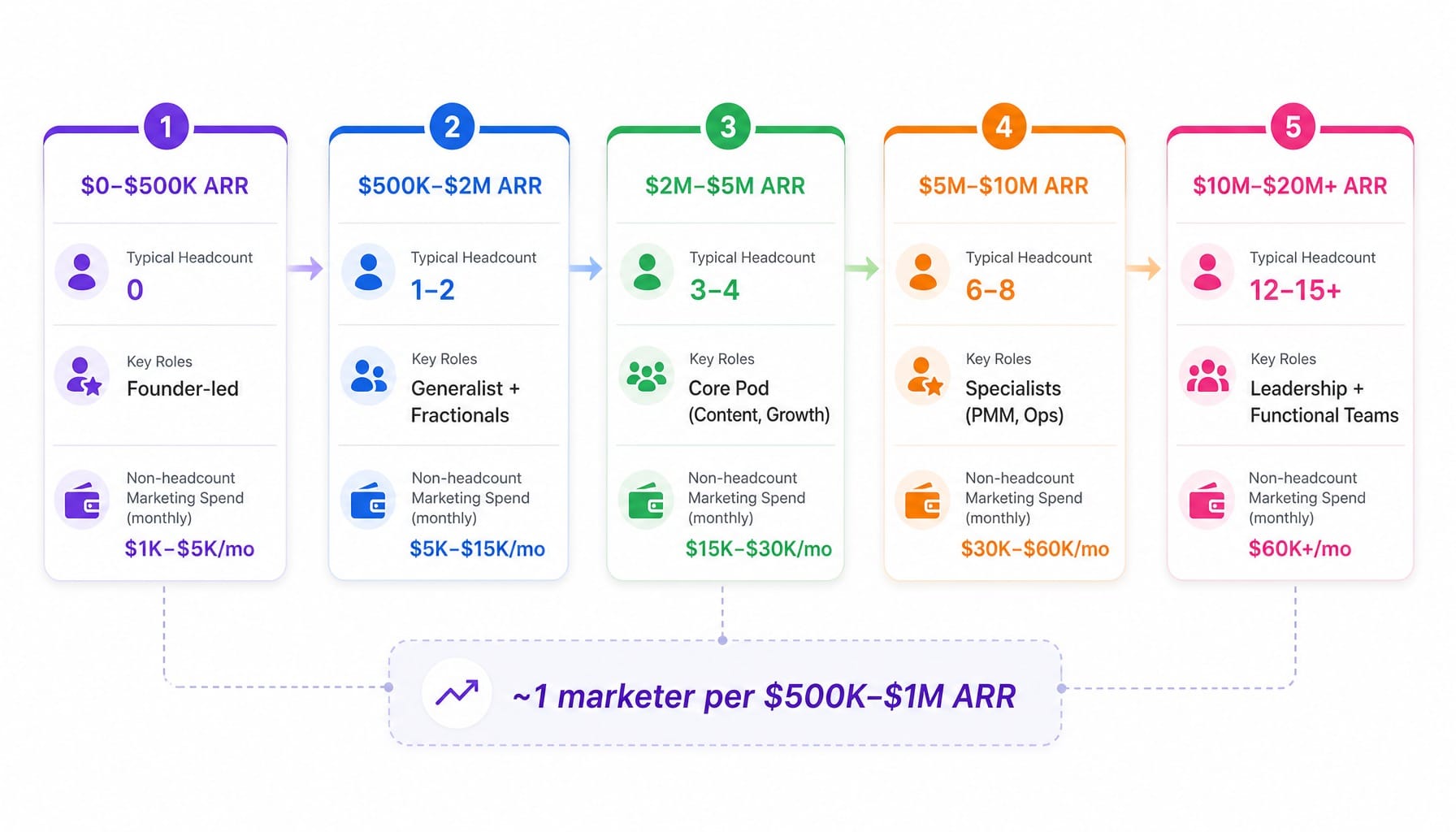
$0–$2M ARR: Founder-Led Marketing and Your First Hire
In the early days, the founder is the marketing team. The goal isn't to replace them but to amplify their output. The trigger to hire your first full-time marketer is when the founder is spending over 30% of their week on marketing execution.
This first hire should be a versatile, player-coach generalist. You need a doer who can write copy, run simple campaigns, manage HubSpot, and build landing pages. Avoid the temptation to hire a "VP of Marketing" at this stage; a $180K strategy deck that nobody can execute is a catastrophic waste of capital. Instead, supplement your generalist with fractional specialists for things like SEO, paid media, or design. This gives you expert execution without the full-time cost and is far more effective than hiring a generalist agency before you have the internal judgment to manage them.
$2M–$10M ARR: Building the Core Team Around Execution Pods
This is where most companies make their biggest structural mistakes. Instead of building functional silos, organize your team around execution pods focused on outcomes like pipeline generation or conversion optimization.
- At $2M–$5M ARR (3-4 people): Your team is a marketing lead (still a player-coach), a content marketer, and a demand gen/growth marketer. You should also have fractional support for design and, crucially, marketing ops.
- At $5M–$10M ARR (6-8 people): The team expands. Now is the time to add a dedicated product marketer, bring marketing ops in-house (or expand the fractional role), and add either a full-time designer or a conversion specialist.
The most commonly under-hired role at this stage is marketing operations. Without someone owning the integration between HubSpot and Salesforce, managing lead scoring, and building attribution models, your team is flying blind. Tools like 6sense or Clearbit (now part of HubSpot) only deliver value when a dedicated owner manages the data layer. Without that role, your demand gen manager ends up spending 30% of their time building workflows instead of running campaigns.
$10M–$20M+ ARR: When Specialization and Leadership Layers Make Sense
This is the first stage where hiring a VP of Marketing or CMO becomes a logical move. Hiring one earlier is often the most expensive mistake a SaaS company can make. By this point, the team is 12-15+ people and needs dedicated functional leaders (e.g., Head of Content, Head of Demand Gen) who report to the VP/CMO.
This stage also forces the "player-coach to pure-coach" transition. The marketing lead who was brilliant at building the team from one to eight people may not be the right person to scale it from eight to twenty. It's a different skill set, moving from hands-on execution to pure strategy, team building, and budget management. A fractional CMO can serve as an effective bridge here, providing senior leadership without the full-time commitment until the company is truly ready. Resist adding management layers until the IC-heavy org reaches at least 8-10 people; premature layers just add communication overhead and slow down execution.
A Worked Example: The Org Chart That Fails vs. The One That Ships
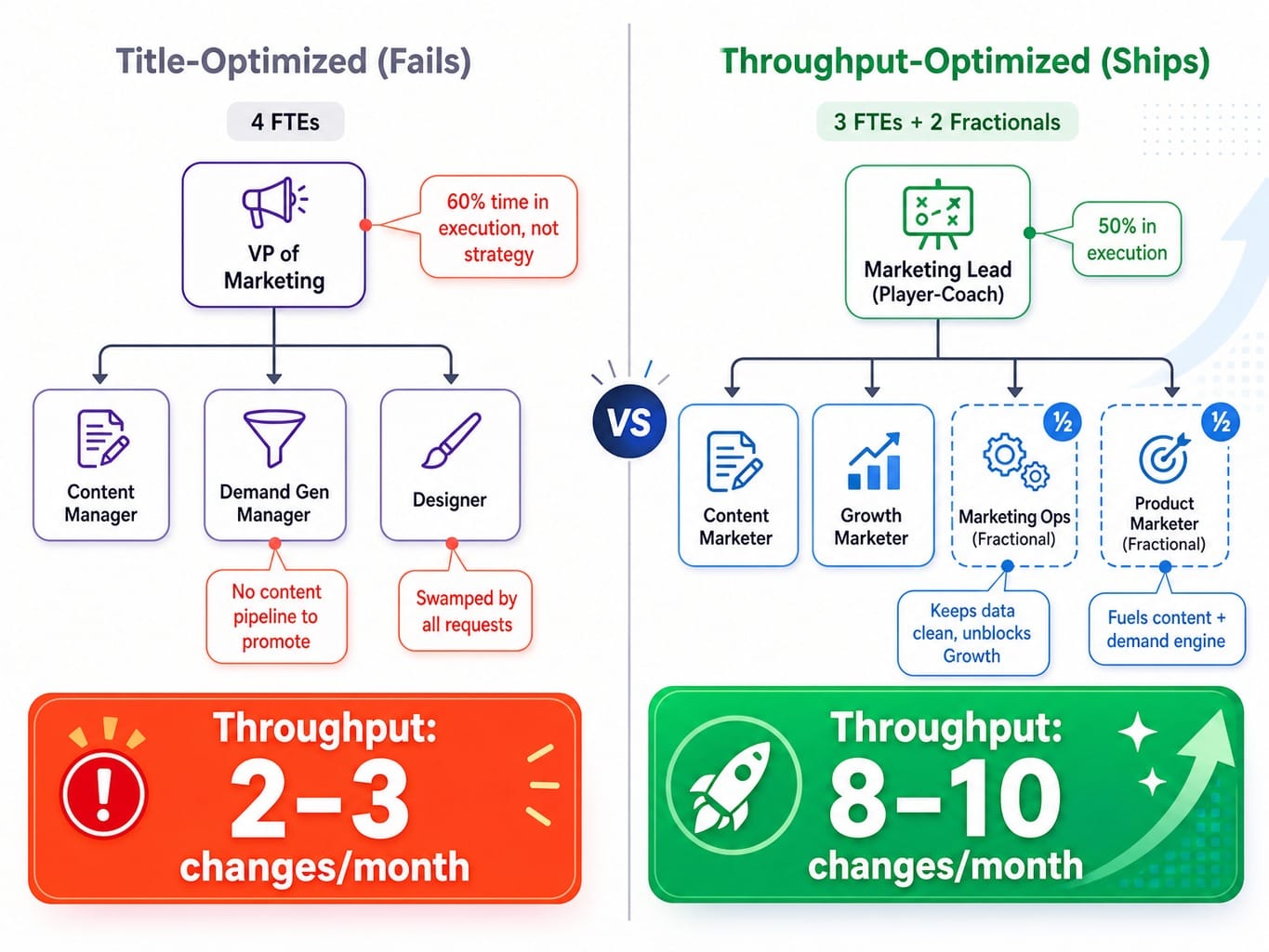
Org charts are only useful when you can see what goes wrong, not just what looks right. Let's compare two structures for a hypothetical $5M ARR B2B SaaS company with a $500K annual marketing budget.
The Failure Case: The Title-Optimized Org Chart
- Structure: VP of Marketing → Content Manager, Demand Gen Manager, Designer (4 FTEs)
- Why it fails: This structure looks good on a slide, but it's an execution bottleneck waiting to happen. The VP, with no marketing ops support, spends 60% of their time in execution, trying to manage the tech stack and pull reports. The Demand Gen Manager has no content pipeline from the single Content Manager and no product marketing support to create compelling offers. The Designer is swamped with requests from both. This team feels busy but isn't productive.
- Execution Throughput: 2-3 meaningful changes shipped per month.
The Working Model: The Throughput-Optimized Org Chart
- Structure: Marketing Lead (Player-Coach) → Content Marketer, Growth Marketer, Marketing Ops (Fractional), Product Marketer (Fractional) (3 FTEs + 2 Fractionals)
- Why it works: This structure has fewer full-time heads but higher output. The Marketing Lead stays 50% in execution, guiding strategy while still shipping work. The fractional Marketing Ops person keeps the HubSpot/Salesforce data clean, enabling the Growth Marketer to focus on both paid acquisition and conversion optimization. The fractional Product Marketer provides the positioning and sales enablement assets that fuel the entire content and demand engine.
- Execution Throughput: 8-10 meaningful changes shipped per month.
The lesson is clear: the working structure has higher execution throughput because it systematically eliminates the upstream dependencies that block the team from shipping. It prioritizes capacity over titles.
How AI Tools Are Collapsing Traditional Marketing Roles in 2025
AI tools are reducing the number of specialists a B2B SaaS marketing team needs by collapsing execution tasks that previously required dedicated headcount. The traditional model of hiring one specialist per channel is becoming obsolete for teams under $10M ARR, as AI-augmented generalists can now deliver specialist-level output.
This is happening in three key areas:
- Content and SEO: A content marketer using modern AI writing assistants can handle research, drafting, and on-page optimization, tasks that once required a dedicated SEO specialist as a counterpart. The human role shifts from pure production to editorial strategy, quality control, and distribution. One person can now manage the entire content engine.
- Conversion and Technical Optimization: The roles of CRO specialist and technical SEO are converging. AI-powered platforms can now run technical site audits, prioritize A/B tests based on potential impact, and even assist with implementation. The human role becomes one of strategic oversight and hypothesis generation, not manual execution.
- Marketing Operations: Core marketing ops tasks like updating lead scoring models, building new automation workflows, and generating performance reports can be partially automated. This means a single fractional ops person can often provide the support that previously required a full-time hire, keeping the team's data infrastructure clean and efficient.
The mistake is to use AI simply to produce more volume. The real value of AI in team structure is enabling the same number of people to ship more meaningful changes per week, breaking through the human bandwidth constraints that have always defined marketing.
When Your Team Structure Cannot Close the Execution Gap
Even with the perfect hiring sequence and AI-augmented roles, most lean marketing teams still accumulate a backlog. There's a persistent list of SEO fixes, conversion optimizations, and content improvements that everyone knows would move the needle on pipe gen but no one has the bandwidth to tackle.
This is the execution gap: the latency between identifying what needs to change and actually shipping it. It exists because human bandwidth is finite.
This is the gap Spike AI is built to close. It's not a replacement for your team; it's the execution layer that bridges the gap between what your team knows should happen and what actually ships. Every week, Spike AI identifies the highest-impact move across your website, SEO, and conversion funnel—and then executes it. Your team's role shifts from doing the manual work to approving the strategic work.
If your team ships 3-4 meaningful changes per month but your backlog grows faster, the problem isn't your structure—it's your execution capacity. Spike AI provides agency-quality execution without the agency cost or coordination overhead, turning your backlog into a weekly shipping cadence.
See how Spike AI closes the execution gap for lean marketing teams
Structuring a Marketing Team for PLG and Enterprise Sales Simultaneously
A B2B SaaS marketing team supporting both a product-led growth motion and an enterprise sales motion needs a shared infrastructure layer (content, ops, brand) with dedicated execution capacity for each GTM motion. Simply asking one team to serve two masters is a recipe for failure.
The most common mistake is assigning the same demand gen person to optimize self-serve signups and run enterprise ABM campaigns. These are fundamentally different skills, cadences, and workflows.
A better structural pattern is to create dedicated roles for each motion, supported by a shared foundation:
- One Growth Marketer dedicated to PLG metrics: activation rate, PQL volume, self-serve conversion, and expansion revenue.
- One Demand Gen Marketer dedicated to sales-led metrics: MQLs, pipeline contribution, and deal acceleration, often using tools like Metadata.io for programmatic campaigns.
- Shared Resources: Both roles are supported by a common content engine, a single marketing ops function, and one product marketer.
The product marketer is the linchpin. They create positioning that works for the self-serve buyer reading a pricing page on their own and the enterprise buyer receiving a sales deck from a rep. This structure allows for specialization without creating redundant, siloed teams, and is critical for any company trying to run a hybrid GTM motion effectively.
Read more: Marketing Task Prioritization for Lean Teams: A Framework That Actually Works | Spike
Conclusion
The most important shift you can make is to stop thinking about your team structure as an org chart exercise. It's an execution design problem.
The companies that scale marketing successfully don't start by drawing boxes and filling them with titles. They start by understanding their GTM motion, sequencing hires to eliminate execution dependencies, and measuring success by their shipping cadence, not their headcount.
The teams that win in 2025 and beyond will be those that treat their marketing structure as a system designed for throughput. They will be augmented by AI where human bandwidth is the constraint and ruthlessly focused on one thing: closing the gap between knowing what to do and actually getting it done.
Frequently Asked Questions
Should marketing own SDRs or should sales own them?
In most B2B SaaS companies under $15M ARR, SDRs should report to sales, as their daily workflow aligns with sales management rhythms. Marketing, however, must own the content, targeting data, and lead scoring models that feed SDR outreach. The failure isn't about which team owns the headcount; it's when there's no feedback loop between SDR conversion rates and marketing's lead quality.
What is the difference between growth marketing and demand generation in a SaaS team?
Demand generation focuses on filling the top of the funnel with MQLs via paid campaigns, content, and events. Growth marketing spans the entire funnel, including user activation, conversion optimization, retention, and expansion. In practice, a company under $5M ARR should hire a growth marketer first for full-funnel coverage; demand gen becomes a distinct role when the funnel is mature enough to specialize.
What KPIs should each marketing role own?
Content marketing owns organic traffic, content-attributed pipeline, and publishing cadence. Demand gen owns MQL volume, cost per MQL, and marketing-sourced pipeline. Product marketing owns win rate and sales cycle length. Marketing ops owns lead-to-MQL conversion rate and attribution accuracy. The marketing lead owns the aggregate: marketing's contribution to total pipeline and revenue.
When should a SaaS startup bring marketing in-house vs. outsource to an agency?
Outsource execution tasks like design, paid media management, or technical SEO when you have internal marketing judgment to evaluate the agency's work. Bring roles that require deep product and customer knowledge—content strategy, product marketing, and marketing leadership—in-house. The worst mistake is outsourcing strategy to an agency that doesn't understand your buyer.
What does a marketing operations role actually do in a SaaS company?
Marketing ops owns the tech stack that makes every other role effective: CRM and marketing automation (HubSpot, Marketo), lead scoring, campaign attribution, and reporting. Without marketing ops, your demand gen manager spends 30% of their time fixing workflows instead of running campaigns. It is the most under-hired, highest-leverage role at the $3-8M ARR stage.