Agile Marketing: Why the Ceremonies Are Now the Bottleneck
TLDR
- Agile marketing's principles are correct, but its execution layer—human ceremonies like standups and sprint planning—is a bottleneck for lean teams, consuming 15-25% of available capacity.
- The coordination overhead of Scrum was designed for large engineering teams with interdependent work, not for small marketing teams with largely independent tasks.
- The next evolution of agile marketing isn't better ceremonies; it's an autonomous system that runs the detection-prioritization-execution loop continuously, without meetings.
- In an autonomous sprint, the marketer's role shifts from operator (doing the work) to approver (setting strategy and greenlighting system-generated changes).
- Teams that out-ship competitors will be those whose execution cadence is continuous, not batched into two-week sprints separated by hours of ritual.
Agile marketing is an execution framework where teams work in short, iterative cycles called sprints, prioritizing work based on data and adapting continuously rather than following a rigid annual plan. Borrowing from agile software development, teams adopt frameworks like Scrum or Kanban to ship faster and learn more quickly, guided by the principles of the Agile Marketing Manifesto. This approach replaces the old waterfall model of building one massive campaign over months, only to find out if it worked at the very end.
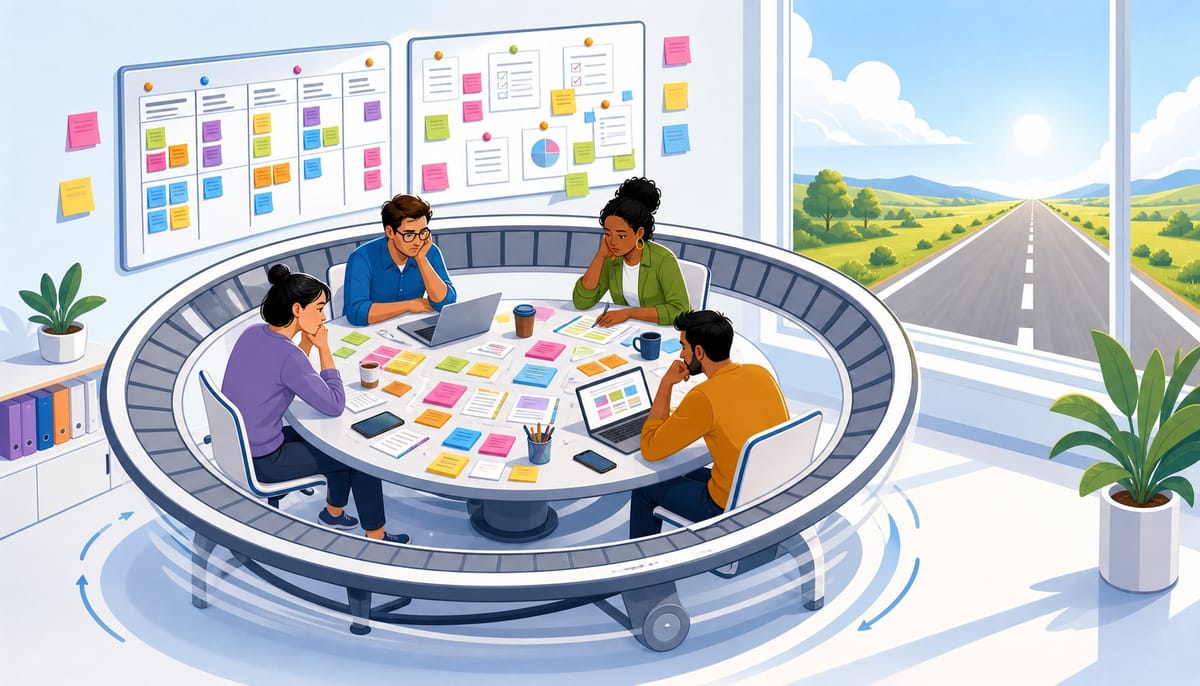
The definition is settled. Adoption is widespread. Yet for most lean marketing teams, shipping velocity is flat. The problem isn't a lack of agile knowledge; it's that the very ceremonies designed to accelerate execution have become the new bottleneck. Daily standups, sprint planning, backlog grooming, and retrospectives now consume 15-25% of a small team's weekly capacity. This article examines the structural flaw in how most teams practice agile marketing and maps out what comes next when the system finally runs itself.
What Agile Marketing Actually Is (and Isn't)
The core mechanism of agile marketing is the replacement of long-range, linear planning with short, cyclical sprints, typically lasting one to four weeks. In each sprint, the team selects the highest-impact work from a prioritized backlog, executes it, measures the results, and feeds those learnings directly into the next cycle. This stands in stark contrast to traditional waterfall marketing, which assumes the initial plan is correct and executes it sequentially over months, a fatal flaw in digital channels where market conditions change weekly.
This methodology is grounded in the five core values of the Agile Marketing Manifesto: responding to change over following a plan, rapid iterations over big-bang campaigns, testing and data over opinions, many small experiments over a few large bets, and collaboration over silos. Distilled into a single operational command, agile marketing is a system for learning faster by shipping smaller.
To implement this, teams typically adopt one of three frameworks:
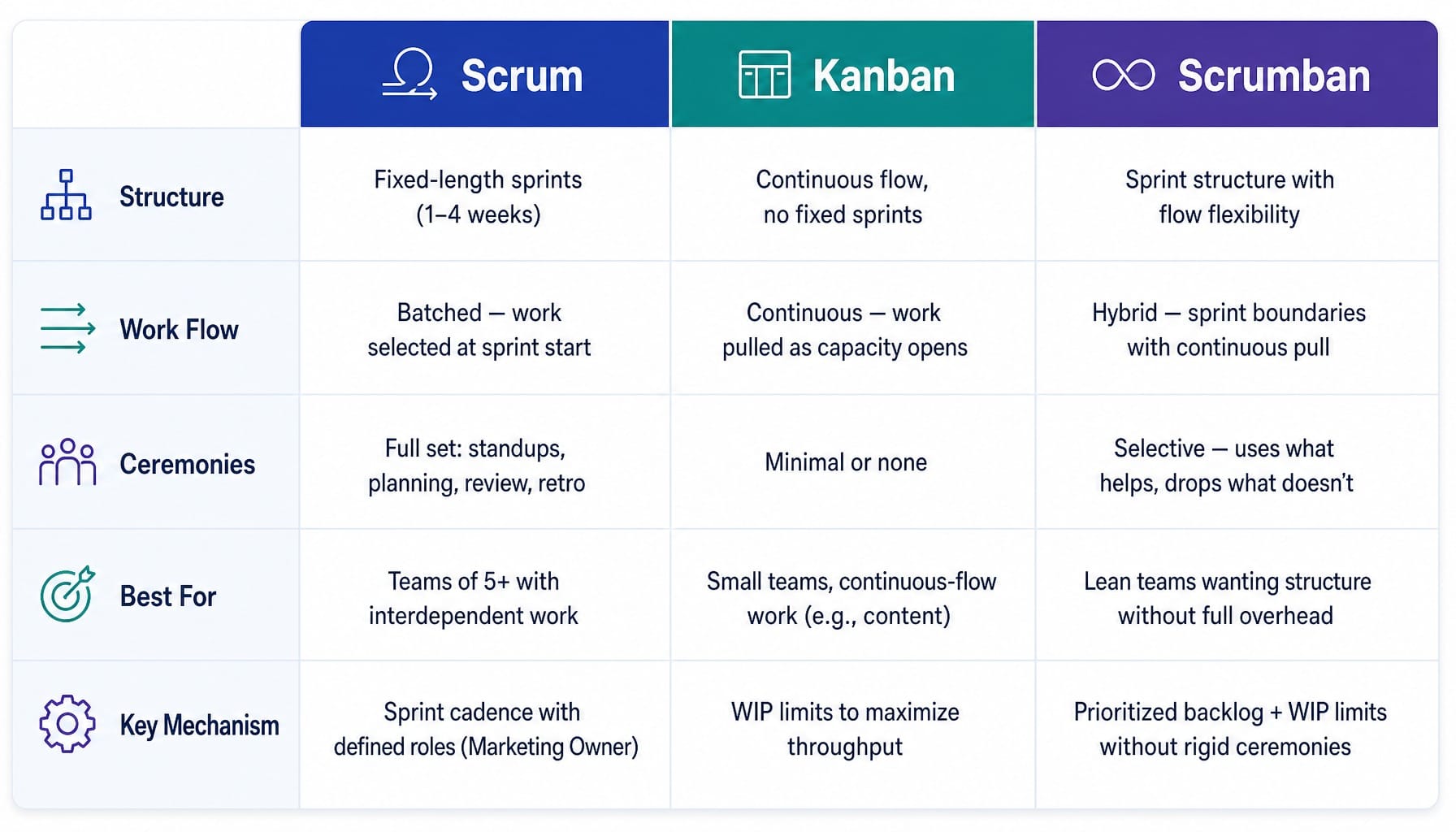
- Scrum: A structured approach with fixed-length sprints, defined roles (like a Marketing Owner), and a set of prescribed ceremonies.
- Kanban: A continuous flow model focused on visualizing work and limiting work-in-progress (WIP limits) to maximize throughput.
- Scrumban: A hybrid that combines the structure of Scrum's sprints with the flexibility of Kanban's flow.
Ultimately, the choice of framework matters less than the execution cadence it enables. And it's at the level of execution where most agile implementations break down.
The Ceremony Bottleneck: When Agile Rituals Consume the Sprint
Consider a typical three-person B2B SaaS marketing team running two-week sprints with Scrum. Their ceremony load is a fixed cost against their execution capacity. The rituals—designed to create alignment and reduce waste—have become a significant source of it. For a lean team where everyone already shares the same Slack channel and dashboards, the alignment problem is often already solved. The ceremonies persist not because the team needs them, but because the framework prescribes them. This isn't a failure of the team; it's a failure of the system's design when applied to a context for which it was not originally intended.
The Time Math Most Teams Never Do
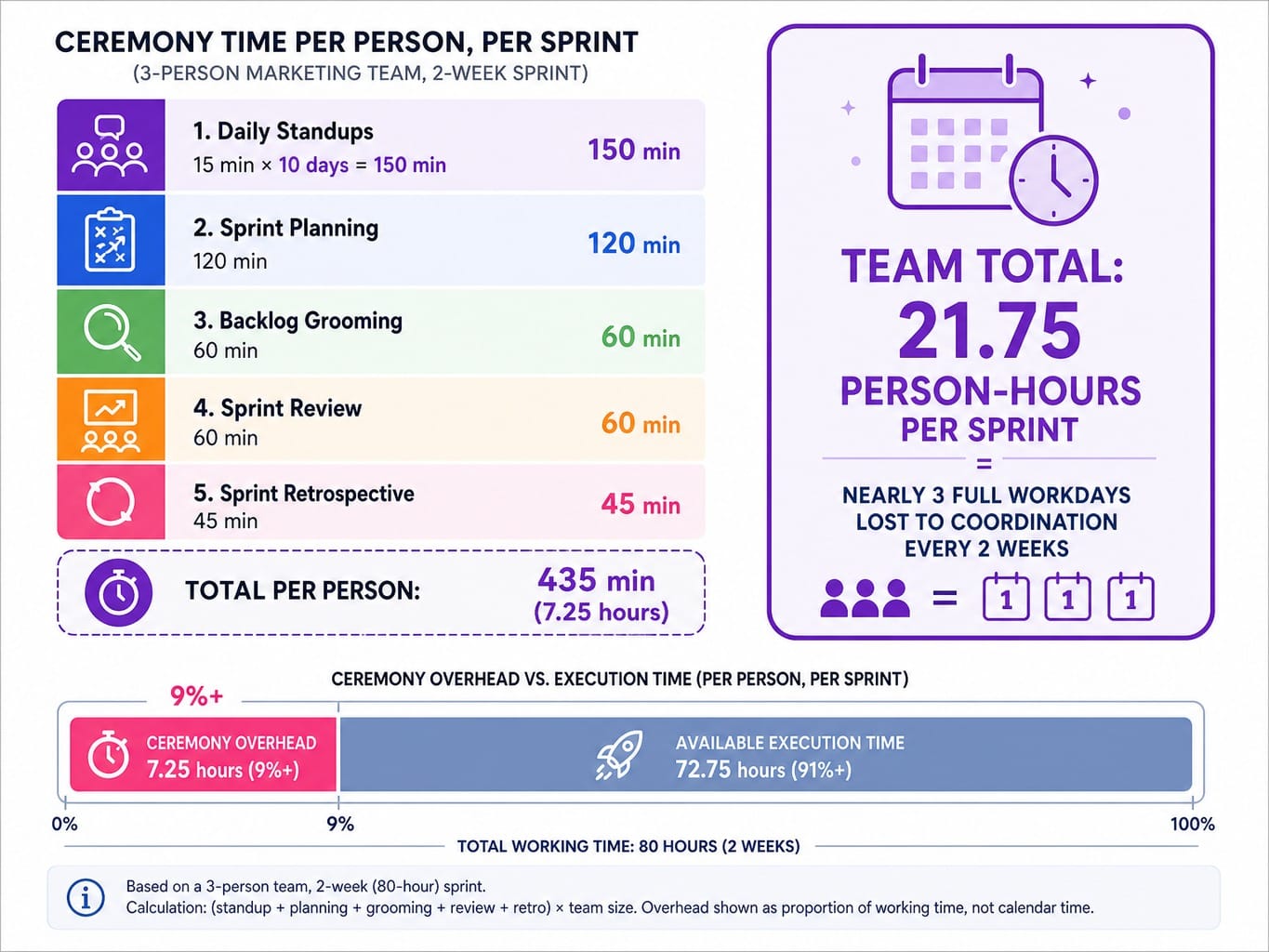
Let's calculate the real cost. For a single marketer on that three-person team, the ceremony load for a two-week sprint looks like this:
- Daily Standups: 15 minutes × 10 days = 150 minutes
- Sprint Planning: 120 minutes
- Backlog Grooming: 60 minutes
- Sprint Review: 60 minutes
- Sprint Retrospective: 45 minutes
Total per person: 435 minutes, or 7.25 hours per sprint.
Total for the team: 21.75 person-hours per sprint.
In a standard 80-hour sprint, that's over 9% of each marketer's time spent in meetings. For a lean team of three, it's a combined 21.75 hours dedicated to talking about the work, not doing it. That's nearly three full workdays of execution capacity consumed by coordination overhead every two weeks. The Scrum framework was designed for development teams of 5-9 people; on a two or three-person marketing team, the ratio of ceremony time to execution time becomes fundamentally imbalanced.
Ceremony Fatigue Compounds Every Sprint
The cost isn't just measured in hours. It's measured in cognitive load and diminishing returns. Ceremony fatigue manifests in predictable ways: the retrospective where the same three observations recur because the team is too small for new patterns to emerge; the sprint planning meeting that takes 90 minutes to decide what three people already agreed on in Slack; the velocity trending chart that flatlines because the team's constraint is bandwidth, not prioritization.
This is "performative agile"—going through the motions because the framework says to, not because the ceremony produces a decision that wouldn't have been reached otherwise. And let's be honest, how many times can you discuss the same 'what went well' points in a retrospective before it feels like a script? The ceremonies become a proxy for an intelligent system that should be running continuously and autonomously, not in scheduled human meetings. The latency isn't in the work; it's in the waiting between rituals.
Read more: How to Prioritize Marketing Tasks for Lean Teams: A Framework That Actually Works
How Agile Marketing Drifted from Velocity to Ritual
This drift from speed to ritual happened for a structural reason. Agile marketing was adopted to solve a real problem: the waterfall planning cycle was too slow and rigid for digital channels. But when marketing teams imported Scrum from engineering, they imported the coordination layer—ceremonies, roles, artifacts—without questioning if marketing's execution constraints were the same.
In software engineering, a sprint ceremony coordinates seven people writing interdependent code that must compile and deploy together. The coordination overhead is justified because a failure in one person's work can break everyone else's. In marketing, a sprint ceremony often coordinates two or three people executing largely independent tasks: one person writes a blog post, another adjusts a landing page, and a third launches an ad campaign. The coordination need is low, but the coordination overhead remains high.
Consider a growth marketer's week. On Monday, they spend two hours in sprint planning to decide to A/B test a headline. Tuesday through Thursday, they execute the test. On Friday, they spend an hour in a retro discussing the results. The entire decision-execution-measurement loop could have been triggered by a system that detected the underperforming headline, generated variants, deployed the test, and reported the outcome. The problem isn't agile marketing's principles—iterate fast, learn from data, prioritize by impact. The problem is that human ceremonies are the wrong execution layer for principles that demand continuous, real-time action. It's an ironic violation of the manifesto's own core value: responding to change over following a plan.
Read more: Stop Syncing Strategy and Execution: Platforms That Unify Marketing Goals With Task Management
What an Autonomous Sprint Actually Looks Like
If agile's principles are sound but its ceremonies are the bottleneck, the logical next step is a system that runs the sprint autonomously. This means it can detect the highest-impact move, execute it, measure the result, and re-prioritize for the next cycle—without requiring a human meeting at each stage.
This isn't about removing the marketer from the loop; it's about removing the ceremony from the loop. The marketer's role shifts from operator to approver. You still set the strategy, define the goals, and approve the changes. But the detection-prioritization-execution-measurement cycle runs continuously, not in two-week batches separated by hours of meetings. The backlog of things you know you should do finally gets executed, because the system closes the gap between your judgment and the deployment of that judgment.
The Detection-Execution Loop Without Meetings
Operationally, an autonomous loop is a direct contrast to the ceremony-driven version.
Ceremony-Driven Loop:
- Team discusses performance data in standups and other meetings.
- Team prioritizes work in a 2-hour sprint planning session.
- Work is assigned to a team member.
- Team member executes over 3-5 days.
- Results are presented in a sprint review.
- Process is discussed in a retrospective.
Autonomous Loop:
- A system ingests cross-channel data—website analytics, search performance, ad metrics—and identifies the single highest-impact constraint.
- It generates the intervention—not a recommendation in a dashboard, but an actual, deployable change.
- It deploys the change without an engineering ticket or agency brief.
- It measures the result within the same cycle and feeds it back into the next prioritization.
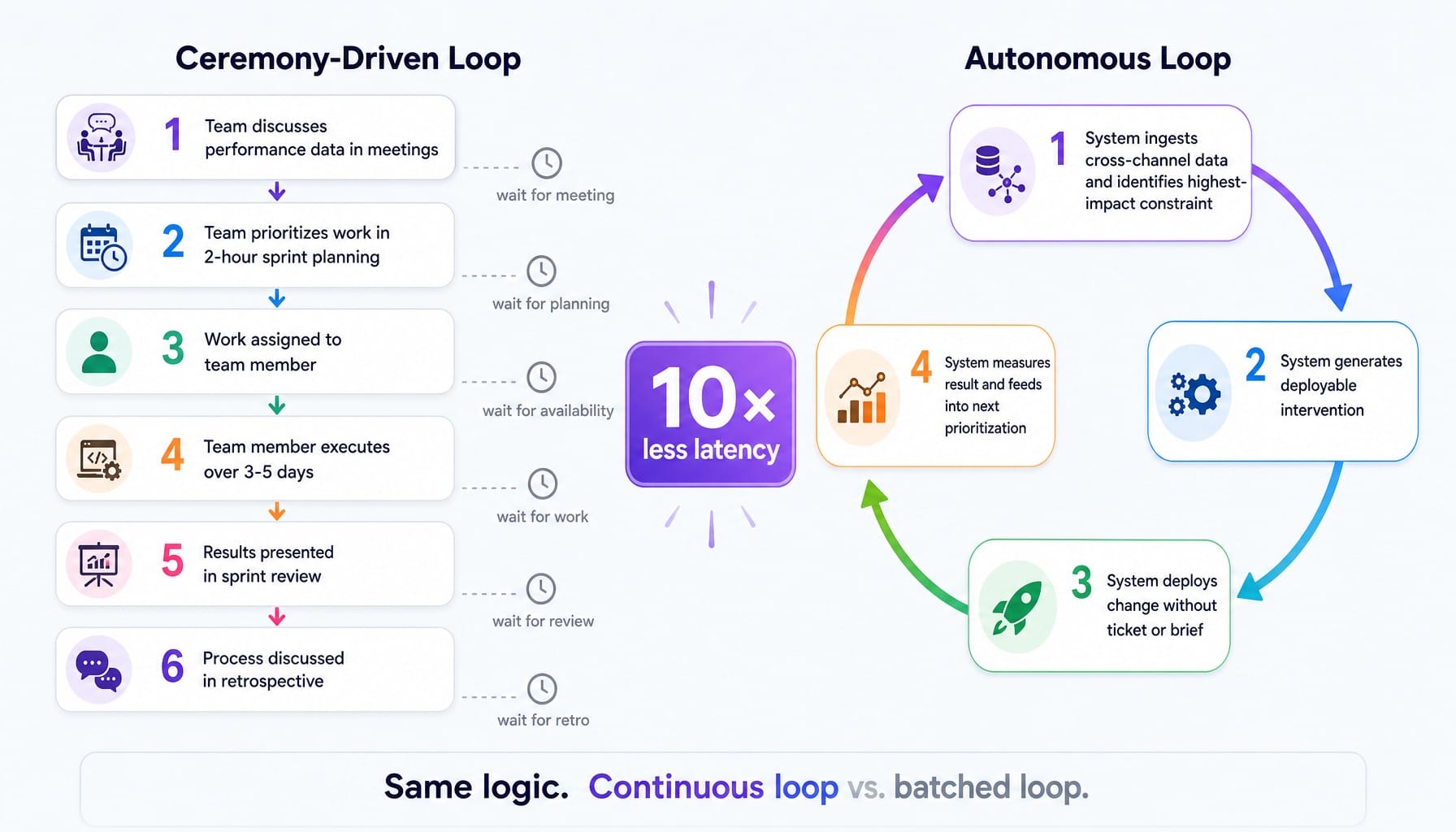
It's the same underlying logic, but with ten times less latency. The difference isn't "AI vs. humans," it's "continuous loop vs. batched loop."
From Operator to Approver: The Marketer's New Role
The immediate objection is that this system removes the marketer from the process. It does the opposite. It elevates them. The marketer moves from being the bottleneck—the person who must personally execute every change—to being the strategist who sets direction, reviews output, and approves releases.
Think about the marketing leader who spends 60% of their week on execution tasks that could be systematized and 40% on the strategic work that actually moves the business. An autonomous system inverts that ratio. It doesn't replace your judgment; it gives you leverage to apply that judgment at scale. The backlog of website fixes, content updates, and CRO tests doesn't shrink because you work harder; it shrinks because the execution layer finally keeps pace with your team's strategic insight.
How Spike AI Runs the Sprint Without the Standup
This autonomous sprint isn't theoretical; it's the execution model systems like Spike AI are built on. The article has built a specific tension: agile marketing's principles are correct, but its human-powered execution layer is the constraint. Spike AI is the working example of the system that resolves this tension.
It functions as an execution engine that fulfills agile marketing's original promise. Spike AI ingests data across your website, SEO/AEO, and ads to identify the highest-impact move each week. It doesn't surface a recommendation in a dashboard and wait for Monday's sprint planning meeting; it generates the change, models the impact, and prepares it for deployment. The marketer stays in control, moving from operator to approver. The system handles the execution.
This directly closes the gaps diagnosed earlier:
- The Ceremony Bottleneck: The 15-25% of capacity lost to coordination overhead is reclaimed for strategic oversight.
- The Latency Problem: The gap between identifying a problem and shipping a fix shrinks from weeks to days.
- The Backlog Problem: The to-do list becomes an approval queue, with weekly releases that compound over time.
Where other tools diagnose problems and hand you homework, Spike AI deploys solutions. It fuses SEO, AEO, and CRO into a single closed-loop system, running the sprint continuously so your team can focus on the outcomes, not the ceremonies.
See how Spike AI runs your marketing sprint — book a discovery call
Conclusion
Agile marketing's principles were always right: iterate fast, prioritize by impact, and learn from data. But the execution layer borrowed from software engineering—standups, sprint planning, retros—was designed for a different kind of work and a different team size. The next evolution isn't better ceremonies; it's removing the ceremony as the execution constraint entirely.
The teams that will out-ship their competitors aren't the ones with the most organized Kanban board. They're the ones whose detection-to-deployment loop runs continuously, without waiting for the next meeting. The question is no longer "should we adopt agile marketing?" It's "should the sprint run itself?"
Frequently Asked Questions
Can agile marketing work for a team of one or two people?
Yes, but the framework must be radically simplified. A solo marketer running full Scrum ceremonies is spending a disproportionate amount of their week on process overhead. For teams under three, a lightweight Kanban approach with WIP limits and a weekly prioritization review—or an autonomous system that handles execution—is far more practical than the full ceremony stack of sprint-based Scrum.
How long should a marketing sprint last?
Most marketing teams use one- or two-week sprints. Shorter sprints force tighter prioritization and faster feedback but increase ceremony frequency. Longer sprints reduce ceremony overhead but delay learning and increase the risk of shipping work that's no longer relevant. If your sprint regularly ends with unfinished work, the issue is likely too much work planned for your team's actual capacity, not the sprint length itself.
Should marketing teams use Scrum, Kanban, or a hybrid?
Scrum works best for teams of five or more with highly interdependent work. Kanban is better suited to smaller teams or continuous-flow work like content production, where fixed sprint boundaries create artificial constraints. Most lean marketing teams naturally gravitate toward a "Scrumban" hybrid, using a prioritized backlog and WIP limits without adopting the full, rigid ceremony structure.
How do you handle long-term brand campaigns inside short agile sprints?
You decompose the campaign into sprint-sized deliverables. A quarterly brand initiative becomes an "epic" that is broken down into smaller weekly or biweekly "stories," each producing a shippable output (e.g., "draft messaging framework," "launch partner outreach," "publish announcement blog"). The strategic direction remains fixed, but the execution becomes iterative, preventing a default back to waterfall planning.
What KPIs should agile marketing teams track beyond velocity?
Velocity (story points completed per sprint) measures output, not outcomes. More important metrics are cycle time (how long a task takes from start to finish) and lead time (how long from backlog entry to deployment). Most importantly, track the business metric each sprint was designed to move—conversion rate, qualified leads, pipeline. If velocity is high but business metrics are flat, the team is busy, not effective.
How do you get executive buy-in for agile marketing when leadership expects annual plans?
Frame agile as the delivery mechanism for the annual plan, not a replacement for it. The strategic goals and quarterly targets stay intact; agile changes how the team executes against them. Present it as a system for de-risking the annual plan by building in continuous measurement and course correction, rather than betting an entire quarter on a strategy that was written three months ago.