5 Agile Marketing Examples That Show the Work, Not Just the Results

TLDR
- Most agile marketing examples are high-level case studies; effective adoption requires seeing the sprint-level work, like specific backlog items and prioritization logic.
- A real marketing sprint isn't a renamed weekly meeting. It requires strict work-in-progress (WIP) limits, a clear "definition of done" for each task, and a retrospective to improve the process.
- Successful agile teams measure throughput quality (like cycle time and conversion impact per sprint), not just output volume (like number of tasks completed).
- The most common failure patterns are renaming old workflows without changing them, treating the backlog as a wish list, and skipping retrospectives that identify recurring bottlenecks.
- Autonomous execution systems like Spike AI represent the next evolution, compressing the sprint cycle to a weekly cadence by removing the human coordination bottleneck.
You've seen the articles. They promise real-world agile marketing examples and deliver a predictable list of logos: Spotify, IBM, Mozilla. They cite a headline metric—a 400% output increase or 500,000 new users—and move on, leaving you with no actual understanding of what changed inside the team's workflow.
This creates a proof gap. Teams searching for examples of agile marketing aren't looking for company names to validate the concept. They need to see the work. They need to know what a marketing sprint backlog looks like, what gets prioritized over what, and what the before-and-after state of a campaign looks like after two weeks of iterative work.
They need to see the artifacts.
This article closes that gap. Below are five agile marketing examples that show the sprint-level details: the specific backlog items, the prioritization decisions, the weekly shipping cadence, and the measurable outcomes that followed. This isn't another list of organizational case studies; it's a look inside the sprint itself.
What a Two-Week Marketing Sprint Actually Looks Like
Most teams adopt agile terminology without changing their workflow. They rename their weekly status meeting a "standup," call their task list a "backlog," and wonder why nothing improves. This isn't agile; it's just renaming a broken system.
Consider a typical three-person B2B SaaS marketing team. Before agile, they planned work monthly, had no work-in-progress (WIP) limits, and treated their backlog as an ever-growing wish list. Their "sprints" were just weekly check-ins on a chaotic to-do list.
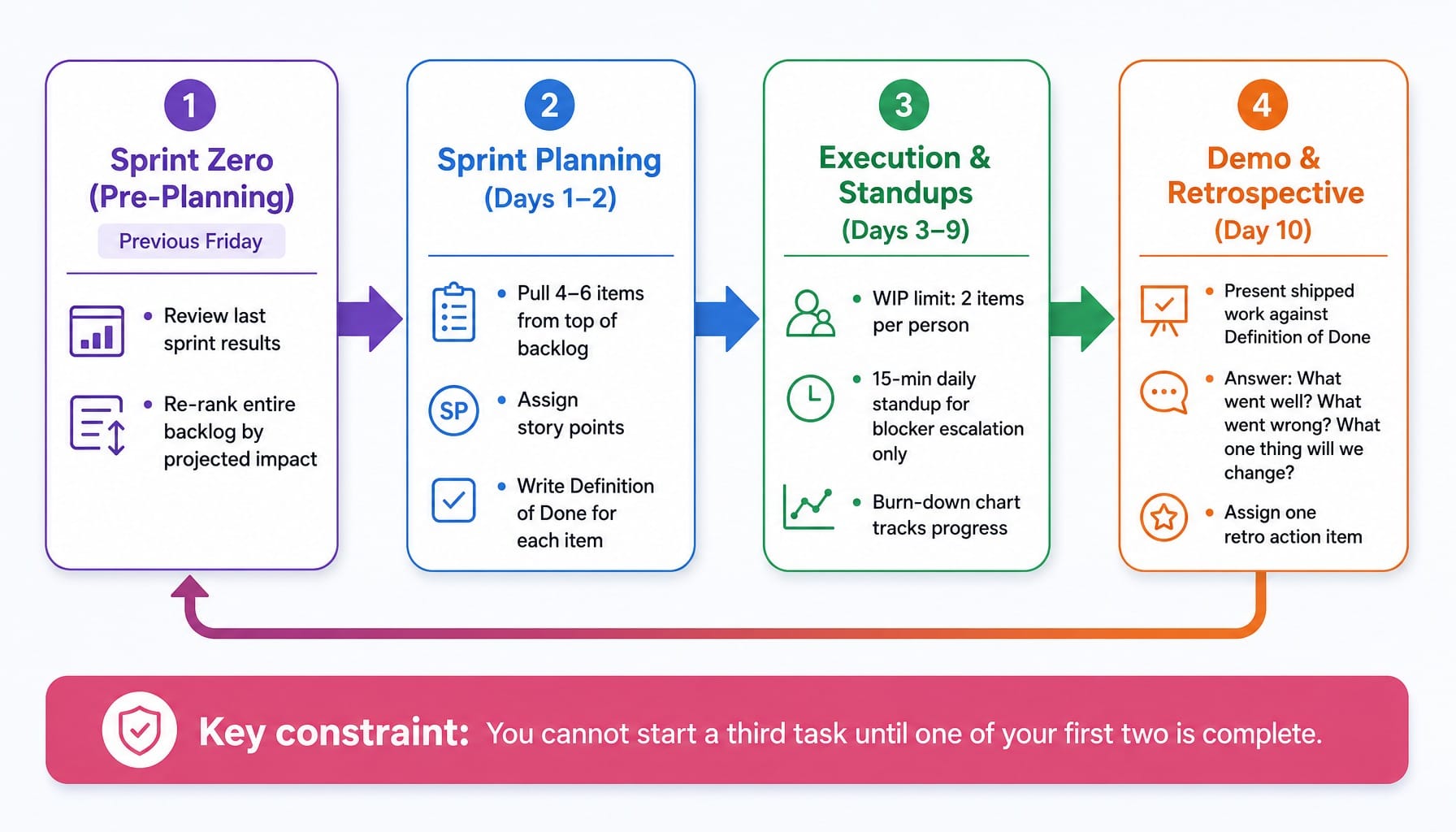
A properly structured two-week sprint is a disciplined execution system, not a meeting cadence. Here's the operational flow:
- Sprint Zero (Pre-Planning): The sprint doesn't start on Monday. It starts the previous Friday, with a review of the last sprint's results. The team analyzes performance data—what moved pipeline, what increased conversions—and re-ranks the entire backlog based on projected impact. The highest-impact items move to the top. This is non-negotiable.
- Days 1-2 (Sprint Planning): The team pulls only 4-6 items from the top of the newly ranked backlog. They assign story points to estimate effort and, crucially, write a "definition of done" for each item. "Publish blog post" is a task; "Blog post is live, has a CTA, is internally linked from two pillar pages, and has been shared on social channels" is a definition of done. This prevents half-finished work.
- Days 3-9 (Execution & Standups): The team executes. A strict WIP limit of two items per person is enforced. You cannot start a third task until one of your first two is complete. This is the single most counterintuitive and effective practice in agile marketing. The daily 15-minute standup is for blocker escalation only: "I can't finish the landing page copy because I'm waiting for a testimonial from sales." It is not a status update. A burn-down chart tracks progress against the sprint commitment.
- Day 10 (Demo & Retrospective): At the sprint demo, the team presents the shipped work, reviewed against its definition of done. Then, in the sprint retrospective, they answer three questions: What went well? What went wrong? What one thing will we change to make the next sprint better? That one process improvement—a "retro action item"—is the key to compounding gains.
This structure transforms marketing from a reactive function into a predictable, iterative execution engine.
Read more: The Marketing Prioritization Framework That Replaces Gut Feel With Compounding Wins
Five Agile Marketing Examples With Sprint-Level Detail
Each example below moves beyond the company name to show what changed inside the team's sprint workflow—the backlog items they prioritized, the artifacts they produced, and the measurable outcome that resulted. These are not organizational transformations; they are sprint-level execution examples.
SEMRush: Autonomous Squads Shipping Regional Campaigns in Two-Week Cycles
SEMRush didn't just "adopt agile"; they used it to solve a specific problem: scaling into new international markets without a monolithic, centralized marketing team. The key was epic decomposition and squad autonomy.
- Before: A central marketing team planned large, quarterly campaigns. Entering a new market like Germany was a six-month project.
- The Artifact (Backlog Decomposition): The "Enter German Market" epic was broken down into sprint-sized stories. A squad's two-week sprint backlog would look like this:
1. Localize top 3 competitor comparison landing pages for German keywords.
2. Launch initial German PPC test campaign with a €500 budget.
3. Translate and publish 2 existing high-performing blog posts on German-market pain points.
4. Identify 5 German tech blogs for outreach in the next sprint.
- After: Over ten autonomous regional squads, each with their own backlog, shipped minimum viable campaigns every two weeks. According to Olga Andrienko, former Head of Global Marketing, this model was a key driver behind their 90% YoY revenue growth from new markets. The advantage wasn't the methodology label; it was the ability to ship and learn in multiple markets simultaneously.
Northern Arizona University: A Four-Person Team Using Kanban to Increase Output by 400%
For Ann Marie deWees's four-person marketing team at NAU, the constraint was serving dozens of internal stakeholders with competing deadlines. They were drowning in requests and context-switching. Kanban provided the system to manage the chaos.
- Before: The team accepted every request simultaneously, leading to constant priority shifts and an average of 15 completed items per month.
- The Artifact (The Kanban Board): They built a board with dedicated swimlanes for each stakeholder group. The critical change was a strict WIP limit of three active tasks per person and a pull-based system. New work entered a "Requested" column but could only be pulled into "In Progress" when a team member's capacity opened up.
- After: By enforcing WIP limits, the team's throughput increased from 15 to over 60 items per month. This 400% increase came not from working more hours, but from focusing on finishing work instead of starting it. The board made the cost of context-switching visible to everyone, including stakeholders.
CA Technologies: Cutting Campaign Delivery From Two Months to Two Weeks
CA Technologies (now part of Broadcom) faced a common enterprise problem: a waterfall campaign process where sequential handoffs created massive delays. Their solution was to restructure the team, not just the process.
- Before: A campaign went from brief → creative → review → legal → launch. Each handoff was a potential bottleneck, stretching delivery time to 1-2 months. The legal review alone often took 2-3 weeks.
- The Artifact (The Cross-Functional Pod): They moved to Scrum-based sprints with pods that included a marketer, a designer, and a compliance reviewer working together. By embedding compliance inside the sprint team instead of treating it as a final gate, they eliminated the single largest delay in their system.
- After: Campaign cycle time dropped from eight weeks to two. According to former SVP of Marketing Cameron van Orman, this led to a 20% pipeline improvement and tripled win rates for campaigns developed via the agile process. The value wasn't just speed; it was removing sequential dependencies.
Spike AI: Weekly Shipping Cadence Across SEO, CRO, and Ads for a B2B SaaS Client
This is an example of agile marketing where the sprint cadence is one week, and the "team" is an AI-driven execution engine. It shows what happens when the loop between prioritization, shipping, and measurement becomes autonomous.
- Before: A B2B SaaS client had a long backlog of desired website, SEO, and ad improvements but lacked the bandwidth and prioritization model to execute them. Work was sporadic and driven by gut feel.
- The Artifact (The Weekly Prioritization & Release Cycle):
Week 1: Spike AI's prioritization engine ingests data across the client's site, analytics, and ad platforms. It identifies that the pricing page has a 68% bounce rate and the top-performing blog post lacks a relevant CTA. It ranks fixing the pricing page as the highest-impact move. Spike AI then deploys a restructured pricing page with clearer tier differentiation and a contextual demo request form.
Week 2: The system measures the results: the pricing page bounce rate has dropped to 41%, and demo requests originating from that page are up 23%. With this new data, the system re-prioritizes the entire backlog. The blog post CTA is now the highest-impact item, and it's deployed in the Week 2 release.
- After: The client moves from quarterly pushes to a weekly release cadence. The closed-loop system of prioritize → ship → measure → re-prioritize compounds gains week over week.
Read more: Landing Page Conversion Rate Optimization: A Revenue-Weighted Playbook
Santander Bank: Agile Sprints in a Regulated Environment With Compliance Constraints
Many agile examples come from tech, where regulatory friction is low. Santander Bank, operating in heavily regulated financial services, shows how to adapt agile when compliance is a non-negotiable constraint.
- Before: Marketing campaigns took 6-8 weeks, primarily because compliance review was a slow, post-production bottleneck.
- The Artifact (Embedded Compliance): Santander embedded compliance reviewers into the marketing sprint teams as permanent members. Sprint planning for any customer-facing deliverable now included a mandatory "compliance pre-check" story. This front-loaded the review process, turning it into a collaborative step within the sprint rather than an adversarial gate after it.
- After: The bank saw a 12% increase in its loyalty program, achieved its highest NPS score in 17 years, and recorded 90% positive customer sentiment on new initiatives. This proves that agile can thrive in regulated industries, but only if compliance is integrated into the sprint structure, not treated as an external dependency.
What Happens When the Sprint Cadence Is Weekly and the Execution Is Autonomous
The examples above reveal a shared truth: agile marketing works when teams ship consistently, prioritize ruthlessly, and close the loop between action and outcome. They also reveal a shared constraint: human bandwidth. The coordination cost of planning, executing, and reviewing each sprint consumes a significant portion of the sprint itself. Even the best teams struggle to maintain a biweekly cadence.
This is the execution bottleneck that current agile frameworks don't solve. What if the sprint cadence was weekly, and the execution was autonomous?
This is where Spike AI functions as the execution layer that resolves the system's core constraint. It takes the principles of agile marketing—prioritization based on impact, a consistent shipping cadence, and a tight feedback loop—and automates the execution. The system runs the closed-loop cadence that most human teams aspire to but can't sustain manually.
Every week, Spike AI's multi-agent system:
- Prioritizes: It identifies the single highest-impact move across your SEO, CRO, and ad performance.
- Executes: It deploys the change—restructuring a landing page, fixing a technical SEO issue, updating ad copy—without engineering tickets or agency briefs.
- Measures: It analyzes the result and feeds that data back into the system.
- Re-prioritizes: It determines the next highest-impact move for the following week's sprint.
The result is a shift from 26 biweekly sprints per year to 52 weekly releases. This compounding cadence is how marketing moves from a series of campaigns to a continuous growth engine.
See how Spike AI runs weekly marketing sprints for B2B teams
How to Measure Whether Your Agile Marketing Is Actually Working
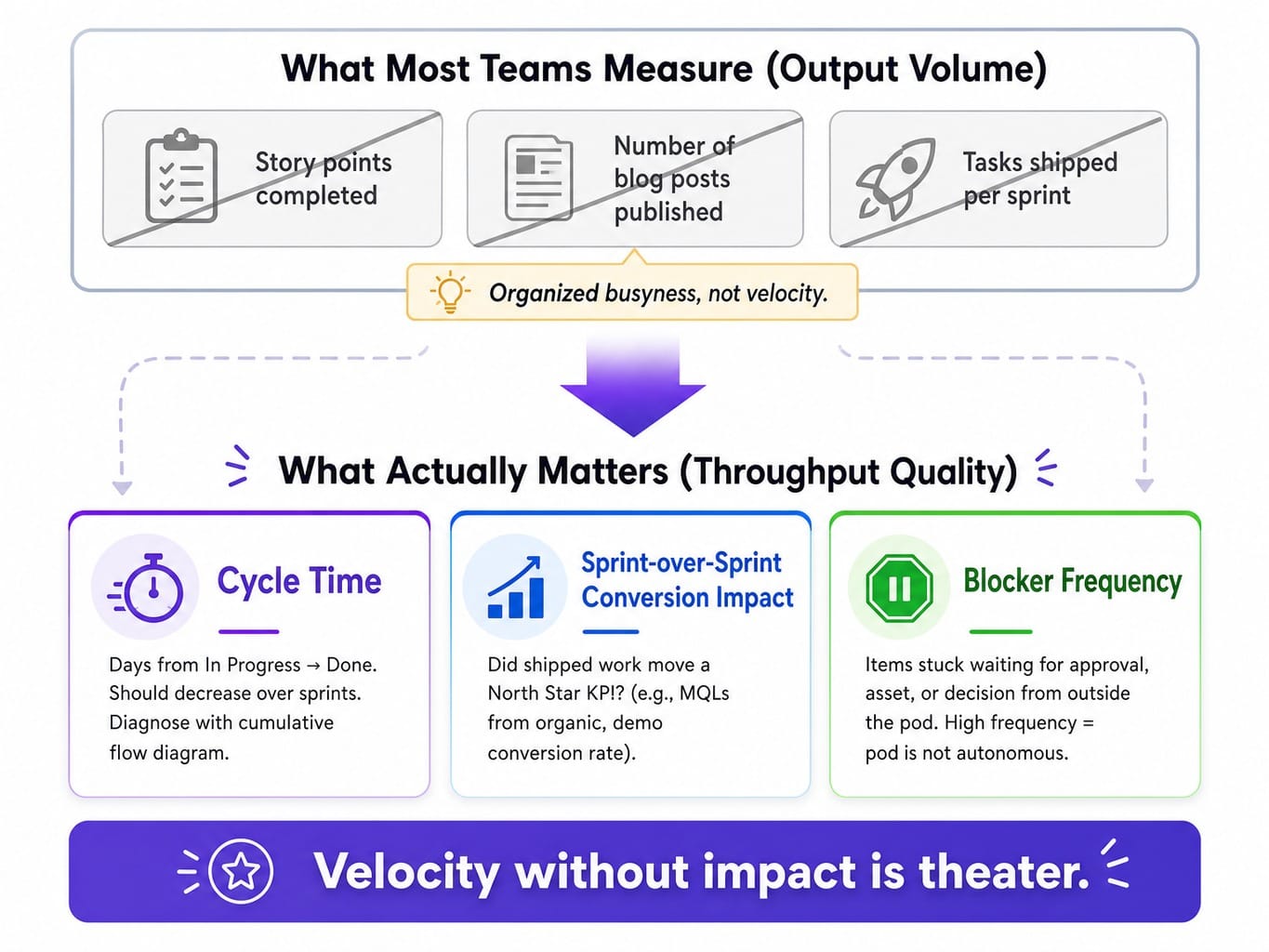
Most teams adopting agile marketing measure the wrong things. They track activity metrics like "story points completed" or "number of blog posts published." A team might celebrate shipping 12 items in a sprint, but if nine were low-impact tasks and pipeline didn't move, the sprint was a failure. This is organized busyness, not velocity.
To know if your agile system is working, you must track throughput quality, not output volume. Focus on these three metrics:
- Cycle Time: How long does it take for a task to go from "In Progress" to "Done," measured in days? If your average cycle time isn't decreasing over several sprints, you have a recurring bottleneck your retrospectives have failed to identify. Use a cumulative flow diagram to visualize where work is getting stuck.
- Sprint-over-Sprint Conversion Impact: Did what you ship actually move a business metric? Choose one North Star KPI for each sprint (e.g., MQLs from organic, demo conversion rate on a key page). If you can't connect the work completed in a sprint to a change in a core business metric, you're just shipping tasks.
- Blocker Frequency: How many items got stuck waiting for an approval, asset, or decision from outside the sprint team? A high blocker frequency is a clear sign that your agile "pod" is not truly autonomous and is being undermined by dependencies on non-agile parts of the organization.
Output is not velocity. Velocity without impact is theater. These metrics tell you whether you're building a compounding growth engine or just getting better at running on a hamster wheel.
Read more: Data-Driven CRO: Evolve Your Marketing Strategy for Revenue
Three Patterns That Kill Agile Marketing Adoptions
Agile marketing fails more often than it succeeds. A report on the State of Agile found that 37% of teams cite a lack of training and experience as the top barrier to adoption. The failures almost always follow one of these three predictable patterns.
Renaming Existing Workflows Instead of Restructuring Them
This is the most common failure mode. A team starts calling their weekly status meeting a "standup" and renames their task list a "backlog." They declare they are agile, but nothing about the underlying workflow—WIP limits, sprint commitments, the retrospective process—has changed. It's an easy trap to fall into because it feels like progress without requiring any difficult changes.
- Diagnostic Question: Does your team have a written "definition of done" for every sprint item, and does someone have the authority to enforce it? If not, you've adopted vocabulary, not structure.
Treating the Backlog as a Wish List Instead of a Prioritized Queue
In this anti-pattern, the backlog swells to over 80 items and nothing is ever removed. Sprint planning becomes a political negotiation where the highest-paid person's opinion (HIPPO) determines priorities. The root cause is the absence of a quantitative marketing channel prioritization model. The team ranks by urgency or stakeholder pressure, not projected business impact.
- Diagnostic Question: Can your team explain why item #1 in the backlog is ranked above item #2 using a metric rather than a feeling? If the answer is "because the VP of Sales asked for it," your backlog is a wish list.
Running Sprints Without Retrospectives
Here, the team ships work every two weeks but never holds a retrospective to analyze the process. The same blockers recur sprint after sprint. For example, a team consistently misses sprint commitments because design assets are always late, but this is never surfaced as a systemic blocker because no one formally asks, "What slowed us down, and how do we fix it next time?" Without retrospectives, agile just becomes a faster way to run a broken process.
- Diagnostic Question: Does your team have at least one concrete "retro action item" that changed how the next sprint was run? If not, you aren't learning.
Conclusion
Agile marketing is not a methodology you adopt; it is a shipping discipline you sustain. The successful teams in the examples above did not just rename their process. They fundamentally changed what they prioritized, how they defined "done," and whether they measured the impact of each release.
The difference between teams that get compounding results from agile and those that abandon it within six months is not their choice of framework. It's whether they build a closed loop between shipping, measuring, and learning.
The next evolution of this discipline is already clear. It's not about running faster human sprints; it's about leveraging autonomous execution systems that maintain a relentless cadence without the coordination overhead. The teams that build or adopt these systems will compound their way past competitors who are still debating sprint length.
Frequently Asked Questions
Can a solo marketer or two-person team run agile sprints without a dedicated scrum master?
Yes, but the framework must be simplified. Use a personal Kanban board with a WIP limit of 2-3 items. A weekly prioritization review replaces formal sprint planning, and a written self-retrospective identifies blockers. The key is enforcing WIP limits and ruthlessly deprioritizing work, not team size.
What is the difference between Scrum and Kanban for marketing teams, and which should I start with?
Scrum uses fixed-length sprints with committed scope. Kanban uses a continuous flow with WIP limits and no fixed sprint boundaries. For teams new to agile, Kanban is often easier to adopt because it lets you visualize your current workflow and add WIP limits without committing to a fixed sprint scope upfront.
How do agile marketing teams handle long-term brand campaigns that do not fit into two-week sprints?
Long-term initiatives are treated as "epics." Each sprint pulls one or two small tasks from that epic. A six-month brand campaign progresses incrementally, with sprint items like "finalize messaging framework" or "launch first paid test." The backlog always contains a mix of long-term epic items and short-cycle optimization work.
How do you get executive buy-in for agile marketing when leadership expects quarterly campaign plans?
Frame agile as the delivery mechanism for the quarterly plan, not a replacement. The plan sets the strategic outcomes; sprints are the fastest, most adaptive way to achieve them. Run a two-sprint pilot on one initiative, measure the cycle time and business impact, and use that data to justify broader adoption.
Is agile marketing effective for SEO and content workflows where results take months to materialize?
Yes, it's particularly effective. Agile forces teams to ship SEO and content changes incrementally—like publishing two articles, fixing five internal links, or updating ten meta descriptions per sprint. The compounding effect of these weekly or biweekly releases consistently outperforms sporadic, large-batch SEO projects over any six-month period.