Marketing Channel Prioritization for 2026: Where Your Budget Actually Compounds

TLDR
- Stop diversifying your marketing budget. Most teams spread spend so thin that no single channel reaches its compounding threshold. Concentrate on two or three channels to see real returns.
- Prioritize channels with high decay resistance—investments that retain value after you stop spending. In 2026, this means a heavy focus on SEO/AEO and owned channels like email/SMS.
- Measure incrementality, not just ROAS. Use holdout tests or geo-lift experiments to determine if a channel is creating new demand or just capturing conversions that would have happened anyway.
- Build a prioritization framework based on five criteria: contribution margin payback, incrementality lift, competitive density, decay resistance, and operational cost.
- Cut channels that are losing leverage, such as organic social on Meta for B2B, most display advertising, and traditional PR for link building. Knowing what to stop is as important as knowing what to start.
Your marketing team is running campaigns across seven channels. SEO, paid search, LinkedIn, email, webinars, podcast sponsorships, and maybe even some display ads. The activity dashboards are full. Yet, quarter over quarter, the qualified pipeline is flat. The team's instinct is to add another channel—maybe TikTok, maybe Reddit Ads—to find that missing spark.
This is the most common failure mode in modern marketing. The problem isn't a lack of activity; it's that budget and attention are spread so thin that no single channel has enough investment to reach its compounding threshold.
The best marketing channels to prioritize in 2026 are not the newest or most hyped. They are the ones where your marginal dollar generates increasing returns, not diminishing ones. This requires a ruthless focus on concentration, not diversification.
This guide provides a system for making those hard decisions. We'll cover why most channel prioritization fails, which channels are gaining and losing leverage, a decision framework for your specific business, and how to measure true incrementality instead of vanity ROAS. It's time to stop spreading thin and start compounding.
Why Most Channel Prioritization Fails Before It Starts
Most channel prioritization fails because teams treat it as a portfolio diversification exercise. They spread budget across many channels to "reduce risk," when it should be treated as a concentration exercise focused on where marginal returns are still increasing. This approach is why, despite ever-increasing martech spend, average website conversion rates remain stubbornly stuck around 2%. More channels do not equal better outcomes.
Consider a B2B SaaS company allocating $50,000 a month across six channels, giving each roughly $8,000. At that spend level, paid search never reaches enough impression share to dominate high-intent keywords. LinkedIn campaigns never accumulate enough data to optimize creative effectively. And content marketing never publishes at the frequency needed to build topical authority. The result is six underperforming channels instead of two or three compounding ones.
Every channel has a spend curve saturation point—a threshold below which investment generates noise, not signal, and above which returns diminish. Sophisticated teams use media mix modeling (MMM) tools like Google's open-source Meridian or Meta's Robyn to identify these thresholds, but most teams never run this analysis. They just allocate budget evenly and hope for the best.
Six underperforming channels is not a diversified portfolio. It's six ways to waste budget simultaneously. The first step in effective prioritization is to abandon the myth of diversification and embrace the power of concentration.
The Channels Worth Concentrating On in 2026
The best marketing channels to prioritize in 2026 are those with high decay resistance—channels where your investment retains value after you stop spending—combined with strong incrementality signals. This means owned and compounding channels almost always outperform rented attention in a B2B context.
Our selection criteria are simple and ruthless:
- Does the channel compound over time? Does today's investment make tomorrow's investment more effective?
- Is it resistant to platform risk? How vulnerable is it to algorithm changes and privacy regulations?
- Does it show measurable incrementality? Can you prove it's creating new demand via holdout testing or geo-lift experiments?
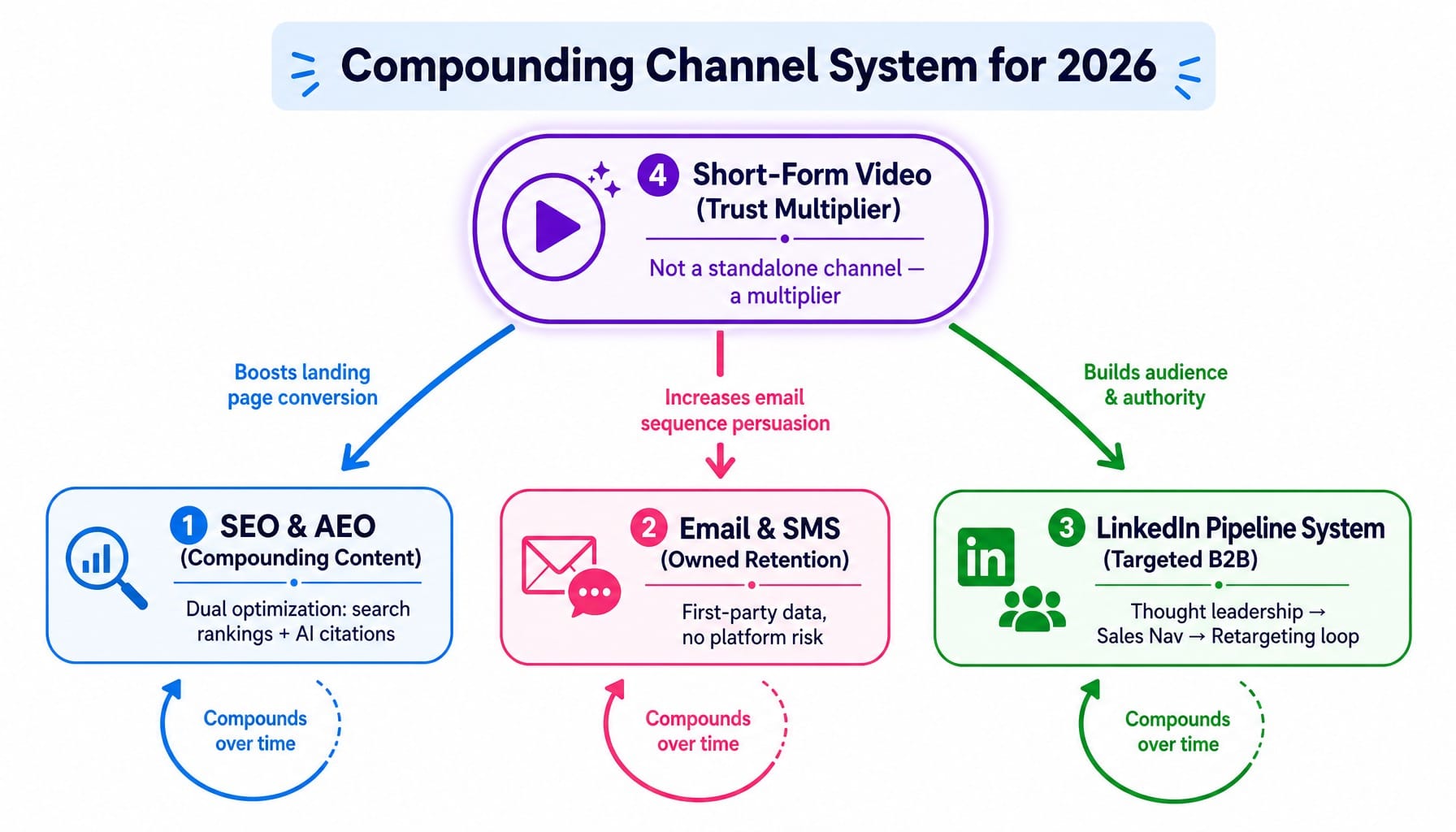
Based on these criteria, four areas demand concentrated investment.
SEO and AI-Optimized Content (With a Caveat)
Let's address the elephant in the room: AI Overviews and the zero-click search landscape are compressing organic CTR for broad, informational queries. This has led many to question SEO's future. But this shift makes SEO more valuable for commercial and transactional intent, not less. The traffic that still clicks through from a search engine in 2026 is higher-intent than ever before.
The caveat is that SEO in 2026 requires optimizing for a dual audience: traditional search rankings and AI citations. This is the domain of Answer Engine Optimization (AEO). As Google's own guidance on generative AI search states, foundational SEO best practices are the bedrock, but your content must also be structured for extraction. You need to create non-commodity content that is so clear, authoritative, and well-structured that AI models choose to cite it.
SEO is still the highest-compounding channel for most businesses, but only if you're tracking AI visibility and citation share alongside organic traffic. The goal is no longer just to rank; it's to become the source.
Email and SMS as Owned Compounding Channels
In an era of crumbling cookies and opaque platform algorithms, email and SMS are the most durable and privacy-resistant channels available. They rely entirely on first-party data. You own the list. No algorithm can suddenly compress your reach, and no ad auction can inflate your costs overnight.
While tools like Klaviyo have made these channels highly actionable, their true ROI isn't in campaign open rates. It's in their function as a re-engagement and nurture layer that compounds customer lifetime value. As Belkins' 2026 trends report notes, email enjoys 87% adoption for a reason—it's a proven, compounding asset. Once built, automated sequences for welcoming, onboarding, and re-engaging customers generate disproportionate revenue relative to the initial effort. This is not a broadcast channel; it's your business's primary retention and LTV multiplier.
LinkedIn for B2B Pipeline (Not Brand Awareness)
For most B2B teams, using LinkedIn for general brand awareness is a low-ROI endeavor. The real value of the platform in 2026 is as a precision pipeline generation tool. This requires a fundamental shift in thinking: away from sponsored content impressions and toward a system of targeted engagement.
High-ROI LinkedIn marketing is a three-part system:
- Organic Thought Leadership: Consistent, insightful posts from key executives that attract inbound followers and establish authority.
- Targeted Outbound: Using Sales Navigator to identify and engage ideal customer profiles who interact with that content.
- Retargeting: Using matched audiences to serve ads only to those who have shown intent.
This closed loop is far more effective than broad-stroke ad campaigns. Tools like LinkedIn's own Revenue Attribution Report, which most teams underutilize, can help connect this activity directly to pipeline and revenue, proving its value beyond simple engagement metrics. Stop treating LinkedIn like a social media platform and start running it like a targeted outbound machine.
Short-Form Video as a Trust Accelerator
Short-form video—whether on YouTube Shorts, LinkedIn, or as a Loom-style product walkthrough embedded in an email—is not a standalone channel. It's a trust accelerator that makes every other channel perform better. For certain audiences, a founder explaining a complex concept in 60 seconds builds more credibility than a 2,000-word blog post.
Belkins' data shows video leads growth plans at 51%, despite ranking 7th in current effectiveness. This isn't a contradiction. It signals that teams recognize video's compounding trust effect even before they can measure it cleanly with traditional attribution.
Don't build a "YouTube Shorts strategy." Instead, ask: "How can a 60-second video make my next email sequence more persuasive? How can a product walkthrough on a landing page increase conversion? How can a founder video on LinkedIn build our audience?" Invest in video not as a channel, but as a multiplier.
Channels Losing Leverage in 2026 (And When to Cut Them)
Knowing which channels to cut is as important as knowing which to prioritize. Yet most guides only add, never subtract. Here are the areas where leverage is actively decaying.
- Organic Social on Meta Platforms: For B2B, organic reach for business pages on Facebook and Instagram has been compressed to near-zero. Unless you are running a significant paid media strategy, spending 10 hours a week crafting posts that generate fewer than 50 impressions is a massive opportunity cost. Reallocate that time.
- Display and Programmatic Banners: The post-cookie world is making broad-based targeting less precise, and creative fatigue decay rates are accelerating. While platforms like The Trade Desk are innovating with solutions like Kokai, the reality for most is diminishing returns.
- Traditional PR for Link Building: The data is clear. Belkins' study shows traditional PR receives half the budget allocation of digital PR (3.1% vs. 6.0%), and that trend is accelerating. Google's algorithms have become too sophisticated to be swayed by low-quality press release links.
- Over-Reliance on Automated Campaigns: Be wary of automated campaign types like Google Performance Max and Meta Advantage+ Shopping. Without careful monitoring, they can cannibalize your branded search traffic, showing a high ROAS on the dashboard while delivering near-zero incrementality lift.
Channel fatigue is real. Belkins' data shows a 46% abandonment rate for review platforms and 39% for influencer marketing. If a channel feels like a grind with declining returns, it probably is. Have the discipline to cut it.
How to Build a Channel Prioritization Framework for Your Business
A channel prioritization framework evaluates each channel against five criteria—contribution margin payback, incrementality lift, competitive density, decay resistance, and operational cost—then ranks them by expected marginal impact per dollar and hour invested. Most teams default to a blended ROAS or Marketing Efficiency Ratio (MER) as their only metric, which masks whether a channel is genuinely driving new revenue or just capturing demand that would have converted anyway.
This framework forces a more rigorous conversation. For example, a SaaS company comparing SEO and paid search would see two different profiles. SEO has high decay resistance and low ongoing operational cost, but a slow contribution margin payback. Paid search has a fast payback but zero decay resistance and high operational cost. An early-stage, cash-constrained startup might prioritize paid search for immediate feedback, while a more established company should be shifting investment toward compounding channels like SEO. The 'right' answer depends on your business context, but the framework ensures you're asking the right questions.
Read more: Data-Driven CRO Strategies: Identifying Marketing Opportunities for True Conversion Optimization
The Five Criteria That Actually Matter
Evaluate every potential and existing channel in your marketing mix against these five factors. Don't get lost in the weeds; a simple high/medium/low rating is enough to start.
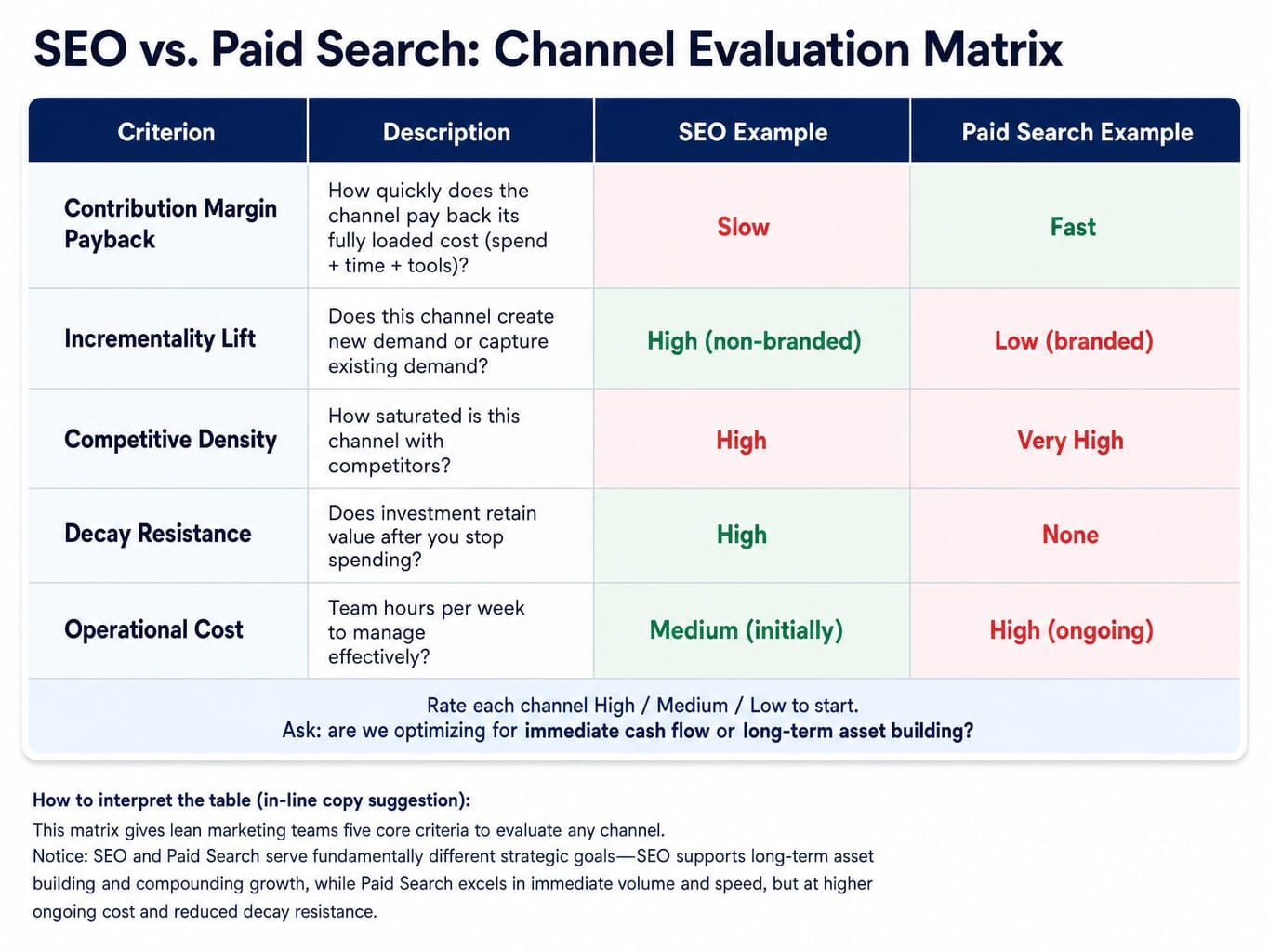
This simple table immediately clarifies the strategic tradeoffs. You stop asking "What's the ROAS?" and start asking "What kind of return are we optimizing for—immediate cash flow or long-term asset building?"
How Often to Reassess Your Channel Mix
The cadence of reassessment is critical. Monthly reallocation is too frequent; it destroys compounding by constantly interrupting a channel's learning phase. This is the hidden cost of channel switching. Annual reviews are too slow; they miss crucial inflection points where a channel either saturates or a new one becomes viable.
The optimal cadence is a quarterly review.
However, you also need an off-cycle trigger for immediate reassessment. Set a rule: if any channel's marginal CPA increases by more than 20% over a rolling 30-day window, it triggers an immediate review. This prevents you from pouring good money after bad while waiting for the next quarterly meeting. This system balances long-term strategy with short-term agility, ensuring you're neither chasing shiny objects nor sticking with a failing channel for too long.
Measuring What's Actually Working: Incrementality Over ROAS
Incrementality measures whether a marketing channel creates conversions that would not have happened otherwise—and it is the only metric that tells you if a channel is worth its budget. The obsession with last-touch ROAS is the single biggest cause of misallocated marketing spend. It systematically over-credits channels that capture existing demand (like branded search and retargeting) and under-credits channels that create it.
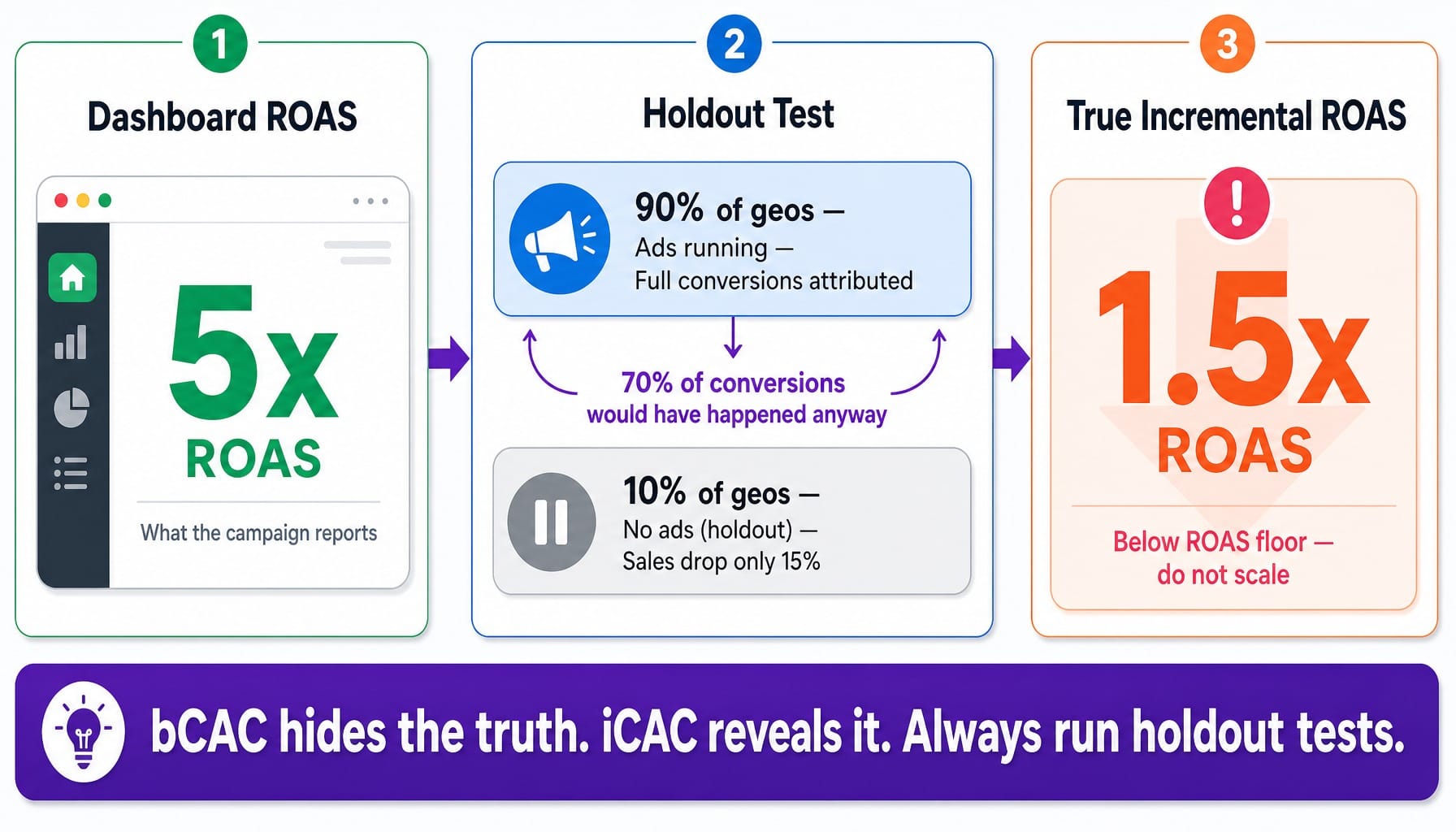
You need to distinguish between your blended Customer Acquisition Cost (bCAC) and your incremental Customer Acquisition Cost (iCAC). Most teams only track bCAC, which hides the true performance of each channel.
Here's a real-world scenario. A team running a Google Performance Max campaign sees a fantastic 5x ROAS in their dashboard. But they run a holdout test, excluding 10% of their geographic target from seeing the ads. They discover that sales in the holdout group only drop by 15%. This reveals that 70% of the conversions attributed to the campaign came from branded queries and users who would have converted anyway. The campaign's true incremental ROAS isn't 5x; it's 1.5x, which is below their ROAS floor.
Without this test, they would have scaled a channel that was barely profitable. This is why incrementality measurement isn't a "nice to have." It's fundamental. Tools like Northbeam and Triple Whale can help with attribution, while MMM platforms and geo-lift experiments provide the most rigorous measure of true, causal lift.
Read more: 5 Best Predictive Conversion Optimization Tools for Pipeline Revenue in 2026
When Prioritization Requires Continuous Execution, Not Just a Plan
You've analyzed the channels, built the framework, and committed to measuring incrementality. You now have a clear, data-backed plan for where to concentrate your budget. But a plan is worthless if you can't ship the changes. The latency between identifying the highest-impact move and actually executing it—across SEO, CRO, and ads—can eat weeks of runway.
This is the execution gap that stalls most lean teams. Your backlog of "should-do" optimizations grows, but the bandwidth to deploy them doesn't. Your quarterly plan to "focus on SEO" gets bogged down in the day-to-day reality of writing content, fixing technical issues, and getting changes approved. Improving landing page conversion rate optimization alone can consume weeks of a lean team's time.
Spike AI closes that gap. Our platform operates as your execution layer. Every week, it identifies the single highest-impact move across your website, SEO/AEO, and ads—then executes it. This turns your channel prioritization from a static slide deck into a living, weekly shipping rhythm. We provide the continuous execution needed to make your strategic framework operational. Your team moves from being buried in a backlog to approving a weekly release that compounds, week after week.
From a List of Channels to a Compounding System
The most critical shift in thinking for 2026 is this: channel prioritization is not about finding the single "best" channel. It's about building a system to concentrate investment where marginal returns are still increasing, ruthlessly cutting where they're decaying, and using incrementality to know the difference.
Most teams fail at this not because they pick the wrong channels, but because they spread their efforts too thin, measure the wrong metrics, and lack the execution cadence to act on what they learn. They are busy, but they are not compounding.
The teams that win in the coming years will not be the ones with the most channels. They will be the ones with the fewest channels running at full compounding velocity, measured by contribution margin, and re-optimized with a disciplined, weekly cadence. That is how you build a marketing engine, not just a marketing plan.
Frequently Asked Questions
Should B2B companies prioritize marketing channels differently than B2C in 2026?
Yes. B2B buying cycles are longer and involve more stakeholders, so channels that build trust over time (SEO, email nurture, LinkedIn thought leadership) outperform impulse-driven channels. B2C can afford channels with shorter payback windows. The framework criteria are the same, but the weights shift: B2B should overweight decay resistance and LTV:CAC cohort analysis; B2C can focus more on immediate contribution margin payback.
Are retail media networks worth the investment for mid-size brands in 2026?
For mid-size brands selling physical products through major retailers, retail media networks (like Amazon DSP) can deliver strong ROAS. But this is only true if your margin structure can absorb the platform fees on top of ad spend. For B2B SaaS or service businesses, they are irrelevant. The key test is whether your product already sells on the retailer's platform; if not, the targeting advantage disappears.
Is connected TV advertising cost-effective for brands without massive budgets in 2026?
CTV has become more accessible via platforms like The Trade Desk, but the minimum effective spend is still in the $15K-25K/month range to generate meaningful results. For brands spending less than $10K/month on total paid media, CTV is premature. The measurement infrastructure alone, such as running geo-lift experiments to prove incrementality, can be prohibitive for smaller campaigns.
How has AI search changed which marketing channels to prioritize?
AI Overviews in Google Search are compressing click-through rates for informational queries, reducing the value of some top-of-funnel SEO. However, they are increasing the value of commercial and transactional SEO, as the traffic that does click through has higher intent. This means you should prioritize content that earns AI citations (structured, authoritative, non-commodity) and double down on owned channels like email and SMS that are independent of search traffic.
How do I reallocate budget when a top-performing channel starts declining?
First, confirm the decline is real and not just seasonal or due to fixable creative fatigue. Run a 4-week holdout test by pausing spend for a geographic segment and measuring the impact on total conversions. If sales don't drop proportionally, the channel was likely capturing demand, not creating it. Reallocate that budget to the channel with the highest proven incrementality lift from your last analysis, not just the one with the best dashboard ROAS.