Agile Marketing vs. Traditional Marketing: When Each Cadence Actually Wins

TLDR
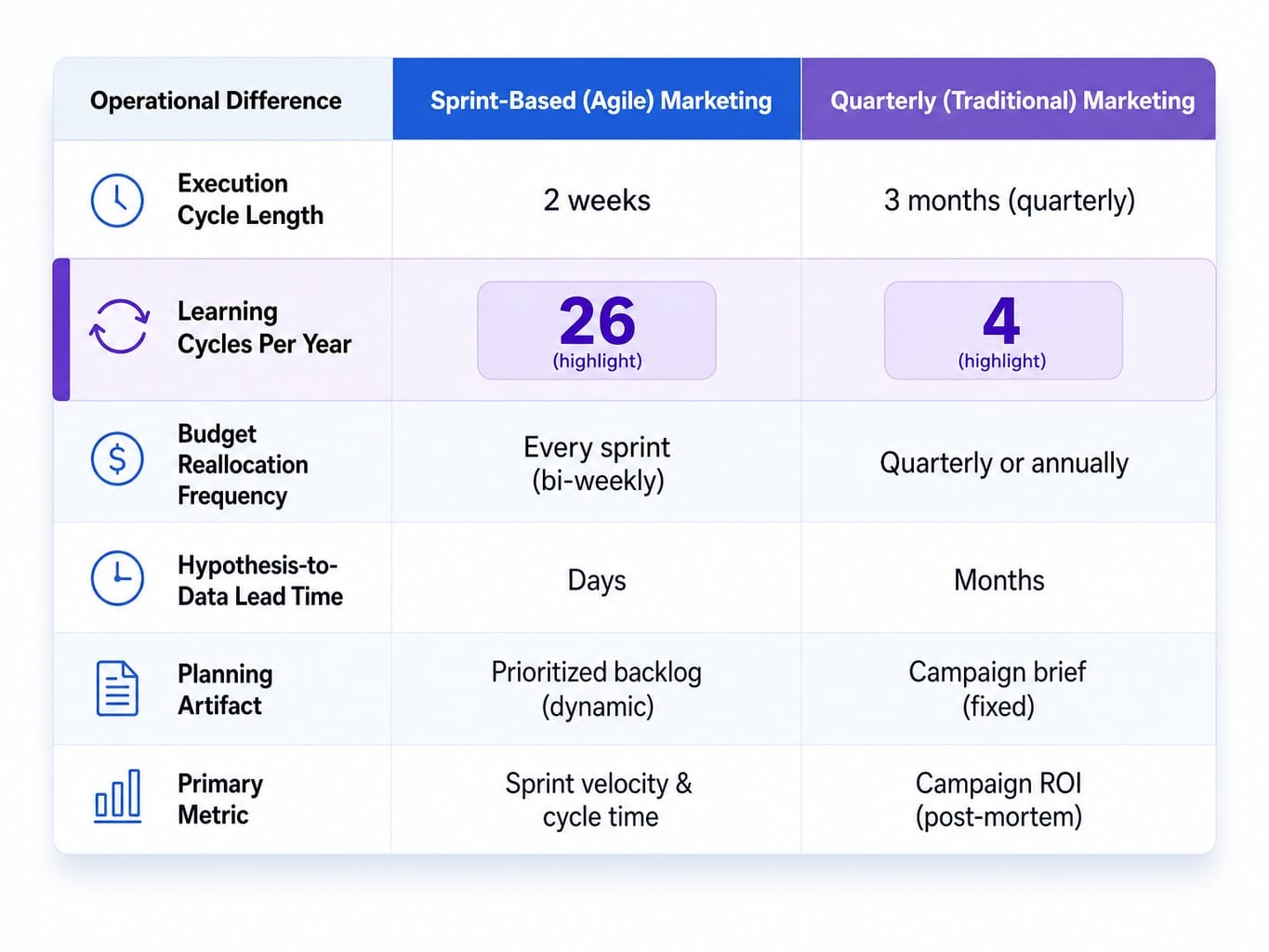
- The core difference between agile and traditional marketing isn't philosophy; it's the execution cadence—weekly sprints generate 26 learning cycles per year, while quarterly campaigns generate four.
- Agile marketing's main advantage is dynamic budget reallocation, allowing teams to shift spend to proven channels mid-quarter instead of being locked into a fixed annual plan.
- Traditional marketing still outperforms agile in specific contexts, such as long-cycle B2B brand building where narrative consistency over 18 months is more critical than rapid iteration.
- Most agile transformations fail not due to methodology but because the organization's reporting structure and approval workflows remain stuck in a traditional, quarterly cadence, creating systemic friction.
- In regulated industries like finance or healthcare, traditional waterfall planning is often a structural necessity, not a bureaucratic choice, as legal review cycles can exceed a typical two-week sprint.
Your B2B SaaS marketing team ships a new landing page in January. The campaign brief, approved last quarter, schedules an A/B test for March. You'll review the results during the Q2 planning cycle. By the time you have a signal, the market has moved on, and the insight is four months stale.
Now, imagine another team. In that same month, they tested three headline variants on their page, identified a winner that lifted conversions by 12%, and moved on to fix the next constraint in their funnel.
The difference between these two teams isn't a philosophical debate about flexibility versus structure. The real difference between agile marketing and traditional marketing is a cadence decision that determines how fast your team can learn and compound improvements. It's a choice between four learning cycles per year and twenty-six.
This isn't another one-sided advocacy piece. Here, we'll compare the two approaches head-to-head on their operational mechanics, identify the specific scenarios where each genuinely wins, and diagnose why most agile marketing transformations fail at the system level—and it's rarely the team's fault.
The Real Difference: Sprint Cadence vs. Quarterly Campaign Cadence
The agile vs. traditional marketing debate is fundamentally about the length of your execution cycle. Everything else—team structure, budgeting, measurement—flows downstream from this single variable. You are not choosing a philosophy; you are choosing a feedback loop speed.
A traditional marketing team's week is defined by execution against a pre-approved campaign plan. Their work is a series of tasks derived from a brief locked in months ago, with a post-mortem scheduled for the end of the quarter. A sprint-based team's week is defined by a Monday standup where they review last week's data, pull the highest-impact item from a prioritized backlog, and ship a change. One team executes a plan; the other runs experiments.
How Execution Rhythm Shapes Learning Speed
The primary advantage of a sprint cadence is not speed of output but speed of learning. A team running two-week sprints generates 26 distinct learning cycles per year. A team executing quarterly campaigns generates four. This difference compounds. The critical metric here is the gap between cycle time and lead time. In a traditional model, the lead time from identifying a hypothesis (e.g., "a new CTA might improve demo requests") to getting data can be months, as the idea must survive the planning, approval, and campaign execution pipeline.
In a sprint model, the cycle time for that same hypothesis can be days. The team pulls the task, builds the test, and has data by the next sprint retrospective. Mechanisms like WIP limits (Work In Progress) prevent the team from overcommitting, while tracking sprint velocity ensures capacity planning is based on reality, not ambition. This system is designed to keep cycle times short, which is the engine of compounding improvement. The advantage is mathematical, not motivational.
Budget Allocation: Fixed Plans vs. Dynamic Reallocation
Budgeting is where the cadence difference becomes financially visible. Traditional marketing allocates budget at the start of a quarter or year against a fixed plan. If that plan's assumptions prove wrong, the budget is already committed and difficult to claw back.
Consider a team that commits 40% of its Q1 budget to a four-part webinar series. After the first event underperforms, the data is clear: this channel isn't working. But the remaining three events are already contracted, promoted, and scheduled. The money will be spent.
An agile team would have treated the first webinar as a minimum viable campaign. After measuring registration-to-pipeline conversion, they would use the sprint retrospective to re-evaluate the channel's priority. By week three, that budget could be redirected to a paid search campaign that showed a stronger signal. This dynamic budget reallocation isn't about spending less; it's about systematically defunding what isn't working to overfund what is, multiple times a quarter.
Read more: How to Prioritize Marketing Channels With a Limited Budget And Resources (Framework for Lean Teams)
Where Agile Marketing Outperforms: Three Scenarios That Expose the Cadence Gap
Abstract benefits are useless. The advantage of a shorter cadence becomes clear in specific operational scenarios where the ability to pivot is not a luxury but a necessity.
Scenario 1: A Competitor Changes the Market
A key competitor launches a new feature that re-frames the value proposition for your entire category. The sprint-based team discusses this in their next marketing standup meeting. They create a "spike" task to research the impact, and in the following sprint, they ship updated landing page copy and a new one-pager addressing the new positioning. The traditional team adds "competitive response" to the Q2 planning document. The agile team's go-to-market speed allows them to control the narrative while the traditional team is still waiting for a meeting. As Agile Sherpas' State of Agile Marketing report consistently finds, agile teams are far better equipped to manage unplanned work and pivot priorities.
Scenario 2: A Paid Channel Suddenly Spikes
Your top-performing paid search campaign sees its cost-per-click double overnight due to unexpected seasonal competition. The traditional team, locked into a quarterly media plan, has two choices: absorb the higher cost and ruin their CAC, or pause the campaign and miss their lead target. The agile team, reviewing channel performance in their weekly meeting, immediately re-prioritizes. They pull budget from the overpriced paid channel and reallocate it to boosting high-performing organic content or a different social channel for the remainder of the sprint. This channel-mix flexibility turns a potential crisis into a simple resource allocation decision.
Scenario 3: Product Ships a New Feature Mid-Quarter
The product team, running on their own agile schedule, ships a valuable new feature that wasn't on the quarterly roadmap. For the traditional marketing team, this is a disruption; there is no campaign brief for it, so it gets added to the marketing backlog for next quarter. The sprint team sees it as an opportunity. They add "create feature support content" to the backlog, prioritize it based on impact, and can have a blog post, a short video, and a CRO experiment live on the pricing page within two sprints. This is cross-functional responsiveness, enabled by a system designed for continuous deployment, not sequential campaigns.
Where Traditional Marketing Still Wins: The Honesty Most Comparisons Skip
Most content comparing agile vs. traditional marketing is created by agile consultants or tool vendors, creating a structural bias. The truth is, there are scenarios where the long-term, sequential nature of traditional planning is not just acceptable but superior. Pretending otherwise undermines the credibility of the entire agile argument. Acknowledging these exceptions is a sign of operational maturity.
Long-Cycle B2B Brand Building and 18-Month Sales Cycles
When you are selling a high-ACV product to enterprise buyers with an 18-month sales cycle, brand coherence matters more than iteration speed. The buyer will interact with dozens of touchpoints—from thought leadership to sales decks to event booths—over more than a year. A sprint team that pivots messaging every two weeks based on short-term conversion data risks fragmenting the brand story. This creates a disjointed experience for a buyer who needs to see a consistent, unified narrative to build trust.
Long-cycle brand building is an epic-level initiative that must hold its strategic line across multiple quarters. The traditional waterfall approach, with its upfront strategic planning and fixed creative, ensures that the message a buyer sees in month one is coherent with the message they see in month twelve. Here, the failure mode of agile is not slowness—it's strategic incoherence born from too many local optimizations.
Read more: How to Build a B2B SaaS Go-to-Market Strategy That Ships, Not Stalls
Regulated Industries and Stakeholder Approval Realities
In industries like financial services, healthcare, or government contracting, the marketing definition of done includes a non-negotiable step: legal and compliance review. These approval workflows often take weeks, not days. A two-week sprint is rendered meaningless if legal review for a single ad creative takes three weeks.
The common agile response—"embed legal in the marketing pod"—ignores the reality that legal and compliance teams serve the entire organization and cannot dedicate their capacity to one marketing team's sprint cycle. In these environments, traditional marketing's upfront planning and sequential stakeholder approval workflows are not bureaucratic waste; they are a structural requirement. By batching all campaign assets for a single, comprehensive review, the waterfall model aligns with the operational constraints of the broader organization. The blocker here is not cultural resistance; it's a fundamental incompatibility between the sprint cadence and external dependency mapping.
Why Most Agile Marketing Transformations Fail—And It's Not the Methodology
Most teams that "try agile" revert to their old ways within six months. The common explanation—resistance to change, lack of training—is almost always wrong. The real failure is systemic. Organizations adopt agile ceremonies (standups, sprints) without changing the operating system they run on: reporting structures, approval cadences, and capacity planning.
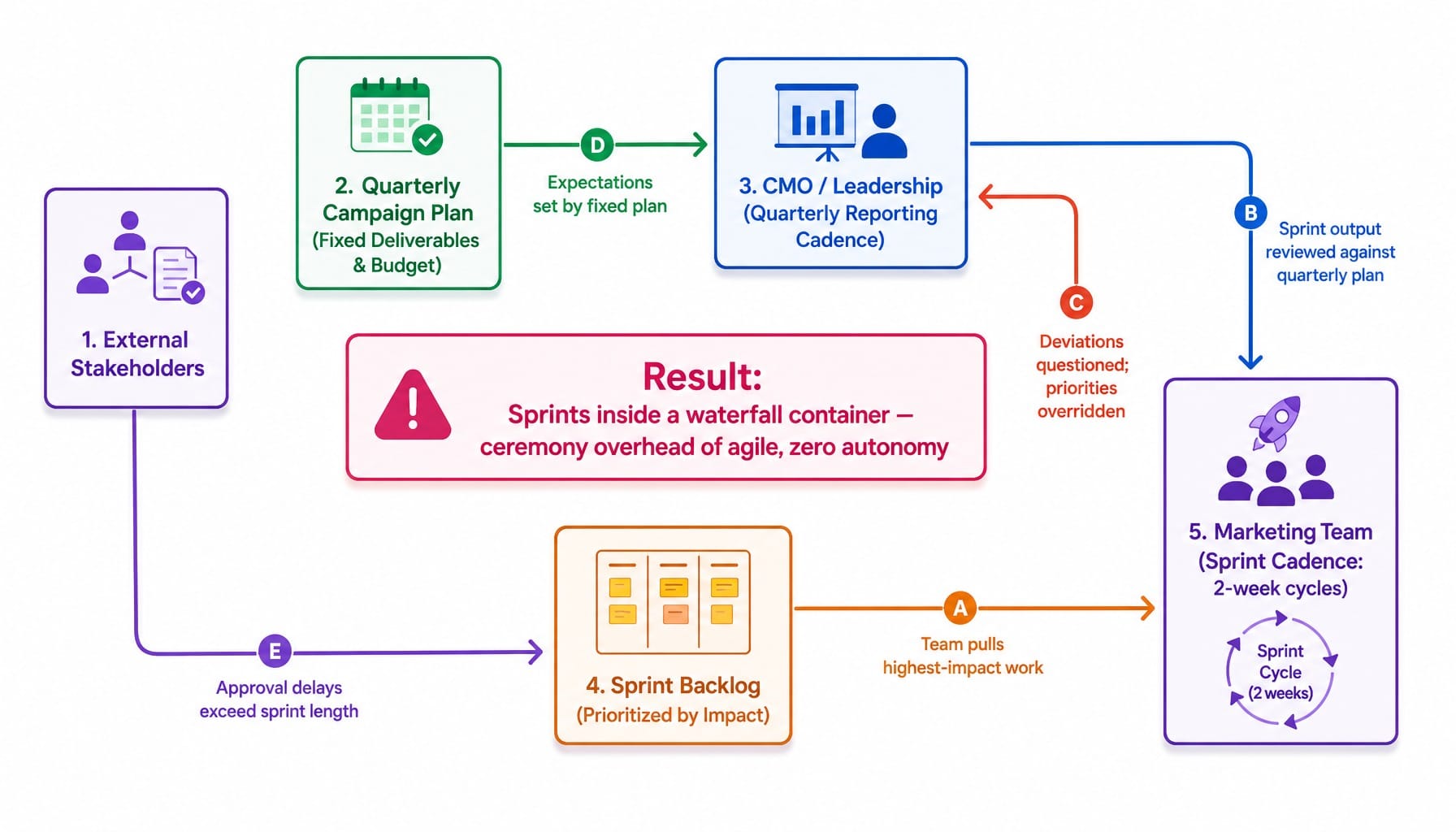
Imagine a marketing team that adopts two-week sprints but still reports to a CMO who expects a detailed quarterly campaign plan with fixed deliverables and budgets. The team generates a backlog, prioritizes it by projected impact, and starts shipping. But at the end of every sprint, their output is reviewed against the quarterly plan they submitted two months ago. Anything that deviates—even if it's a data-driven pivot—is questioned.
Within two quarters, the team is running sprints inside a waterfall container. This is the worst of both worlds. They have the ceremony overhead of agile with none of the autonomy, leading to a high thrash rate as priorities are constantly overridden by external stakeholders. This is an org chart problem, not a methodology problem. Agile marketing requires a level of autonomy that most marketing teams, unlike their engineering counterparts, simply do not have. Adopting agile is an organizational design decision, not a project management one. Most failures happen because leadership treats it as the latter.
A marketing prioritization framework that replaces gut feel with data-driven scoring can help bridge this gap, giving teams a defensible rationale for sprint-level decisions that leadership can trust.
What If the Cadence Ran Itself?
The tension is clear: a weekly sprint cadence creates compounding advantages, but most teams can't sustain it because the surrounding organizational system—approvals, reporting, dependencies—resists the change. This leaves most marketing leaders stuck with a structural problem that methodology alone cannot solve.
This is where the system design needs to change. Instead of forcing your team to adapt to a new cadence, what if the execution cadence was an autonomous function of your marketing system? Spike AI operates as a weekly shipping engine that closes this execution gap. Every week, it identifies the highest-impact move across your website, SEO, or ads, and then executes it. The cadence is built into the platform, not dependent on your team's ability to win a political battle for organizational redesign.
This offers a third option. You don't have to choose between the slow certainty of quarterly campaigns and the high overhead of a full agile transformation. With an autonomous execution layer, you get the 52-cycle-per-year learning advantage without carrying the operational burden. The marketer moves from operator to approver. The backlog shrinks into an approval queue. And the cadence compounds, week after week.
Conclusion
The debate over agile marketing vs. traditional marketing is the wrong conversation. The right question is: how many learning cycles can your team complete per year, and can your organization structurally support that cadence?
Sprint-based execution compounds learning and budget efficiency far faster, making it the superior choice for most modern B2B marketing functions. Yet, traditional waterfall planning remains the right system for specific contexts like long-cycle brand building and in heavily regulated industries. For most teams, however, the biggest hurdle isn't choosing a methodology; it's the organizational friction that sabotages any attempt to increase cadence.
The teams that will outperform in the next two years won't be the ones who picked the "right" methodology. They will be the ones who found a way to sustain a weekly shipping and learning cadence, regardless of their org chart.
Frequently Asked Questions
What size marketing team is needed to run agile marketing effectively?
Agile marketing works best with cross-functional pods of 3–7 people who can execute end-to-end without external dependencies. Teams smaller than three often lack the capacity to sustain sprint cadence alongside daily responsibilities. However, the constraint is not headcount—it is whether the team has decision-making autonomy to ship without waiting for approvals from outside the pod.
How do you measure ROI in agile marketing compared to traditional campaigns?
Traditional marketing measures ROI per campaign, usually after it has concluded. Agile marketing measures ROI per sprint cycle, tracking which experiments moved the target metric and feeding that data into the next sprint's prioritization. The shift is from post-mortem analysis to continuous measurement, meaning ROI attribution happens on a weekly or bi-weekly basis rather than quarterly.
Can agile and traditional marketing work together in a hybrid model?
Yes, and most mature organizations operate hybrid models. The practical approach is to map which marketing functions benefit from sprint cadence (e.g., performance marketing, CRO, content production) and which require longer-term waterfall planning (e.g., major brand campaigns, annual event marketing). The mistake is trying to force one model on all functions; the decision should be function-specific, not team-wide.
How long does it typically take to transition a marketing team from traditional to agile?
Most teams can adopt sprint ceremonies like standups and retrospectives within a few weeks. The real transition—changing approval workflows, reporting cadence, and stakeholder expectations to support the new model—takes at least 3–6 months. Teams that only adopt the ceremonies without changing the surrounding system typically revert within two quarters because the organizational friction outweighs the benefits.
What tools do agile marketing teams use that traditional teams typically do not?
Agile marketing teams rely on visual workflow tools like Jira, Monday.com, or Asana configured with kanban boards, WIP limits, and sprint velocity tracking. While traditional teams may use these same tools, they often function as simple task lists. The key difference is the configuration: agile teams use them as kanban pull systems with built-in constraints to manage flow and capacity.