Ahrefs vs Semrush (2026): The Differences That Change Your Workflow; Not Just Your Dashboard

TL;DR
- Data Discrepancy: Ahrefs and Semrush show different traffic and keyword volume numbers because they use different data sources and modeling. Trust the tool whose estimates are directionally closer to your Google Search Console data, not the one with the bigger database.
- Keyword Difficulty (KD): The tools calculate KD differently. Ahrefs is heavily backlink-focused; Semrush uses a broader model. The "right" KD score is the one that more accurately predicts ranking outcomes for your domain's authority level.
- Workflow Gaps: The only two feature differences that change daily workflows are Semrush's built-in content optimization suite (which can replace Surfer/Clearscope) and its deeper PPC intelligence (which can replace SpyFu). If you don't need these, the tools are functionally equivalent for most core SEO tasks.
- True Cost: The sticker price is misleading. Your actual cost is determined by user seats, Ahrefs' credit system, and Semrush's add-on modules. A 3-person team will pay significantly more than the base plan price on either platform.
- The Real Bottleneck: Neither tool solves the execution gap. They provide intelligence, but they don't ship the optimizations. The bigger challenge is having the bandwidth to act on the data you pay for.
Your three-person B2B SaaS marketing team subscribes to Semrush. You run a content gap analysis against three competitors and export a pristine list of 200 high-intent keyword opportunities. It's a goldmine. Then, reality hits. After accounting for blog posts already in the pipeline, landing pages that need updating, and the upcoming product launch, you have the bandwidth to act on maybe eight of those opportunities this quarter. The tool gave you a backlog. It did not give you execution capacity.
This scenario is the core of the Ahrefs vs Semrush debate, but it's the part most comparisons miss. They treat the decision as a feature-counting exercise, producing exhaustive lists that declare a winner for each of 13 different categories.
The truth is, for most core SEO functions, the tools have reached parity. The meaningful gap between them is narrower than ever. The more consequential gap is the one between having SEO intelligence and actually shipping optimizations.
This comparison isn't a feature list. It's a decision framework based on the three differences that actually change how your team operates:
- Data Derivation: Why their numbers for the same keyword or domain disagree, and what it means for your strategy.
- Workflow Impact: The few feature gaps that genuinely alter your daily process, versus the many that are cosmetic.
- Total Cost of Ownership: What you'll actually pay after user seats, credits, and add-ons are factored in.
Choosing between Ahrefs and Semrush is an important decision. But it's a system input, not the system itself. Let's analyze it with the precision it deserves.
Why Ahrefs and Semrush Show Different Numbers for the Same Keywords
The most common source of confusion when comparing Ahrefs and Semrush is that their core metrics—organic traffic estimates, keyword volume, backlink counts—don't match. A domain's traffic estimate can differ by 30-50% between the tools. This isn't because one is "right" and the other is "wrong." It's because they are not measuring the same thing in the same way.
Both platforms build their estimates on a foundation of third-party data, primarily from clickstream-derived estimates and Google Ads API data, which they then process through proprietary models. They use different data providers, different crawl schedules for their backlink index, and different algorithms to account for variables like zero-click keyword filtering and SERP feature CTR decay.
Pull up any mid-authority B2B SaaS domain in both tools. You might see 45,000 monthly organic visits in Ahrefs and 68,000 in Semrush. Meanwhile, your actual Google Search Console clicks for the month are 52,000. Neither tool is perfectly accurate. They provide modeled estimates, not direct measurements.
The practical takeaway is this: the better tool for you is the one whose estimation model happens to be directionally closer to your actuals, which you can only determine by comparing both against your own GSC data blending. The absolute size of their database is secondary to how well their model reflects your specific niche and traffic patterns.
Backlink Index: Size vs. Freshness
At first glance, backlink database size seems like a clear differentiator. Semrush reports a larger index (around 43 trillion backlinks) compared to Ahrefs (around 30.6 trillion). But for a practitioner, total index size is a vanity metric. The actionable question is about freshness: how quickly does a newly acquired link show up in the tool?
This is the crawl-to-index lag. For a team actively running link building campaigns, verifying 15 new links from last month's outreach is a time-sensitive task. You need to see them within days, not weeks. Historically, Ahrefs has maintained a reputation for faster crawl-to-index times, making it a preferred tool for specialists whose primary workflow is monitoring link velocity tracking and verifying new referring domains.
A larger historical index might be useful for deep forensic analysis of a legacy domain, but for 90% of teams, the speed at which the index is updated matters more than its absolute size. Don't choose based on the trillions; choose based on the tool that registers your hard-won backlinks the fastest.
Keyword Volume: Where the Estimates Come From
Just like traffic estimates, keyword search volumes are not first-party data from Google. Both Ahrefs and Semrush use a blend of data from third-party clickstream providers and the Google Ads API, then apply their own smoothing algorithms. This is why a keyword can show 1,600 monthly searches in one tool and 2,400 in the other.
The traffic value delta—the difference in estimated value from ranking for a keyword—can be significant based on which tool you use. However, making a content prioritization decision based on a perceived difference between an 800 and 1,200 volume keyword is operating on noise, not signal. The margin of error in these estimates is larger than the difference between the keywords themselves.
A better mental model is to treat keyword volumes as directional ranges (e.g., low-thousands, mid-hundreds) rather than precise figures. For any keyword where you already have some visibility, your GSC impression data is a far more reliable indicator of search demand than any third-party tool's estimate.
Read more: Semrush vs Ubersuggest (2026): Data Accuracy, Real Costs, and When Each Tool Stops Being Enough
Keyword Difficulty Scores Disagree—and It Changes Your Prioritization
Here's where the data methodology differences create real-world divergence in strategy. Ahrefs and Semrush both provide a 0-100 Keyword Difficulty (KD) score, but they calculate it differently. This KD discrepancy between tools is not a minor calibration issue; it reflects a fundamental difference in philosophy.
Ahrefs' KD score is calculated almost exclusively based on the quantity and quality of referring domains pointing to the pages ranking in the top 10. It's a direct measure of the backlink strength required to compete.
Semrush's KD score is a composite metric. It incorporates backlink data but also weighs factors like the authority of the ranking domains, on-page signals, and the presence of SERP features.
This leads to situations that change your content calendar. A keyword like "B2B lead scoring software" might score a KD of 12 in Ahrefs, suggesting a lean team with a DR 40 site can compete. The same keyword in Semrush might show a KD of 38, flagging it as moderately difficult and causing that same team to deprioritize it. One team builds the page; the other doesn't. Both are making rational decisions based on their tool's data, but those decisions are opposite.
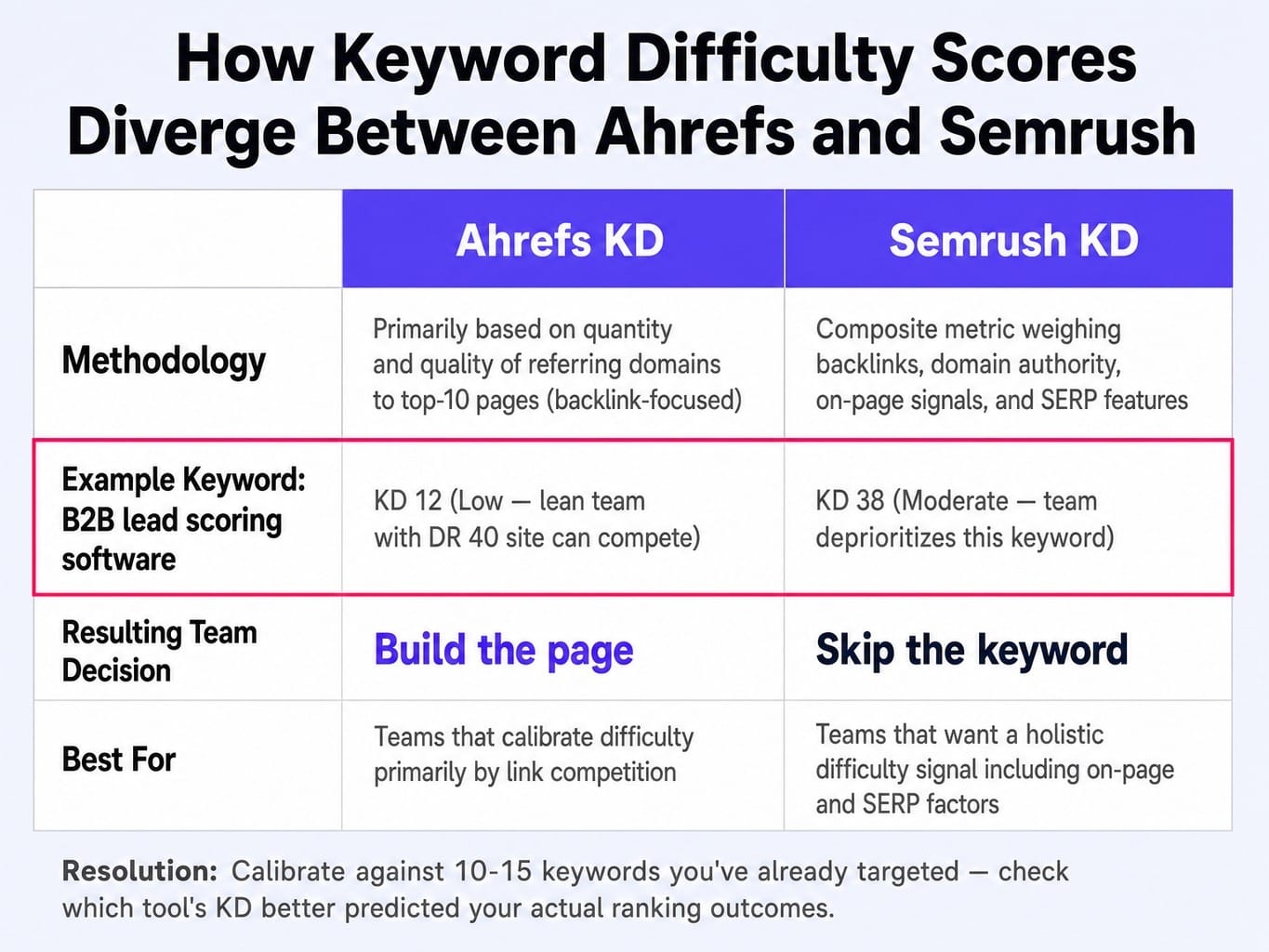
The resolution isn't about finding the "true" KD score. It's about calibrating each tool's model against your own domain. Look at 10-15 keywords you've targeted in the past. What was their KD score in each tool, and did you successfully rank? Over time, you'll discover that one tool's model is a better predictor of success for your site's authority level, especially when accounting for factors like DR inflation. Blindly following either score without this calibration is a recipe for failed prioritization.
Read more: Semrush vs Moz (2026): Which SEO Tool Fits Your Team's Actual Workflow
The Two Feature Differences That Actually Change Your Workflow
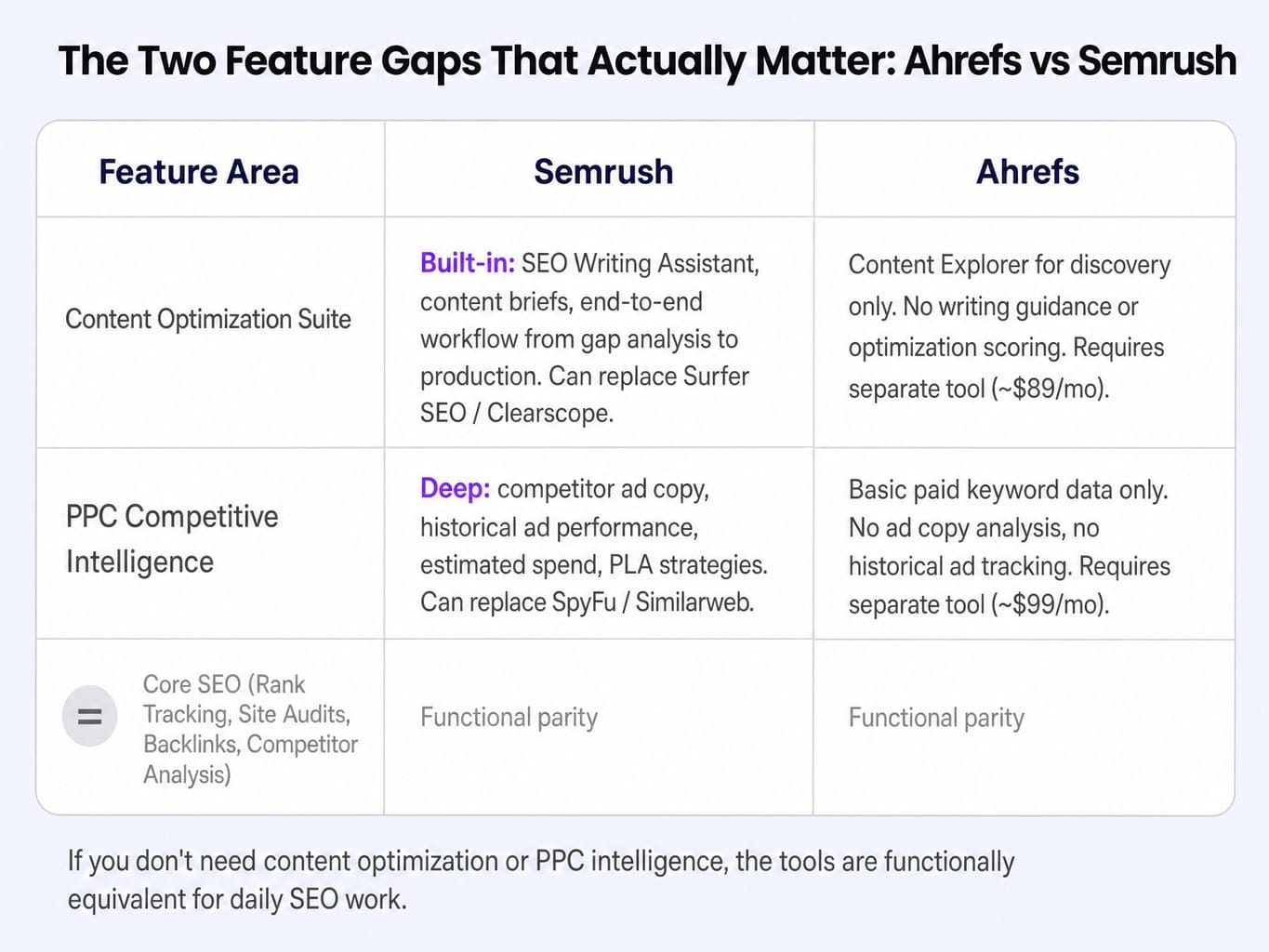
An exhaustive, 13-category feature comparison tells you everything and nothing. For most core SEO tasks—rank tracking, site audits, backlink analysis, and broad competitor domain analysis—Ahrefs and Semrush have reached functional parity. The differences are marginal and unlikely to impact your team's output.
Instead of a redundant checklist, let's focus on the two areas where the platforms diverge enough to change what your marketing team does on a Tuesday morning. These are the differences that can eliminate other tools from your stack or enable workflows that are impossible in the other platform.
Content Optimization: Semrush Has a Writing Workflow, Ahrefs Does Not
Semrush's Content Marketing Toolkit, which includes the SEO Writing Assistant and functionality for generating content briefs, creates an end-to-end workflow from content gap analysis to production. Ahrefs' Content Explorer is excellent for discovering proven content ideas, but its utility stops at discovery. It doesn't guide the creation process.
For a lean team where the same person researches, writes, and optimizes content, this is a significant difference. Using Semrush can eliminate the need for a separate content optimization tool like Surfer SEO or Clearscope, saving both subscription costs and the friction of context-switching. A content marketer writing four articles a month could consolidate their stack and streamline their process. However, for a team that already has a mature content workflow with a preferred optimization tool, this advantage is irrelevant. It only matters if you're looking for an all-in-one solution.
PPC Intelligence: Semrush Goes Deeper on Paid Search
This is arguably the most significant functional differentiator. Semrush began its life as a competitive intelligence tool for paid search, and that DNA remains strong. Its PPC Advertising Toolkit offers deep insights into competitor ad copy, historical ad performance, estimated ad spend, and Product Listing Ad (PLA) strategies. Ahrefs provides data on paid keywords but lacks this depth of PPC competitor intelligence.
For a growth marketer or a team responsible for both organic and paid channels, Semrush provides a unified platform for analyzing the entire SERP. It can replace the need for a dedicated PPC competitive analysis tool like SpyFu or Similarweb. You can see how a competitor is bidding, what ad copy they're running, and which landing pages they're using, all in the same interface where you conduct keyword research. For a team that is 100% focused on organic SEO, this entire feature set is irrelevant. But if paid acquisition is part of your strategy, Semrush offers a far more integrated system.
The Real Cost: What You Pay After the Sticker Price
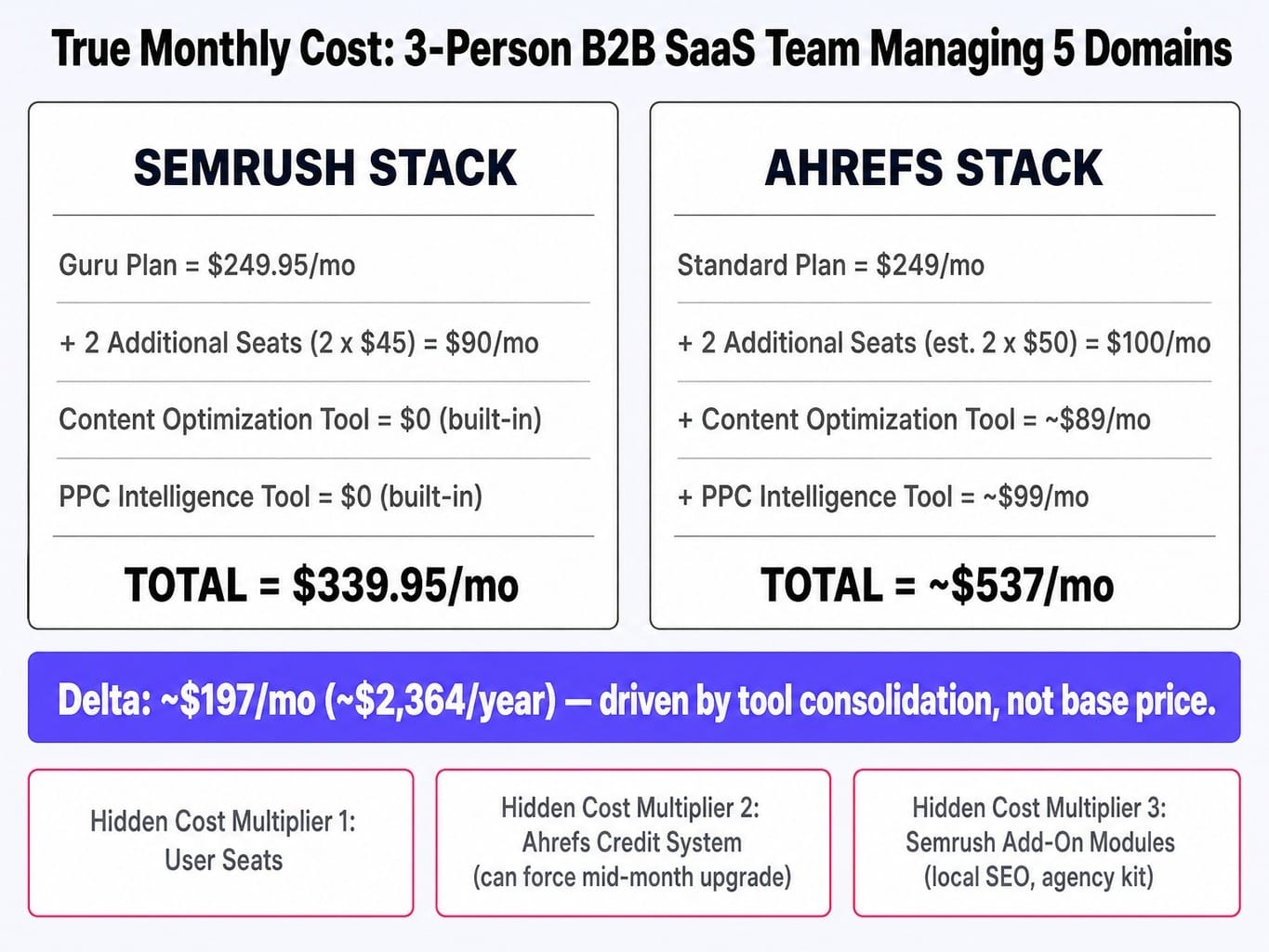
Comparing the entry-level plan prices—Ahrefs' Standard plan at $249/month versus Semrush's Pro plan at $139.95/month—is dangerously misleading for any team with more than one person. The true cost of ownership is driven by three multipliers that most pricing pages downplay.
- User Seats: This is the most immediate hidden cost. Semrush's Pro plan includes one user; additional seats cost $45/month each. Ahrefs' Standard plan also includes one user, with additional seats carrying their own cost. For a three-person marketing team, the base price is just the starting point. Your actual monthly bill for multi-user seat pricing will be substantially higher.
- Ahrefs' Credit System: Ahrefs' plans operate on a credit system where actions like running a Site Audit, exporting rows of data, or analyzing keywords in Keyword Explorer consume credits. On lower-tier plans, a power user can easily exhaust these credits mid-month, forcing an abrupt workflow halt or an unplanned upgrade. This system makes budgeting less predictable compared to Semrush's more straightforward limits.
- Semrush's Add-On Modules: While Semrush's plans are more inclusive out of the box, several key features are sold as add-ons. The Agency Growth Kit, additional projects, and the crucial Listing Management tool for local SEO all carry separate fees.
Let's calculate a realistic scenario: a 3-person B2B SaaS team managing 5 domains, needing content optimization tools, and with one person analyzing PPC.
- On Semrush: They would need the Guru plan ($249.95/mo) for content features, plus two additional seats (2 x $45 = $90). Total: $339.95/month.
- On Ahrefs: They would need the Standard plan ($249/mo), plus two additional seats (cost varies, but let's estimate $50/seat). They would also need a separate content optimization tool (~$89/mo) and a PPC tool (~$99/mo). Total: ~$538/month.
The sticker price is marketing. Your actual cost depends entirely on your team size and workflow needs. For a deeper look at what Ahrefs charges after add-ons and overages, see our breakdown of Ahrefs pricing plans.
Which Tool Fits Which Team: A Decision Framework
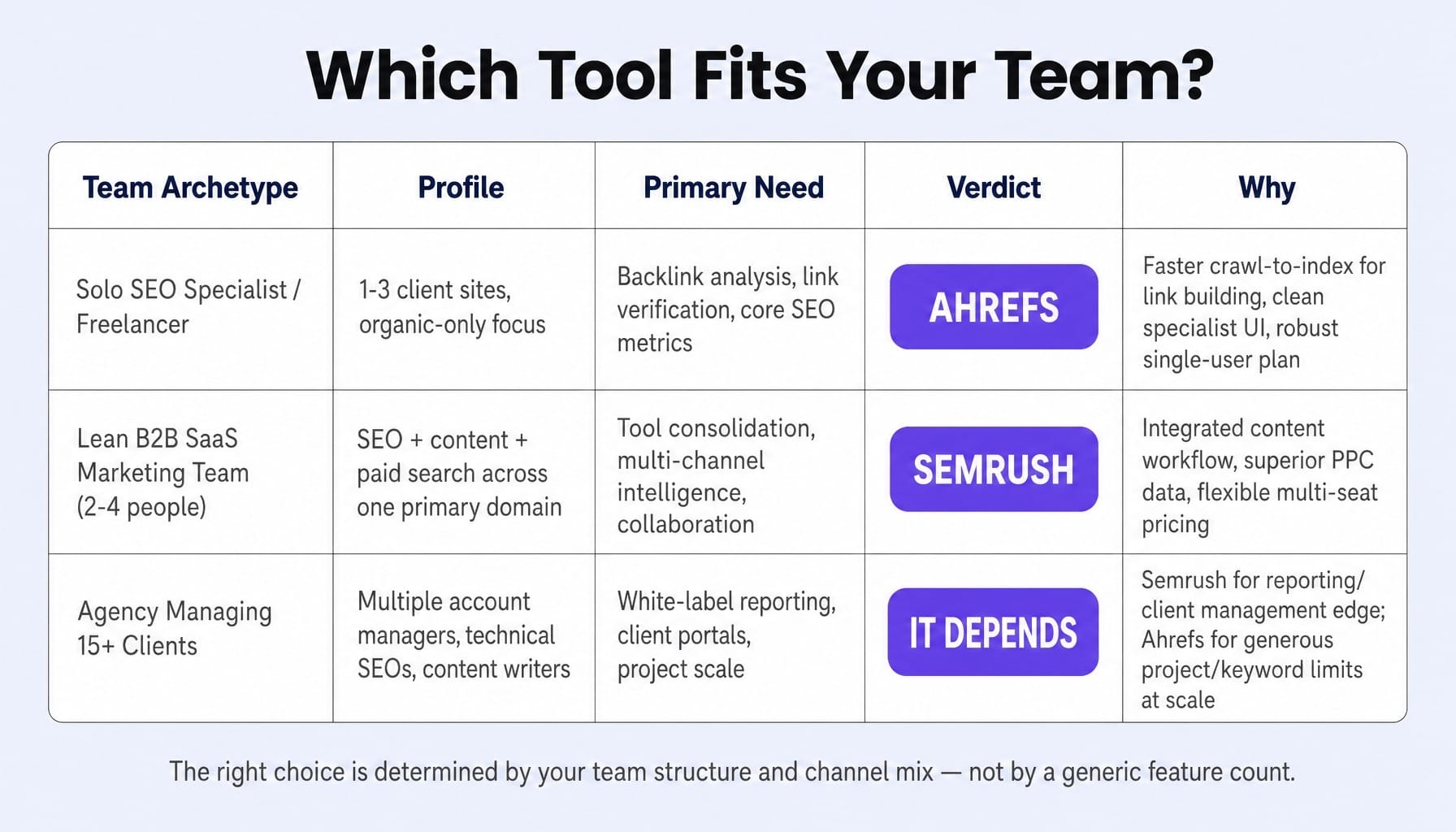
There is no universal "winner" in the Ahrefs vs Semrush debate. Any article claiming one is oversimplifying. The better choice depends entirely on your team's structure, channel mix, and primary execution model. Here are three common archetypes:
Archetype 1: The Solo SEO Specialist or Freelancer
- Profile: Managing 1-3 client sites, primarily focused on organic search (technical SEO, link building, keyword strategy). No paid search responsibilities.
- Verdict: Ahrefs. Its industry-leading backlink data, faster crawl-to-index speed for verifying new links, and clean UI focused on core SEO metrics make it a powerful tool for the specialist. The Standard plan offers a robust feature set for a single power user.
Archetype 2: The Lean B2B SaaS Marketing Team
- Profile: A 2-4 person team responsible for SEO, content marketing, and paid search across a primary business domain. They need to reduce tool sprawl and improve collaboration.
- Verdict: Semrush. The integrated content marketing workflow, superior PPC intelligence, and flexible seat-based pricing make it a more efficient all-in-one system for a multi-channel team. It consolidates workflows that would require 2-3 separate tools alongside Ahrefs.
Archetype 3: The Agency Managing 15+ Clients
- Profile: Needs robust project management, white-label reporting, and client-facing dashboards. Workflows are split between technical SEOs, content writers, and account managers.
- Verdict: It depends. This requires a direct comparison of Semrush's Agency Growth Kit (with its client portal and reporting features) against Ahrefs' higher-tier plans, which offer more generous project and keyword tracking limits. If the agency's core deliverable is reporting and client management, Semrush has the edge. If it's pure-play SEO execution at scale, Ahrefs' limits may be more favorable.
Identify your archetype, and the choice becomes clear.
The Gap Neither Tool Closes: From SEO Data to Shipped Optimizations
We've analyzed data methodologies, workflow gaps, and hidden costs. You can now choose the right intelligence tool for your team. But this brings us back to the problem from the introduction: you now have a tool that generates a 200-item backlog for a team with the bandwidth to ship eight fixes.
No amount of better data from Ahrefs or Semrush changes that ratio. The fundamental constraint on growth is not a lack of insight; it's the latency between identifying what needs to change and actually getting it done. Fixing the title tags, publishing the new content, restructuring internal links, A/B testing the headline—this is where marketing velocity is won or lost.
This is the execution gap. It's where Spike AI operates. We are not another analytics layer that gives you more dashboards. We are the execution engine that connects to your data, prioritizes the single highest-impact action you can take, and then ships it for you. Every week.
Spike AI closes the loop that Ahrefs and Semrush leave open. We turn the insights from these powerful tools into deployed changes that compound over time. Your team moves from being operators buried in a backlog to orchestrators approving a steady cadence of weekly releases. The tool gives you the what. Spike AI delivers the done.
See how Spike AI turns your SEO backlog into weekly shipped optimizations
Conclusion
The debate between Ahrefs and Semrush is often framed as a high-stakes choice between two titans. The reality in 2026 is that the decision is less consequential than you think. The platforms have converged on most core capabilities, and the true differentiators are narrow and specific to your team's unique execution model.
Both tools are excellent. Your choice should be based on a clear-eyed assessment of how they derive their data, which specific workflows they support natively, and what they will actually cost your team once you account for seats and add-ons. Choose based on your operating reality, not a generic feature list.
But don't mistake this choice for a complete solution. The harder question is not which tool to subscribe to, but whether your team has the system to act on what either tool will tell you. The best SEO intelligence in the world compounds at zero if it sits untouched in a dashboard.
Frequently Asked Questions
Is it worth subscribing to both Ahrefs and Semrush at the same time?
For most B2B teams, no. The feature overlap is too significant to justify the doubled cost. The main exception is for SEO agencies or high-stakes enterprise teams that need to cross-reference traffic and keyword data from multiple sources to build higher-confidence forecasts. For most, it's better to pick one and invest the savings in execution.
How do the free and trial versions of Ahrefs and Semrush compare?
Semrush offers a 7-day free trial of its Pro or Guru plans, providing access to nearly the full suite of features for evaluation. Ahrefs offers a free but limited Webmaster Tools account, which provides site audit and backlink data for your own verified sites but does not include competitor analysis or comprehensive keyword research. For a full platform evaluation, Semrush's trial is more revealing.
Do Ahrefs and Semrush track AI Overviews and zero-click SERP features differently?
Both platforms are actively integrating AI Overview tracking into their SERP feature analysis. As of late 2025, Semrush's SERP feature tracking identifies a slightly wider range of features, including AI Overviews. However, both tools are still in the early stages of this integration. They currently track the presence of AI features but do not yet offer robust, actionable advice for optimizing to appear in them.
What are the API rate limits and data export differences between Ahrefs and Semrush?
This is a critical difference for teams building custom reports. Ahrefs provides API access starting with its Standard plan ($249/mo) and prices access based on exported rows. Semrush includes API access on its Guru plan ($249.95/mo) and above, with limits based on API requests. If you plan to pull large volumes of data into Looker Studio or an internal BI tool, you must model your expected usage against each platform's specific API pricing, as the costs can diverge significantly.
Which tool handles local SEO and map pack tracking better?
Semrush is the clear winner for businesses focused on local SEO. It offers a dedicated Listing Management tool (as a paid add-on) that distributes your business information to local directories and provides specific tracking for map pack rankings. Ahrefs does not have an equivalent local SEO management module. While its Rank Tracker can be set to specific locations, it doesn't offer the listing management and GMB-focused features that Semrush does.