
Ahrefs vs Ubersuggest (2026): Data Accuracy, Hidden Costs, and Which Actually Fits Your Workflow

TL;DR
- Data Accuracy is the Real Differentiator: Ahrefs uses clickstream data, giving more realistic volume and difficulty scores for low-volume B2B keywords. Ubersuggest relies more on Google's data, which can overestimate volume for niche commercial terms.
- Model True Cost, Not Sticker Price: Ubersuggest's lifetime deal ($490) is 18x cheaper than a 3-year Ahrefs subscription ($8,964+), but it locks you into its current data quality. Ahrefs' price buys flexibility and a superior backlink index.
- Ahrefs Excels at Strategy: Features like Content Gap analysis and Link Intersect turn competitor data into a prioritized content roadmap. Ubersuggest is strong for ideation but weaker for strategic planning.
- Choose Based on Operational Reality: Ubersuggest is the pragmatic choice for freelancers and solo marketers on a tight budget. Ahrefs is the necessary investment for growth teams and agencies where resource allocation decisions depend on data accuracy.
- Intelligence Isn't Execution: Both tools provide insights. The real bottleneck is acting on them. The ROI of either tool depends on your team's ability to consistently ship improvements.
Most Ahrefs vs Ubersuggest comparisons walk you through the same feature checklist—keyword research, backlinks, site audit—and declare a winner for each. The problem is that feature parity tells you almost nothing about which tool will actually deliver ROI for your specific situation. A solo consultant running three client sites has fundamentally different needs than a four-person SaaS marketing team publishing 20 pages per month.
The real decision comes down to three things most comparisons ignore. First, how accurate is the data you're basing decisions on? Second, what does the tool actually cost when you use it at your team's volume? And third, does it fit how your team operates, or does it just add another dashboard to check?
This comparison goes beyond the feature list. We'll analyze the data provenance, model the total cost of ownership, and map each tool to the operational reality of different marketing teams.
Keyword Research: Where Data Accuracy Matters More Than Database Size
Both tools show you keyword volume and difficulty scores. But the numbers they show for the same keyword are often meaningfully different, and those differences compound into bad prioritization decisions. The real question isn't "which has more keywords?" but "which gives you numbers you can trust enough to allocate resources?"
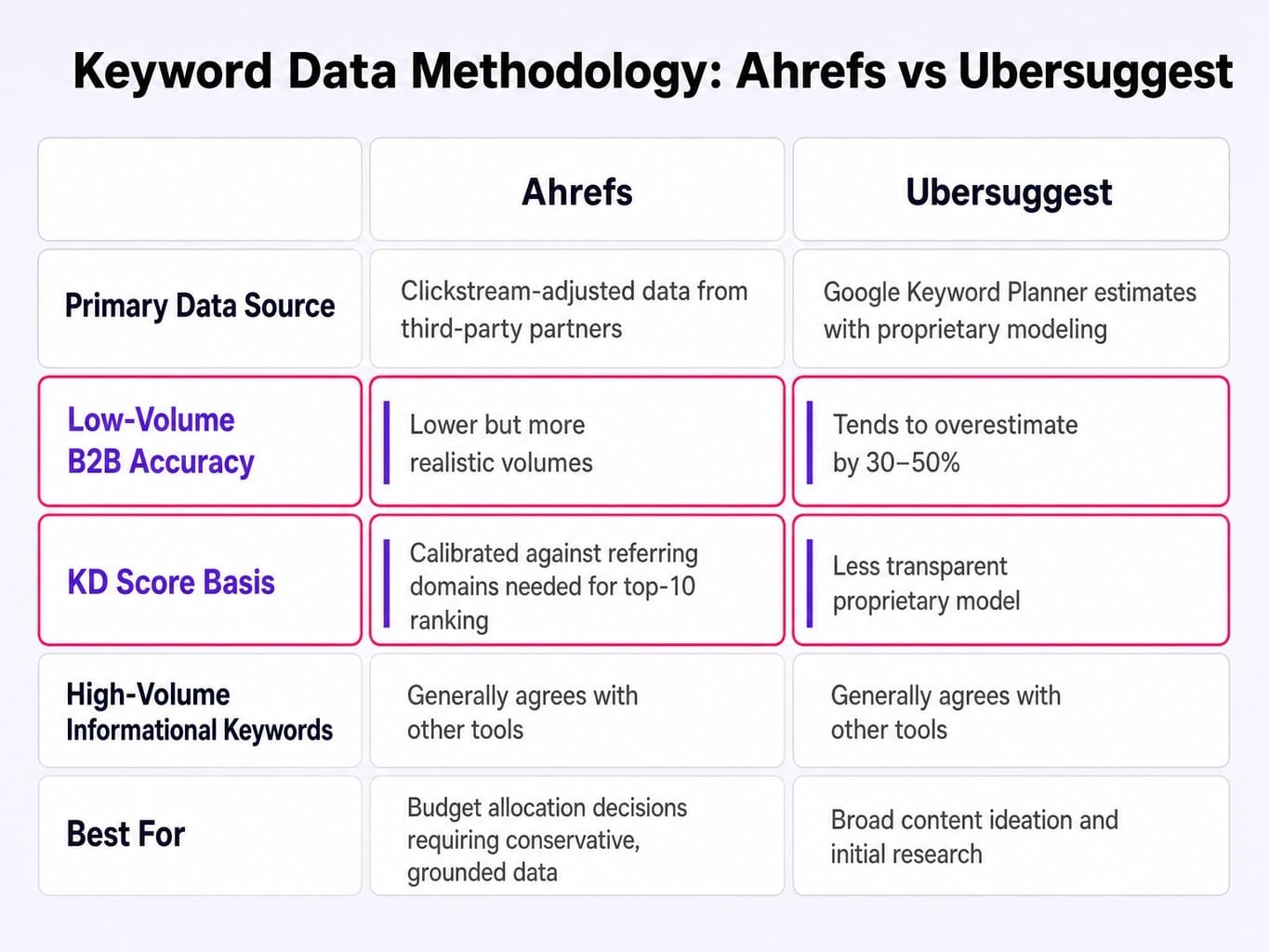
Imagine you're a B2B SaaS marketer evaluating whether to invest three weeks of content effort into a keyword cluster. If the tool overestimates search volume by 40% or underestimates the keyword difficulty (KD) score, that isn't just a data discrepancy—it's a misallocated quarter. Ahrefs uses clickstream-adjusted volume data, while Ubersuggest relies more heavily on Google Keyword Planner estimates. For the low-volume, high-intent B2B keywords most teams chase, this methodological difference is everything.
Read more: SaaS Keyword Research: A Revenue-First Framework for 2026 | Spike AI
Volume and Difficulty Calibration: Why the Same Keyword Shows Different Numbers
The divergence in metrics comes down to data sources. Ahrefs adjusts its search volume figures using clickstream data sourced from third-party partners, which helps account for searches that don't result in clicks. Ubersuggest pulls primarily from the Google Keyword Planner (GKP) database, applying its own modeling on top.
For high-volume informational keywords, the tools often agree. But for low-volume commercial B2B terms—like "enterprise onboarding software"—the difference is stark. Ahrefs tends to show lower but more realistic volumes, while Ubersuggest can overestimate. A 30-50% discrepancy is common for keywords under 1,000 monthly searches.
The same applies to KD scores. Ahrefs' KD is calibrated against the number of referring domains a page needs to rank in the top 10. Ubersuggest uses a less transparent model. This KD calibration drift isn't a bug; it reflects different methodologies. The practical takeaway is to pick one tool's system and commit to it. Cross-referencing both just creates confusion, as you're comparing apples to oranges. For teams making budget decisions based on these numbers, Ahrefs' more grounded, clickstream-adjusted data provides a more conservative and reliable foundation.
Seed Keyword Expansion and Suggestion Quality
A massive keyword database sounds impressive—Ahrefs claims over 20 billion—but it's a vanity metric. What matters more is the relevance of suggestions returned for a given seed keyword.
Here, Ahrefs' parent topic rollup feature is a significant workflow advantage. It intelligently groups semantically related keywords under a single content opportunity, which helps prevent your team from creating redundant pages that cannibalize each other. Ubersuggest organizes suggestions into helpful categories (questions, prepositions, comparisons), which is great for initial content ideation but doesn't deduplicate intent in the same way.
For zero-volume keyword mining—finding valuable niche queries that tools report as having "0" search volume—Ahrefs surfaces these opportunities more reliably due to its clickstream data. Ubersuggest's suggestion engine is perfectly adequate for broad content planning, but it's thinner for niche B2B verticals where the most valuable queries are often long-tail and low-volume.
Backlink Analysis: Index Size Is Not the Whole Story
Every comparison article says, "Ahrefs has a bigger backlink index," and moves on. While true, it's an incomplete analysis. The operational questions that matter are: how quickly does the tool discover new links, how deep does it crawl at your plan tier, and can you track link velocity trending over time?
Ahrefs' crawler is widely considered second only to Google's, with a live index of over 14 trillion links and a historical index stretching back years. This index freshness lag is minimal; new links are often found within days. Ubersuggest's backlink data is serviceable for basic competitor research—you can see referring domains and anchor text profiles—but its index is observably smaller and updates less frequently.
Consider a SaaS company that just launched a digital PR campaign. They need to verify link acquisition and monitor whether new links are being offset by ref domain decay rate (lost links). With Ahrefs, you can track this weekly, analyzing link velocity and position distribution histograms. With Ubersuggest, you get a snapshot that may lag by weeks, making it difficult to measure the immediate impact of your efforts.
For budget-constrained teams, Ahrefs Webmaster Tools (their free offering) closes some of this gap, providing robust backlink monitoring for your own verified sites. But for competitive analysis, Ahrefs' paid tiers remain the gold standard due to the freshness and depth of their third-party link data.
Content Gap Analysis and Competitor Traffic Estimates: Where Strategic Decisions Get Made
Keyword research and backlink analysis are inputs. Content gap analysis is where those inputs become a strategic plan. This is where the difference between a research tool and a strategic planning tool becomes clear.
Ahrefs' Content Gap and Link Intersect tools allow you to identify keywords your competitors rank for that you don't, with granular filters for position, volume, and difficulty. This is the exact workflow that turns raw intelligence into a prioritized content calendar. You can, for instance, filter for keywords where two competitors rank in positions 4-10—the "striking distance" opportunities ripe for the taking.
Ubersuggest offers a "Similar Websites" feature and basic keyword overlap data, but it lacks the advanced filtering to make this analysis truly actionable. The output is a list, not a prioritized plan.
Furthermore, Ahrefs' traffic value delta metric estimates the equivalent PPC cost of a competitor's organic traffic. This helps B2B teams quantify the revenue opportunity of closing specific gaps, making it easier to justify content investment to leadership. Ubersuggest provides traffic estimates, but with less granularity and often lower accuracy for sites outside the top 10k. For a growth marketer building next quarter's content roadmap, the Ahrefs workflow is a 30-minute analysis; the Ubersuggest workflow requires manual spreadsheet work and produces less reliable prioritization.
Site Audit: Similar Outputs, Different Depth Limits
Site audit is perhaps the most commoditized feature in this comparison. Both tools crawl your site, flag technical and on-page issues like broken links and missing meta tags, and assign a health score. The output is largely similar.
The practical difference lies in crawl depth limits per plan and the actionability of the report. Ahrefs' site audit allows for larger crawl budgets on higher plans, making it more suitable for large, complex websites. Its issue prioritization also tends to be more granular. Ubersuggest's audit is often faster to run and presents issues with clear, beginner-friendly explanations, making it more accessible for non-technical marketers or small business owners.
For most sites under 500 pages, the difference is negligible. For larger B2B sites with complex architecture or international subdirectories, Ahrefs' deeper crawl becomes more meaningful. But for the majority of teams, the site audit feature is not a compelling differentiator. It's a tie-breaker at best.
Pricing and True Cost of Ownership: The Comparison Nobody Does Honestly
Every comparison lists the starting prices—$29/mo for Ubersuggest, $129/mo for Ahrefs Lite—and moves on. This is fundamentally dishonest. The actual cost depends entirely on how you use the tool, specifically how many keyword reports, site crawls, and data exports you need. The sticker price is an entry point, not a reflection of what you'll actually pay.
Sticker Price vs. Actual Per-Query Cost
Let's break down the entry-level plans. Ahrefs Lite ($129/mo) gives you 500 monthly credits, which are consumed by running keyword reports and other analyses. Ubersuggest Individual ($29/mo) limits you to 150 keyword searches per day.
For a small team running keyword research, tracking rankings, analyzing competitors, and auditing their site, these base-tier limits can be exhausted quickly. The jump to the next tier changes the cost equation significantly. Ahrefs Standard is $249/mo; Ubersuggest Business is $49/mo.
The real divergence happens at scale. An agency managing multiple client domains will find Ubersuggest's Enterprise plan ($99/mo for up to 8 domains) far more economical than Ahrefs' agency-tier plans, which can easily exceed $1,000/mo. The '$29 vs $129' framing is misleading because it compares entry points, not equivalent capability levels or usage caps. You have to model your team's actual usage to find the true cost.
The Ubersuggest Lifetime Deal: 3-Year TCO Model
The elephant in the room is Ubersuggest's lifetime deal ($290-$990 one-time). This is, without question, its most compelling differentiator for budget-constrained teams.
Let's model the math over three years for a small team.
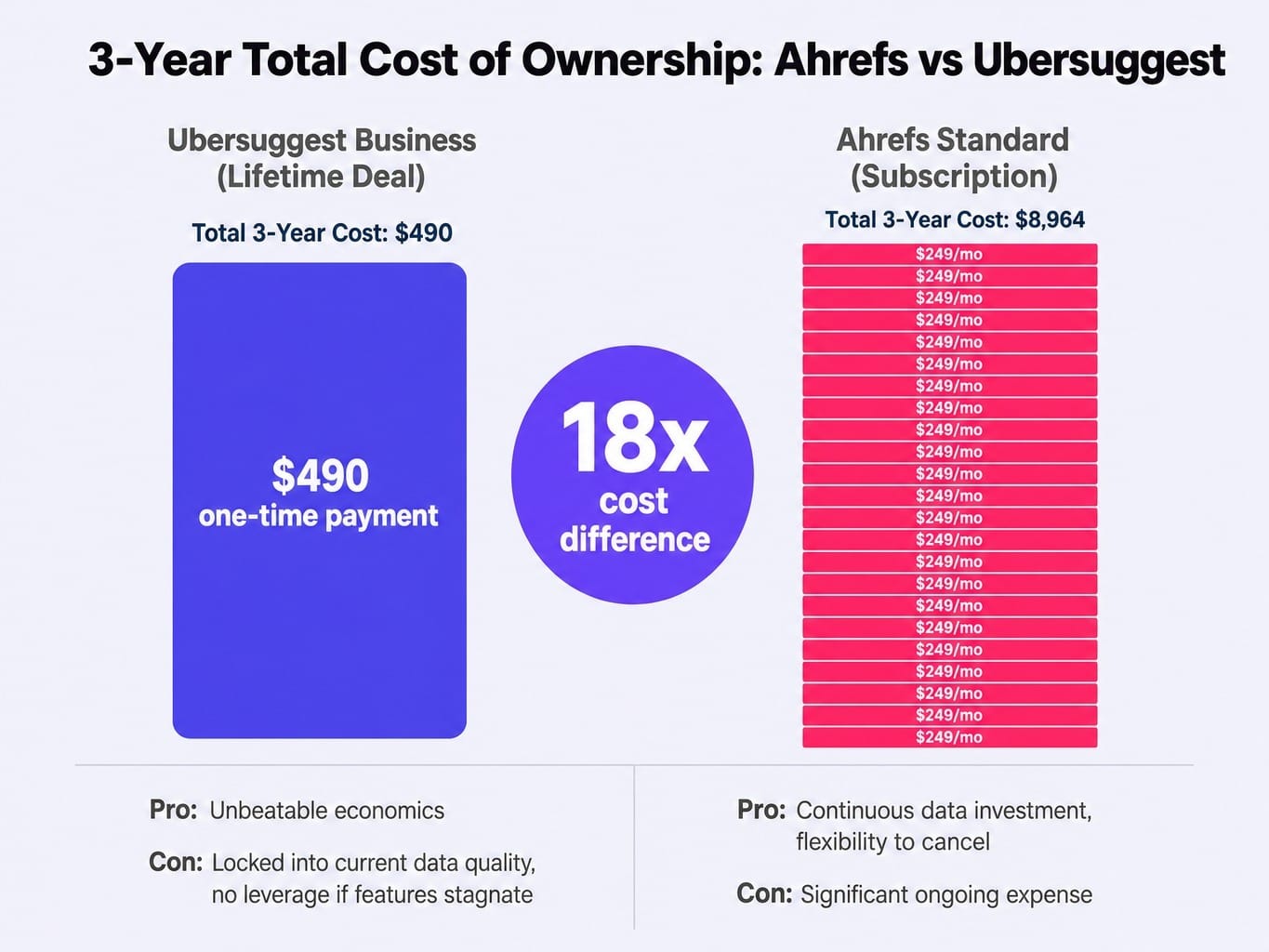
- Ubersuggest Business (Lifetime): $490 one-time payment.
- Ahrefs Standard (Subscription): $249/mo x 36 months = $8,964.
The cost difference is over 18x. However, this isn't just a financial decision. The lifetime deal locks you into Ubersuggest's current feature set and data quality. If its backlink index falls further behind or its SERP feature tracking capabilities stagnate, you have no leverage. Ahrefs' monthly subscription is a premium paid for flexibility and continuous investment in their core data assets.
The lifetime deal is an excellent economic choice for freelancers and small teams whose needs are straightforward and unlikely to outgrow Ubersuggest's capabilities. It's a poor choice for ambitious growth teams that will need enterprise-grade data accuracy within 12-18 months.
Which Tool Fits Your Situation: A Decision Framework
Don't look for an overall "winner." The right tool depends entirely on your team's budget, scale, and strategic needs.
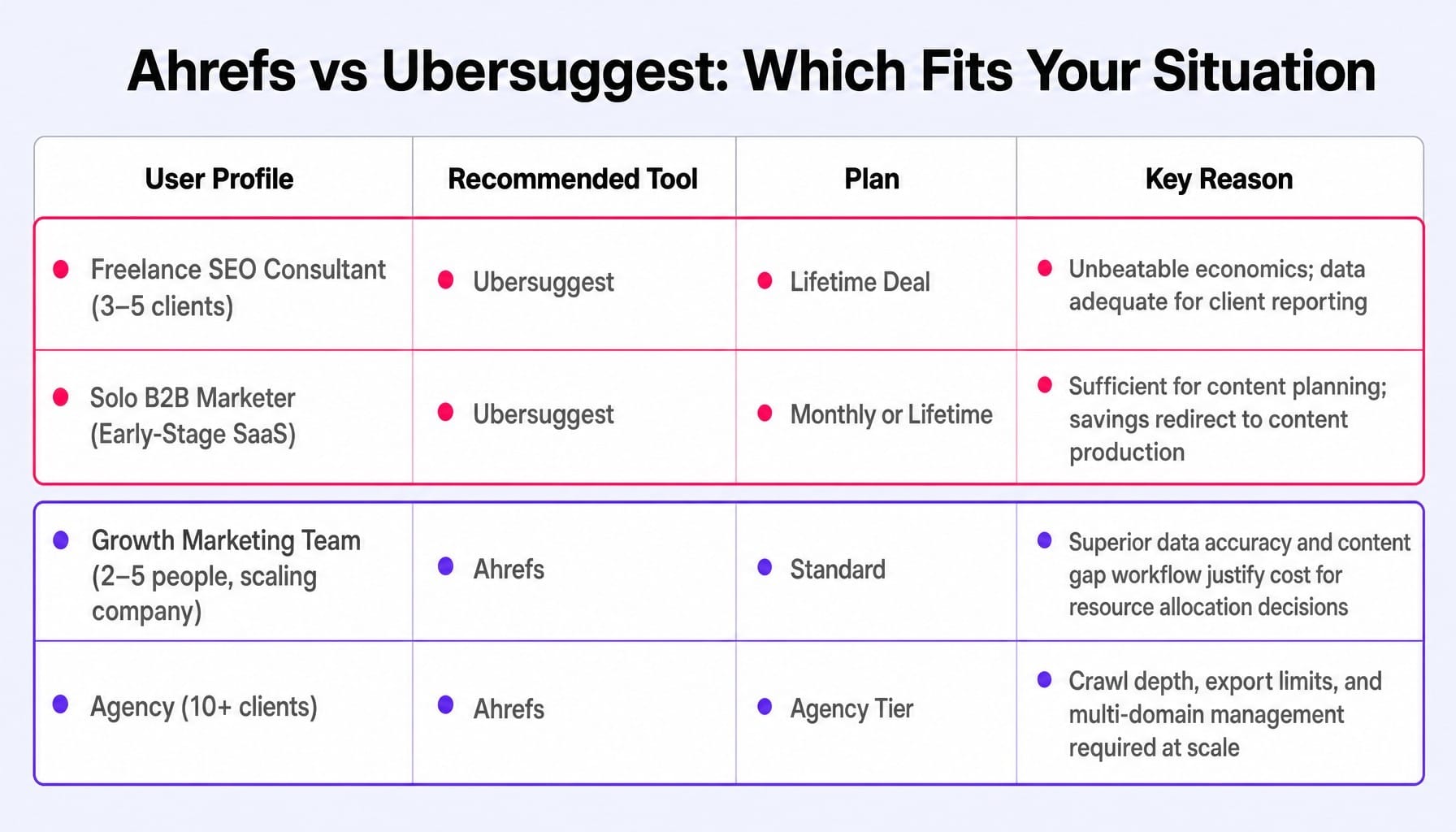
- For Freelance SEO Consultants (3-5 clients): Ubersuggest (Lifetime Deal). The economics are unbeatable, and the data is adequate for client reporting and foundational keyword research where budget is the primary constraint.
- For Solo B2B Marketers (Early-Stage SaaS): Ubersuggest (Monthly or Lifetime). It's more than sufficient for content planning and basic competitive analysis, and the significant cost savings can be redirected to where it matters more: content production.
- For Growth Marketing Teams (2-5 people at a scaling company): Ahrefs Standard. The superior data accuracy, content gap analysis workflow, and backlink index depth justify the cost when you're making resource allocation decisions that impact the entire content program.
- For Agencies (10+ clients): Ahrefs (Agency Tier), likely paired with another tool like Semrush. Ubersuggest's crawl depth, export limits, and multi-domain management are insufficient for agency-scale operations.
If you're weighing Ahrefs against other alternatives beyond Ubersuggest, our Semrush vs Ubersuggest comparison and SE Ranking vs Ahrefs breakdown cover those matchups in similar depth.
When the Right Tool Still Leaves You With a Shipping Problem
Choosing between Ahrefs and Ubersuggest is about picking the best source of SEO intelligence for your situation. But intelligence is only half the problem.
Even with the perfect keyword report or a glaring content gap identified, you still need to turn that insight into a published article. You still have to convert backlink opportunities into outreach campaigns and site audit findings into deployed fixes. For lean marketing teams, the bottleneck is never a lack of data—it's the latency between identifying what needs to change and actually shipping it.
This is the execution gap. It's where strategic inputs from tools like Ahrefs or Ubersuggest stall in backlogs and planning documents. Spike AI operates as the execution layer that closes this gap, taking the highest-priority move your SEO tool surfaces and turning it into a shipped change—across your website, content, and ads—every single week. It's the system that makes either tool's output actually compound into results.
See how Spike AI turns SEO insights into shipped improvements every week
Conclusion
The Ahrefs vs Ubersuggest debate isn't about which tool has more features. It's a question of operational fit. The right choice depends on which tool's data accuracy, cost structure, and workflow capabilities match your team's reality.
Ubersuggest has evolved into a genuinely capable and accessible tool, making it the pragmatic choice for individuals and teams where budget is the primary constraint and SEO needs are foundational. Ahrefs remains the professional standard, a necessary investment when data accuracy and deep strategic analysis directly influence how you allocate significant time and resources.
Whichever you choose, remember that the tool's ROI is not determined by its dashboard. It's determined by how consistently your team can act on the opportunities it surfaces.
Frequently Asked Questions
How do Ahrefs and Ubersuggest handle AI-generated keyword suggestions differently?
Ahrefs uses AI for keyword clustering, grouping semantically related terms under a single "parent topic" to prevent content duplication. Ubersuggest uses AI more for content brief generation. For B2B teams focused on efficiency, Ahrefs' approach is more effective at preventing wasted effort on creating overlapping content.
Is the Ahrefs free Webmaster Tools tier competitive with Ubersuggest's free plan?
They serve different purposes. Ahrefs Webmaster Tools offers a powerful site audit and backlink monitoring for your own verified domains but no competitor research. Ubersuggest's free plan allows limited competitor and keyword lookups. For monitoring your own site, Ahrefs is stronger; for free competitor intel, Ubersuggest is more useful.
What are the API rate limits for Ahrefs vs Ubersuggest in 2026?
Ahrefs provides a well-documented API with usage limits tied to subscription tiers, supporting high-volume programmatic access for enterprise customers. Ubersuggest's API is more limited in scope and documentation, making it less suitable for teams building automated reporting pipelines or custom internal dashboards with SEO data.
Which tool better tracks AI Overviews and evolving SERP features?
Ahrefs has consistently been faster to integrate tracking for new SERP features, including AI Overviews and detailed featured snippet analysis. Ubersuggest tracks basic SERP features but has shown more of a lag in detecting and reporting on AI-driven results. For teams optimizing for AI visibility, Ahrefs currently offers more granular data.
Can I use Ubersuggest and Ahrefs together in the same SEO workflow?
Yes, some practitioners use this "workflow stacking" approach. They use an Ubersuggest lifetime plan for quick ideation and daily rank tracking, then use Ahrefs for deep competitive analysis and keyword validation on high-stakes projects. This can be a cost-effective way to get the best of both worlds.