
The Marketing Tools Learning Curve Tax: Quantifying What You Pay For vs. What You Actually Use

TL;DR
- Most marketing teams use only 20-30% of their software's features, meaning a typical B2B stack costing $28,800/year has over $21,600 in unused capability.
- The real cost isn't just money; it's the 3-5 hours per week marketers spend on "tool maintenance"—learning, troubleshooting, and re-learning—which adds up to 6-10 lost work weeks per year.
- The "cognitive overhead" of knowing features exist but not using them creates a psychological drag that slows decision-making and leads to decision-avoidance patterns.
- Consolidating your martech stack often fails to reduce complexity; it just concentrates multiple steep learning curves into a single, more complex platform.
- Evaluate tools based on their "power user ceiling" and potential for "config debt," not just their ease of onboarding. If utilization hasn't increased in two quarters, it's time to re-evaluate.
A marketing manager at a scaling B2B SaaS company looks at her budget. She's paying roughly $2,400 a month across six core tools: HubSpot, Ahrefs, Google Analytics 4, Mailchimp, Hotjar, and Semrush. During a quarterly review, a nagging thought becomes a hard number: her team actively uses maybe 25% of the features they're paying for.
She's watched the onboarding videos. She's bookmarked the documentation. She even started a certification course before a new product launch pulled her away. But the gap between what she's licensed and what her team actually operates is enormous—and it never closes.
This article quantifies that gap. It's not just about the dollar cost of unused features. It's about the hidden hours spent learning things that never get applied and the cognitive weight of carrying tools you only partially understand. This constant, low-grade pressure—the feeling that you're behind, that there's a better workflow you haven't built yet—is the real marketing tools learning curve tax. And it never shows up on any timesheet.
The Feature Utilization Audit: What You Pay For vs. What You Actually Use
The gap between a tool's potential and its practical application is not a personal failure; it's a structural reality of the SaaS market. Industry-wide, the average SaaS product has only 20-30% of features actively used. For lean marketing teams, where generalists are expected to perform as specialists across multiple platforms, this number feels generous.
RevOps leaders who measure martech ROI by license cost alone miss the larger drag: every hour a marketer spends re-learning a platform's updated interface is an hour not spent on experimentation. Teams that fail to account for this hidden tax consistently underperform on conversion velocity.
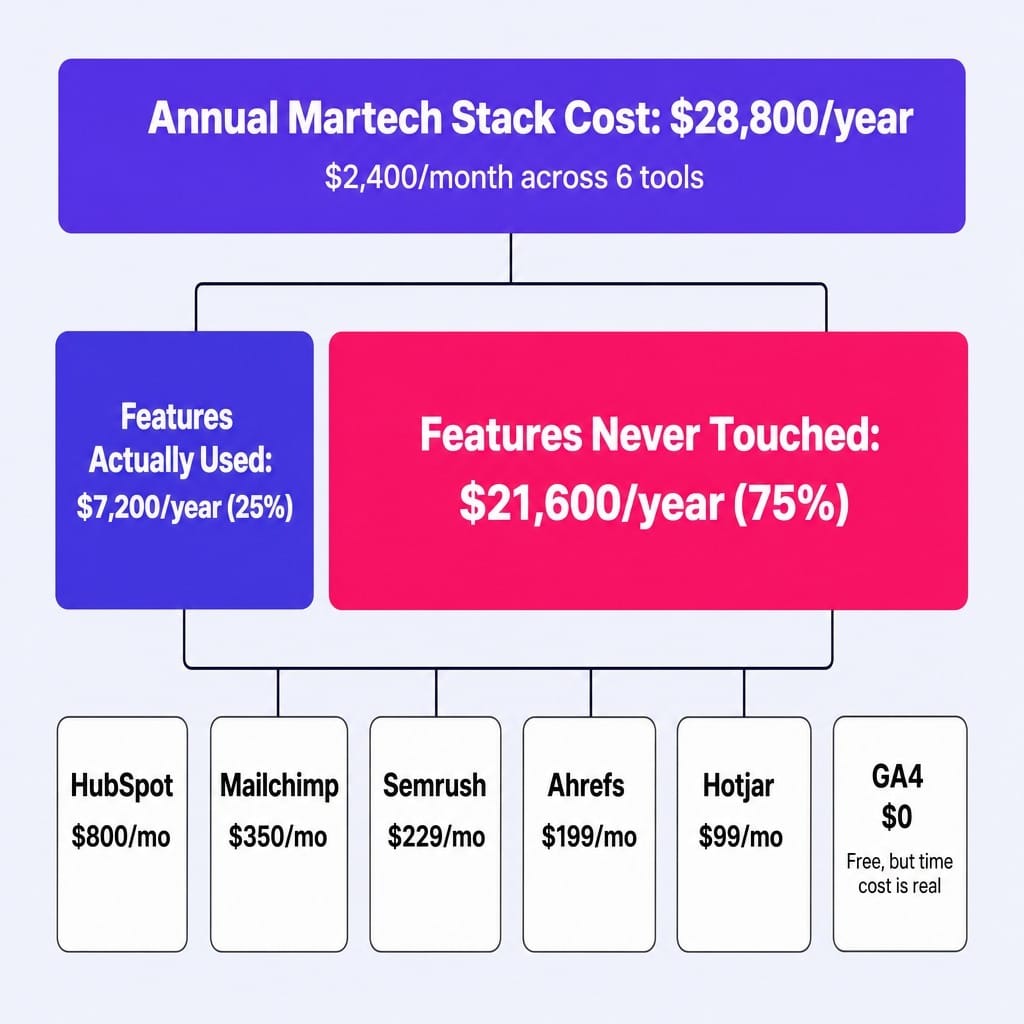
Consider a typical three-person B2B marketing team paying $2,400/month for a standard stack:
- HubSpot Marketing Pro: $800/month
- Ahrefs Standard: $199/month
- Semrush Pro: $229/month
- Hotjar Business: $99/month
- Mailchimp Standard: $350/month
- Google Analytics 4: Free, but with potential BigQuery costs for advanced analysis.
This isn't an extravagant stack. It's a functional toolkit for a team responsible for driving pipeline. Yet, the chasm between licensed capability and daily operation is vast.
What 25% Utilization Actually Looks Like Across Your Stack
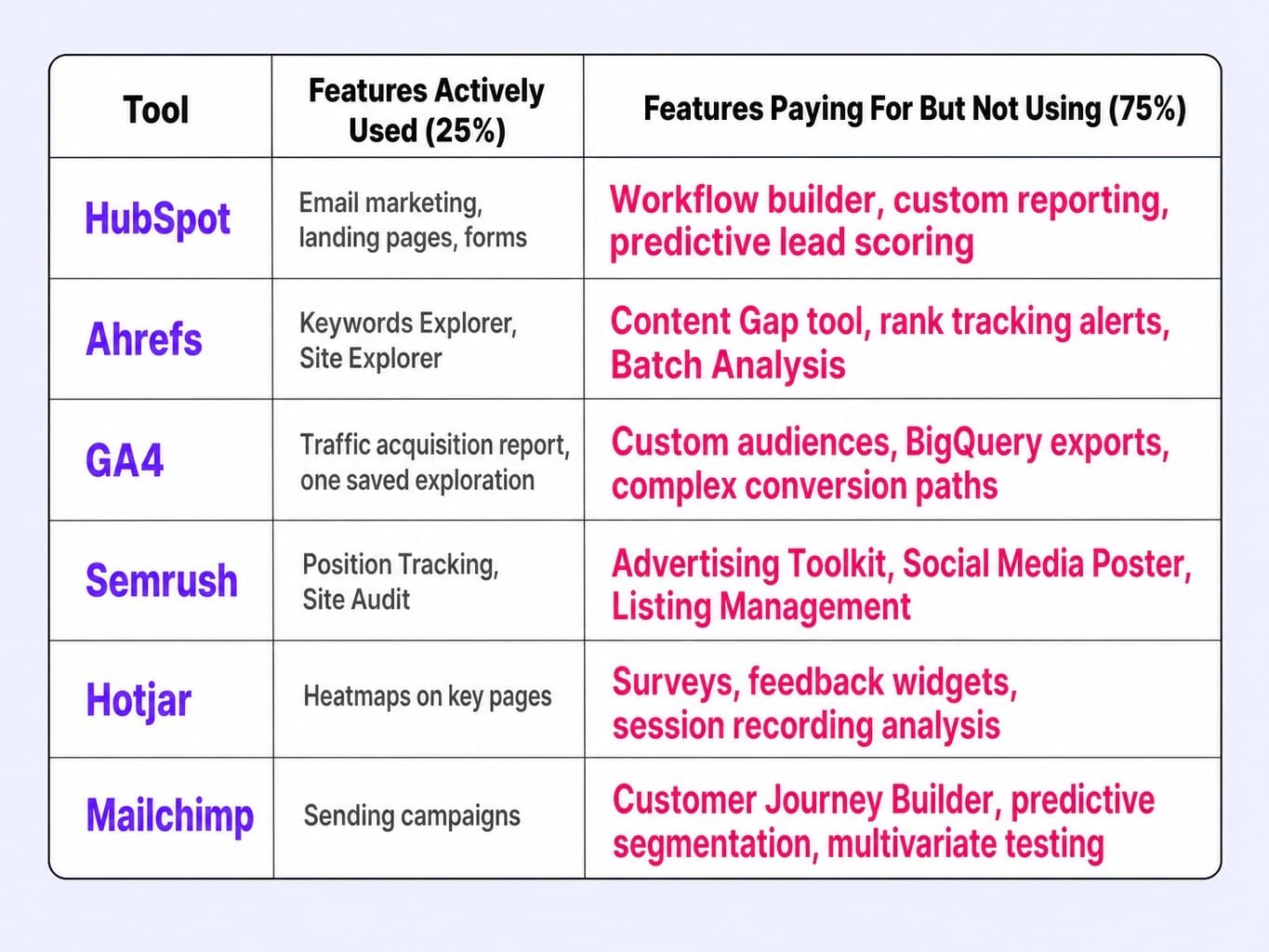
That 25% utilization rate isn't an abstract figure. It's a concrete set of workflows. For our example team, it looks like this:
- HubSpot: They live in the email marketing tool and basic landing page builder. They use forms for lead capture. They almost never touch the automated workflow builder, custom reporting dashboards, or predictive lead scoring models that justify the "Pro" tier pricing.
- Ahrefs: They use Keywords Explorer for research and Site Explorer for backlink checks. They don't use the Content Gap tool, automated rank tracking alerts, or the Batch Analysis feature for competitive intelligence at scale.
- GA4: They check the traffic acquisition report and maybe have one saved exploration for content performance. They aren't building custom audiences for remarketing, leveraging BigQuery exports for deeper analysis, or configuring complex conversion paths.
- Semrush: They rely on Position Tracking and the core Site Audit tool. The comprehensive Advertising Toolkit, the Social Media Poster, and the Listing Management features go untouched.
- Hotjar: They review a few heatmaps on key pages after a redesign. They don't consistently run surveys, use the feedback widgets, or dedicate time to analyzing session recordings to find friction points.
- Mailchimp: They send campaigns. They don't use the Customer Journey Builder, predictive segmentation, or the multivariate testing features that separate the "Standard" plan from cheaper options.
The issue isn't incompetence. It's a mismatch of design. Each of these tools was built to be the primary interface for a full-time specialist. A lean marketing team is one person wearing three of those specialist hats before lunch.
The Annual Cost of Features You'll Never Touch
Now, let's calculate the visible cost. Our team's stack runs $2,400 per month, which is $28,800 per year. If we apply a conservative 25% utilization rate, that means $21,600 of that annual spend is for features that are never touched.
This isn't waste in the traditional sense; it's a structural inefficiency baked into SaaS pricing. These platforms price for the power user ceiling, not for the median user's workflow. The result is that lean teams are forced to subsidize enterprise-grade feature bloat they will never need, just to access the core 25% they depend on.
This is the cost you can see on a P&L statement. The costs you can't see are far worse.
The Hidden Time Tax: Hours That Never Show Up on a Timesheet
The marketing tools learning curve is not a one-time onboarding event. It's a recurring tax on your team's most valuable asset: focus. As most practitioners know, reaching basic proficiency with a complex marketing platform like HubSpot or Marketo can take 20-40 hours. Reaching mastery can take hundreds.
But the real time sink isn't in the initial setup. It's in the ongoing maintenance. I once tracked time allocation for a five-person growth team and found that roughly nine hours per person per week went to what could only be classified as tool maintenance: updating broken Zapier connections, re-learning a workflow builder after a UI change, and cross-referencing data between two tools because neither matched. None of those hours appeared in any sprint plan.
For a marketer managing just three core platforms, a conservative estimate of 3-5 hours per week is spent on non-productive learning and troubleshooting. That's 150-250 hours a year—the equivalent of 4 to 6 full work weeks. This invisible overhead directly compresses the time available for actual marketing: writing copy, analyzing campaign results, and talking to customers. It's why so many teams feel like they're running in place, busy with activity but making little progress.
The distinction between a tool's learning curve and its maintenance curve matters enormously. Many platforms are reasonably learnable at first, but they impose a recurring re-learning cost every time they ship a major UI or workflow update—a cost teams rarely budget for.
The Cognitive Overhead You Can't Measure
The most damaging part of the learning curve tax isn't the hours you spend. It's the psychological weight of the hours you don't spend.
Every unread changelog email, every "New Feature!" banner in the UI, every certification course you started but didn't finish—these create a low-grade, persistent anxiety. It's the feeling of being perpetually behind. This cognitive overhead is the true cost. You're not just paying for features you don't use; you're paying a mental tax for knowing they exist.
This isn't just about feelings; it has a direct operational impact. The cognitive tax of partial tool mastery creates a decision-avoidance pattern where marketers unconsciously route around features they don't fully understand. This means a tool's most powerful capabilities go unused not because they're unknown, but because they're intimidating. When you half-understand your stack, every task takes longer because you're never sure if there's a better, faster way to do it.
The Reverse Learning Curve: Tools That Get Harder the More You Use Them
We assume learning curves flatten over time. With much of today's martech, the opposite is true. For many platforms, basic usage is deceptively straightforward, but the moment your use case becomes more complex, the tool becomes exponentially harder to operate.
Google Analytics 4 is the canonical example. Setting up a basic property is manageable. But the moment you need reliable cross-domain tracking, custom dimension scoping, consent mode configuration, or a BigQuery integration, you've effectively entered a different product—one that requires a data specialist.
HubSpot follows the same pattern. Sending a one-off email is easy. Building multi-branch workflows with conditional logic, custom properties, and automated lifecycle stage transitions requires a level of technical skill most marketers weren't hired for. Many teams build dozens of simple workflows over years, only to find they've accumulated massive config debt. When it's time to restructure a core process, they discover a tangled web of undocumented dependencies that makes any change a high-risk project.
This is the reverse learning curve. A tool that's easy to start but impossible to master without a specialist creates a dependency trap. You become too invested to switch, but you can't unlock the value you're paying for. This is why a tool's "power user ceiling" matters more than its onboarding ease.
The Consolidation Paradox: Why Fewer Tools Can Mean a Harder Learning Curve
The common advice is to "consolidate your martech stack." The logic seems sound: fewer tools, fewer logins, less complexity. But this advice is often wrong.
When you consolidate from five specialized, best-in-class tools into one platform that tries to do everything, you don't eliminate learning curves. You concentrate them. The learning curve for HubSpot's full Marketing, Sales, Service, and CMS Hubs is far steeper than the individual curves of Mailchimp, Ahrefs, and Hotjar combined.
Consolidation reduces integration complexity but often increases platform complexity. It trades visible tool sprawl for invisible feature bloat. A single platform with 200 features behind one login is not "simpler" than three focused tools with 30 features each. It just means the admin tax is paid to a single vendor. Moreover, consolidation ROI models almost always undercount the switching cost of muscle memory. When a team has internalized the shortcuts of a specialized tool, moving to an all-in-one platform's less-capable version of that function imposes a productivity dip that can last for months.
Read more: B2B SaaS Marketing Team That Actually Ships: A Stage-by-Stage Framework | Spike AI
When to Invest in Mastery vs. When to Switch Tools
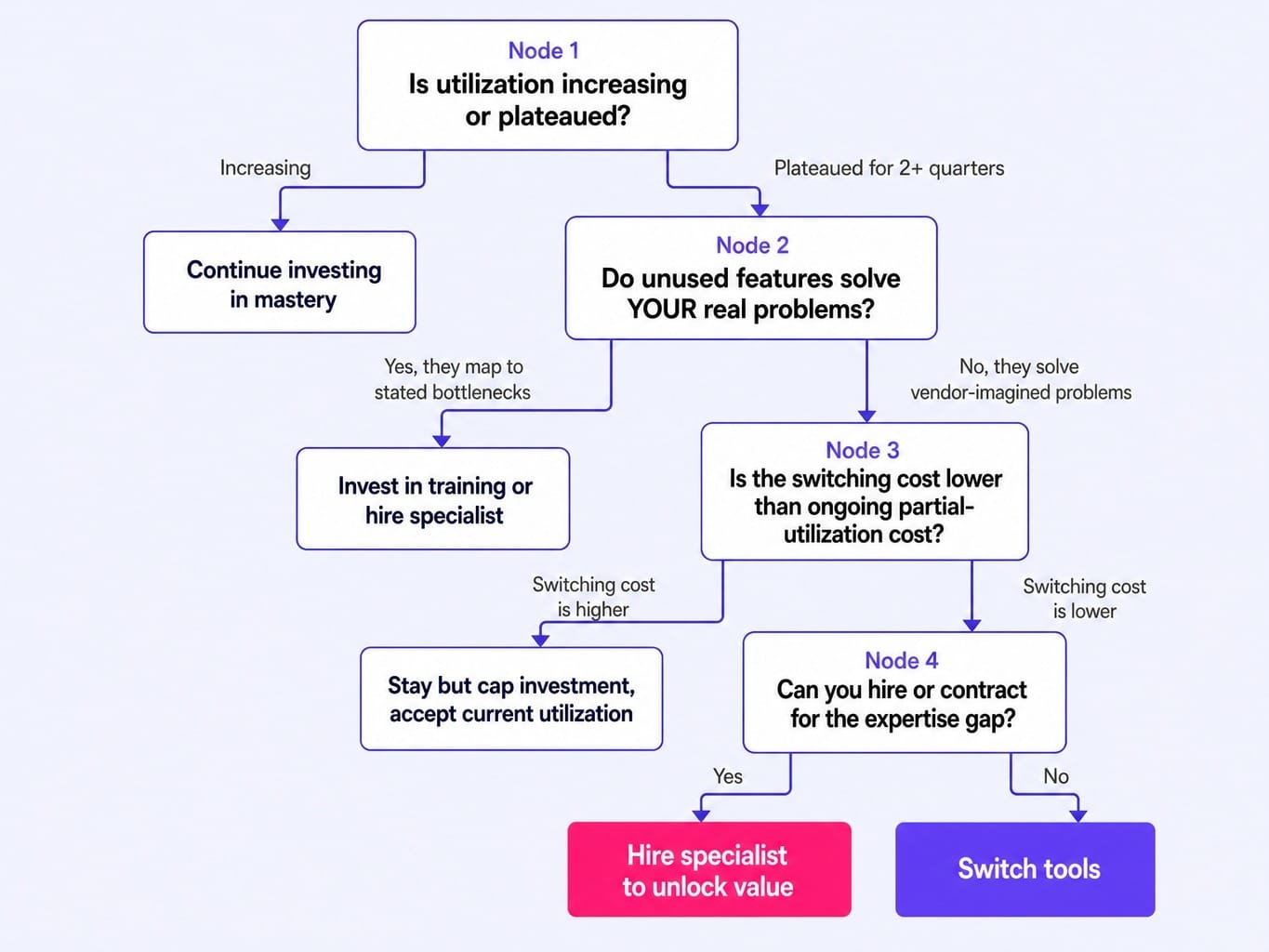
How do you decide whether to push through a tool's learning curve or cut your losses? Instead of relying on gut feel or sunk cost fallacy, use a simple decision framework. Ask four questions about any tool in your stack:
- Is utilization increasing or has it plateaued? Track your team's active feature usage quarterly. If it has been flat for two consecutive quarters, the tool has likely reached its practical ceiling for your team's current operating model.
- Do unused features map to your real problems? Look at the features in the next pricing tier or the ones you aren't using. Do they solve your actual, stated bottlenecks (e.g., "we can't generate enough qualified leads")? Or do they solve problems the vendor thinks you should have (e.g., "you should be using predictive AI lead scoring")? Mastery is pointless if it solves the wrong problem.
- What is the true switching cost? Calculate the cost not just in dollars, but in migration time, data loss risk, and team retraining. Is that one-time cost higher or lower than the ongoing annual cost of partial utilization and cognitive overhead?
- Can you hire or contract for the expertise gap? If a tool's power-user features are critical but beyond your team's skill set, is it more efficient to hire a specialist or engage a consultant than to force your team to master it?
This is a learning curve ROI calculation. It reframes the question from "Can we learn this tool?" to "Is learning this tool the highest-value use of our team's time?" For teams evaluating Semrush vs Moz or similar head-to-head comparisons, this framework matters more than any feature checklist.
What If the Tool Didn't Require a Learning Curve at All?
The entire marketing technology industry is built on a broken model: it requires marketers to become expert tool operators. The problem isn't which tool to learn, but the fact that learning is required at all.
Spike AI was designed to eliminate this structural inefficiency. Instead of giving you another dashboard to learn, another certification to pursue, and another changelog to read, it identifies the highest-impact moves across your website, SEO, and ads—and then helps you ship them.
The marketer's role shifts from operator to orchestrator. You approve the strategy; the platform handles the implementation. The learning curve disappears because there is no complex interface to master. The cognitive overhead of unused features vanishes.
The real cost of the marketing tools learning curve is the permanent compression of your team's capacity. It's the strategic work that doesn't get done because your best minds are busy troubleshooting a workflow or trying to build a report. Spike AI gives you that capacity back. You stay in control of strategy and approvals. The system handles the rest.
See how Spike AI replaces your tool learning curve with weekly shipped improvements
The End of the Learning Curve
The marketing tools learning curve is not a one-time onboarding cost. It is a permanent tax on your team's capacity, compounding through the money spent on unused features, the invisible hours sunk into non-productive learning, and the cognitive weight of tools you only half-understand.
The problem isn't a lack of training; it's a structural cost baked into the tool-operator model itself. The teams that will outperform in the coming years won't be the ones who mastered the most tools. They'll be the ones who eliminated the need to master tools at all.
Frequently Asked Questions
Is it worth getting certified in a marketing platform before using it?
Certifications teach you what a tool can do, not what it should do for your specific business. They're most valuable for dedicated roles (e.g., a HubSpot admin). For generalist marketers, the 20-40 hours spent on certification often has a lower ROI than applying that time to campaign work using the features you already know.
How do I measure my team's actual feature utilization rate?
Many enterprise tools have admin dashboards with usage analytics (like HubSpot's usage logs). Export login frequency and feature-level engagement quarterly. Compare this against the total feature set on your pricing tier. If you're below 30% utilization for two consecutive quarters, you've likely over-licensed for your needs.
Which marketing tools have the flattest learning curves for solo marketers?
Tools designed with "progressive disclosure"—where complexity is hidden until needed—are best. Platforms like Mailchimp, Canva, and Customer.io excel here. In contrast, tools like Marketo or Salesforce Marketing Cloud were built for specialist operators and expose complexity immediately, resulting in a much steeper initial curve.
How do AI copilots inside marketing tools actually affect the learning curve?
AI copilots (like those in HubSpot or Semrush) reduce the learning curve for discovery—finding where a feature lives or generating a first draft. They rarely reduce the curve for judgment—knowing if the AI's output is correct, if the workflow is optimal, or if the recommendation fits your business context. They lower the floor but don't raise the ceiling.
How do I reduce onboarding time when switching marketing tools?
Before switching, document your team's core workflows—the 5-10 essential tasks you perform weekly. Map those tasks to the new tool's interface before migrating any data. This prevents the common failure of trying to rebuild your old tool's configuration instead of adapting to the new platform's strengths.
What role does community support play in shortening a marketing tool's learning curve?
Community forums are often more useful than official documentation because they surface real-world workarounds, not idealized use cases. Tools with active practitioner communities (like HubSpot, Ahrefs, and GA4) often enable a faster time to value because you can find someone who has already solved your exact, messy problem.