SE Ranking vs Ahrefs 2026: A Practitioner's Comparison Beyond Feature Lists

TL;DR
- Ahrefs wins on data depth: Its larger, fresher backlink index and Content Explorer are non-negotiable for competitive intelligence in high-stakes verticals.
- SE Ranking wins on cost efficiency and workflow: It delivers 80% of the core functionality for 30% of the price, with superior rank tracking granularity and a more structured keyword planning workflow for lean teams.
- The real cost isn't the subscription: It's the sum of credits, seat licenses, and supplementary tools. SE Ranking is a true all-in-one; Ahrefs often requires pairing with other tools, inflating its total cost.
- Your team structure dictates the right choice: Ahrefs is for specialized, in-house enterprise teams. SE Ranking is the default for most freelancers, lean marketing teams, and agencies prioritizing cost-effective scale.
- Neither tool solves the execution gap: Both are diagnostic platforms that identify problems. The bottleneck remains your team's capacity to ship fixes, a problem neither SEO tool is designed to solve.
Your marketing lead just forwarded you two screenshots: the SE Ranking pricing page next to the Ahrefs pricing page. The question is implied but sharp: "Is the tool that costs 3x more really 3x better? Or will we regret switching to the cheaper one in three months?"
Every other SE Ranking vs Ahrefs comparison article you'll find lists the same features in the same order and declares the same predictable winners. It's a pointless exercise. The real decision isn't about which tool has a bigger backlink index or more keyword suggestions. It's about which tool fits the way your team actually operates—your reporting cadence, your budget constraints, your channel complexity, and whether you have the bandwidth to act on the insights you pay for.
This comparison evaluates Ahrefs and SE Ranking on the dimensions that change outcomes, not the ones that pad feature tables. We'll analyze backlink depth, workflow structure, and the true cost per actionable insight to help you make a decision that sticks.
SE Ranking vs Ahrefs at a Glance: Who Wins for Which Use Case
This table is the TL;DR. If you already know your team's primary constraint, your decision is likely here. The sections below explain the reasoning and nuance behind each verdict.
The rest of this article breaks down the evidence behind these verdicts.
Backlink Index and Competitive Analysis: Where Ahrefs Still Leads
Ahrefs' backlink index is genuinely larger and fresher than SE Ranking's, and this difference isn't academic—it changes the quality of competitive analysis for sites in intense verticals. While SE Ranking's claimed 3 trillion backlinks is respectable, Ahrefs' 24.7 trillion internal link database simply provides a more complete picture.
Consider a B2B SaaS company analyzing a competitor's link profile to find new outreach opportunities. Using Ahrefs' Link Intersect tool, you can find domains linking to three of your competitors but not to you. Because the index is larger and has lower index freshness lag, it catches newly acquired links and obscure referring domains that SE Ranking's smaller index misses. Independent audits using GSC as a ground truth baseline show Ahrefs consistently detecting 15–30% more unique referring domains for competitive sites.
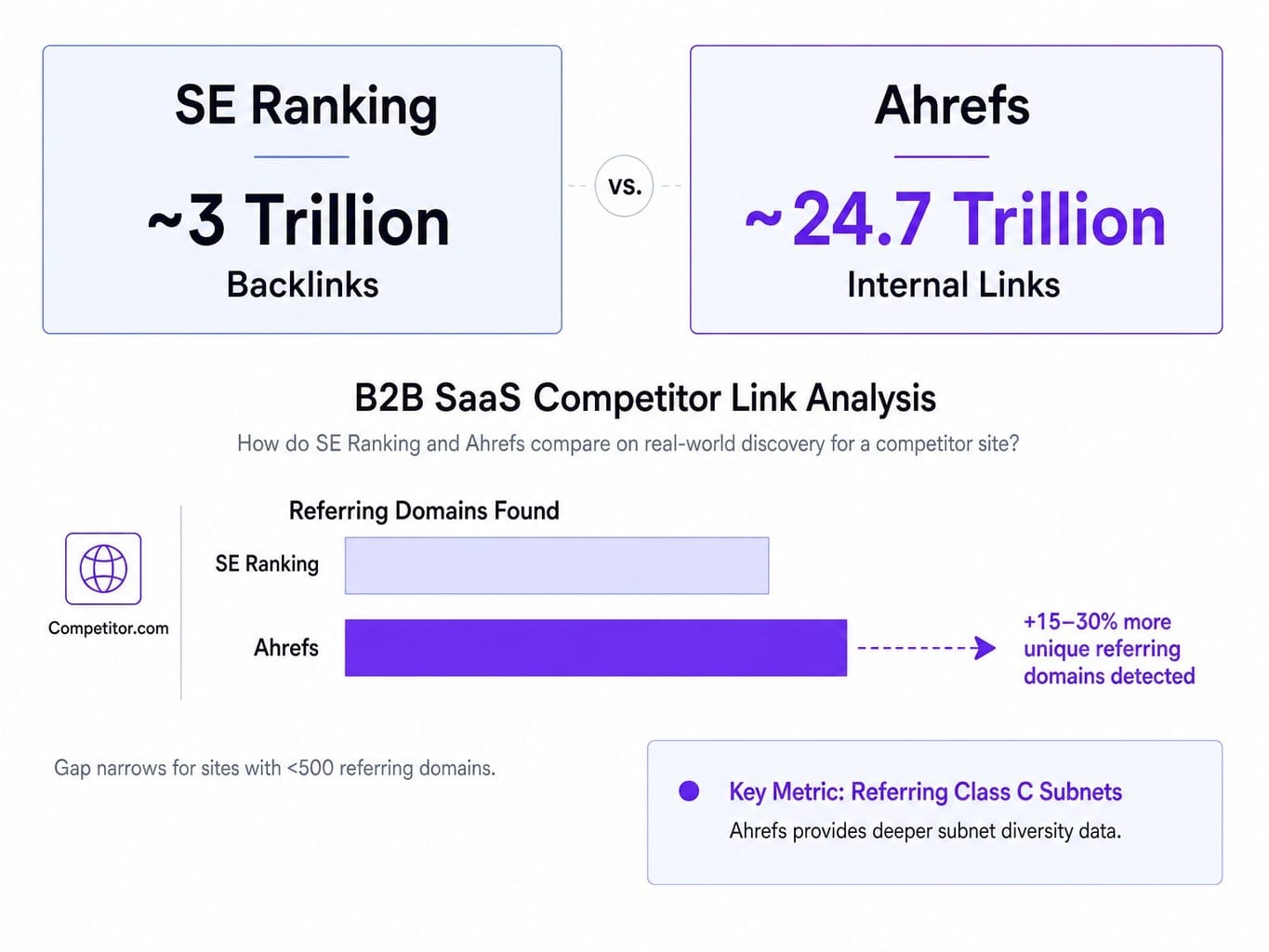
This isn't just about raw count. It's about the diversity of referring class C subnets, which affects how Google evaluates link profile authority. Ahrefs provides a deeper view here. However, this advantage diminishes at the lower end of the market. For a local services website with fewer than 500 referring domains, the practical difference between the two indexes is minimal; both tools will return nearly identical results. The gap widens as competitive intensity and domain authority increase.
To its credit, SE Ranking's backlink monitoring tool is a genuine advantage for tracking link velocity trending and getting alerts on new/lost links, a workflow Ahrefs handles less elegantly within its core UI. For a deeper look at how Ahrefs stacks up against another backlink-focused tool, see our Ahrefs vs Majestic comparison.
Verdict: For deep competitive intelligence in crowded markets, Ahrefs' data depth is a distinct advantage. For routine backlink monitoring and analysis on mid-market sites, SE Ranking is more than sufficient.
Keyword Research and Rank Tracking: Different Workflows, Not Just Different Numbers
Keyword research and rank tracking are where these tools diverge most in daily workflow, not just in the size of their databases. Ahrefs boasts a 28 billion keyword database versus SE Ranking's 5.3 billion, but how you interact with that data is the more critical distinction.
Keyword Research: Database Size vs. Workflow Structure
Ahrefs' massive keyword database gives it an undeniable edge in long-tail discovery and zero-volume keyword mining, especially in niche verticals or for non-Google search engines. Its Keywords Explorer is a powerful engine for open-ended discovery. However, SE Ranking's workflow is more structured for teams that plan content in batches.
Imagine a growth marketer building a quarterly content plan. The task is to cluster 200 seed keywords into topic groups, assess difficulty, and export them into a content brief template. SE Ranking's Keyword Grouper tool (which costs a marginal $0.004 per query) handles this clustering natively, providing an accuracy score to show how tightly related the terms are. With Ahrefs, this is a manual process: export to a spreadsheet and cluster by hand or use a third-party tool.
It's also important to note the KD calibration drift between the two. Ahrefs' Keyword Difficulty (KD) is heavily weighted by the backlink profiles of ranking pages. SE Ranking's score incorporates more on-page signals. Neither is "more accurate"; they measure different facets of difficulty.
Verdict: Ahrefs is superior for exploratory, open-ended keyword research. SE Ranking is more efficient for structured, campaign-based keyword planning and clustering.
Rank Tracking: Daily Updates and the Cost of Granularity
SE Ranking is the decisive winner in rank tracking on both cost and default granularity. For an agency tracking 5,000 keywords across 10 client domains, the difference is stark. SE Ranking includes daily rank updates in its standard plans and scales affordably. Ahrefs charges an additional $100/month for daily updates on its Standard plan and has lower keyword limits on comparable tiers.
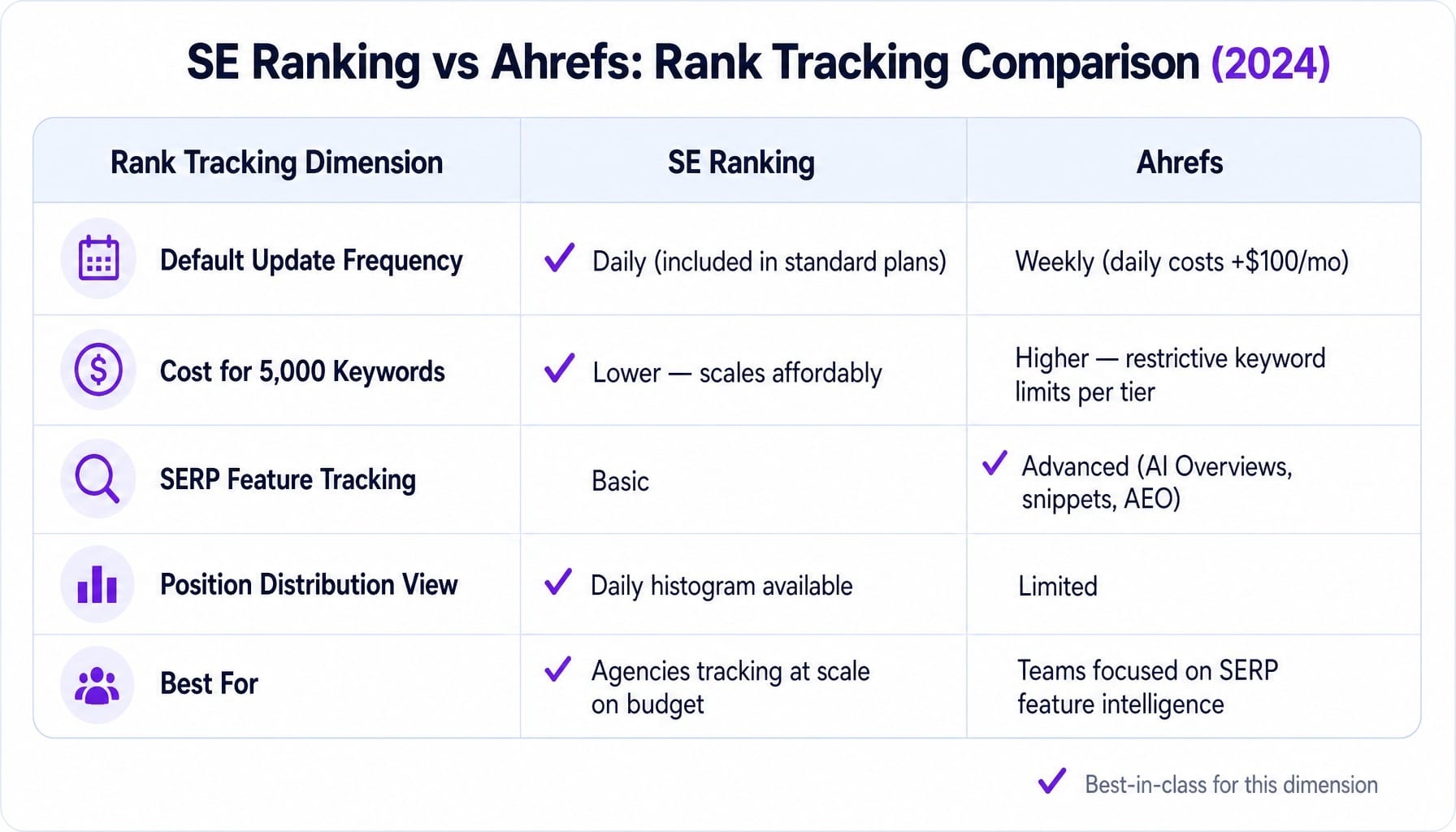
For any team monitoring SERP volatility, measuring the impact of technical fixes, or running A/B title tag tests, daily position data isn't a luxury; it's the minimum viable signal. A weekly tracker can completely miss the fluctuations that tell you if your changes are working.
Ahrefs does have an advantage in its SERP feature tracking. It provides more granular data on owned snippets, AI Overviews, and other non-traditional results, which is valuable for teams focused on AEO (Answer Engine Optimization). But for the core task of tracking keyword positions at scale without breaking the bank, SE Ranking is the clear choice. The ability to see a daily position distribution histogram gives a much clearer picture of ranking momentum.
Verdict: SE Ranking is the superior choice for cost-effective, high-frequency rank tracking. Ahrefs offers richer SERP feature intelligence for a significant premium.
Read more: SE Ranking vs Semrush (2026): Real Tests, Hidden Costs, and Who Should Use Which
Site Audits and Technical SEO: Crawl Depth vs. Actionability
Site audit feature counts are a marketing vanity metric. The only thing that matters is whether the audit output tells a non-specialist what to fix first and why.
Imagine a two-person marketing team at a B2B SaaS company running an audit on their 500-page website. Ahrefs' Site Audit will surface 170+ issue types, assign a health score, and flag problems by severity. But the prioritization assumes the user understands concepts like crawl budget, canonical chains, and hreflang conflicts. It's comprehensive but can lead to paralysis.
SE Ranking's audit runs fewer checks (around 100) but presents findings with clearer, more actionable remediation steps. It integrates page changes monitoring, so the team can see if fixes actually moved the needle. This creates a closed feedback loop that a lean team can manage without a dedicated technical SEO specialist.
Of course, at enterprise scale, the tables turn. For a site with over 10,000 pages, Ahrefs' higher crawl depth ceiling and more robust JavaScript rendering become critical. But it's crucial to remember that neither tool is a replacement for a dedicated crawler like Screaming Frog for deep diagnostic work. Both are primarily monitoring-grade auditors.
Verdict: For sites under 2,000 pages managed by lean teams, SE Ranking's audit is more actionable. For enterprise sites, Ahrefs' technical depth is superior.
The Real Pricing Comparison: Cost Per Actionable Insight, Not Sticker Price
Comparing SE Ranking at $52/month to Ahrefs at $108/month is like comparing two cars by sticker price without checking insurance or fuel economy. The real metric is the cost per actionable insight—how much you pay to get from "data on screen" to "decision made and implemented."
Let's break down the three hidden cost dimensions:
- Credits and Row Limits: Ahrefs' plans are built on a credit system that governs everything from keyword exports to competitive analyses. The Lite plan is particularly restrictive, throttling data access to the point of being a demo. SE Ranking's plans are more generous with data exports and rank tracking but use a pay-per-query model for tools like the Keyword Grouper. For a team running 500 keyword queries and 50 backlink analyses per month, SE Ranking's model is often more predictable and less constrained. Batch export throttling in Ahrefs can be a real workflow bottleneck for agencies.
- Seat Restrictions: Ahrefs charges per seat, with no sharing allowed. A single additional user on the Standard plan costs an extra $108/month. SE Ranking allows multiple user seats on its Pro and Business plans. For a three-person team, the seat cost difference alone can be over $200/month.
- Supplementary Tool Costs: This is the biggest hidden cost. Ahrefs lacks a built-in content optimization tool, so teams often pair it with Surfer SEO or a similar platform (an extra $99+/month). It also lacks native white-label reporting, forcing agencies to use Looker Studio or another tool ($50-$150/month). SE Ranking includes a content editor, an AI writer, and white-label reporting in its standard plans.
For a three-person agency team, the effective monthly cost could look like this:
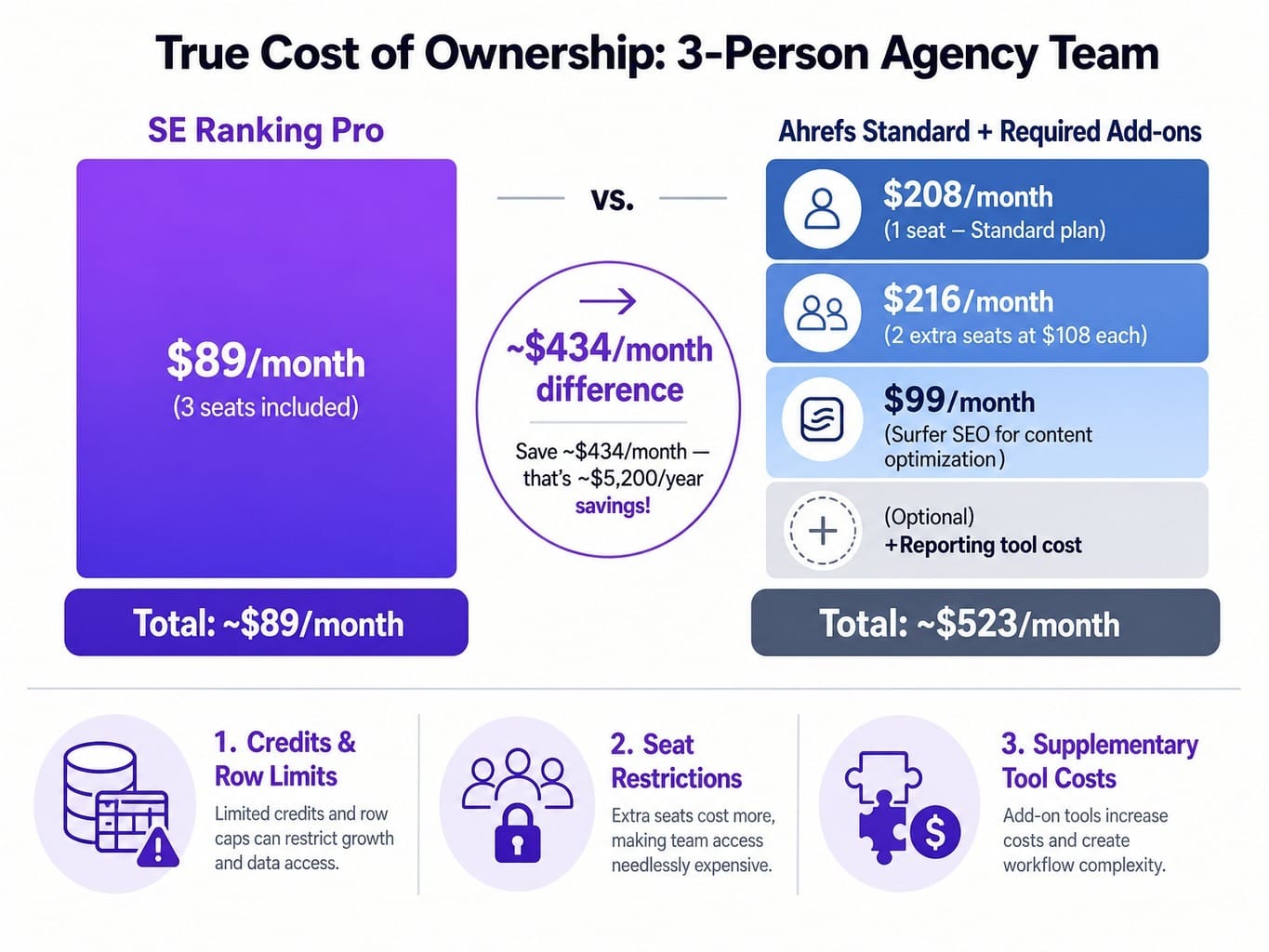
- SE Ranking Pro: ~$89/month (3 seats included).
- Ahrefs Standard: ~$208/month (1 seat) + $216 (2 extra seats) + $99 (Surfer SEO) = ~$523/month.
Verdict: When you calculate the true cost of ownership, SE Ranking provides significantly more value per dollar for most small to mid-size teams.
Read more: SaaS Marketing Tools in 2026: How to Build a Stack That Ships, Not Just Reports
Which Tool Fits Which Team: A Decision Framework
The right tool isn't the one with the most features; it's the one that matches your team's operational reality.
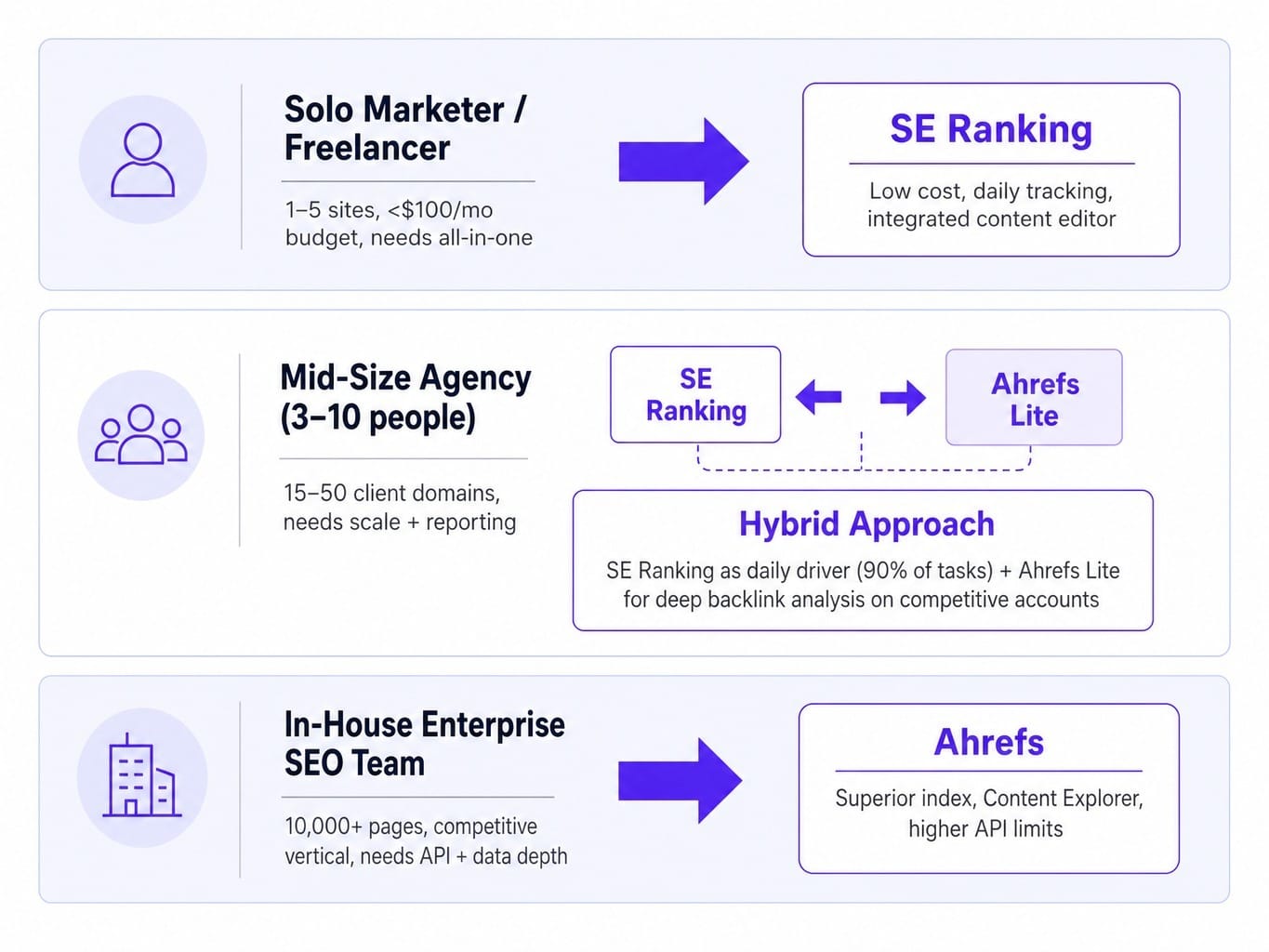
- Profile 1: The Solo Marketer or Freelancer
Constraints: Manages 1–5 sites, budget under $100/month, needs an all-in-one solution for rank tracking, keyword research, and basic audits.
Verdict: SE Ranking. The combination of low cost, daily rank tracking, and an integrated content editor makes it the default choice. The depth of Ahrefs' backlink data is overkill and not worth the 3x price tag for this use case.
- Profile 2: The Mid-Size Agency
Constraints: 3–10 people managing 15–50 client domains, needs scalable rank tracking, efficient white-label reporting, and solid competitive analysis.
Verdict: A Hybrid Approach. Use SE Ranking as the daily driver for 90% of tasks—rank tracking, site audits, and reporting—due to its cost efficiency and agency-friendly features. Supplement with an Ahrefs Lite or Standard plan specifically for deep backlink gap analysis on high-value, competitive accounts. This blended stack provides the best of both worlds without the full Ahrefs overhead.
- Profile 3: The In-House Enterprise SEO Team
Constraints: Manages a site with 10,000+ pages in a competitive vertical (e.g., fintech, SaaS), needs deep competitive intelligence, robust API access, and high data limits.
Verdict: Ahrefs. At this scale, the superior backlink index, Content Explorer, and higher API rate limits justify the premium price. The constraints of SE Ranking's data coverage become a tangible limitation when competing at the highest level.
The Gap Neither Tool Closes: From Insight to Shipped Fix
You've just spent ten minutes evaluating two excellent diagnostic tools. Both SE Ranking and Ahrefs are designed to surface problems: backlink gaps, keyword opportunities, technical debt. But surfacing an insight and acting on it are two different things, separated by a latency gap of discussions, prioritization debates, engineering tickets, and approval cycles that can eat weeks.
The most expensive SEO tool isn't the one with the highest subscription. It's the one whose insights sit in a backlog for months, generating zero return. The real bottleneck isn't the quality of your diagnostics; it's the velocity of your execution.
This is the gap Spike AI is built to close. We function as an execution layer that ingests signals from across your marketing stack—SEO, CRO, Ads—to identify the single highest-impact move you can make, and then we help you ship it. Weekly. Instead of building a backlog of problems, you build a rhythm of shipped improvements that compound. The question shifts from "Which tool finds more problems?" to "How do I build a system that fixes them?"
See how Spike AI turns your SEO backlog into weekly shipped improvements
Conclusion: The Choice That Matters Most
The SE Ranking vs Ahrefs debate is legitimate. Ahrefs remains the leader in raw data depth, essential for teams in hyper-competitive verticals where a 15% edge in backlink discovery matters. SE Ranking is the pragmatic, high-value choice for the other 80% of the market—lean teams, agencies, and freelancers who need robust, all-in-one functionality without the enterprise price tag.
But the tool you choose only determines the quality of the problems you can see. It does not determine how fast you can solve them.
The teams that generate compounding SEO gains aren't the ones with the most expensive diagnostic tools. They are the ones with the shortest distance and lowest friction between identifying an opportunity and shipping a change. Your choice of SEO platform is important, but your investment in an execution system is what will ultimately define your growth trajectory.
Frequently Asked Questions (FAQ)
How often does SE Ranking update its backlink index compared to Ahrefs?
Ahrefs refreshes its backlink index almost continuously, with new links often appearing within 15–30 minutes of being discovered by its crawlers. SE Ranking's index updates are less frequent, typically operating on a multi-day cycle. For teams monitoring link velocity after a major outreach campaign or a disavow file submission, Ahrefs' freshness lag is a clear advantage. For routine monthly reporting, the difference is less critical.
Does SE Ranking have a Content Explorer equivalent to Ahrefs?
No, and this is a significant gap. Ahrefs' Content Explorer, which allows you to search a database of billions of pages by topic and filter by traffic, social shares, and backlinks, has no direct equivalent in SE Ranking. SE Ranking offers a content marketing module with an idea finder and brief generator, but this is a content creation workflow tool, not a content discovery and analysis engine.
How do Ahrefs and SE Ranking API rate limits compare for automation workflows?
Ahrefs offers API access on its higher-tier plans, with rate limits and monthly credit caps that can be restrictive for heavy use. SE Ranking provides API access starting on its Business plan with more generous rate limits, especially for rank tracking and keyword data pulls. For teams building automated reporting pipelines in Looker Studio or integrating SEO data into a CRM like HubSpot, SE Ranking's API is more accessible and cost-effective at lower price points.
Which tool has more accurate organic traffic estimates when checked against Google Search Console?
Neither tool is consistently accurate, as both rely on clickstream data models. Independent analyses show Ahrefs tends to overestimate traffic for high-authority domains and underestimate it for newer sites. SE Ranking's estimates often skew lower across the board. The best practice is to use either tool's estimates for directional competitor benchmarking and trend analysis—not as absolute truth. Always use Google Search Console as the ground truth for your own properties.
Does SE Ranking support white-label reports for client deliverables?
Yes, SE Ranking includes a robust white-label reporting feature on its Pro and Business plans, allowing custom branding, scheduled delivery, and PDF exports. Ahrefs does not offer native white-label reporting. Agencies using Ahrefs must export data to Looker Studio or a third-party reporting tool like Agency Analytics, adding a supplementary cost of $50–$150/month and significant setup time. This is a major workflow and cost advantage for SE Ranking.
What are the main limitations of SE Ranking if I'm migrating from Ahrefs?
Three gaps will be most noticeable for a power user. First, the smaller backlink index means competitive link gap analyses will surface fewer opportunities. Second, the lack of a Content Explorer equivalent fundamentally changes how you might research content gaps and trending topics. Third, Ahrefs' batch analysis tools for bulk URL analysis and large data exports handle enterprise-scale datasets with fewer throttling issues. If your daily workflow depends heavily on these, consider a hybrid approach.