Martech Stack Integrations Are Breaking Silently – Here's What It's Costing You
TL;DR
- Your martech stack integrations are not "set and forget." Each connection is an ongoing liability that generates invisible maintenance work and silent failure risk.
- Integration failures have direct costs (lost leads, corrupted data, wasted ad spend) and indirect costs (debugging hours, trust erosion, workaround debt) that rarely appear on any budget.
- Calculate your stack's Integration Fragility Score (Integration Points × Monthly Failure Rate × Hours to Debug) to quantify the hidden operational tax you're already paying.
- Lean teams are most exposed to these failures because they lack dedicated ops resources to monitor integration health, meaning breaks go undetected longer and cause more damage.
- The alternative to manual monitoring isn't hiring an ops engineer; it's adopting a system that provides continuous optimization and flags underperformance before it impacts revenue.
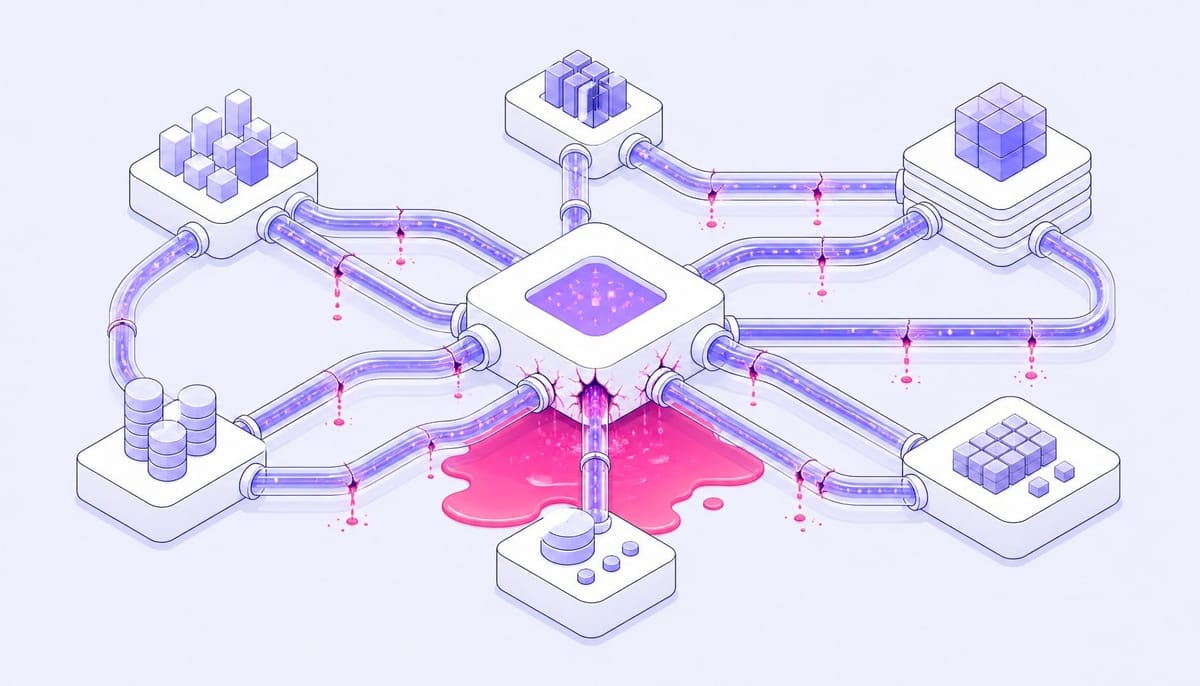
A four-person marketing team connects their form builder to their CRM via Zapier, their CRM to their ad platform with a native integration, and their analytics tool to their email platform using a webhook. For three months, everything works. Then the Zapier workflow silently stops syncing. No error notification, no alert. Three weeks of leads vanish into a dead connection before anyone notices.
This isn't a hypothetical. It's a standard operating reality for lean teams. We treat martech stack integrations as a one-time setup task, but they are actually ongoing liabilities that generate invisible maintenance work. Every connection point is a potential failure point, and the distinction between a sync failure and a mapping failure matters enormously: sync failures stop data flow and are usually caught, while mapping failures can continue flowing bad data for weeks undetected.
This article maps the actual cost of keeping your marketing tech stack integrations alive. We'll walk through real failure scenarios, break down the hidden cost layers, and give you a simple framework to quantify your own integration risk. Because the uncomfortable truth is that the cost is invisible until something breaks and most lean teams don't have a dedicated ops person watching for it.
Three Integration Failures That Cost More Than the Tools Themselves
The real cost of a broken integration isn't the price of the middleware subscription. It's the pipeline that never materializes and the ad budget spent on corrupted data. When a silent integration failure corrupts lead routing or attribution data for even a week, the downstream cost compounds across misallocated ad spend, stalled pipeline, and hours of forensic debugging that a two-person marketing team simply cannot absorb, which is precisely the monitoring gap that a system providing continuous optimization is designed to close before the damage accrues. Here are three common failure chains.
The Silent Zapier Sync: Three Weeks of Lost Leads
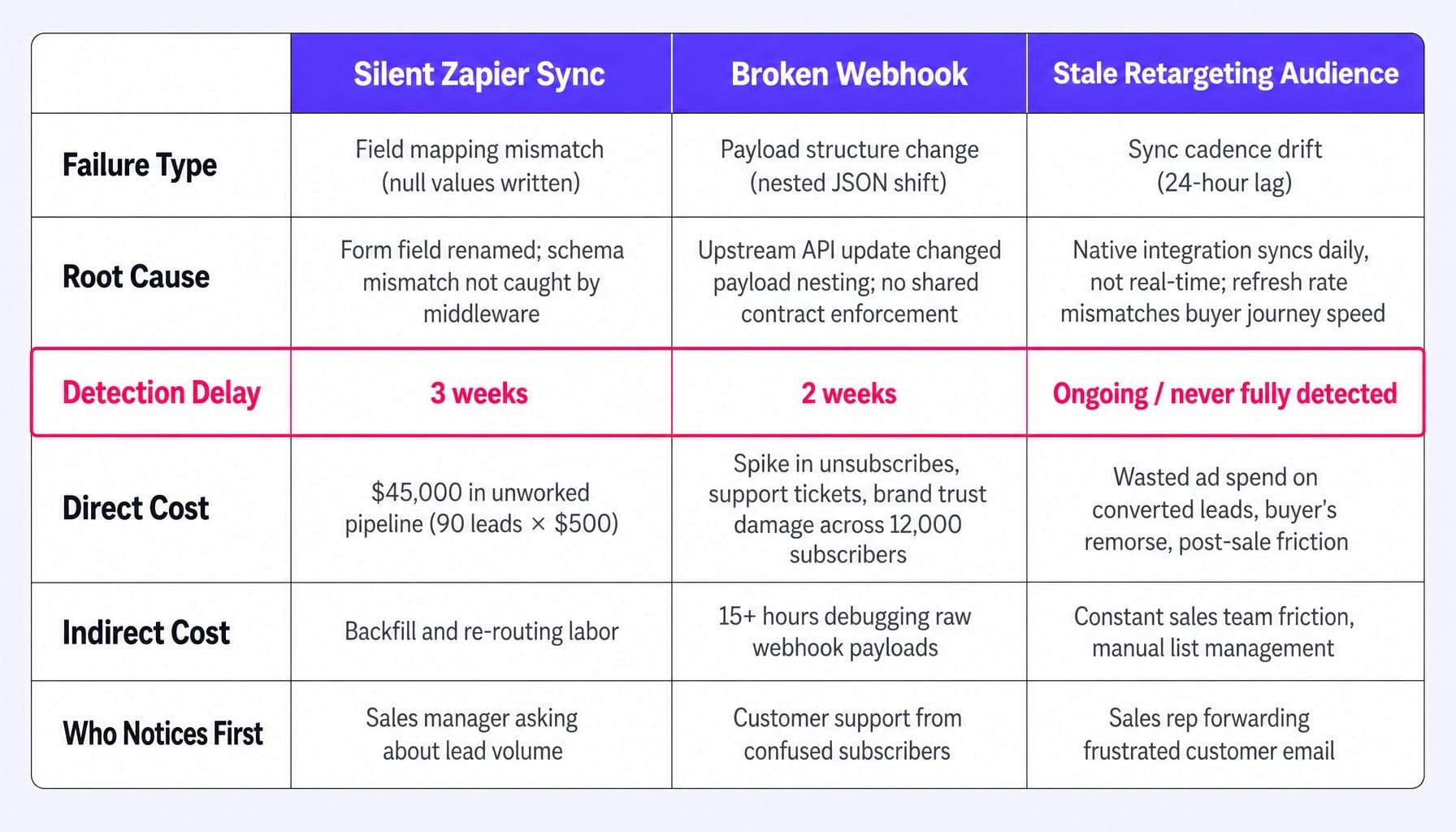
A team uses Zapier to connect their Typeform demo request form to HubSpot. The workflow is simple: a new form submission creates a new contact and deal in the CRM. It works perfectly until a marketer updates the landing page and renames a form field from "Work Email" to "Business Email" for clarity.
The Zap doesn't break. It continues to run successfully, but the field mapping is now broken. The Zap attempts to pass a value from a field that no longer exists, writing a null value into the HubSpot email property. For three weeks, no new leads appear in the sales team's view. The team only discovers the gap when a sales manager asks why inbound demo volume has "dried up."
By then, over 90 leads have been captured by Typeform but never reached the CRM. They exist, but they were never routed, nurtured, or contacted.
- Pipeline Cost: At a $500 average lead value, that's $45,000 in unworked pipeline.
- Root Cause: This isn't a Zapier failure; it's a schema mismatch. Middleware platforms report task success based on whether the automation executed, not whether the downstream system correctly processed the payload. Renaming a field is effectively a schema migration, and the other end of the integration has no way of knowing.
The Broken Webhook: 12,000 Subscribers Get the Wrong Segment
A SaaS company uses a webhook to send behavioral data from its analytics platform, Amplitude, to its email tool, Customer.io. When a user performs a key action, the webhook fires and adds them to a specific segment. One day, Amplitude pushes a minor API update that changes its payload structure—a nested JSON field containing the segment identifier moves one level deeper.
The webhook still fires with a 200 OK status. But Customer.io can no longer parse the segment ID correctly from the altered payload. For two weeks, 12,000 subscribers are assigned to the wrong behavioral segment. Trial users start receiving retention emails meant for paying customers, while long-time customers are hit with onboarding sequences.
- Direct Cost: A spike in unsubscribes, dozens of confused support tickets, and significant brand trust erosion.
- Indirect Cost: The team spends over 15 hours debugging. Webhook payload parsing errors don't surface in either tool's dashboard; you have to manually inspect the raw payloads and compare them against the expected schema to find the discrepancy. Webhook-based integrations are fundamentally fragile because they depend on both endpoints maintaining compatibility, with no shared contract enforcement between them.
Read more: SaaS Email Marketing in 2026: The Execution System That Replaces Drip Campaigns
The Stale Retargeting Audience: Always 24 Hours Behind
A marketing team uses the native integration between their HubSpot CRM and LinkedIn Ads to sync audience lists for retargeting. The integration is "native" and "official," so they assume it's real-time. It isn't. The audience list syncs once every 24 hours.
A prospect visits the pricing page, gets added to a retargeting list, and sees ads for a demo. The next day, they book that demo, talk to sales, and sign a contract. But because of the sync cadence drift, they remain in the "Prospect" audience on LinkedIn for up to 24 more hours. The newly signed customer continues seeing acquisition ads, sometimes with a discount offer they didn't get, creating immediate buyer's remorse and a frustrated email to their sales rep.
- Compounded Cost: Multiply this across hundreds of new customers a month. The result is wasted ad spend on already-converted leads, brand inconsistency that damages the post-sale experience, and constant friction for the sales team.
- Root Cause: The integration technically works. The failure is that its refresh rate doesn't match the speed of the buyer journey. "Native integration" doesn't mean "real-time," and that gap is where budget and trust leak out.
The Two Cost Layers Nobody Budgets For
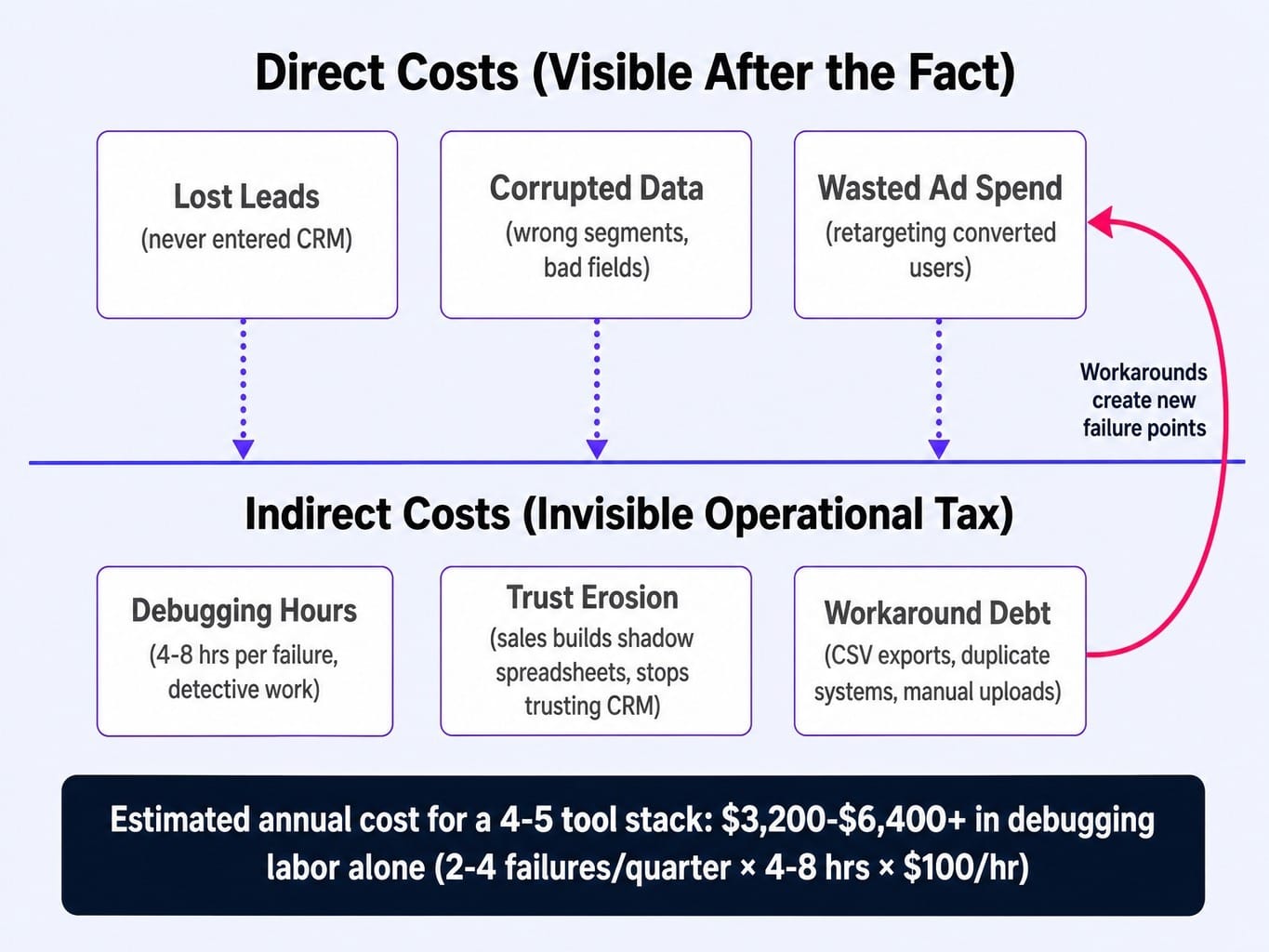
Most teams budget for integration setup—the Zapier subscription, the developer hours for a custom webhook. They never budget for integration maintenance. The true cost of marketing tech stack integrations lives in two layers that don't appear on any invoice. Based on common stack configurations, it's reasonable to estimate that a 4-5 tool stack with 6-8 integration points generates 2-4 failures per quarter, each requiring 4-8 hours to diagnose and fix. At a blended marketing ops rate of $100/hour, that's thousands per year in debugging labor alone.
Direct Costs: Lost Leads, Corrupted Data, Wasted Spend
Direct costs are the measurable business impact of an integration failure. These are the leads that never entered your CRM, the subscribers who received the wrong message and churned, and the ad budget spent retargeting users who already bought your product.
These costs are quantifiable, but they're almost always discovered after the fact. No one tracks "revenue lost to integration downtime" as a line item on the P&L. Consider a simple scenario: if a 4-tool stack experiences just one silent sync failure per quarter, and each failure goes undetected for an average of 10 days, the cumulative annual cost in lost or misrouted leads can easily exceed the subscription costs of the tools themselves. These failures have a direct revenue impact, but because they're intermittent and invisible, they never get attributed correctly. They just look like a "slow week" for leads.
Indirect Costs: Debugging Hours, Trust Erosion, Workaround Debt
Indirect costs are the operational drag and technical debt that integration failures create long after they're fixed. This is the hidden tax on your team's bandwidth.
- Debugging Hours: When a sync breaks, a marketer doesn't just "fix it." They have to become a detective, figuring out which integration broke, when it broke, what data was affected, and how to perform a backfill. This is pipe hygiene and schema mismatch forensics that can consume an entire day—a day not spent on revenue-generating work.
- Trust Erosion: Once a sales team discovers their CRM data was wrong for two weeks, they stop trusting all of it. They start keeping their own spreadsheets and second-guessing every report. This erosion of trust in the system of record is corrosive.
- Workaround Debt: In response to that mistrust, teams build manual workarounds: weekly CSV exports, duplicate tracking systems, manual list uploads. Each workaround built on top of a fragile integration adds another layer of complexity and another potential point of failure, creating a compounding cycle of integration debt.
Calculate Your Integration Fragility Score
Most teams have no way to quantify their integration risk because the failures are intermittent and the costs are distributed. The Integration Fragility Score is a simple model to estimate the hidden maintenance tax your martech stack is levying on your team.
The formula is:
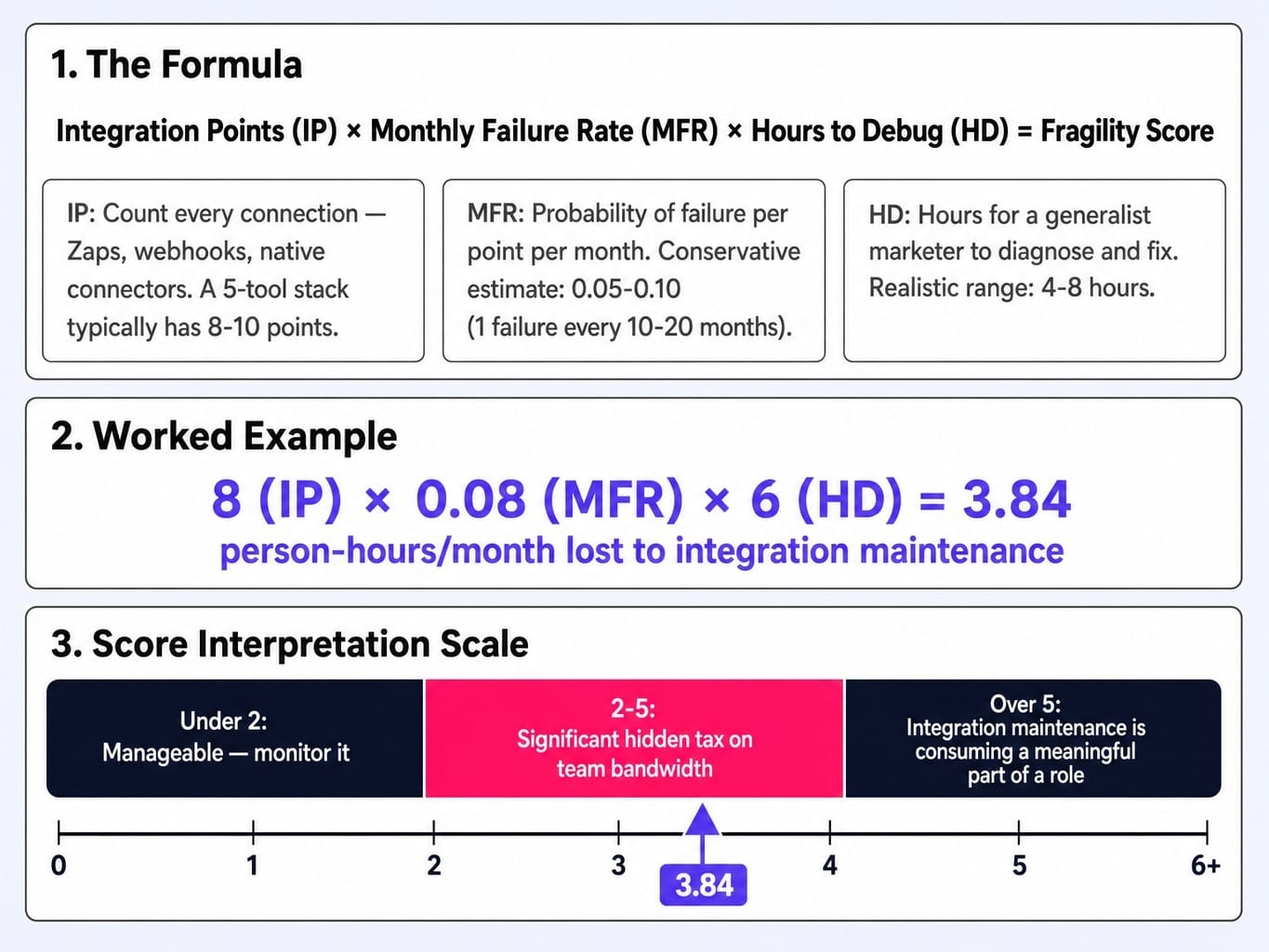
Integration Points × Average Monthly Failure Rate × Hours to Debug = Fragility Score
Here's how to estimate each variable:
- Integration Points (IP): Count every connection between tools in your stack. A webhook, a Zap, or a native connector each count as one point. A 5-tool stack (e.g., HubSpot, Webflow, GA, Customer.io, LinkedIn Ads) with tools connected to each other can easily have 8-10 integration points.
- Average Monthly Failure Rate (MFR): This is the probability of any single integration point failing in a given month. If you don't track this, a conservative starting point for stacks using middleware like Zapier or webhooks is 0.05 - 0.10. This assumes one failure per integration point every 10-20 months.
- Hours to Debug (HD): Estimate the average time a generalist marketer (not a dedicated ops specialist) takes to diagnose and fix a failure. A realistic range is 4-8 hours.
Worked Example:
A team has a stack with 8 integration points. They use a conservative MFR of 0.08 and estimate an average of 6 hours to debug.
8 (IP) × 0.08 (MFR) × 6 (HD) = 3.84
This score means the team is losing roughly 3.84 person-hours per month to integration maintenance and debugging—time they almost certainly aren't tracking.
Interpreting Your Score:
- Under 2: Manageable, but keep an eye on it.
- 2 - 5: You're paying a significant hidden tax on your team's bandwidth.
- Over 5: Integration maintenance is consuming a meaningful part of a role and actively preventing growth work.
Why This Problem Hits Lean Teams Hardest
This isn't just a technology problem; it's a bandwidth and resource allocation problem. Enterprise teams often have dedicated marketing ops or RevOps engineers who monitor integration health, build robust error alerting, and maintain pipe hygiene as their primary job.
A two-person marketing team does not.
The same person who built the Zapier workflow is also writing blog posts, managing ad campaigns, and reporting to the CEO. They are not checking webhook logs on a Tuesday afternoon. This means integration failures on lean teams go undetected 2-3x longer than on enterprise teams. When a break is finally discovered, the person pulled in to debug it is taken away from critical, revenue-generating work.
Picture a growth marketer at a Series A SaaS company. They built six crucial Zapier workflows during their first month to connect lead forms, webinars, and sales alerts. Four months later, they haven't checked any of them. Two are still working perfectly. One is creating duplicate records. One stopped entirely last month. Two are syncing to fields that were renamed in the CRM during a cleanup project. This isn't negligence; it's the predictable outcome of asking generalists to maintain specialist infrastructure.
Read more: How to Structure a B2B SaaS Marketing Team That Actually Ships: A Stage-by-Stage Framework
What If Your Stack Monitored Itself?
The article has built a specific tension: every integration point is a failure point, the costs are invisible until something breaks, and your team is structurally unable to monitor its stack continuously. You probably have silent failures in your stack right now, and you don't have the bandwidth to go looking for them.
This is where the system design changes. The alternative to hiring a full-time marketing ops engineer or hoping your Zaps don't break is having a system that continuously identifies what's underperforming and acts on it. Spike AI is designed as this missing intelligence layer. It doesn't just connect tools; it provides continuous optimization that eliminates the gap between "something broke" and "someone noticed."
Instead of reacting to a pipeline drop and spending a day on forensic debugging, you operate with a system that's always watching your website and marketing funnels for conversion degradation, attribution gaps, and execution bottlenecks. Spike AI represents a shift from reactive, manual fire-fighting to continuous, intelligent optimization. It turns your stack from a collection of fragile connections into a resilient system that self-corrects, allowing your team to focus on strategy, not on whether the data is correct this week.
See how Spike AI keeps your marketing systems optimized continuously — without adding headcount.
Your Integrations Are a Liability, Not an Asset
The defining belief shift is this: martech stack integrations are not a setup task. They are an ongoing operational liability with compounding costs that most teams never measure. Every tool you connect creates a new failure point. Every failure point generates invisible costs in lost leads, corrupted data, and debugging hours. And lean teams are structurally unequipped to monitor these connections manually.
Before you add another tool to your stack or build another Zapier workflow, calculate your Integration Fragility Score. If it's over 2, you're already paying an operational tax you haven't accounted for. The question isn't whether your integrations will break—it's whether you'll notice when they do.
Frequently Asked Questions
What is the difference between iPaaS and native martech integrations?
iPaaS platforms (Workato, Tray.io) act as middleware connecting tools via APIs, offering flexibility but adding another system to maintain. Native integrations are pre-built by vendors (e.g., HubSpot's Salesforce connector); they are simpler to set up but often less flexible, with fixed sync schedules that can create data latency. Each represents a different tradeoff between flexibility and fragility.
How does reverse ETL fit into a martech integration strategy?
Reverse ETL tools like Hightouch and Census push data from a central data warehouse (e.g., Snowflake) back into your operational tools. This treats the warehouse as the single source of truth, reducing point-to-point integration fragility. However, this warehouse-native architecture requires a data engineering maturity that most lean marketing teams do not yet possess.
How do I handle data privacy compliance across integrated martech tools?
Consent signals—opt-outs, deletion requests—must propagate to every tool holding customer data. Most integrations only sync marketing data, not consent status. This creates a compliance risk where a user unsubscribes in one system but remains active in another. You must manually map every tool storing PII and verify that consent and deletion requests are honored across the entire stack.
Should I consolidate to fewer martech vendors or integrate best-of-breed tools?
Consolidation reduces integration points and failure risk but locks you into a single vendor's ecosystem. A best-of-breed stack offers superior functionality in each category but multiplies your integration surface area and maintenance burden. Your Integration Fragility Score should guide this decision: if you can't afford the maintenance tax of a best-of-breed stack, consolidation is simply pragmatic risk management.
How do I prevent data sync errors between my CRM and marketing automation platform?
Most sync errors stem from field mapping conflicts, mismatched deduplication logic, or broken lifecycle stage handoffs. Institute a monthly integration audit: check record counts on both sides, spot-check 20 records for field accuracy, and verify that stage transitions are triggering correctly. If key counts diverge by more than 2%, it's a signal of a silent failure that requires immediate investigation.