B2B Marketing Funnel: Why Most Stall and How to Build One That Ships
TLDR
- Your B2B marketing funnel isn't a strategy problem; it's an execution throughput problem constrained by human bandwidth.
- Most funnels stall due to the insight-to-action gap, fragmented channel ownership, and the quarterly optimization trap.
- Shift from quarterly roadmaps to a weekly shipping cadence. Compounding small, weekly improvements outperforms large, infrequent updates.
- Unify cross-channel visibility to prioritize the single highest-impact change across your entire funnel, not just within channel silos.
- Retention isn't a post-sale function; it's the funnel stage that determines if your economics work, measured by Net Revenue Retention (NRR).
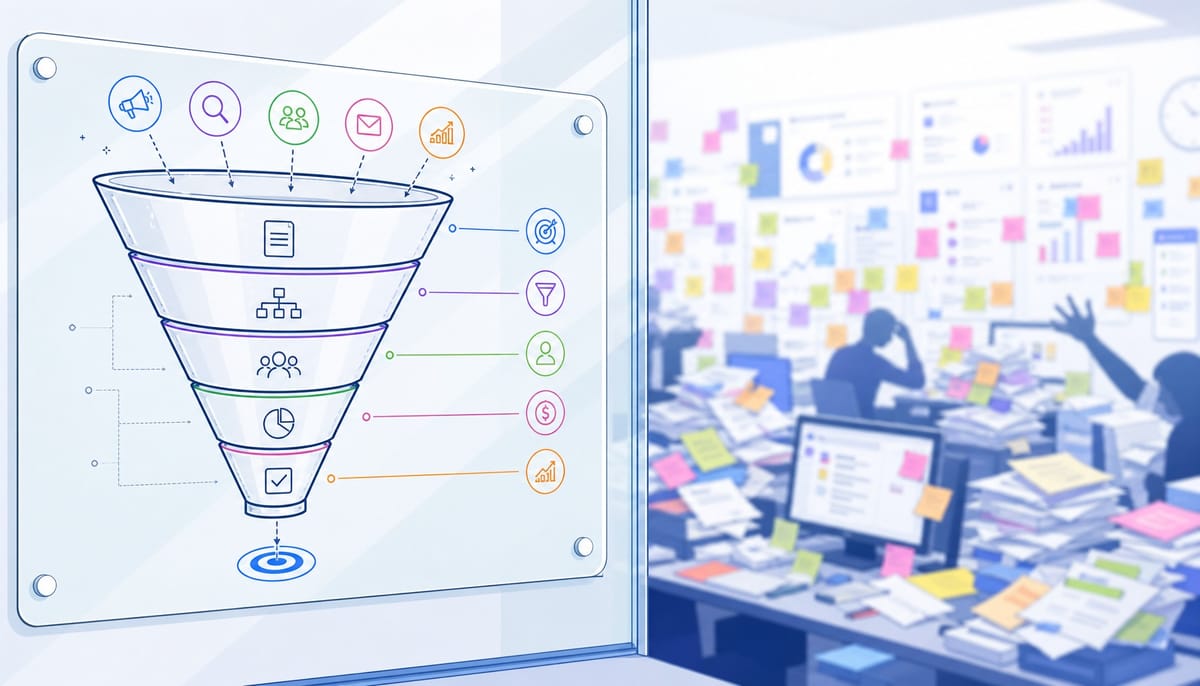
Most B2B marketing teams can sketch their funnel on a whiteboard in five minutes. Awareness, Consideration, Decision, Retention—the stages are universal. But ask how many meaningful optimizations they shipped across those stages last quarter, and the answer is usually two or three. We've all been in that meeting.
The funnel isn't the problem. The gap between knowing what each stage needs and actually executing changes at each stage is the problem. It's the latency that eats weeks.
This isn't another guide that just defines the stages of a B2B marketing funnel. We will cover the stages, but more importantly, we will diagnose why funnels stall in practice. We'll reframe the funnel not as a diagram for a slide deck, but as an execution system designed for continuous shipping—and show you how to build one.
What a B2B Marketing Funnel Actually Is (and How It Differs from B2C)
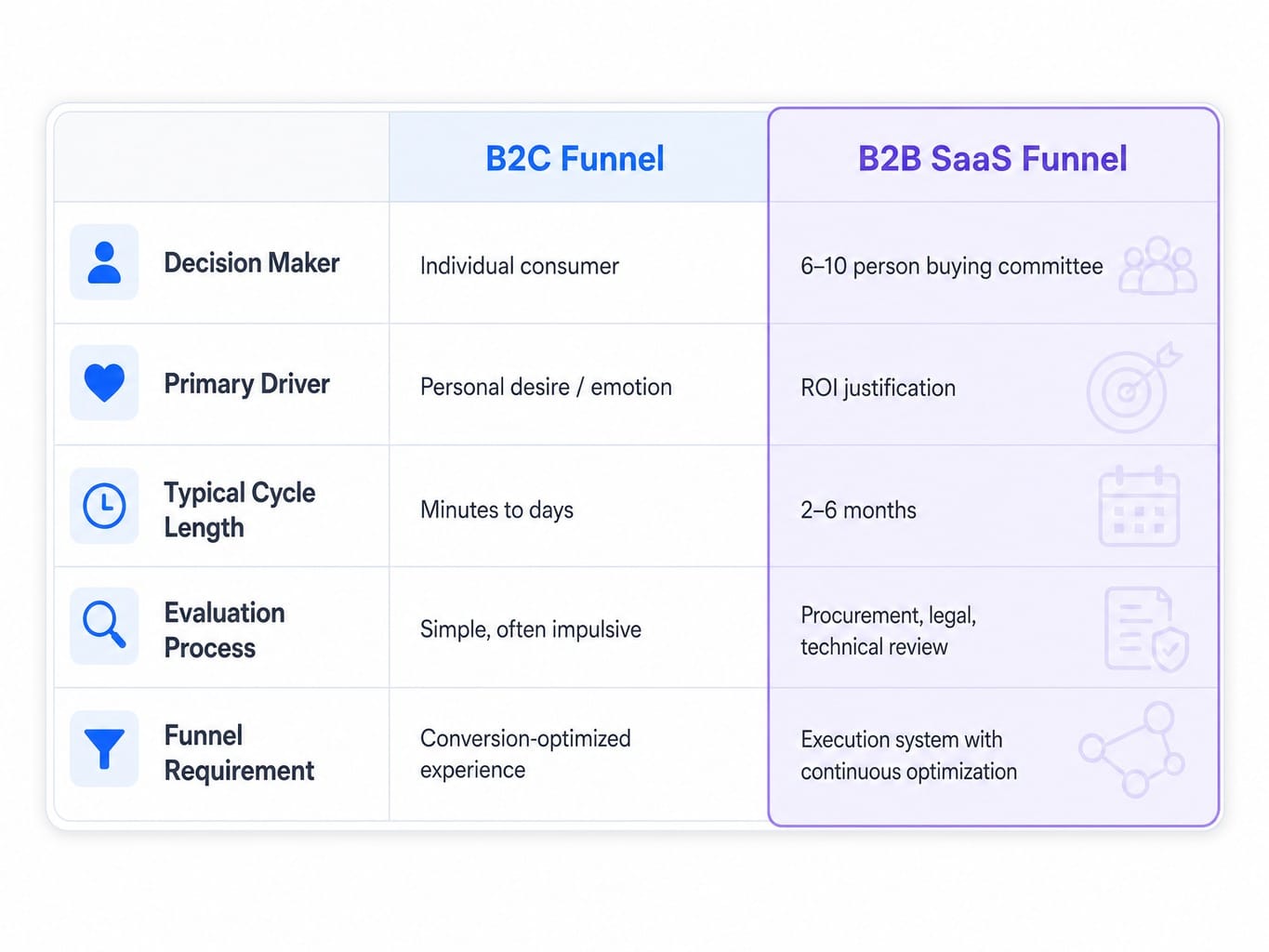
A B2B marketing funnel is the structured path a business buyer moves through from first encountering your brand to becoming a customer—and ideally, a retained one. It's a map of a complex decision process. Unlike B2C funnels, which are often short and driven by individual emotion, the B2B SaaS marketing funnel is a different machine entirely. B2B purchase decisions are driven by ROI justification, not personal desire.
The contrast is stark. A consumer buying running shoes might complete their entire funnel in a single, 15-minute session. A VP of Engineering evaluating a new infrastructure tool, however, is embarking on a journey. That journey, according to Gartner, involves an average of 6 to 10 decision-makers and a sales cycle that can last anywhere from two to six months. Procurement, legal, and a technical evaluation committee all get a vote.
This is why the funnel cannot be just a strategic model; it must be an execution system. Each stage requires specific content, specific touchpoints, and specific optimizations to move a committee, not an individual. The question is not whether you understand the stages, but whether you have the operational bandwidth to continuously improve performance at each one.
The Four Stages of a B2B Marketing Funnel
The four stages below are not just labels—each one represents a distinct operational challenge. The question at each stage is not 'what content should we create?' but 'what is breaking here, and how do we know?'
Let's walk through them with a running example: a B2B SaaS company selling a project management tool to mid-market engineering teams.
Awareness: Reaching Buyers Before They Know They Need You
Awareness is not about traffic volume; it's about reaching the right accounts before they even enter a buying cycle. The common failure here is measuring top-of-funnel (TOFU) success by total traffic rather than ICP-qualified reach. Our PM tool company, for example, publishes SEO content targeting "engineering team productivity." It's broad enough to capture pre-intent searches but specific enough to attract the right persona.
The metric that matters isn't total visitors, but ICP-qualified visits and brand recall. According to the Ehrenberg-Bass Institute, only about 5% of B2B buyers are in-market at any given time. This means 95% of your TOFU investment is about building a brand that gets recalled months later. Your job is to be memorable to the right people.
Read more: Marketing Channel Prioritization for 2026: Where Your Budget Actually Compounds
Consideration: Earning a Spot on the Shortlist
Consideration is where most B2B funnels quietly hemorrhage prospects. The content isn't bad, but it often arrives too late or adds friction. The common failure mode is gating valuable comparison assets behind forms at the exact moment a buyer is trying to evaluate alternatives. You're asking for their contact information when they're just trying to do their homework.
Our PM tool company avoids this by offering an ungated ROI calculator and a side-by-side feature comparison against competitors. This reduces friction and demonstrates confidence. The metric that matters here is engagement depth—time on page, return visits, content downloads—not the raw number of MQLs from a gated PDF. Your goal is to make the buyer's evaluation process easier, not harder.
Decision: Converting Evaluation into Revenue
The decision stage is where the funnel becomes a sales-marketing alignment problem. The common failure is a clean handoff that's information-poor. Marketing passes an MQL to sales with no context on what content the prospect consumed, which objections remain, or which stakeholders are involved in the buying committee.
In our example, the PM tool company's marketing system tags prospects with their content consumption data. The sales rep knows the VP of Engineering watched the on-demand demo, but the CFO hasn't seen the ROI case study yet. That single piece of information changes the entire sales conversation. The metric that matters is pipeline velocity—the time from MQL to closed-won—and overall win rate. Decision-stage optimization is about information continuity.
Retention: The Stage Most B2B Funnels Forget to Build
Retention isn't a post-sale afterthought; it's the stage that determines if your funnel economics actually work. The common failure is celebrating a closed deal and immediately moving on, leaving onboarding and renewal entirely to a separate customer success team. This is a massive leak.
Our PM tool company runs a quarterly "power user" webinar series and a monthly product update email, both designed to reduce churn and surface upsell opportunities. It's a well-cited fact from Harvard Business Review that acquiring a new customer can cost 5 to 25 times more than retaining an existing one. The metric that truly matters for a SaaS business is Net Revenue Retention (NRR). If your funnel stops at "closed-won," you're rebuilding your pipeline from scratch every quarter instead of compounding it.
Why Most B2B Marketing Funnels Stall Between Strategy and Execution
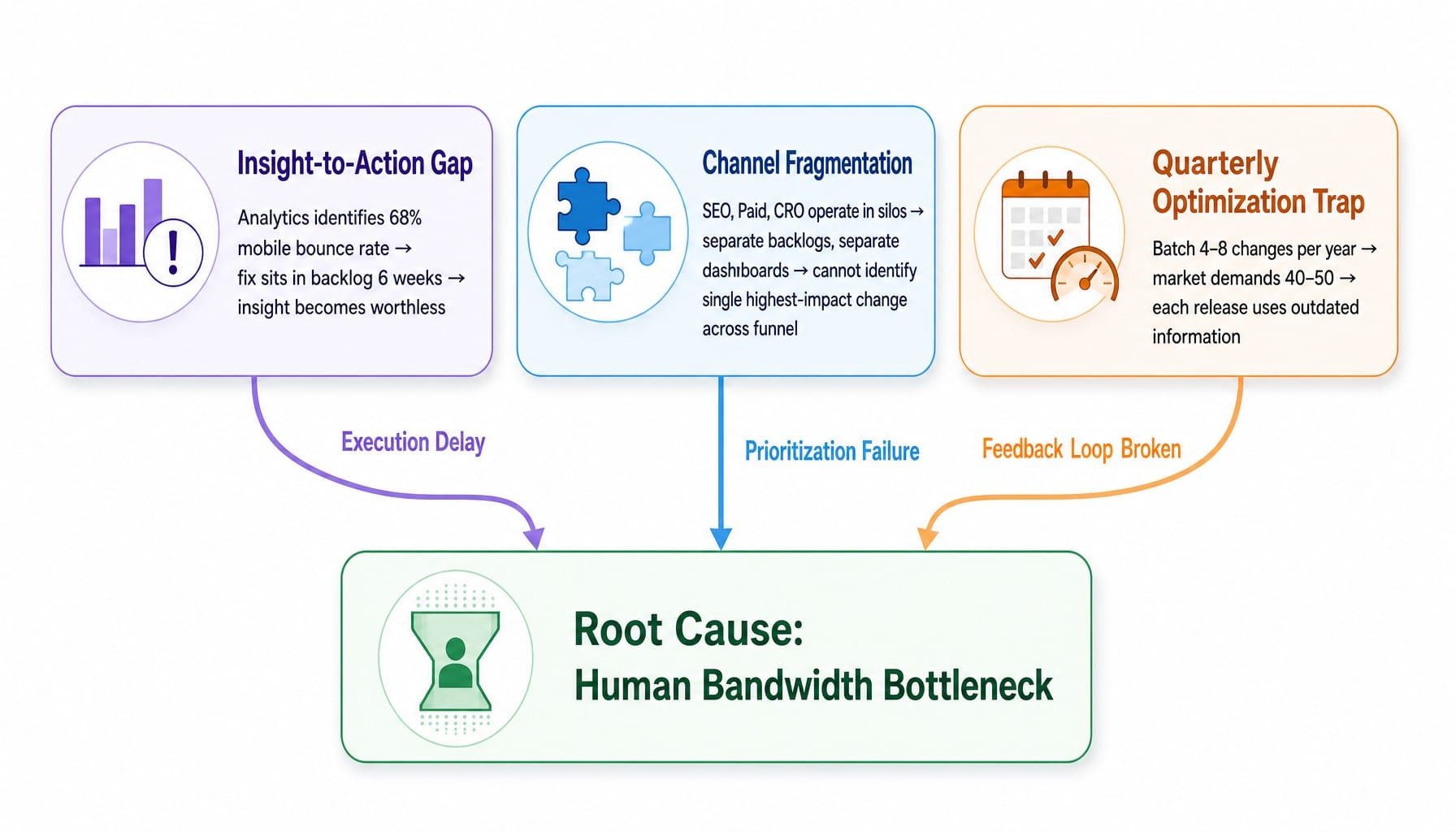
The reason most B2B funnels underperform is not a failure of strategy. It's not that teams chose the wrong stages or the wrong content. The funnel stalls because the latency between identifying what needs to change and actually shipping that change is measured in weeks, not hours. This is a systemic execution problem. It shows up in three distinct patterns.
1. The Insight-to-Action Gap: Your analytics team identifies that a key consideration-stage landing page has a 68% bounce rate among mobile users. The insight is clear: fix the mobile experience. But the fix requires design mockups, new copy, development time, and QA. The ticket sits in a backlog for six weeks. The insight was valuable, but the execution delay made it worthless for this quarter.
2. The Channel Fragmentation Problem: The SEO lead, the paid media manager, and the CRO specialist all operate in silos. Each has their own backlog, their own dashboard, and their own priorities. No one can answer the most important question: "What is the single highest-impact change we could make across the entire funnel right now?" The team optimizes whatever channel the loudest stakeholder cares about, not what would move the most qualified leads.
3. The Quarterly Optimization Trap: Marketing teams often batch funnel improvements into quarterly sprints or roadmaps. This feels organized, but it means you only ship 4 to 8 meaningful changes per year when the market demands 40 or 50. Each batched release is a bet made with outdated information, disconnected from the immediate feedback loops that drive real growth.
The common thread is human bandwidth. Your funnel framework isn't the bottleneck. Your execution throughput is.
Read more: How to Prioritize Marketing Tasks for Lean Teams: A Framework That Actually Works
How to Build a B2B Funnel Designed for Continuous Execution
If the core problem is execution throughput, then the funnel itself needs to be designed for continuous shipping, not quarterly planning. This requires two fundamental operational shifts that transform a static funnel into a compounding execution system.
Replace Quarterly Roadmaps with a Weekly Shipping Cadence
The single most impactful structural change a B2B marketing team can make is shifting from quarterly planning cycles to a weekly release cadence.
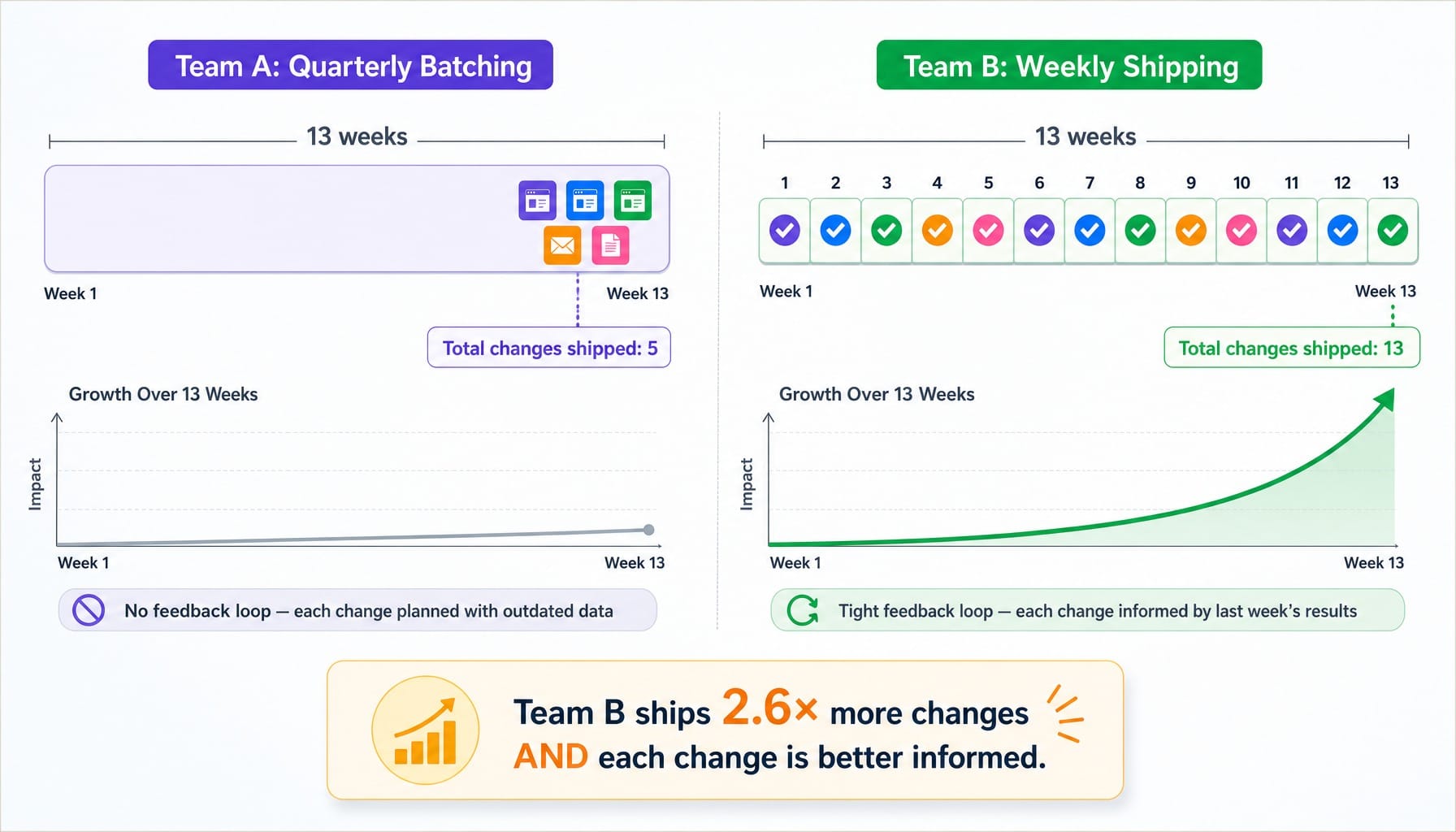
Consider two teams. Team A batches its funnel improvements. In Q2, they plan to ship three landing page tests, one email sequence update, and a new case study. They execute these over 13 weeks. Team B, however, identifies the single highest-impact change each week and ships it. After 13 weeks, they've made 13 targeted changes, each one informed by the results of the last.
The compounding effect is the key. Weekly execution creates a tight feedback loop where each change informs the next, while quarterly batches operate with huge information gaps. It's the difference between saving for retirement with a few large deposits versus small, automatic weekly contributions. The latter always wins over time. Start by auditing your funnel for the single stage with the worst conversion rate. Ship one improvement this week. Measure. Repeat.
Unify Cross-Channel Visibility to Prioritize the Right Change
You cannot ship the highest-impact improvement if you cannot see across the entire system. And let's be honest, most teams can't. SEO, paid media, CRO, and email are managed as separate workstreams.
Imagine a team spends two weeks A/B testing a homepage headline (a CRO task). At the same time, their most important consideration-stage blog posts are ranking on page three for high-intent keywords (an SEO problem). The SEO fix would have five times the pipeline impact, but no one surfaced it because the CRO and SEO backlogs are managed in different spreadsheets by different people.
The operational shift is to create a single, unified backlog across all channels, ranked by projected impact on qualified pipeline. This forces a conversation about trade-offs and ensures you're always working on the most valuable problem. Building this unified view is hard. It requires either a large, cross-functional team or a platform that unifies marketing goals with task management.
How Spike AI Turns Your Funnel from a Diagram into a Weekly Shipping Engine
The article has built to a specific tension: B2B marketing funnels stall because lean teams lack the execution bandwidth to continuously identify, prioritize, and ship improvements across every stage and channel. The requirements—a weekly shipping cadence and unified cross-channel prioritization—are nearly impossible to sustain manually.
This is the execution gap that Spike AI is built to close.
Spike AI functions as the execution layer that connects your funnel strategy to shipped changes. It ingests signals across your website, SEO, and ads to identify the single highest-impact move you can make each week. Then, it executes it. The insight-to-action gap disappears because Spike AI handles both prioritization and implementation, turning a six-week backlog into a weekly release.
Because Spike AI operates on this weekly cadence, each release compounds on the results of the last. Your funnel transforms from a static framework you review quarterly into a dynamic growth system that gets smarter and more efficient every single week.
See how Spike AI ships weekly funnel improvements — book a discovery call
From Funnel Diagram to Execution System
The most important belief shift you can make is this: the B2B marketing funnel is not a strategy problem. It is an execution throughput problem.
Understanding the stages is table stakes. Diagnosing where your funnel stalls between insight and action is where the real leverage lives. Building a system that ships improvements weekly, not quarterly, is what separates teams that compound growth from those that plateau.
The teams that win in B2B over the next two years will not be the ones with the most elegant funnel diagrams on their whiteboards. They will be the ones that ship the most improvements per quarter across every single stage. The question is, how many will you ship?
Frequently Asked Questions
How many stages should a B2B marketing funnel have?
Most effective B2B funnels use four stages—awareness, consideration, decision, and retention—though some models add sub-stages. The exact number matters less than whether each stage has a clear owner, a measurable conversion metric, and an active optimization process. Adding stages without the operational capacity to manage them just creates complexity without value.
What is the difference between an MQL and an SQL in the B2B funnel?
An MQL (Marketing Qualified Lead) has shown engagement signals suggesting interest, like downloading content. An SQL (Sales Qualified Lead) has been vetted and confirmed by sales as having the budget, authority, need, and timeline to purchase. The handoff criteria between MQL and SQL must be mutually agreed upon by both marketing and sales to be effective.
How does account-based marketing (ABM) change the B2B funnel?
ABM inverts the traditional funnel. Instead of casting a wide net and filtering down, ABM starts with a defined list of target accounts and concentrates resources on them. The stages still apply, but the approach is about deep, personalized engagement with a few high-value accounts rather than optimizing for volume at the top of the funnel.
What conversion rate benchmarks should B2B companies target at each funnel stage?
Benchmarks vary widely, but for B2B SaaS, directional ranges are: 2–5% visitor-to-lead, 15–30% lead-to-MQL, 20–40% MQL-to-SQL, and 15–30% SQL-to-closed-won. More important than hitting a specific number is your stage-over-stage improvement rate. Are your conversion rates improving month-over-month as you optimize, or are they flat?
Can a B2B marketing funnel work without marketing automation?
Technically, yes, but it creates a massive manual bottleneck. Without automation, lead scoring, nurture sequences, and content delivery all require human effort for every prospect. Teams without automation find their bandwidth consumed by manual operations, leaving no time for the strategic improvements that actually drive growth.