B2B SaaS Lead Generation Strategies That Scale Pipeline, Not Just Lead Counts
TL;DR
- Most B2B SaaS lead gen fails by conflating demand generation (building awareness) with lead capture (gating content), resulting in high MQL volume but low pipeline.
- Shift from volume outbound to signal-based selling. Use hiring, technology, and product usage triggers to create warm outbound sequences that get 5-15% reply rates, not <1%.
- Choose your channels based on your Average Contract Value (ACV). A sub-$1K ACV product needs Product-Led Growth and SEO, while a $150K+ deal requires executive referrals and ecosystem partnerships.
- Stop running campaigns that reset to zero. Build compounding assets like ungated original research and a continuously optimized website that increase your baseline lead flow over time.
- Replace vanity metrics like MQLs and CPL with pipeline-focused metrics: Pipeline Sourced by Channel, MQL-to-SQL Conversion Rate, and Lead-to-Opportunity Ratio.
Your marketing team generated 1,200 MQLs last quarter. You hit the lead target, the dashboard looked green, but the pipeline review was a bloodbath. Sales missed their number by 40%, and the feedback from AEs was brutal: the leads were junk.
They were low-ICP-fit contacts from companies that could never buy, all sourced from a generic eBook download. They never opened a single SDR email.
This is the quiet failure state of most B2B SaaS lead generation. The strategies aren't wrong—the system is. Most playbooks optimize for lead volume, a metric that measures activity, not the creation of revenue. The problem isn't a lack of tactics; it's a fundamental misalignment between what gets measured (leads) and what builds a business (qualified pipeline).
This guide diagnoses why that happens. We'll deconstruct the shift to signal-based selling, provide a channel selection framework matched to your deal size, and show you how to build a SaaS B2B lead generation engine that compounds instead of resetting every quarter.
Why Most B2B SaaS Lead Generation Strategies Produce Activity, Not Pipeline
The single biggest point of failure in lead generation for B2B SaaS is the conflation of two different functions: demand generation and lead capture. Demand generation is the slow, un-gated work of creating awareness and trust over time. Lead capture is the event of converting existing intent into a contact record.
When teams treat a gated eBook as "demand generation," they're actually running lead capture on an audience with no buying intent. This is how you get a dashboard full of MQLs that behave like strangers.
Consider the common scenario: a Series B SaaS company runs LinkedIn ads to a gated whitepaper. They celebrate a $28 CPL, well below the industry average of ~$237. But the AE team reports that fewer than 5% of those leads ever respond to outreach. The demo-to-close rate on these marketing-sourced leads is three times worse than on inbound demo requests.
This is the hidden cost of cheap leads. When low-ICP-fit volume floods the funnel, it doesn't just produce no revenue; it actively destroys value. It consumes SDR and AE time that could have been spent on high-intent accounts. It inflates your blended CAC by adding expensive noise. It creates a false sense of marketing effectiveness that masks a broken system.
A healthy MQL-to-SQL conversion rate for B2B SaaS sits between 10-25%. If yours is lower, the problem isn't volume; it's the quality of the inputs. The critical question isn't "What's our cost per lead?" but "What's our cost per AE-accepted opportunity?" Until you make that shift, you're just building a system that's incredibly efficient at generating contacts who will never buy.
The Shift to Signal-Based Selling: Replacing Volume Outbound with Trigger-Event Prospecting
The era of brute-force outbound is over. Blasting 1,000 cold emails to book 10 meetings and close one deal is a model built on collapsing unit economics. It's not that outbound is dead; the signal-to-noise ratio has just imploded. With AI-generated email reaching saturation, reply rates on generic, untargeted sequences have fallen below 1% for most SaaS companies.
The answer isn't "better copy." It's better timing.
The replacement for volume outbound is signal-based selling, where outreach is triggered by an observable buying signal rather than a contact's position on a static list. This is the core of effective SaaS lead generation in 2026. It's not about reaching more people; it's about reaching the right people at the moment they become receptive to your message. Reply rates on warm outbound sequences triggered by intent signals routinely hit 5-15%—a different world entirely.
Read more: SaaS Outbound Marketing: 7 Signal-First Strategies That Actually Convert in 2026
What Counts as a Buying Signal in B2B SaaS
Most teams define "intent data" too narrowly, thinking only of third-party platforms like 6sense or Demandbase. The most actionable signals are often first-party and product-adjacent, and they exist in a clear hierarchy of strength.
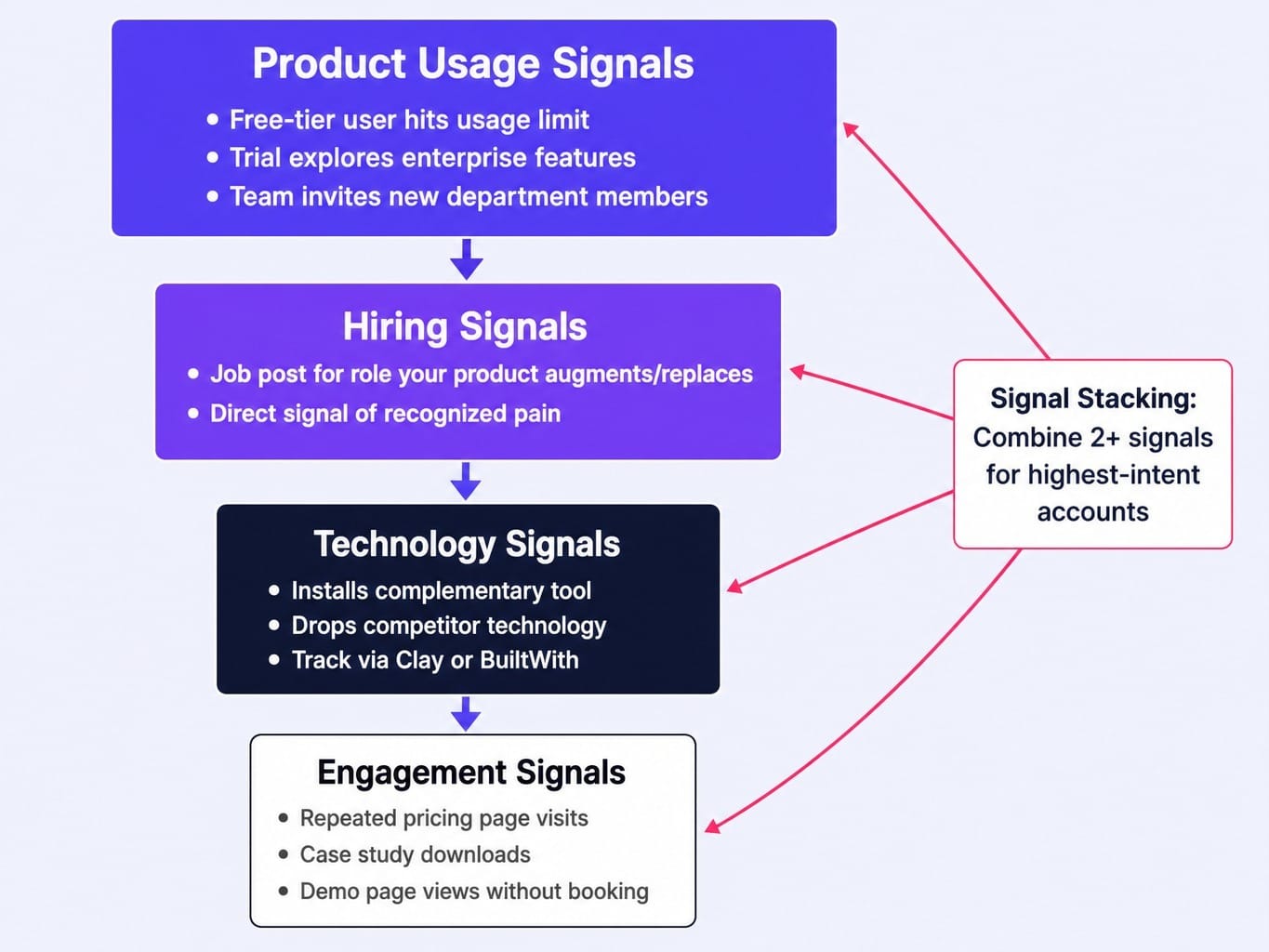
- Product Usage Signals: A free-tier user hits a usage limit, a trial account explores enterprise-only features, or a team invites members from a new department. These are the highest-quality signals you have.
- Hiring Signals: A target account posts a job for a role your product augments or replaces (e.g., "Manual Data Entry Specialist"). This is a direct signal of recognized pain.
- Technology Signals: A company installs a complementary tool or, even better, drops a competitor's technology. Tools like Clay or BuiltWith can track this automatically.
- Engagement Signals: A prospect from a target account makes repeated visits to your pricing page, downloads a technical case study, or views the demo page without booking. Tools like Warmly can surface this "dark funnel" activity.
Building Warm Outbound Sequences Around Signals
Signal detection without a rapid, personalized response is just wasted intelligence. The goal is to build a system that connects signal to action. For example, a mid-market SaaS company can use a tool like Clay to monitor for hiring signals, automatically enrich those accounts with contact data, and push them into an Apollo.io or Instantly.ai sequence.
The key is that the sequence isn't generic. The opening line references the specific job posting and connects it directly to the product's value proposition. The result is an 8-12% reply rate, a 10x improvement over their old list-based approach.
This is where sophisticated teams practice "signal stacking"—combining two or more signals (e.g., a hiring signal plus a recent pricing page visit) to prioritize the absolute highest-intent accounts for SDR outreach. This requires a solid data foundation, often built using waterfall enrichment to pull the best contact data from multiple sources like ZoomInfo and Clearbit.
Choosing B2B SaaS Lead Generation Channels by Deal Size, Not by Trend
The question "What are the best B2B SaaS lead gen channels?" is meaningless without one other variable: your Average Contract Value (ACV).
A $29/month self-serve tool and a $120,000/year enterprise platform require fundamentally different lead generation architectures. The highest-ROI channel for a low-ACV product (e.g., content SEO) will bankrupt a team selling six-figure deals (where ABM and executive referrals dominate).
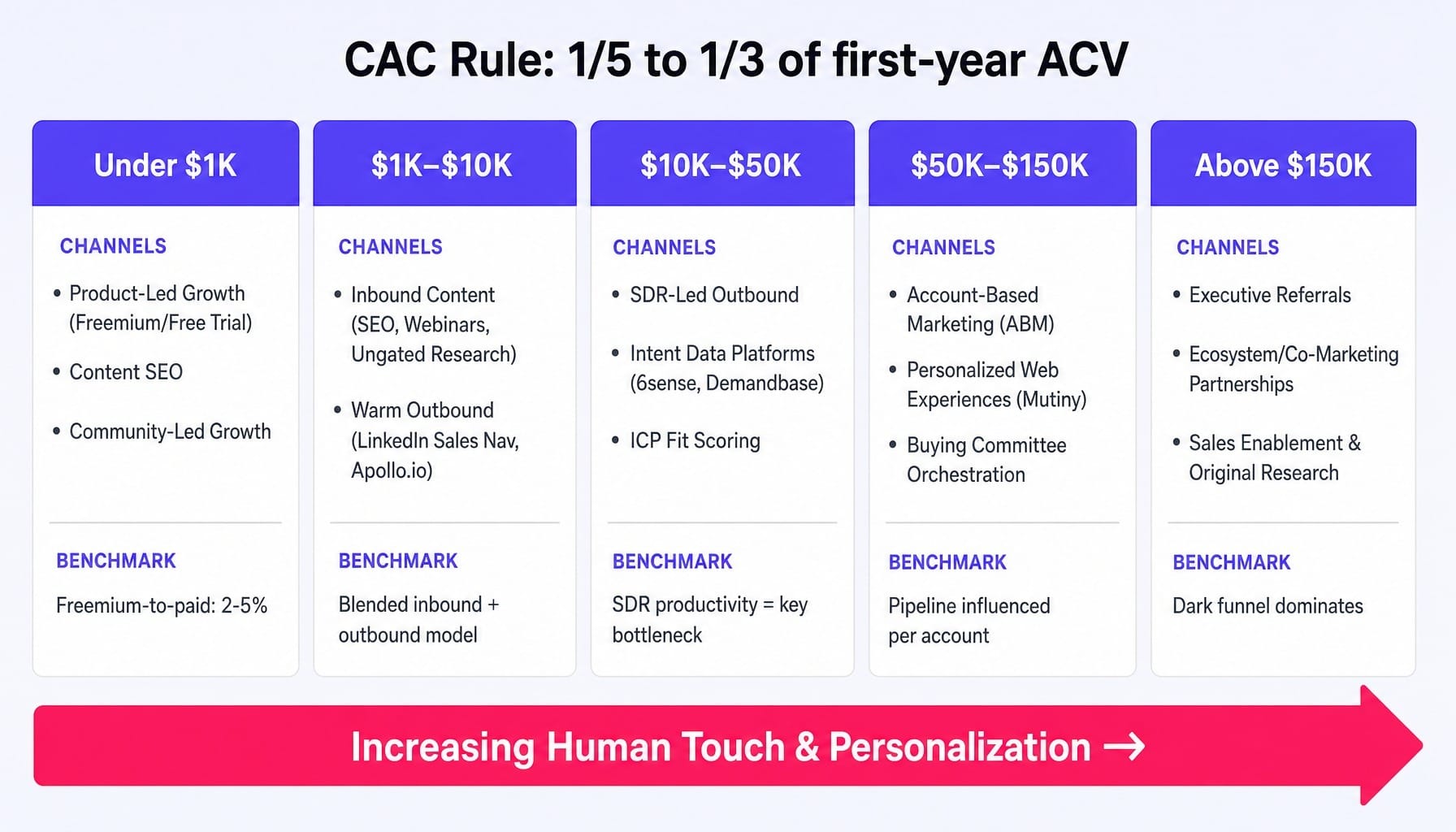
Your blended CAC should be roughly 1/3 to 1/5 of your first-year ACV for healthy unit economics. This simple math dictates which channels are even viable. What follows is a decision framework, not a listicle. Find your ACV tier and focus your resources there.
Read more: How to Prioritize Marketing Channels With a Limited Budget And Resources (Framework for Lean Teams)
Under $1K ACV: Product-Led Growth and Content SEO
At this price point, the unit economics cannot support a sales-assisted motion for most leads. The engine must be self-serve. This means a freemium or free trial experience that converts users without human touch, supported by a deep library of SEO-driven content that captures problem-aware search traffic. The benchmark for freemium-to-paid conversion is 2-5%, so you need volume. Community-led growth—engaging in niche Slack groups or on Reddit—is an underutilized channel here that builds trust before the click.
$1K–$10K ACV: Inbound Content Plus Warm Outbound
This ACV range is the sweet spot for a blended model. Inbound content—SEO, webinars, and especially ungated original research—generates awareness and captures high-intent inbound demo requests. This is supplemented by warm outbound, using tools like LinkedIn Sales Navigator and Apollo.io to run signal-triggered sequences that proactively build pipeline. The biggest mistake at this tier is over-investing in paid ads for gated content; the MQL-to-SQL conversion rate is rarely high enough to justify the AE time it consumes.
$10K–$50K ACV: SDR-Led Outbound with Intent Data
At this deal size, dedicated Sales Development Representatives (SDRs) become an economic necessity. The bottleneck, however, is SDR productivity. The highest-performing teams don't just hire more SDRs; they arm them with better data. This means contact-level intent signals from platforms like 6sense or Demandbase and triple-verified contact data from ZoomInfo or a waterfall enrichment process. Using an ICP fit score to prioritize accounts ensures SDRs spend their time on prospects that can actually buy, doubling or tripling the number of AE-accepted leads per rep.
$50K–$150K ACV: Account-Based Marketing (ABM)
When your TAM is a few thousand companies, you can't afford to treat them like items on a list. At this high ACV, marketing's job is not to generate leads but to orchestrate engagement across a buying committee of 6-10 stakeholders. ABM isn't a channel; it's a go-to-market strategy. Using platforms like Demandbase or 6sense, you track engagement across a target account list, personalizing website experiences with tools like Mutiny, and measuring success in pipeline influence per account, not cost per lead.
Above $150K ACV: Executive Referrals and Ecosystem Partnerships
For enterprise deals, the highest-converting lead source is almost always a warm introduction from an investor, advisor, or customer. No amount of content marketing or cold outbound will reliably generate $150K+ pipeline. Marketing's role shifts to sales enablement: arming AEs with deep account intelligence, creating executive-level content like original research reports, and building co-marketing partnerships with complementary tech platforms. At this tier, most of the buyer's journey happens in the "dark funnel"—conversations you can't track. Your job is to influence them.
Building a Lead Generation Engine That Compounds Instead of Resets
Most B2B SaaS teams operate in campaign mode. A webinar this month, a content syndication push the next. Each effort starts from zero and its impact decays quickly. This is a linear, exhausting way to grow.
The alternative is to build an engine with assets that compound. This means creating SEO content that ranks and generates inbound leads every month without incremental spend. It means building a website that gets progressively better at converting visitors into pipeline. It means structuring a system where every action makes the next action more effective.
This is the difference between running on a hamster wheel and building a flywheel. One burns energy to stay in place; the other stores it to accelerate.
Why Ungated Original Research Is the Highest-Compounding Lead Gen Asset
In an era saturated with AI-generated commodity content, the assets that build real brand equity are the ones that can't be faked: original research, proprietary benchmarks, and first-party data studies.
When a SaaS company publishes an annual "State of the Industry" report based on its own customer data, it creates a linkable, citable, and shareable asset. This content earns backlinks, drives high-authority traffic, and fuels social media for months. Google's algorithms are increasingly rewarding this kind of information gain—content that contributes something new to the web.
Contrast this with a generic, gated eBook. The eBook generates a burst of low-intent downloads and then disappears. The original research report becomes a cornerstone of your digital presence, compounding in value as it ages.
Your Website Is the Conversion Layer Most Teams Neglect
B2B SaaS teams spend 80% of their lead gen budget driving traffic and 20% optimizing what happens when that traffic arrives. That ratio is backward.
The average B2B SaaS website converts at a dismal 2%. That means for every 100 visitors you fight to acquire, 98 leave without taking a meaningful action. A 50% improvement in your conversion rate—from 2% to 3%—has the same pipeline impact as a 50% increase in traffic, but at a fraction of the cost.
The highest-leverage optimizations are almost always the simplest:
- Messaging Clarity: Can a visitor understand what you do and who it's for in five seconds?
- CTA Specificity: "Get a Demo" is weak. "See How to Automate Your Invoicing in 15 Mins" is compelling.
- Social Proof Placement: Logos and testimonials should be placed directly next to CTAs, not buried on a separate page.
Conversion rate optimization isn't a one-time project; it's the continuous maintenance that ensures your lead generation engine runs efficiently.
What Happens When Your Website Optimizes Itself Continuously
You now understand the tension: your website is the most neglected, highest-leverage part of your B2B SaaS lead gen engine. But lean teams neglect it for a reason. Continuous CRO requires specialist expertise, constant A/B testing, and bandwidth that most marketing teams simply don't have.
The traditional fix—hiring a CRO agency—is slow and expensive, with retainers from $10,000-$25,000 a month for quarterly test cycles that operate in a silo, disconnected from your SEO and content strategy.
Spike AI resolves this tension. It's the system that closes the execution gap between knowing what needs to change and actually shipping the change. Every week, Spike AI identifies the highest-impact move across your website, SEO/AEO content, and ads—then deploys it. It's not another tool that gives you a dashboard of recommendations. It's the execution engine that turns your backlog into weekly releases that compound over time. Each optimization builds on the last, turning your website from a static brochure into a dynamic conversion asset.
The Metrics That Actually Predict B2B SaaS Pipeline Growth
The standard marketing dashboard—MQLs, CPL, Total Leads—measures activity, not impact. These metrics create perverse incentives, encouraging teams to optimize for cheap leads that never convert and celebrate volume targets while the pipeline shrinks.
This is how you end up in a board meeting trying to explain why a 50% increase in marketing spend didn't move the revenue needle.
Mature SaaS companies have moved on. They track a different set of numbers that measure pipeline health. Here's what should be on your weekly dashboard:
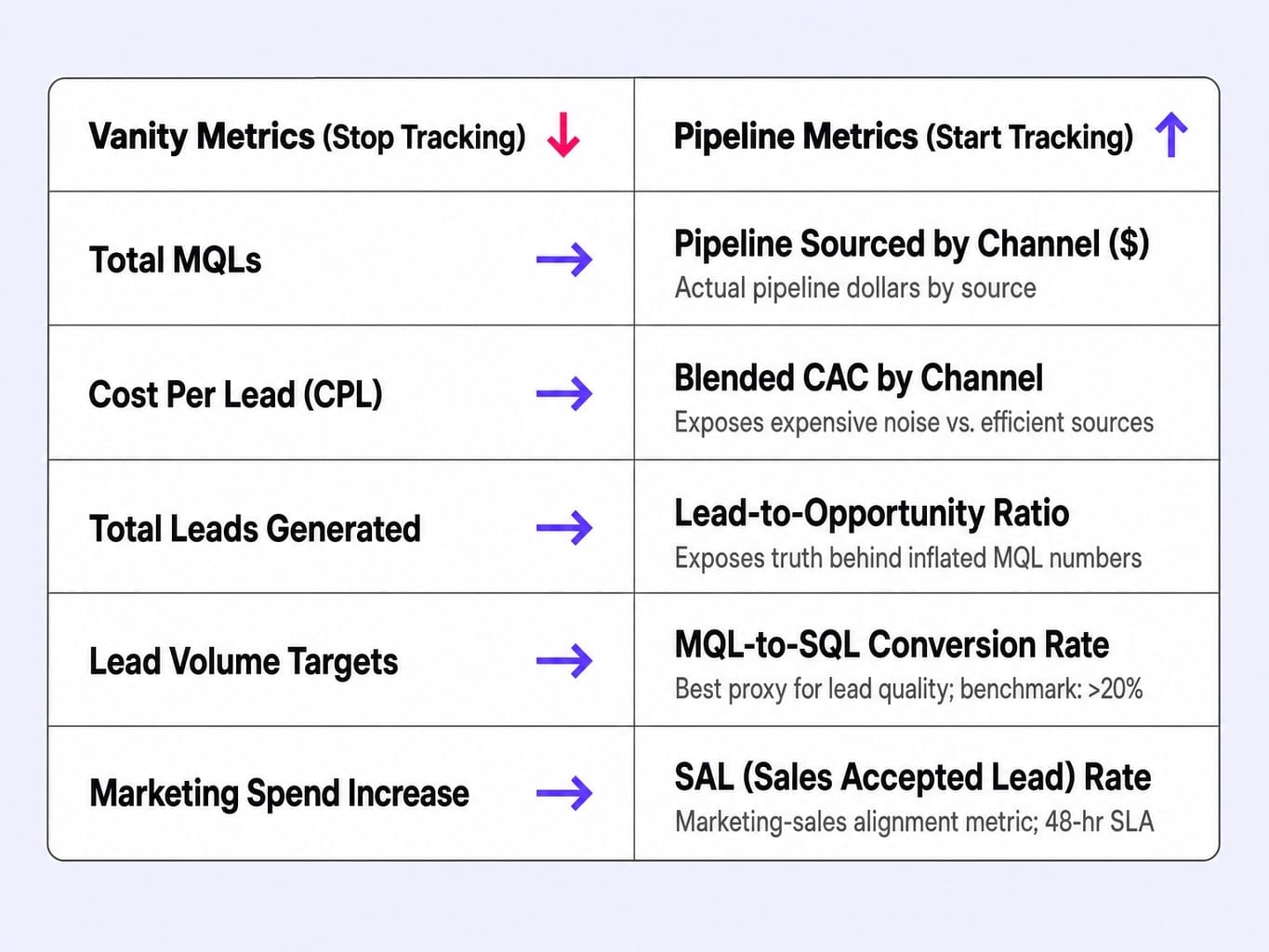
- Pipeline Sourced by Channel: The ultimate metric. Not leads, not opportunities, but actual pipeline dollars, broken down by source. This tells you where your revenue is really coming from.
- MQL-to-SQL Conversion Rate: The single best proxy for lead quality. If this number is below 20%, your targeting is wrong.
- SAL (Sales Accepted Lead) Rate: The percentage of leads your AE team agrees are worth pursuing. This is the marketing-sales alignment metric. A low SAL rate is an early warning sign of a quality problem.
- Blended CAC by Channel: Don't just look at overall Customer Acquisition Cost. Break it down by channel to see which sources produce efficient pipeline versus expensive noise.
- Lead-to-Opportunity Ratio: The final gut check. Of all the leads you generate, how many become real, qualified opportunities? This exposes the truth behind inflated MQL numbers.
Conclusion
Effective B2B SaaS lead generation is not a collection of tactics. It is a system. And that system fails when it's optimized for the wrong output—lead volume instead of pipeline quality.
The teams that build predictable, scalable revenue in 2026 will be the ones who internalize this shift. They will match their channels to their deal size, not to the latest trend. They will replace volume outbound with signal-triggered engagement that respects their buyers' time. They will invest in compounding assets over disposable campaigns. And they will measure their success in pipeline sourced, not MQLs generated.
The competitive advantage is no longer about who has the longest list of tactics. It's about who can build the system that ships improvements fastest and compounds results most consistently.
Frequently Asked Questions
How much should a B2B SaaS company spend per lead in 2026?
The blended average is around $237, but this is a misleading metric. Focus instead on cost per AE-accepted opportunity. A $50 lead that never converts is infinitely more expensive than a $500 lead that closes. The most useful benchmark is to measure your Customer Acquisition Cost (CAC) against your first-year Average Contract Value (ACV); for a healthy business, your CAC should be 1/5 to 1/3 of your ACV.
Is product-led growth replacing traditional B2B SaaS lead generation?
No, it's augmenting it. For products with a sub-$5K ACV, PLG is becoming the primary conversion model for the bottom of the funnel. For higher-ACV products, PLG acts as a powerful lead qualification layer, creating Product-Qualified Leads (PQLs) with high buying intent that are then routed to a sales team. The two models are increasingly blended, creating a hybrid "product-led sales" motion, rather than competing.
How do you build a lead scoring model for a SaaS product with a long sales cycle?
For long sales cycles, behavioral signals are more predictive than static demographics. A simple and effective model uses two axes: ICP Fit Score (how well the account matches your ideal firmographics and technographics) and Engagement Score (a tally of high-intent actions). Weight behaviors like pricing page visits, return visits, and case study downloads more heavily than a single eBook download. Platforms like HubSpot and Salesforce Sales Cloud allow for this custom scoring logic.
How do you generate leads for a B2B SaaS product with no brand awareness?
Focus on channels that don't require pre-existing brand trust. First, use warm outbound triggered by hiring and technology signals to target accounts with recognized pain. Second, appear as a guest on niche podcasts and in communities where your ICP already gathers to borrow their audience's trust. Third, create a single piece of high-value original research that you can use to earn backlinks and media coverage, building authority from scratch.
How do you align marketing and sales on lead quality in a SaaS organization?
The most effective mechanism is a formally defined SAL (Sales Accepted Lead) and a weekly review meeting. Marketing and sales must agree on the specific firmographic, technographic, and behavioral criteria that constitute a qualified lead. Sales then commits to accepting or rejecting every lead within a 48-hour SLA, providing a clear reason for any rejection. The SAL acceptance rate—not MQL volume—becomes the shared metric of accountability.
How do you attribute leads accurately across a multi-touch B2B SaaS funnel?
Perfect attribution is a myth in B2B SaaS; too much of the buyer's journey happens in the "dark funnel" of Slack groups and peer conversations. A pragmatic approach is best. Use a multi-touch attribution model in your CRM (like HubSpot or Salesforce) for what you can track. Supplement this with self-reported attribution—a simple "How did you hear about us?" field on your demo form. Optimize for directional accuracy, not perfect precision.